Your Brand Can Win AI Search and Still Lose the Click
AI Search Zero Click, Zero Click Search, AI Search, AI Overviews, GEO SEO, Generative Engine Optimization, AI Visibility, SEO Traffic, Search Visibility, Brand Visibility, AI Search Optimization, Organic Traffic
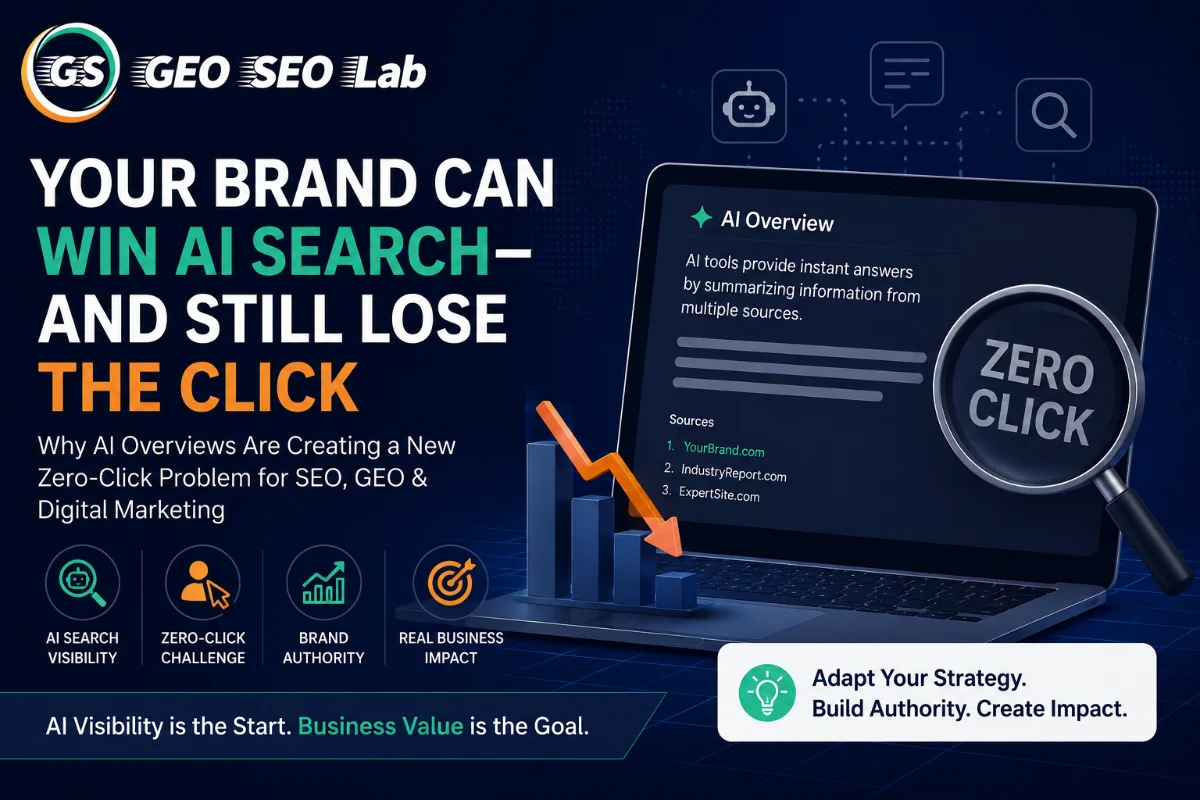
Your Brand Can Win AI Search and Still Lose the Click
Why AI Overviews Are Creating a New Zero Click Problem for SEO, GEO and Digital Marketing
Introduction: The Uncomfortable Truth About AI Search Success
Imagine spending eighteen months building a detailed content library around the most important subjects in your industry. Your team researches topics carefully, publishes useful articles, improves technical SEO, builds authority, updates old pages and works continuously to improve organic visibility. Eventually, the effort begins to produce results. Your company starts appearing in AI generated search responses. Your brand is mentioned when potential customers ask questions related to your industry. Your content is being referenced as a source. From the perspective of AI visibility, everything appears to be moving in the right direction.Then you open your website analytics.The traffic numbers are not growing in the way you expected. In some cases, organic traffic may even be declining while your brand visibility inside AI search experiences is increasing. Your content is influencing the answers that users see, but many of those users never visit your website. The visibility is real, the exposure is real, and the potential influence is real, but the traditional website visit that marketers have always used as evidence of success may never happen.This is the growing zero click paradox of AI search.For years, digital marketing operated around a relatively simple relationship. A person searched for something, a search engine displayed websites, the person clicked a result, and the website had an opportunity to create value. SEO developed around improving every part of this process. Better rankings created more impressions, more impressions created more clicks, more clicks created more visits, and visits created opportunities for leads, sales and conversions.
AI search is changing that relationship.Modern AI search features can provide complete answers directly inside the search experience. Instead of requiring users to open several websites, read multiple articles and compare information themselves, an AI system can collect information from different sources, summarize it and present an answer in a conversational format. The user may receive enough information to make a decision without visiting the websites that contributed to the answer.This creates a difficult question for every SEO and digital marketing team.
What happens when your brand wins visibility but loses the click?The question is becoming increasingly important because AI search is not simply another ranking feature. It changes the way information is consumed. A traditional search result asks the user to choose a source. An AI generated answer can perform much of that selection and synthesis before the user decides whether to visit anything.The source material for this article highlights research showing that clicks to sources cited inside Google AI Overviews can be extremely limited, while the appearance of AI Overviews can also reduce traditional organic clicks. The larger lesson is not that websites are becoming useless. The lesson is that visibility, traffic, influence and business value are becoming separate measurements rather than different names for the same outcome.
This distinction is critical because businesses that continue to evaluate AI visibility using only traditional organic traffic metrics may incorrectly conclude that their strategy is failing.The real challenge is not simply getting mentioned by AI systems. The challenge is creating an environment where AI visibility contributes to awareness, trust, consideration and eventually business outcomes, even when the initial exposure does not generate a direct website visit.
How the Search Value Chain Has Changed
The Traditional Search Model
For most of the history of modern search marketing, the value chain was relatively straightforward. A business created content. Search engines indexed that content. The content appeared for relevant searches. Users selected a result and visited the website. Once on the website, the business could educate the visitor, demonstrate expertise, promote a product, capture a lead or encourage a purchase.This model made SEO measurement comparatively easy.
Rankings were important because rankings influenced visibility. Visibility was important because visibility influenced clicks. Clicks were important because clicks created website visits. Website visits were important because they created opportunities for conversion.The model was never perfect. Search engines have always included features that answer questions without requiring a click. Featured snippets, knowledge panels and other search elements have reduced the need for some users to visit websites. Many searches also naturally end without a click because users may only need a short piece of information.However, traditional search still maintained a strong relationship between visibility and traffic.
If a page moved from the second page to the first page, the probability of receiving traffic generally increased. If a page moved higher within the first page, the probability of receiving clicks often increased further. SEO teams could therefore build business cases around expected traffic gains from ranking improvements.
AI search introduces a more complicated environment.
What AI Overviews Change
Traditional answer features generally answered narrow questions. A featured snippet might provide a definition or a short explanation. A knowledge panel might show information about an entity. A direct answer might provide a specific fact.
AI generated search responses can go much further.An AI system can combine information from multiple sources and organize it into a response that addresses several connected questions at once. It can explain a concept, compare options, identify advantages and disadvantages, summarize research and provide recommendations within a single response.
Consider a user researching software for a small business. In the traditional search environment, that person might search for several topics. They might first look for the best CRM software, then compare CRM features, then search for pricing, then read implementation guides and finally visit several vendor websites.An AI search experience can potentially combine much of that research into one answer.The user may still visit websites, particularly when they need pricing, product demonstrations, detailed documentation, customer reviews, trials or transactions. But the early informational part of the journey can happen without a website visit.This is the fundamental reason zero click behavior becomes more important in AI search.The search engine is no longer simply helping users discover information. It is increasingly helping users consume and understand information directly.
Why This Matters for Content Marketing
The change is particularly significant for businesses that have invested heavily in informational content.A company may have spent years publishing articles such as what is SEO, how does keyword research work, what is digital marketing, what is technical SEO, what is conversion tracking or how does Google Analytics work.These articles can still be useful. They can still establish authority. They can still help search engines understand the company's expertise. They can still contribute to AI generated responses.But their ability to consistently generate website traffic may decline if AI systems can answer the underlying question directly.This creates an important distinction between content that creates visibility and content that creates visits.A page can be extremely successful at establishing topical authority while producing fewer clicks than it once did.That does not automatically make the page unsuccessful.It means the page may now be performing a different role.
Understanding the Zero Click Problem
What Zero Click Really Means
Zero click search describes a situation in which a user completes the immediate search task without visiting an external website.The user may see an answer directly in the search results, decide that the information is sufficient and end the search session.AI search increases the potential for this behavior because AI responses can provide more complete information than earlier search features.A user who previously needed to open three or four websites may now receive a summarized answer within the search interface.This does not mean that every AI search ends without a click. It means that the probability of a click can change depending on the query, the user's intent and the quality of the AI response.
The Difference Between Visibility and Traffic
One of the most important concepts for modern SEO teams is that visibility and traffic should no longer be treated as interchangeable.Visibility means that your brand or content is being exposed to a potential customer.Traffic means that the customer actually visits your website.These two outcomes can be connected, but they are not identical.A person may see your company mentioned in an AI response, remember the company name and search for it several days later. That later visit may appear as branded search or direct traffic rather than an AI referral.Another user may see your company mentioned and never visit at all.A third user may click immediately.All three users have experienced your brand differently, but traditional analytics may capture only one of those journeys clearly.
Why AI Visibility Can Still Matter Without a Click
A click is valuable, but it is not the only form of marketing value.Advertising has operated on this principle for decades. A person can see an advertisement without clicking it. The impression may still influence awareness, familiarity and future consideration.AI search can create a similar effect, although the context is different.When your company is mentioned in response to a relevant question, the exposure occurs at a moment when the user is actively looking for information. That context can make the exposure meaningful.If the AI response says that your company developed a particular framework, conducted original research or provides a specialized service, the user may associate your brand with that expertise.
The challenge is determining whether this effect actually produces business value.
Businesses should not assume that every AI mention creates meaningful brand lift. They should measure downstream signals and compare those signals with changes in AI visibility.
Not All Content Has the Same Zero Click Risk
Pure Informational Content
Pure informational content generally carries the highest zero click risk.Definitions, basic explanations, simple factual answers and general introductions are easy for AI systems to summarize.If someone searches for the definition of a marketing term, they may not need to read a 2000 word article after receiving a clear explanation directly from the search interface.This does not mean informational content should disappear.Informational content remains important for building topical authority and helping AI systems understand your expertise.The strategic change is that businesses should stop expecting every informational article to function primarily as a traffic acquisition asset.
Research and Comparison Content
Research oriented content has a moderate level of zero click vulnerability.A user asking which software category is best for a specific business may receive a useful summary from AI, but the decision may still require deeper research.
Users may want detailed feature comparisons, implementation examples, pricing information, customer experiences and specific evidence.This creates opportunities for websites to provide information that goes beyond the AI summary.
The more complex the decision, the more likely the user may need a deeper source.
Commercial Content
Commercial content generally has stronger protection against zero click displacement.A product page can explain a product, but the user may still need to purchase it.A service page can describe a consulting service, but the user may need to contact the company.A pricing page can display pricing that an AI system may summarize, but the actual transaction still happens through the business.A demo page requires an interaction.A free trial requires an interaction.A calculator requires user input.These experiences create reasons to visit the website because the website is not merely providing information. It is enabling an action.
Original Research
Original research is another content category with strong click potential.If a company publishes a dataset that does not exist anywhere else, AI systems can summarize the findings but cannot reproduce the full research asset from nothing.
The user may want to inspect the methodology, view charts, examine detailed results, compare segments or cite the source.This creates a direct reason to visit the original website.
The Irreplaceability Question
The central question businesses should ask about content in the AI search era is simple.If an AI system gives the user a good summary of this page, why would the user still need to visit the page?If the answer is nothing, the page has high zero click vulnerability.If the answer is the original dataset, interactive tool, detailed case study, proprietary framework, full methodology, downloadable resource or commercial action, the page has stronger click potential.This question can completely change the way content teams plan their editorial calendars.Instead of asking only what keyword should we target, teams should also ask what unique value will exist on the page after the AI has already answered the basic question.That is a much more important strategic question.
Building Content That AI Cannot Fully Replace
Original Research Creates Information Assets
Original research is one of the strongest ways to create durable content value.A business can conduct customer surveys, analyze first party data, study market trends, compare industry performance or publish original experiments.The resulting information becomes an asset.AI systems may summarize the research, but the full research remains at the source.
For example, imagine a company publishes an annual report containing data from thousands of industry professionals.
An AI system may summarize the major findings.However, researchers, journalists, marketers and business leaders may still want to access the complete report.They may want to verify the methodology.They may want specific numbers.
They may want charts.They may want to compare different segments.They may want to cite the report.The summary therefore creates awareness of the research rather than completely replacing the research.
Proprietary Frameworks
Proprietary frameworks can create a similar effect.A company that develops a distinctive methodology can build an association between its brand and a specific concept.The framework can be explained in AI responses, but users may still want the complete framework, assessment model or implementation guide.This creates an interesting relationship between AI visibility and website traffic.AI visibility can become the discovery layer.The proprietary framework becomes the destination.Instead of trying to prevent AI from discussing your framework, you can make the framework recognizable enough that AI systems mention it while making the complete implementation valuable enough that users want to visit the source.
Interactive Tools
Interactive tools are especially valuable in a zero click environment.A calculator can explain what it does, but the user still needs to enter information.An assessment can be described, but the user needs to complete it.A personalized audit can be summarized, but the actual result requires interaction.A configuration tool can be mentioned by AI, but the user still needs to use it.This makes interactive content structurally different from ordinary articles.The article can be consumed without visiting the website.The tool cannot provide its full value without interaction.Businesses that develop genuinely useful tools therefore create strong reasons for users to move from awareness to website engagement.
Real Experience and Expert Judgment
Another important source of differentiation is genuine professional experience.AI systems are becoming increasingly capable of producing explanations that sound knowledgeable. That means simply writing in a professional tone is no longer enough.The valuable content is content that reflects actual experience.A consultant can explain what repeatedly goes wrong during implementation.A developer can describe a failure pattern that documentation does not mention.
A marketing professional can explain why a strategy that works for one business fails for another.A researcher can describe unexpected results from an experiment.These details create depth that generic content often lacks.
Experience becomes valuable because it provides context rather than simply information.
The Attribution Problem in AI Search
When the Click Disappears
Traditional analytics depend heavily on identifiable visits.A user arrives from Google.A tracking system records the source.
The user browses the website.The user converts.The marketing team connects the conversion to the acquisition source.
AI search complicates this chain.A person may see a company in an AI response and leave without clicking.Three days later, the same person searches the company name.They visit the website through branded search.They later return directly.They finally submit a lead form.Traditional analytics may attribute those visits to branded search and direct traffic.
The original AI exposure may remain invisible.This creates an attribution gap.
Why Direct Traffic Can Become More Important
Direct traffic has always been difficult to interpret.Some direct traffic is genuinely direct navigation.Some traffic may becategorized as direct because the referral information was not preserved.In the AI search environment, direct traffic can also represent people who remember a brand after encountering it elsewhere.This is why direct traffic trends should be considered alongside AI visibility rather than interpreted in isolation.An increase in AI visibility combined with an unexplained increase in branded demand and direct visits may provide evidence of a broader brand effect.
It still does not prove causation, but it provides a useful signal.
Branded Search as a Proxy
Branded search is another important measurement.If more people begin searching specifically for your company after your AI visibility increases, that may indicate that users are remembering the brand.However, branded search can also increase because of advertising, public relations, social media, offline campaigns and other marketing activities.
For this reason, businesses should not automatically attribute every increase in branded search to AI visibility.
The better approach is to compare multiple data sources and look for consistent patterns.
Customer Surveys
Customer attribution surveys can provide information that analytics cannot.A simple question such as how did you first hear about us can sometimes reveal AI assisted discovery.A customer might say they saw the company mentioned in an AI search result.That information can be extremely valuable because it exposes part of the customer journey that standard analytics may not capture.As AI search becomes more common, customer feedback may become an increasingly important part of attribution.
Redesigning Content Strategy for the Zero Click Era
The Two Layer Content Strategy
A strong AI era content strategy should recognize that different content assets can have different jobs.The first layer is authority and visibility content.This content helps establish expertise, build topical authority and strengthen the association between the brand and important subjects.The second layer is engagement and conversion content.This content gives users a reason to visit the website and take an action.It may include tools, original research, case studies, product experiences, assessments, reports, calculators, demos and consultation pages.The mistake many companies make is expecting every article to perform both jobs equally well.That expectation is becoming less realistic.An informational article may be excellent for establishing expertise but weak at generating direct conversion.A product page may be excellent at conversion but less useful for broad informational queries.Both can be successful if they are measured according to their actual purpose.
Creating a Path From Awareness to Action
AI visibility should not be treated as the final destination.It should be considered part of a larger journey.A user sees the brand.The user remembers the brand.The user searches for the brand.The user visits the website.The user explores a useful resource.The user interacts with a tool or reads original research.The user eventually becomes a lead or customer.This journey may take days or weeks.The important point is that the first AI exposure does not need to produce an immediate click to have value.However, the business must create a strong path for the user to continue the journey later.
Brand Memorability
Brand memorability becomes increasingly important when clicks are not guaranteed.If a user sees your company name inside an AI response but forgets it immediately, the exposure has limited value.Distinctive positioning, consistent naming, memorable frameworks and clear associations can help.A company should aim to own specific concepts in the minds of its audience.When users think about a particular problem, they should have a reason to remember the company associated with that problem.
Strong Branded Search Experiences
Once a user searches for the brand, the website must deliver.A poor website experience can waste the awareness created through AI visibility.The user should quickly understand what the company does.The website should clearly communicate its expertise.Important resources should be easy to find.Commercial actions should be easy to complete.If the user arrived because they saw the company associated with a particular topic, the website should provide a clear continuation of that topic.The experience should feel connected rather than generic.
The Content Quality Threshold Has Increased
Adequate Content Is No Longer Enough
In traditional search, adequately optimized content could produce significant traffic.The content answered the question, contained relevant terms and satisfied basic search requirements.AI search changes the economics.If a page simply provides an adequate explanation, an AI system may be able to summarize that explanation easily.The content can still contribute to visibility, but its ability to create a compelling reason for a click is limited.This means the standard for valuable content is rising.The content must offer something distinctive.It should contain evidence, experience, original data, useful tools, strong examples, unique analysis or a perspective that cannot be easily reproduced from generic sources.
From Content Volume to Content Value
The old content model often rewarded volume.Publish more pages.Target more keywords.Cover more topics.The AI environment puts pressure on this approach because AI systems can synthesize large amounts of generic information.
Publishing another article that says the same thing as hundreds of existing pages may not create meaningful differentiation.A smaller library of genuinely valuable assets can be more defensible than a huge library of repetitive articles.The objective should move from content production to intellectual contribution.
Building a Measurement Framework for AI Search
Layer One: AI Visibility
The first layer should measure how frequently the brand appears in AI search experiences.Businesses can create a fixed set of relevant queries and test them regularly.The goal is not to check random searches.The goal is to monitor queries that represent important customer needs.For every query, the team can record whether the brand appears, how the brand is described, whether the description is accurate and which competitors are mentioned.Over time, this creates a visibility baseline.
Layer Two: Representation Accuracy
Being mentioned is not automatically positive.
An AI system can mention the wrong service, describe the company incorrectly or associate it with an inaccurate category.
That can create confusion.Therefore, businesses should measure representation quality as well as frequency.
A company should ask whether its expertise is represented correctly, whether its positioning is accurate and whether the AI response reflects the intended brand identity.If not, the problem may involve inconsistent entity signals, unclear website information or insufficient authoritative evidence.
Layer Three: Brand Demand
The third layer measures what happens after visibility.Branded search volume is an important indicator.Direct traffic can provide another signal.Social mentions, customer surveys and other brand demand indicators can also provide context.
The objective is to determine whether AI exposure is creating additional interest in the brand.
Layer Four: Engagement Quality
Website traffic volume alone becomes less useful when AI search satisfies many low intent informational needs.
A smaller number of highly interested visitors may be more valuable than a large number of visitors who leave immediately.
This is why engagement quality deserves greater attention.Businesses can examine time spent on important pages, depth of browsing, return visits, interaction with tools and movement toward commercial pages.A decline in total organic visits does not necessarily mean that the remaining visitors are less valuable.
Layer Five: Business Outcomes
The final layer is commercial performance.Qualified leads, purchases, consultation requests, trial registrations and revenue remain the most important outcomes.AI visibility should ultimately connect to business value, even if the connection cannot always be measured perfectly.The goal is not to abandon traditional conversion metrics.The goal is to place them inside a broader measurement framework.
SEO and GEO Should Work Together
Traditional SEO Is Not Dead
The rise of AI search does not mean businesses should stop investing in traditional SEO.Organic search still creates valuable traffic.Commercial queries still generate clicks.Product searches still lead users to websites.Users still compare providers through traditional search.Many people still prefer visiting websites when they want detailed information.
The correct response is therefore integration rather than replacement.
GEO Adds Another Search Layer
GEO focuses on helping brands become visible and accurately represented in generative search experiences.
This includes strengthening entity signals, improving content quality, demonstrating expertise and creating authoritative information that AI systems can understand.Many GEO activities also strengthen traditional SEO.Clear information helps search engines.Strong topical authority helps organic visibility.Original research creates links and citations.Useful content improves user satisfaction.Strong brand entities improve recognition across search environments.The two disciplines therefore overlap significantly.
The Complete Search Funnel
The modern search funnel can be understood as a combination of AI exposure, traditional search, website engagement and commercial action.At the top, users may encounter the brand through AI generated responses.This creates awareness.In the middle, users may conduct deeper research through traditional search and visit detailed resources.
This creates consideration.At the bottom, users may search for the brand, visit product or service pages and complete commercial actions.This creates conversion.Different stages require different content.Different stages also require different metrics.Trying to judge every stage using only traffic is increasingly ineffective.
The Future of Zero Click Search
AI Search Will Continue to Evolve
The current AI search environment is still developing.Search engines are improving their ability to understand questions, combine information and provide direct answers.AI assistants are also becoming more capable.As these systems improve, more informational tasks may be completed without external website visits.This does not mean every search becomes zero click.Commercial decisions, transactions, original research and interactive experiences still create reasons to visit websites.The important change is that informational discovery may increasingly happen before the website visit.
The Opportunity for Businesses
The zero click environment is not only a threat.It creates an opportunity for companies that have something genuinely valuable to say.Organizations with original research, strong expertise, useful tools and proprietary knowledge can benefit from AI systems distributing awareness of their work.A strong AI summary can introduce a user to a concept and identify the organization behind it.If the organization provides deeper value, the user has a reason to continue.This can create a stronger relationship between authority and demand.Instead of competing only for clicks on generic informational keywords, businesses can build recognition around distinctive knowledge.
Why Genuine Expertise Matters More
The AI era makes generic content easier to produce.That means generic content becomes easier to replace.Human expertise becomes more valuable when it produces something distinctive.The companies most likely to benefit are those that can demonstrate what they know through evidence, original research, real experience and useful intellectual property.
This changes the role of the content team.The team is no longer simply responsible for publishing articles.It becomes responsible for documenting what the organization actually knows.
The Zero Click Survival Framework
Content Assessment
Before publishing a new content asset, the team should consider the search intent behind it.The next question should be whether an AI system could completely satisfy that intent without a website visit.The team should then identify what unique value exists on the page.If the page contains nothing beyond information that can easily be summarized, its click potential may be limited.If the page includes original evidence, tools, proprietary research, unique expertise or a commercial experience, the opportunity is stronger.This assessment should become part of content planning rather than something considered after traffic declines.
Differentiation
Differentiation should be deliberate.A business should know what it can provide that competitors and AI summaries cannot easily reproduce.This could be original data.It could be a proprietary methodology.It could be a detailed case study.
It could be a tool.It could be an expert perspective.It could be an unusual dataset.It could be a real implementation story.
The more distinctive the asset, the stronger the reason for users to continue beyond the AI response.
Brand Association
Every important content asset should also strengthen brand association.The audience should understand why the company is qualified to discuss the topic.The brand should be connected to specific areas of expertise.Proprietary concepts and frameworks can help create this association.Over time, the goal is to make the company recognizable as an authority within a specific knowledge area.
Practical Implementation Over the Next Ninety Days
The First Thirty Days
The first stage should focus on creating a baseline.A business can select a set of relevant customer queries and test how frequently the brand appears in AI generated responses.The team should document competitor visibility, representation accuracy and the context in which the brand appears.At the same time, branded search volume and direct traffic should be recorded.The existing content library can then be reviewed to identify pages with high zero click vulnerability.This creates a clear picture of the current situation.
The Next Thirty Days
The second stage should focus on improvement.High value informational content can be upgraded with original examples, expert commentary, proprietary data and deeper analysis.The business can identify opportunities for original research.
It can also identify opportunities for calculators, assessments, reports and interactive tools.Commercial pages should be reviewed to ensure they provide a clear next step for visitors arriving from informational discovery.
The goal is to create a stronger connection between visibility and action.
The Final Thirty Days
The third stage should focus on measurement.AI visibility can be compared with the original baseline.Branded search trends can be reviewed.Direct traffic can be examined.Engagement quality can be compared with earlier periods.
Conversions and lead quality should be reviewed.The business should then determine which content assets are creating visibility, which are creating engagement and which are creating revenue.This helps establish a more realistic content investment model.
Conclusion: Redefining What Winning in Search Means
Yes, a brand can win AI search and still lose the click.That is becoming one of the defining challenges of modern SEO and digital marketing.AI search can increase brand visibility while reducing the number of people who immediately visit the source website.This does not mean that AI visibility is useless.It means that the relationship between visibility and traffic has changed.Businesses need to stop treating every search impression as a promise of a website visit.They need to understand what role each content asset plays.Some content exists to establish authority.Some content exists to create awareness.Some content exists to generate engagement.Some content exists to convert demand.The strongest strategies connect all of these roles.Winning in AI search means appearing accurately when potential customers ask relevant questions.It means building a recognizable association between your company and specific expertise.
It means producing information that deserves to be cited.It means creating assets that are useful enough to make people want to visit the original source.It means measuring brand demand, engagement and business outcomes alongside traditional traffic metrics.It also means continuing to invest in traditional SEO.AI search and organic search are not enemies.They are increasingly different parts of the same discovery ecosystem.The businesses that understand this distinction will be better positioned to adapt.The future of search will not be defined only by who ranks first.It will be defined by who becomes the trusted source, who owns distinctive knowledge, who creates useful experiences and who can convert awareness into lasting customer relationships.The click still matters.Traffic still matters.Rankings still matter.
But they are no longer the entire story.The real objective of search has always been to connect people with useful businesses, products, services and information.AI search changes the path that users take to make that connection.
Sometimes the path will include a click.Sometimes it will begin with an AI generated answer and continue days later through a branded search.Sometimes the first interaction will never appear clearly inside analytics.Businesses that understand this broader journey will be able to measure search more intelligently.They will also be able to build content that has value beyond rankings.The strongest brands will not simply try to make AI systems mention them.They will build enough expertise, evidence and distinctive value that AI systems have a reason to mention them and users have a reason to seek them out.That is the real opportunity in the zero click era.The goal is not to fight AI search.The goal is to become valuable within it.The businesses that make this transition successfully will move beyond a search strategy based entirely on rankings and clicks.They will build a broader visibility strategy based on authority, recognition, evidence, experience and business value.The click was never the final objective.The real objective was always the relationship between a customer and a business that can genuinely help them.AI search changes how that relationship begins.The businesses that understand this change will continue to win visibility, build trust and create demand even when the first interaction does not produce a click.
Frequently Asked Questions
Find answers to common questions about this topic
About the Author

Aman Kesharwani
SEO Expert & Content Creator
Experienced digital marketing professional specializing in SEO strategies, content optimization, and data-driven marketing solutions. Passionate about helping businesses grow their online presence and achieve better search rankings.
Related Articles
View all posts
AI Search Doesn’t Have a Ranking Page: How to Measure Competitor Visibility
AI search has changed how businesses compete online. Learn how to measure AI competitor visibility, track AI Share of Voice, analyze brand mentions, monitor competitors, and build a practical AI competitive intelligence strategy.
Being Cited by AI Isn't Enough: Why AI Visibility Needs Better Metrics
AI citation count can show that your content is being selected, but it does not reveal how much your knowledge actually influences AI generated answers. Learn why businesses need to measure informational contribution, content quality, entity authority, accuracy, competitive visibility, and real business impact.
The AI Visibility Score: Measure Brand Presence Across AI Search
Learn how to measure and improve your AI Visibility Score across ChatGPT, Google AI Mode, Gemini, Claude, Perplexity, and modern AI search platforms.