AI Search Doesn’t Have a Ranking Page: How to Measure Competitor Visibility
AI search has changed how businesses compete online. Learn how to measure AI competitor visibility, track AI Share of Voice, analyze brand mentions, monitor competitors, and build a practical AI competitive intelligence strategy.
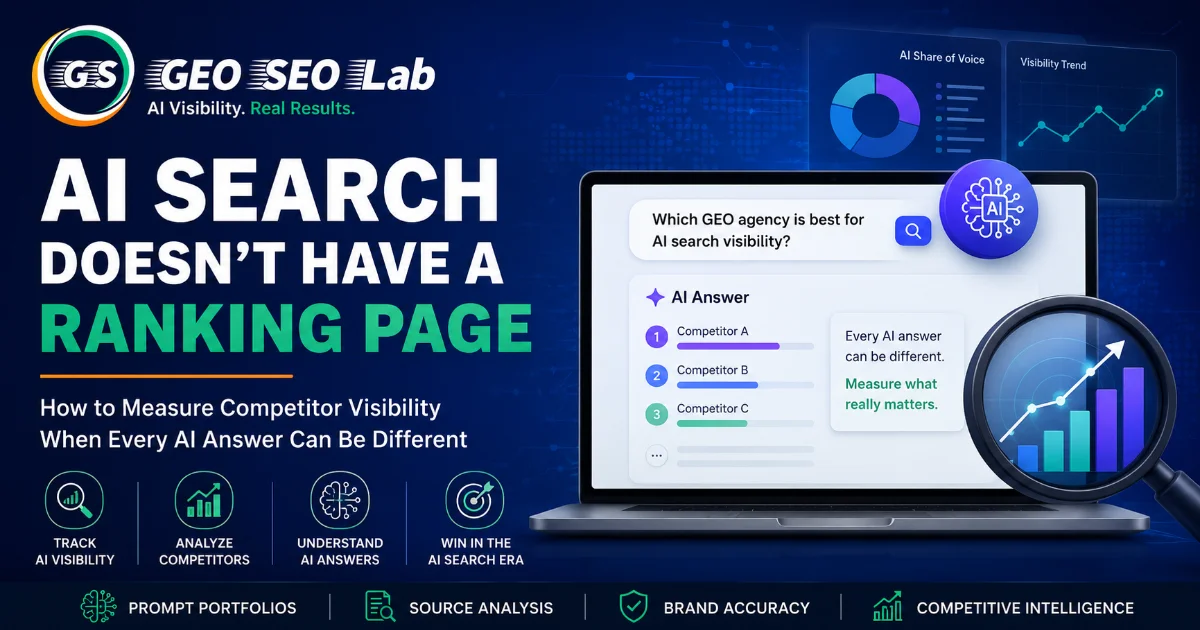
AI Search Does Not Have a Ranking Page
How to Measure Competitor Visibility When Every AI Answer Can Be Different
Traditional search has always given marketers something very simple to look at. You type a keyword into a tracking tool, check the position of your website, compare it with competitors, and then decide what needs to improve. If another company is sitting at number one and your website is sitting at number seven, the competitive situation is easy to understand. You know who is ahead of you, you know where you stand, and you have a number that can be followed over time.AI search has changed that comfortable picture.There is no fixed leaderboard sitting in front of you when someone asks an AI system which company they should choose. There is no permanent position one, position two or position three that you can simply record every morning. Instead, the system may mention several companies, explain their strengths, compare their services, recommend one option over another, or sometimes leave a company out completely. The answer can also change when the question is changed slightly.That creates a completely different competitive environment for businesses.A company can have excellent Google rankings and still lose visibility when potential customers start asking AI systems for recommendations. Another company may not look particularly impressive in a traditional SEO report but may repeatedly appear in answers because AI systems have enough information from different sources to understand that company as a relevant authority.This is where many businesses are beginning to face a measurement problem.
They know how to measure traditional search visibility, but they do not yet have a reliable way to understand how competitors are appearing inside AI generated answers. They may test a few questions manually, see a competitor mentioned, and assume that competitor is winning. But one answer is not enough to establish a competitive position.
AI search needs a different way of thinking.The important question is no longer simply where a company ranks. The more useful question is which companies AI systems remember, mention, recommend and describe when customers ask questions that matter to the business.That difference sounds small, but it changes almost everything about competitive research.
The Day the Traditional Leaderboard Disappeared
Imagine a marketing manager reviewing the company's weekly SEO report.
The report looks healthy. Several important keywords are ranking inside the top five. Organic traffic is stable. The company has invested heavily in content, technical SEO and backlinks. When the manager compares the company with two major competitors, the numbers appear encouraging.From a traditional search perspective, the company looks competitive.
Then the sales team starts noticing something strange.Potential customers are mentioning another company during sales conversations. They say they researched their options using ChatGPT, Gemini, Perplexity or another AI search experience. When they asked which solution would be suitable for their particular situation, the competitor repeatedly appeared in the answer.The competitor was not necessarily ranking above the company in Google.It simply had a stronger presence in the answers that customers were actually reading.This situation is becoming increasingly important because the way people search for information is changing. A person who once searched for several keywords, opened multiple websites and compared the information manually can now ask a much more detailed question and receive a synthesized answer.
That question might contain a business problem, an industry, a location, a budget, a preferred technology and a specific goal. Instead of asking for ten websites, the user may ask for three recommendations and an explanation of which one is most suitable.That creates a new competitive battlefield.The company that wins this interaction is not necessarily the company with the highest traditional ranking. It is the company that appears to be the strongest and most relevant answer to the question.This is why traditional competitor analysis can become incomplete when it is used by itself.
For many years, search competition could be understood through rankings. Marketers collected keywords, identified competitors, monitored positions and studied backlinks. The search results page provided a visible competitive scoreboard.AI search removes much of that simplicity.The system does not simply return a fixed list of documents. It may retrieve information from different sources, interpret the user's question, combine information and produce an answer that did not exist before the query was submitted.That answer can change.The same question can produce a different response on another attempt. A different platform can produce a different set of sources. A small change in wording can introduce completely different companies into the conversation.
This means competitive research must move from the idea of a fixed ranking toward the idea of repeated visibility patterns.
Why Traditional Competitor Analysis Breaks Down
Traditional Search Was Easier to Measure
Traditional search works around indexed documents and ranking systems. When someone searches for a phrase, the search engine evaluates available pages and returns results in an ordered format.That structure made competitor research relatively straightforward.If a company wanted to understand its position for a keyword such as best GEO agency, it could monitor the search results and identify the companies appearing near the top. It could then compare content quality, backlinks, technical performance, domain authority and other signals.The process was not perfect, but the competitive picture was visible.You could say that a competitor ranked first and your company ranked fifth. You could track whether your position moved from fifth to third. You could compare changes over several weeks or months.
The number itself had meaning.AI search changes this because there is generally no stable ranking position that works in the same way.An answer might mention one company first, another company later and a third company in a completely different section. The order may change on another run. A company may be mentioned prominently for one question and disappear entirely when the wording changes.This means the old language of rankings becomes less useful.
Instead of asking where a company ranks, competitive intelligence needs to ask how frequently the company appears, how prominently it appears, why it appears, how accurately it is described and which sources support that appearance.
Those are more complicated questions, but they are also much closer to what users actually experience.
Every Question Can Create a Different Competitive Landscape
One of the biggest changes introduced by AI search is the importance of question framing.
Consider two questions.The first question might ask which are the best GEO agencies in India.
The second might ask which AI visibility company would be suitable for a healthcare business operating in Bangalore.
Both questions are related.Yet they can produce very different competitive landscapes.
The first question is broad. It may bring well known companies, publishers, industry resources and established agencies into the answer.The second question introduces a specific industry and location. Suddenly, companies with healthcare experience, local authority, specialized content or relevant case studies may become more important.
This means a company cannot understand its AI competitive position by testing only a few broad questions.
It needs a portfolio of questions that represent the real decision journey of its customers.People ask different questions at different stages.Someone discovering a problem may ask what GEO means.Someone who understands the problem may ask how to improve their visibility.Someone ready to buy may ask which agency can help.Someone comparing providers may ask whether one company is better than another.Someone in a specific city may ask which providers are available locally.Each question creates another opportunity for a company to appear.It also creates another opportunity for a competitor to appear instead.
Different Platforms Can Tell Different Stories
Another important issue is platform variation.ChatGPT, Gemini, Perplexity and Google's AI experiences do not necessarily retrieve information in exactly the same way. Their underlying systems, data sources, retrieval mechanisms and presentation formats can differ.Because of that, a company may have strong visibility on one platform and weaker visibility on another.This is not necessarily a problem with the measurement.It is part of the competitive reality.
If a business discovers that it is frequently mentioned by one platform but rarely mentioned by another, that difference may reveal something valuable about its information ecosystem.Perhaps one platform has access to sources that frequently mention the company while another platform relies on a different source set.Perhaps the company's website is strong but independent coverage is weak.Perhaps the company has strong local information but limited industry authority.
These differences can provide useful clues.For this reason, platform specific results should not simply be mixed into one giant number without explanation. Keeping platform results separate makes it easier to understand where visibility is strong and where it needs attention.
The Invisible Competitor
Traditional SEO usually gives companies a familiar competitor list.
These are the websites that rank for important keywords. They are the companies that appear repeatedly in search results. They are the domains that marketing teams already know.AI search can introduce another category.The invisible competitor.An invisible competitor is a company, publication, organization or expert that may not look like a major competitor in traditional SEO but repeatedly appears in AI generated answers.This can happen because the organizationhas strong external recognition.Perhaps industry publications mention it regularly.Perhaps its experts are interviewed.Perhaps its research is cited.Perhaps its information appears consistently across professional directories and authoritative databases.Perhaps its content is used by AI systems when answering questions related to its area of expertise.The organization may not have been on the traditional SEO team's competitor list at all.
Yet customers may encounter it repeatedly through AI search.This is why competitive research needs to begin with actual customer questions rather than assumptions about who the competitors are.When businesses run a well designed prompt portfolio and record every company that appears, unexpected names often emerge.Some will be direct competitors.Some will be content competitors.Some will be experts.Some will be publishers.Some will be organizations from adjacent industries.All of them can occupy valuable visibility space.
The New Meaning of Competitive Visibility
Competitive visibility in AI search is broader than simply being mentioned.A company can be mentioned in a poor context.It can be mentioned accurately.It can be mentioned incorrectly.It can appear as the first recommendation.It can appear near the end.It can be mentioned because the user specifically asked about it.It can be introduced naturally by the system as one of several recommended choices.These situations are not equal.Suppose two companies are both mentioned in one hundred AI responses.Company A is usually the first recommendation and receives a detailed explanation of its strengths.
Company B is normally mentioned near the end of the answer with little context.Both companies have a similar appearance rate.Their competitive positions are obviously not the same.This is why a useful measurement system needs to look beyond raw mention counts.
AI Share of Voice
One useful starting concept is AI Share of Voice.Traditional Share of Voice attempts to estimate how much visibility a brand receives across a defined search environment.AI Share of Voice applies a similar idea to AI generated responses.
Imagine that a company monitors one hundred relevant AI responses. Across those responses, different brands receive a total of two hundred recorded mentions. If the company receives thirty of those mentions, its basic mention share would be fifteen percent.That number provides a useful starting point.It allows a marketing team to compare brands within the same question set.However, it should never be treated as the complete picture.Mention frequency does not explain prominence.
It does not explain accuracy.It does not explain source quality.It does not explain whether the company appears across many different customer questions or only one narrow category.AI Share of Voice should therefore be treated as one measurement inside a broader competitive visibility framework.
Five Dimensions of AI Competitive Visibility
Appearance Rate
The first measurement is the simplest.How often does the brand appear?If a company appears in eighty percent of relevant commercial prompts while another appears in thirty percent, the difference is meaningful.But appearance rate should be broken down by question type.A company might be strong in informational questions but weak in commercial questions.It might perform well in local searches but disappear from industry specific questions.It might be highly visible during the discovery stage but rarely appear when customers are ready to compare providers.
Those differences are strategically important.
Recommendation Prominence
The second dimension is prominence.When the company appears, where does it appear?Is it the first recommendation?Is it introduced among the leading options?Is it mentioned in the middle?Is it simply referenced as an example?The exact scoring system can vary, but the organization should use consistent criteria.The purpose is not to pretend that AI responses can be reduced to a perfect mathematical ranking.The purpose is to create a repeatable way to compare patterns.If a company moves from being mentioned occasionally near the end of answers to being regularly included among the leading recommendations, that is a meaningful competitive change even though there is no formal ranking number.
Source Citation Patterns
The third dimension is source support.When the company appears, what information is supporting that appearance?Does the AI system cite the company's website?Does it cite independent publications?Does it reference research?Does it rely on industry sources?Does the company appear without visible supporting sources?This can reveal a great deal about the information ecosystem surrounding a brand.A company that receives frequent independent coverage may have stronger external authority than a company whose visibility depends almost entirely on its own website.Source analysis helps identify those differences.
Brand Description Accuracy
The fourth dimension is accuracy.This is one of the most important and most frequently overlooked parts of AI competitive research.Imagine a company that provides enterprise GEO consulting.An AI system describes it as a general digital marketing agency.The company has been mentioned, but the mention is not useful.It may actually hurt the customer journey because the person is looking for a specialist and the system has placed the company into a broader and less relevant category.Accuracy therefore matters almost as much as appearance.Businesses should monitor whether AI systems correctly understand their services, industry, specialization, target customers and positioning.Incorrect descriptions should be treated as important visibility issues.
Query Coverage Depth
The fifth dimension is coverage.Does the brand appear across a wide range of relevant questions?A company could have a high appearance rate for five very similar prompts and almost no visibility across the rest of the customer's decision journey.Another company might have moderate visibility across discovery, problem solving, commercial, comparison, local and industry specific questions.The second company may have a healthier competitive position because its visibility is distributed more broadly.Coverage tells you whether the brand is present throughout the customer journey or only in a narrow corner of it.
Building a Useful Prompt Portfolio
The prompt portfolio is the foundation of the entire measurement system.If the questions are poorly designed, the data will also be poor.The easiest mistake is to take a traditional keyword list and convert every keyword into a slightly different question.That is not enough.AI users do not always search the way they searched traditional search engines.They often provide context.They explain what they are trying to accomplish.They mention their industry.They describe their situation.They ask for recommendations.They ask follow up questions.A useful prompt portfolio should reflect these real decision patterns.
Discovery Questions
Discovery questions come from people who are still learning.They may ask what a concept means, how a technology works or why a problem exists.For a GEO company, a discovery question might ask what generative engine optimization means or how businesses can improve their visibility in AI search.These questions often reveal educational competitors.A publisher, university, researcher or industry expert may appear even though they are not selling the same service.
That information is valuable because it shows who AI systems associate with the topic.
Problem Questions
Problem focused questions come from users who understand that something is wrong but are still looking for solutions.
They may ask how to improve their brand representation in AI search or how a healthcare company can increase its visibility in AI recommendations.These questions often reveal organizations that have built strong educational and practical authority.
Commercial Questions
Commercial questions are particularly important because they often indicate buying intent.A user may ask which GEO companies are best, which AI visibility agency is suitable for a certain business or which providers specialize in a particular industry.These questions deserve close monitoring because competitors appearing here can influence actual purchasing decisions.
Comparison Questions
Comparison questions are even more direct.Users may ask which company is better, what alternatives exist or how two providers compare.These prompts reveal how AI systems position your brand against specific competitors.They can also expose inaccurate assumptions about your business.
Local Questions
Local prompts introduce geography.A user may ask for GEO agencies in Bangalore or AI visibility companies in India.Location can significantly change the competitive landscape.A company that is strong nationally may not have strong local visibility in a particular city.
Industry Specific Questions
Industry specific prompts add another layer of context.A healthcare company may ask about AI visibility for hospitals.A financial services company may ask how its industry should approach generative search.A software company may ask which GEO strategy is suitable for SaaS.These questions are valuable because they reveal whether a company has built genuine authority within the industries it wants to serve.
How Large Should the Prompt Portfolio Be?
There is no universal number that works for every company.A focused portfolio of thirty to fifty carefully selected questions can be extremely useful for a smaller business.A larger organization operating across multiple markets may need hundreds of prompts.The important issue is not the size of the list.It is the relevance of the list.A portfolio containing one hundred meaningless variations will produce less useful intelligence than a portfolio containing forty carefully chosen questions that represent real customer decisions.The portfolio should also evolve.Customer questions change.Products change.Competitors change.Markets change.AI systems change.A portfolio that was perfect six months ago may no longer represent the business accurately today.
Creating a Reliable Measurement Process
Once the prompt portfolio is ready, consistency becomes extremely important.The exact wording of important prompts should be documented.If the wording changes every month, it becomes difficult to understand whether visibility changed because the brand changed or because the question changed.Platforms should also be documented.If one measurement uses one platform and the next measurement uses another, the results cannot be compared fairly.Repeated observations are equally important.One answer is an observation.It is not a competitive trend.The same question should be tested repeatedly, particularly when the question is commercially important.If a company appears once out of ten runs, that tells a very different story from appearing eight out of ten times.The repeated pattern is what matters.
Why Repeated Testing Matters
Generative responses can vary.That variation creates a major difference between traditional rank tracking and AI competitive monitoring.In traditional search, a keyword can usually be checked and recorded as a position.In AI search, a single answer may not represent the broader pattern.Imagine testing a commercial prompt once and seeing Competitor A appear first.It would be tempting to conclude that Competitor A is winning.But suppose the same prompt is tested ten more times and Competitor A appears first only twice.Another company appears first five times.Your own company appears first three times.The competitive picture is now much more complicated.Repeated testing gives you a distribution rather than a single snapshot.That is much more useful for decision making.
Discovering Competitors You Did Not Know About
One of the most valuable benefits of AI competitive research is competitor discovery.When businesses monitor responses carefully, they often discover companies they were not previously tracking.A direct competitor may have strong AI visibility despite weak traditional rankings.A publisher may dominate informational questions.An expert may appear repeatedly because their research is widely referenced.An adjacent company may be expanding into your market and already building visibility.These discoveries can influence strategy.
Direct Competitors
Direct competitors sell similar products or services to similar customers.They are usually the easiest competitors to recognize.The important difference is that AI monitoring can reveal which direct competitors actually receive visibility in customer questions.
Content Competitors
Content competitors do not necessarily sell the same thing.They may be publications, research organizations or educational websites.Yet they compete for attention because their information is used to answer questions relevant to your market.
Thought Leadership Competitors
Experts can become competitors for authority.A person who is frequently cited in answers about your industry may influence how customers understand the topic.Their influence may be larger than their company's traditional search visibility suggests.
Adjacent Competitors
Adjacent competitors come from nearby markets.They may not be direct alternatives today, but their services may overlap with your market enough for AI systems to include them in relevant answers.This can be an early warning signal.
Understanding Why Competitors Appear
Finding a competitor is only the first step.The more important question is why the competitor appears.Source analysis can help answer that.Look at the sources associated with competitor mentions.Study which publications cover them.Look for research they have produced.Check whether their experts appear in respected industry discussions.Examine their entity information across relevant platforms.Study whether their website clearly explains their services and specialization.Patterns often emerge.A competitor may have strong media coverage.Another may have original research.Another may have exceptionally clear service information.Another may have strong local entity signals.Each situation requires a different response.
From Monitoring to Intelligence
There is a major difference between monitoring and intelligence.Monitoring tells you what happened.Intelligence helps you understand what it means.A dashboard can show that Competitor A appears in sixty percent of commercial prompts while your company appears in twenty five percent.That is useful.But it is not enough.The business needs to know why the difference exists.Maybe Competitor A has stronger case studies.Maybe it has better industry coverage.Maybe it has original research.Maybe its company information is more consistent across the web.Maybe it has stronger expert recognition.The purpose of competitive intelligence is to connect the observation with a strategic explanation.The report should therefore answer three questions.What is happening?Why is it happening?What should we do next?Without the third question, the report may become an interesting collection of numbers rather than a decision making tool.
Competitive Gap Analysis
Competitive gap analysis is one of the most useful ways to turn AI visibility data into strategy.The first step is identifying where competitors outperform you.Do not stop at overall visibility.Find the specific categories where the difference is strongest.Perhaps you perform well ondiscovery questions but poorly on commercial questions.Perhaps you perform well nationally but poorly on local prompts.Perhaps you have good visibility in software but weak visibility in healthcare.Those are much more useful findings than a single overall score.The next step is diagnosis.Look at the sources supporting competitor visibility.Then classify the gap.A content gap means you do not have enough useful information covering the topic.An authority gap means competitors have stronger independent recognition.An entity gap means your business information is inconsistent or incomplete across relevant sources.A research gap means competitors have original data or studies that attract citations.Once the gap has been classified, the response becomes clearer.
Prioritizing Competitive Gaps
Not every gap deserves the same level of investment.Some questions have direct commercial value.Others do not.A company should first focus on gaps connected to important business outcomes.A high value question with a clear path to improvement should receive immediate attention.A high value question that requires major investment should become part of the long term strategy.A low value question that can be fixed easily can be handled when resources are available.A low value question that requires major investment may not deserve attention at all.This type of prioritization prevents teams from spending months improving visibility in areas that do not matter to customers.
Designing the AI Competitive Dashboard
A useful dashboard should serve different audiences.Executives usually need the broad picture.They want to know whether the company's competitive position is improving, where competitors are gaining ground and which areas require investment.Strategic teams need more detail.They need to understand performance by question category, industry and customer intent.Operational teams need even deeper information.They need to see individual prompts, source citations, brand descriptions and specific examples.All three levels are useful.The dashboard should also explain how the numbers were created.A metric without methodology can easily be misunderstood.If a visibility score is based on fifty observations, users should know that.If a platform has higher variability, that should be acknowledged.If a result is directional rather than statistically precise, the report should say so.Transparency makes the measurement more trustworthy.
What a Good Competitive Report Should Avoid
A good report should never pretend that AI search has fixed rankings when it does not.Saying that a brand ranks number three on ChatGPT creates a misleading impression of precision.It is more accurate to describe the observed appearance pattern.Reports should also avoid drawing conclusions from one response.One answer is not enough evidence.Another mistake is combining every platform into one number.Platform differences can contain important strategic information.A final mistake is claiming that a particular content change caused a visibility increase without enough evidence.If visibility increased after content was published, the two events may be related.But that does not automatically prove that the content caused the increase.Good competitive intelligence separates observation from interpretation.
Turning Competitive Intelligence Into Content StrategyOnce gaps have been identified, the next step is deciding what to build.Content is often part of the answer, but not always.If competitors dominate commercial questions because their service pages are clearer, improving commercial content may help.If competitors are being cited because they publish original research, creating another generic blog post will probably not close the gap.The company may need to invest in original research instead.If competitors dominate industry specific questions, the company may need deeper vertical content.If competitors are recognized because their experts are repeatedly quoted, expert positioning may become more important.The response should therefore match the cause.
Commercial Content Gaps
Commercial content needs to answer practical questions.What does the company provide?Who is the service for?What problems does it solve?How is it different?What evidence supports the claims?What results have customers experienced?Clear service pages, useful case studies, detailed explanations and strong positioning can help AI systems understand where a company fits.The goal is not to create content simply because a competitor has it.The goal is to make the company's real expertise easier to understand.
Research Gaps
Original research can create a powerful authority foundation.When a company produces useful data, industry findings or original analysis, other websites may reference that information.Those references create an external information footprint.Over time, this can strengthen the company's association with the topic.Research is not a quick tactic.It requires effort.But when the research genuinely contributes something useful, it can create value far beyond a single webpage.
Expert Positioning Gaps
People matter in authority building.A company may have strong services but weak recognition of the people behind those services.Developing clear expert profiles, publishing meaningful insights, participating in industry discussions and contributing to relevant publications can help create stronger associations between people, organizations and topics.The important point is authenticity.Expert positioning should reflect real knowledge and experience.
Industry Specific Gaps
A company that wants customers from a particular industry needs to demonstrate understanding of that industry's problems.Generic content can only go so far.Healthcare businesses have different concerns from financial companies.Software companies have different buying journeys from local service businesses.Industry specific content should reflect those realities.When the content is genuinely useful, it gives both customers and information systems more context about the company's expertise.
Authority Must Be Earned
One of the most important lessons from competitive intelligence is that authority cannot be reliably manufactured through empty signals.If a competitor receives strong visibility because respected publications discuss its research, copying the appearance of authority without creating something valuable is unlikely to produce the same result.Real authority comes from knowledge, useful information, independent recognition and consistent evidence.This takes time.That is also why competitive intelligence should not be treated as a short campaign.
It is a continuous function.
AI Competitive Intelligence Should Be Continuous
The competitive landscape will continue changing.New companies will enter the market.Existing companies will publish new research.AI platforms will change how they retrieve and present information.Customers will learn new ways to ask questions.A company that has strong visibility today may lose ground later.A company that is almost invisible today may become highly visible after building authority.This makes continuous monitoring important.A monthly comprehensive review can provide a useful baseline for many businesses.High value commercial prompts can be checked more frequently.The exact schedule should depend on the market and the resources available.The key is consistency.
Combining AI Competitive Intelligence With Traditional SEO
AI competitive intelligence does not make traditional SEO irrelevant.Traditional SEO still provides valuable information.Rankings, technical performance, backlinks, indexing, content quality and organic search behavior remain important.The problem occurs when businesses assume that traditional SEO tells the entire competitive story.It does not.Traditional SEO shows one part of the search environment.AI competitive intelligence shows another.Together they provide a more complete view.A company might discover that it ranks strongly in Google but has weak AIvisibility.That could suggest an external authority or entity problem.Another company might have moderate Google rankings but strong AI visibility.That could reveal strong independent recognition or content authority.These differences are valuable.They help marketing teams understand that search visibility is no longer represented by one number.
The Competitive Question Has Changed
For years, marketers asked one basic question.Where do we rank?That question still has value.But it is no longer enough.The new question is more closely connected to the customer's actual experience.When a potential customer asks an AI system about a problem your company solves, does your company appear?When the customer asks for recommendations, are you included?When the customer asks for comparisons, how are you described?When the customer asks for a local provider, are you visible?When the customer asks an industry specific question, does the system understand your expertise?When your company appears, is the description accurate?Are credible sources supporting the information?These questions provide a much richer picture of competitive visibility.
Building a Better Measurement Culture
The biggest change is not necessarily the software.It is the mindset.Marketing teams need to become comfortable with measuring patterns rather than pretending every result is perfectly stable.A good measurement culture accepts uncertainty.It records observations carefully.It repeats important tests.It separates platforms.It distinguishes facts from interpretation.It avoids exaggerated claims.It focuses on trends rather than isolated events.This approach may feel less simple than traditional rank tracking.But it is closer to the reality of AI search.
The Complete AI Competitive Intelligence Framework
A mature competitive intelligence system begins with customer questions.Those questions are organized into discovery, problem focused, commercial, comparison, local and industry specific categories.The questions are tested across relevant AI platforms.Important prompts are repeated to account for response variability.Every brand appearing in the responses is recorded.Appearance rate is measured.Prominence is evaluated.Source citations are studied.Brand descriptions are checked for accuracy.Coverage is analyzed across the customer journey.Competitors are categorized.Source ecosystems are investigated.Competitive gaps are identified.Gaps are classified as content, authority, entity or research problems.The gaps are prioritized according to commercial value and feasibility.Strategic responses are developed.Changes are implemented.Measurement is repeated.The process continues.That is what turns AI visibility monitoring into competitive intelligence.
Why the Customer Experience Matters Most
At the end of the day, the purpose of competitive measurement is not to create another dashboard.
The purpose is to understand what customers are seeing.A customer does not care whether your internal visibility score increased by three points.They care whether they can find your company when they ask for help.They care whether the information they receive is accurate.They care whether the recommendation makes sense.They care whether your company appears trustworthy.That is why AI competitive intelligence should always connect back to customer experience.If customers increasingly use AI systems to research products, services and companies, then businesses need to understand how those systems represent the market.
The Future of Competitor Research
Competitive research is likely to become more conversational.Instead of monitoring only keywords, companies will monitor questions.Instead of tracking only rankings, they will track appearances and recommendation patterns.Instead of looking only at backlinks, they will examine the broader information ecosystem surrounding a company.Instead of treating competitors as a fixed list, they will discover competitors from real customer questions.This does not mean that traditional SEO disappears.It means that the definition of search competition becomes broader.The businesses that understand this early can build better measurement systems and respond to changes before they become obvious in sales data.
Conclusion
AI search has removed the simple leaderboard that made traditional competitor analysis so easy to understand.
There is no single permanent position that tells a company exactly where it stands.There are questions.There are responses.There are patterns.There are sources.There are recommendations.There are descriptions.And there are competitors that may not look like competitors when viewed through traditional SEO reports.That is the central challenge.A company can have strong rankings and still have weak AI visibility.A company can have modest rankings and still become highly visible in AI answers.The difference often comes from how clearly the broader information ecosystem understands the company, its expertise, its services and its authority.The most useful way to measure this environment is therefore not to search for a fake ranking number.It is to build a systematic measurement process around the questions customers actually ask.Track appearance.Track prominence.Track source support.Track accuracy.Track coverage.Repeat the measurements.Separate platforms.Study competitors.Investigate the sources behind their visibility.Then turn those findings into practical decisions.That is where competitive intelligence becomes valuable.The question businesses should be asking is no longer simply whether they rank higher than a competitor.The more important question is whether they are present when their customers ask the questions that influence real decisions.If customers ask an AI system which company they should choose, which solution makes sense for their situation, which providers are trustworthy or which approach is best for their industry, the companies that appear in those answers have an opportunity to influence the decision.The companies that consistently disappear from those answers may have a visibility problem that traditional SEO reports will never show.This is why AI competitive measurement deserves its own place inside modern search strategy.It does not replace SEO.It extends the competitive picture.And the organizations that learn to measure that picture carefully will have a much clearer understanding of how customers actually discover, compare and evaluate brands in the changing search environment.
Frequently Asked Questions
Find answers to common questions about this topic
About the Author

Aman Kesharwani
SEO Expert & Content Creator
Experienced digital marketing professional specializing in SEO strategies, content optimization, and data-driven marketing solutions. Passionate about helping businesses grow their online presence and achieve better search rankings.
Related Articles
View all posts
Why Creator Content Is Becoming a Critical Ranking Signal for AI Search
Creator content is becoming an important part of AI search visibility. Learn why real experience, independent reviews, expert opinions, customer discussions and professional communities can influence how AI search systems understand a brand and its expertise.

Being Cited by AI Isn't Enough: Why AI Visibility Needs Better Metrics
AI citation count can show that your content is being selected, but it does not reveal how much your knowledge actually influences AI generated answers. Learn why businesses need to measure informational contribution, content quality, entity authority, accuracy, competitive visibility, and real business impact.
Ghost Citations: The AI Visibility Problem Most Brands Have Not Discovered
Ghost Citations happen when AI systems use a brand’s knowledge to answer user questions without giving meaningful recognition to the original source. Learn why this happens and how businesses can build stronger AI visibility through original research, proprietary frameworks, entity authority, and brand recognition.