Being Cited by AI Isn't Enough: Why AI Visibility Needs Better Metrics
AI citation count can show that your content is being selected, but it does not reveal how much your knowledge actually influences AI generated answers. Learn why businesses need to measure informational contribution, content quality, entity authority, accuracy, competitive visibility, and real business impact.
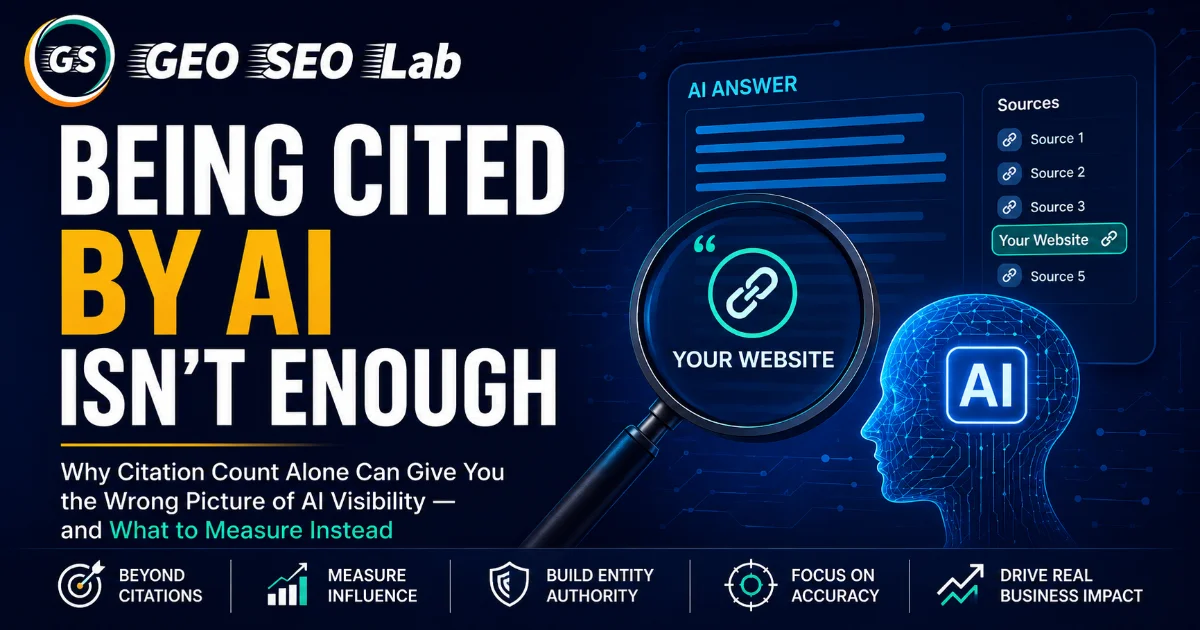
Being Cited by AI Isn't Enough
Introduction: The Metric Everyone Is Watching
Digital marketing has changed considerably in a short period of time. For years, businesses focused on rankings, impressions, clicks, backlinks, traffic and conversions. Search visibility was relatively easy to understand because marketers could enter a keyword into a search engine, look at the results and see where a website appeared.
The growth of AI powered search has introduced another layer to that process. People are increasingly asking conversational systems questions instead of searching through pages of traditional results. They may ask for the best software for a particular business, compare several companies, request an explanation of a complicated subject or ask for recommendations before making a purchase.That change has created a new concern for businesses. They want to know whether their company is appearing in these answers.This has led to a growing focus on AI citations. Marketing teams are monitoring queries, checking which websites are mentioned, recording how frequently their brand appears and comparingcitation numbers with competitors. On the surface, this seems like a sensible way to measure visibility.
It is certainly better than ignoring the change completely.But citation counting has an important limitation.A citation tells you that a system selected or displayed your source. It does not necessarily tell you how much your source influenced the actual answer.That difference is easy to overlook because a citation feels like proof of visibility. When a company sees its website listed as a source, it is natural to assume that the information in the answer came from that website. Sometimes that may be true. Sometimes the source may have supplied a specific statistic or definition. In other situations, however, the cited page may have contributed only a small part of the final response.This creates a measurement problem.Imagine a user asks an AI search system, "What are the most effective strategies for improving visibility in AI search?"
The system provides a detailed response and cites five websites.Your company is one of those five sources.
Your team records the result as a successful citation.But imagine that another company supplied the main definition used in the answer. A second competitor provided the framework. A research organization supplied the statistics. A third website provided the examples. Your article contributed only one small piece of supporting information.
You received a citation.Your competitor also received a citation.The numbers look equal.The influence was not equal.
One source helped shape the central explanation while another merely supported a small statement.This is why businesses need to think beyond citation frequency. The important question is not only whether a source appears in an answer. The more useful question is whether the knowledge contained in that source actually helps shape what the user learns.That distinction becomes increasingly important as AI search becomes more sophisticated and as businesses invest more money into visibility strategies.
Citation Selection Is Not the Same as Informational Influence
When an AI search system produces an answer, it may use information from several sources. It can retrieve pages, evaluate their relevance, combine information and produce a response that brings different pieces of knowledge together.
The final response may contain several citations.However, those citations do not necessarily represent equal informational contribution.One source might explain the basic concept. Another might provide a number. Another might offer a comparison. Another might explain a process. Another might provide background context.The source list therefore tells us something about selection, but it does not automatically tell us about influence.This distinction is particularly important for companies that use citation frequency as their primary performance metric.Suppose Company A appears in 40 percent of monitored AI responses while Company B appears in 25 percent.At first glance, Company A seems to be winning.But suppose deeper analysis shows that Company A is usually mentioned for generic background information while Company B's research repeatedly becomes part of the actual explanation.Company B could have fewer citations but greater informational influence.The difference matters because the long term value of visibility comes from what people learn about your organization and your expertise.If a user sees your company mentioned but learns the key ideas from a competitor, your brand may still be present, but your competitor may be establishing the conceptual authority.
This is one of the reasons citation counting can create a false sense of success.
The Difference Between Being Present and Being Important
A useful way to understand this problem is to compare AI visibility with a discussion between several experts.
Imagine ten experts are invited to discuss a complicated subject.One person speaks for only thirty seconds but provides a crucial definition that everyone uses afterward.Another person speaks several times but mostly repeats information everyone already knows.If you counted how many times each person spoke, you might conclude that the second expert was more influential.But that conclusion would be wrong.The first expert changed the direction of the discussion.
AI generated answers can work in a similar way.A source that contributes one highly distinctive piece of information may have more practical influence than a source that contributes several generic statements.This is why businesses should examine what information from their pages appears in generated answers instead of simply recording whether the page was cited.The difference sounds subtle, but it can completely change the way a company approaches content.
Why Generic Content Struggles to Create Real Influence
One of the biggest problems facing modern content strategies is sameness.
Search almost any popular marketing topic and you will find hundreds or thousands of pages explaining similar ideas.
Many articles contain the same definitions.Many repeat the same advice.Many use similar examples.Many explain the same process using slightly different wording.This content may be accurate. It may even be well written. But accuracy alone does not make information distinctive.Consider a statement such as, "AI search is changing how people discover information."There is nothing particularly wrong with that statement.The problem is that almost every publication discussing AI search can say exactly the same thing.An AI system does not need your version of this statement. The information exists in countless other sources.The same problem appears with statements such as, "Businesses should optimize their content for AI visibility."Again, this is reasonable advice, but it provides little distinctive information.
Now consider a company that studies 1,000 websites and discovers that a large percentage of those websites use inconsistent business descriptions across different platforms.That finding is different.It contains a specific dataset.It contains a specific observation.It comes from a particular analysis.It gives the reader something that cannot simply be copied from hundreds of generic articles.That is where informational value begins to increase.
Specific Information Gives Content More Value
The most valuable information is often information that answers a specific question clearly.
Definitions can do this.Statistics can do this.Research findings can do this.Comparisons can do this.Processes can do this.
Original observations can do this.Expert interpretation can do this.A good piece of content does not simply discuss a subject. It gives the reader useful pieces of knowledge that can stand on their own.For example, instead of saying that reviews are important for local search, a stronger explanation would describe why reviews matter, what information they contain, how independent customer feedback supports business claims and what patterns businesses should monitor.
The second approach gives the reader a clearer understanding of the subject.
It also creates more specific information that can potentially be recognized and incorporated into future answers.
This does not mean content should be written mechanically for machines.The opposite is actually true.
The more useful the content becomes for a knowledgeable human reader, the easier it often becomes for a system to identify its important information.
The Extractability of Information
A useful way to think about content quality is extractability.
Extractability describes how easily an important idea can be identified and understood without losing its original meaning.
A page can be very detailed and still have poor extractability.This happens when important claims are hidden inside long sentences, when definitions are unclear, when evidence is separated from the claims it supports or when the main conclusion is buried beneath unnecessary explanation.Good extractability does not mean turning every article into a collection of short statements.It does not require removing nuance.It does not mean every page should become a table or a list.It simply means that important information should be expressed clearly.Consider the difference between vague language and precise language.A vague explanation might say that businesses need to think about their presence across different digital platformsbecause modern systems evaluate information from many sources.
The statement is understandable, but it does not tell the reader exactly what is being evaluated.
A stronger explanation might state that organizations are represented through multiple digital signals, including website information, business profiles, author information, third party references and external recognition.
The second explanation gives the reader something more concrete.It creates clearer informational units.It also makes the relationship between different ideas easier to understand.
Long Form Content Can Still Be Highly Extractable
There is sometimes a misunderstanding that extractable content must be short.That is not true.Long form content can contain enormous informational value.The issue is not the number of words.The issue is how those words are organized and how clearly the important ideas are expressed.A 5,000 word article can contain excellent definitions, original research, examples, explanations, comparisons and practical guidance.Another 5,000 word article can repeat general statements for thousands of words without adding much new information.
Both are long.Their value is completely different.This is why reducing content length simply for the sake of making it easier to process is not necessarily the right approach.The better goal is to make important information easier to understand within the depth of the article.
Original Research Creates a Different Kind of Advantage
Original research is one of the strongest ways for an organization to create distinctive informational assets.
When a company publishes its own research, it creates information that other websites do not automatically possess.A competitor can write an article about the same topic.A competitor can provide its own opinion.A competitor can explain a similar concept.But a competitor cannot honestly claim the exact findings of research it did not conduct.
This gives original research a special position.Suppose a company analyzes 850 local business profiles and discovers a particular pattern.That finding becomes associated with the research.Other websites may discuss it later, but the original source remains important because it contains the underlying evidence.This creates what can be described as informational singularity.The organization owns the original observation.That does not guarantee that an AI system will cite it.There is no guarantee that every piece of original research will become visible.But original research gives a company something generic content cannot provide.It gives the company information that is uniquely its own.
Why Original Frameworks Matter
Research is not the only form of distinctive knowledge.A company can also develop its own framework.A framework can explain how an organization approaches a problem.It can organize a complicated process into a clear model.
It can define stages, relationships or decision points.When a framework is genuinely useful and clearly associated with an organization, it becomes another informational asset.This is especially valuable when the framework is supported by real experience.A framework should not simply rename common concepts and present them as something new.
The value comes from genuinely useful thinking.If an organization has developed a practical process after working with many businesses, documenting that process can turn experience into a reusable knowledge asset.
Over time, these assets can become part of the organization's identity.
The Information Object Approach
Another useful way to think about strong content is through information objects.An information object is a clearly identifiable piece of knowledge that serves a specific purpose.A definition is one information object.A research finding is another.A comparison is another.A process is another.An expert interpretation is another.A causal explanation is another.
The strength of a comprehensive article often comes from the way these different information objects work together.
A definition tells the reader what something means.Research tells the reader what has been observed.A comparison explains how two approaches differ.A procedure explains what someone can do.Expert analysis explains why the information matters.A causal explanation explores why something happens.When these elements are combined naturally, an article becomes more than a collection of paragraphs.It becomes a coherent knowledge resource.
Definitions Are More Important Than They Look
Definitions are often underestimated.When someone encounters an unfamiliar concept, the first question is usually simple.
What does this mean?A clear definition answers that question immediately.A strong definition also establishes the boundaries of a concept.It tells the reader what the term includes and what it does not include.This becomes especially important in emerging areas where terminology is still developing.Organizations that define concepts clearly can contribute to how those concepts are understood.That is a meaningful form of authority.
Statistics Give Claims Weight
Numbers can also make information more concrete.Compare the statement, "Many websites have inconsistent business information."Now compare it with a statement describing a specific study, its sample size, its methodology and the percentage of websites that showed a particular pattern.The second statement is more useful because the reader has something concrete to evaluate.However, statistics should never be used simply to make an article look authoritative.
A number without methodology can create more confusion than clarity.When publishing research, organizations should explain where the data came from, what was measured, how the sample was selected and what the findings actually mean.Good evidence is not just a number.It is a number with context.
Comparisons Help Users Understand Differences
Comparison content is another strong source of informational value.People often search because they need to choose between two options.They may want to know the difference between two strategies, platforms, tools or approaches.
A useful comparison does more than declare one option better.It explains the conditions under which each option makes sense.For example, one approach may be better for organizations that need speed, while another may be more suitable for organizations that require deeper control.A thoughtful comparison helps the reader make a decision.
It also provides structured information that can be useful when answering questions involving differences between concepts.
Procedures Answer the Most Practical Questions
Many users do not simply want to know what something is.They want to know how to do it.This is why procedural information has strong practical value.A guide that explains how to audit a website, conduct research, analyze competitors or improve a particular process can become a useful reference.However, procedural content should not simply repeat generic instructions.The strongest guides contain practical experience.They explain what commonly goes wrong.
They show how to interpret results.They explain decisions that cannot be understood from a basic checklist.
That is where organizational expertise becomes visible.
Expert Interpretation Adds Meaning
Raw information is not always enough.Suppose a company publishes a research report showing that a particular percentage of websites have inconsistent business information.The number is useful.But the reader may still ask what it means.Does the inconsistency matter?Why might it matter?What should a business do about it?What limitations should be considered?Expert interpretation answers these questions.This is where experienced professionals can provide something more valuable than simple data.They explain the meaning behind the data.
The Entity Behind the Content Matters
Content does not exist in isolation.When a reader sees an article, they also encounter the organization and author behind it.The same applies to systems that attempt to understand information across the web.A page published by an established organization with a clear identity and strong external recognition may exist in a very different credibility context from a similar page published by an organization that is difficult to understand.This does not mean that established brands automatically produce better information.It means that identity and context matter.A system trying to understand information needs to understand who produced it.
Consistency Builds a Stronger Identity
Organizations often describe themselves differently across different platforms.The company name may vary.The description may change.The services may be presented differently.The expertise may be unclear.Authors may have incomplete profiles.External references may use different terminology.These inconsistencies can make organizational identity harder to understand.A stronger approach is to maintain a consistent description of the organization, its expertise, its products and its people across important digital properties.Consistency does not mean copying the exact same sentence everywhere.It means maintaining the same underlying facts.
External Recognition Strengthens Context
An organization can describe itself as an expert.That is self reported information.External recognition provides another layer.When respected publications, professional organizations, industry communities or independent researchers recognize an organization, the organization gains additional context.This is one reason external references matter.
The goal should not be collecting mentions simply for the sake of increasing numbers.The goal should be becoming genuinely recognized for something valuable.Recognition is most meaningful when it reflects real expertise.
Author Identity Matters Too
The people behind content deserve attention.A page containing a strong claim should make it clear who made that claim and why that person has relevant expertise.An identifiable author with a clear professional background provides context.
For example, a detailed analysis of search technology is more meaningful when the reader can understand the author's experience with search, analytics, marketing or technical research.This does not mean every article needs a famous person.It means authors should not be treated as invisible.Their expertise should be clear.Their professional identity should be consistent.Their contributions should be connected to the areas where they actually have experience.
Moving Beyond the Simple Citation Report
A mature visibility program needs more than a spreadsheet showing citation counts.A stronger measurement framework can examine several stages.The first stage is discovery.Was the content encountered during retrieval?This is difficult to observe directly because the retrieval process is not fully transparent.The second stage is citation.Was the page explicitly cited?This is easier to measure and remains useful.The third stage is contribution.Did distinctive information from the page appear in the generated response?This requires deeper analysis.The fourth stage is business impact.Did the visibility contribute to meaningful outcomes?This is ultimately what businesses care about.
Discovery Is Difficult to Measure
Retrieval systems are not fully visible to marketers.A company may not know whether its page was considered and rejected, never retrieved, retrieved but not usedorretrieved and used without being prominently cited.
This means discovery metrics should be treated carefully.The absence of a citation does not necessarily mean the content was never encountered.Likewise, a citation does not reveal everything about the retrieval process.This is one reason why AI visibility measurement requires humility.
Citation Still Has Value
Moving beyond citation counting does not mean abandoning citations.Citation frequency remains useful.If a page begins appearing in relevant responses after previously receiving no visibility, that is meaningful.If a company consistently appears for important commercial queries, that is also meaningful.The problem occurs when citation count becomes the complete definition of success.Citation should be treated as one layer of measurement.It is evidence of visibility, but not complete evidence of influence.
Contribution Analysis Requires Care
Measuring contribution is more difficult.A practical approach begins with collecting the actual responses generated for important queries.The organization can then review the cited pages and compare their information with the response.The goal is to identify specific correspondence.Did a particular definition appear?Did a distinctive statistic appear?Did the system reproduce the structure of a unique framework?Did a specific conclusion appear?Did a particular procedure appear?General similarity is not enough.If every website says that reviews matter, seeing that idea in an AI answer does not prove that your page contributed it.The information needs to be distinctive enough to create a meaningful connection.
Avoiding False Attribution
One of the biggest risks in measurement is claiming more than the evidence supports.Suppose a company updates a page in March.In April, citation frequency increases.It may be tempting to say that the update caused the increase.But several things could have changed.The search system may have changed.A competing page may have disappeared.The query pattern may have changed.The model may have been updated.The retrieval system may have changed.
The market itself may have changed.Therefore, the responsible statement is that the organization observed a change after the update.That is different from proving that the update caused the change.This distinction is not just academic.
Poor attribution can lead companies to invest heavily in tactics that did not actually create the result.
Competitive Analysis Changes the Picture
Looking only at your own visibility can hide important opportunities.A competitor may be appearing less frequently overall but dominating a handful of commercially important questions.Another competitor may have developed one original research asset that repeatedly becomes part of answers.A third competitor may own the strongest definition of a concept in the category.These observations are more useful than simply knowing that another company has a higher citation percentage.The important question becomes:What information is my competitor contributing that I am not?That question leads to practical action.
Content Portfolios Are More Powerful Than Individual Articles
One article rarely establishes complete authority around a major subject.Strong organizations build connected libraries of knowledge.A foundational article explains the concept.A research report provides evidence.A comparison article explains alternatives.A practical guide explains implementation.An expert analysis explains implications.
These resources can support each other.A reader who discovers one article can move naturally into another.
The result is a broader information ecosystem.This approach also helps organizations cover different types of questions.
Someone may ask what a concept means.Someone else may ask why it matters.Another person may ask how to implement it.Another may ask which approach is better.A connected content portfolio can address all of these needs.
Foundational Content Establishes the Basics
Every knowledge ecosystem needs strong foundational pages.These pages explain the central concepts of a field.They should not attempt to sound complicated.A good foundational page makes difficult subjects understandable.It defines terms clearly.It explains relationships between concepts.It gives examples where necessary.It establishes the terminology that later articles can build upon.
Research Creates Distinctive Knowledge
Research content sits at the other end of the spectrum.Instead of explaining what everyone already knows, it produces new observations.Research may involve analyzing websites, reviewing datasets, studying customer behavior, examining search results or comparing industry patterns.The exact method depends on the organization.What matters is that the result produces information that others do not already have.
Methodology Pages Show How Expertise Works
Organizations should also explain their methods.A company may have a particular way of conducting audits.Another may have a proprietary process for evaluating content.Another may have developed a framework for measuring visibility.
Explaining these methods helps demonstrate expertise.It also gives users a clearer reason to trust the organization's recommendations.
Practical Guides Turn Knowledge Into Action
A research report can explain what is happening.A practical guide can explain what to do next.Both have value.The best guides are grounded in real experience.They acknowledge complications.They explain what to check.They describe common mistakes.They show how to interpret results.This is much more useful than simply presenting a generic checklist.
Expert Analysis Connects Everything
Expert analysis provides the bridge between information and decision making.Research tells us what wasobserved.Analysis explains why it matters.Practical guidance explains what can be done.Together, these forms of content create a much stronger knowledge resource.
Prioritizing Content Investment
Not every page deserves the same amount of effort.Organizations often have large content libraries containing hundreds or thousands of pages.Trying to optimize everything at the same time is inefficient.The highest priority should usually go to content that combines strong business value with genuine organizational expertise.Original research deserves serious attention.Proprietary frameworks deserve serious attention.Core methodology pages deserve attention.
Important definitions deserve attention.Generic awareness articles may still have value, but they usually offer less opportunity for distinctive informational contribution.
Improving Existing Content
Creating new content is not always the best answer.Many organizations already have useful information buried inside old articles.The first step is to identify the main claims.What is the article actually trying to teach?Are those ideas clearly stated?The next step is to examine evidence.Are important claims supported by research, examples, data or credible references?Then look at information density.Does the article contain specific knowledge or mostly broad statements?
Structural clarity matters too.Can a reader quickly understand what the page is about?Can important information be found without reading every sentence?Finally, consider attribution.Is the author clearly identified?Is the organization clearly connected to the subject?Is the methodology behind research explained?These improvements can often make an existing article significantly more useful.
Accuracy Is an Important Missing Metric
Visibility is not automatically positive.A company can appear frequently in generated responses and still be represented incorrectly.The system might describe an outdated service.It might confuse two similarly named companies.It might misunderstand what the organization specializes in.It might associate the company with a product it no longer offers.This creates a serious problem.A user who sees inaccurate information may form the wrong expectation before visiting the company's website.Therefore, businesses should measure accuracy as well as visibility.The goal is not simply to be mentioned.The goal is to be understood correctly.
Business Outcomes Are the Final Test
Ultimately, businesses do not invest in visibility simply to collect screenshots.They invest because visibility should support business growth.The downstream indicators may include branded searches, direct visits, qualified enquiries, leads, sales conversations and conversions.The exact metrics will differ between businesses.A large enterprise may care about qualified opportunities.A local business may care about calls and appointments.A software company may care about product trials.A consultancy may care about high quality enquiries.The important point is that AI visibility should eventually be connected to meaningful business outcomes.
Building a Better GEO Dashboard
A mature dashboard should therefore include visibility data, contribution observations, accuracy information, competitive comparisons and business outcomes.Citation frequency can remain part of the dashboard.It simply should not occupy the entire dashboard.For each important query, teams can record which brands appear, which pages are cited, what information is represented, whether the representation is accurate and whether distinctive content from a particular source appears to have influenced the answer.Over time, this creates a much richer dataset.
Quarterly Audits Provide Better Perspective
AI systems can change quickly.A response observed today may not look exactly the same next month.That variability makes one time observations unreliable.A quarterly audit provides a more useful perspective.Teams can test important queries, collect responses, analyze citations and contribution patterns, review competitors and identify changes.
The following period can then focus on improvements.This creates a continuous cycle.Measure.Analyze.Improve.Measure again.The value comes from the pattern over time rather than one isolated result.
The Importance of Honest Reporting
The GEO industry will become more credible if organizations are careful about how they report results.
There is a difference between saying that a citation rate increased and saying that a particular content change caused the increase.There is a difference between saying two things changed during the same period and saying one caused the other.There is also nothing wrong with reporting that an experiment produced no significant change.In fact, negative or neutral results can be valuable.They tell the organization what did not work.They prevent teams from wasting resources.
They create a more realistic understanding of how unpredictable AI search can be.
From Citation Hunting to Knowledge Leadership
The future of AI visibility is unlikely to be defined by companies that simply try to collect the largest number of citations.
Citation visibility will still matter.But the deeper advantage will belong to organizations that produce information worth using.
The first question businesses asked was whether AI systems could find them.Then the question became whether AI systems would cite them.The next question is more important.Does the organization's knowledge actually influence what AI tells people?That is a much higher standard.It requires companies to think about what they know that others do not.It requires them to document real experience.It requires them to conduct research.It requires them to develop useful frameworks.It requires them to explain complicated subjects clearly.It requires them to build recognizable expertise around real people and real organizations.Most importantly, it requires them to stop treating content as a collection of pages created only to attract traffic.Content can become organizational knowledge.A research report can become an industry reference.A framework can become a recognized methodology.An expert explanation can become the answer people remember.A practical guide can become a trusted resource.That is much more valuable than simply appearing in a citation list.
The Real Meaning of AI Visibility
True visibility is not just being seen.It is being understood.It is being associated with the right subject.
It is having your expertise represented accurately.It is contributing information that users actually need.It is becoming one of the sources that helps shape how a subject is explained.This changes the way organizations should think about their content strategy.Instead of asking, "How can we get another citation?" they should ask, "What information can we create that would genuinely improve the answer?"That question naturally leads to better content.It leads to better research.It leads to stronger expertise.It leads to more useful resources.It also creates a stronger brand.
Why Knowledge Leadership Creates a Durable Advantage
Generic content can be copied.A distinctive research finding cannot be copied without reproducing the underlying work.A genuine methodology is difficult to reproduce because it comes from experience.An expert's interpretation develops through years of practice.A strong reputation takes time to build.This is why knowledge leadership can create a durable advantage.Companies that focus only on visibility metrics may constantly chase changes in platforms.Companies that build genuine knowledge assets have something more stable.Their knowledge remains valuable even when interfaces change.The way people discover information may change.The systems generating answers may change.The terminology may change.But useful knowledge continues to have value.
The Role of Human Expertise
As technology becomes better at processing information, human expertise does not become irrelevant.It becomes more important in a different way.People create the original observations.People conduct the research.People make judgments.
People interpret results.People develop frameworks from experience.People understand customer problems that cannot always be reduced to keywords.This is why organizations should make their expertise visible.Readers should be able to understand who is responsible for an analysis.They should be able to understand why the organization knows the subject.They should be able to distinguish genuine experience from generic commentary.
What Businesses Should Do Differently
The biggest change is conceptual.Businesses should stop treating AI visibility as a simple ranking problem.It is increasingly a knowledge problem.The question is not merely whether a page can be retrieved.The question is whether the page contains useful information.The question is whether the organization behind the page is understandable.The question is whether its claims are supported.The question is whether its information is distinctive.The question is whether the expertise is recognizable.The question is whether the knowledge contributes something meaningful to the conversation.These questions create a much stronger foundation for long term visibility.
Conclusion: Build Knowledge Worth Using
Citation counting is not useless.It is simply incomplete.A citation tells you that a source was selected or displayed.It does not automatically tell you that the source shaped the answer.That is the distinction businesses need to understand.The organizations that build strong AI visibility will not necessarily be those with the largest collection of citations.They will be the organizations with the strongest body of useful, distinctive and credible knowledge.They will publish original research.They will develop useful frameworks.They will explain important concepts clearly.They will provide specific evidence.They will make their authors identifiable.They will build consistent organizational identities.They will measure not only visibility but also contribution, accuracy, competition and business outcomes.Most importantly, they will understand that the real objective is not to make a brand appear in an answer.The real objective is to become a source of knowledge that improves the answer.That is a much more valuable position.When an organization becomes known for a specific area of expertise, when its research is referenced, when its frameworks are discussed, when its explanations help people understand difficult subjects and when its knowledge repeatedly becomes useful in important conversations, citation becomes a natural result of something deeper.It becomes evidence that the organization has created knowledge worth using.That is where GEO becomes more than visibility management.It becomes knowledge strategy.The businesses that recognize this shift early can build an advantage that is difficult for competitors to reproduce.They will not spend all their time chasing mentions.They will spend their time becoming worth mentioning.They will not measure success only by how many times their name appears.They will measure whether their ideas matter.And they will not ask only whether AI can find them.They will ask whether AI understands them correctly, whether their expertise is represented accurately and whether their knowledge contributes to the answers their potential customers are seeking.That is the direction in which meaningful AI visibility is heading.Build knowledge worth using.Everything else follows.
Frequently Asked Questions
Find answers to common questions about this topic
About the Author

Aman Kesharwani
SEO Expert & Content Creator
Experienced digital marketing professional specializing in SEO strategies, content optimization, and data-driven marketing solutions. Passionate about helping businesses grow their online presence and achieve better search rankings.
Related Articles
View all posts
Ghost Citations: The AI Visibility Problem Most Brands Have Not Discovered
Ghost Citations happen when AI systems use a brand’s knowledge to answer user questions without giving meaningful recognition to the original source. Learn why this happens and how businesses can build stronger AI visibility through original research, proprietary frameworks, entity authority, and brand recognition.
Why Creator Content Is Becoming a Critical Ranking Signal for AI Search
Creator content is becoming an important part of AI search visibility. Learn why real experience, independent reviews, expert opinions, customer discussions and professional communities can influence how AI search systems understand a brand and its expertise.
AI Search Doesn’t Have a Ranking Page: How to Measure Competitor Visibility
AI search has changed how businesses compete online. Learn how to measure AI competitor visibility, track AI Share of Voice, analyze brand mentions, monitor competitors, and build a practical AI competitive intelligence strategy.