The AI Visibility Score: Measure Brand Presence Across AI Search
Learn how to measure and improve your AI Visibility Score across ChatGPT, Google AI Mode, Gemini, Claude, Perplexity, and modern AI search platforms.
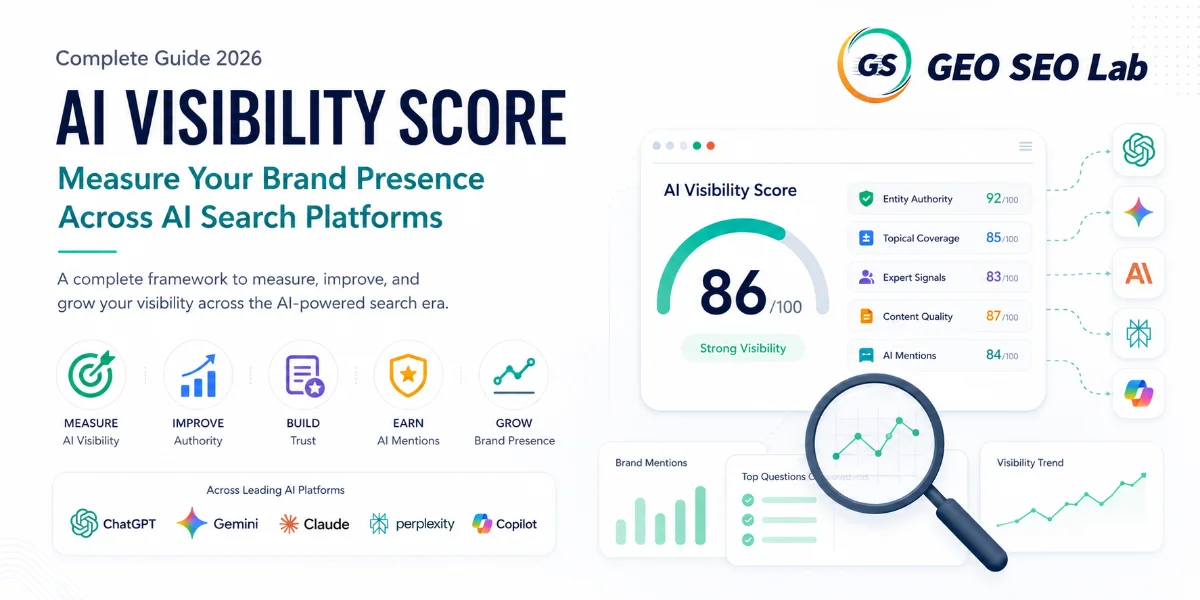
The AI Visibility Score: Why Traditional SEO Metrics Are No Longer Enough in the Age of AI Search
There was a time when measuring digital success felt remarkably straightforward. Marketing teams tracked keyword rankings, organic traffic, backlinks, impressions, click-through rates, and conversions. Every dashboard reflected a familiar journey: users searched, discovered a webpage, clicked a result, and eventually became customers.
That model still exists, but it no longer tells the complete story.Millions of people now begin their research inside AI-powered assistants rather than traditional search engines. Instead of scrolling through ten blue links, they ask conversational questions to ChatGPT, Google AI Mode, Gemini, Claude, Perplexity, and other intelligent search systems that generate direct answers instead of presenting a list of websites.For businesses, this changes far more than the user experience. It changes how brands are discovered, how authority is earned, and how buying decisions are influenced long before a visitor lands on a website.A company can dominate Google rankings while remaining almost invisible inside AI-generated recommendations. Another business with fewer backlinks and lower search traffic may become the preferred recommendation because AI systems recognize it as the most trustworthy source for a specific topic.
That shift demands an entirely different way of thinking about digital visibility.Traditional SEO remains essential because websites still need to be crawlable, technically healthy, and rich with valuable content. Yet AI assistants evaluate information differently. They don't simply rank pages. They interpret knowledge, understand relationships between entities, compare competing sources, and synthesize information before presenting an answer.The result is a new competitive landscape where the brands that invest in knowledge, authority, and structured information consistently outperform those relying only on conventional optimization techniques.
Organizations that recognize this transition early are building long-term advantages that become stronger over time. Those waiting for AI search to stabilize risk becoming increasingly difficult to discover, regardless of how successful their traditional SEO strategy appears.
Why Search Is Becoming an Intelligence Layer Instead of a List of Websites
The internet is moving from retrieval to reasoning.
For decades, search engines acted primarily as librarians. Users described what they wanted, and search engines returned the most relevant documents. Humans compared those documents before deciding what information deserved their trust.
Large language models introduce another layer into that process.
Instead of merely locating information, they interpret it.Instead of ranking pages, they connect ideas.Instead of asking users to evaluate dozens of resources, they generate a synthesized response built from their understanding of numerous sources.This seemingly simple change transforms the relationship between brands and potential customers.
A software buyer no longer searches for "best CRM."
They ask:"I run a healthcare company with forty employees. Which CRM integrates with electronic health records and scales without requiring a dedicated IT team?"
The answer is no longer determined solely by keyword rankings.It depends on whether the AI system understands which companies specialize in healthcare workflows, recognizes their expertise, trusts their documentation, and believes they are appropriate recommendations for that specific business scenario.Visibility has evolved from ranking pages to becoming part of an AI system's understanding of a subject.Businesses that appreciate this distinction are beginning to rethink how they create, organize, and distribute knowledge.
The Invisible Customer Journey Most Analytics Platforms Never Record
Imagine two companies competing in the same industry.
Both receive similar organic traffic.Both publish blogs every week.Both have comparable domain authority.
Traditional SEO dashboards suggest they perform almost identically.Now consider how a prospective customer researches solutions.Instead of visiting Google, the customer opens ChatGPT and asks for recommendations tailored to their business.The AI recommends Company A.Company B never appears.No click occurs.No impression is recorded.
Google Analytics shows nothing unusual.Search Console reports no problem.Yet one business participated in the buying conversation while the other remained completely absent.This invisible interaction is becoming increasingly common across software, healthcare, finance, legal services, education, manufacturing, consulting, retail, and countless other industries.The organizations influencing these conversations gain trust before customers even visit their websites.
That influence cannot be measured with rankings alone.
It requires understanding how AI systems perceive brands as sources of knowledge.
AI Systems Evaluate Organizations, Not Just Webpages
Search engines historically ranked URLs.Modern AI systems increasingly evaluate entities.An entity is anything that has a clear identity.Companies.Products.People.Technologies.Research papers.Locations.Industries.Concepts.
Relationships between those entities help AI systems understand the world.When an assistant recognizes that a company publishes authoritative cybersecurity research, employs respected securityexperts, develops enterprise security software, contributes to open-source projects, and receives consistent industry recognition, it develops confidence in that organization's expertise.This confidence influences recommendations.It influences citations.It influences explanations.
Most importantly, it influences trust.Businesses often underestimate how fragmented their digital identity actually is.
One platform describes the company as an AI consultancy.Another calls it a software agency.
A third labels it a marketing firm.Executive biographies differ across websites.Service descriptions change from page to page.Products receive inconsistent names.Structured data is incomplete or missing.Humans may overlook these inconsistencies.AI systems rarely do.Every contradiction weakens organizational clarity.Every consistent signal strengthens it.
Visibility Has Become Multi-Dimensional
For years, marketers thought about visibility in binary terms.Either a webpage ranked.
Or it didn't.AI search introduces much richer outcomes.A business might contribute knowledge without receiving explicit credit.It may be referenced indirectly.It could appear as an example.It might be cited as supporting evidence.Sometimes it becomes one recommendation among several.Occasionally it becomes the primary recommendation.
Each outcome reflects a different level of AI confidence.Understanding these distinctions helps organizations prioritize where improvements create the greatest business impact.Being retrieved differs from being recognized.
Recognition differs from citation.Citation differs from recommendation.Recommendation differs from influence.These layers collectively define modern digital visibility.
The Foundation of AI Visibility Begins With Knowledge
Many organizations still think content marketing means publishing articles consistently.
Frequency certainly matters.Quality matters even more.AI systems increasingly reward organizations that contribute meaningful knowledge rather than simply producing more pages.
The strongest performers rarely publish generic "ultimate guides" assembled from information already available elsewhere.
Instead, they create resources that expand understanding.Original research.Industry benchmarks.Proprietary methodologies.Technical documentation.Practical implementation guides.Case studies with measurable outcomes.
Independent analysis.Expert commentary grounded in experience.Knowledge that genuinely helps professionals solve problems naturally becomes more valuable for both humans and AI systems.This represents a significant shift from content written primarily to satisfy search algorithms.Instead of asking which keywords deserve another article, organizations benefit more from asking which unanswered questions deserve meaningful research.That mindset changes everything.
Why Original Knowledge Creates Compounding Competitive Advantages
Publishing another article summarizing existing information rarely changes an industry's understanding of a topic.
Publishing original insights often does.Imagine two cybersecurity companies.The first publishes weekly blogs explaining common security concepts.The second conducts quarterly research analyzing thousands of ransomware attacks and publishes detailed findings.Both create content.Only one creates knowledge.
AI systems consistently prioritize information that contributes something genuinely new because originality strengthensconfidence in expertise.Every proprietary dataset.Every benchmark report.Every industry survey.Every technical framework.Every independently verified case study becomes another signal demonstrating that an organization is advancing knowledge rather than repeating it.Over time these assets reinforce one another.Research supports articles.
Articles strengthen topical authority.Topical authority improves recognition.Recognition increases citations.
Citations improve recommendations.Recommendations enhance brand trust.The process becomes self-reinforcing.
Organizations often focus on publishing more content when they would achieve greater results by creating better knowledge.The difference appears subtle.Its long-term impact is enormous.
Entity Recognition Is Becoming a Competitive Advantage
Search engines indexed webpages.AI systems organize information around relationships.Every company exists inside a broader network of connected entities.Founders connect to organizations.Organizations connect to products.Products connect to industries.
The stronger these relationships become across the public web, the easier it becomes for AI systems to understand where an organization belongs within its industry.
Businesses that intentionally develop their digital identity create a much clearer picture than competitors whose information remains scattered across disconnected platforms.
This goes beyond adding structured data.
It involves consistent naming conventions, authoritative author profiles, comprehensive product documentation, well-maintained knowledge hubs, trusted external references, and coherent descriptions across every digital property.
Every interaction contributes another piece of the organizational identity AI systems assemble over time.
When those pieces fit together naturally, confidence increases.
When they conflict, uncertainty grows.
Confidence influences recommendations.
Uncertainty reduces visibility.
Retrieval Readiness Determines Whether Great Content Can Be Used
Excellent information provides little value if AI systems struggle to access or interpret it.
Many organizations unknowingly hide valuable expertise behind technical barriers.
Complex JavaScript applications.
Poor information architecture.
AI retrieval systems perform best when information is logically structured and semantically connected.
Clear headings improve interpretation.
Meaningful internal links establish conceptual relationships.
Consistent terminology reduces ambiguity.
Dedicated knowledge hubs reinforce topical depth.
Supporting articles naturally strengthen cornerstone resources instead of competing against them.
A well-designed knowledge ecosystem behaves much like a university library.
Every subject connects logically with related disciplines.
Readers discover deeper explanations effortlessly.
Experts become recognizable through their published work.
Information flows naturally rather than existing as isolated documents.
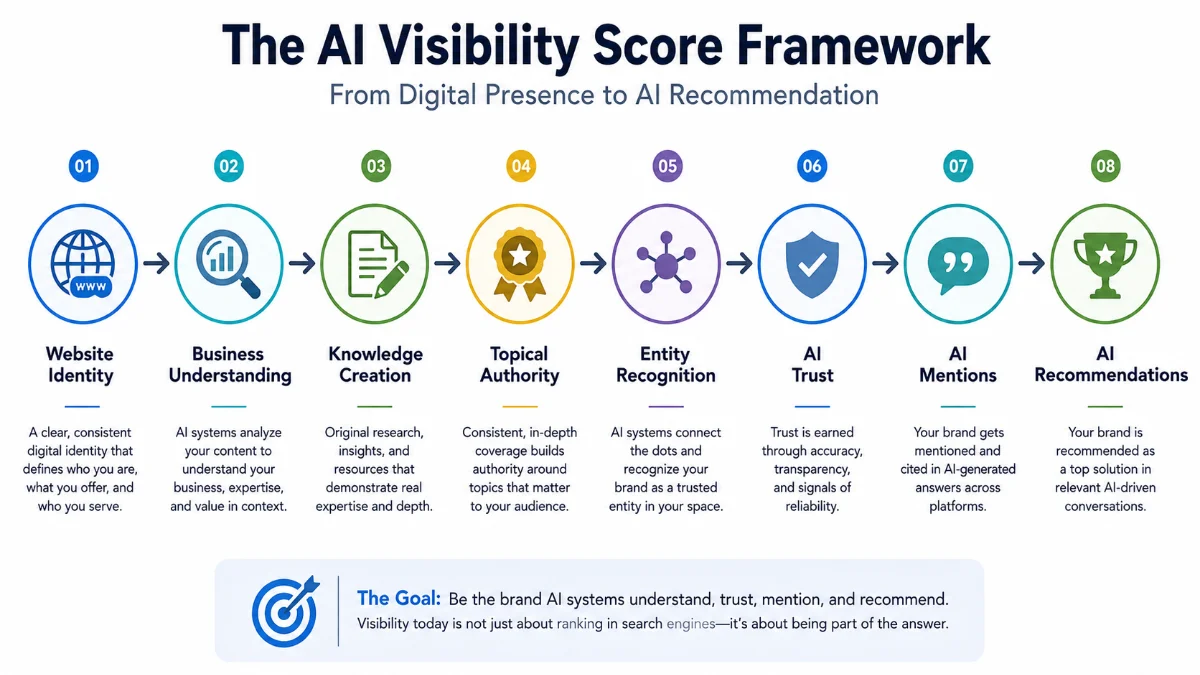
Authority Is Earned Through Consistency, Not Volume
Many organizations still believe publishing more content automatically increases visibility across AI platforms. That assumption was already becoming less reliable in traditional SEO, and it becomes even weaker in AI-powered search.
Large language models evaluate information differently. They attempt to determine whether a source consistently demonstrates expertise instead of simply producing large quantities of content.
Imagine two financial advisory firms.
The first publishes five short blogs every week covering dozens of unrelated finance topics.
The second publishes one comprehensive market analysis every month, supported by original research, economic data, expert commentary, and practical business recommendations.
The first company creates more content.
The second creates more authority.
AI systems are increasingly designed to recognize that difference.
Authority develops when every new publication strengthens the credibility established by previous work. Instead of treating every article as an isolated marketing asset, organizations should think of every publication as another chapter in a continuously expanding knowledge library.
Over time, this creates a recognizable pattern that AI systems can associate with genuine expertise rather than routine content production.
Why Topical Depth Beats Topical Breadth
One of the biggest mistakes businesses make is trying to publish about everything related to their industry.
A digital marketing agency writes about SEO, social media, email marketing, branding, PPC, graphic design, video editing, web development, CRM software, artificial intelligence, blockchain, NFTs, cryptocurrency, and dozens of unrelated trends.
The result is a scattered knowledge ecosystem.
Now compare that with another agency that dedicates years to mastering one specific subject—Generative Engine Optimization (GEO).
Every expert interview expands the same knowledge graph.
Instead of appearing knowledgeable about many disconnected topics, the organization becomes deeply associated with one specialized domain.This depth makes entity recognition significantly stronger.
AI systems become more confident describing the organization because they repeatedly encounter consistent expertise surrounding the same subject.
The lesson is simple.
Specialists are easier for AI systems to understand than generalists.
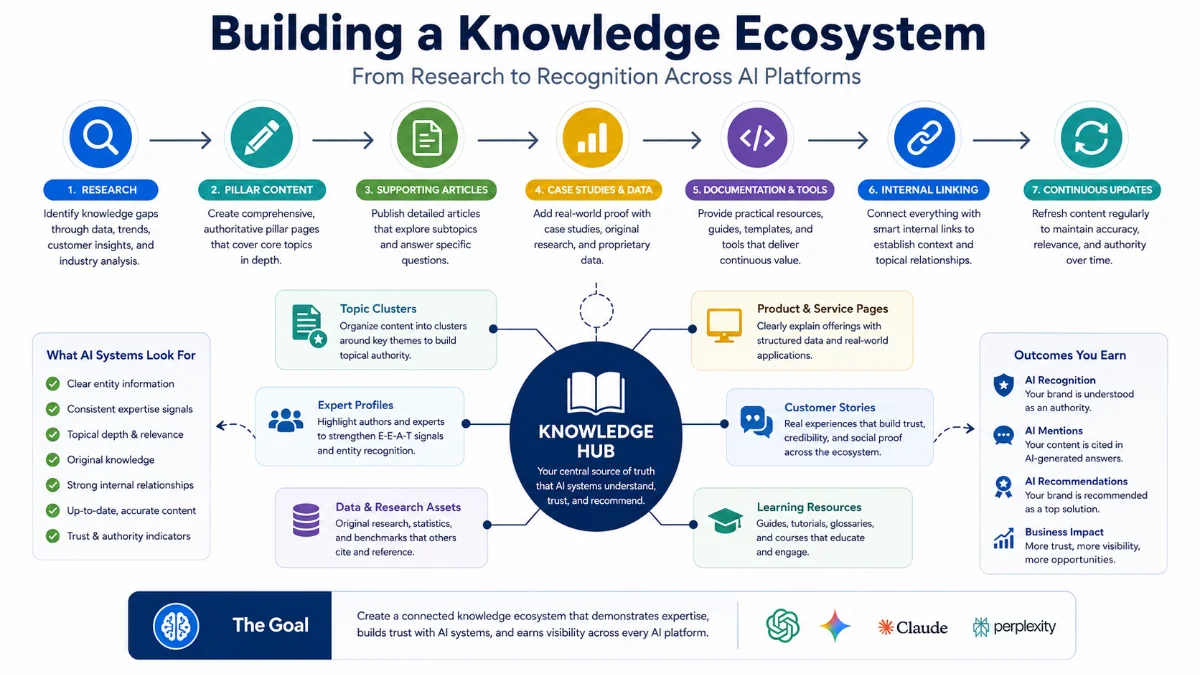
Building a Knowledge Ecosystem Instead of a Content Calendar
Content calendars focus on publishing schedules.
Knowledge ecosystems focus on strategic relationships.
That distinction changes how organizations create information.
Rather than asking, "What should we publish next week?" successful AI-first brands ask a different question.
"What information is still missing from our industry's knowledge base?"
The answer often leads to far more valuable content.
Original surveys. Industry reports.Implementation guides.Technical documentation.Educational resources.Frameworks.
Every asset supports another asset.
Instead of existing independently, articles become interconnected pieces of a larger system.
A mature knowledge ecosystem helps both people and AI systems navigate information naturally.
Users find answers faster.Search engines understand topical relationships better.
AI assistants recognize comprehensive expertise with greater confidence.
The long-term result is stronger visibility across traditional search and AI-powered discovery.
Technical SEO Still Matters—But It Plays a Different Role
Some marketers mistakenly believe AI search has replaced technical SEO.
Nothing could be further from reality.
Technical optimization remains the foundation that allows search engines and AI retrieval systems to access information efficiently.
Accessible websites increase content availability across devices and platforms.
These fundamentals are no longer the final objective.
They are infrastructure.
Just as a modern office needs electricity before employees can perform meaningful work, AI visibility depends on technical excellence before authority can be recognized.
Organizations that neglect technical quality often discover that their expertise remains hidden behind unnecessary barriers.
Conversely, businesses that combine exceptional technical SEO with outstanding knowledge creation create an environment where AI systems can retrieve, interpret, and recommend their content far more effectively.
Structured Data Is Becoming the Language of Machines
Humans understand context intuitively.
Machines need explicit signals.
When implemented correctly, structured data helps AI systems identify organizations, products, services, authors, events, articles, reviews, and countless other entities.
Instead of guessing what a webpage represents, AI systems receive clear semantic descriptions.
With structured data, it can recognize the author, their organization, publication date, subject area, expertise, related research, cited resources, and relationships with other entities across the web.
These additional signals strengthen machine understanding without changing the human reading experience.
Schema alone will not make a company an authority.
However, it allows genuine authority to be communicated much more effectively.
Internal Linking Creates Context That AI Systems Understand
Many organizations treat internal links as simple navigation tools.
Their real value extends much further.
Internal links reveal relationships between ideas.
An article discussing AI Search can naturally connect to resources about SEO, GEO, Retrieval-Augmented Generation, structured data, topical authority, entity optimization, semantic search, and knowledge graphs.
Every connection teaches AI systems how concepts relate.
Rather than existing as isolated pages, articles become nodes within an interconnected knowledge network.
Each chapter references previous knowledge while preparing readers for more advanced topics.
The strongest AI-ready websites follow the same philosophy.
Every article contributes to a broader understanding instead of competing for attention independently.
Expert Signals Help AI Systems Differentiate Real Authority from Generic Content
Artificial intelligence models are becoming increasingly effective at identifying authentic expertise. They don't rely on a single signal to determine whether an organization deserves to be recommended. Instead, they evaluate hundreds of interconnected indicators that collectively establish credibility.
The first company publishes anonymous blog posts with no author information, minimal documentation, and generic marketing copy. The second company introduces every article through experienced engineers, maintains comprehensive technical documentation, publishes original benchmark reports, contributes to open-source projects, and regularly speaks at industry conferences.
Both organizations may rank for similar keywords.
However, AI systems develop much greater confidence in the second company because its expertise is visible across multiple trusted sources. The consistency of these expert signals creates a stronger digital identity that AI assistants can reference when answering complex user questions.
For enterprise organizations, this means every public contribution—from engineering blogs and research papers to webinars and technical documentation—strengthens the organization's overall knowledge profile.
Brand Mentions Matter Even Without Backlinks
For years, digital marketers treated backlinks as the strongest measure of authority.
They remain valuable, but AI search expands the definition of trust.
When respected publications, universities, technology communities, research organizations, podcasts, and professional forums consistently discuss a brand, AI systems recognize those mentions as contextual evidence of industry relevance.
A cybersecurity company cited by government agencies carries a different level of authority than one mentioned only within its own website.
A SaaS platform referenced by independent analysts, technology reviewers, and enterprise consultants builds stronger credibility than one relying exclusively on self-promotion.
This shift encourages businesses to think beyond traditional link-building campaigns.
Digital PR.These activities generate meaningful conversations across the web, creating a richer network of entity relationships that AI systems can understand.
The objective is no longer collecting links.
It is becoming impossible to ignore within your industry's digital knowledge graph.
Fresh Knowledge Keeps AI Confidence High
Authority is not permanent.
Regulations are updated.
AI systems naturally place greater confidence in organizations that continuously refresh their knowledge.
Imagine searching for guidance on Generative Engine Optimization.
Would an AI assistant trust an article published three years ago that has never been updated?
Or would it recommend a resource that reflects the latest developments across ChatGPT, Google AI Mode, Gemini, Claude, Perplexity, and emerging AI search platforms?
The answer is obvious.
Freshness doesn't simply mean changing publication dates.
It means improving information.
Every update tells AI systems that the organization actively maintains its knowledge rather than allowing valuable resources to become outdated.
Organizations that establish systematic content governance create long-term advantages because their knowledge remains accurate while competitors gradually lose relevance.
AI Visibility Is Built Across the Entire Customer Journey
Traditional SEO often focused heavily on attracting visitors at the beginning of the buying process.
AI-powered search influences every stage of customer decision-making.
A potential buyer may ask ChatGPT to identify the best software vendors.
Later, they might ask Gemini to compare pricing models.
They could use Perplexity to verify technical specifications.
Finally, they may ask Claude to summarize implementation challenges before making a purchasing decision.
Each interaction creates another opportunity for a trusted brand to appear.
Organizations that publish content supporting every stage of this journey become significantly more visible than competitors concentrating only on awareness-focused keywords.
Educational resources answer introductory questions.
Comparison content helps buyers evaluate alternatives.
Implementation guides reduce uncertainty.
Case studies demonstrate measurable outcomes.
Technical documentation supports purchasing decisions.
Customer success stories reinforce confidence after adoption.
Together, these assets create a complete knowledge ecosystem that AI systems can draw upon throughout the entire customer lifecycle.Measuring AI Visibility Requires a New Set of Performance Indicators
Traditional analytics platforms were designed for a search experience centered around clicks. They report impressions, sessions, bounce rates, and conversions with remarkable precision because those actions happen on websites.
AI-powered search introduces an entirely different layer of customer interaction.
A technical architect could validate implementation requirements through Perplexity before visiting any official website.
In every scenario, the buying conversation begins before website analytics can record a single interaction.
That is why organizations need a measurement framework designed specifically for AI visibility rather than traditional search alone.
Instead of asking whether a page ranks, businesses should ask whether AI systems understand, trust, mention, cite, and recommend their brand during relevant conversations.
These signals provide a much clearer picture of future digital influence than keyword rankings alone.
The AI Visibility Score Framework
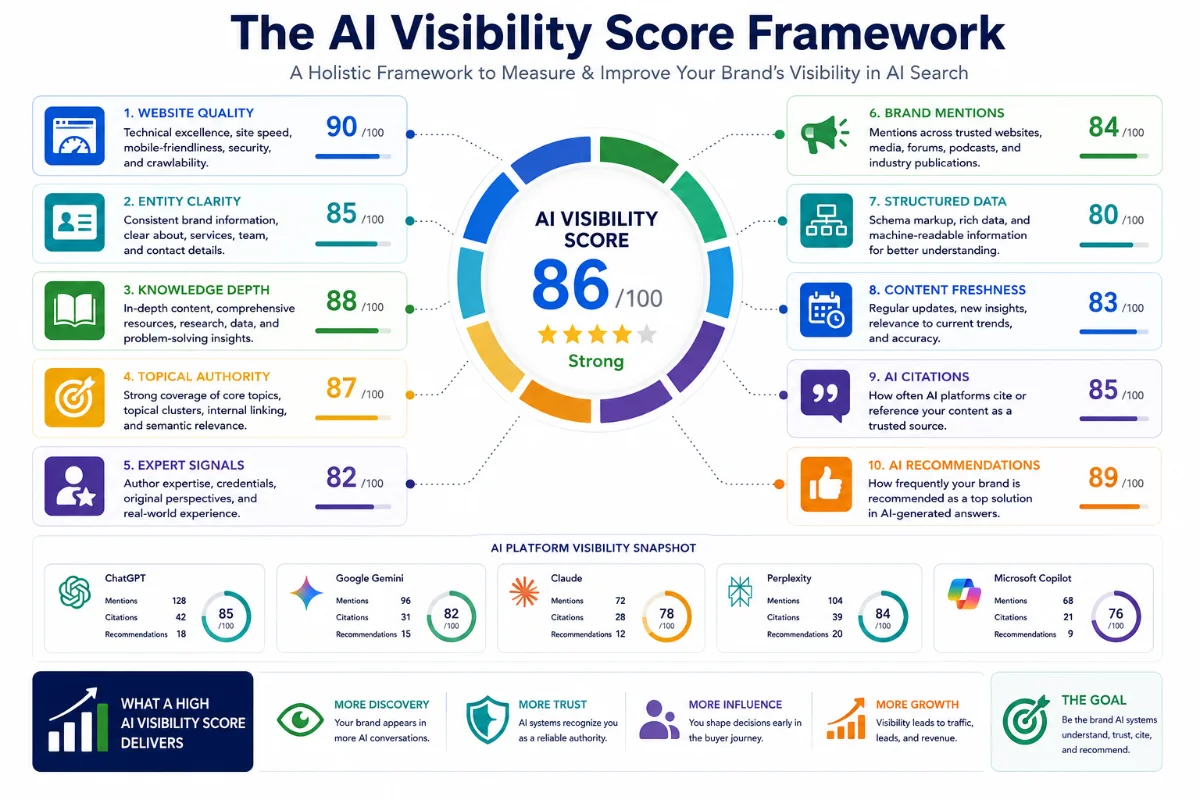
An effective AI Visibility Score should evaluate how well an organization is represented across the modern AI ecosystem rather than relying on a single metric.
The framework combines multiple dimensions that collectively determine whether a business becomes part of AI-generated answers.
Website quality establishes the technical foundation.
Content freshness maintains long-term trust.
AI citations reveal recognition.
AI recommendations indicate confidence.
Together, these dimensions create a comprehensive picture of AI readiness.
Unlike keyword rankings, which fluctuate daily, AI visibility reflects long-term organizational authority that compounds over time.Rather than optimizing for isolated metrics, businesses should continuously improve every component of this ecosystem because weaknesses in one area often reduce confidence across the entire knowledge graph.
Monitoring AI Mentions Across Multiple Platforms
Every AI platform retrieves, interprets, and presents information differently.
ChatGPT may emphasize authoritative educational resources.
Google AI Mode often integrates search quality signals with generative responses.
Gemini benefits from Google's understanding of entities and structured information.
Claude frequently produces detailed analytical responses grounded in trustworthy sources.
Perplexity openly references citations, making source attribution more transparent.
It is to understand how consistently the organization's expertise is recognized.
Questions worth monitoring include:
Does the platform correctly describe the company?
Are products explained accurately?
Are competitors recommended more frequently?
Is outdated information being surfaced?
Are recent research publications influencing responses?
These observations reveal opportunities to strengthen public knowledge rather than attempting to influence AI outputs directly.
Enterprise Organizations Need an AI Content Operating System
Publishing occasional articles is no longer sufficient for organizations competing in AI-driven discovery.
Successful enterprises operate more like knowledge companies than content publishers.
Marketing teams collaborate with product managers.
Researchers publish proprietary data.
Every department becomes a contributor to the organization's collective knowledge.
Instead of producing isolated marketing campaigns, the organization continuously expands a centralized knowledge ecosystem that serves customers, search engines, and AI systems simultaneously.This collaborative approach produces richer, more accurate content because it reflects practical expertise rather than marketing assumptions.
As AI systems increasingly reward authentic knowledge, organizations with cross-functional publishing strategies develop significant competitive advantages.
Common Mistakes That Reduce AI Visibility
Many businesses unintentionally weaken their AI visibility despite investing heavily in SEO.
One common issue is creating dozens of articles that repeat nearly identical information without contributing new insights.
Another is inconsistent brand messaging across websites, documentation, press releases, and social profiles, making entity recognition more difficult.
Technical documentation is often incomplete, leaving AI systems without sufficient context to understand products or services accurately.
Some organizations neglect author credibility, publishing anonymous content that lacks visible expertise.
Others focus exclusively on acquiring backlinks while ignoring original research, proprietary data, and thought leadership.
Perhaps the most significant mistake is treating AI optimization as a separate marketing tactic.
AI visibility is not another channel.
It is the natural outcome of building trustworthy, structured, and consistently valuable knowledge that can be understood by both humans and intelligent systems.
Organizations that embrace this philosophy are not merely preparing for the future of search.
Organizations That Win in AI Search Think Like Publishers, Not Advertisers
For decades, digital marketing revolved around campaigns.
A campaign had a beginning, a launch date, a budget, and an end.
AI search rewards an entirely different mindset.
The most visible organizations are continuously publishing, refining, validating, and expanding knowledge. Their websites evolve into living knowledge platforms rather than collections of landing pages created for individual campaigns.
This distinction is becoming increasingly important because large language models learn from patterns of expertise rather than isolated promotional messages.
A company that publishes consistent educational resources over several years develops a reputation that extends far beyond its own website.
Its frameworks influence best practices.
Each contribution strengthens the organization's position within the broader digital knowledge ecosystem.
Over time, the brand becomes synonymous with expertise instead of advertising.
AI Search Rewards Businesses That Solve Problems Before Selling Products
Many traditional marketing strategies begin with the product.
Features.
Pricing.
Benefits.
Competitive comparisons.
AI assistants often reverse this sequence.
Organizations that publish comprehensive answers to these questions naturally become part of AI-generated responses.
Only after establishing trust does the conversation shift toward products and services.
This is why educational content has become one of the strongest business assets in the AI era.
Every genuinely helpful resource creates another opportunity to become the trusted source before a purchase decision is even considered.
Businesses that prioritize customer education consistently outperform those focused exclusively on promotion.
First-Party Data Is Becoming One of the Most Valuable Content Assets
The internet already contains millions of articles explaining common marketing concepts.
What it lacks is original evidence.
First-party data changes that equation.
When a company analyzes thousands of customer interactions, benchmarks AI visibility across hundreds of brands, publishes annual industry reports, or releases proprietary performance statistics, it creates information unavailable anywhere else.
Original datasets create a competitive advantage that generic content cannot replicate.
Unlike ordinary blog posts, proprietary research continues generating citations, mentions, backlinks, and AI references for years after publication.
Trust Is Built Through Consistency Across Every Digital Touchpoint
A surprising number of businesses unintentionally confuse AI systems by presenting inconsistent information across the web.The homepage describes the company one way.
LinkedIn uses different terminology.
Each inconsistency introduces uncertainty.
Humans usually adapt to these differences without much effort.
Brand messaging should align across documentation, blogs, knowledge bases, and public profiles.
Consistency strengthens entity recognition.
Entity recognition strengthens trust.
Trust increases recommendations.
The relationship is remarkably direct.
AI Search Optimization Is a Long-Term Business Investment
Many organizations approach AI optimization expecting immediate ranking improvements.
That expectation often leads to disappointment.
AI visibility develops gradually because it reflects accumulated trust rather than isolated optimization tactics.
Every published research paper.
Every updated knowledge base.
Recognition develops through years of consistently valuable contributions.
Organizations follow the same pattern.
Those investing steadily in expertise become increasingly difficult for AI systems to overlook.
Competitors attempting short-term shortcuts rarely achieve the same level of recognition because trust cannot be manufactured overnight.
Preparing for the Next Generation of Search
Artificial intelligence will continue evolving.
New models will emerge.
Retrieval methods will improve.
Reasoning capabilities will become more sophisticated.
Search experiences will grow increasingly conversational and personalized.
AI systems will always require trustworthy knowledge.
The organizations that consistently create accurate, original, well-structured information will remain visible regardless of how underlying algorithms evolve.
Businesses chasing temporary optimization tricks may experience short-lived gains, but those investing in knowledge creation, technical excellence, semantic clarity, and authentic expertise build durable competitive advantages.
The future of search will not belong to the companies producing the most content.
It will belong to the organizations contributing the most valuable knowledge.
That distinction represents the true foundation of AI visibility.
As search transitions from ranking documents to understanding expertise, brands have an opportunity unlike any previous era of digital marketing. Organizations that embrace this transformation today will become the trusted sources that tomorrow's AI assistants recommend with confidence. Those recommendations will influence purchasing decisions, shape industry conversations, and define market leaders long before customers ever reach a search results page.
The AI Visibility Score is more than a reporting metric. It is a strategic framework for understanding how machines perceive your organization, how effectively your knowledge travels across the AI ecosystem, and how prepared your business is for the future of discovery. Companies that measure, strengthen, and continuously improve this visibility will not simply adapt to the next generation of search—they will help define it.
The Organizations That Will Lead the AI Economy Are Building Knowledge, Not Just Content
Every major technological shift creates a new definition of competitive advantage.
The rise of websites rewarded businesses that established an online presence before their competitors.
Search engines rewarded organizations that mastered technical SEO and content marketing.
Social media rewarded brands capable of building communities and maintaining continuous engagement.
Sales teams should continuously surface emerging customer questions.
Executive leadership should actively shape the organization's public expertise through research, commentary, and strategic thought leadership.
The companies that integrate knowledge creation into every department will steadily increase their visibility across AI ecosystems.
Those that continue publishing disconnected marketing content will struggle to establish lasting authority.
AI Visibility Should Become a Board-Level Business Metric
Digital visibility has traditionally been considered a marketing responsibility.
AI changes that assumption.
When intelligent assistants recommend software vendors, healthcare providers, financial institutions, legal firms, educational platforms, or consulting agencies, they influence revenue long before prospects interact with a sales representative.
This makes AI visibility an organizational asset rather than a departmental KPI.
The answers provide valuable strategic insight because AI-driven discovery increasingly influences brand perception, customer trust, and purchasing behavior.
Organizations that monitor these signals consistently will adapt faster than those relying exclusively on traditional SEO dashboards.
Continuous Improvement Will Separate Market Leaders from Market Followers
There is no finish line in AI optimization.
New language models appear every year.
Customer feedback uncovers unanswered questions.
Every improvement increases the quality of the organization's public knowledge.
Over months and years, these incremental gains compound into substantial competitive advantages that become increasingly difficult for competitors to replicate.
[IMAGE: Modern flat vector infographic showing the Continuous AI Visibility Improvement Cycle: Audit → Research → Create → Optimize → Publish → Measure → Update → Expand Knowledge. White background, premium corporate design, minimal style, 16:9.]
Businesses that embrace continuous learning position themselves to remain authoritative regardless of how AI search evolves in the coming decade.
Final Perspective
The future of digital discovery will not be determined solely by rankings, backlinks, or keyword positions. Those metrics will continue to matter, but they will represent only one layer of a much larger ecosystem.
The next generation of search is built around understanding.
AI systems evaluate organizations based on the quality of their knowledge, the consistency of their digital identity, the credibility of their experts, the originality of their research, and the trust they earn across the broader web.
Every article, research report, product page, case study, technical document, expert interview, and customer success story contributes another signal that shapes how intelligent systems perceive a brand.
Organizations that invest in these assets today are creating a durable competitive advantage that extends far beyond search rankings.The AI Visibility Score provides a practical framework for measuring that progress. It encourages businesses to look beyond traditional analytics and focus on the deeper indicators that influence AI-generated recommendations.As AI assistants become the first destination for research, comparison, and decision-making, the brands that consistently educate, innovate, and contribute meaningful knowledge will become the ones that intelligent systems trust first.In the coming years, the most valuable digital asset will not simply be a high-ranking website. It will be a trusted knowledge ecosystem capable of informing both people and machines with equal confidence. That is the foundation of sustainable AI visibility, and it is the competitive advantage that forward-thinking organizations should begin building today.
Tags
Frequently Asked Questions
Find answers to common questions about this topic
About the Author

Aman Kesharwani
SEO Expert & Content Creator
Experienced digital marketing professional specializing in SEO strategies, content optimization, and data-driven marketing solutions. Passionate about helping businesses grow their online presence and achieve better search rankings.
Related Articles
View all posts
AI Search Spam Is Rising: Why Brand Mentions Alone Will Not Win AI Visibility
AI search spam is increasing as businesses look for shortcuts to improve brand visibility. This guide explains why fake brand mentions, Reddit manipulation and coordinated promotion are not sustainable strategies, and why genuine expertise, community trust, original research and authentic digital reputation matter more for long term AI visibility.
How to Audit Your AI Entity Footprint Before Your Competitors Do
Learn how to audit and improve your AI Entity Footprint by checking business identity, digital profiles, topical authority, expert information, external recognition, and online consistency. This guide explains how businesses can build a clearer digital identity for GEO and AI search visibility.
Being Cited by AI Isn't Enough: Why AI Visibility Needs Better Metrics
AI citation count can show that your content is being selected, but it does not reveal how much your knowledge actually influences AI generated answers. Learn why businesses need to measure informational contribution, content quality, entity authority, accuracy, competitive visibility, and real business impact.