Why Creator Content Is Becoming a Critical Ranking Signal for AI Search
Creator content is becoming an important part of AI search visibility. Learn why real experience, independent reviews, expert opinions, customer discussions and professional communities can influence how AI search systems understand a brand and its expertise.
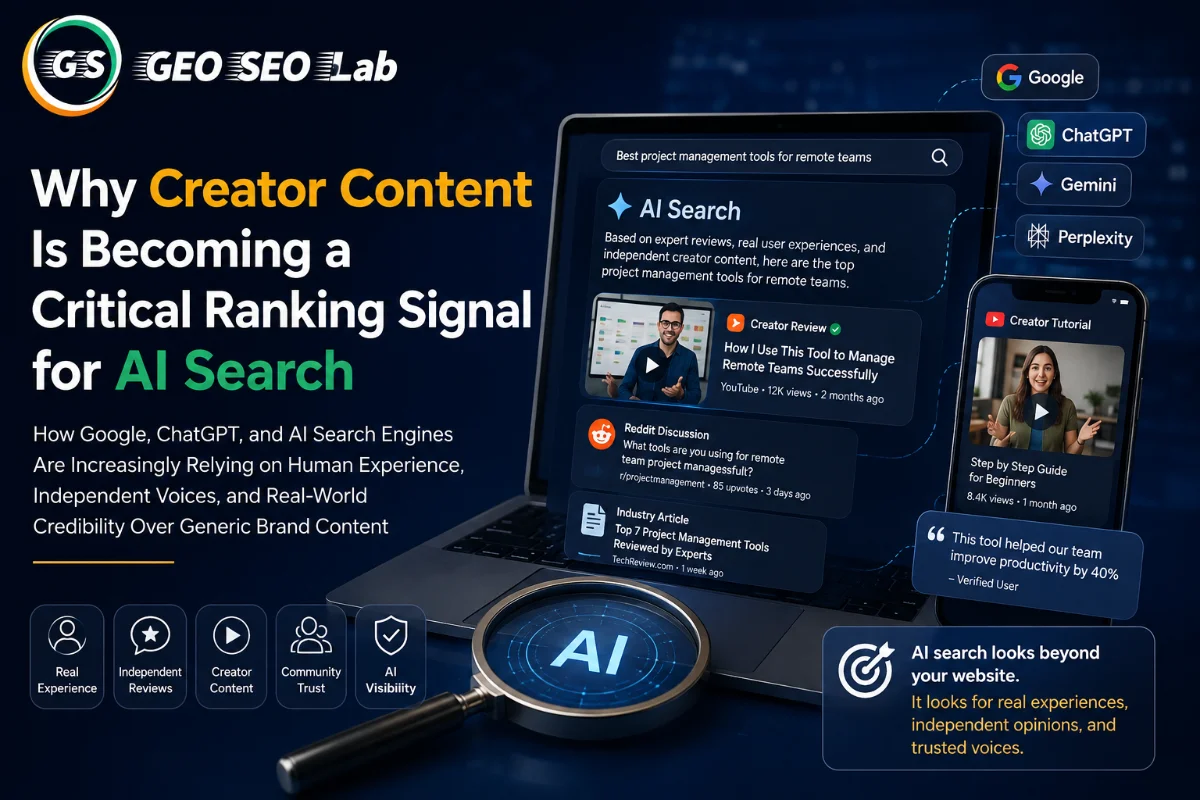
Why Creator Content Is Becoming a Critical Ranking Signal for AI Search
How Google, ChatGPT and Other Search Platforms Are Giving More Importance to Real Experience and Independent Voices
For many years, businesses believed that having a strong website was the main requirement for gaining visibility in search. Companies spent a lot of time creating pages, improving keywords, building links and publishing articles. The basic idea was simple. If a company wanted search engines to understand its expertise, most of the important information had to be available on its own website.That approach is still important, but the way search systems understand businesses is becoming much broader. Search platforms are no longer looking only at what a company says about itself. They can also find information from creators, customers, industry experts, professional communities, reviews, videos, podcasts and other independent sources.This change is especially important for businesses that want to appear in AI powered search experiences. When someone asks a detailed question about a company, product or service, the answer may not come only from the company's website. The system may have information from many different places and use those sources to build a broader understanding.Creator content has an important role in this environment because creators often share something that a company website cannot easily provide. They can show how a product works in real situations. They can explain what they liked, what they found difficult and how they used the product to solve a problem.
This type of experience gives users a different form of information. It is not simply a company making a claim about itself. It is another person explaining what happened after using the product or working with the company.
That difference matters.A business may say that its software is easy to use, reliable and powerful. Those statements are useful, but they are also part of normal business communication. When an independent professional demonstrates the same software in a real project and explains what worked and what did not, the information becomes more useful for people trying to make a decision.This is why creator content is becoming an important part of the wider search ecosystem. Businesses should not think of it only as social media promotion. It can become part of how their expertise, reputation and practical value are understood across the internet.
AI Search Is Looking Beyond the Company Website
The Basic Change in Search
Traditional search mainly worked by finding webpages that matched a user's query. Search engines crawled websites, stored information about pages and used many different signals to decide which pages should appear for particular searches.Businesses therefore focused heavily on their own websites. They improved page content, technical SEO, internal linking, backlinks, page speed and other signals that helped search engines understand and rank their pages.
The website was the main place where a business could explain what it did, what it sold and why customers should trust it.
Modern search experiences are becoming more complicated. When a person asks a detailed question to an AI powered search system, the system may need to understand a topic rather than simply find one webpage containing matching words.For example, imagine someone asks which project management platform is suitable for a remote creative agency.
A simple search could return a list of software websites and review pages. A conversational search system may instead try to understand which platforms are commonly used by remote teams, which ones are easy to learn, which ones work well for creative projects and what actual users say about them.
To answer that kind of question, information from many sources can become useful.
The company's website may explain the features. A creator may show the software being used in a real project. A customer may describe their experience. A professional publication may compare several platforms. A community discussion may explain a problem that users commonly face.Together, these sources create a much richer picture.
The Information Ecosystem Has Become Larger
The company website is still an important part of this ecosystem. It provides official information and gives a business control over its own message. Documentation, product pages, service pages and company information help establish the basic facts.However, other sources add different kinds of information.
Creator tutorials can show practical use. Customer reviews can describe real experiences. Industry publications can provide outside recognition. Community conversations can reveal how people actually discuss a company. Podcasts can provide detailed expert opinions. Professional posts can show how practitioners think about a particular product or service.
Each source has a different role.A company website tells people what the organization says about itself. Independent sources can show what other people have experienced or concluded.
This difference is important because users often want more than a company description before making a decision.
They want to know whether the product works in practice.They want to know whether other professionals use it.
They want to know what problems people faced.They want to know whether the company is respected in its industry.
They want to know whether the claims made on the website match real experiences.Creator content can help answer many of these questions.
Why Independent Content Adds More Context
Company content naturally comes from the company's own point of view. This does not automatically make it unreliable. Businesses should explain their products and services clearly. They should publish accurate information and maintain useful documentation.At the same time, company communication has a purpose. A business wants people to understand its strengths and choose its products or services.An independent creator has a different relationship with the audience.
A creator may use a product because it solves a real problem. They may demonstrate the product while explaining their own workflow. They may compare it with another product. They may mention features they like and also explain limitations they discovered.This creates useful context.For example, a project management company might describe its platform as one of the easiest tools for remote teams.That statement alone does not tell a potential customer everything.
Now imagine several experienced project managers create tutorials showing how they use the platform with distributed teams. They explain how they organize projects, manage communication and track deadlines. Some may mention that the platform is easy to learn but requires additional setup for certain advanced workflows.
The picture is now much clearer.
The audience gets information from people who have actually used the product. The company claim is supported by practical examples, while the limitations provide balance.
This is one reason independent creator content can become valuable for search visibility.
From Website SEO to Ecosystem SEO
The Website Is Still the Foundation
The growing importance of creator content does not mean businesses should stop investing in their websites.
That would be a mistake.A strong website is still the foundation of a digital presence. It contains the information that the company wants to make available to customers, search engines and other systems. It is also the place where businesses can explain their products, services, expertise and experience in detail.
The change is that the website should no longer be treated as the entire digital reputation of an organization.
A business can have an excellent website and still have a weak reputation outside its own domain.
If nobody talks about the company, if customers rarely share experiences, if experts never discuss its products and if professional communities have little knowledge of it, the overall digital picture remains limited.
This is where ecosystem based search strategy becomes important.
The goal is to create a strong and consistent presence across the places where customers and professionals already exchange information.
What Ecosystem SEO Means
Ecosystem SEO means looking at the entire digital environment around a business rather than focusing only on its own website.This includes creator content on YouTube, LinkedIn and industry blogs. It includes customer reviews and discussions. It includes industry publications and expert opinions. It includes podcasts and professional communities.
The idea is not to create fake mentions or manufacture positive conversations.
The real goal is to build a reputation that naturally appears across different parts of the internet.
A company that provides genuinely useful products has an opportunity to create this kind of ecosystem by helping customers succeed, sharing useful knowledge, supporting creators and participating honestly in professional communities.
Over time, these activities can create a much broader picture of the organization.
Why This Cannot Be Built Through Quantity Alone
One of the biggest mistakes businesses can make is assuming that more creator content automatically means better visibility.It does not work that way.Twenty low quality promotional videos may be less useful than two detailed tutorials created by experienced professionals.The value of creator content comes from relevance, expertise, experience and trust.
If a creator simply repeats a company script without actually using the product, the content may not provide much additional value.If the creator spends time understanding the product, uses it in a real workflow and explains the experience honestly, the result can be much stronger.This is why businesses should focus on relationships rather than numbers.The objective should not be to get as many creators as possible talking about the company.
The objective should be to work with people who genuinely understand the industry and can explain the product in a useful way.
Why Creator Content Can Be More Trustworthy
The Value of Independent Experience
There is an important difference between a company describing its product and a professional explaining how they used it.
Suppose a software company says that its platform saves teams time.
That is a normal product claim.Now imagine a consultant creates a detailed tutorial showing how they used the platform to manage a real client project. They explain the process, the time involved, the features they used and the problems they encountered.The second piece of content gives the audience something that the original claim does not.
It provides experience.That experience is valuable because people often make decisions based on what happens in the real world rather than what a product page promises.Search systems also benefit from information that provides context.
A company can explain what its software is designed to do. A practitioner can explain what actually happened when they used it.Both pieces of information can be useful.
The Difference Between Advocacy and Validation
Company content can be viewed as an official explanation of the organization.
Creator content can act as outside validation when it comes from someone who has genuine experience and is free to express an independent opinion.This does not mean every creator automatically has more credibility than a company.The quality of the creator matters.Their expertise matters.Their relationship with their audience matters.
Their actual experience with the subject matters.A random person mentioning a product in a short post does not necessarily provide strong evidence.An experienced professional who has spent months using the product and explains the results in detail provides much more useful information.
The difference is not simply the platform.
The difference is the quality and independence of the information.
How Search Systems Build a Broader Understanding of a Brand
Official Information Creates the Starting PointA company website provides the basic information needed to understand the organization.It can explain what the company does, who it serves, what products it offers and how those products work.Documentation can explain technical details.Service pages can explain the problems the company solves.About pages can provide information about the organization and its people.Structured information can help search systems connect important facts.This official information creates the foundation.But the foundation becomes stronger when other independent sources support the same understanding.
Creator Content Adds Practical Experience
Creators can explain how a product works in actual situations.
A software creator might record a complete implementation. A marketing consultant might show how they use a platform for client work. A developer might demonstrate a technical feature. A business consultant might compare several tools and explain when each one makes sense.This type of content can answer questions that official documentation may not cover.
People can see the product in action.They can understand the workflow.They can learn about common problems.They can see how experienced users solve those problems.This practical information makes the broader knowledge surrounding a company more useful.
Customer Experiences Add Another Layer
Customer reviews provide another perspective.A customer can explain what happened after purchasing a product or service. They may discuss the quality of support, ease of use, results, pricing and overall experience.Positive reviews can strengthen confidence.Negative reviews can reveal problems that a company should address.
Both can be informative.The important thing for businesses is not to try to eliminate every negative comment. Instead, businesses should focus on delivering good products and services, responding professionally and learning from genuine customer feedback.A healthy reputation is not one where nobody ever complains.
A healthy reputation is one where the overall experience is strong and the organization responds responsibly when problems appear.
Professional Communities Add Natural Discussion
Professional communities can provide another important layer.People often discuss tools and companies while solving problems for one another.Someone may ask which platform is better for a particular workflow. Another professional may explain what they have used. Someone else may mention a limitation or recommend an alternative.These conversations are valuable because they are usually driven by practical needs rather than marketing campaigns.
A company cannot completely control these conversations.That is actually part of what makes them useful.
The best way for a business to influence this environment is to build a strong reputation through genuine participation and good products.
Why Authenticity Matters More Than Volume
More Content Does Not Always Mean More Trust
Once businesses understand the value of creator content, there is a natural temptation to create as much of it as possible.
They may contact dozens of creators and ask them to publish videos or posts about the company.
The problem is that volume can easily reduce quality.If creators receive the same script and publish almost identical promotional content, the result may look artificial.Audiences can recognize this.Search systems are also exposed to enormous amounts of promotional material. Simply mentioning a company repeatedly does not automatically make those mentions valuable.The strongest creator content usually comes from people who have a real reason to discuss the topic.
Real Experience Creates Better Content
Imagine two creators reviewing the same software.The first creator receives access for one day, records a short promotional video and repeats the company's key features.The second creator uses the software for several weeks, applies it to real work and then publishes a detailed tutorial.The second creator can explain things the first creator cannot.
They know where the product works well.They know where the setup becomes difficult.They understand which features are useful for specific situations.They can show the process rather than simply describe it.This is why real experience matters.
Honest Limitations Can Increase Trust
Businesses sometimes worry that creators mentioning limitations will damage their reputation.
In many situations, honest discussion can actually make the content more credible.A creator who says that a product is excellent for one type of business but less suitable for another situation is giving theaudience useful information.
That honesty can increase trust because it shows that the creator is not simply repeating promotional language.Businesses should therefore be comfortable with honest reviews.A product does not need to be perfect for every user.What matters is whether the company understands its strengths, knows its limitations and provides real value to the customers it is designed to serve.
Building a Creator Led Search Strategy
Move From Influencer Marketing to Knowledge Marketing
Traditional influencer marketing often focuses on reach.Businesses ask how many followers a creator has, how many views a video may receive and how much engagement a campaign can generate.Those numbers can still matter.
However, a search visibility strategy needs a different perspective.The more useful question is whether the creator is helping people understand the subject.This is where knowledge marketing becomes important.
Knowledge marketing focuses on expertise, education and long term value.Instead of asking only how many people will see a video, a company can ask whether the video will still be useful six months or one year later.
A detailed tutorial can continue attracting viewers long after a campaign ends.An expert interview can remain useful for years.A professional article can continue appearing when people search for a particular problem.This creates a long term asset.
Choose Creators for Expertise
Follower count should not be the first filter.
A creator with a smaller professional audience may be much more valuable than a creator with millions of general followers.Suppose a company sells specialized enterprise software.
A creator with fifty thousand followers who works directly in that industry may provide more relevant exposure than a general lifestyle creator with one million followers.The smaller creator understands the audience.They understand the problems.They understand the terminology.Their audience may already trust them for professional recommendations.This makes their content more relevant.
Look at Community Reputation
Expertise is important, but community reputation matters too.The best creators are often people whose work is respected by other professionals.They may be invited to speak at conferences.They may appear on industry podcasts.Other professionals may share their articles.They may participate regularly in professional discussions.
These signals indicate that the person has built trust over time.Businesses should look for this type of reputation rather than selecting creators only by follower numbers.
Educational Depth Matters
Good creator content teaches something.It does not simply say that a product is good.It explains why.
It shows how.It provides examples.It discusses practical situations.It answers common questions.It may compare different approaches.It may explain mistakes and solutions.This type of content has a much longer useful life.
People search for answers to the same problems repeatedly.A detailed tutorial can therefore continue attracting attention long after publication.
Which Platforms Matter Most
YouTube
YouTube is especially useful for educational creator content because video can demonstrate practical processes clearly.
A creator can show a complete workflow instead of explaining everything through text.
For software companies, this can be particularly valuable.
A tutorial can show installation, setup, configuration, daily use and troubleshooting.
A comparison video can explain the differences between competing products.
A practical demonstration can show exactly how a feature works.
This kind of content can remain useful for a long time when it answers a real question.
Businesses should therefore focus on creators who produce educational videos rather than creators who only make short promotional mentions.
LinkedIn can be particularly valuable for B2B companies and professional services.
Professionals use the platform to share experiences, discuss industry changes and explain lessons from their work.
A consultant discussing how they solved a client problem can provide valuable context.
An experienced marketer explaining a strategy can help others understand a topic.
A technical professional showing how they implemented a system can provide practical evidence.
These conversations can contribute to the wider understanding of a company and its area of expertise.
Industry Publications
Industry publications provide another important source of outside credibility.
When respected publications discuss a company, product or approach, the business becomes part of a larger professional conversation.Good editorial coverage is different from a paid advertisement.The publication is providing its own editorial context.This can help establish professional recognition.Businesses should therefore invest in useful research, expert commentary and thought leadership rather than only promotional press releases.
Podcasts
Podcasts can provide long form discussions that allow experts to explain ideas in detail.A short social media post may communicate one idea.A podcast conversation can explore the background, challenges, examples and lessons behind that idea.For businesses, expert interviews can be useful when the discussion focuses on genuine industry knowledge rather than becoming a long advertisement.The strongest podcast appearances usually teach the audience something useful.
Professional Communities
Communities such as Reddit, specialized forums and professional groups can provide some of the most natural discussions around products and services.People ask questions because they need help.They share experiences because they want to help others.They recommend products because they believe those products solved a particular problem.
Businesses should not attempt to control these discussions.Instead, they should focus on being useful when participation is appropriate.A company representative who genuinely answers a technical question can build trust.A company representative who enters every conversation only to promote a product can damage trust.
Creating Genuine Creator Relationships
Give Creators Enough Time With the Product
Creators cannot provide meaningful experience if they barely use the product.Businesses should provide enough access for creators to understand the product properly.For software, this may mean giving access to the full platform rather than a limited demonstration.For professional services, it may mean allowing creators to understand the actual process.
The creator needs enough information and access to form an independent opinion.This is more valuable than trying to control every sentence they publish.
Explain Strengths and Limitations Clearly
A creator should have accurate information.If a feature has a limitation, explain it.If a particular function is available only under certain conditions, make that clear.If the product is designed for a specific type of customer, explain that too.This helps creators produce accurate content.It also prevents situations where a creator makes incorrect claims because the company only provided promotional information.Accuracy is important for both users and long term reputation.
Focus on Education
When working with creators, businesses should begin with audience needs.Ask what problem the audience is trying to solve.Ask what information they need.Ask what questions they regularly have.Then create content around those needs.
This produces more useful material than giving creators a list of promotional statements.A tutorial about how to solve a real business problem can generate value for years.A video that simply says a product is excellent may have a much shorter useful life.
Give Creators Room to Be Honest
Creators build their audiences through trust.If a business demands that every piece of content must be completely positive, the creator may lose credibility.The better approach is to allow genuine opinions.If the creator likes a feature, they should explain why.If they find a feature difficult, they should be able to say so.If the product is not suitable for a particular use case, they should be able to explain that.This does not mean businesses should ignore quality control.
Technical information should still be accurate.But accuracy and honesty are different from controlling the creator's opinion.
Build Relationships Instead of One Time Campaigns
A single sponsored video may create temporary attention.A long term relationship can create much more value.
A creator who uses a product repeatedly can publish updates.They can explain new features.They can share new workflows.They can refer to the product naturally when discussing related problems.Over time, this creates a pattern of genuine involvement.That pattern is much stronger than one isolated promotional mention.
Measuring Creator Impact
Traditional Marketing Metrics Still Matter
Businesses should continue tracking basic performance metrics.Views can show how many people watched a video.
Watch time can show whether people stayed interested.Engagement can show whether the content generated discussion.
Traffic can show whether viewers visited the company website.Leads can show whether creator content contributed to business opportunities.These numbers are useful.However, they are not enough for a long term search strategy.
Measure Long Term Discoverability
A useful creator video may continue attracting visitors months after publication.Businesses should therefore check whether their educational content continues appearing in relevant searches.A video that gets ten thousand views in one week and then becomes irrelevant may have less long term value than a tutorial that receives steady traffic for several years.
Long term discoverability should therefore be part of the measurement process.
Track Branded Searches
Creator content can cause people to search for a company directly.Someone may discover a product through a tutorial and later search for the company name.An increase in branded searches can be an important sign that outside content is helping people remember the organization.Businesses should monitor branded search patterns over time and compare them with creator activity.
Watch Community Conversations
Another useful signal is how people talk about the company in professional communities.
Are people recommending it?Are they mentioning specific use cases?Are they discussing its strengths?
Are they comparing it with competitors?Are they asking questions about it?
The quality of these conversations can provide useful information about reputation.
Monitor Visibility Across Search Experiences
Businesses should also monitor how consistently they are mentioned when users ask relevant questions across different search and conversational platforms.The goal should not be to force a particular answer.Instead, businesses should look for whether their reputation and expertise are becoming more consistently understood.If independent sources repeatedly describe the company accurately, that can create a stronger information environment around the brand.
Why Every GEO Strategy Needs a Creator Strategy
GEO Is Becoming an Ecosystem Discipline
Search visibility is no longer limited to optimizing individual webpages.
A business can have excellent website content and still have limited visibility if almost nobody outside the organization discusses its expertise.
This is why GEO needs to be viewed as an ecosystem discipline.The company website is one part.Creator content is another.Customer reviews are another.Industry coverage, professional communities, podcasts and research are additional parts.The goal is to build a complete and trustworthy digital presence.
The Website and Creator Content Should Support Each Other
Creator content should not replace the company website.Instead, the two should work together.A creator may explain a product and send viewers to the website.The website should then provide accurate information, documentation and useful resources.If the website is poor, creator traffic may not convert.If the website is strong but nobody discusses the company independently, the overall reputation may remain limited.The strongest strategy connects both sides.The website provides the foundation.Creators provide practical experience.Customers provide real outcomes.Professional communities provide discussion.Industry publications provide recognition.Together, these sources create a broader reputation.
Building the AI Knowledge Ecosystem
Start With the Website
Before spending heavily on creator relationships, businesses should make sure their own website is strong.Important information should be easy to understand.Product and service descriptions should be accurate.Documentation should be useful.The company's expertise should be clearly explained.Important people and organizations should be represented consistently.The website should provide enough knowledge for creators and customers to understand the company properly.A creator can bring attention, but the website needs to support that attention.
Audit the Existing Digital Reputation
The next step is understanding what already exists.
Businesses should search for their brand across YouTube, LinkedIn, industry blogs, review platforms, professional communities and other relevant sources.They should identify what creators are already discussing.
They should look at customer feedback.They should check whether industry publications have mentioned the company.
They should examine how professionals describe the company.audit can reveal opportunities that the business may not have noticed.It can also reveal inaccurate information that needs clarification.
Identify Priority Creators
Businesses do not need hundreds of creator relationships.A smaller group of highly relevant creators can be more useful.
The first goal should be identifying several creators with strong expertise and community trust.Look for people who already discuss the problems your product solves.Look for people whose audiences match your customers.
Look for people who explain topics clearly.Look for people who have real professional experience.Look for people who are trusted by other professionals.These factors are usually more important than raw follower numbers.
Build Relationships Naturally
The first interaction with a creator does not always need to be a business proposal.
Businesses can begin by genuinely engaging with their work.Read their articles.Watch their tutorials.Share useful content when appropriate.Understand their interests.Participate in relevant discussions.This helps create a relationship based on mutual respect rather than a simple transaction.If the creator later becomes interested in the product, they already understand the organization and its area of expertise.
Create Knowledge Partnerships
Once a strong relationship exists, the business can develop a more formal partnership.The partnership should focus on useful educational content.The creator should receive enough product access to understand it properly.
Technical support should be available when needed.The company should provide accurate information.The creator should retain the ability to express an honest opinion.Compensation can still be provided when appropriate.The important point is that payment should not turn the creator into a scripted spokesperson.The value comes from independent professional knowledge.
Supporting Community Generated Knowledge
Customers Can Become Valuable Sources of Experience
Satisfied customers often have useful stories to tell.They may explain how they solved a problem.They may describe how a service changed their workflow.They may share measurable outcomes.These experiences can be more convincing than generic marketing claims.Businesses should make it easy for customers to share genuine experiences.That does not mean asking customers to publish fake reviews.It means creating a product and customer experience that people genuinely want to talk about.
Participate in Professional Discussions
Businesses can also contribute to professional communities.
The contribution should be useful.If someone asks a technical question, provide a helpful answer.If someone is struggling with a problem the company understands, explain the solution.If a common misconception exists, provide accurate information.This type of participation can gradually improve professional reputation.It is much more sustainable than entering communities only when the company wants promotion.
The Long Term Value of Ecosystem SEO
Good Content Can Continue Working
One of the biggest advantages of high quality creator content is longevity.A useful tutorial does not necessarily become worthless after a campaign ends.People may continue discovering it through search.Professionals may continue sharing it.Customers may continue using it to learn.Search systems may continue finding it when users ask related questions.
This gives educational creator content a long life.
Reputation Can Compound
A company that consistently provides good products, supports customers and works with knowledgeable creators can build a strong reputation over time.Each new piece of useful content adds another independent reference.Each satisfied customer can create another experience.Each professional discussion can reinforce the company's reputation.
Each industry mention can add another layer of recognition.The result is not immediate.It develops gradually.But once a strong ecosystem exists, competitors cannot easily copy it.A competitor can create a new website quickly.
A competitor can publish many articles.A competitor can launch a social campaign.It is much harder to reproduce years of genuine customer experiences, expert relationships, community trust and independent educational content.
The Creator Knowledge Loop
How the Different Parts Connect
The process begins with genuine company expertise.The company develops useful products, services, research or knowledge.Creators then have something meaningful to explain.They produce educational content based on their own understanding and experience.People consume that content and develop a better understanding of the company or its area of expertise.Some users then discover the company.Customers use the product and create their own experiences.
Those experiences become part of community discussions and reviews.The wider reputation becomes stronger.
This can create more opportunities for creators and professionals to discuss the company.The cycle continues.The important point is that the process begins with something real.Without genuine expertise or useful products, creator marketing becomes mostly promotion.With genuine expertise, creators have something worth teaching.
A Practical Strategy for Businesses
First Build Something Worth Talking About
The foundation of creator visibility is not the creator.It is the quality of the company's product, service or knowledge.
If the product does not solve a meaningful problem, creators have little reason to discuss it.If the company has strong expertise but does not publish useful information, creators may struggle to understand that expertise.
Businesses should therefore begin by improving the actual value they provide.
Then Make That Knowledge Easy to Understand
The next step is publishing clear information.Explain complex topics in simple language.Provide examples.Show real processes.Publish research when possible.Document lessons from real projects.Share practical experience.
This gives creators material they can explore further.
Then Find the Right Voices
After building a strong knowledge foundation, identify creators and professionals who already care about the subject.
Do not choose people simply because they have large audiences.Choose people who understand the topic.
Choose people whose audiences have the problems your business solves.Choose people who have earned trust through useful work.
Give Them Freedom to Explore
Creators should be allowed to use the product and form their own conclusions.Provide access.Provide technical help.
Answer questions.Correct factual mistakes when necessary.But do not attempt to control every opinion.
The strongest content comes from genuine experience.
Common Mistakes Businesses Should Avoid
Treating Creator Content Like Advertising
The first mistake is turning every creator collaboration into an advertisement.If every sentence is written by the marketing department, the creator's independent perspective disappears.The content may still receive views, but it loses much of the value that comes from real experience.
Choosing Creators Only by Followers
A large audience does not guarantee relevant expertise.A creator may have millions of followers but very little knowledge about your industry.Another creator may have a much smaller audience but deep professional expertise.For knowledge based visibility, relevance should come first.
Creating Too Much Low Quality Content
Publishing a large number of shallow videos is not the same as building authority.Businesses should focus on useful content that answers real questions.One excellent tutorial can provide more long term value than many repetitive promotional posts.
Hiding Product Limitations
Trying to make a product look perfect can reduce trust.Customers know that every product has limitations.Honest discussion can make a creator review more believable.Businesses should focus on making sure limitations are accurately explained rather than trying to hide them.
Ignoring Existing Conversations
Some businesses spend money creating new content while ignoring what people are already saying.That is a mistake.Before launching a creator program, search for existing discussions.Read reviews.Watch existing videos.
Look at professional posts.Understand the current reputation.This provides valuable information about where the business stands.
A Complete Creator Led Visibility Framework
Foundation
The company website should provide a strong knowledge base.Important information should be accurate.Product pages should explain real benefits.Documentation should answer practical questions.
Company expertise should be clearly represented.
Reputation Audit
The company should understand its current presence across external platforms.Existing creator content should be reviewed.Customer experiences should be examined.Industry mentions should be identified.Professional discussions should be monitored.
Creator Selection
Creators should be selected based on expertise, relevance, community reputation and educational quality.Follower numbers can be considered, but they should not be the main factor.
Relationship Development
Businesses should develop relationships before treating creators as campaign partners.Genuine engagement creates stronger foundations.Product access should be useful and unrestricted enough for real evaluation.
Content Development
Content should focus on education.
Tutorials, demonstrations, comparisons, implementation guides and detailed discussions can provide lasting value.
Accuracy Support
Creators should have access to accurate product information and technical support.
This helps prevent incorrect claims without forcing a particular opinion.
Community Development
Businesses should encourage genuine customer experiences and participate responsibly in professional discussions.
Measurement
Traditional metrics should be tracked along with long term signals such as branded search growth, content longevity, community discussion and visibility across relevant search experiences.
The Future of Creator Content in Search
The role of creator content is likely to become more important as search continues moving toward richer answers and broader information discovery.
People increasingly want direct explanations instead of only lists of webpages.
They want demonstrations.They want comparisons.They want opinions from people who have actually used products.
They want practical examples.Creators are well positioned to provide this kind of information.
For businesses, this creates an important opportunity.Instead of thinking only about how to rank their own pages, companies can begin thinking about how their expertise is represented across the wider internet.
That is a much bigger challenge, but it also creates a much stronger opportunity.
A company that is mentioned only on its own website has control over its message but limited outside validation.
A company that is discussed by experienced professionals, recommended by satisfied customers, covered by respected publications and demonstrated by trusted creators has a much broader digital reputation.
That reputation can become valuable in traditional search, social discovery and conversational search experiences.
Why Genuine Experience Will Matter More
The internet contains an enormous amount of generic information.
Many businesses say similar things.Many websites use similar language.Many product pages make similar claims.This makes real experience increasingly valuable.A creator who explains what actually happened during a project provides information that is difficult to reproduce with generic marketing language.A customer who describes a real outcome provides evidence that is connected to actual use.A professional who explains a problem and its solution provides practical knowledge.These experiences make digital information more useful.
That is why businesses should invest in expertise first and promotion second.When a company genuinely knows its subject, creators have something valuable to explore.
When customers genuinely receive value, they have something worth sharing.When professionals genuinely trust acompany, they have a reason to recommend it.
This creates a much stronger foundation for long term visibility.
Conclusion
Creator content is becoming an important part of the wider search environment because it adds something company websites cannot provide on their own.A company website explains what the organization says about itself.Creators can explain what they experienced.Customers can explain what happened when they used the product.
Industry experts can explain how the company fits into a larger professional field.Communities can show how people discuss the organization naturally.Publications can provide outside recognition.Together, these sources create a much more complete picture.Businesses should therefore stop thinking about creator partnerships only as influencer marketing campaigns.The more useful approach is to treat creators as part of a larger knowledge ecosystem.
The goal is not to generate hundreds of mentions.The goal is to build genuine relationships with people who understand the subject and can provide useful information to their audiences.The goal is not to control every review.
The goal is to build products and services good enough to earn positive experiences.
The goal is not to create promotional content everywhere.
The goal is to make useful knowledge available wherever customers and professionals are looking for it.
A strong website remains the foundation.
Creator content adds independent experience.
Customer reviews add real world evidence.
Professional communities add natural discussion.
Industry publications add recognition.
Research and expert analysis add deeper authority.
When these parts work together, a company develops a stronger digital reputation that extends far beyond its own website.
This is the larger shift from website focused SEO toward ecosystem focused visibility.
The businesses that understand this early will have an advantage because genuine reputation takes time to build.
A competitor can publish a new article tomorrow.
A competitor can redesign a website next month.
A competitor can start a creator campaign immediately.
But genuine expertise, trusted relationships, customer experience and professional reputation cannot be created overnight.
They are built through consistent work.
That is ultimately why creator content matters.
It is not simply another marketing channel.
It is another way for the outside world to understand what a company actually knows, what its products actually do and what real people experience when they interact with the organization.
For businesses preparing for the future of search, the important question is no longer only whether their website can rank.
The bigger question is whether the wider internet provides enough genuine evidence to support what the company says about itself.
If the answer is yes, the organization has a much stronger foundation for long term visibility.
If the answer is no, improving the website alone may not be enough.
The next stage of search visibility will increasingly depend on building a complete ecosystem of knowledge, experience, trust and independent recognition.
And creator content can become one of the most important parts of that ecosystem.
Frequently Asked Questions
Find answers to common questions about this topic
About the Author

Aman Kesharwani
SEO Expert & Content Creator
Experienced digital marketing professional specializing in SEO strategies, content optimization, and data-driven marketing solutions. Passionate about helping businesses grow their online presence and achieve better search rankings.
Related Articles
View all posts
AI Search Doesn’t Have a Ranking Page: How to Measure Competitor Visibility
AI search has changed how businesses compete online. Learn how to measure AI competitor visibility, track AI Share of Voice, analyze brand mentions, monitor competitors, and build a practical AI competitive intelligence strategy.
Being Cited by AI Isn't Enough: Why AI Visibility Needs Better Metrics
AI citation count can show that your content is being selected, but it does not reveal how much your knowledge actually influences AI generated answers. Learn why businesses need to measure informational contribution, content quality, entity authority, accuracy, competitive visibility, and real business impact.
Ghost Citations: The AI Visibility Problem Most Brands Have Not Discovered
Ghost Citations happen when AI systems use a brand’s knowledge to answer user questions without giving meaningful recognition to the original source. Learn why this happens and how businesses can build stronger AI visibility through original research, proprietary frameworks, entity authority, and brand recognition.