What If Google Stops Sending You Traffic?
Here's a scenario worth actually thinking through rather than rushing past. Your brand shows up inside an AI-generated answer. Your content gets cited...
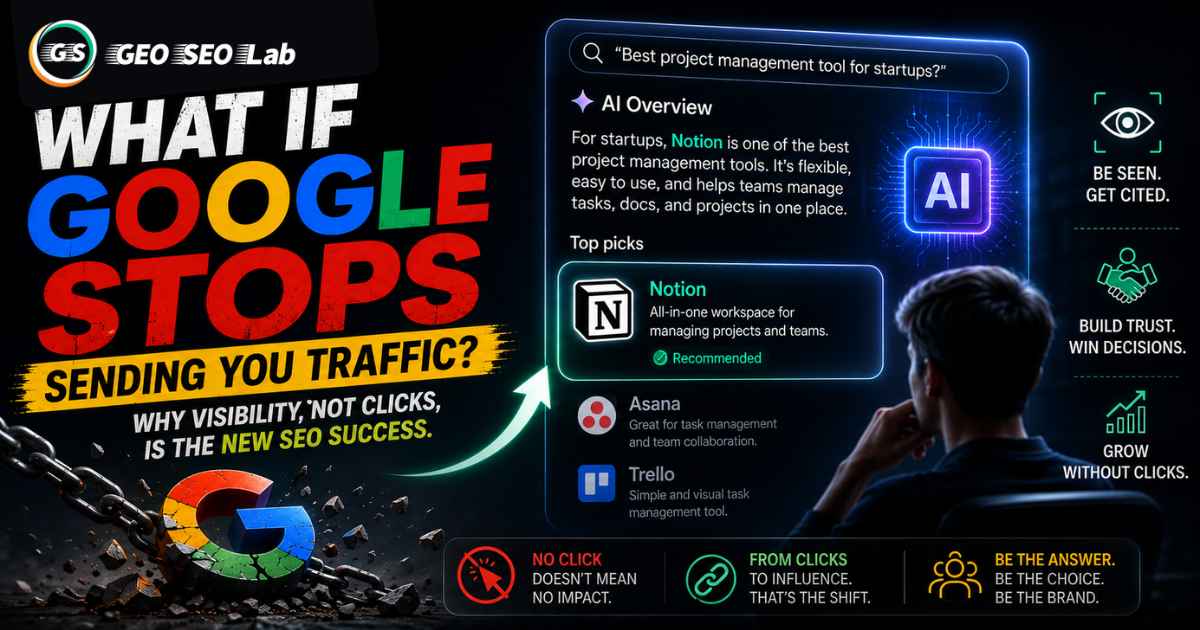
Here's a scenario worth actually thinking through rather than rushing past. Your brand shows up inside an AI generated answer. Your content gets cited by name. A real customer reads that answer, forms a genuine opinion about your product, and makes a decision partly because of what that answer told them.
And they never visit your website. Not once. No session, no pageview, no line in any analytics dashboard anywhere in your organization.
Would you call that a loss?
Most marketing teams, if they're honest, would answer yes without thinking about it much further, because for twenty five years, a visit was the entire point. No click meant no contact, no contact meant no chance at conversion, and no chance at conversion meant the whole exercise failed by definition. That instinct made complete sense in the world that built it. It's starting to make considerably less sense in the world we're actually operating in right now, and this article is about why that instinct deserves a second look before you keep building your entire measurement strategy around it.
Search Is Changing, and Not in a Small Way
For most of the internet's commercial history, the search journey followed one dependable shape. A person had a question, typed it into a box, scanned a list of results, clicked one, and landed on a website built to answer that question and, ideally, turn the visit into something more. Question led to click led to website. That sequence was so consistent for so long that entire industries, entire job titles, entire ways of measuring marketing success got built directly on top of it without much need to question the underlying assumption.
That sequence is no longer the only one happening, and in a growing number of cases, it isn't even the primary one. Increasingly, the shape looks more like this instead. A person asks a question. An AI system answers it directly, drawing on multiple sources, synthesizing them into one coherent response. The person reads that response, and a real decision starts forming right there, sometimes finishing right there too, without ever needing to visit any of the sources that made the answer possible in the first place.
Question leads to answer leads to decision. The click, the thing an entire industry was built to chase, becomes optional rather than mandatory, and for a meaningful and growing share of questions, it doesn't happen at all. This isn't a hypothetical future scenario some analyst is predicting five years out. It's already the lived reality behind a rising share of searches happening across Google's own AI Overviews, AI Mode, and every major standalone AI assistant on the market right now.
Your Website's Job Is Quietly Changing Underneath You
Here's where this gets genuinely interesting instead of just uncomfortable. If the destination isn't always the endpoint anymore, that doesn't mean the website stopped mattering. It means the website's actual job inside the process is shifting into something different, and arguably something considerably more powerful, even when a visit never technically happens.
Think about what a website used to be asked to do, start to finish, in the old model. It had to capture cold, unconvinced attention, build a case from scratch, and close a decision, all in one place, all in one visit, all under real time pressure before that visitor left and possibly never came back.
In the new model, a website increasingly plays a different, earlier, and in some ways more foundational role. It becomes the source an AI system actually reads and trusts. That source becomes evidence the system can point to when constructing an answer. That evidence becomes a citation the system includes directly inside its response. And that citation becomes the recommendation an actual human being reads, weighs, and often acts on, all before any click was ever required to happen at all.
Source leads to evidence leads to citation leads to recommendation. The click can genuinely disappear from that chain entirely, and the website's influence doesn't have to disappear along with it. That's the real, substantive difference between this shift being a threat and this shift being an opportunity, and it depends almost entirely on whether a business understands which one it's actually looking at.
No Click. Now What?
This is the question that actually matters, and it's worth asking directly rather than dancing around it. If someone never visits your website, can they still genuinely know your brand. Can they still trust it. Can they still choose it over a competitor. Can they still turn around and recommend it to someone else, entirely on the strength of what an AI system told them, with no direct experience of your website at all.
The honest answer is yes, and it's worth sitting with how strange that answer would have sounded even five years ago. People form real opinions, make real decisions, and develop real brand preference based on secondhand information constantly, and they've done it for as long as word of mouth and media coverage have existed. What's changed is the specific mechanism doing the telling. It used to be a friend, a review site, a magazine article. Increasingly, it's an AI assistant, synthesizing what dozens of sources say and handing a person a confident, coherent answer they're often inclined to trust precisely because it feels considered and balanced rather than like a sales pitch.
That means the new search challenge isn't really about traffic at all, at least not as the primary target. It's about whether your brand becomes part of the story an AI system tells when someone asks a question in your category. Whether it shows up favorably. Whether it gets described accurately. Whether it earns the kind of confident recommendation that shapes a decision, even when the person making that decision never once opens your homepage.
The New Battlefield Isn't Built Around Clicks Anymore
If the old fight was entirely about earning a click, the new fight is really about earning a place inside someone's understanding before a click was ever necessary in the first place. That's a genuinely different battlefield, with genuinely different terrain, and it's worth naming what winning on it actually looks like.
Being mentioned is the baseline, the minimum bar of simply showing up somewhere inside a relevant AI generated answer at all, rather than being completely absent from the conversation.
Being cited goes a step further, meaning an AI system didn't just mention a brand in passing but actually pointed to specific content as the evidence behind a claim, which signals a meaningfully higher level of trust than a passing mention ever does.
Being recommended is stronger still, the moment an AI system doesn't just describe an option neutrally but actually suggests it as the right answer for a specific situation, the digital equivalent of a knowledgeable friend telling you what they'd personally choose.
Being trusted sits underneath all of that, the accumulated pattern of consistency, accuracy, and credibility that makes an AI system, and the humans reading its answers, willing to keep leaning on a brand's information again and again rather than treating it with suspicion.
And being remembered is the outcome all of the above is actually working toward, the point where a brand becomes the name that comes to mind first, in a category, regardless of which specific platform or search happened to introduce it in the first place.
Mentioned, cited, recommended, trusted, remembered. None of those five things require a click to happen. All five of them can happen entirely inside a conversation a business never directly witnesses, and all five of them can genuinely shape whether that business gets chosen in the end.
Traffic Measures Visits. Visibility Measures Influence.
This is really the whole argument, distilled down to one plain, unavoidable distinction. Traffic tells you how many people showed up. It's always been a useful, honest number, and it's not becoming useless now. But it was never actually the goal in the first place. It was always a proxy, a reasonably reliable stand in for the thing marketing teams actually cared about, which was influence over a real decision.
For most of search's history, traffic and influence were close enough to the same thing that nobody needed to draw a sharp line between them. If you didn't show up in someone's search results, you couldn't influence their decision. If you did show up and they clicked, that click was reasonable proof the influence had at least a chance to happen. The two numbers moved together closely enough that measuring one was a fine way to estimate the other.
That's the exact assumption breaking down right now. It's entirely possible to have real, measurable influence over a decision without ever generating a click, and it's entirely possible to generate a click that produces almost no real influence at all, someone bouncing off a page in three seconds having learned nothing and trusted nothing. The two numbers are quietly coming apart from each other, and a business still treating them as interchangeable is measuring the wrong thing without realizing it's the wrong thing.
Your next report shouldn't stop at how many people clicked. It needs to start asking a genuinely different question alongside it. How often did AI choose us, when it had a real choice to make between us and a competitor.
The Influence Chain Model
Put simply, the chain this article has been describing runs through five connected stages, and it's worth laying them out together as one coherent structure rather than five separate ideas. A business creates something genuinely credible, a source. That source becomes evidence an AI system can point to and trust. That evidence turns into a citation inside a real, generated answer. That citation, if it's strong and consistent enough, becomes an actual recommendation rather than a neutral mention. And that recommendation shapes real influence over a real decision, whether or not a click ever happened anywhere along the way.
Each stage in this chain depends on the one before it holding up honestly. A source that isn't genuinely credible never becomes trusted evidence, no matter how well it's technically optimized. Evidence that isn't specific and well supported rarely gets promoted into an actual citation rather than being quietly skipped over in favor of a stronger source. And a citation that isn't part of a consistent, credible pattern rarely graduates into a confident recommendation, since AI systems, much like careful human readers, tend to reserve their strongest endorsements for sources that have proven reliable across more than one single instance.
Understanding where a business actually sits along this chain, rather than only checking whether traffic numbers moved this month, is the real diagnostic question this entire shift demands.
Why This Reframe Actually Matters for Real Business Decisions
It would be easy to read all of this as an interesting philosophical point that doesn't change much about how a business actually operates day to day. That would be a mistake, because this reframe has genuinely practical consequences once you take it seriously.
Content decisions change once influence, not just traffic, becomes the target. A page built purely to maximize clicks and minimize bounce rate looks different from a page built to become the kind of source an AI system would confidently cite. The second kind tends to be more specific, more honest about tradeoffs, and more thoroughly evidenced, since those are exactly the qualities that earn trust from a system trying to construct a reliable answer, not just from a person trying to decide whether to keep scrolling.
Budget conversations change once leadership accepts that a zero click outcome can still be a win. A marketing team still reporting success purely through session counts and conversion rates is going to systematically undervalue the exact work that's building AI visibility, since a lot of that work's real payoff never shows up as a session at all. Leadership needs a new, honest vocabulary for describing that value, or the budget for building it will keep losing internal arguments to channels that still produce a clean, familiar, countable number.
Team structure changes once visibility becomes a genuinely cross functional goal. Earning a place inside an AI generated recommendation depends on content quality, technical accessibility, entity consistency, and earned third party credibility all working together, which means this isn't a project any single team can own entirely on its own the way a website redesign or a paid search campaign traditionally could.
Competitive strategy changes once you realize a competitor can be quietly winning without ever showing up in your traffic reports. A business watching only its own website analytics has no way of seeing a competitor pulling ahead entirely inside AI generated answers, since that entire battle happens somewhere neither company's own dashboard was ever built to observe.
How to Actually Start Measuring This
Track how often, and how favorably, a business actually gets mentioned across major AI platforms for the real questions its customers ask. This means running the same category of question repeatedly across ChatGPT, Gemini, Perplexity, Claude, and Google's AI powered search experiences, and recording not just whether a brand shows up, but whether it shows up as a passing mention or a genuine, confident recommendation.
Watch branded search and direct traffic trends as a proxy for influence that happened somewhere upstream of any click. Since a meaningful share of AI driven influence eventually shows up as someone searching for a brand by name, or typing a URL directly, rather than clicking straight through from an AI generated answer, these two signals are among the clearest available evidence that invisible influence is actually translating into real, measurable interest.
Build a genuine sourcing and citation habit into content review, not just a keyword checklist. Before publishing, it's worth asking honestly whether a piece of content is actually specific and well evidenced enough that an AI system would have a real reason to point to it directly, rather than simply asking whether it hits a target word count and mentions the right keyword the right number of times.
Treat entity consistency as a measurable input, not a vague, unmeasured aspiration. Auditing how consistently a business is described across its own site, its social presence, directory listings, and press coverage is a concrete, trackable exercise, and it directly affects whether an AI system trusts that business enough to cite it confidently in the first place.
Accept that some of the most valuable work a business does now will never show up as a clean, attributable number, and build reporting that says so honestly rather than pretending otherwise. A report that includes a line explaining, plainly, that a portion of this month's likely influence isn't reflected in the traffic numbers above, is a more honest and ultimately more useful report than one that quietly implies traffic is still the whole story.
The Visibility Without Clicks Framework
For a business trying to actually operationalize this shift, it helps to separate measurement into two honest categories rather than one blended, misleading number. Direct, attributable outcomes are everything a business can trace cleanly back to a specific click, a session, a conversion, exactly the kind of number traditional analytics has always been good at capturing. Indirect, inferred influence is everything that likely happened without leaving a clean trail, AI mentions, AI citations, AI recommendations, branded search growth, and direct traffic that can't be tied to any specific campaign. Neither category should be reported in isolation as if it were the whole picture. A business that only reports the first category is systematically undercounting its own real impact. A business that only reports the second is building a story leadership will rightly be skeptical of, since it can't be verified as cleanly. The honest, useful approach reports both, clearly labeled as what they actually are, and lets leadership see the fuller, more accurate picture that results from holding them side by side.
What This Doesn't Mean
It's worth being clear about what this reframe isn't arguing, because it's easy to overcorrect in the opposite direction once you take the core idea seriously.
This isn't an argument that traffic stopped mattering. It's still a genuinely important, genuinely trackable signal, and plenty of business models still depend directly on visits converting into transactions right there on the website itself. This is an argument that traffic stopped being the only signal worth watching, not that it stopped being a signal worth watching at all.
This also isn't an argument that a business should stop investing in its own website in favor of chasing AI mentions exclusively. The website remains the actual source everything else in the influence chain depends on. A weak, thin, poorly maintained website gives an AI system very little worth citing in the first place, no matter how much a business wants to be recommended. The website's job changed. Its importance didn't shrink.
And this isn't a claim that every zero click outcome is secretly a win in disguise. Plenty of zero click outcomes really are just lost opportunities, especially for business models built entirely around transactions that have to happen directly on a business's own site. The honest, useful version of this argument is narrower and more precise. Some zero click outcomes are genuine losses. Others are real, measurable wins that simply don't look like wins under old measurement habits. Telling the difference, honestly and consistently, is the actual skill this new environment demands.
Closing Thought
The old question was simple, and simple enough that almost nobody thought to question it for two decades. Did they click. The new question is harder to answer cleanly, which is exactly why so many businesses are still avoiding it. Did they come to know us, trust us, choose us, or recommend us, even without ever clicking at all. That's a genuinely harder question to measure, and it demands a genuinely more honest kind of reporting than a simple traffic number ever required. But it's also the more accurate question, the one that actually reflects how a growing share of real decisions are forming right now. A business willing to sit with that discomfort, and build its strategy and its measurement around the harder, truer question rather than the easier, outdated one, is the business that ends up actually understood, actually trusted, and actually chosen, long after the click stopped being the only thing anyone was counting.
None of this requires abandoning what already works. It requires adding a second lens next to the one your team already knows how to use, and being willing to sit with an uncomfortable amount of uncertainty in exchange for a genuinely more complete picture of what your marketing is actually accomplishing. That trade is worth making. The businesses that make it early are the ones building real influence while their competitors are still quietly wondering why a solid looking traffic report never seems to fully explain where their new customers actually came from.
Key Takeaways
- Search is shifting from a reliable question, click, website sequence toward a question, answer, decision sequence, where the click becomes optional rather than mandatory for a growing share of queries.
- A website's role is changing from final destination to source, evidence, citation, and ultimately recommendation, a chain where real influence can happen without a visit ever occurring.
- The new competitive battlefield runs through being mentioned, cited, recommended, trusted, and remembered, none of which strictly require a click to happen.
- Traffic measures visits. Visibility measures influence. The two used to move together closely enough to treat as interchangeable. They no longer do.
- Measuring this properly means tracking direct, attributable outcomes and indirect, inferred influence side by side, honestly labeled as what they actually are, rather than pretending traffic alone still tells the whole story.
About GEO SEO Lab
GEO SEO Lab is a research and strategy group focused on helping businesses understand and improve visibility across AI assisted search and discovery, including Google Search, Google AI Mode, ChatGPT, Gemini, Claude, Perplexity, and the broader ecosystem reshaping how people find, evaluate, and ultimately choose the brands they trust. Our work spans Generative Engine Optimization, AI visibility strategy, entity optimization, and measurement frameworks built to help businesses see the full, honest picture of their influence, not just the part that shows up as a click.
Be found. Build trust. Get recommended.
References and Further Reading
- Google Search Central, documentation on AI features and how AI generated summaries are constructed
- GEO SEO Lab, Google's AI Search Boom, why rankings alone no longer define success
- GEO SEO Lab, The Death of the Landing Page
- GEO SEO Lab, The New Rules of AI Visibility, why rankings alone won't win in 2026
- GEO SEO Lab, The Prompt Gap, why search volume no longer tells you what people are asking
Tags
Frequently Asked Questions
Find answers to common questions about this topic
About the Author

Anubhav
SEO Expert & Content Creator
Experienced digital marketing professional specializing in SEO strategies, content optimization, and data-driven marketing solutions. Passionate about helping businesses grow their online presence and achieve better search rankings.
Related Articles
View all posts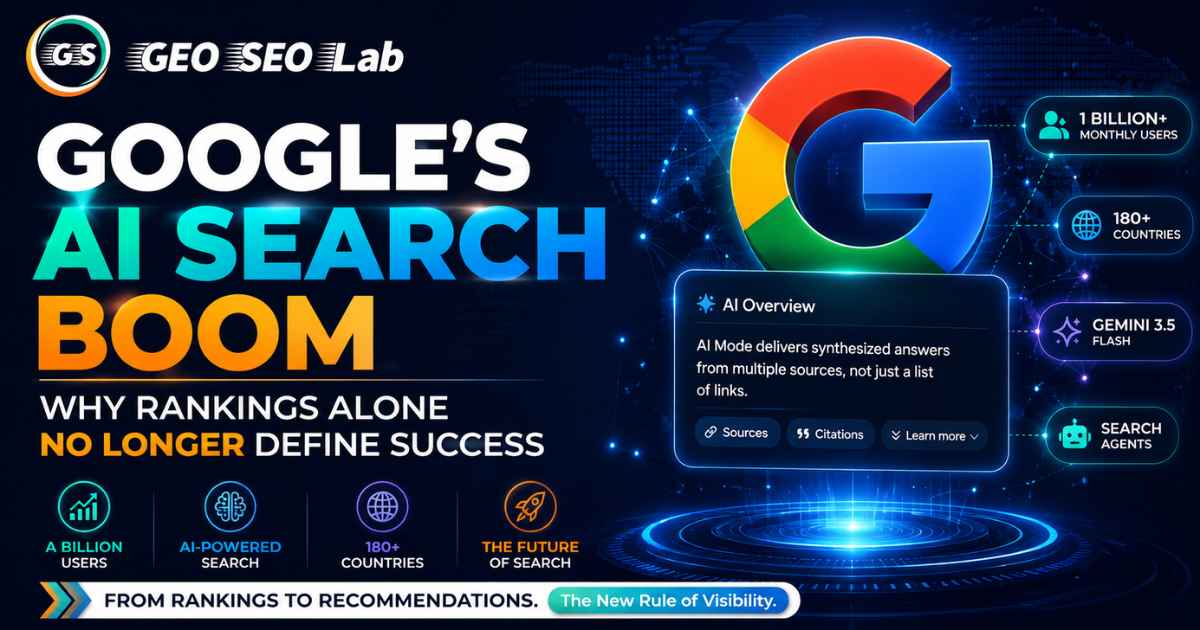
Google's AI Search Boom In 2026: How AI Mode, AI Overviews & Query Fan-Out Are Changing Rankings
Google's AI Search Boom: Why Rankings Alone No Longer Define SuccessCategory: AI Search Analysis & GEO Strategy | Published: July 2026 | Reading Time:...

How to Turn FAQ Content Into GEO Content
How to Turn FAQ Content Into GEO ContentThink about the last time you searched for a complex product or a nuanced troubleshooting step. Did you type a...
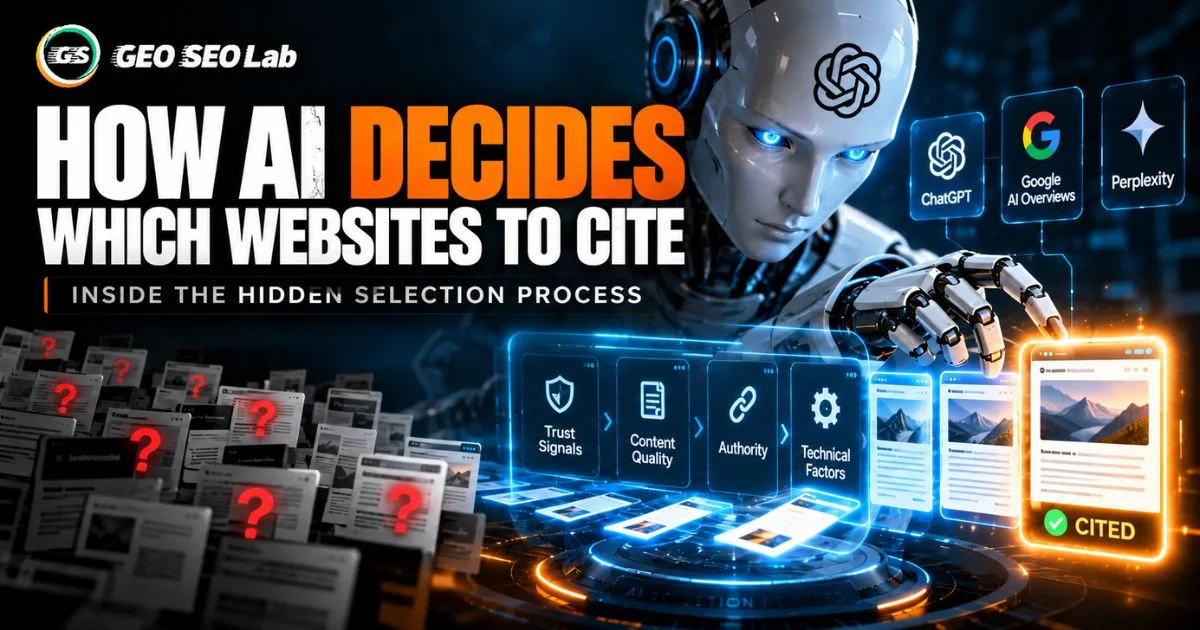
How AI Decides Which Websites to Cite: Inside the Hidden Selection Process
Introduction: The New Gatekeepers of VisibilityPicture this. Someone types a question into ChatGPT, Perplexity, or Google's AI Overview box. Within se...