Google's AI Search Boom In 2026: How AI Mode, AI Overviews & Query Fan-Out Are Changing Rankings
Google's AI Search Boom: Why Rankings Alone No Longer Define SuccessCategory: AI Search Analysis & GEO Strategy | Published: July 2026 | Reading Time:...
A Billion Users Later, the Old Scoreboard Doesn't Work Anymore
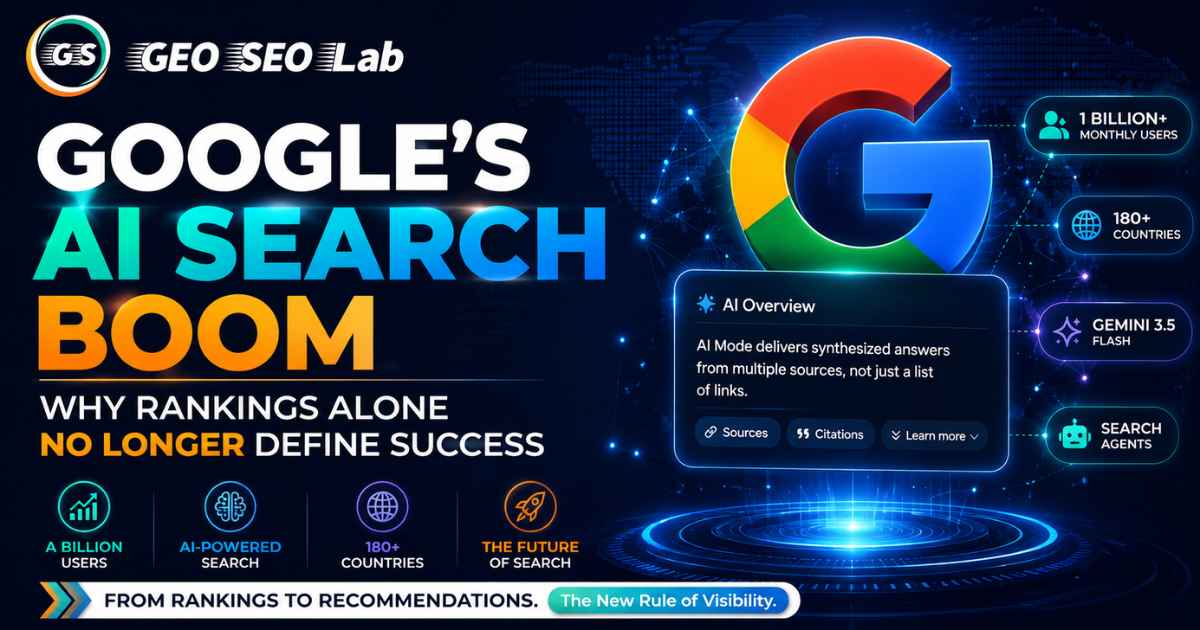
Google AI Mode crossed a billion monthly active users within roughly a year of becoming available to everyone in the US — one of the fastest adoption curves of any product Google has ever shipped, with query volume reportedly doubling every quarter since. That's not a modest feature rollout. That's a genuine change in how a meaningful share of the world now searches, and it happened faster than most of the SEO industry expected it to.
The uncomfortable part for a lot of businesses is that their scoreboard hasn't caught up. Rank tracking tools still report position one, position two, position three, as though the only thing that mattered was where a page sits on a results page that fewer people are scrolling through in the traditional way. Meanwhile, a growing share of queries never produce a ranked list at all — they produce one synthesised answer, built from whichever sources Google's systems decided were worth pulling from, with a citation trail that has very little to do with classic ranking position.
This piece looks at what's actually driving Google's AI search boom, why the businesses still measuring success purely by rank are working from an incomplete picture, and what a genuinely current definition of "winning" in Google's ecosystem actually requires.
How Does Google AI Search Work?
The adoption curve is real, not hype. AI Mode started quietly in Search Labs in March 2025, reached every US user by May 2025 with no signup required, expanded to more than 180 countries by the end of that year, and crossed a billion monthly users by Google I/O 2026. That's a genuinely unusual growth rate for a change this fundamental to how a core product works, and it signals that Google isn't treating this as an experimental side feature. It's becoming the default lens a growing share of users reach for first, and Google has been explicit that it expects that share to keep climbing rather than plateau.
The underlying mechanism is query fan-out. Rather than running one search per question, AI Mode breaks a query into several sub-questions — definitions, comparisons, counterpoints, examples — and runs parallel searches across all of them before synthesizing one response. A single question from a user can quietly trigger a dozen background searches nobody sees, and a business's content either gets pulled in as a source for one of those sub-queries or it simply isn't part of the conversation at all. This is the mechanical reason ranking position and AI visibility have started to diverge: a page that ranks well for the exact keyword someone typed can still get skipped if it doesn't happen to answer the specific sub-question the system generated internally.
The response itself is generated fresh, not lifted from one page. What a user actually sees isn't a copy of any single source — it's synthesized from whatever combination of retrieved material made the cut, sometimes assembled into what Google calls Generative UI for more complex questions: a custom, interactive layout built on the spot for that specific query rather than a static template. For comparison or planning questions in particular, this means the format of the answer itself is being decided dynamically, which raises the bar for what kind of content is actually useful raw material for that process.
Personalization and agentic features are compounding the shift. Newer versions of AI Mode increasingly draw on a user's own search history and account activity to personalize responses (what Google calls Personal Intelligence), and background "Search agents" are beginning to monitor prices, track availability, and handle multi-step tasks without a fresh search each time. That means winning a single query is becoming less important than being the option an ongoing, semi-autonomous process keeps returning to over time — a genuinely different kind of competition than ranking for a keyword.
Google is also folding richer real-time and multimodal signals directly into AI-generated answers — Top Stories integration for fast-moving topics, image and voice input through features like Search Live, and increasingly interactive, custom-built response layouts for complex questions. Each of these expands the range of queries where a synthesized answer, rather than a page of links, is the thing a user actually sees first.
Put together, none of this is a minor product update. It's Google reshaping what "search" produces as an output — from a list of options to a single, confident, synthesized answer — and that reshaping is what's actually driving the boom in adoption.
Does Ranking #1 Still Matter in Google AI Search?
Ranking remains important because AI Mode and AI Overviews are grounded in Google Search, but a high organic position does not guarantee that a page will be used as a supporting source for every AI-generated answer. A page still needs to be indexed, technically accessible, and relevant enough to be considered at all — nothing about AI Mode removes that requirement. But clearing that bar no longer guarantees inclusion in the answer itself. Because AI Mode runs parallel searches across sub-questions rather than serving the single top-ranked page for the literal query typed, a page can rank first for an exact keyword match and still get left out of the synthesized answer if a competitor's content more completely covers the specific angle the system generated internally.
A concrete illustration makes this easier to see. Picture two SaaS companies competing for the same head-term keyword, both sitting on page one of a traditional results page. Company A's page is tightly optimized around that exact phrase, loads fast, and has a solid backlink profile. Company B's page covers the same core topic but also explicitly addresses the follow-up questions a buyer would naturally ask next — implementation timeline, pricing tiers, common integration issues — each as its own clearly labeled section. Ask Google AI Mode a genuinely comparative question in that category, and Company B's content is considerably more likely to get pulled into the synthesized answer, precisely because query fan-out is looking for material that answers those specific sub-questions, not just the head-term keyword both companies optimized for equally well. Both pages would look roughly tied on a classic SEO audit. Only one of them is actually built for how the answer gets assembled today.
The page is no longer always the full unit of competition. Classic SEO optimizes one page to win one query. AI Mode often assembles its answer from fragments pulled across several different sources rather than handing the whole response to a single winning page. A business can produce excellent, well-optimized content and still not "win" a query outright — it might end up as one of several sources blended into a single answer, sitting right alongside competitors rather than beating them outright on a results page.
Being accurate and complete is starting to outweigh being technically optimized. Rankings have historically rewarded signals that could be engineered somewhat independently of whether a page was genuinely the best available answer — keyword placement, backlink volume, site structure. AI Mode's synthesis step leans harder on whether a source is accurate, well-sourced, and genuinely useful, because a misleading or incomplete citation shows up immediately inside an answer someone is reading right now — not buried on a results page most users never scroll to.
A lot of the resulting traffic effect is currently invisible to standard analytics. When someone gets a favorable recommendation inside an AI-generated answer, they often don't click straight through — they go search for the brand by name afterward, which shows up in analytics looking exactly like an ordinary branded search with no trace of the AI conversation that actually triggered it. A business watching only its click-through rate and rank tracker is very likely missing a meaningful share of how its own visibility is actually changing right now.
None of this means rank position became irrelevant. It means rank position answers a narrower question than it used to — "can we be found" rather than "will we be the answer" — and businesses that keep treating the two as the same thing are optimizing for a metric that no longer captures the outcome that actually matters.
What Determines Google AI Search Visibility?
If rank alone doesn't define success, the honest follow-up question is: what does? A few dimensions are proving to matter consistently, across the growing body of evidence coming out of this shift.
Being selected as a trusted source for the specific sub-questions inside a topic, not just the headline keyword. Since AI Mode is fundamentally breaking questions apart before answering them, content that comprehensively covers the real follow-up questions a curious person would actually have — not just the single phrase a keyword brief was built around — has a structural advantage in getting pulled into the synthesis step at all. A page on "CRM pricing" that skips the obvious next questions — implementation costs, contract terms, hidden fees — leaves exactly the kind of gap a more complete competitor page can fill instead.
Being consistently and accurately represented as an entity everywhere online, not just optimized on-page. AI systems are increasingly trying to evaluate the credibility of the organization behind a page, not just the page's content in isolation — pulling in signals from a Business Profile, LinkedIn, press coverage, and review platforms alongside the page itself. A business whose identity is described consistently and specifically everywhere it appears gives these systems considerably more confidence to cite it than one with a fragmented, inconsistent presence. A company describing itself one way on its own site and differently on LinkedIn or in a directory listing is creating exactly the kind of ambiguity that makes a system hesitant to cite it confidently on anything specific.
Contributing something genuinely original, rather than repeating what's already thoroughly covered. In a dense information environment where hundreds of pages already say roughly the same thing about a popular topic, a source that adds something new — original data, a documented case study, a distinctive framework — has real scarcity value that a system doing synthesis has genuine reason to draw on specifically. The fifteenth article covering ground fourteen others have already covered thoroughly adds essentially nothing to that environment, no matter how well it's optimized.
Being recommended, not just mentioned. There's a meaningful difference between a brand name appearing once in a longer answer and a system actually recommending a business as the answer to a specific question. Recent independent research tracking this distinction found that brands genuinely recommended by an AI assistant were considerably more likely to receive a website visit within the following week than a competitor that wasn't recommended at all — real evidence that a favorable AI citation converts into measurable downstream business outcomes, not just visibility for its own sake. That same research found a meaningful share of the resulting traffic showed up disguised as ordinary branded search rather than a direct click, reinforcing just how much of this effect is currently sitting outside standard attribution models.
Showing up reliably across repeated queries, not just once. AI-generated answers vary by phrasing, by session, and even across repeated runs of an identical question. A single favorable test result tells a business very little on its own — genuine success looks like consistent representation across many query variations, tracked systematically over weeks rather than checked once and reported as a finished result. A business that tests one query, sees a favorable mention, and stops testing is drawing a conclusion from exactly the kind of single data point that this environment's natural variability makes unreliable.
The GEO SEO Lab Ranking-to-Recommendation Framework
Put simply, the shift this section describes runs:
Discovered → Ranked → Retrieved → Cited → Recommended → Visited → Converted
Classic SEO optimized almost entirely for the first two stages. Businesses serious about AI-era visibility now need a deliberate strategy for every stage after that — because a page can clear the first two hurdles cleanly and still fail to reach the outcome that actually drives business results.
Each stage in this chain depends on getting the one before it right, but success at an earlier stage doesn't guarantee success at the next one — which is exactly why so many businesses with strong traditional rankings are surprised to find themselves absent from AI-generated answers. A page can be found and ranked without ever being retrieved for the specific sub-questions AI Mode generates internally. It can be retrieved without being selected for synthesis, if a competitor's material more completely covers the angle in question. It can be synthesized into an answer as one of several sources without ever being the one actually recommended. And it can be recommended without the resulting visit turning into the kind of branded search or return visit that signals a business was genuinely remembered rather than briefly noticed. Treating this as one continuous funnel, rather than assuming a strong showing at the first stage carries through automatically, is the practical mindset shift this whole moment actually requires.
How to Optimize for Google AI Search in 2026
Keep the technical and content fundamentals solid — they're the floor, not the whole building. Fast, well-structured, accessible pages with genuinely helpful content remain the prerequisite for everything else. Nothing about this shift makes that work less important; if anything, the bar has risen, since whatever's competing for inclusion in a synthesized answer is drawn from the full pool of well-indexed content across every domain, not just one business's own site. A business that lets crawlability or page speed slide while chasing AI-specific tactics is undermining the very foundation those tactics depend on.
Invest specifically in the questions people ask after the first one. Since AI Mode is functionally decomposing questions into sub-questions before answering, comprehensive coverage of the natural follow-ups — cost, implementation, edge cases, comparisons — matters more than optimizing narrowly around a single head-term keyword. A useful internal exercise: map out how a genuinely thorough conversation about a core topic would actually unfold, question by question, and check whether existing content covers that whole trajectory or just the single most-searched entry point.
Audit entity consistency across every place a business shows up online. Business Profile, LinkedIn, directory listings, press mentions — description, credentials, and positioning should tell the same story everywhere, since inconsistency creates exactly the kind of ambiguity that makes an AI system less confident recommending a business as an authority on anything specific. This is worth treating as a recurring audit rather than a one-time cleanup, since profiles drift out of sync naturally as a business evolves, adds services, or rebrands parts of its offering.
Prioritize original knowledge over additional volume. A business's content investment should be judged against a real question: does this add something a curious reader — or a synthesizing AI system — couldn't already find just as easily from ten other sources covering the same ground. Three genuinely original, well-researched pieces published in a quarter build more durable AI visibility than fifty derivative articles restating what every competitor already says.
Build practitioner visibility into the strategy, not just company-level content. A named specialist who consistently publishes useful, identifiable expertise under their own byline reads as a stronger credibility signal — to both human readers and synthesizing AI systems — than anonymous corporate copy. This is a relatively underused lever for a lot of businesses, and one that compounds over time as a specific person's public track record builds up.
Start testing AI visibility as an ongoing practice, not a one-time check. Running the same category of question across multiple phrasings and multiple sessions, tracked over weeks rather than checked once, is the only way to get a signal that actually reflects how a business is showing up rather than a single noisy data point. Testing across several of the major AI platforms rather than just Google's own AI Mode is worth building into this practice too, since the underlying retrieval systems differ enough that a favorable result on one doesn't reliably predict the same on another.
Track branded search and direct traffic trends alongside click-through rate. Since a meaningful share of AI-driven visibility shows up disguised as ordinary branded search rather than a direct AI-platform referral, a rise in branded search that doesn't correspond to a traditional marketing push is a reasonable signal worth investigating rather than dismissing as unexplained. The same logic applies in reverse — a branded search plateau alongside declining rank tracker performance might be an early warning sign worth chasing down rather than a random blip.
Closing Thought
Google didn't quietly retire the ranking system — it built something bigger on top of it. Rank position is still the entry ticket, but it's no longer the show. The businesses that will actually benefit from Google's AI search boom are the ones treating this as an expansion of what "winning" requires, not a threat to be defended against with the same old playbook. Rankings get you considered. Being genuinely, consistently useful — and recognizably, consistently you, everywhere an AI system might look — is what actually gets you recommended.
Key Takeaways
- Google AI Mode crossed a billion monthly users within roughly a year of general availability, powered by query fan-out — a mechanism that breaks questions into sub-queries and synthesizes an answer from multiple sources rather than serving a single ranked page.
- Ranking well remains a prerequisite for AI visibility, but it no longer guarantees inclusion in a synthesized answer, since a page can rank first for a keyword and still miss the specific sub-question the system generated internally.
- A meaningful share of AI-driven traffic currently shows up disguised as ordinary branded search, meaning standard analytics likely understate how much AI visibility already affects a business's numbers.
- Success now depends on entity consistency, original knowledge, comprehensive coverage of real follow-up questions, and being recommended rather than merely mentioned.
- AI visibility needs to be tested systematically and repeatedly over time, not checked once — a single favorable query result is not a reliable signal on its own.
About GEO SEO Lab
GEO SEO Lab is a research and strategy group focused on helping businesses understand and improve visibility across AI-assisted search and discovery — Google Search, Google AI Mode, ChatGPT, Gemini, Claude, Perplexity, and the broader ecosystem reshaping how people find and evaluate information. Our work spans Generative Engine Optimization, AI visibility strategy, entity optimization, and measurement frameworks built to connect real AI visibility to real business outcomes.
Tags
Frequently Asked Questions
Find answers to common questions about this topic
About the Author

Anubhav
SEO Expert & Content Creator
Experienced digital marketing professional specializing in SEO strategies, content optimization, and data-driven marketing solutions. Passionate about helping businesses grow their online presence and achieve better search rankings.
Related Articles
View all posts
What If Google Stops Sending You Traffic?
Here's a scenario worth actually thinking through rather than rushing past. Your brand shows up inside an AI-generated answer. Your content gets cited...

How to Turn FAQ Content Into GEO Content
How to Turn FAQ Content Into GEO ContentThink about the last time you searched for a complex product or a nuanced troubleshooting step. Did you type a...

How AI Decides Which Websites to Cite: Inside the Hidden Selection Process
Introduction: The New Gatekeepers of VisibilityPicture this. Someone types a question into ChatGPT, Perplexity, or Google's AI Overview box. Within se...