Which Platform Reaches the Right Audience? Why the Context Matters More Than the Logo
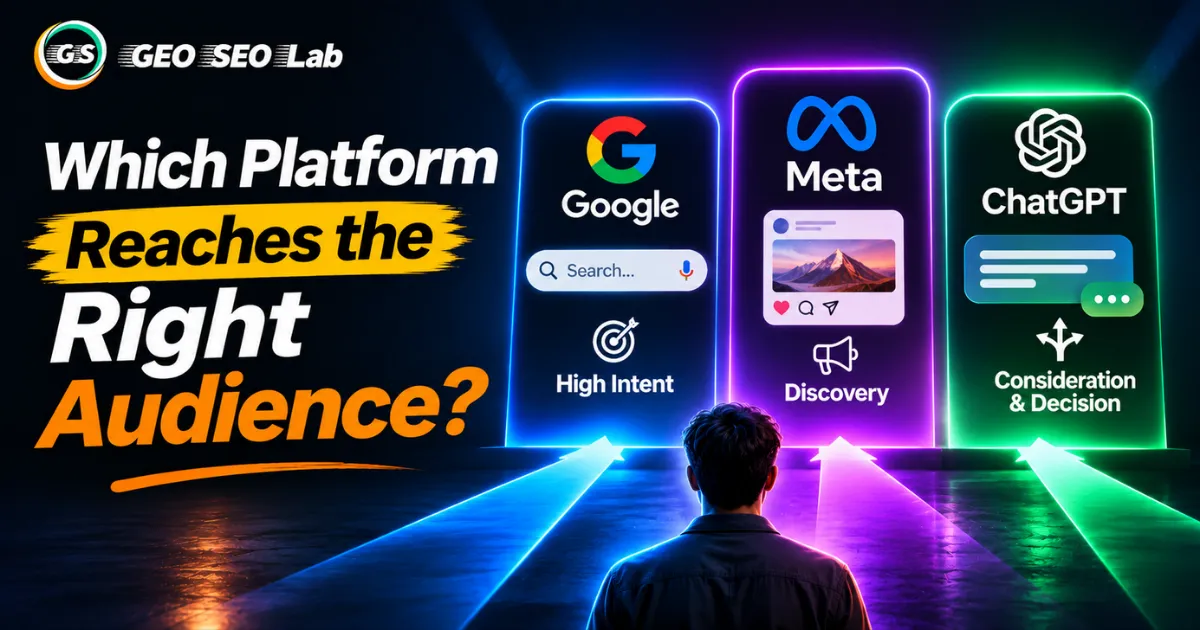
Which Platform Reaches the Right Audience? Why the Context Matters More Than the Logo. Google, Meta, and ChatGPT ads compared by what people are doing when your brand appears,
Introduction
Every few months, someone in a marketing meeting asks the same question: should we be on Google, Meta, or ChatGPT? The question usually comes wrapped in a pile of metrics. Cost per click on one platform, cost per thousand impressions on another, a case study from a conference about a third. Everyone wants a verdict.
The trouble is that the verdict depends on a question most teams skip. Before you ask which platform is cheapest or biggest, ask what the person is doing at the moment your ad appears. Are they hunting for a solution they already know they need? Are they scrolling with no particular goal and happen to run into something interesting? Are they thinking through a decision, comparing options, and asking for guidance?
Those three states produce very different audiences, even when the people involved might be the same individuals on different days. A parent might search for a pediatric dentist on Google on Tuesday, watch a short video about a new snack brand on Instagram on Wednesday, and ask an AI assistant to help plan a family budget on Thursday. The same person, three different mindsets, three different doors into the same brand.
This article is about those doors. We'll look at what each platform's context tends to produce, where each one is strongest and weakest for reaching the right people, and how to match your message and goals to the context you're entering. We'll also give you a practical way to check whether your current platform mix is reaching the audience you actually want, or just the audience that's easiest to measure.
Let's start with why context matters more than the platform name suggests.
Why Context Matters More Than the Platform Name
Advertisers often talk about platforms as if they were audiences. "We need to be on Meta because our customers are there." "Our buyers use Google." That shorthand is convenient, but it hides the real variable, which is the state of mind people bring to the screen.
Think about how you use a search engine compared with how you use a social feed. When you search, you've already decided you want something. You typed a specific phrase because you're trying to solve a problem, answer a question, or find a particular thing. Your attention is directed and your patience for irrelevant material is low. When you scroll a social feed, you're usually there for entertainment, connection, or a loose sense of what's new. Your attention is wandering, and an ad has to earn its place in the flow.
ChatGPT introduces a third state. People using a conversational AI are often working through something: planning a trip, weighing two software tools, drafting a business plan, or trying to make sense of a medical symptom they don't fully understand. The interaction is sustained and reflective. Users tend to ask follow-up questions, refine their requirements, and look for guidance rather than a list of links.
Google's own research on consumer behavior, which it has promoted for years under labels like "micro-moments" and the "zero moment of truth," points in a similar direction. People increasingly make decisions in small, intent-driven moments across devices, and those moments are shaped by what they're trying to do right then. The insight isn't that one platform wins. It's that brands should show up with the right message at the right moment of intent.
This is why a single creative asset rarely works equally well everywhere. An ad that wins a click from someone actively searching for a solution may look out of place in a feed, where the same viewer wanted to be entertained. A video that stops someone mid-scroll may do nothing for a person comparing three vendors in a chat window. The platform sets the expectations, and the expectations shape what success looks like.
So when we say the key difference between these three platforms is why the user is there, we mean something specific. It's the reason the user opened the app, typed the query, or started the conversation. Everything else in your strategy, from budget to creative to measurement, should follow from that reason.
Google: Capturing Demand That Already Exists
Google is the platform most advertisers understand best, and for good reason. Search has been one of the most reliable ways for businesses to reach people with a clear need for decades. Someone types "emergency plumber near me" or "best accounting software for freelancers" and reveals, in a few words, exactly what they're hoping to accomplish.
That explicit signal is Google's great strength. The query tells you something about intent that few other channels can match. A person searching for a specific product, service, or answer has already done the hard work of identifying their need. Your job is to be present, relevant, and convincing at the moment they're looking.
Google Ads supports several campaign types that serve this demand. Search campaigns place text ads alongside organic results when someone enters a query you've chosen to target. Shopping campaigns show product listings with images and prices for ecommerce businesses. Performance Max campaigns use automation to serve ads across Google's properties, including Search, YouTube, Display, Gmail, and Discover, based on the goals and assets you provide. Documentation from Google describes these campaign types and their targeting options, and it's worth reading the current version before you launch, since features evolve.
The audience Google reaches is often closest to a decision. Someone searching for a specific service or comparing vendors is typically further along than someone scrolling a feed. That doesn't mean every search is a buyer. Plenty of people search for information, research, or curiosity. But the proportion of commercially motivated searches is high, and the intent behind them is easier to read than the intent behind almost any other ad placement.
There are real limits, though. Google reaches people who already know, roughly, what they're looking for. If nobody has ever heard of your category, or if people don't yet realize they have a problem worth solving, search volume may be thin or nonexistent. A new product in a crowded market may find that its keywords are expensive because competitors have already claimed the commercial terms. And people searching for a solution aren't always looking for a new brand. Some want the one they already trust, and some are simply comparing prices.
Google also reaches people at very different stages. A query like "what is a credit score" sits at the top of the funnel, while "lowest price for brand name standing desk with free shipping" sits at the bottom. Both are valuable, but they require different messages and expectations. Advertisers who treat all search traffic as equally ready to buy often overspend on broad terms and underinvest in the queries that actually convert.
A useful way to think about Google is as a channel for demand capture. It's strongest when you want to meet people who have already begun looking, and when your offer can answer a specific question clearly and quickly.
Meta: Creating Demand People Didn't Know They Had
Meta's family of apps, which includes Facebook and Instagram, works in a fundamentally different way. People don't usually open these apps to find a product. They open them to see what friends are doing, watch videos, catch up on news, or pass time. Advertising that appears in these feeds has to fit into that experience, or it gets ignored.
That context creates an opportunity that search can't offer. Meta can reach people before they've articulated any need at all. A well-made video from a skincare brand might catch the attention of someone who never thought about their routine until that moment. A product demonstration might spark curiosity in someone who didn't know a solution existed. This is demand creation: planting an idea or a preference that may grow into a purchase later, sometimes much later.
Meta's advertising tools are built around this discovery role. Its audience targeting uses information about people's interests, behaviors, demographics, and the activity on its platforms, and advertisers can also use custom audiences built from their own customer lists or website visitors, as well as lookalike audiences modeled on existing customers. Meta's Advantage+ products use automation to help find people likely to respond to a campaign's goal. Current targeting options and the rules around them are documented in Meta's Business Help Center, and those rules have changed over time, particularly around sensitive categories and data use, so check them before you plan a campaign.
The audience Meta reaches tends to be broader and less immediately ready to buy. That's not a flaw. It's the nature of the context. Someone watching a short video is open to surprise and inspiration but isn't actively shopping. This is why Meta often looks expensive when you judge it by direct conversions alone. The people who saw your ad may buy next week after a search, or the following month when a related need comes up, and a last-click report won't show that path clearly.
Meta's strength is the ability to build awareness and interest at scale, reaching large numbers of people who fit a profile you care about. Its weakness, for many advertisers, is that it can be hard to convince an unaware audience to act right away. Creative quality matters enormously here, because the ad has to earn attention in a few seconds. Messages that feel like an interruption rarely work as well as content that feels native to the feed, entertaining, useful, or socially relevant.
Meta also works well as a retargeting environment. People who have visited your site or engaged with your content can be shown more specific messages designed to move them forward. In that sense, Meta can support the whole funnel, though it tends to shine most at the top and middle.
The clearest way to describe Meta is as a channel for demand creation. It's strongest when you want to introduce your brand, shape preferences, and reach people who weren't already looking.
ChatGPT: Entering the Conversation Before the Decision
Advertising in ChatGPT is the newest of the three, and it's the one most advertisers are still learning to read. OpenAI has publicly described advertising in ChatGPT as a way to support access to the service, and it has announced that ads are being tested and expanded in several markets. According to its public materials, ads are labeled, kept distinct from the organic answers, and governed by policies about where and how they can appear. OpenAI's Help Center describes available formats, including impression-based and click-based options, and conversion measurement capabilities. Because this area is changing quickly, we'd encourage you to read the current OpenAI announcements and Help Center articles directly before you plan spend.
The more interesting question is what kind of audience context a conversational interface creates. People use ChatGPT for an enormous range of tasks, from writing and coding to planning and learning. Within that range, a large share of conversations involve questions that lead toward a choice: which laptop fits my budget, what should I consider when hiring a designer, how do I compare two accounting packages. These are moments of evaluation, and the person is actively trying to reduce uncertainty.
That's a distinctive mindset. Compared with a search, a conversation is more exploratory. Users often describe their situation in detail, provide constraints, and ask follow-up questions. The interaction builds context over time, which means the system has a richer picture of what the person needs than a single keyword provides. Compared with a social feed, the user is not passively scrolling. They've asked for help and are reading carefully.
For advertisers, this suggests a particular kind of opportunity. A relevant, clearly labeled recommendation that appears during a comparison or planning conversation can speak to someone who is actively weighing options. The message should respect the flow of the conversation. A pushy or generic pitch is likely to feel out of place, both to the user and to the platform's standards. An ad that clearly helps someone make a decision, with a concrete benefit and honest framing, is more likely to be welcome.
This also means that ChatGPT's audience may be closer to a decision than a social feed audience but may be less certain than someone who has already typed a precise commercial query into a search engine. The person is in the middle of thinking things through. They haven't necessarily chosen a vendor yet. They may be open to a new option, provided it fits their stated needs.
There are open questions here, and it's worth being honest about them. The ad formats, targeting controls, and measurement options available in ChatGPT are still developing. Advertisers will need to learn how relevance is determined, how placements are labeled and presented, and how reliable the conversion data will be compared with mature platforms. It's also unclear how user trust will evolve if conversational environments become crowded with commercial messages. Early advertisers should treat results as provisional and build in conservative test budgets.
The best way to describe ChatGPT's context is as a channel for decision assistance. It's strongest when your offer can genuinely help someone compare, evaluate, or plan, and when the message respects the user's need for clear, trustworthy information.
The Mindset Context Matrix
With the three contexts described, it helps to have a simple way to compare them side by side. We built the Mindset Context Matrix to do exactly that. It looks at three questions for each platform: what the user is trying to do, how much attention they're giving the screen, and how open they are to a brand they didn't already know.
Google Search typically involves a user who is goal-directed and has a specific question or need. Attention is focused, and openness to new brands depends heavily on the query. Someone searching for a brand name is likely looking for that brand. Someone searching for a generic solution may be open to options they haven't seen before, but they're also comparing you against competitors on the same results page.
Meta feeds typically involve a user who is browsing for entertainment, connection, or inspiration. Attention is divided and tends to be brief. Openness to new brands can be high, but only if the content earns its place quickly. Users are unlikely to tolerate an ad that feels like an obvious sales pitch in the first two seconds.
ChatGPT conversations typically involve a user who is working through a problem or decision. Attention is sustained within the conversation, and the user is actively seeking input. Openness to new options can be high if the recommendation is relevant to their stated situation, but skepticism may also be elevated, since the user is trying to make a sound choice.
Reading the matrix this way clarifies a common mistake. Advertisers often run the same offer with the same message across all three platforms and then wonder why results differ. The offer may be perfectly sound. The mindset is what changed.
The matrix also helps you spot a mismatch between your goals and your channel. If you need immediate sales for a product that people rarely research, Meta's discovery context may frustrate you. If you need to build awareness for a new category, a search-only strategy may leave most of your potential audience invisible. Using the matrix to ask "what is this person doing right now?" before choosing a channel is one of the simplest and most useful habits in platform planning.
The Audience Readiness Ladder
Mindset tells you what the user is doing. Readiness tells you how close they are to acting. We use a four-step model called the Audience Readiness Ladder to describe where people sit in their journey, and we find it useful for matching platforms to goals.
Unaware. The person doesn't yet recognize a problem worth solving, or doesn't know that solutions exist. Their needs are latent. Meta's discovery environment tends to do the most useful work at this step, since it can introduce ideas, demonstrate products, and spark curiosity. Search is weak here, because people can't search for something they've never heard of, unless they're searching for a broader problem your product happens to solve.
Aware. The person knows they have a problem or interest and is beginning to explore. They might be reading articles, watching videos, or asking general questions. Search does well at this step when queries are informational, and Meta can keep building interest through content. ChatGPT is also relevant here, since users often ask broad questions to understand a topic before narrowing down.
Considering. The person has a shortlist or a clear set of criteria and is comparing options. This is where ChatGPT's conversational context is especially interesting, because users often ask for comparisons, pros and cons, and recommendations. Google also performs strongly, since comparison queries and brand-versus-brand searches are common at this stage. Meta can help through retargeting and reinforcement, showing proof points to people who've already engaged.
Deciding. The person is ready to act and is choosing a vendor, product, or provider. Search is typically strongest here, especially for transactional and local queries where someone wants to buy, book, or call immediately. Retargeting on Meta can also help close the gap for people who have visited a site but haven't converted, and ChatGPT may be useful when a user asks for a final recommendation that fits their constraints.
The ladder shows why a single platform rarely covers the whole journey. A brand that relies only on search may capture people who are already deciding but miss the much larger group still in the unaware and aware stages. A brand that relies only on social discovery may build plenty of interest but struggle to convert it without support at the decision point. Mapping your audience to the ladder helps you allocate effort to the platforms that fit each stage, rather than treating all budget as interchangeable.
It's worth being realistic about how people move through these stages. Not everyone climbs the ladder in order. Some people jump from unaware to deciding after a single strong recommendation. Others circle between aware and considering for months. The ladder is a planning aid, not a rigid sequence, and your own customer data will show you which patterns are most common in your business.
The Platform Role Map
With the matrix and the ladder in hand, we can summarize each platform's role in a way that's easy to remember. We call this the Platform Role Map.
Google's role is demand capture. It meets people who are already looking, and it's best used to convert search intent into visits, calls, purchases, or leads. It works well when you have a clear offer and when your category has meaningful search volume.
Meta's role is demand creation. It introduces people to brands, products, and ideas they weren't actively seeking, and it builds the familiarity and preference that can make later decisions easier. It works well when you have a visual or emotionally engaging story and when your audience is broad enough to justify reaching them at scale.
ChatGPT's role, based on what's currently known about the context, is decision assistance. It enters the conversation when people are evaluating options, and it's best used when your offer can genuinely help someone choose. It works well when your product or service has clear comparison points, specific use cases, or constraints that a thoughtful recommendation can address.
These roles aren't permanent, and they aren't exclusive. Search can create demand, as when a well-targeted informational campaign builds interest. Meta can drive direct sales, especially for products that suit impulse decisions. ChatGPT may end up supporting awareness as well as evaluation. But thinking about each platform's primary role gives you a starting point for allocation, and it keeps you from judging a discovery channel by the standards of a capture channel.
The role framing also helps with internal conversations. When a stakeholder asks why Meta isn't converting as efficiently as search, you can explain that the two channels are doing different jobs, and that the right comparison is how each one contributes across the journey, not which one looks better in a single report.
Matching Your Message to the Context
Even the right platform can fail if the message doesn't fit the context. This is one of the most common and most fixable problems in cross-platform advertising, and it's worth working through with an example.
Imagine a company that sells a home water filtration system. The product is the same across all three platforms, and so is the core benefit: cleaner, better-tasting water from the tap. But the message needs to change depending on what the viewer is doing.
On Google, someone searching for "best water filter for well water" has a specific problem and a clear intent. The ad should speak directly to that need. It might name the contaminant the person is worried about, explain how the system addresses it, and point to a relevant landing page with testing information. The headline should answer the query, not tell a general brand story.
On Meta, a person scrolling their feed hasn't asked about water filters. The creative has to earn attention first. A short video showing a family's kitchen routine, or a before-and-after taste comparison presented as a quick, honest experiment, might work better. The message can introduce the benefit gently, with the expectation that the viewer may return to the brand later when the topic becomes relevant.
On ChatGPT, a user who is asking for help choosing between filtration types has already described their situation. The recommendation should reflect that situation. If they mentioned a rental apartment, a recommendation that requires installation may be a poor fit. If they mentioned a family with young children, the response should address the constraints they care about. The message should be clearly labeled, relevant to the question, and free of exaggerated promises.
Notice that the product didn't change. What changed was the job the message had to do in each context. Search needed relevance. Meta needed attention and interest. ChatGPT needed fit and trust.
Creative and messaging guidelines should reflect this. Teams that build one universal ad and push it everywhere tend to get middling results. Teams that create a small set of context-specific variations, each built around the mindset and readiness of its audience, tend to learn faster and waste less money.
The Context Fit Test
Once you've chosen platforms and written messages for each context, it's worth checking whether your plan really fits. We built a short diagnostic called the Context Fit Test to help. It asks five questions about each platform you're considering.
What is the user doing when this ad appears? Describe the mindset in plain language. If you can't do it in a sentence, your planning may be too vague.
What do they need from the ad in the first few seconds? A search user may need relevance. A feed user may need interest. A conversation user may need a clear reason to trust the recommendation.
Where do they sit on the readiness ladder? Be honest. Many brands assume their audience is ready to buy when it's actually still learning about the category.
Does the offer match that readiness level? A high-commitment offer, like a large purchase or a long-term contract, may be a poor fit for an unaware audience. A low-commitment step, like a guide, a demo, or a calculator, may be a better first move.
How will you know whether the ad is working in this context? Define the right success measure before launching. For a discovery campaign, reach, engaged view time, or brand search lift may matter more than immediate conversions. For a search campaign, qualified conversions and cost per qualified lead may be the core metric.
If you can answer all five questions for a platform, you've probably got a workable plan. If you struggle with two or more, it's a sign the platform may not be the right fit yet, or that your audience definition needs more work.
The test is deliberately simple because the most useful planning tools usually are. The goal is to slow down long enough to think about the person on the other side of the screen, which is easy to forget when budgets and dashboards dominate the conversation.
Common Mistakes When Choosing Platforms by Audience
A few patterns keep showing up when brands try to match platforms to audiences, and naming them can save you time and money.
Choosing platforms by popularity instead of context. A platform having a huge user base doesn't mean it reaches your audience in a useful state of mind. A massive audience in the wrong mindset can produce plenty of impressions and very little progress.
Judging discovery channels by capture metrics. Meta campaigns often look weak when measured by last-click conversions, but they may be building familiarity that shows up later in branded search or direct visits. Measure discovery channels with discovery metrics, and capture channels with capture metrics.
Using one message everywhere. A single creative asset rarely fits three different mindsets. Adapting the message to the context is usually cheaper than paying for a platform's attention with an ad that doesn't fit.
Ignoring the readiness ladder. Pushing a purchase offer to an unaware audience wastes budget and irritates viewers. Matching the offer to readiness, with lower-commitment steps for earlier stages, tends to produce better results.
Overreacting to early data. Newer platforms, especially in the early stages of advertising, can produce noisy results. Give tests enough time and budget to reveal patterns, and be cautious about drawing permanent conclusions from a few days of data.
Forgetting that the audience overlaps. The same person may see your Meta ad, search your brand, and ask an AI assistant for a recommendation. Treating each channel as a separate universe makes it hard to understand how they work together.
Assuming the cheapest click is the best one. Cost per click varies widely by platform and context. A cheap click from an unqualified audience can cost more in the end than an expensive click from someone who was ready to buy.
Building an Audience Map Across Platforms
If you want to put these ideas to work, a practical starting point is an audience map. It doesn't need to be elaborate. A spreadsheet or a shared document is enough, as long as it captures the key relationships between audience, context, and platform.
Start by listing your most important audience segments. These might be defined by problem, industry, company size, life stage, or any other dimension that matters for your business. Keep the list short enough to manage, perhaps three to five segments, and describe each one in a few sentences that include what they're trying to achieve.
For each segment, describe the typical journey. Where do they first hear about a solution? What do they search for? What questions do they ask when comparing options? What would make them trust a recommendation? Your sales team, customer support staff, and existing customer data are excellent sources for this information, and they often know more about real buying behavior than the analytics dashboard does.
Next, place each segment on the readiness ladder for each major stage of the journey, and note which platform contexts are most likely to reach them at that stage. This is where you'll see gaps. You may find that a valuable segment is mostly unaware but you're only investing in search, which captures people who have already moved beyond that point.
Then assign each platform a role for each segment. A segment that's mostly unaware may need Meta's demand creation. A segment that's actively comparing may benefit from search and ChatGPT's decision assistance. A segment that's already decided may respond best to search and retargeting. The map doesn't need to be perfect. It needs to make your thinking visible so you can test it.
Finally, define how you'll measure each role. Discovery channels need reach, engagement, and brand lift indicators alongside direct conversions. Capture channels need qualified conversions and cost per qualified outcome. Decision assistance needs a measure of how often the brand is recommended in relevant contexts and whether those recommendations lead to meaningful next steps. Agree on these measures before launching, so you're not choosing the metric after you see the results.
Revisit the map every quarter or whenever something significant changes, such as a new product, a new platform feature, or a shift in your customers' behavior. Audiences change, and so do platforms. A map that stays current is far more useful than a perfect one that's out of date.
Where This Leaves Your Platform Decision
It's tempting to look for a single winner among Google, Meta, and ChatGPT. The more useful answer is that each one reaches a different kind of audience in a different state of mind, and the right choice depends on which state you need to influence.
Google is where people go when they've decided to look for something. If your business meets specific, searchable needs and wins on clarity and relevance, search is likely to remain central. Meta is where people go to be surprised, entertained, and connected. If your brand can create interest through compelling stories and visuals, it can reach people who would never have typed your category into a search bar. ChatGPT is where people go to think things through. If your offer can genuinely help someone evaluate options, it may find an audience at a moment when careful guidance matters most.
Most brands will benefit from some combination of these roles, weighted by their goals, their audience's readiness, and their capacity to produce messages that fit each context. A small business with a narrow local market may lean heavily on search. A consumer brand launching a new product may invest more in discovery. A software or professional services firm with a complex decision process may find that decision assistance matters more than it expected.
The key is to make the decision on purpose. Ask why the person is there, what they need in the moment, and how close they are to acting. Then choose the platform that matches that picture, write the message to fit it, and measure the result against the job you asked the channel to do.
Key Takeaways
The biggest difference between Google, Meta, and ChatGPT is the context in which people encounter your brand. Google meets people who are actively searching, Meta reaches people who are browsing for discovery and inspiration, and ChatGPT appears in conversations where people are weighing options and seeking guidance.
Google is strongest for demand capture, especially when people already know what they need and are close to acting. Its strengths are intent signals and relevance, and its limits include competition for commercial terms and thin search volume in unfamiliar categories.
Meta is strongest for demand creation, introducing brands and ideas to people who weren't looking. Its strengths are reach, audience targeting, and creative storytelling, and its challenge is converting an unaware audience quickly without feeling intrusive.
ChatGPT's advertising context is still developing, but its conversational setting suggests a role in decision assistance. Advertisers should treat early results as provisional and focus on offers that genuinely help people evaluate options.
The Mindset Context Matrix, the Audience Readiness Ladder, the Platform Role Map, and the Context Fit Test offer a practical way to compare platforms by audience state rather than by reputation or cost alone.
The same product often needs different messages on different platforms, because the job each message does changes with the context. Adapting creative to the mindset and readiness of each audience usually produces better results than running one message everywhere.
Measure each platform against the role you assigned it. Discovery channels, capture channels, and decision assistance channels need different success measures, and judging them by the same standard leads to poor decisions.
About GEO SEO Lab
GEO SEO Lab is a research and content publication focused on search visibility, generative AI, and the practical side of digital marketing. We write for marketers, business owners, and SEO professionals who want clear, verifiable guidance rather than hype. Where we introduce original frameworks, we label them as ours, and where we rely on platform documentation or published research, we point you to the source so you can check the details yourself.
References
Google Ads Help, documentation on Search, Shopping, and Performance Max campaign types (support.google.com/google-ads)
Google, research on consumer micro-moments and the zero moment of truth, including the book "Winning the Zero Moment of Truth" by Jim Lecinski (thinkwithgoogle.com)
Meta Business Help Center, documentation on audience targeting, custom audiences, lookalike audiences, and Advantage+ campaigns (facebook.com/business/help)
Meta for Business, resources on creative best practices for feed and short-form video placements (facebook.com/business)
OpenAI, announcements about advertising in ChatGPT and expanding access to ChatGPT through advertising (openai.com)
OpenAI Help Center, "Ads in ChatGPT: The Basics," covering available formats and conversion measurement (help.openai.com)
Think with Google, consumer behavior research on cross-device and cross-channel decision journeys (thinkwithgoogle.com)
Nielsen, research on advertising effectiveness and the role of reach and frequency in brand building (nielsen.com)
Harvard Business Review, research on marketing attribution and the limits of last-click measurement (hbr.org)
Tags
Frequently Asked Questions
Find answers to common questions about this topic
About the Author

Anubhav
SEO Expert & Content Creator
Experienced digital marketing professional specializing in SEO strategies, content optimization, and data-driven marketing solutions. Passionate about helping businesses grow their online presence and achieve better search rankings.
Related Articles
View all posts
Why Is My Website Not Ranking on Google? A Practical Diagnostic Path
A step-by-step way to find out whether Google can't see your site, doesn't trust it yet, or simply prefers someone else's page.

AI Content Is Cheap to Produce. Why Is It Still Expensive to Scale in 2026
Ask a room full of marketers what AI has done to content production, and you'll usually hear some version of the same answer: it's made things faster ...
Your Products Are Live. So Why Can't Google Find Them?
Here's a scenario that plays out in ecommerce teams more often than most people admit. The store has a few thousand products live, the catalog team ha...