The New Rules of AI Visibility: Why Rankings Alone Won't Win in 2026
The New Rules of AI Visibility: Why Rankings Alone Won't Win in 2026Category: GEO Strategy & AI Search Visibility | Published: July 2026 | Reading Tim...
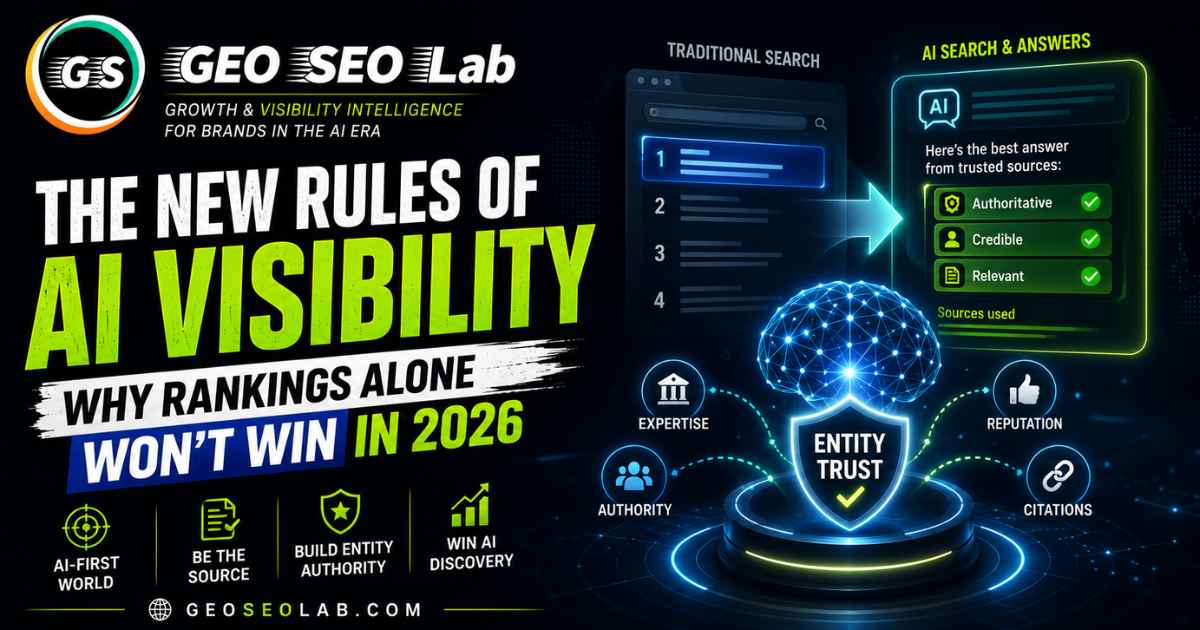
For twenty years, the goal of search marketing could be summarised in one sentence: rank as high as possible for the terms that matter. That sentence is no longer sufficient, and a growing number of marketers are discovering this the hard way — watching a page that sits comfortably at position one on Google get completely skipped when the same question gets asked of ChatGPT, Gemini, or Google's own AI Mode.
This isn't a glitch or a temporary quirk of early AI systems still working out the kinks. It's a structural difference in how these systems decide what to surface, and it means the playbook that won the last two decades of search marketing needs a real update, not a minor patch. Businesses that keep measuring success purely by rank position are going to keep missing an increasingly large share of how people actually discover brands in 2026.
This piece walks through why AI assistants select sources so differently from traditional search engines, what that's already doing to referral traffic, why entity SEO and structured data have become non-negotiable rather than nice-to-haves, what a practical GEO framework actually looks like across the major AI platforms, and which metrics deserve a permanent seat on a marketing dashboard going forward.
Why AI Assistants Choose Different Sources Than Search Engines Do
Traditional search engines were built to solve one job: given a query, find and rank the most relevant documents. Google's classic ranking stack evaluates a page largely on its own terms — keyword relevance, backlink profile, technical health, engagement signals — and returns a list, leaving the evaluation of which result actually answers the question to the person doing the searching.
AI assistants aren't doing that job. They're doing a fundamentally different one: understanding what someone's actually trying to accomplish, pulling information from multiple sources at once, and synthesizing a single coherent answer — sometimes with citations, sometimes without. That shift changes what "being a good answer" actually requires.
A few consequences follow directly from this difference. First, relevance to a keyword stops being sufficient on its own. A page can be a perfect keyword match and still get skipped if an AI system judges a different source as more directly useful for constructing its actual answer. Second, synthesis rewards clarity over cleverness. AI systems are trying to lift specific, well-defined claims out of a page — content that states things plainly, in clearly organized sections, gets used more easily than content that's technically comprehensive but buried in dense, meandering prose. Third, corroboration matters more than it used to. When multiple credible sources agree on a claim, an AI system can synthesize it with more confidence than when only one source makes it — which means being one of several sources saying something consistent is often more valuable than being the single loudest voice saying something unique but unconfirmed.
Perhaps the biggest shift, though, is that AI systems increasingly evaluate entities, not just pages. Google's classic model mostly asked "does this page match this query." AI systems increasingly ask "what do we know about the organization behind this page, and is it a credible source on this topic at all" — pulling in signals from well beyond the page itself: how consistently the organization is described elsewhere, whether its practitioners are identifiable and credentialed, whether independent sources treat it as authoritative. A page can be technically excellent and still fail to get cited if the organization behind it reads as an ambiguous or inconsistent entity everywhere else it shows up online.
None of this means classic SEO signals stopped mattering — a page that isn't indexed or is technically broken still won't get used by anyone, AI or human. What's changed is that clearing the classic SEO bar is now a prerequisite, not a finish line.
A concrete illustration is worth walking through. Imagine two consulting firms in the same niche, both ranking on page one for the same competitive keyword. Firm A has a well-optimized page that hits the target phrase cleanly, has a healthy backlink profile, and loads fast. Firm B has a similarly solid page, but its founder also speaks at industry conferences, its research gets cited by a trade publication, and its service descriptions read identically across its own site, LinkedIn, and industry directories. Ask an AI assistant a nuanced question in that niche, and Firm B is considerably more likely to get cited — not because its page beat Firm A's on classic ranking signals, but because the AI system has more independent evidence that Firm B is a credible, coherent source worth trusting. Both firms would look roughly equivalent on a traditional SEO audit. Only one of them looks credible to a system trying to decide who actually deserves the citation.
This is the practical shape of the shift: two organizations can be technically tied on the metrics that used to decide everything, and end up on opposite sides of an AI visibility gap because of factors that never used to matter much at the page level at all.
How AI Overviews and AI Mode Are Already Reshaping Referral Traffic
The practical, bottom-line effect businesses are feeling right now is a shift in referral traffic patterns — not a uniform collapse, but a real redistribution that's easy to miss if you're only watching aggregate numbers.
Simple, factual queries are increasingly resolved without a click at all. When Google's AI Overview or AI Mode can answer a question directly and completely, a meaningful share of users simply don't click through to any source — the answer already met their need. This isn't new in principle (Google has answered simple factual questions directly for years), but AI dramatically expands the range of queries this applies to, from "what's the capital of X" to genuinely complex, multi-part comparison questions that used to require visiting several sites. For a publisher whose traffic historically leaned heavily on these kinds of simple informational queries, this is the part of the shift that shows up most directly and most painfully in a traffic report.
Higher-intent queries are producing better-qualified visits, even as raw volume drops. For research-heavy, comparison-driven questions, an AI system doing some of the initial orientation work tends to send people to a source once they're already further along in their decision — meaning fewer total visits, but visits from people arriving with more context and clearer intent. That's a real trade: lower volume, often higher conversion quality. A business that measures success purely by session count might read this as a decline. A business that measures success by conversion rate and average order value might see the exact same shift as an improvement.
A meaningful share of AI-influenced traffic now shows up disguised as ordinary branded search. People increasingly get a brand recommendation from an AI assistant and then go search for that brand by name rather than clicking a link directly inside the AI response — which means a rise in branded search that looks, on the surface, like organic brand awareness growth might actually be a downstream effect of AI recommendations that never show up anywhere in standard attribution. Recent independent research tracking this exact dynamic found that more than half of the traffic generated by an AI brand recommendation arrived through this indirect, branded-search path rather than a direct click from the AI platform itself — a genuinely large blind spot in how most organizations currently measure their own marketing performance.
The practical takeaway isn't that referral traffic is dying — it's that referral traffic is becoming a less complete picture of what's actually happening, and marketers who only watch click-through numbers are increasingly working from an incomplete dataset. A marketing team that sees branded search climb without an obvious cause in their own campaign calendar now has real reason to ask whether AI recommendations are part of the explanation, rather than simply crediting an unrelated brand initiative.
Why Entity SEO, Structured Data, and Digital Trust Are No Longer Optional
If AI systems are evaluating organizations as entities rather than just ranking pages, then the practices that build a clear, credible entity become core strategy rather than a technical afterthought.
Entity SEO means making sure an organization's identity — what it does, who it serves, what it's actually expert in — reads consistently everywhere it appears: its own site, its Google Business Profile, LinkedIn, industry directories, press coverage, review platforms. Contradictory descriptions across these sources create genuine ambiguity for an AI system trying to decide whether an organization is a credible source on a given topic — and ambiguity reduces the confidence with which that system is willing to cite you. Consistency isn't glamorous work, but it's foundational. A business describing itself as an "AI visibility platform" on its own site, an "SEO agency" on LinkedIn, and a "marketing consultancy" in a directory listing is creating exactly the kind of fragmented identity that makes an AI system less willing to confidently cite it as an authority on anything specific at all.
Structured data — Schema.org markup for organizations, articles, products, FAQs, and local business details — gives machines a reliable, unambiguous way to interpret what a page actually represents, cutting down on the guesswork an AI system would otherwise have to do from raw text alone. It's important to be precise about what structured data actually does, though: it clarifies content that already exists, it doesn't manufacture credibility that isn't there. A business with pristine markup wrapped around thin, generic content has simply made its thin content easier to identify as thin — markup earns its value once genuine substance sits underneath it, not as a substitute for that substance. There's no Schema.org property that functions as a citation request; the value sits entirely on the clarity side of the equation, not the persuasion side.
Digital trust signals are the accumulated pattern that emerges from many things considered together — transparent, credentialed authorship; consistent and accurate information everywhere an organization shows up; authentic customer reviews reflecting real experiences; independent editorial coverage. None of these is a single ranking lever in the way a backlink used to be treated. Together, they build the kind of organizational credibility that lets an AI system use an organization's content as a reliable grounding source with real confidence, rather than hedging or leaving it out altogether. This kind of trust can't be shortcut through a single campaign — it accumulates through consistent, reliable behavior over an extended period, which is exactly why it's such a durable advantage once it's actually been earned.
The organizations investing seriously in all three of these — consistent entity representation, accurate structured data, and genuine trust signals — are building something considerably harder for competitors to quickly replicate than a stack of optimized keywords ever was. A competitor can copy a keyword strategy in an afternoon. Replicating years of consistent entity representation and earned third-party validation takes considerably longer, which is exactly what makes this kind of investment worth making early.
A Practical GEO Framework for ChatGPT, Google AI Mode, Gemini, Claude, and Perplexity
Every major AI platform works differently under the hood — different retrieval systems, different citation philosophies, different training priorities — which means a strategy built around any single platform's quirks tends to underperform everywhere else. A more resilient approach focuses on the capabilities that seem to matter consistently across all of them.
Foundation: technical accessibility. None of this works if content can't be crawled, indexed, and interpreted in the first place. Fast-loading pages, clean site architecture, sensible internal linking, and no crawl barriers remain the floor everything else stands on — not because AI made this less important, but because AI depends on the same underlying discovery infrastructure classic search always has. A piece of content that's technically invisible to a crawler is just as invisible to an AI system's retrieval process, regardless of how good it might otherwise be.
Layer two: genuinely helpful content. Content that clearly, specifically, and accurately explains a real question — organized so a system can lift a clean claim out of it — is simply more useful to synthesis than content padded out to hit a word count or built primarily around keyword density. Answer the actual question a person has, including the natural follow-ups they'd have next, not just the single keyword phrase a content brief was built around. A page on "CRM pricing" that skips the obvious next questions — implementation costs, contract terms, hidden fees — leaves an opening for a more complete competitor page to win the citation instead.
Layer three: original knowledge. For any well-covered topic, the existing information environment is already dense — hundreds of sources saying roughly the same thing. A source that adds something genuinely new — original research, a documented case study, a distinctive framework, real firsthand expertise — has real scarcity value in that environment, since it contributes something no other source already covers. This is consistently the highest-leverage investment available for AI visibility specifically, because it's the one layer competitors genuinely can't replicate just by publishing more content on the same topic.
Layer four: entity consistency. As covered above — keeping identity, credentials, and description aligned everywhere an organization appears, so an AI system can build a confident, unambiguous picture of who's behind the content. This includes the accuracy of basic facts (name, location, leadership, service area) as much as it includes the more nuanced positioning of what an organization actually specializes in.
Layer five: external validation. Independent citations, media coverage, and mentions from sources an organization doesn't control carry weight that self-published content simply can't replicate on its own — and AI systems appear to weight sources more heavily once other parts of the web already treat them as credible. This layer can't be manufactured through press releases alone; it develops as a genuine consequence of the quality built into the layers beneath it.
Practical, platform-aware habits worth building. Test how a brand actually shows up across all five major platforms — ChatGPT, Google AI Mode, Gemini, Claude, and Perplexity — for the real questions customers ask, not just once, but repeatedly over time and across different phrasings, since AI-generated answers vary meaningfully by wording and by session. Pay attention to which platforms cite sources prominently (Perplexity, notably, treats citation transparency as a core product feature) versus which synthesize more opaquely, since that affects how directly you can verify your own visibility on each one. And treat this testing as an ongoing practice rather than a one-time audit — a favorable citation today doesn't guarantee the same result next week, let alone next quarter.
The Metrics Every Marketer Should Actually Be Tracking
Traditional SEO metrics — rank position, organic sessions, click-through rate — remain useful, but on their own they're increasingly incomplete for understanding actual AI-era visibility. Three additions deserve a permanent place on the dashboard.
AI citations. How often, and how prominently, does a brand actually get referenced when major AI platforms answer questions relevant to its domain? This requires systematic testing — running the same category of question across multiple phrasings and multiple platforms over time, rather than a single spot-check — since AI-generated answers are genuinely variable and a single query tells you very little on its own. A citation that shows up consistently across dozens of query variations over several weeks is a far more meaningful signal than one favorable response captured once and then repeated in a slide deck.
AI Share of Voice. Among the brands that could plausibly be cited for a given category of question, what proportion of AI-generated answers actually include yours versus a competitor's? This is the AI-era equivalent of tracking rank position against competitors, adapted for an environment where there's no single ranked list to check, only a distribution of outcomes across repeated queries. Tracking this consistently over a quarter, rather than a single week, smooths out the natural variability in how AI systems respond and gives a much clearer read on genuine competitive standing.
AI-assisted brand discovery. This is the hardest of the three to measure directly, and also arguably the most important — capturing how much of a brand's overall awareness and traffic is being shaped by AI recommendations that never show up as a direct AI-platform referral in standard analytics. Branded search volume growth that doesn't correspond to a traditional marketing push is one reasonable proxy signal here. So is direct traffic growth without an obvious explanation. So is a shift in the specificity of inbound customer inquiries — customers arriving with more informed, more particular questions than a typical cold search visitor would have, suggesting they've already done some AI-assisted research before ever reaching out.
None of these three metrics replace the traditional stack — they sit alongside it, filling in exactly the part of the picture that click-through rate and rank position were never built to see. A marketing dashboard built entirely around traditional metrics in 2026 is, in a real sense, only showing half the picture of how a brand is actually being discovered.
Closing Thought: What "Winning" Actually Means Now
The organizations that will be genuinely well-positioned by the end of 2026 aren't the ones that find a clever new ranking trick — they're the ones that treat AI visibility as an extension of real organizational substance rather than a new set of levers to game. Rankings still matter as a prerequisite. They've simply stopped being the whole story. The businesses pulling ahead are the ones building genuine expertise, keeping their identity consistent everywhere it shows up, earning real independent validation, and measuring all of it with metrics built for how people actually discover brands today — not just how they did a decade ago.
Key Takeaways
- AI assistants evaluate entities and synthesize claims across multiple sources, rather than simply ranking individual pages the way classic search engines do.
- AI Overviews and AI Mode are reshaping referral traffic — reducing clicks for simple factual queries while often sending better-qualified visitors for complex ones, and hiding a real share of their effect inside ordinary branded search.
- Entity SEO, accurate structured data, and genuine digital trust signals are now foundational to AI visibility, not optional technical extras.
- A resilient GEO strategy builds up through technical accessibility, genuinely helpful content, original knowledge, entity consistency, and external validation — in that order, since each layer depends on the one below it.
- AI citations, AI Share of Voice, and AI-assisted brand discovery deserve a permanent place alongside traditional SEO metrics on any marketing dashboard.
About GEO SEO Lab
GEO SEO Lab is a research and strategy group focused on helping businesses understand and improve visibility across AI-assisted search and discovery — Google Search, Google AI Mode, ChatGPT, Gemini, Claude, Perplexity, and the broader ecosystem reshaping how people find and evaluate information. Our work spans Generative Engine Optimization, AI visibility strategy, entity optimization, and measurement frameworks built to connect real AI citations to real business outcomes.
Tags
Frequently Asked Questions
Find answers to common questions about this topic
About the Author

Anubhav
SEO Expert & Content Creator
Experienced digital marketing professional specializing in SEO strategies, content optimization, and data-driven marketing solutions. Passionate about helping businesses grow their online presence and achieve better search rankings.
Related Articles
View all posts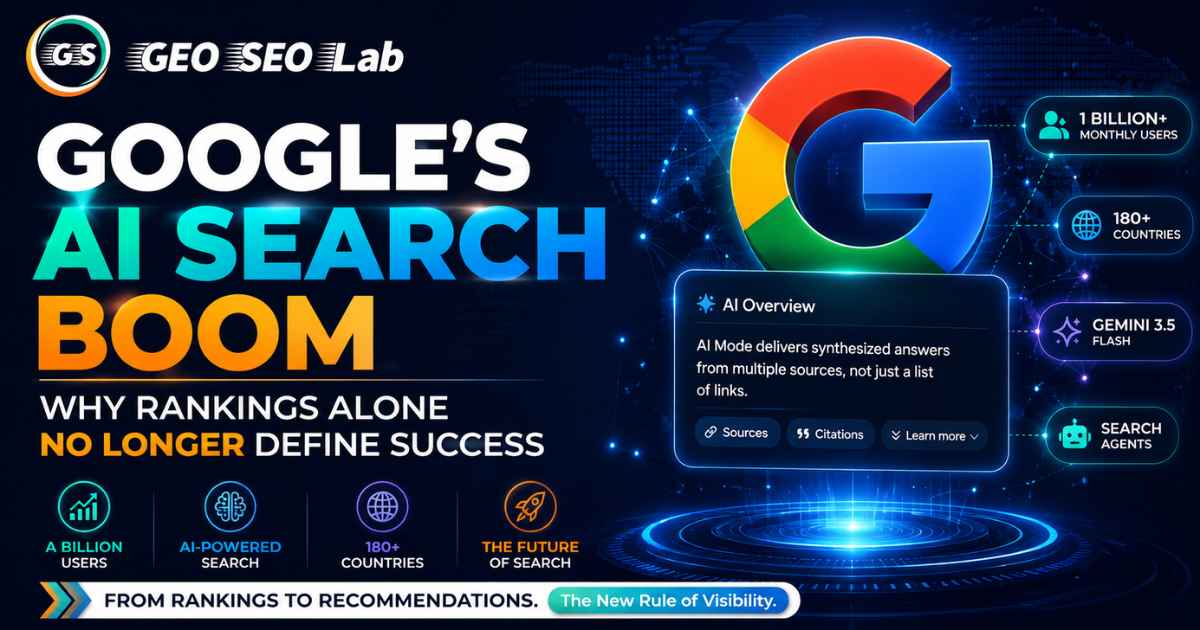
Google's AI Search Boom In 2026: How AI Mode, AI Overviews & Query Fan-Out Are Changing Rankings
Google's AI Search Boom: Why Rankings Alone No Longer Define SuccessCategory: AI Search Analysis & GEO Strategy | Published: July 2026 | Reading Time:...
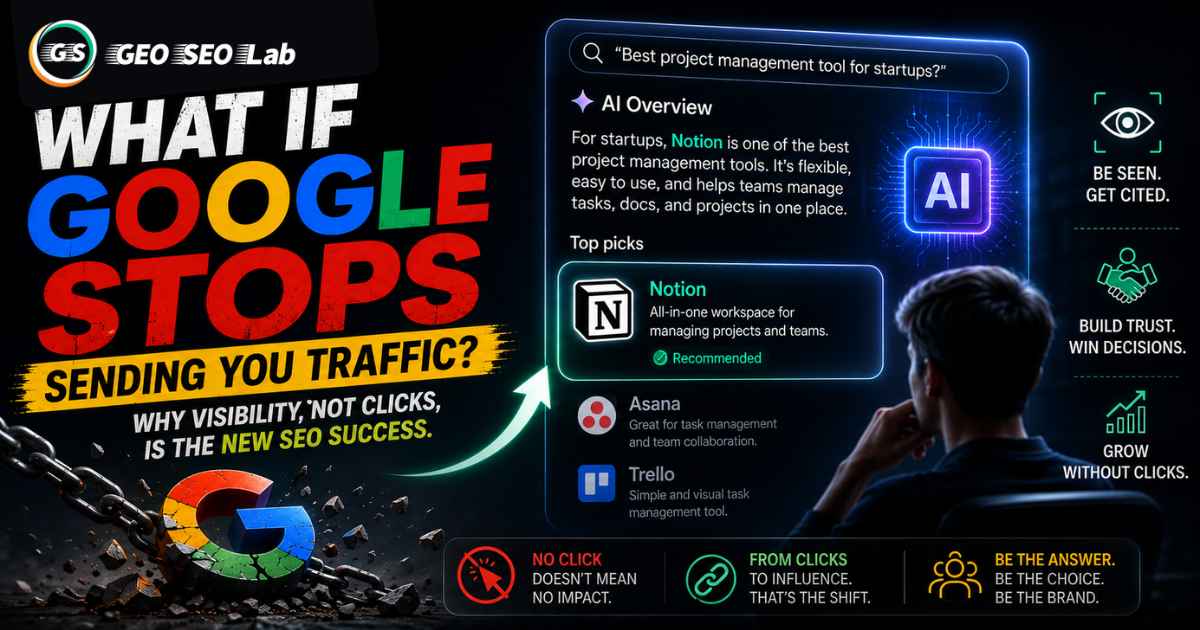
What If Google Stops Sending You Traffic?
Here's a scenario worth actually thinking through rather than rushing past. Your brand shows up inside an AI-generated answer. Your content gets cited...
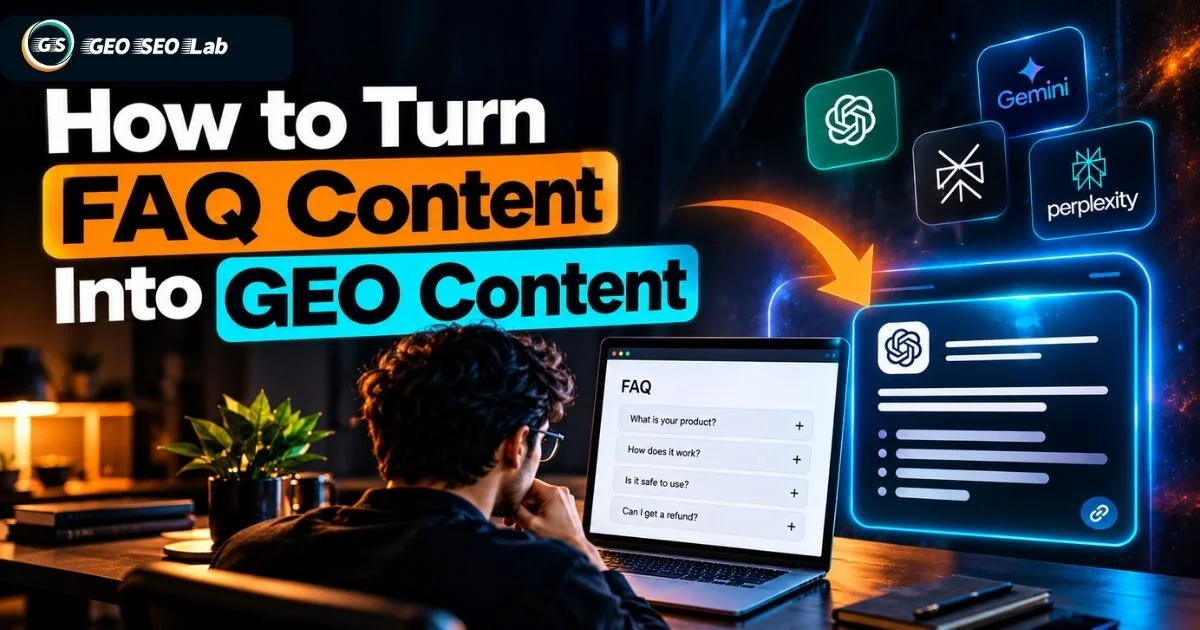
How to Turn FAQ Content Into GEO Content
How to Turn FAQ Content Into GEO ContentThink about the last time you searched for a complex product or a nuanced troubleshooting step. Did you type a...