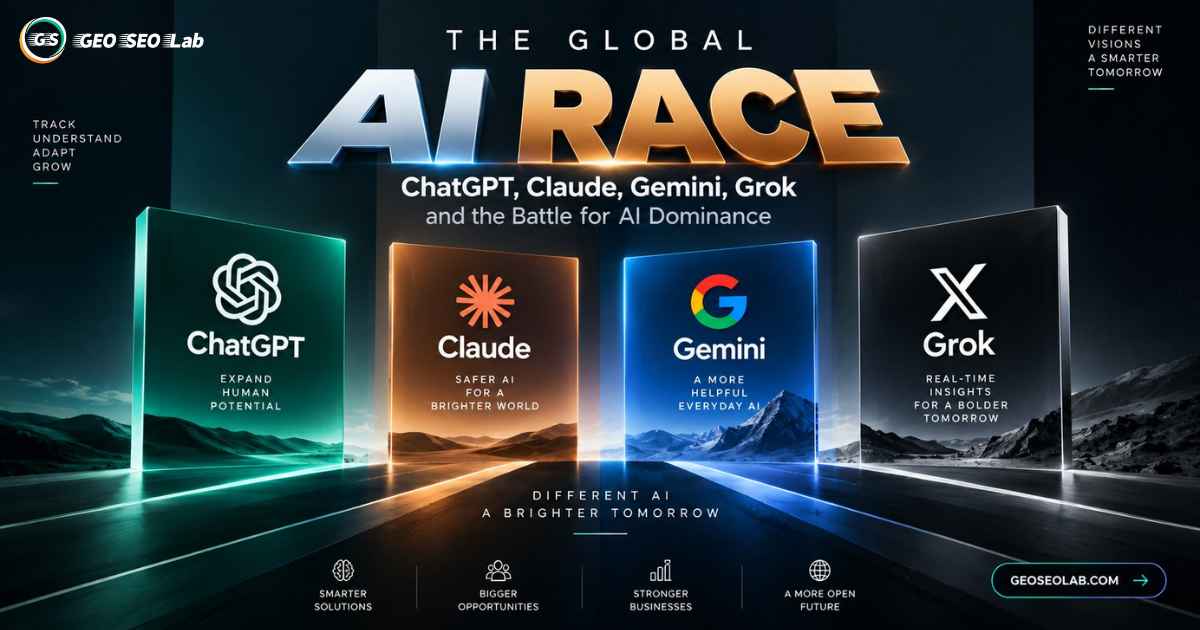
The Global AI Race: ChatGPT, Claude, Gemini, Grok and the Battle for AI Dominance
The Global AI Race: ChatGPT, Claude, Gemini, Grok and the Battle for AI DominancePublication: GEO SEO LabCategory: Technology / Artificial Intelligenc...
Introduction: The Chatbot Era Is Already Over
Here is something worth saying plainly at the start: the AI chatbot race, the one the media spent most of 2023 obsessing over, is already old news.
Yes, ChatGPT, Claude, Gemini, and Grok are still the four names everyone mentions when artificial intelligence comes up at the dinner table or in the boardroom. But the competition those names represent has quietly, rapidly, and dramatically expanded into something far more consequential than which AI writes the most fluent paragraph.
We are now watching a full-scale technology war play out across half a dozen critical domains at once. AI search that challenges the way Google built its empire. Reasoning engines that work through legal, scientific, and financial problems the way a careful human expert would. Autonomous agents that do not just answer your questions but actually go out and complete tasks on your behalf. Coding assistants that write, test, debug, and deploy software. Multimodal systems that process video, audio, images, and text simultaneously without breaking a sweat.
The companies behind these systems, OpenAI, Anthropic, Google DeepMind, and xAI, are not just building products anymore. They are building the infrastructure of the next era of computing. And the decisions they make right now, about safety, pricing, enterprise access, open standards, and real-time data, will shape how knowledge work, creativity, and even governance function for the next several decades.
So no, this is not just a story about chatbots. It never really was.
This article is a serious, honest, and genuinely useful look at where each of the four major AI platforms stands in 2025, what they are actually good at, where they still have meaningful gaps, and what the real competitive dynamics of this race look like from the inside. Whether you are a product manager choosing a platform, a developer picking a coding assistant, a business leader evaluating enterprise AI adoption, or simply someone who wants to understand what is actually happening beneath the hype, you are in the right place.
Let's get into it properly.
How a Single Product Launch Changed Everything
To really understand where we are, it helps to remember where we started.
When OpenAI released ChatGPT publicly in November 2022, it reached one million users in five days. Not five months. Five days. That kind of adoption curve does not happen because of clever advertising. It happens because something genuinely surprising and useful shows up in the world and people feel it immediately.
For most people, ChatGPT was the first time a machine actually felt like a conversation partner. Not a search bar returning blue links. Not a voice assistant dodging the question. A real back-and-forth that adapted, explained, wrote, and reasoned in ways that felt almost disturbingly human. That experience created a cultural moment that the entire technology industry is still responding to.
Google found itself in a genuinely uncomfortable position. Their own researchers had co-authored the transformer architecture paper that made modern large language models possible. They had been running AI systems at scale longer than almost anyone. And yet, somehow, they were watching a startup dominate the cultural narrative around AI. The pressure to respond fast led to a rushed launch of Bard, a public demonstration that included a factual error, and a market reaction that briefly wiped billions off Alphabet's stock value. It was a painful beginning to what has since become a serious competitive effort.
Anthropic was founded in 2021 by Dario Amodei, Daniela Amodei, and several colleagues who had left OpenAI with specific concerns about how rapidly the field was moving relative to safety research. Their approach was slower, more deliberate, and more philosophically grounded than the move-fast posture of their former employer. Claude was their answer: an AI system designed around honesty, helpfulness, and harm avoidance as foundational values rather than afterthoughts.
Then Elon Musk, who had been an early backer and board member at OpenAI before a very public and very messy departure, founded xAI and launched Grok. Where Claude was cautious and thoughtful, Grok was direct, a little irreverent, and connected to the real-time firehose of content flowing through X, formerly known as Twitter. The personality was deliberate. The real-time data advantage was structural and genuinely meaningful.
By early 2025, the field has dozens of serious competitors, including Meta's Llama models, Mistral's open-source releases, Cohere's enterprise focus, Perplexity's AI search product, and a growing roster of specialized AI tools. But ChatGPT, Claude, Gemini, and Grok remain the four platforms shaping mainstream AI perception and driving the most significant commercial competition. Understanding them properly means understanding where the industry actually is right now.
ChatGPT: Still the Name Everyone Knows, For Good Reason
There is a reason ChatGPT comes up first in almost every conversation about AI, and it is not just because it arrived first. It is because OpenAI has continued to build aggressively, iterate quickly, and expand into use cases that would have seemed speculative just two years ago.
The platform's reach is staggering. Over 100 million weekly active users were reported in late 2023, and growth has continued since. The GPT-4o model processes text, images, audio, and video with genuine fluency across all four modalities. The quality of its outputs across a wide range of everyday tasks- writing, summarising, explaining, translating, planning, researching- is consistently strong and consistently improving.
What makes ChatGPT worth taking seriously in 2025 is not the chatbot functionality, though. It is the ecosystem being built around it.
The GPT Store allows third-party developers to build custom AI applications on top of OpenAI's infrastructure, creating a marketplace of specialised tools that functions somewhat like a focused version of the App Store. This ecosystem effect creates a compounding advantage: the more developers build on ChatGPT, the more useful it becomes for specialised purposes, which attracts more users, which attracts more developers.
The enterprise play has been similarly smart. ChatGPT Enterprise gives businesses meaningful data privacy guarantees, administrative controls, higher rate limits, and access to the most capable models. Companies ranging from small creative agencies to large financial institutions are running genuine production workflows on this infrastructure, not just experimenting with it.
The most significant development in recent months has been the o-series reasoning models. OpenAI's o1 and o3 models represent a qualitatively different approach to AI problem-solving. Rather than generating the statistically most likely next token as quickly as possible, these models work through chains of reasoning before producing an answer. They slow down, think it through, and produce more carefully considered responses for complex tasks. On mathematics, scientific reasoning, legal analysis, and multi-step planning, the difference is measurable and practically significant.
The agentic direction is where things get most interesting. OpenAI's Operator feature allows ChatGPT to interact with real websites, services, and systems autonomously, completing tasks without requiring the user to be present for each individual step. This shifts the platform's identity from something you talk to into something that works on your behalf. That is a fundamentally different product category, and it is genuinely early-stage right now, but the direction is clear, and the investment is serious.
Where ChatGPT still has room to grow: web browsing and source reliability are inconsistencies that experienced users notice. Hallucination, the tendency to produce confident-sounding incorrect information, has improved but has not been eliminated. The pricing model, with the best features sitting behind a $20 monthly subscription or higher enterprise tiers, creates friction for some users. None of these is dealbreakers, but they are real.
Claude: The AI Built Around a Different Set of Priorities
If you have never used Claude seriously, you are probably missing one of the most genuinely useful AI experiences currently available. The brand recognition gap between Claude and ChatGPT is real, and it does not fully reflect the quality gap, which is much narrower and in some areas reverses.
Anthropic built Claude around a framework they call Constitutional AI. The practical effect of this is an AI model that prioritises accuracy over confidence, honesty over agreeableness, and caution over speed when those values come into tension. Claude is more likely to say it does not know something. It is more likely to flag when a request contains ambiguity that could lead to a harmful or misleading output. It is more likely to produce nuanced rather than simplistic answers to complex questions.
For some users, this feels like excessive caution. For others, particularly professionals who rely on accurate information to make consequential decisions, it feels like exactly the right design philosophy.
The long context window is Claude's most practically significant technical advantage. While competitors measure context in tens of thousands of tokens, Claude Opus handles context windows of up to 200,000 tokens, which is roughly equivalent to a full-length novel or a very large codebase. In practical terms, this means you can feed Claude an entire legal contract, a full research paper, a lengthy financial report, or a complete software repository and ask it to analyse, summarise, cross-reference, or reason across the whole thing in a single conversation.
For lawyers reviewing contracts, researchers synthesising literature, analysts working with large datasets, or developers navigating complex codebases, this is not a minor feature. It is a capability that changes what the tool can actually do for you.
The writing quality is the other thing that consistently earns Claude praise. It produces prose that reads naturally. The rhythm varies. The sentences feel like they were composed by someone who actually thinks about language, not generated by a system optimising for plausible word sequences. Marketers, journalists, authors, and content strategists have noticed this, and many have quietly shifted toward Claude for work where the quality of the prose itself matters.
Claude Sonnet and Claude Opus represent two different operating modes. Sonnet handles speed-sensitive tasks and everyday requests efficiently. Opus goes deeper and slower, making it the right choice when careful, precise, thoughtful output is worth the extra time. This tiering mirrors how human experts actually work: quickly for routine tasks, slowly and carefully for things that matter.
The enterprise story for Claude runs heavily through Amazon. Anthropic's partnership with AWS means Claude is available through the Bedrock platform, giving it access to the enormous installed base of businesses already running on Amazon infrastructure. For enterprises that have already committed to AWS, adding Claude to their AI toolkit is a practical rather than disruptive step.
The honest limitation is visibility. Claude is genuinely excellent, and many professionals who use it regularly prefer it to alternatives for specific tasks. But it does not have the cultural footprint of ChatGPT, and cultural footprint matters in consumer adoption. Anthropic is a research-forward company, and the marketing posture reflects that. Whether they can close the awareness gap while maintaining the quality reputation that makes Claude valuable is one of the more interesting strategic questions in the industry.
Gemini: Google's Comeback Is More Real Than You Might Think
If you wrote Gemini off after Bard's stumbling debut, it is worth taking a fresh look. What Google has built since that awkward beginning is considerably more impressive and considerably more competitive than most outside observers give it credit for.
The core argument for Gemini is not that it is the best AI model in a vacuum. The core argument is that it is a native part of the most deeply integrated productivity ecosystem most people on earth already use every day. Gmail, Google Docs, Google Sheets, Google Meet, Google Search, YouTube: the average professional interacts with multiple Google products for several hours every day. Gemini is being woven into all of them, not as a plugin or an add-on, but as a native capability that understands the context of what you are already doing.
This kind of integration creates value that benchmark comparisons cannot capture. When Gemini inside Gmail understands the thread of an email conversation and helps you draft a reply that is contextually appropriate, or when it synthesises your Google Calendar and your Docs to prepare you for an upcoming meeting, the value is not about raw model performance. It is about useful, frictionless presence in the workflow that already exists.
The multimodal capability of Gemini Ultra is genuinely impressive at a technical level. Google has built multimodal understanding into the core architecture rather than adding it as a feature on top of a language model. This means Gemini can reason across text, images, audio, and video simultaneously in ways that feel more integrated than the approaches taken by some competitors. A user can share a video clip and ask complex questions about specific moments. A developer can describe a UI in a diagram and ask for the implementation. These capabilities are not gimmicks; they reflect deep architectural investment.
The AI Overviews integration in Google Search deserves its own discussion. This is Google's attempt to evolve its search product in an era when users increasingly expect synthesised answers rather than a list of links to explore on their own. The challenge is that Google's search advertising business depends on users clicking through to websites, which AI-generated answers can short-circuit. The tension between improving user experience and protecting the revenue model is one of the most strategically complex problems in tech right now, and Google is navigating it in real time.
For existing Google One subscribers, Gemini Advanced offers access to the most capable models as part of the subscription they are already paying for. This bundling strategy is enormously effective at driving adoption, even when it does not reflect enthusiastic preference for Gemini over alternatives.
Where Gemini genuinely needs work: output consistency. The model can be brilliant on one task and surprisingly weak on a nearly identical task shortly afterwards. This variability is frustrating for power users who depend on predictable performance for professional work. Google acknowledges it, and the models are improving, but it remains a meaningful differentiator when compared to Claude's more stable prose quality or ChatGPT's more reliable reasoning outputs.
The enterprise trajectory for Gemini runs through Google Cloud and Workspace Business accounts. Google's existing relationships with enterprise customers give it a distribution advantage that money alone cannot buy: millions of businesses already in the Google ecosystem, already familiar with the interface, already paying for access.
Grok: The Platform That Has Something Nobody Else Does
Grok is easy to underestimate, and that would be a mistake.
xAI launched Grok in late 2023, initially as a feature exclusive to X Premium subscribers. The model's personality was deliberately positioned as more direct and less filtered than competitors, willing to engage with topics that ChatGPT's default safety settings would decline and less likely to hedge every answer with cautious qualifications. This positioning attracted a specific and enthusiastic user base while generating plenty of eye-rolling from observers who read it as provocation for its own sake.
But underneath the personality, there is a structural advantage that deserves serious attention: real-time data.
Grok is trained on and connected to the live stream of content on X. No other major AI platform has this. While ChatGPT has improved web browsing, Claude has knowledge cutoffs, and Gemini accesses the web through search integration, Grok has a direct pipeline to one of the world's largest real-time public discourse platforms. For questions about what is happening right now, what people are saying about a breaking story, what the real-time sentiment is around a market event or a product launch, Grok has a structural information advantage that cannot be replicated without an equivalent real-time data source.
In practice, this matters more than it might initially seem. Financial analysts tracking market-moving conversations. Journalists monitoring how a story is developing. PR professionals watching how a brand is being discussed. Political researchers tracking public opinion shifts. These are real use cases with real commercial value, and Grok serves them in ways that competitors simply cannot match.
Grok 2 and Grok 3 have also closed the capability gap on standard benchmarks considerably. xAI's published results and independent third-party assessments both suggest that the raw model performance has improved dramatically from the initial release. On coding tasks in particular, Grok has performed well relative to GPT-4o and Claude Sonnet in several head-to-head comparisons, though results vary by benchmark and methodology.
The coding capability is worth flagging separately because it appears to be a deliberate priority for xAI. Grok has shown strong performance on code generation, debugging, and explanation tasks, and for developers who spend significant time on X anyway, the combination of real-time information and solid coding assistance in a single platform has genuine appeal.
The honest limitations: Grok's context window is smaller than Claude's, which limits its usefulness for large document analysis. The ecosystem around it is thinner, with no equivalent of the GPT Store and a smaller developer community. The business model ties Grok's growth directly to X's own trajectory, which has been volatile since Musk's acquisition of the platform. And for users outside the X ecosystem, there is less reason to choose Grok specifically unless the real-time data advantage matters for their particular use case.
None of these limitations makes Grok a minor player. A focused advantage in real-time information combined with improving general capabilities makes it a meaningful competitor in specific and growing domains.
The Real Battlegrounds: Where the Outcome Is Actually Being Decided
The chatbot comparison gets attention, but the actual competitive dynamics are being shaped on several more specific fronts. Understanding these is essential for making sense of why the AI race matters beyond the feature comparisons.
AI Search and the End of the Blue Link
Search is the highest-stakes arena in the entire AI competition. Google processes roughly 8.5 billion searches per day. The advertising revenue generated by those searches funds one of the most profitable businesses in history. And AI is now capable of synthesising answers directly, which changes the search behaviour that makes advertising valuable.
OpenAI has built search integration into ChatGPT. Microsoft has embedded Copilot, powered by OpenAI, throughout Bing and its broader product suite. Perplexity AI has built a dedicated AI search product that has attracted serious investment and a rapidly growing user base. Google is defending with AI Overviews while trying not to cannibalise its own revenue in the process.
This is not just a product competition. It is a genuine restructuring of how people find information online, and the outcome will have massive implications for publishers, advertisers, content creators, and the economics of the open web.
The Reasoning Revolution
The emergence of dedicated reasoning models is one of the most significant capability jumps in recent AI history. These are not faster or larger versions of existing models. They are architecturally different in approach: designed to think through problems step by step before producing outputs, rather than generating the most statistically probable response quickly.
OpenAI's o1 and o3 models, Google's Gemini thinking features, and Claude's extended reasoning mode all represent serious investments in this direction. For domains where being precisely right matters more than being quickly helpful, the difference in output quality between a standard language model and a reasoning model can be substantial.
Scientific research, legal analysis, financial modelling, medical diagnosis support, and complex engineering problems are all areas where reasoning capabilities create genuine professional utility. The institutions that adopt these tools early and integrate them into professional workflows will have meaningful productivity advantages over those that do not.
Enterprise: The Quiet War With the Biggest Stakes
Consumer adoption is visible and generates headlines. Enterprise adoption is quieter but financially more significant. A single enterprise contract for AI infrastructure can be worth more revenue than thousands of individual subscriptions, and the relationships tend to be stickier because switching costs are high once AI tools are integrated into organisational workflows.
Every major platform is fighting for this market. OpenAI has ChatGPT Enterprise and a growing roster of corporate customers. Anthropic's AWS partnership gives Claude strong distribution through the cloud infrastructure that many enterprises already rely on. Google's existing Workspace enterprise relationships represent an enormous installed base to sell Gemini Advanced into. Microsoft's Copilot integration across Office 365 and Azure makes AI access nearly automatic for businesses in the Microsoft ecosystem.
The formula that wins enterprise adoption consistently involves three elements: reliable and consistent output quality, robust data privacy and security compliance, and seamless integration with the tools and workflows that already exist inside the organisation. All four platforms understand this. The differences lie in execution.
Coding and the Developer Ecosystem
Developers were among the first serious adopters of AI tools, and their loyalty is worth fighting for. Developers build things. The platform they trust for their own work tends to be the platform they build on top of, which creates distribution advantages that compound over time.
GitHub Copilot, powered by OpenAI, has hundreds of thousands of paying subscribers and is deeply embedded in the code editors most developers already use. Claude has earned strong respect in the developer community for its long context handling, which is critical for working with large codebases that exceed the capacity of smaller context windows. Gemini has integration advantages with Google's developer cloud and developer tools. Grok has shown competitive benchmark performance on coding tasks.
The frontier here is not code completion, though. It is agentic coding: AI systems that understand an entire project, write and refactor code intelligently, run tests, identify and fix bugs, and manage deployments with minimal human supervision. This is early but real, and the platform that earns developer trust at this level will have advantages that compound across the entire technology industry.
Multimodal and Creative Applications
Image, audio, and video capabilities are increasingly central to AI's value proposition in creative and marketing contexts. Gemini leads on native multimodal architecture. OpenAI has DALL-E for image generation and is investing in video capabilities. Anthropic has focused more heavily on text quality but is expanding into other modalities. Grok's multimodal features are developing but trail the leaders.
The creative market- designers, videographers, content strategists, marketers, musicians, and writers- represents a large and growing segment of AI users. The platform that builds the most compelling and most integrated creative workflow will attract a vocal and influential community that creates its own word-of-mouth advertising.
Autonomous Agents: The Frontier That Changes Everything
This is where the competition gets genuinely consequential in ways that extend well beyond product preferences.
An AI agent is not an AI you talk to. It is an AI that acts. It reads your email, identifies the request, accesses the relevant system, executes the appropriate action, and reports back. It monitors a situation over time, detects changes that require response, and takes the response without being asked. It plans a multi-step project, breaks it into tasks, assigns sub-tasks, tracks progress, and adapts when something does not go as expected.
OpenAI's Operator, Anthropic's model context protocol for agent interactions, Google's agent development features, and xAI's roadmap all point toward this future with varying levels of current capability and deployment readiness. The early implementations are impressive in demos and uneven in real-world deployment, which is normal for genuinely new technology. The trajectory is clear, and the investment is enormous.
The risks are also real. Autonomous agents with access to email, calendars, financial systems, and communication platforms represent a significant trust question. When an agent makes a mistake in a consequential situation, who is responsible? How do users maintain meaningful oversight of systems that are designed to operate without their continuous supervision? These are not philosophical questions reserved for ethics committees. They are practical product design challenges that every major platform is actively working through.
What the Coverage Gets Wrong: Three Common Misconceptions
A significant amount of AI coverage repeats the same analytical mistakes. Identifying them helps you read the landscape more accurately.
The first misconception is that benchmark scores translate directly into real-world usefulness. They do not. A model that performs brilliantly on graduate-level mathematics reasoning might produce frustrating outputs for a non-technical user trying to plan a marketing campaign. Benchmarks measure specific capabilities under controlled conditions with specific evaluation criteria. Real utility is messier, more personal, and much more contextual. The right question is not which model scores highest on a particular leaderboard. It is which model produces the most useful output for the specific task you actually need to complete.
The second misconception is that the best technology wins. History provides almost no support for this assumption. VHS beat Betamax despite being technically inferior on several dimensions. Internet Explorer dominated browsers for years not because it was better but because it came bundled with Windows. The iPhone was not the first smartphone. Google was not the first search engine. In technology markets, distribution, pricing strategy, ecosystem lock-in, brand trust, timing, and integration often matter more than raw technical superiority. The AI company that wins the enterprise market is not necessarily the one with the highest benchmark scores. It is the one with the deepest existing relationships, the most seamless integration with incumbent workflows, and the most credible data security posture.
The third misconception is that this is a winner-takes-all market. It almost certainly is not. Different users have genuinely different needs, and different AI platforms serve different needs genuinely better. A law firm might standardise on Claude for document analysis while also using ChatGPT Enterprise for client communication drafting. A media organisation might use Grok for real-time information monitoring while using Gemini for content production inside their existing Google Workspace setup. The AI market is large enough, and the use cases varied enough, that meaningful multi-platform coexistence is the most likely medium-term outcome.
The Ethical Weight of a Race Moving This Fast
There is no honest way to write about the global AI race without acknowledging the serious concerns that exist alongside the remarkable capabilities.
The safety question is not abstract. As AI models become more capable, more autonomous, and more embedded in consequential decision-making, the potential consequences of errors, biases, and deliberate misuse grow proportionally. Anthropic was founded specifically because some of the people who helped build large language models believed the industry needed to invest more seriously in understanding and controlling what it was creating. OpenAI's stated mission centres on ensuring AI development benefits humanity broadly. Google has published AI principles. xAI frames its work as advancing human knowledge and capability.
The stated values are good ones. Whether the actual development practices, release timelines, and commercial priorities consistently reflect those stated values is a harder question. Regulators in the EU, the UK, and the United States are all paying closer attention than they were two years ago, and the AI industry is going to face more scrutiny, more legislation, and more accountability than it has so far. The companies that have invested in genuine safety practices will be better positioned for that scrutiny than those that treated it as a PR exercise.
The environmental dimension is underreported and genuinely significant. Training frontier AI models requires enormous amounts of computing infrastructure and the electricity to power it. The expansion of data centre capacity to support AI development at scale has real implications for energy grids, water consumption for cooling, and carbon emissions. This is not a reason to stop AI development. It is a reason to demand transparency, accountability, and genuine investment in sustainable infrastructure from the companies doing the developing.
The economic disruption question deserves more intellectual honesty than it typically receives. AI is clearly automating specific categories of cognitive work right now, in production, at scale, not just in theory. The net effect on employment, the distribution of economic gains and losses across different communities and income levels, and the speed of the transition are all genuinely uncertain. People who confidently predict that AI will create more jobs than it destroys, or confidently predict the opposite, are both working with less evidence than their confidence implies.
Key Takeaways
The global AI race in 2025 is bigger, more consequential, and more genuinely competitive than most coverage suggests.
ChatGPT remains the most widely recognised and most broadly capable AI platform for everyday users. Its ecosystem, reasoning models, enterprise offering, and agentic development make it the safest default choice for most new users and a serious professional tool for experienced ones.
Claude from Anthropic is the preferred choice for professionals who work with large volumes of text and need reliable, nuanced, precisely accurate outputs. Its long context window, writing quality, and thoughtful design philosophy make it genuinely excellent for specific high-value use cases, even if its consumer brand recognition lags.
Gemini is a far more serious platform than its rocky debut suggested, with genuine multimodal strength, deep ecosystem integration, and enormous distribution advantages through Google's existing user base. Consistency improvements are ongoing, and the platform's integration with Workspace gives it a practical advantage for anyone already living in the Google ecosystem.
Grok occupies a distinct and genuinely valuable niche built around real-time information access and a direct, autonomy-respecting design philosophy. Its improving benchmark performance and structural data advantages make it a meaningful competitor in specific high-value domains, not just an interesting experiment.
The real competition is not about which AI writes the best email. It is about AI search, enterprise infrastructure, reasoning for professional applications, autonomous agents, coding ecosystems, and creative workflows. These are the arenas where the outcome of the global AI race will actually be determined.
No single platform is winning everything. The most sophisticated approach for most users is not loyalty to a single AI but strategic awareness of which tool genuinely serves each purpose best.
About GEO SEO Lab
GEO SEO Lab is an independent research and content publication dedicated to producing original, deeply researched analysis at the intersection of search technology, artificial intelligence, digital strategy, and the commercial dynamics of the modern web.
We exist because there is a significant gap between the AI coverage that generates clicks and the AI analysis that actually helps people make better decisions. We try to live in that gap: producing content that is thoroughly researched, honestly assessed, originally framed, and genuinely useful to the professionals, developers, business leaders, and curious individuals who read it.
Our editorial approach prioritises original thinking over aggregated summaries, honest assessment of evidence over promotional framing, and practical utility over theoretical abstraction. Where we use analytical frameworks, comparison structures, or strategic categorisations that we developed ourselves, we disclose that clearly. Where we rely on external research and data, we cite it.
We believe the most important function of technology journalism right now is helping people understand what is actually happening in AI without either breathless optimism or reflexive alarm. Both of those postures feel satisfying, and neither of them is particularly useful.
If you found this article useful, we would be glad to have you back for the next one.
References and Sources
Stanford University Human-Centered AI Institute. (2024). AI Index Report 2024: Measuring Trends in AI. Stanford HAI Publications.
OpenAI. (2024). GPT-4o Technical Report and System Card. OpenAI Research Publications.
OpenAI. (2024). OpenAI o1 and o3 Model Series: Reasoning Capabilities Overview. OpenAI Blog.
Anthropic. (2024). Claude's Constitution: The Values That Guide Claude's Responses. Anthropic Research.
Anthropic. (2024). Claude 3 Model Card and Technical Overview. Anthropic Publications.
Google DeepMind. (2024). Gemini 1.5: Unlocking Multimodal Understanding Across Millions of Tokens of Context. Google DeepMind Technical Report.
Google. (2024). AI Overviews: How They Work and What They Mean for Search. Google Search Central Blog.
xAI. (2024). Grok-3 Technical Capabilities and Benchmark Results. xAI Official Publications.
Microsoft. (2024). Microsoft Copilot for Microsoft 365: Technical Documentation and Enterprise Deployment Overview. Microsoft Documentation.
Amazon Web Services. (2024). Anthropic Claude Models on Amazon Bedrock: Technical Guide. AWS Documentation.
Bommasani, R., Hudson, D.A., Aditi, E., et al. (2021). On the Opportunities and Risks of Foundation Models. Stanford Centre for Research on Foundation Models.
Bender, E.M., Gebru, T., McMillan-Major, A., and Shmitchell, S. (2021). On the Dangers of Stochastic Parrots: Can Language Models Be Too Big? Proceedings of FAccT 2021.
Goldman Sachs Research. (2023). Generative AI Could Raise Global GDP by 7 Per cent. Goldman Sachs Global Investment Research.
International Energy Agency. (2024). Electricity Consumption from DataCentress, Artificial Intelligence, and the Cryptocurrency Sector. IEA Publications.
Pew Research Centre. (2023). How Americans View Artificial Intelligence. Pew Research Centre.
European Union. (2024). EU AI Act: Regulatory Framework for Artificial Intelligence. Official Journal of the European Union.
Nature Editorial Board. (2024). AI in Science: Opportunities, Challenges, and the Path Forward. Nature.
MIT Technology Review. (2024). The State of AI in 2024: Capabilities, Limits, and the Road Ahead. MIT Technology Review.
All product capabilities, features, market positions, and pricing described in this article reflect publicly available information as of early 2025. The AI industry evolves rapidly. Readers should consult primary sources and current product documentation for the most up-to-date information on specific capabilities and pricing. GEO SEO Lab does not receive compensation from any AI company referenced in this article.
Tags
Frequently Asked Questions
Find answers to common questions about this topic
About the Author

Anubhav
SEO Expert & Content Creator
Experienced digital marketing professional specializing in SEO strategies, content optimization, and data-driven marketing solutions. Passionate about helping businesses grow their online presence and achieve better search rankings.
Related Articles
View all posts
Myth: "AI Search Has Replaced SEO"
Myth: "AI Search Has Replaced SEO"What the 2026 Data Actually Says About Where Your Traffic Comes FromA GEO SEO Lab ReportEditorial Disclosure: This r...
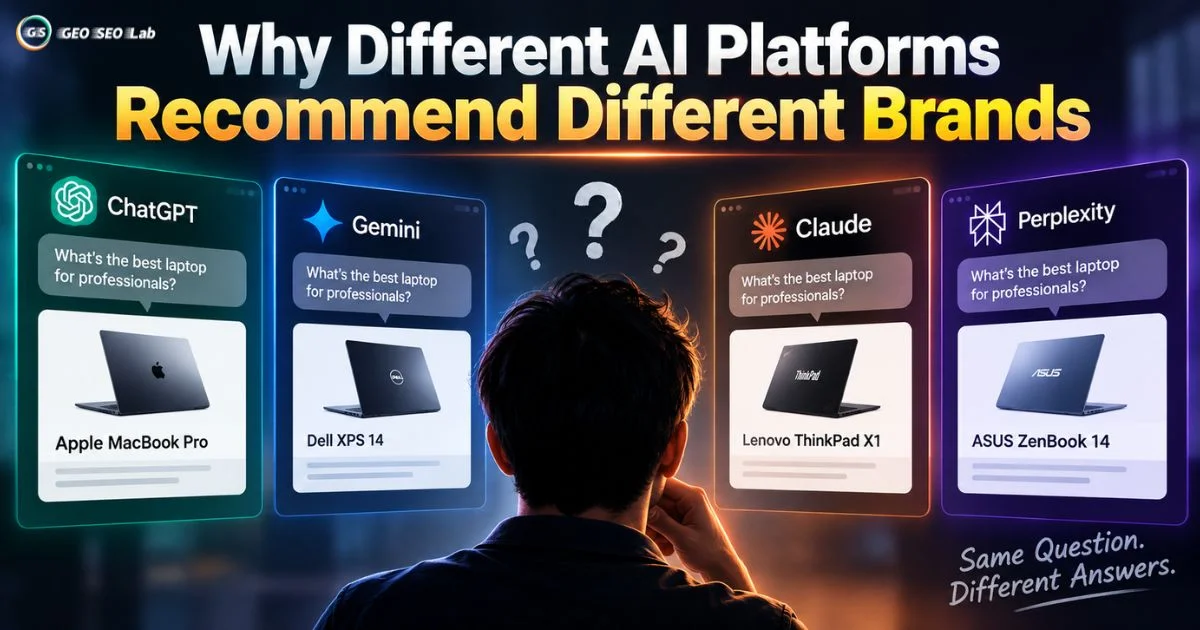
Why Different AI Platforms Recommend Different Brands
Why Different AI Platforms Recommend Different BrandsSame Question, Four Answers, Almost Zero OverlapA GEO SEO Lab ReportEditorial Disclosure: This re...
How AI Answers “Best Business Near Me” in 2026 | Local AI Search
How AI Answers "Best Business Near Me"Inside the Shortlist That Decides Who Gets the CallA GEO SEO Lab ReportEditorial Disclosure: This report introdu...