Why Different AI Platforms Recommend Different Brands
Why Different AI Platforms Recommend Different BrandsSame Question, Four Answers, Almost Zero OverlapA GEO SEO Lab ReportEditorial Disclosure: This re...
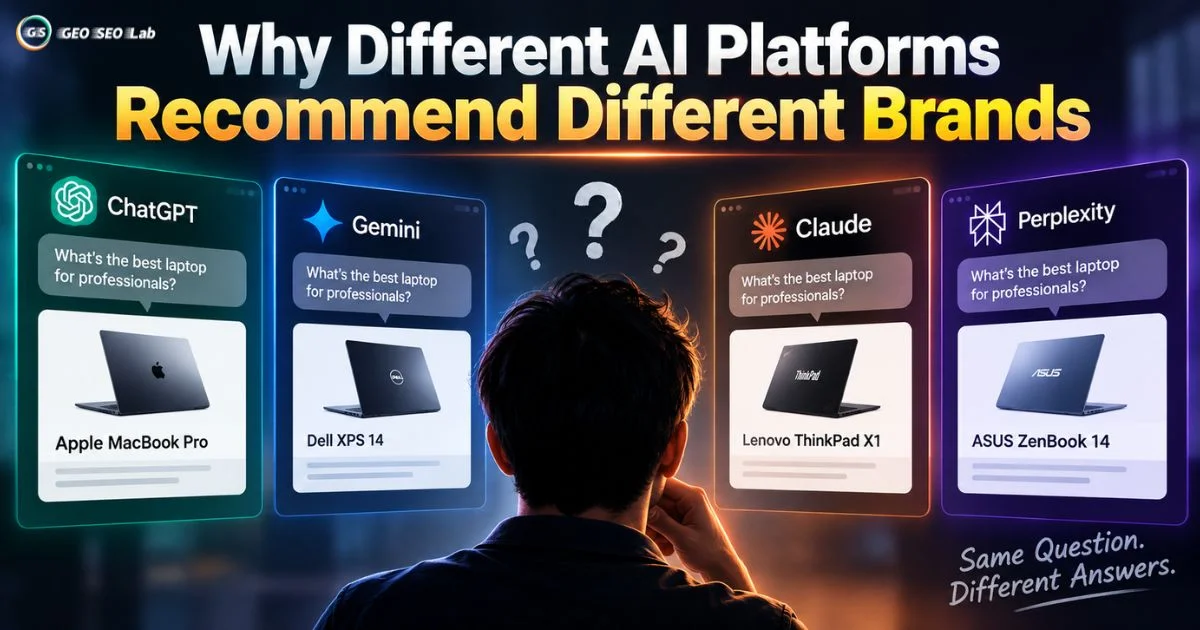
Why Do AI Platforms Recommend Different Brands?
Same Question, Four Answers, Almost Zero Overlap
Try this experiment and it'll probably unsettle you a little. Ask ChatGPT, Gemini, Perplexity, and Claude the exact same question about your product category, on the same day, phrased identically. Then compare the answers side by side.
You won't get four versions of roughly the same recommendation. You'll get four genuinely different answers, pulled from four source pools that barely touch each other. Averi's analysis of 680 million AI citations found only 11% domain overlap between ChatGPT and Perplexity, a figure Passionfruit independently confirmed at 12% across three engines. Superlines documented citation volume variance running as high as 615 times for the exact same brand between different platforms. A company that thoroughly dominates Perplexity's citation pool can be nearly invisible inside ChatGPT, and the reverse happens just as often.
That's not a measurement error or a temporary glitch that'll smooth out as these systems mature. It's a structural feature of how these platforms are built, and it has real consequences for anyone treating "AI search" as a single channel to optimize for. Because it isn't one channel. It's four or five genuinely distinct retrieval systems, each running its own index, its own scoring logic, and its own set of implicit assumptions about which kinds of sources deserve trust.
This report walks through exactly why that divergence happens, what each platform's actual citation signature looks like based on the largest published datasets available, and how a brand should realistically allocate effort when winning on one engine genuinely doesn't transfer to the others.
How Much Do AI Search Sources Overlap With Each Other?
It's worth grounding this in real numbers before getting into explanations, because the scale of the divergence is genuinely larger than most marketers assume.
Studies covering hundreds of millions of citations show each engine drawing from a distinctly different corpus, with overlap between any two engines' cited sources running roughly 16% to 59% depending on the pairing and the topic. In BrightEdge's analysis, overlap between the sources two engines cited for the same topics ran as low as 16%. Academic work published this year found source overlap averaging 32% to 43% across repeated runs, with brand overlap ranging from 33% in sporting goods up to 48% in consumer electronics.
Then there's the question of how well any of this tracks traditional Google rankings, which is where the older "rank on Google and the AI will follow" instinct genuinely falls apart. Ahrefs studied 15,000 prompts and found only 12% of URLs cited by assistants like ChatGPT, Gemini, and Copilot actually ranked in Google's top 10 for the original query. Per engine, that overlap varied enormously, from around 28.6% on one platform down to single digits on another.
Perplexity is the notable exception here, and it's worth flagging because it complicates any simple narrative. Semrush measured Perplexity at 91% domain overlap and 82% URL overlap with Google's top 10, meaning Perplexity tracks Google tightly while ChatGPT barely tracks Google at all. Interestingly, Perplexity also shows high semantic overlap with Google's AI Overviews, around 86%, but minimal URL overlap at just 13.7%, suggesting the two systems arrive at similar conclusions through genuinely different authority weighting rather than by reading the same pages.
Why Do AI Platforms Retrieve Different Sources?
Understanding the mechanism behind this makes the whole picture considerably less mysterious, and it comes down to four structural differences stacked on top of each other.
The first is the underlying search index each platform actually queries. These systems don't all read the same web. Perplexity runs a hybrid of its own proprietary index combined with Bing, Claude uses Brave Search, Copilot is Bing-based with a model layer on top, and Gemini is grounded in Google Search while still behaving like its own distinct surface with low source overlap even against Google's own AI Mode. Four different indexes means four different candidate pools before any scoring even begins.
The second is retrieval behavior, meaning whether and when a platform actually goes out to the live web at all. This one surprises people. Academic research found ChatGPT activating web search only for specific queries, leaving 57.8% of its runs with zero citations entirely, answering instead from what the model already learned during training. That single fact explains a lot about why ChatGPT's citation profile looks so different from Perplexity's. Roughly half the time, ChatGPT isn't citing anything at all.
The third is citation density, how many sources a platform pulls into a single answer. Perplexity averages 21.87 citations per response, the highest across all platforms and nearly four times ChatGPT's typical count. Claude averages around 5.67 and Copilot around 6.89. More citations means more room for divergence, though research specifically testing this found citation count didn't actually explain the overlap gap, since similarity scores stayed essentially flat regardless of how many sources a response contained.
The fourth is source-type weighting, the implicit preferences each system carries about which kinds of publishers deserve trust. This is where the most interesting differences live, and it's what the next section digs into properly.
The Engine Affinity Map
This is where GEO SEO Lab's original framework comes in. We call it the Engine Affinity Map, and it organizes each major platform by the source types it demonstrably favors, so a brand can see at a glance which of its existing assets are actually working on which surface.
The map runs across four source categories that consistently separate the engines. Owned technical content covers a brand's own documentation, technical pages, and official reference material. Community and social covers Reddit, YouTube, LinkedIn, and forum discussion. Editorial and review covers review platforms, listicles, press coverage, and third-party comparison content. And specialist and institutional covers patents, analyst reports, academic sources, and specialized industry directories.
No engine ignores any category entirely. What separates them is the weighting, and that weighting is stark enough that a 120,000-citation analysis of a single B2B category found the top-cited domain on Perplexity accounting for 26% of that engine's total citations while the exact same domain accounted for just 7.9% on ChatGPT. Some sources dominating ChatGPT's citation list with thousands of citations were cited effectively zero times by Claude on the identical query set.
What ChatGPT Favors
ChatGPT leans heavily toward Wikipedia and authoritative media, plus manufacturer-official and owned technical domains. In the Engine Affinity Map, that puts it squarely in the owned technical content and institutional media quadrants, and notably light on community and social sources.
That pattern has a few concrete implications. YouTube is structurally important on AI Overviews and Perplexity but mostly absent from ChatGPT's citations. Reddit, which lands in the top two sources on AI Overviews and is the single largest source on Perplexity, carries considerably less weight here. LinkedIn is a partial exception, showing up at 14.3% of ChatGPT citations according to Semrush's measurement, comparable to its 13.5% share on Google AI Mode and considerably higher than its 5.3% share on Perplexity.
There's a genuinely important caveat about ChatGPT worth stating plainly, though. Research tracking six B2B SaaS brands across 300,000-plus citations over 90 days found ChatGPT consistently the worst platform for brand visibility across nearly every measure tested. Combine that with the finding that 57.8% of ChatGPT runs produce zero citations at all, and a picture emerges of a platform that's simultaneously the most widely used and among the hardest to reliably earn visibility inside.
What Perplexity Favours
Perplexity is the community and freshness engine, and its signature is the most distinctive of the four.
Reddit is the single largest source on Perplexity. YouTube carries real structural weight. And freshness matters more here than anywhere else, with research finding an 82% citation rate for content published within the last 30 days, a dramatically higher recency preference than any other platform tested. Perplexity also cites inline with per-claim attribution rather than bundling sources at the end, which means individual claims need to be independently supportable rather than just the overall page being relevant.
The high Google overlap noted earlier, 91% domain and 82% URL against Google's top 10, means Perplexity is the one engine where strong traditional SEO genuinely does translate fairly directly into AI visibility. For a brand with solid existing Google rankings, Perplexity is likely the easiest early win available, and the platform where existing SEO investment transfers most cleanly.
What Claude Favours
Claude's citation profile skews toward specialist and institutional sources, patents, analyst reports, and specialized directory listings, and away from social distribution almost entirely.
Claude also gave brands the highest owned citation share of any platform tested at 9.1%, compared to Perplexity's 6.8%, meaning a brand's own domain has a better chance of being cited directly here than elsewhere. Claude runs on Brave Search with real-time retrieval and averages around 5.67 citations per response, a considerably more selective approach than Perplexity's volume.
It's worth being honest that Claude remains the least well-documented of the four. Credible large-scale data on Claude's source-type distribution hasn't been published at the scale available for the others, which makes it a surface worth monitoring directly rather than modeling from secondhand numbers. One frequently quoted statistic, that Claude mentions a brand in 97.3% of answers compared to ChatGPT's 73.6%, is genuinely real but measures something different from citation frequency, and shouldn't be read as Claude being nine times easier to get cited by.
What Gemini and Google AI Mode Favor
Gemini is grounded in Google Search but behaves like its own distinct surface, with low source overlap even against Google's own AI Mode, which is genuinely counterintuitive given both are Google products drawing from the same underlying index.
Practically, a Gemini-focused approach buys traditional Google SEO fundamentals on an owned domain, combined with vertical industry publication placement. It's the closest of the four to classic SEO work, which makes it the most familiar surface for teams with established SEO capability, though the low overlap with AI Mode means even inside Google's own ecosystem, winning one surface doesn't guarantee winning the other.
AI Overviews sit adjacent to this as their own surface again, with Reddit landing in the top two sources and YouTube carrying structural importance, a profile that looks considerably more like Perplexity's than like ChatGPT's despite both being Google-adjacent.
What Branded Queries Reveal About AI Citations
One finding cuts across every platform and deserves its own treatment, because it reorders what most brands assume matters.
Omniscient Digital's study of 23,387 citations across all five major engines found that 57% of branded citations come from reviews and social proof, meaning review sites, listicles, and press coverage. Another 17% come from directories. Only around 4.5% come from a brand's own About, FAQ, or homepage.
Read that ratio again, because it's genuinely striking. When an AI system is answering a question specifically about your brand, your own homepage contributes under five percent of the sourcing. Third-party validation contributes roughly three quarters of it. That holds across engines despite everything else about their behavior differing, which makes it one of the few genuinely universal findings in this entire report.
Why Cross-Platform AI Optimization Is a Budget Problem
Here's where the practical stakes become clear, and it's fundamentally a resource allocation question rather than a tactical one.
Most 2026 AEO programs still budget as if AI search were a single channel, and the citation data says otherwise fairly decisively. A ChatGPT-first budget buys deep owned technical content and manufacturer or reference-site placements, but it doesn't buy Reddit, YouTube, or LinkedIn distribution. A Perplexity-first budget buys Reddit sentiment monitoring, LinkedIn thought leadership, YouTube content, and aggregator listing quality, but it doesn't require heavy analyst-firm spend. A Claude-first budget buys patent filings, analyst report placements, and specialized directory listings, but it doesn't buy social distribution. A Gemini-first budget buys traditional Google SEO fundamentals and vertical publication placement.
Those are four genuinely different spending plans, funding four different activities, producing four different asset types. Very few brands have a legitimate single-engine budget, which means most need a weighted mix determined by where their actual buyers spend time rather than by which platform happens to be most talked about this quarter.
Why AI Visibility Is Inconsistent
There's a second layer of variance sitting underneath all of this that makes measurement genuinely harder than a simple cross-platform comparison suggests.
These engines aren't just different from each other. They're inconsistent with themselves. Research measuring repeated runs of identical prompts within a 24-hour window found Gemini maintaining source similarity near 0.30, SearchGPT near 0.40 to 0.42, and Perplexity near 0.50. Even the most consistent platform changed roughly half its cited sources between two runs of the exact same question.
A separate study focused on research citations found average pairwise similarity highest for ChatGPT at 31%, Claude at 23%, and Gemini at just 9%, concluding that roughly 70% of cited references changed between any two runs of an identical prompt even on the most consistent model.
The practical implication is significant and frequently ignored. Running a prompt once, seeing your brand absent, and concluding you're invisible is measurement error, not a finding. So is running it once, seeing your brand present, and concluding you've won. Any genuine assessment of AI visibility requires multiple runs across multiple days, on every platform, before the numbers mean anything at all.
A Practical Cross-Platform AI Visibility Strategy
Pulling the Engine Affinity Map together into something actionable, a few priorities emerge that hold up regardless of which engines matter most for a given business.
Start by identifying which engines your actual buyers use, rather than optimizing evenly across all of them by default. A B2B software buyer's platform mix looks genuinely different from a local consumer's, and spreading effort evenly wastes budget on surfaces your audience isn't touching.
Invest in third-party validation as the universal foundation, since the 57% branded-citation finding holds across every engine tested. Review platform presence, press coverage, and listicle inclusion do work on every surface simultaneously, which makes them the highest-efficiency investment available when budget is constrained.
Then layer engine-specific work on top of that foundation based on your actual priority platforms. Community and video content for Perplexity and AI Overviews. Deep owned technical documentation for ChatGPT. Analyst and specialist placements for Claude. Traditional SEO and vertical publication work for Gemini.
And measure per-platform rather than in aggregate, running each prompt multiple times across multiple days to separate genuine visibility patterns from the substantial run-to-run noise these systems produce naturally. A single aggregate "AI visibility score" blending four structurally different engines into one number obscures exactly the information a brand needs to act on.
Key Takeaways
- Averi's analysis of 680 million AI citations found only 11% domain overlap between ChatGPT and Perplexity, with Superlines documenting citation volume variance up to 615 times for the same brand across platforms.
- Each engine queries a different underlying index. Perplexity uses a proprietary and Bing hybrid, Claude uses Brave Search, Copilot is Bing-based, and Gemini is grounded in Google Search while still diverging from Google's own AI Mode.
- ChatGPT activates web search for only some queries, leaving 57.8% of its runs with zero citations, which explains much of why its citation profile differs so sharply from Perplexity's.
- Perplexity tracks Google closely at 91% domain overlap with the top 10, making it the platform where existing SEO investment transfers most directly, while ChatGPT barely tracks Google at all.
- Source affinities differ sharply by engine: Reddit and YouTube favor Perplexity and AI Overviews, manufacturer and owned technical content favors ChatGPT, and patents and analyst reports favor Claude.
- Across every engine, 57% of branded citations come from reviews and social proof while only around 4.5% come from a brand's own homepage, making third-party validation the one universal priority.
- These engines are inconsistent with themselves as well as with each other, with roughly 70% of cited references changing between identical runs on some platforms, meaning single-run measurement is unreliable.
About GEO SEO Lab
GEO SEO Lab helps brands become discoverable, trusted, and recommended in the AI era. Built specifically for modern businesses and MSMEs, the platform transforms complex digital marketing into a clear, intelligent growth system, continuously monitoring website health, AI visibility, content performance, competitor movements, local presence, and customer sentiment while delivering prioritized, actionable recommendations that drive real traffic, qualified leads, and measurable growth. Our GEO SEO Analyzer is built to give businesses a clear read on visibility across the major AI platforms, rather than a single blended number that hides exactly the per-engine differences this report describes.
References
- Averi, analysis of 680 million AI citations (March 2026)
- Superlines, cross-platform citation variance analysis (March 2026)
- Semrush, AI & SEO Report 2026 and analysis of 100 million-plus citations
- Ahrefs, study of 15,000 prompts and 863,000 SERPs (March 2026)
- Qwairy, AI Citation Analysis 2026, covering 118,000 AI responses
- Omniscient Digital, study of 23,387 citations across five major engines
- Slate HQ, study of 300,000-plus AI citations across six B2B SaaS brands
- Sanbi.ai, 120,000-citation source affinity analysis
- Frase, Which AI Engines Cite Which Sources? (2026 Data)
- QuickSEO, What Gets Cited by ChatGPT, Claude, Gemini, and Perplexity (2026 Data)
- Whitehat SEO, Perplexity vs ChatGPT vs Gemini: AI Citations
- BrightEdge, cross-engine source overlap analysis
- Princeton Generative AI Index
- Academic research on AI visibility measurement variance (arXiv, 2026)
All statistics reflect publicly available research current as of mid to late 2026. Given how quickly AI retrieval behavior continues to evolve, figures are worth reverifying against original sources before quoting them elsewhere.
Tags
Frequently Asked Questions
Find answers to common questions about this topic
About the Author

Anubhav
SEO Expert & Content Creator
Experienced digital marketing professional specializing in SEO strategies, content optimization, and data-driven marketing solutions. Passionate about helping businesses grow their online presence and achieve better search rankings.
Related Articles
View all posts
How AI Answers “Best Business Near Me” in 2026 | Local AI Search
How AI Answers "Best Business Near Me"Inside the Shortlist That Decides Who Gets the CallA GEO SEO Lab ReportEditorial Disclosure: This report introdu...
How to Improve AI Visibility in 2026 : 5 Fixes You Can Make Today
5 Things You Can Fix Today for Better AI Visibility No Redesign, No New Budget, Just Real Fixes You Can Ship This Afternoon Introduction Most GEO advice ...
Can a Small Business Beat a Big Brand in AI Search? 2026 Research
Can a small business beat a big brand in AI search? Explore how specificity, consistency and genuine customer trust can help smaller businesses compete with established brands in AI-powered search. This article breaks down the Underdog Advantage Model, a practical local business case study and actionable strategies to improve AI search visibility in 2026.