How AI Answers “Best Business Near Me” in 2026 | Local AI Search
How AI Answers "Best Business Near Me"Inside the Shortlist That Decides Who Gets the CallA GEO SEO Lab ReportEditorial Disclosure: This report introdu...
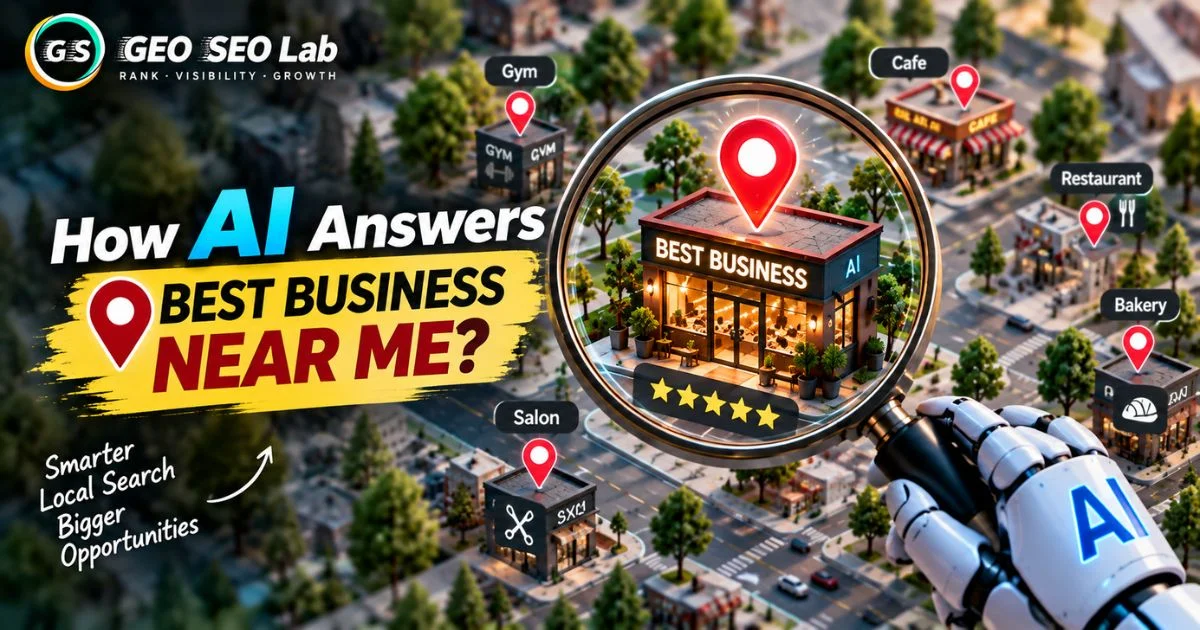
How AI Answers "Best Business Near Me"
How AI Search Builds Local Business Shortlists — and How to Improve Your Visibility
Introduction
When people ask AI-powered search tools questions such as “best plumber near me” or “how do I choose a good plumber in Phoenix?”, the experience can look very different from a traditional local search. Instead of giving users a long list of results to compare, an AI-generated answer may summarize local options, identify specific businesses, and explain why they may fit the query.
That creates a new visibility challenge for local businesses: being present in local search is no longer the only goal. Being represented accurately and consistently in AI-generated recommendations is becoming an important part of discoverability.
One SOCi analysis cited in this report found that ChatGPT recommended a small share of the local businesses included in its study. Separately, BrightLocal's 2026 research reported a substantial increase in consumer use of AI for local-search-related tasks. These findings should be interpreted according to each study's methodology and population rather than treated as a universal measure of all local businesses or all AI platforms.
This report examines the Local Answer Chain, a GEO SEO Lab framework for understanding the signals that can influence local AI answers — from location context and business data to reviews, third-party mentions, website content, and ongoing visibility testing.
Why AI Search Gives Local Businesses a Smaller Recommendation Set
The single most consequential change here isn't that AI is answering local questions. It's how few businesses make it into the answer.
A traditional Google local pack showed three businesses, backed by a scrollable map and ten organic results underneath. A user could browse, compare, click around, and eventually pick. AI local answers work differently. They name one to three businesses, sometimes just one, and present that as the recommendation rather than as a starting point for further browsing. That's a dramatically narrower window, and it means the gap between being named and not being named carries far more weight than the gap between ranking third and ranking seventh ever did in traditional local SEO.
The click-through math makes this concrete. Ranking first in traditional organic results historically delivered around a 27.6% click-through rate, but when an AI Overview appears above that first result, organic click-through drops by roughly 61%. The AI answer captures the attention first, and if your business isn't named inside it, your underlying traditional ranking matters considerably less than it used to.
There's also an important distinction between query types that most local businesses have completely missed. Optimizing for the "near me" pattern, setting up a Google Business Profile, gathering a handful of reviews, and stopping there, leaves a business entirely absent from the higher-intent "best" queries, which is exactly where real purchase decisions actually happen. A family vetting a contractor for a forty-thousand-dollar kitchen remodel asks "best," not "near me." A serious commercial lead asks "best." Winning that query requires deliberate reputation work that goes well beyond simply appearing in the map pack.
The Local Answer Chain: How AI Builds a Local Recommendation
This is where GEO SEO Lab's original framework comes in. We call it the Local Answer Chain, and it maps the five steps an AI system actually moves through between receiving a vague local question and naming a specific business.
The first step is location resolution, figuring out where "near me" actually means, since an AI chat interface doesn't have the GPS access a mapping app does. The second is source retrieval, pulling structured business data from a specific set of platforms the system already trusts. The third is corroboration, cross-checking that structured data against independent reviews, directory listings, and any press or best-of coverage it can find. The fourth is shortlist construction, narrowing a wide field down to the one to three names that will actually appear in the answer. And the fifth is answer synthesis, writing that recommendation in natural language, usually with a brief reason attached to each named business.
Understanding these five steps individually matters because each one represents a separate point where a business can drop out of the chain. A business can survive location resolution and source retrieval perfectly well, then get filtered out at corroboration because its reviews are thin or generic, never reaching the shortlist at all. Knowing which link in the chain is breaking is considerably more useful than knowing only that you're not showing up.
How AI Interprets “Near Me” in Local Search
Start with the step almost nobody thinks about, because it explains a lot of otherwise confusing behavior.
When someone asks ChatGPT "best plumber near me," ChatGPT doesn't have location data the way Google Maps does. It infers location from an IP address or makes a reasonable guess based on conversation context. That inference is often approximate, which is precisely why AI local answers frequently skew toward well-known city-level businesses rather than the genuinely closest option, and why adding an explicit city name to a prompt tends to produce dramatically better results than leaving "near me" vague.
This has a real, practical implication for how a local business should think about its content. If an AI system is resolving location at a city or neighborhood level rather than a precise street-level proximity, then explicitly naming your city, your neighborhood, and your specific service areas throughout your website and business listings genuinely matters more than it would in a proximity-driven map pack. A business relying entirely on Google's distance calculation to surface it for nearby customers is depending on a signal these AI systems often don't have direct access to in the first place.
Which Data Sources Can Influence Local AI Recommendations?
Once location is resolved, the AI pulls from a fairly consistent, identifiable set of sources, and knowing exactly which ones they are turns a vague optimization problem into a concrete checklist.
Google Business Profile sits at the center of nearly every local AI answer, across every major platform. When ChatGPT needs to recommend a local service, it pulls GBP information directly into its answer. When Gemini answers a local query, it reads GBP as authoritative data. When Google's AI Overviews generate a local recommendation, GBP forms the spine of the entire output. That makes a complete, active, well-reviewed Google Business Profile the single most important asset a local business has for AI visibility, because it's the primary structured source these systems trust about you.
Beyond GBP, the platforms feeding AI local recommendations most reliably include Yelp, Angi, HomeAdvisor, Nextdoor, and the broader network of industry-specific directories relevant to a given category. ChatGPT specifically leans heavily on Foursquare for its local answers, which means a stale or incomplete Foursquare listing can make a business invisible through that particular channel even when everything else looks healthy. Apple Maps, Bing Places, and the various vertical directories serving specific industries all contribute to the same underlying picture.
Perplexity works somewhat differently from the others, adding its own research layer on top of directory data. It may cite local press articles, regional publications, or industry databases alongside the standard listings, which means a business appearing in genuine local press coverage has a real advantage on that specific platform that wouldn't show up in a pure directory audit.
Structured data on your own website rounds out the source list, particularly LocalBusiness and FAQPage schema, which give these systems an unambiguous, machine-readable version of your core business facts rather than requiring them to parse it out of unstructured page text.
Why Google Business Profile and Your Website Both Matter for AI Visibility
This is worth stating directly, because it runs against the instincts of a lot of business owners who've invested heavily in their website while treating their Google Business Profile as a set-it-and-forget-it task.
Birdeye's 2026 State of GBP report found that 86% of GBP impressions come from category-based searches rather than branded ones, meaning someone searching "plumber near me" or "HVAC Phoenix" rather than searching your business name directly. Your GBP is fundamentally how strangers find you, not how existing customers look you up. And profiles that haven't received a new post, photo, or update in thirty or more days are showing measurable visibility drops, based on tracking from multiple local SEO practitioners this year.
The practical implication is that activity itself functions as a signal, somewhat independently of what any individual post actually says. A reasonable approach is posting one GBP update per week, and it genuinely doesn't need to be elaborate. A completed job photo with a short caption, a seasonal tip, a service reminder. The consistency of the signal appears to matter more than the polish of any individual post, which is genuinely good news for a small business owner without a content team.
The inverse of this is worth sitting with too. If your profile is thin, outdated, or poorly reviewed, you're effectively handing the recommendation to competitors whose profiles are stronger, regardless of how good your actual business is. AI systems have no independent way of knowing you do excellent work if the structured data they're reading suggests otherwise.
Why Detailed Reviews Beat Perfect Star Ratings
This is one of the more counterintuitive findings in local AI search, and it changes how a business should think about review generation entirely.
Detailed reviews that specifically mention services and neighborhoods perform considerably better than a large pile of generic five-star ratings. The reasoning becomes clear once you think about what an AI system is actually trying to do. It's not just checking whether a business is well-liked. It's trying to determine whether that business specifically handles the thing the user asked about, in the area the user cares about. A review saying "great service, highly recommend" tells an AI system almost nothing actionable. A review saying "they replaced our water heater in the Willow Creek area the same day we called" gives that system concrete, citable evidence tying a specific business to a specific service in a specific place.
The research backs this out clearly. A plumber with a 4.8-star rating built this year from fifty-plus reviews describing specific work, water heater replacement, pipe repair, emergency callouts, will generally outperform an older competitor holding a perfect 5.0-star rating from fifteen generic reviews. Recency matters here too, since these systems favor current evidence over historical reputation, meaning a steady flow of recent detailed reviews beats a large but aging collection.
That reframes what a review request should actually ask for. Instead of simply asking a happy customer to leave a review, asking them to mention the specific service performed and the neighborhood or area they're in produces reviews that carry meaningfully more weight in exactly the systems now deciding who gets recommended.
Consistency Across Platforms Is Doing More Work Than You Think
Name, address, and phone number consistency has been standard local SEO advice for over a decade, which is precisely why a lot of businesses assume it's already handled and move on. In an AI-driven local landscape, it deserves a fresh look, because the consequences of getting it wrong have changed.
Your name, address, and phone number need to match exactly across Foursquare, Bing Places, Apple Maps, Yelp, and your Google Business Profile, not approximately, but identically. When these sources disagree, an AI system has to decide which one to trust, and ambiguity at that stage frequently resolves toward simply not recommending the business at all rather than guessing wrong. That's a genuinely different failure mode than traditional local SEO, where inconsistent listings typically meant slightly degraded ranking rather than complete omission from a two-name shortlist.
There's a structural advantage hiding in here for independent businesses specifically. Research from SOCi's 2026 Local Visibility Index found AI systems often favoring independent, single-location businesses over large multi-location chains, precisely because an independent operator's reviews, hours, and business information tend to be considerably more consistent than a national chain's, where individual locations frequently carry wildly inconsistent listings across dozens of directory profiles. Being small, in this specific respect, is genuinely easier.
Building Content That Actually Answers the Question Being Asked
Website content still matters in this chain, but the kind of content that matters has shifted meaningfully.
The pages that perform well in local AI answers are detailed, question-focused service and location pages rather than broad, general "what we do" content. A page specifically addressing "emergency water heater replacement in North Phoenix" gives an AI system something concrete and directly matched to a real query. A generic services page listing eight offerings in bullet points gives it almost nothing specific enough to cite confidently.
Schema markup reinforces this, particularly LocalBusiness schema identifying your core business facts in structured form, and FAQPage schema structuring genuine question-and-answer content on your site. Neither guarantees a citation on its own, and it's worth being skeptical of anyone promising otherwise, but both remove ambiguity between what your page actually says and what a system can reliably extract from it.
One genuinely useful practical exercise here: write down fifteen to twenty questions a real customer might ask an AI system about your category and your area, then check whether your website contains a direct, specific answer to each one. Most local business websites, when actually tested this way, turn out to answer surprisingly few of them directly, because the site was built to describe the business rather than to answer customer questions.
Local Press and Third-Party Mentions Carry Real Weight
This piece gets consistently underinvested in by local businesses, and it's one of the more meaningful differentiators between businesses that show up in AI answers and businesses that don't.
Press coverage functions as a validation mechanism in these systems, signaling authority in a way self-published content structurally can't. An article in a local publication mentioning your business builds topical credibility, and it's particularly influential on Perplexity, which explicitly layers press and publication research on top of standard directory data when constructing a local answer.
It's worth being clear that this isn't a standalone tactic that works in isolation. Press coverage forms part of a broader answer engine optimization strategy rather than a shortcut around the GBP and review fundamentals covered above. But for a local business that's already handled the basics and is looking for what actually separates it from similarly well-optimized competitors, genuine local press coverage, community involvement that generates real mentions, and inclusion in local "best of" roundups represent exactly the kind of independent corroboration these systems reward.
How to Actually Test Whether Any of This Is Working
Here's the uncomfortable operational reality of AI local visibility: there's no dashboard alert, no ranking drop notification, and no visible signal when your business quietly stops appearing in AI answers. The only reliable way to know where you stand is checking manually and consistently.
The most direct method is running the actual queries your customers would use, across ChatGPT, Perplexity, Gemini, and Google's AI Mode, then recording whether and how your business appears. Tracking fifteen to twenty queries gives a genuinely useful picture of how often you show up, and doing it on a recurring monthly basis rather than as a one-off audit turns that snapshot into an actual trend line.
Perplexity deserves particular attention in this testing process, because its numbered citations show exactly which third-party sites are contributing to a given answer, whether that's Yelp, a local directory, a press article, or something else entirely. That transparency makes it genuinely useful for diagnosing which specific source is driving a competitor's visibility, information the other platforms don't surface nearly as clearly.
The scale of the opportunity here is worth noting. An audit conducted in May 2026 across five HVAC companies in San Antonio found a combined AI visibility rate of just 15% across sixty queries. That's a lot of empty space in most local markets right now, and it means a business that does this work deliberately is competing against a field where most competitors haven't started.
What Winning Actually Looks Like
Pulling the Local Answer Chain back together, a business that consistently shows up in local AI answers has typically done a fairly specific, identifiable set of things.
It has a complete, actively maintained Google Business Profile updated weekly, with geo-tagged photos, current hours, and a fully filled-out category and service list. It has identical name, address, and phone information across Google, Yelp, Foursquare, Apple Maps, and Bing Places, verified rather than assumed. It has a steady flow of recent, detailed reviews mentioning specific services and specific neighborhoods, generated through review requests that actually ask for that specificity. It has question-focused service and location pages on its website, backed by LocalBusiness and FAQPage schema. It has some genuine third-party validation, local press coverage, community mentions, or inclusion in regional best-of lists. And it checks its actual visibility across the major AI platforms on a recurring schedule rather than assuming good traditional rankings translate automatically.
None of that requires an enterprise budget or a dedicated marketing department. What it requires is treating AI local visibility as an ongoing operating habit rather than a one-time setup task, and given that 98.8% of local businesses currently aren't doing it at all, the businesses that start now are competing in a genuinely uncrowded field.
Key Takeaways
- When SOCi analyzed roughly 350,000 local business locations, ChatGPT recommended just 1.2% of them, meaning 98.8% of local businesses are currently invisible to AI-driven local recommendations.
- AI usage for local search jumped from 6% in 2025 to 45% in 2026, with Google's AI Overviews now appearing on somewhere between 40% and 68% of local-intent queries.
- AI local answers name only one to three businesses, a dramatically shorter shortlist than the traditional map pack plus ten organic results, making the gap between being named and unnamed far more consequential.
- Google Business Profile functions as the primary structured data source across ChatGPT, Gemini, and Google's own AI Overviews, with profiles inactive for thirty or more days showing measurable visibility drops.
- Detailed reviews mentioning specific services and neighborhoods outperform generic five-star ratings, and a recent 4.8-star profile with fifty specific reviews typically beats an older 5.0-star profile with fifteen generic ones.
- ChatGPT leans heavily on Foursquare for local answers, making listing consistency across Foursquare, Yelp, Apple Maps, and Bing Places genuinely consequential, not just a legacy SEO checkbox.
- There's no alert when a business stops appearing in AI answers, making manual monthly testing across fifteen to twenty realistic queries the only reliable measurement method currently available.
About GEO SEO Lab
GEO SEO Lab helps brands become discoverable, trusted, and recommended in the AI era. Built specifically for modern businesses and MSMEs, the platform transforms complex digital marketing into a clear, intelligent growth system, continuously monitoring website health, AI visibility, content performance, competitor movements, local presence, and customer sentiment while delivering prioritized, actionable recommendations that drive real traffic, qualified leads, and measurable growth. Our local SEO and Google Business Profile guidance is built specifically for businesses trying to win exactly the kind of local AI recommendations covered in this report.
References
- SOCi, 2026 Local Visibility Index and local business AI recommendation analysis
- BrightLocal, 2026 Local Consumer Review Survey
- Birdeye, 2026 State of Google Business Profile Report
- Unified Platforms, How AI Answers "Best Near Me" in 2026 (Local AEO Guide)
- Evolve, Local Business AI Search: The 2026 Playbook for Getting Cited by ChatGPT, Claude, and Gemini
- The Valley Marketing Group, Get Found in Google AI Mode and ChatGPT: 2026 Local Business Guide
- TwentyOne Solutions, How Local Businesses Show Up in ChatGPT and AI Search (2026 Guide)
- Strategyc, Local Business AI Search Optimization
- Instant Press, AI Search for Local Businesses: The 2026 Playbook
- SEM Nexus, How Local Businesses Can Appear in AI Search Answers in 2026
- Minneapolis Made, How AI Is Changing Google Local Search and Your Business
Tags
Frequently Asked Questions
Find answers to common questions about this topic
About the Author

Anubhav
SEO Expert & Content Creator
Experienced digital marketing professional specializing in SEO strategies, content optimization, and data-driven marketing solutions. Passionate about helping businesses grow their online presence and achieve better search rankings.
Related Articles
View all posts
Why Different AI Platforms Recommend Different Brands
Why Different AI Platforms Recommend Different BrandsSame Question, Four Answers, Almost Zero OverlapA GEO SEO Lab ReportEditorial Disclosure: This re...
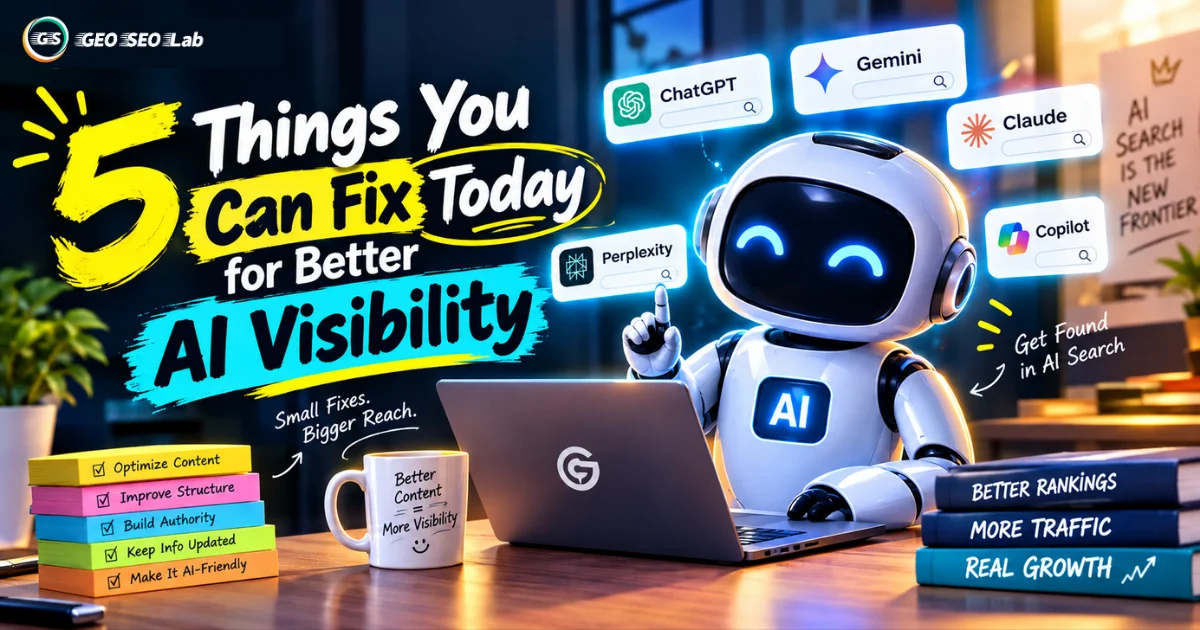
How to Improve AI Visibility in 2026 : 5 Fixes You Can Make Today
5 Things You Can Fix Today for Better AI Visibility No Redesign, No New Budget, Just Real Fixes You Can Ship This Afternoon Introduction Most GEO advice ...
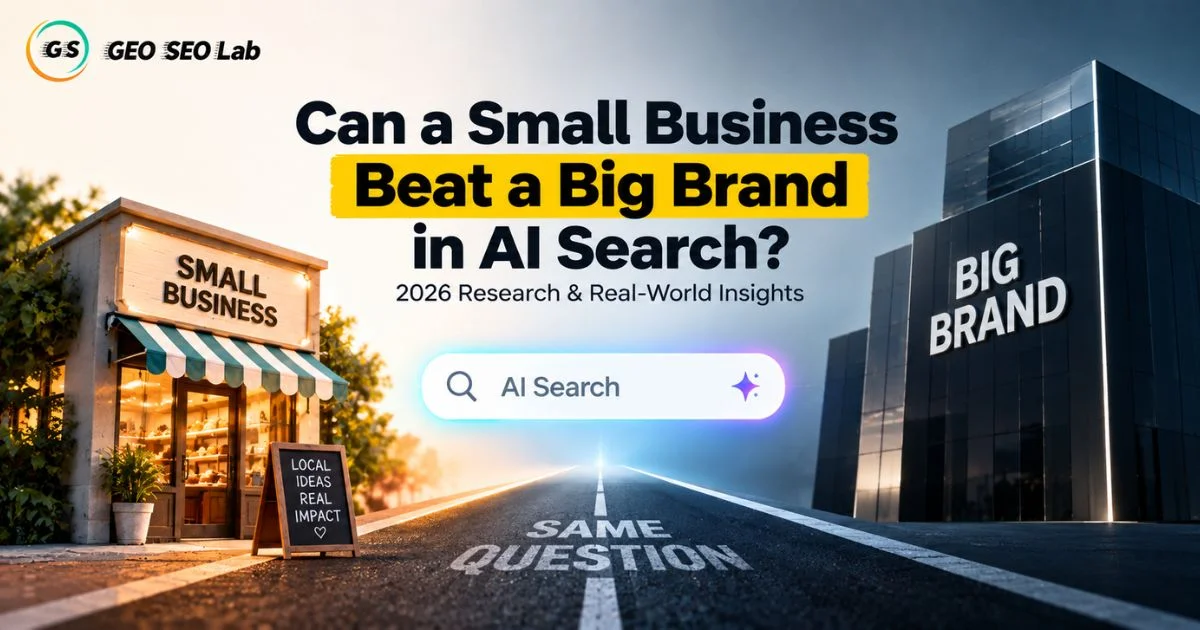
Can a Small Business Beat a Big Brand in AI Search? 2026 Research
Can a small business beat a big brand in AI search? Explore how specificity, consistency and genuine customer trust can help smaller businesses compete with established brands in AI-powered search. This article breaks down the Underdog Advantage Model, a practical local business case study and actionable strategies to improve AI search visibility in 2026.