Myth: "AI Search Has Replaced SEO"
Myth: "AI Search Has Replaced SEO"What the 2026 Data Actually Says About Where Your Traffic Comes FromA GEO SEO Lab ReportEditorial Disclosure: This r...
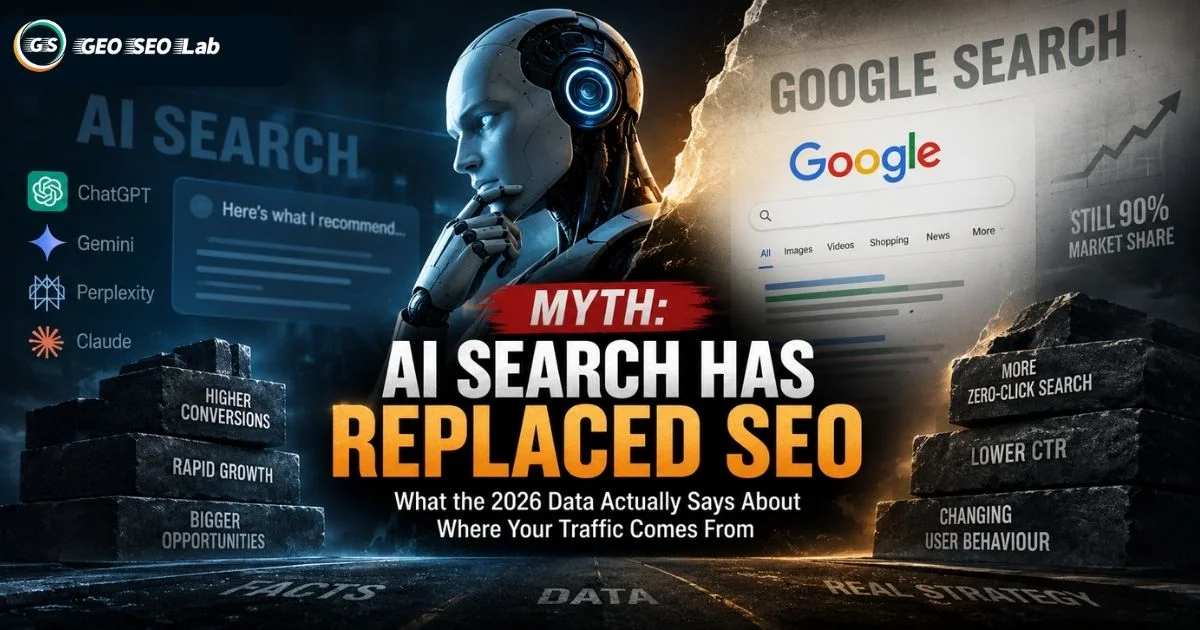
What the 2026 Data Actually Says About Where Your Traffic Comes From
Introduction
There's a version of the current moment that makes for a great LinkedIn post and a terrible business decision. It goes something like this: AI search has arrived, Google is finished, organic traffic is collapsing, and anyone still investing in SEO is rearranging deck chairs.
The data tells a considerably more complicated story, and the complication is where all the useful strategy actually lives.
Start with the number that gets left out of most "SEO is dead" arguments. Google still holds roughly 90% of global search market share as of January 2026, down from a 92.9% peak in 2023, processing somewhere between 8.5 and 16.4 billion searches per day depending on which estimate you trust. Google Search generated $224.53 billion in revenue in FY2025, accounting for over 55% of Alphabet's total. By raw scale, Google Search has genuinely never been bigger.
Now the number that makes the "SEO is dead" crowd sound right. Between January and May 2025, AI-sourced traffic increased 527% year over year, and AI platforms generated 1.13 billion referral visits in June 2025 alone, up 357% from the previous year. Traffic from AI platforms converts at 14.2% compared to 2.8% from conventional organic search, roughly five times more valuable per session.
Both sets of numbers are accurate. That's the whole problem with the myth. It's not built on false data. It's built on true data applied to the wrong question, and this report is about untangling exactly where each channel genuinely matters and where it genuinely doesn't.
Where the Myth Comes From, and Why It Feels True
The "AI replaced SEO" narrative isn't irrational. It's built from three real observations that get stitched together into a conclusion none of them individually support.
The first observation is that click-through rates on top organic positions have genuinely collapsed. Position one on Google earns 39.8% click-through on a clean results page, but that drops to under 20% when an AI Overview appears above it. Other analyses put the same shift more starkly, noting a first-place ranking that once delivered 20 to 30% click-through on competitive keywords now yields just 8 to 12%. If you're a publisher watching that happen in your own analytics, it genuinely feels like the floor is falling out.
The second observation is that zero-click search has become the default behavior rather than an edge case, with 58 to 62% of Google searches now ending without a click to any website at all.
The third is that AI platform growth has been genuinely explosive. ChatGPT reached 800 million weekly active users in October 2025 and kept growing. The top 10 AI chatbots generated 55.2 billion visits in a single year, up 80.9% year over year, while search engines showed a small decline over the same period.
Stack those three together and the conclusion writes itself. But each observation describes a different thing, and none of them actually says traffic stopped flowing through search. They say the shape of that traffic changed, which is a genuinely different claim with genuinely different strategic implications.
Introducing the Query-Type Split
This is where GEO SEO Lab's original framework comes in. We call it the Query-Type Split, and it's the single most useful lens for understanding why the myth feels true for some businesses and obviously false for others.
Search queries divide into four broad categories, and AI search has taken meaningful share in exactly one of them while leaving the other three largely intact.
Navigational queries are people typing a brand name instead of a URL, and they're enormous. In 2025, the single most searched term on Google was "Google" itself, with YouTube, Amazon, and Facebook close behind. YouTube alone draws around 83.6 million US searches a month. This is habit and muscle memory, the hardest kind of usage for any competitor to steal, and AI chatbots have taken essentially none of it.
Transactional queries are people ready to buy something specific. Google retains dominance here, and its share is even growing on local and shopping queries where Google's product surfaces have expanded.
Local queries are people looking for something nearby. Google's map pack, business profiles, and location data remain structurally dominant, though AI is genuinely making inroads on the "best" variants of these queries specifically.
Informational and research queries are where the actual disruption lives. AI platforms are taking 15 to 20% of informational query volume specifically, absorbing research, learning, and commercial investigation queries, which happen to be exactly the segments that historically drove organic traffic to content sites.
That last sentence is the whole myth in a nutshell. AI didn't replace search. It took a bite out of one specific query category, and that category happens to be the one content marketers and publishers care about most, which is precisely why the people most likely to write about this feel it most acutely.
The Numbers That Actually Contradict the Myth
It's worth laying out the counterevidence directly, because it rarely gets equal airtime.
Google's market share decline is real but modest. It moved from 91.97% to 89.94% over the course of 2025, described as the largest single-year decline in a decade, and yet still leaves Google with nearly 90% of all searches. That's not collapse. That's erosion from an extraordinarily high base.
Mobile, which is where the majority of search actually happens, looks even more lopsided. Google holds 94.35% of the mobile search market, with 60% of all Google searches coming from mobile devices and 63% of US organic search traffic originating there. On desktop, where competition is genuinely stronger, Google holds a lower but still dominant 79.88%.
Meanwhile, AI's absolute query volume remains a fraction of search. One widely referenced estimate puts AI chatbots at handling roughly 2 to 3% of search-like queries, growing quickly but not yet threatening Google's overall dominance, while other estimates put ChatGPT's share of search-like queries closer to 17%. That range is wide enough to be worth flagging honestly rather than glossing over, and it largely reflects different definitions of what counts as a "search query" in the first place.
Even the bearish forecasts don't actually predict replacement. Gartner's widely cited prediction of a 25% decline in traditional search volume by 2026 is a significant number, but a 25% decline still leaves 75% of an enormous channel intact. And forecasts suggesting AI engines might overtake traditional search as a traffic driver put that crossover around 2028, not today.
Why Strong SEO Is Still the Entry Ticket to AI Visibility
Here's the argument that should end the debate for anyone running both channels, and it's structural rather than statistical.
Google's own documentation states plainly that AI Overviews and AI Mode are rooted in core Search systems, and that pages generally need to be indexed and eligible for standard Google Search before they can appear as supporting links in these AI experiences. There's no separate AI index to get into. If you're not eligible for Search, you're not eligible for Google's AI surfaces either.
The pattern extends beyond Google. Semrush measured Perplexity at 91% domain overlap and 82% URL overlap with Google's top 10, meaning the single fastest-growing dedicated AI search platform is drawing from essentially the same pool of pages Google already ranks well. For Perplexity specifically, strong traditional SEO translates almost directly into AI visibility.
ChatGPT is the genuine exception, showing very little correlation with Google rankings, which is why cross-platform strategy matters. But even there, the underlying work that earns AI citation, crawlable pages, clear structure, specific and verifiable information, genuine authority, is the same work good SEO has always required. The tactics diverge at the margins. The foundation doesn't.
This is why "abandon SEO for GEO" is genuinely bad advice rather than just aggressive advice. It's recommending you remove the foundation the thing you're switching to is built on.
The Conversion Argument Cuts Both Ways
The strongest genuine point in favor of prioritizing AI visibility is conversion rate, and it deserves an honest hearing rather than a dismissal.
AI referral traffic converts at 14.2% compared to 2.8% from traditional organic, roughly five times more valuable per session. Seer Interactive found LLM visitors converting at 4.4 times the rate of traditional organic visitors. Those figures hold up across multiple independent analyses, which is more than can be said for a lot of statistics in this space.
But conversion rate without volume context is a genuinely misleading metric, and this is where the myth quietly smuggles in a bad conclusion. A channel converting at five times the rate while delivering one fiftieth of the volume still produces less total revenue. The math only favors AI-first prioritization once AI volume reaches a threshold that, for most businesses in most categories, it hasn't reached yet.
The correct read on the conversion data isn't "abandon organic for AI." It's "AI traffic is disproportionately valuable relative to its size, so it deserves investment ahead of what its raw volume alone would justify." That's a genuinely different recommendation, and it's the one the data actually supports.
Where the Myth Is Closest to True
It would be dishonest to spend this entire report arguing one side without acknowledging where the "AI replaced SEO" crowd has a legitimate point, because in certain specific situations, they're closer to right than wrong.
For publishers and content sites monetizing through ad impressions on informational content, the disruption is genuinely severe. That's precisely the query category AI has absorbed most aggressively, and a business model built entirely on clicks to informational pages is facing a real, structural problem rather than a temporary dip. One benchmark report documented traditional organic dropping 40% while AI-driven traffic surged 527% over the same period, and for a site in that specific position, those numbers describe an emergency rather than a shift.
For B2B software and considered-purchase categories, the buying journey has genuinely restructured around AI-mediated research, with a large majority of buyers now using AI somewhere in their process. Treating that as a minor channel addition rather than a fundamental change to how buyers discover vendors is a real strategic error.
And for any business competing on broad informational keywords where an AI Overview now appears, the click-through economics have permanently changed. Ranking first on those terms no longer delivers what it used to, and planning as though it will is genuinely wishful.
The honest framing is that the myth is wrong as a general statement about search but directionally right about a specific segment. Which segment you're in determines how much of the panic actually applies to you.
What Replaced What, Precisely
It helps to be surgical about what has actually changed rather than arguing about whether SEO is alive, which is a fairly useless question.
What genuinely changed is the reliability of the click as an outcome of ranking. Ranking well and receiving traffic used to be nearly the same thing. They've separated. A page can rank first, be summarized in an AI Overview, and receive a fraction of the clicks it would have earned two years ago, and that separation is permanent rather than cyclical.
What genuinely changed is where the shortlist gets built. For research and commercial investigation queries, a meaningful share of buyers now form their initial set of options inside an AI conversation rather than on a results page, which means visibility inside that conversation has become a distinct thing to compete for.
What genuinely changed is the measurement stack. Rank tracking alone no longer describes visibility, because it measures one surface among several and misses AI citation entirely.
What did not change is that AI systems retrieve from indexed web pages, that those pages need to be crawlable and well structured, that authority and trust signals determine which sources get used, and that genuinely useful, specific content outperforms generic content. Every one of those is a description of SEO fundamentals, and every one of them still governs AI visibility.
What a Sensible 2026 Strategy Actually Looks Like
Given all of this, the practical allocation question isn't SEO or GEO. It's what mix, based on where your specific business sits in the Query-Type Split.
If most of your traffic comes from navigational, transactional, or local queries, Google remains your primary distribution channel by a wide margin, and heavy AI-first reallocation would be premature. Maintain SEO investment, add AI visibility monitoring so you're not blind to changes, and treat GEO as a growing secondary channel rather than a replacement.
If most of your traffic comes from informational and research queries, you're in the disrupted segment, and the urgency is real. This is where meaningful budget reallocation genuinely makes sense, alongside a hard look at whether a click-dependent business model still works when a majority of those queries resolve without a click.
If you're B2B with a considered sales process, prioritize AI visibility ahead of what its raw traffic volume would suggest, because the conversion data and the buyer research both indicate outsized influence at the shortlist stage regardless of how few sessions it sends.
Across all three situations, one recommendation holds universally. Measure both. A reporting setup that tracks rankings and organic traffic while ignoring AI citation is measuring a shrinking portion of reality. A setup that tracks AI visibility while ignoring organic is measuring a channel built on a foundation it isn't watching. Neither gives you the picture you actually need to make decisions.
Key Takeaways
- Google still holds roughly 90% of global search market share as of January 2026, down from a 92.9% peak in 2023, and processes billions of searches daily with $224.53 billion in FY2025 search revenue.
- AI platforms have taken 15 to 20% of informational query volume specifically, while Google retains dominance on navigational, transactional, and local queries, and is even growing on shopping and local surfaces.
- AI referral traffic converts at 14.2% versus 2.8% for traditional organic, but conversion rate without volume context is misleading, since a five-times better rate on a fraction of the volume still produces less total revenue in most categories.
- Google's own documentation confirms AI Overviews and AI Mode draw from core Search systems, meaning pages must be eligible for standard Search before they can appear in Google's AI surfaces at all.
- Perplexity shows 91% domain overlap with Google's top 10, meaning strong traditional SEO transfers almost directly to that platform, while ChatGPT is the genuine exception with very little correlation to Google rankings.
- The myth is closest to true for ad-supported publishers on informational content and for B2B considered-purchase categories, and furthest from true for local, transactional, and navigationally driven businesses.
- What genuinely changed isn't that SEO stopped working. It's that ranking and receiving traffic separated into two different outcomes, requiring both to be measured independently.
About GEO SEO Lab
GEO SEO Lab helps brands become discoverable, trusted, and recommended in the AI era. Built specifically for modern businesses and MSMEs, the platform transforms complex digital marketing into a clear, intelligent growth system, continuously monitoring website health, AI visibility, content performance, competitor movements, local presence, and customer sentiment while delivering prioritized, actionable recommendations that drive real traffic, qualified leads, and measurable growth. Our GEO SEO Analyzer delivers a dual SEO and GEO score precisely because, as this report shows, neither number tells the whole story on its own.
References
- StatCounter, global search market share data (January 2026)
- Alphabet Q4 2025 Earnings Release, SEC EDGAR
- Similarweb, 2026 AI Search Report
- Gartner, search volume decline projection
- Ahrefs, click-through rate analysis (December 2025)
- First Page Sage, organic click-through rate by position
- Seer Interactive, LLM visitor conversion analysis
- Exposure Ninja, AI versus organic conversion rate comparison
- Semrush, AI platform and Google ranking overlap analysis
- Colorlib, Search Engine Statistics 2026: Market Share, Volume & AI
- Digital Applied, AI Search Engine Statistics 2026: Market Share Data
- Omnibound, Google Search Statistics 2026: 55+ Data Points
- Skillademia, Google Search Statistics 2026
- OneLittleWeb, 24-month AI chatbot traffic study
- Presence AI, 2026 GEO Benchmarks Report
- Google Search Central, official documentation on AI Overviews and AI Mode eligibility
Statistics in this space vary meaningfully between sources depending on methodology and definitions, particularly around what counts as a search query. Where estimates conflicted materially, both figures are noted. All data reflects publicly available reporting current as of mid to late 2026 and is worth reverifying against original sources before quoting elsewhere.
Tags
Frequently Asked Questions
Find answers to common questions about this topic
About the Author

Anubhav
SEO Expert & Content Creator
Experienced digital marketing professional specializing in SEO strategies, content optimization, and data-driven marketing solutions. Passionate about helping businesses grow their online presence and achieve better search rankings.
Related Articles
View all posts
The Global AI Race: ChatGPT, Claude, Gemini, Grok and the Battle for AI Dominance
The Global AI Race: ChatGPT, Claude, Gemini, Grok and the Battle for AI DominancePublication: GEO SEO LabCategory: Technology / Artificial Intelligenc...

Why Different AI Platforms Recommend Different Brands
Why Different AI Platforms Recommend Different BrandsSame Question, Four Answers, Almost Zero OverlapA GEO SEO Lab ReportEditorial Disclosure: This re...
How AI Answers “Best Business Near Me” in 2026 | Local AI Search
How AI Answers "Best Business Near Me"Inside the Shortlist That Decides Who Gets the CallA GEO SEO Lab ReportEditorial Disclosure: This report introdu...