Google Zero: Is the Traditional Search Traffic Model Coming to an End ?
Google Zero: Is the Traditional Search Traffic Model Coming to an End? Why Publishers, SEOs, and Businesses Must Prepare for the Era of AI Search, Zero...
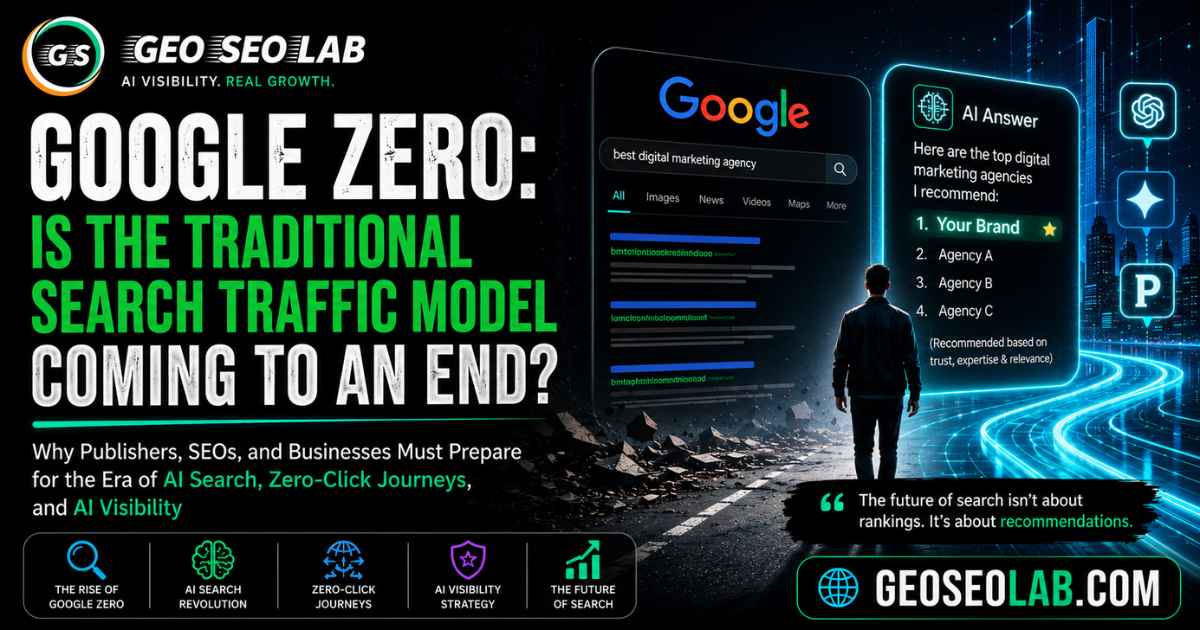
Every industry eventually hits a moment where the assumptions everyone built their business on turn out shakier than they looked. Digital publishing and SEO are living through one of those moments right now.
For roughly twenty-five years, the deal between content creators and Google was simple: make something genuinely useful, Google indexes and evaluates it, and directs people to it when their question matches. Those people land on your site and, depending on what you built, they read, click an ad, subscribe, or buy something. The loop closes, value changes hands, and everyone has a reason to keep participating.
That model was never perfect — it rewarded keyword stuffing and link manipulation as much as genuine usefulness — but it funded an enormous amount of real knowledge creation across nearly every field. Now, over roughly three years, a meaningful share of those journeys are taking a different path. People ask AI assistants questions they'd have searched for before, get a synthesized answer, and never visit an outside site. The loop everyone built their business around is getting interrupted right at its most important step.
The term that's emerged for this is "Google Zero" — a label that captures the worry cleanly, even if it slightly overstates how binary the actual shift is. It's not a specific Google initiative or some sudden break. It's a gradual, consequential shift in how a growing share of people interact with information, and what that shift does to the economics behind content creation.
This piece takes a careful look at what's actually changing, what isn't, and what a genuinely good strategic response looks like — trying to avoid both the panic and the dismissiveness that dominate most of the current conversation.
Understanding the Rise of "Google Zero"
What the term actually means. Google Zero isn't an official Google product or stated direction — Google hasn't described anything by this name. It started in the publisher and SEO community as shorthand for a specific worry: that AI-powered search might increasingly answer queries inside Google's own interface, cutting into the referral traffic publishers have relied on for decades.
The concept builds on something that predates AI entirely — zero-click search, where a query gets satisfied right on the results page with no click to any external site. Weather, sports scores, a country's population, a word's definition — Google has answered these directly for years, with no harm done, since these were never valuable visits anyway. AI expands this dramatically. Instead of just simple lookups, it can now synthesize multi-paragraph explanations, compare options across dimensions, personalize recommendations, hold a follow-up conversation, and handle genuinely nuanced multi-part questions. The range of needs satisfiable without a click keeps growing as capability improves. "Google Zero" is best read not as a fixed endpoint but as a directional worry — that the trajectory points toward progressively more needs met inside the search interface, with correspondingly less traffic flowing out to the sites whose content made the answer possible.
The value exchange that built the web. Google's ability to send people to relevant content gave publishers a reason to make that content in the first place. Better, more comprehensive content attracted more visitors from Google, which generated more revenue, which funded more good content — a loop where Google's interest in good results and publishers' interest in traffic pointed the same direction. That alignment is what made the open web's knowledge ecosystem possible at the scale we know it: newsrooms affording reporting staff because journalism traffic sustained ad revenue, educational publishers investing in curricula because that traffic was reliable, documentation teams justifying their budgets because good docs improved visibility. Pull the traffic out, and the logic sustaining all of that investment weakens. That's the real concern buried in the Google Zero discussion — not that individual page views might dip, but that the incentive to do serious knowledge creation might gradually erode if AI captures the journey before it reaches the source.
How AI actually changes the journey. The old search journey was linear in a way that was genuinely valuable for publishers — question, query, scan results, visit a page or several, read, maybe follow more links, eventually land on an answer. Every step created value for someone: ad impressions, affiliate clicks, newsletter signups, or just brand awareness banked for later. AI compresses all of that. The user asks, the AI understands the real intent underneath the words, retrieves from multiple sources, synthesizes one coherent answer, and if that's satisfying, the journey just ends there. Multiple publishers whose content fed that answer got nothing. This isn't universally a problem — for queries with clear, objective answers (simple facts, definitions, quick math), AI answering directly is a genuine improvement, since those visits rarely generated real engagement anyway. The real concern sits with higher-engagement queries — research, comparison, evaluation, genuine exploration where people used to spend real time across multiple pages. If AI satisfies those inside the interface, the implications for publishers are considerably bigger.
Google's pushback, and why it's only partly reassuring. Google consistently pushes back on the Google Zero narrative, pointing out that AI search still sends billions of clicks weekly and that engagement has grown rather than shrunk since AI features arrived. Those statements deserve to be taken seriously — Google genuinely needs a healthy publishing ecosystem, since an assistant limited to stale training data with no access to fresh, expert web content would be a worse product. Google's business interests and the open web's health really are aligned in important ways. That said, aggregate numbers about billions of clicks don't fully reassure a publisher watching traffic decline in a specific content category. The whole can be growing while specific segments — how-to guides, informational content, certain kinds of product research — shrink. And the publishers most exposed tend to be the ones with the least diversified revenue and the least room to absorb disruption while adapting. Both things can be true at once: AI search generating more total clicks across the ecosystem while redistributing them in ways that hurt specific publishers and content types. Understanding that distributional complexity, rather than leaning on aggregate reassurance, is what actual strategic planning requires.
Tracing the value exchange. In the old model, creators invest in content, search engines index it, people with relevant questions get directed to it, the visit generates value directly (ads, transactions) and indirectly (awareness, relationships), and that value funds more content — closing the loop. AI doesn't eliminate this cycle, but it inserts a new stage between "people have questions" and "people visit pages" — synthesizing and often fully satisfying the need before any visit happens. For some queries, that's a filter cutting visits that were never going to convert anyway. For others, it's a qualifier, sending fewer but better-oriented visitors further along their decision journey. The real strategic question for any organization: which category does most of your content actually fall into? Is AI mostly filtering out low-value traffic while sending you more qualified visitors, or is it redirecting visits that would have generated real engagement? Answering that honestly, with real analytics rather than assumption, is the prerequisite for a strategy that fits your actual situation rather than an industry average.
Why This Changes SEO and GEO for Good
Traffic is the wrong organizing question. "Will AI reduce our traffic" dominates most Google Zero conversations, but it's the wrong frame. Traffic is a means, not an end — the real objectives are customer acquisition, brand awareness, revenue, relationships, and influence over decisions. Traffic has always been a useful leading indicator of those things, never identical to them. AI search makes it an even less reliable standalone number: a business getting fewer but higher-quality visits — people who've already gotten an AI-mediated orientation and are past the early research stage — may end up with better outcomes than one pulling in more traffic made of casual, low-intent visitors. The better question is how AI is changing the way people discover, evaluate, and trust information before deciding anything, and how an organization should position itself inside that changed process. That question points toward investing in knowledge quality, entity authority, and AI citation potential — things that may not move traffic numbers immediately but build the real foundation for lasting advantage.
Zero-click doesn't always mean zero value. Picture two scenarios. First: someone asks an AI the speed of light, gets the right answer, moves on. No visit, no publisher benefit — but also no real loss, since that visit was never going to be valuable business-wise anyway. Second: someone asks which ERP software fits a 200-employee manufacturer with three facilities and existing Salesforce integration. The AI orients them across several options and the key tradeoffs, and they go investigate two specific vendors directly — arriving with far more context and intent than if they'd typed a generic keyword and clicked the first result. That second scenario is zero-click at the AI stage but can genuinely improve outcomes at the website stage: fewer visits, but meaningfully better ones. The right response differs by scenario — accept that some query categories simply won't generate visits and plan content around that, while making sure the AI-mediated orientation stage represents your brand accurately and favorably, which is exactly what GEO is for.
Search is turning into a decision engine, not just a finder. Traditional search found documents and left the evaluating to the user. Modern AI search increasingly does some of that evaluating itself — when someone asks which laptop suits architecture school, the AI isn't just surfacing pages, it's synthesizing specs, software requirements, and budget into an actual recommendation tailored to the situation. That shifts what a website visit is even for. It's no longer where evaluation starts — it's where people go to verify, go deeper, or act on a conclusion they've already begun forming elsewhere. Broad orientation content ("everything you need to know about X") matters less when AI already provided that orientation; specific, high-intent content — detailed comparisons, implementation specifics, real case evidence, expert tradeoff analysis — matters more.
Visibility itself needs a wider definition. For most of SEO's history, visibility meant rank — average position, impressions, click-through rate, all centered on the results page. AI search needs a considerably wider definition, since influence over behavior now starts before the results page and runs through the AI interaction itself, before any click happens. An organization that consistently shows up in AI-generated answers is shaping understanding and decisions regardless of whether those appearances generate a visit — and that influence is real and commercially significant, even though it's largely invisible in standard analytics, which show no record of the visit that didn't happen or the brand impression that occurred purely inside an AI response. Organizations that grasp this will start measuring and improving AI citation rates alongside traditional metrics — a genuinely different competitive game from the ranking-centric model that's dominated digital marketing for decades.
Entity authority is the new unit of competition. Traditional search evaluated individual pages — content, inbound links, technical quality, relevance to a term. AI systems evaluate entities — organizations, people, products, and the relationships between them — assembling a coherent picture of what a company is and does from many sources at once, not extracting it from one page. That means a digital presence strategy now has to account for how an entity is represented everywhere AI systems might look — not just the company website, but its Business Profile, LinkedIn, directory listings, press coverage, and review profiles. Inconsistency across these sources is damaging in a way it never was in the page-centric era: contradictory descriptions create genuine uncertainty for an AI system about which version is accurate, and that uncertainty reduces confidence, which reduces citation. Entity management — keeping representation consistent, accurate, and comprehensive everywhere — is becoming a core SEO and GEO priority, not an administrative afterthought.
How Businesses Actually Win in the Google Zero Era
The differentiation that actually matters. AI search's impact isn't uniform — it depends heavily on how distinctive an organization's content genuinely is. Organizations built on easily replicated, widely available information — generic how-tos, keyword-optimized overviews thousands of other sites cover identically — face the most direct pressure, since AI can synthesize that material without needing to send anyone anywhere. Organizations built on genuinely distinctive knowledge — original reporting, proprietary research, expert judgment, first-hand experience — are far better positioned, since that material doesn't exist in synthesizable form anywhere else and can't be shortcut by AI. The real question for any organization: which category does most of our content actually fall into, and what would it take to shift more of it toward the distinctive side?
Publishers face the sharpest version of this. News organizations, educational publishers, and vertical content sites depend on traffic volume more directly than most other businesses — when it drops, revenue feels it fast. The most exposed publishers are the ones organized around scale: high volume across many topics chasing organic traffic for a wide range of queries. That worked when satisfying a query meant visiting a page; it stops working as well when AI can synthesize an answer from dozens of similar pages without sending anyone to any of them. The publishers best positioned are the ones investing in what AI genuinely can't replicate — investigative work with exclusive sources, original research producing findings nobody else has, expert analysis built on years of specialized practice, first-hand reporting from places remote synthesis can't reach. None of this is new editorial wisdom — quality publishers have always valued originality. What's changed is the stakes: originality was always better than imitation, and now it's becoming necessary for survival rather than just a competitive edge.
SaaS and tech companies sit in an interesting spot. Their how-to content and integration guides may see fewer visits as AI gets better at answering implementation questions directly. But their official documentation is exactly what AI systems need to answer technical questions reliably — an AI coding assistant giving wrong API examples because it's drawing on a stale third-party blog helps nobody, least of all the company whose API is being misdescribed. That creates a real incentive to treat documentation quality as an AI visibility strategy, not just a support-cost line item — clear structure, accurate current behavior, proper markup, all of it doing double duty for users and for AI systems referencing it.
Healthcare carries stakes beyond competitive advantage. People increasingly ask AI assistants health questions, and getting it wrong has real consequences. That creates pressure — AI can flood the space with plausible-sounding but inaccurate health content — and opportunity, since AI systems trying to answer reliably need sources they can actually trust. Organizations with established medical credibility are well positioned to be exactly that trusted source, provided their digital presence clearly signals credentials and their content is visibly grounded in evidence rather than just confident-sounding. That means clinician profiles that actually show specialization, content that demonstrably reflects clinical reasoning, and genuine participation in the professional networks that signal medical authority.
Local businesses are shifting from listed to recommended. Old local search ran on proximity and basic quality signals — "restaurants near me" mostly needed an accurate profile and a decent review score. Conversational AI local queries are richer: "which family restaurant near this neighborhood has a quiet atmosphere and good vegetarian options" needs an AI system to understand what actually distinguishes a business, not just where it sits on a map. Businesses with a rich, specific digital identity — detailed descriptions of their actual approach, review profiles that capture what makes them different, content that's clear about who they serve — are better positioned than ones with generic descriptions and thin footprints.
B2B competes on authority now, more than ever. B2B buyers increasingly use AI assistants to accelerate early research — orienting themselves to a market category, key players, and differentiating factors before ever visiting a vendor site. Being part of that orientation — named accurately among the relevant players — is functionally a first-stage sales activity that happens before any direct contact, and one that's largely invisible to standard analytics. The B2B organizations best positioned are the ones that've invested seriously in real thought leadership: original research that actually advances industry understanding, frameworks that help people reason through complex decisions, analysis that reflects genuinely deep knowledge — the kind of signal that distinguishes a real market leader from a generic competitor inside an AI-mediated evaluation.
The AI Authority Flywheel rewards moving early. In classic SEO, a new entrant could outrank an established competitor fairly quickly with better content targeting the right keywords. AI visibility works differently — the confidence with which AI systems reference an organization comes from accumulated signals across many sources over time: entity breadth and consistency, the volume and quality of external references, the depth of published expertise, the stability of that information over time. These signals compound, which means early, serious investment becomes increasingly hard for late movers to catch up to. That's the real strategic argument for treating this moment as an opportunity to seize, not just a threat to manage — organizations investing seriously in knowledge quality and entity authority now are building a position competitors will find genuinely difficult to replicate later.
The Future of Search, and How to Actually Prepare
"Google Zero" isn't the end of anything. The dramatic framing — an era ending, the web's economics collapsing — is useful for conveying urgency but misleading taken literally. Every major search transition has come with predictions that were both too dramatic about near-term disruption and too conservative about the real underlying change. Featured snippets were supposed to end organic traffic; voice search was supposed to make text search irrelevant. Neither happened in the dramatic form predicted, but both pointed at something real that mattered. Websites won't disappear. Publishers won't universally lose all traffic. What will change is the role websites play in the journey — increasingly where people go to verify and act on understanding that started forming during an AI-mediated research process, with visits skewing toward people carrying more context and clearer intent than the average keyword searcher.
The unit of competitive advantage is shifting from pages to ecosystems. Old-model advantage was page-level — better content, better technical work, more inbound links, winning query by query. AI-search advantage is ecosystem-level — a more trustworthy, coherent, distinctive knowledge presence across every source where information about an organization appears, not just its own site. That's harder to game artificially and more durably tied to genuine value creation, which makes it a more sustainable form of advantage than page-level competition ever was. Genuine expertise leads to original knowledge, which becomes structured information AI systems can process, which builds AI understanding, which produces citations, which build recognition, which attracts qualified visitors, which sustains growth — each link in that chain depending on real investment in the one before it, which is exactly why the resulting position is hard for shortcut-seekers to replicate.
A practical way to prepare. Technical SEO remains the floor — accessible, well-structured, properly marked-up sites, since AI systems can't reference what they can't crawl and interpret; letting fundamentals slip while chasing AI-specific tactics is a real mistake. On top of that, knowledge quality becomes the main driver of AI visibility — an honest look at whether current content is genuinely distinctive or mostly a recombination of what's already everywhere, and redirecting investment toward the areas of real first-hand knowledge or expert insight nobody else can offer. Entity management deserves more deliberate attention than most organizations currently give it — regular audits of how the organization is described across major platforms, active management of profiles and listings, and real monitoring of how AI systems currently represent the organization when asked. Measurement needs to expand too — AI citation rates, brand mention frequency inside generated answers, brand search volume as a proxy for AI-mediated awareness, and referral quality metrics that capture whether the character of organic traffic is actually improving. And genuine investment in original knowledge production — research programs, expert hiring, structured capture of internal expertise — builds the most durable asset available here, precisely because it takes real time to pay off, which is exactly why starting early matters.
What the next five years most plausibly look like. Precise prediction is impossible, but the visible trend likely continues gradually: AI handling more of the early information-gathering stage while websites remain the destination for depth, verification, and action. The share of queries fully satisfied by AI with no click will likely keep growing, especially for informational and research queries — and the share where AI involvement improves the quality of the eventual visit will likely grow too. The organizations that do well here are the ones that've made themselves genuinely, irreplaceably valuable at whatever stage of the journey stays on websites — deep expert engagement, real transactional capability, authentic first-hand experience, established credibility that AI synthesis simply can't replicate. The ones that struggle are the ones that've been leaning on the mechanics of search — keyword tricks, link acquisition, ranking-signal gaming — as a substitute for actual expertise. This era is mostly accelerating how visible that substitution has always been as an insufficient long-term strategy.
Key Takeaways
- Google Zero is a directional concern, not a binary prediction — a trajectory toward more queries satisfied inside the search interface, not a sudden cliff edge.
- Traffic is the wrong organizing question. How AI changes discovery, evaluation, and trust before a visit even happens is the more useful frame.
- Zero-click doesn't uniformly mean zero value — AI-mediated orientation can improve visit quality even while reducing visit quantity.
- Entity authority is the new competitive frontier, since AI systems evaluate organizations across many sources at once, not one page at a time.
- Originality is becoming necessary, not just better — content that just recombines widely available information is losing ground fastest.
- The AI Authority Flywheel rewards early, serious investment, since these signals compound over time in ways late movers find hard to catch up to.
- GEO builds on SEO rather than replacing it — technical excellence and content quality remain the foundation everything else stands on.
About GEO SEO Lab
GEO SEO Lab helps brands become discoverable, trusted, and recommended in the AI era. Traditional SEO alone is no longer enough — businesses now need visibility across AI search engines, LLMs, local search, reviews, and digital platforms. Our platform continuously monitors website health, AI visibility, content performance, competitor movements, local presence, and customer sentiment while providing actionable recommendations that drive real traffic, qualified leads, and measurable growth. Built specifically for modern businesses and MSMEs, GEO SEO Lab transforms complex digital marketing into a clear, intelligent growth system.
References and Further Reading
Google and official documentation: Google Search Central on helpful, people-first content; Google's "How Search Works" documentation; Search Quality Rater Guidelines; Alphabet quarterly earnings materials.
Tags
Frequently Asked Questions
Find answers to common questions about this topic
About the Author

Anubhav
SEO Expert & Content Creator
Experienced digital marketing professional specializing in SEO strategies, content optimization, and data-driven marketing solutions. Passionate about helping businesses grow their online presence and achieve better search rankings.
Related Articles
View all posts
Google's AI Search Boom In 2026: How AI Mode, AI Overviews & Query Fan-Out Are Changing Rankings
Google's AI Search Boom: Why Rankings Alone No Longer Define SuccessCategory: AI Search Analysis & GEO Strategy | Published: July 2026 | Reading Time:...
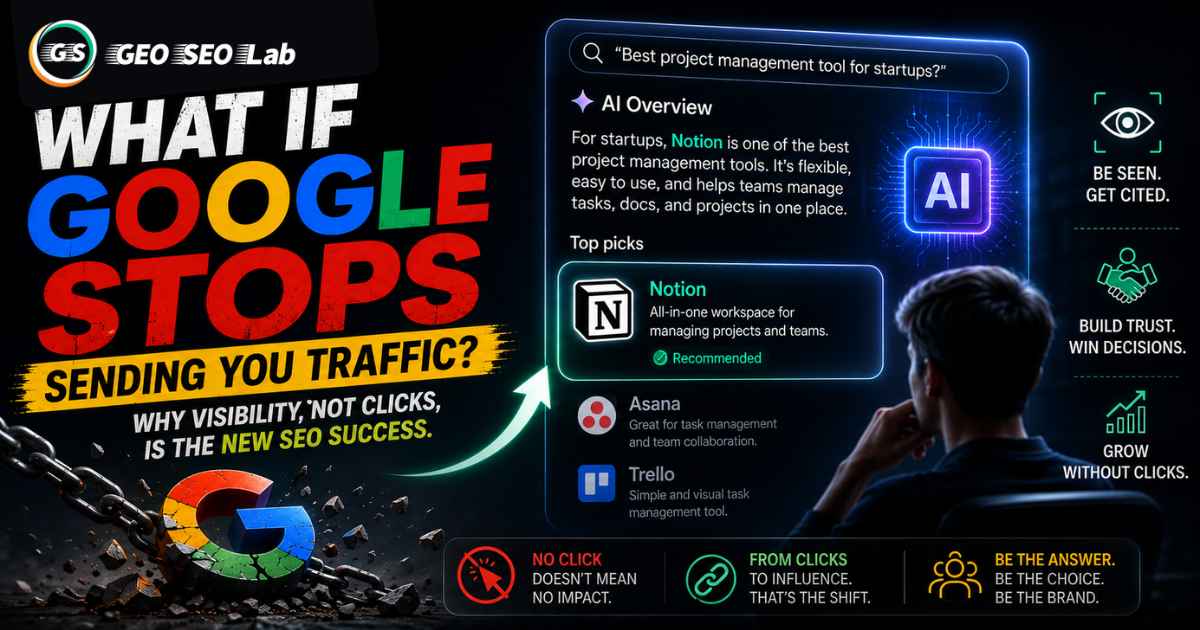
What If Google Stops Sending You Traffic?
Here's a scenario worth actually thinking through rather than rushing past. Your brand shows up inside an AI-generated answer. Your content gets cited...
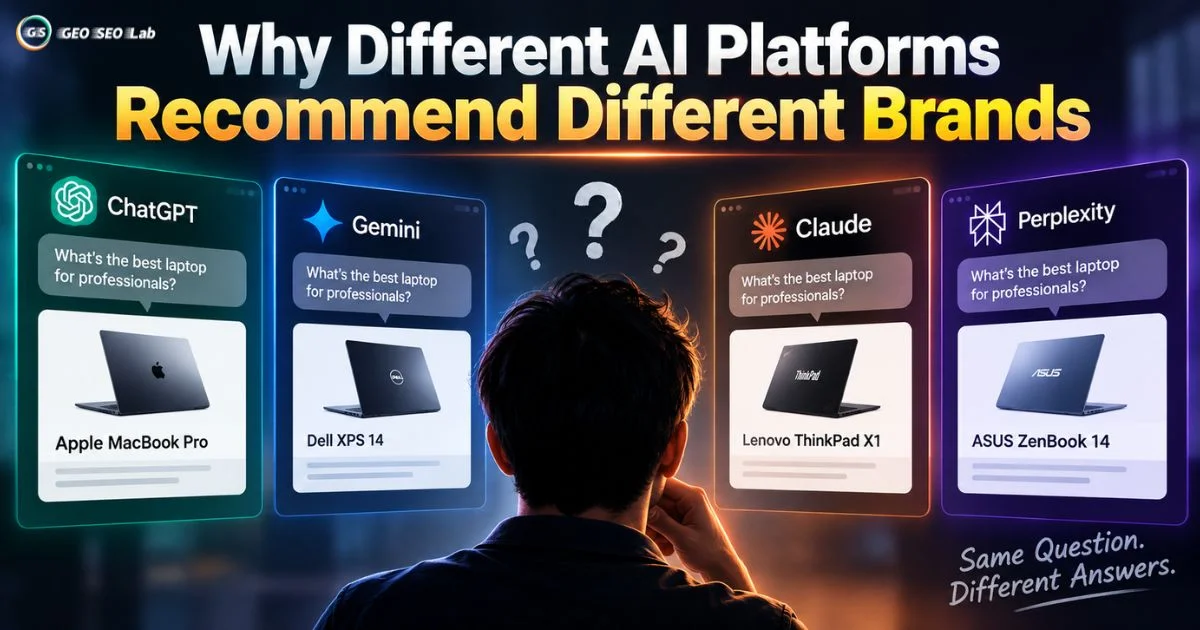
Why Different AI Platforms Recommend Different Brands
Why Different AI Platforms Recommend Different BrandsSame Question, Four Answers, Almost Zero OverlapA GEO SEO Lab ReportEditorial Disclosure: This re...