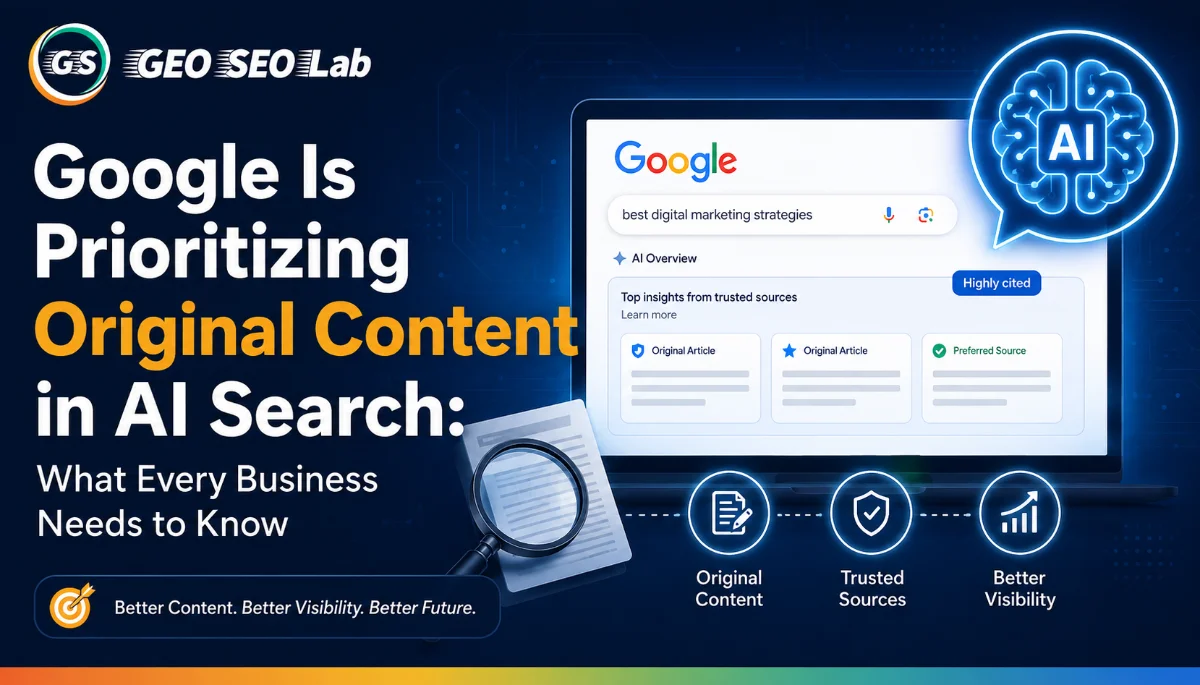
Google Is Prioritizing Original Content in AI Search: What Every Business Needs to Know
Google is reshaping AI Search by rewarding original, trustworthy content over mass-produced articles. Learn how businesses can improve SEO, GEO, topical authority, and long-term AI visibility.
Google Is Prioritizing Original Content in AI Search: What Every Business Needs to Know
The Biggest Shift in Search Is No Longer About Rankings
Search has changed many times over the last two decades, but the latest evolution feels different from everything that came before. Businesses that once focused almost entirely on keyword rankings are now facing an environment where search engines are becoming intelligent assistants instead of simple information directories. Instead of showing users a long list of blue links, AI-powered search is beginning to generate direct answers while choosing which websites deserve to be mentioned, referenced, or cited. That single change is transforming how digital visibility works.For years, many businesses believed that publishing more content automatically increased their chances of gaining traffic. Content calendars became larger, publishing schedules became faster, and thousands of articles were created around every possible keyword variation. While this approach worked for a long time, today's AI-driven search environment is encouraging a completely different mindset. The focus is gradually moving away from quantity and toward genuine value.
Organizations that continue relying only on mass content production may discover that their articles receive impressions but fail to become trusted references inside AI-generated answers. Meanwhile, businesses that consistently publish thoughtful research, expert analysis, and genuinely useful resources are beginning to gain stronger recognition. This transition represents far more than another search algorithm update. It represents a new way of evaluating knowledge on the internet.The future belongs to organizations capable of contributing something original rather than repeating information that already exists. Businesses that understand this shift early will build stronger authority while others continue competing only for rankings.
Why AI Search Is Changing the Rules of Digital Visibility
Artificial intelligence has introduced a completely different method for understanding content. Instead of matching keywords alone, modern AI systems analyze topics, relationships between ideas, author expertise, context, factual consistency, and overall usefulness. This allows search platforms to determine not only whether a page is relevant but also whether it deserves to become part of an answer that millions of users may trust.This creates a higher standard for publishers. A website is no longer competing only against pages targeting the same keyword. It is competing against every credible source capable of answering a user's question with greater clarity, stronger evidence, and better expertise.
Businesses often assume that technical optimization alone is enough to succeed. Technical SEO remains important because websites still need to load quickly, remain accessible, and provide a smooth user experience. However, technical excellence without meaningful information is becoming less effective as AI systems become better at recognizing genuine expertise.This change explains why organizations investing in real knowledge are increasingly outperforming websites built around repetitive articles. AI wants information that teaches, explains, and helps people solve problems instead of merely occupying search results.
From Ranking Pages to Referencing Knowledge
Traditional search engines rewarded pages that satisfied ranking signals. AI-powered search introduces another objective altogether. Instead of asking which webpage deserves Position One, AI asks which source deserves to become part of its answer.That distinction changes everything. A ranking simply places a webpage near the top of search results. A reference, however, represents trust. It means the AI system believes the information is reliable enough to help answer someone's question.This subtle difference creates an entirely new competitive landscape. Businesses are no longer optimizing only for visibility. They are optimizing for credibility.When an AI assistant references your content, your brand gains authority in a way that traditional rankings alone cannot achieve. Users naturally associate cited sources with expertise because the AI selected them while generating its response.
AI Understands Expertise Differently
Expertise cannot be manufactured through keyword repetition. It develops through experience, research, documented knowledge, and consistent publishing over time.Modern AI systems evaluate signals that go beyond simple optimization. They look for comprehensive explanations, logical structure, consistent terminology, updated information, and clear evidence supporting important claims.A company publishing thoughtful industry research naturally appears more valuable than another publishing hundreds of short articles repeating similar ideas.The difference becomes obvious when users search complex questions. AI-generated answers rely on sources capable of explaining concepts thoroughly rather than websites offering superficial summaries.Businesses that consistently educate their audience are therefore creating assets that remain valuable long after publication.
Why Original Content Has Become More Valuable Than Ever
Originality has always mattered, but AI search makes it significantly more important. The internet already contains millions of articles covering nearly every common topic imaginable. Publishing another version of the same information rarely creates additional value for readers or AI systems.Original content introduces something new into the conversation. It may include unique research, firsthand experience, practical implementation lessons, expert opinions, customer insights, or proprietary data collected through real work.When information cannot easily be found elsewhere, it naturally becomes more valuable.Businesses sometimes underestimate how much original knowledge already exists inside their own teams. Customer support departments understand recurring user problems. Consultants recognize implementation challenges. Engineers discover technical solutions during projects. Marketing teams collect behavioral insights from campaigns.
Much of this expertise never reaches published content.
Organizations that begin documenting this knowledge create resources competitors cannot easily copy because those insights originate from real-world experience rather than internet research.
Original Knowledge Creates Lasting Authority
Authority develops gradually through consistent contribution.
Every genuinely useful article becomes another building block supporting an organization's reputation. Over time these articles connect together, forming a knowledge ecosystem that demonstrates experience instead of simply claiming it.
Readers notice this difference almost immediately.A website containing detailed implementation guides, research findings, practical recommendations, and thoughtful analysis naturally feels more trustworthy than one publishing generic advice.
AI systems reach similar conclusions because comprehensive expertise creates stronger semantic relationships between articles.Instead of isolated blog posts targeting individual keywords, authoritative websites build interconnected collections of knowledge covering an entire subject area.
That depth becomes increasingly valuable as AI search continues evolving.
Rewriting Existing Articles Is No Longer Enough
Many businesses still create content by reading existing articles and rewriting the same information in different words. While this may appear unique in plagiarism tools, it often fails to provide readers with anything new or valuable. Modern AI search systems are becoming better at identifying content that simply repeats ideas already available online. If multiple websites explain a topic in almost the same way, another similar article adds very little value. Instead of focusing only on keywords, businesses should ask one important question before publishing: What new knowledge or practical insight will readers gain from this article? Answering that question helps create content that solves real problems, builds long-term authority, and stands out in AI-powered search.
Businesses Must Stop Measuring Success Only Through Traffic
Traffic is still an important measure because it helps businesses gain brand awareness, attract potential customers, and generate leads or sales. However, in the age of AI Search, traffic alone is no longer enough to measure online success. A website may be frequently mentioned or referenced in AI-generated answers even before it sees a noticeable increase in visitors. At the same time, another website may continue getting impressions but gradually lose credibility if AI systems stop recognizing it as a trusted source. That's why businesses should look beyond traffic and rankings by tracking how often their expertise is recognized, whether their research is being noticed, and if their educational content continues to build authority. Strong authority takes time to develop, but once established, it becomes a long-term competitive advantage that is difficult for others to match.
Visibility Without Trust Has Limited Value
High rankings and strong visibility can bring people to your website, but they do not automatically earn trust. The real question every business should ask is whether readers believe the information they publish. When users consistently find accurate, useful, and reliable content, they are more likely to return to the same website instead of searching elsewhere. AI systems follow a similar approach by repeatedly selecting trusted sources that provide dependable information. This is why businesses should focus on becoming reliable educators rather than simply publishing more content. As credibility grows over time, every new article strengthens the brand's reputation, creating sustainable visibility and long-term authority that cannot be achieved through shortcuts alone.
The Future Belongs to Knowledge Leaders
Every major shift in technology creates new opportunities for businesses that adapt early, and AI-powered search is no exception. Companies that continue focusing only on publishing large amounts of content may see fewer results over time, even if they increase their efforts. In contrast, businesses that invest in original research, expert insights, educational content, and real-world experience are building a stronger foundation for long-term growth. Becoming a trusted source doesn't happen overnight. It requires consistency, transparency, and a genuine commitment to helping people with accurate and valuable information. Organizations that start following this approach today are more likely to become the trusted sources that AI search systems recommend in the future.
Why Google's Latest AI Search Direction Matters More Than Most Businesses Realize
Many organizations still treat every Google update as another algorithm change that requires adjusting keywords, improving metadata, or fixing technical issues. While those improvements remain valuable, they no longer represent the complete picture of digital visibility. The introduction of AI-powered search signals something much larger. Search engines are becoming intelligent information systems that evaluate knowledge rather than simply ranking webpages.This evolution changes how businesses should think about content investment. Success is no longer determined only by how many pages a website publishes or how many keywords it targets. Instead, success increasingly depends on whether an organization contributes reliable, helpful, and original knowledge that AI systems believe deserves to become part of their answers.The companies benefiting from this transition are not necessarily the ones producing the highest number of blog posts every month. They are the businesses consistently publishing content that teaches something meaningful, explains complex ideas clearly, and demonstrates real experience instead of repeating information already available across hundreds of websites.This shift rewards patience, expertise, and quality. It encourages organizations to build authority over time instead of relying on shortcuts designed to manipulate rankings.
The Difference Between Being Found and Being Trusted
Traditional search focused heavily on discovery. If users searched for a keyword and your page appeared near the top of the results, your optimization efforts were considered successful. AI-powered search introduces another layer of evaluation because simply appearing in search results is no longer enough.AI assistants must decide which sources deserve inclusion inside generated answers. Every citation becomes a trust decision.This means businesses should stop asking only whether their pages rank well and begin asking whether their content is trustworthy enough to become a reference.
That difference may appear small, but it completely changes content strategy.Instead of writing for search engines, organizations begin writing for people while ensuring AI systems can clearly understand the expertise being demonstrated.
Over time this approach creates stronger credibility because both users and AI recognize the same qualities in excellent content.
Trust Is Becoming the Strongest Ranking Signal
Search technology has become increasingly effective at identifying information that users genuinely find valuable.
Helpful explanations, practical guidance, transparent authorship, updated information, and factual consistency all contribute toward stronger trust.When people repeatedly engage with reliable content, search platforms receive positive quality signals. AI systems also recognize patterns showing which sources consistently provide accurate information across different subjects.This creates a cycle where trustworthy publishers gradually receive greater visibility while low-value content slowly loses influence.Businesses should understand that trust cannot be added during the final editing stage of an article.It develops through consistent publishing standards, expert review, transparent information, and a long-term commitment to quality.Every article contributes either positively or negatively toward that reputation.
Why High-Volume Publishing Is Becoming Less Effective
Publishing large amounts of content once provided a competitive advantage because each article represented another opportunity to rank for additional keywords. Many companies built enormous content libraries based on this assumption.
The problem today is that AI systems can quickly recognize when dozens of articles essentially communicate the same ideas using different wording.Large publishing volumes alone no longer indicate expertise.Instead, AI evaluates whether each article contributes meaningful information beyond what already exists.A website containing five hundred average articles may provide less overall value than another containing fifty exceptional resources written by experienced professionals.This represents one of the biggest mindset changes modern content marketing has experienced.
Businesses should stop measuring productivity through article counts and begin measuring value through knowledge contribution.
More Articles Do Not Automatically Mean More Authority
Authority develops through usefulness rather than repetition.Publishing another article explaining basic SEO fundamentals rarely strengthens a website if countless similar guides already exist.However, publishing a detailed implementation case study showing how a business improved AI visibility using documented strategies provides something genuinely different.
That distinction matters because AI systems seek unique insights capable of improving answer quality.
Readers appreciate originality for the same reason.
People searching online generally hope to discover practical solutions instead of reading slightly modified versions of information they've already encountered elsewhere.Organizations that understand this naturally produce content attracting stronger engagement, more references, and greater long-term authority.
Quality Always Outlasts Quantity
Quantity can produce temporary growth, but quality creates lasting influence.A well-researched article often continues generating visibility years after publication because people repeatedly reference it when discussing the topic.
Generic articles rarely experience the same longevity because newer versions quickly replace them.Businesses investing additional time into research, editing, and expert contribution often discover that fewer high-quality publications outperform dozens of average posts.This approach also improves resource efficiency because every article becomes a long-term business asset instead of another piece requiring constant replacement.Rather than filling editorial calendars with repetitive content, organizations should focus on publishing resources they remain proud of years later.
The Rise of Information Value
Today, every article published online competes with millions of other pieces of content covering similar topics. This makes one question more important than ever: Why should someone read your article instead of another one? The answer lies in the value your content provides. If an article simply repeats information that is already available everywhere, it offers very little benefit regardless of how many words it contains. However, when content includes original insights, practical experience, unique examples, or expert knowledge, it helps readers learn something new and becomes far more valuable. AI-powered search systems also prefer this type of information because it improves the quality and accuracy of the answers they generate. Before publishing any content, businesses should ask themselves whether it genuinely helps readers understand the topic better than existing resources. If the answer is yes, the content has real information value.
Original Experience Is Difficult to Copy
Competitors can easily copy keywords, writing styles, or article structures, but they cannot copy the real experience gained from working with customers, solving problems, and managing projects over time. Every business has valuable insights hidden within its daily operations, including implementation challenges, customer feedback, successful campaigns, lessons learned, and industry observations. Sharing these real experiences creates content that stands out because it offers practical knowledge that cannot be found through simple internet research. Readers trust authentic experiences because they provide realistic solutions, and AI systems also recognize the depth and credibility that firsthand knowledge brings. This makes original experience one of the strongest advantages a business can have in AI-powered search.
Businesses Already Own Valuable Knowledge
Many businesses believe they need outside experts to create authoritative content, but in reality, they already have a wealth of knowledge within their own teams. Sales professionals understand customer concerns, support teams know the most common user questions, developers solve technical issues every day, consultants gain practical experience across different projects, marketers analyze changing customer behavior, and business leaders make important strategic decisions. When this knowledge remains inside the organization, it benefits only the internal team. By turning these insights into educational content, businesses can build public authority, strengthen their reputation, and increase their visibility in both traditional and AI-powered search over time.
Building Content That AI Actually Wants to Reference
Creating content for AI search does not mean writing specifically for artificial intelligence. Instead, it means creating content that is so useful, accurate, and informative that AI systems naturally choose it as a trusted source. The first step is understanding what readers actually want instead of focusing only on search keywords. Most people are not looking for more information—they are looking for better understanding and practical solutions. Content that provides detailed explanations, logical organization, expert insights, and actionable advice is far more likely to earn trust from both readers and AI systems. When information is clear, complete, and genuinely helpful, it has a much greater chance of being referenced in AI-generated answers.
Structure Improves Understanding
A well-structured article is easier for both readers and AI systems to understand. Every section should follow a logical flow so readers immediately understand the problem being discussed, why it matters, and how the content helps solve it. Random ideas placed together can confuse readers, while a clear structure builds confidence and keeps them engaged. Each heading should introduce a meaningful topic, and every paragraph should add new information instead of repeating previous points. A logical structure improves readability, strengthens topical relevance, and helps AI better understand the relationship between different ideas throughout the article.
Clarity Creates Confidence
Good content does not need complicated language to sound professional. In fact, the most trusted experts often explain difficult concepts in simple words that anyone can understand. Businesses should focus on making their content clear, direct, and easy to follow instead of using unnecessary technical terms. Readers appreciate straightforward explanations because they save time and improve understanding. AI systems also interpret clearly written content more effectively, making it more likely to be selected as a trusted source. Simple writing is not a sign of limited expertise—it is a sign that the author understands the subject well enough to explain it clearly. That ability builds confidence with readers and helps create lasting authority.
AI Search Rewards Consistency Over Short-Term Wins
Many businesses expect immediate results after publishing new content, but building authority in AI-powered search takes time. Every high-quality article strengthens a website's reputation and adds to its overall expertise. As businesses continue publishing useful and relevant content on the same topic, they gradually build a strong knowledge base that both readers and AI systems begin to recognize. Instead of focusing on short-term ranking changes, organizations should remain consistent with their content strategy because long-term success comes from trust, and trust is built through regular, high-quality publishing. Businesses that stay committed to this approach develop a stronger competitive advantage than those constantly changing strategies for quick results.
Why Topical Authority Is Becoming More Important Than Individual Rankings
Modern AI search no longer evaluates articles in isolation. Instead, it looks at how much expertise a website demonstrates across an entire subject. Publishing one good article may improve visibility for a short time, but creating a collection of detailed, interconnected content around the same topic builds lasting authority. When a website consistently answers important questions, shares practical insights, and keeps its content updated, it becomes a trusted source for both users and AI systems. This comprehensive approach helps businesses build stronger credibility than relying on individual keyword-focused articles.
A Knowledge Ecosystem Creates Stronger Visibility
Every article should support a larger content strategy instead of existing on its own. Businesses should create content that naturally connects with previous and future articles, helping readers learn more as they move through related topics. This interconnected structure improves the user experience while making it easier for AI systems to understand the depth of expertise across the website. Over time, each new article strengthens the value of existing content, creating a powerful knowledge ecosystem that contributes to long-term visibility.
Consistency Builds Long-Term Authority
Authority is not created by publishing one excellent article. It develops gradually through consistent effort and high-quality content over time. As businesses continue sharing valuable information, readers begin to trust their expertise, other websites may reference their work, and AI systems become more confident in recommending their content. These positive signals reinforce each other, making the website increasingly authoritative. Although this process requires patience, the long-term benefits are far more sustainable than temporary ranking improvements.
Businesses Should Invest in Research Instead of Repetition
Publishing content that simply repeats existing information rarely helps a business stand out. Instead, organizations should invest in research, customer insights, surveys, performance analysis, and real-world observations that provide something new to readers. Every business collects valuable information through its daily operations, and sharing these findings can transform ordinary business knowledge into trusted educational content. Research-backed articles build credibility because they offer evidence and unique perspectives that readers and AI systems both value.
Practical Experience Creates Better Educational Content
Real experience often provides insights that cannot be learned from theory alone. Businesses working directly with customers encounter challenges, discover effective solutions, and gain valuable lessons through everyday projects. Sharing these practical experiences helps readers understand how concepts work in real situations rather than ideal scenarios. Authentic examples make content more useful, while AI systems also recognize the value of firsthand knowledge, making practical experience an important factor in building long-term authority.
Transparency Strengthens Credibility
Readers are more likely to trust businesses that openly discuss both successes and challenges. Content that shares lessons learned, explains mistakes, or acknowledges limitations often feels more genuine than articles presenting perfect results. Transparency shows honesty and builds stronger relationships with readers because it reflects real professional experience. AI systems also benefit from balanced and trustworthy information, making transparent content more valuable than overly promotional material. Businesses that focus on educating rather than simply promoting themselves naturally develop stronger credibility over time.
The Future of SEO and GEO Will Work Together
AI-powered search does not replace traditional SEO; instead, it builds upon it. Technical SEO remains essential because websites still need to be crawled, indexed, and understood by search engines. Fast loading speeds, mobile-friendly design, structured data, and strong user experience continue to play an important role. At the same time, Generative Engine Optimization focuses on creating original, trustworthy content that AI systems are willing to reference. Businesses that combine strong technical SEO with expert content, topical authority, and genuine knowledge will be better prepared for the future of digital visibility.
Businesses Should Prepare for Continuous Change
Artificial intelligence continues to evolve, and search will keep changing in the coming years. Instead of reacting to every new update, businesses should focus on long-term principles that remain valuable regardless of technology. Publishing accurate information, sharing real expertise, updating content regularly, and helping users solve problems are strategies that will continue to build trust over time. Organizations that consistently follow these principles are more likely to adapt successfully to future developments in AI-powered search.
Final Thoughts
The future of AI search belongs to businesses that create meaningful knowledge rather than simply producing more content. Original ideas, practical experience, research, and educational resources are becoming the foundation of long-term digital authority. Every valuable article strengthens a brand's credibility, expands its topical expertise, and increases the likelihood of being recognized by AI systems. Companies that invest in helpful, trustworthy, and original content today will be better positioned to earn lasting visibility, stronger audience trust, and sustainable growth as AI-powered search continues to evolve.
Frequently Asked Questions
Find answers to common questions about this topic
About the Author

Aman Kesharwani
SEO Expert & Content Creator
Experienced digital marketing professional specializing in SEO strategies, content optimization, and data-driven marketing solutions. Passionate about helping businesses grow their online presence and achieve better search rankings.
Related Articles
View all posts
Your Brand Can Win AI Search and Still Lose the Click
AI Search Zero Click, Zero Click Search, AI Search, AI Overviews, GEO SEO, Generative Engine Optimization, AI Visibility, SEO Traffic, Search Visibility, Brand Visibility, AI Search Optimization, Organic Traffic
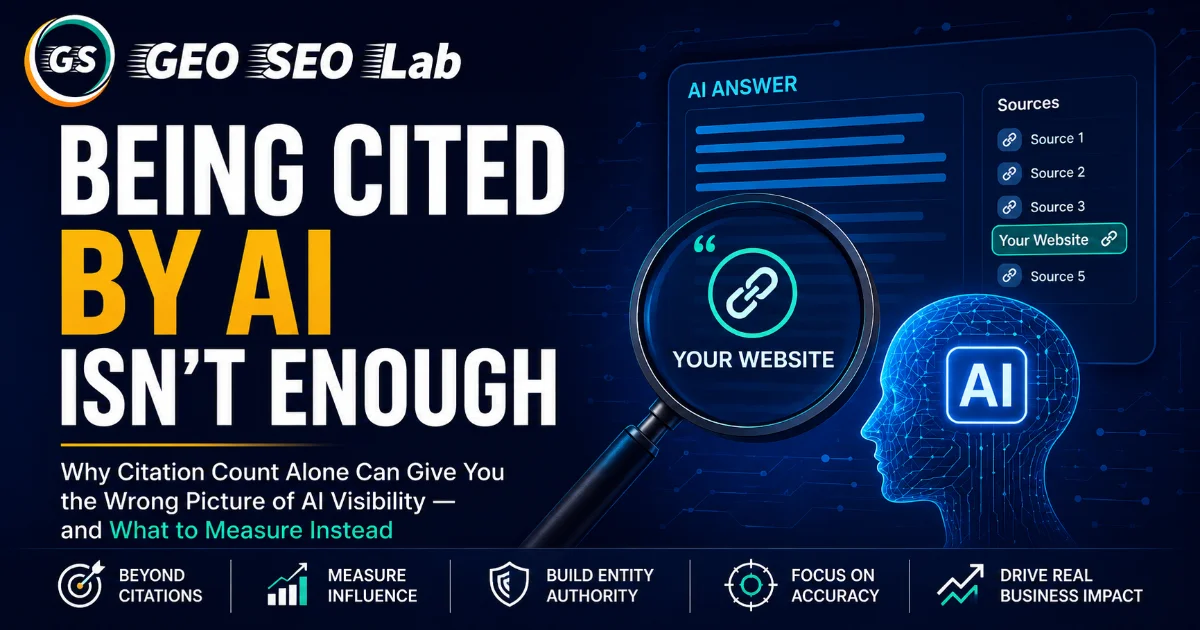
Being Cited by AI Isn't Enough: Why AI Visibility Needs Better Metrics
AI citation count can show that your content is being selected, but it does not reveal how much your knowledge actually influences AI generated answers. Learn why businesses need to measure informational contribution, content quality, entity authority, accuracy, competitive visibility, and real business impact.
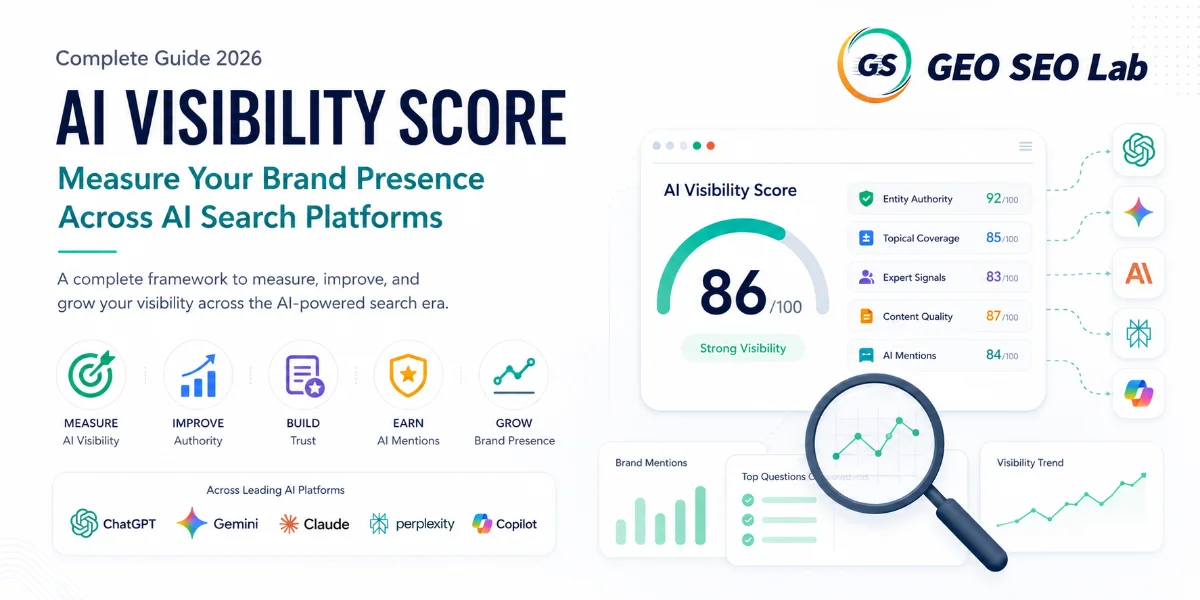
The AI Visibility Score: Measure Brand Presence Across AI Search
Learn how to measure and improve your AI Visibility Score across ChatGPT, Google AI Mode, Gemini, Claude, Perplexity, and modern AI search platforms.