Google AI Search Is Creating a New Competition Between Rankings and Source Selection
Google AI Search is changing how businesses compete for online visibility. Ranking high in traditional search is still important, but businesses also need to become trusted sources that search systems can select for answers. This guide explains why source selection matters, how original knowledge, expert experience, evidence and topic authority influence visibility, and what businesses can do to build stronger AI search presence.
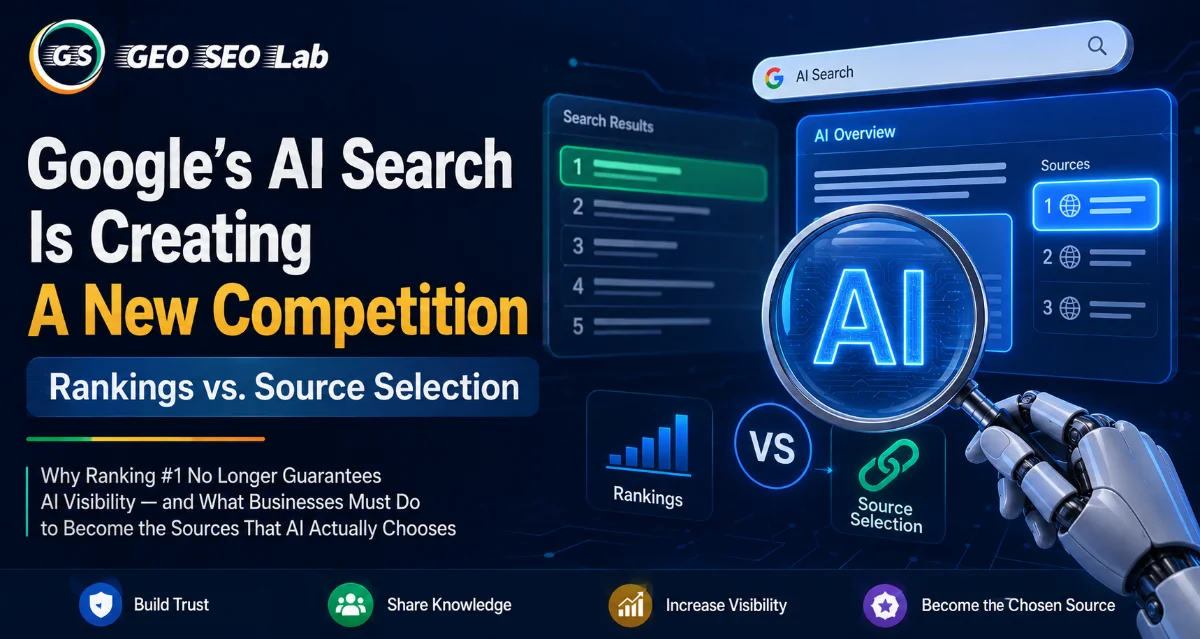
Google Search Is Creating a New Competition Between Rankings and Source Selection
Why Ranking Number One Is No Longer Enough
For many years, businesses believed that reaching the first position on Google was the clearest sign that their search strategy was working. A company that ranked number one for an important keyword usually received more visibility, more visitors and more opportunities to turn those visitors into customers.That idea still matters, but search is changing. Today, a company can have a strong position in traditional Google results and still receive very little visibility when people ask questions through newer search experiences.Imagine a company that ranks first for one of its most important keywords. Its website receives regular visitors and its pages have strong search performance. From a traditional SEO point of view, everything looks positive.Now imagine someone asks Google AI Mode, ChatGPT or Gemini the same question that the company has been targeting for years. The system provides a detailed answer and recommends several sources. The company that ranks first does not appear among those sources.At the same time, another company that ranks fifth or sixth for the same topic is mentioned in the answer. Its research report is referenced. Its data is used. Its explanation becomes part of the answer.This situation can be confusing for businesses because both companies may appear successful when traditional search measurements are considered. The difference becomes visible only when businesses look at how information is selected for answers.Traditional search is mainly concerned with deciding which pages should appear and in what order. New search experiences also need to decide which information is useful enough to include in an answer and which sources are worth showing to the user.
This creates a second form of competition.
Businesses are no longer competing only for a better position in search results. They are also competing to become a source that search systems trust enough to mention and recommend.That change does not mean traditional SEO has become useless. Search rankings, website quality, technical performance and authority still matter. The important point is that they are no longer the complete picture.Businesses now need to think about two connected goals. They need to make their websites easy to discover and understand, while also building knowledge that is useful, credible and worth referring to.
Traditional Search Rankings Are Still Important
How Traditional Search Works
Traditional Google Search has always followed a simple purpose. When someone searches for something, Google tries to find pages that are relevant to the question and useful for the person searching.A large number of factors can influence where a page appears. The quality of the website matters. The relevance of the content matters. Technical accessibility matters. Links and authority signals matter. The overall usefulness of the page also matters.Businesses have spent years improving these areas because higher rankings can bring more visitors.This model created a clear relationship between visibility and traffic. A page appearing near the top had a greater opportunity to receive clicks than a page appearing much lower.This is why keyword research, technical SEO, internal linking, content creation, website speed and authority building became important parts of digital marketing.There is nothing wrong with this approach. Businesses still need strong search visibility.The problem begins when companies assume that a high ranking automatically means that their content will be used whenever a search system creates an answer.
That is not necessarily true.
Search Rankings and Source Selection Are Different
A search ranking tells us where a page appears in a traditional list of results.Source selection is about whether information from a website is useful enough to become part of an answer.These two things can overlap, but they are not identical.
A page can rank highly because it is relevant, technically strong and authoritative. However, another page may provide original research, detailed evidence or a unique explanation that is more useful when an answer is being prepared.
This creates an important difference for businesses.Ranking asks which page should appear prominently.Source selection asks which information can help create a better answer.The second question requires a deeper understanding of content quality.A page that simply repeats information found on many other websites may still rank well. However, it may not give a search system a strong reason to choose it over another source.A page that contains original information, real experience, useful evidence and a clear explanation can provide something different.
That difference can become valuable when search systems decide which sources to mention.
The Two Search Competitions Businesses Need to Understand
The First Competition Is Search Ranking
The first competition is familiar to almost every SEO professional.Businesses try to make their pages relevant to search queries. They improve technical performance. They build useful content. They earn links. They improve website structure. They make pages easier for search engines to understand.The goal is better visibility in traditional search results.
Success can be measured through rankings, impressions, clicks, traffic and conversions.
These measurements remain important because people still use traditional search results every day.
The Second Competition Is Source Selection
The second competition is newer.When a person asks a detailed question through an AI search experience, the system may look at information from different sources and create a combined answer.The system needs to understand the question first. It then needs to find relevant information, evaluate the quality of that information and decide which details are useful.After preparing the answer, it may show links or references to sources that can help the person explore the subject further.This makes source selection a different type of competition.A website is not simply trying to appear in a position. It is trying to become useful enough to be included.That requires businesses to think beyond keywords and rankings.They need to ask a more important question.What does our content provide that another reliable source does not provide in the same way?
What Makes a Website Worth Selecting as a Source
Original Knowledge Matters
One of the strongest ways a business can become valuable as a source is by publishing information that does not already exist everywhere else.Consider two articles about the same subject.The first article collects information from several public sources and explains it in a simple way. The second article includes the company's own research, customer observations, practical results and original analysis.
Both articles may be well written.
However, the second article contributes more information to the wider knowledge available online.This is important because repeating existing information does not create much additional value.Businesses should therefore look at their own experience and ask what knowledge they have that competitors cannot easily reproduce.This could come from customer data, internal research, project results, surveys, experiments, industry observations or years of practical work.
Real experience is difficult to copy.
Expert Experience Builds Trust
People naturally trust information more when they understand who is providing it and why that person is qualified to discuss the subject.The same principle matters when businesses want their content to appear trustworthy.
A page written by an identifiable professional with relevant experience provides more context than a page published under a generic company name.An expert profile can explain the person's background, professional experience, areas of knowledge and previous work.When this information is consistent across the website and professional platforms, it becomes easier to understand the organization and the people behind its content.
Businesses should not simply claim expertise.
They should show it.A professional profile, published research, case studies, speaking experience and documented work can provide evidence that supports those claims.
Evidence Makes Information Stronger
A strong statement becomes more useful when it is supported by evidence.
For example, saying that a certain strategy improves website performance is less convincing than showing the results of an actual project.Evidence can include research findings, company data, case studies, surveys, documented outcomes and credible references.Businesses should make an effort to support important claims whenever possible.This does not mean every sentence needs a reference.It means that significant statements should have a clear basis.
The difference between saying something and demonstrating something becomes increasingly important when businesses want their content to be treated as reliable information.
Why Generic Content Is Losing Its Value
The Internet Already Contains Huge Amounts of Similar Information
The internet has millions of articles explaining common subjects.For many topics, a person can find dozens of pages that provide almost the same information.One article may use different words from another, but the actual knowledge remains similar.This creates a problem for businesses that depend only on producing more articles.Publishing more content does not automatically make a company more authoritative.If every new article simply explains what hundreds of existing articles already explain, the total amount of useful knowledgeprovided by that company may not increase very much.
This is why content volume should not be the only goal.A smaller collection of genuinely useful resources can be more valuable than a large collection of repetitive articles.
More Content Does Not Always Mean More Authority
Many companies believe that publishing every day will automatically create stronger visibility.Frequency can be useful, especially when a business has important developments to share.But publishing frequently without adding new information can create a large archive without creating strong knowledge authority.The better question is not how many articles were published this month.The better question is how much useful knowledge those articles added.A company that publishes ten articles containing original findings may create more long term value than a company publishing fifty articles that repeat existing information.
This is especially important when businesses want their content to become a trusted source.
The Knowledge Value Equation
What Creates Real Knowledge Value
Useful content usually combines several important qualities.Original research provides information that cannot easily be found elsewhere.Expert experience adds practical understanding.Evidence supports important claims.Clear explanation makes complicated subjects easier to understand.Fresh information keeps the content accurate and useful.
When these qualities work together, the result is much stronger than content that simply contains keywords and basic information.A business should therefore review important content and ask whether it contains genuine knowledge value.
If the content was removed from the internet tomorrow, would readers lose something useful?
If the answer is no, the content may need stronger research, better examples, more experience or more original analysis.
Clear Explanation Is Still Important
Original information alone is not enough.A company can have excellent research but explain it poorly.
If readers cannot understand the information, the value of that research decreases.Businesses should therefore focus on simple language, logical organization and clear explanations.Technical subjects should be explained in a way that both experienced professionals and new readers can understand.
Good content should not try to sound complicated.
It should try to make the subject easier to understand.
Entity Authority Is Becoming More Important
Search Systems Need to Understand the Organization
Traditional SEO often focuses heavily on individual pages.Businesses ask whether a page is optimized correctly, whether the keyword appears in important places and whether the page has enough authority.For newer search experiences, the organization behind the page also matters. Search systems need to understand who the company is, what it does, what subjects it knows and whether its identity is consistent across the internet.If a company describes itself differently on its website, LinkedIn profile, business directories and other platforms, understanding the organization becomes harder.
Consistency creates clarity.The company name should remain consistent.The description of the company should be clear.The expertise areas should be understandable.Expert contributors should have professional information that can be verified.
Why Consistency Matters
Imagine a company that calls itself a software company on its website, a digital marketing agency on one platform and an SEO consultancy on another platform.All three descriptions may be partly correct, but together they create confusion.
A clearer organization would explain exactly what it does and maintain similar information across important platforms.
The same applies to people who contribute content.If an article is written by an expert, the reader should be able to understand who that person is and why their experience matters.
This creates stronger trust around the content.
Building Topic Authority
Authority Comes From Depth
Publishing one article about a topic does not demonstrate complete knowledge.A company that wants to become known for a subject needs to cover that subject from different angles.A strong knowledge ecosystem may include beginner explanations, advanced guides, practical examples, research, case studies, frequently asked questions and current updates.Each resource should connect naturally with the others.This allows the website to demonstrate that the company understands the topic beyond a single article.
Beginner Content
Every important topic needs clear introductory information.New readers should be able to understand the basic concepts without feeling lost.Definitions should be simple.Important ideas should be explained before complex details are introduced.This creates a strong foundation for the rest of the knowledge available on the website.
Advanced Content
Beginner content alone cannot demonstrate deep expertise.Businesses should also discuss complex situations, implementation problems, limitations and practical decisions.This is where real experience becomes valuable.
A professional who has worked on the subject can explain problems that are difficult to understand from general information alone.These practical details often make content more useful and more distinctive.
Research Content
Research can become one of the strongest assets in a knowledge strategy.
A company can conduct surveys, study internal data, analyze industry trends or investigate a problem that matters to its customers.The research should be carefully documented.The methodology should be understandable.The findings should be explained clearly.When research is based on information that competitors do not have, it becomes difficult to reproduce.
That creates lasting value.
Information Gain Is a Simple Test for Content Quality
What Information Gain Means
Information gain means the amount of genuinely useful new understanding that a reader receives from content.
Length does not automatically create information gain.A three thousand word article can provide less value than a thousand word article if most of the longer article repeats information already available elsewhere.The important question is whether the reader learned something useful.This makes information gain a powerful test for content planning.
Before creating an article, businesses should ask whether the planned content adds something new.
If the answer is no, the topic may need a different approach.
The Information Gain Test
Imagine that an experienced reader already knows the basic information about a subject.Would that person learn something new after reading your article?Perhaps your company has data that others do not have.Perhaps your team has solved a difficult problem.Perhaps you have developed a useful framework.Perhaps you have studied a trend for several years.Perhaps you have worked with hundreds of customers and discovered a pattern.These are valuable forms of information.They give readers a reason to choose your content instead of another general explanation.
Five Practical Ways to Build Stronger Source Selection Eligibility
Conduct a Knowledge Contribution Audit
The first step is to review the existing content library honestly.Businesses should examine their most important articles and ask what each one contributes.Some pages may contain original research.Some may provide strong practical experience.Some may simply repeat common information.The goal is not to remove every basic article.
Basic articles still have value for new readers.The goal is to understand where the strongest knowledge currently exists and where the biggest gaps are.This audit can help businesses stop spending resources on content that adds little value.
Build Knowledge Hubs
A website should not look like a random collection of articles.
Important subjects should have a clear central resource supported by related pages.For example, a company may create a detailed guide about a major topic.That guide can connect to beginner explanations, advanced resources, research, case studies and frequently asked questions.Together, these resources create a complete knowledge hub.The reader can move from one part of the subject to another without leaving the website.This also helps search systems understand the relationship between the company's content.
Invest in Original Research
Research should become part of the long term content strategy rather than an occasional project.A company does not need a large research department to begin.It can start with a focused survey, customer study, internal data analysis or industry report.The important thing is that the research should provide information that is genuinely useful.Over time, a regular research program can create a strong library of original knowledge.Each new report can build on previous findings.
The company can become known for producing information instead of only commenting on information produced by others.
Create Strong Expert Profiles
Businesses should make their contributors visible.An expert profile should explain professional experience, areas of knowledge and relevant work.The person's published content should be connected to the profile.The same professional identity should also be visible on appropriate external platforms.This creates a clearer connection between the person and their expertise.A strong author profile is not about adding impressive sounding words.It is about providing information that can be checked and understood.
Maintain Important Content
Good content can become outdated.Industries change.Products change.Research changes.Search systems change.
Customer expectations change.A page that was accurate two years ago may need updates today.Businesses should therefore create regular review schedules for important content.Fast changing subjects may need more frequent reviews.
Stable subjects may need less frequent reviews.The important point is to make content maintenance a regular responsibility rather than something done only when a problem appears.
Why Case Studies Are Valuable
Real Work Creates Strong Evidence
Case studies can show what a company has actually done.Instead of simply claiming that a strategy works, a case study can explain the situation, the work performed and the result.The information should be specific where possible.
For example, instead of saying that website traffic improved significantly, a company can explain how traffic changed during a defined period and what actions contributed to the result.Real examples help readers understand how ideas work outside theory.They also provide evidence of practical experience.
Documenting Results Properly
A useful case study should explain the starting situation.It should describe the problem.It should explain the approach.It should discuss important decisions.It should present the result.It should also be honest about limitations.Not every project produces perfect results.Showing what went wrong can sometimes make a case study more useful because readers learn from real challenges.
Why Knowledge Hubs Are Better Than Random Article Collections
Connecting Related Information
A strong website should make it easy for readers to move between related resources.A detailed guide can link to a research report.The research report can link to a practical case study.The case study can link to a beginner explanation.
Frequently asked questions can connect back to the main guide.These relationships create a stronger knowledge structure.The website becomes more than a group of separate pages.It becomes a connected source of information.
Serving Different Types of Readers
Not every visitor knows the same amount about a subject.A beginner may need a simple explanation.An experienced professional may want advanced details.A decision maker may want examples and results.A researcher may want original data.A good knowledge hub serves all of these needs.This is one reason comprehensive coverage is more valuable than simply publishing a large number of similar articles.
Traditional SEO and GEO Should Work Together
SEO Still Provides the Foundation
Businesses should not abandon traditional SEO.Technical SEO remains important.A website still needs to be accessible.
Pages still need to be understandable.Content still needs to match user needs.Internal linking still matters.Authority still matters.Website performance still matters.Without these foundations, valuable information may not be easy to discover.The mistake is thinking that these foundations are the entire strategy.They provide access and visibility, but businesses also need strong knowledge if they want to become trusted sources.
GEO Adds Another Layer
GEO focuses on improving the chances that useful knowledge from a business can be understood and selected within generative search experiences.This means businesses need to think about information quality, entity clarity, expert credibility, original research and comprehensive topic coverage.The strongest strategy combines both areas.A technically strong website with weak knowledge may struggle to become a preferred source.A company with excellent knowledge but a poorly accessible website may also struggle to receive visibility.
Both sides matter.
How Businesses Should Measure AI Search Visibility
Traditional Metrics Are Not Enough
Businesses usually monitor rankings, impressions, clicks, traffic and conversions.These measurements are still useful.
However, they do not show everything that happens when people use conversational search.A company may receive a mention inside an answer even when the user does not click immediately.The company may influence a customer's understanding before the customer visits the website.This creates a measurement challenge.Businesses need to add new measurements to their existing reports.
Source Mention Frequency
One useful measurement is how often a company is mentioned when important questions are asked.Businesses can create a list of important queries related to their products, services and expertise.They can then regularly test those queries across major search and conversational platforms.The results can be recorded over time.This creates a basic visibility history.
Citation Frequency
Another useful measurement is how often specific pages are cited or linked.A company may discover that one research report is frequently referenced while ten other articles receive little attention.This information can guide future content investment.Instead of creating more average articles, the company can study why the research report performs well and use those lessons in future work.
The New Meaning of Ranking Number One
Ranking Still Matters
There is no reason for businesses to stop caring about first page rankings.People still click search results.Search traffic can still generate leads, sales and brand recognition.Strong ranking performance remains a valuable business asset.
The important change is that ranking should no longer be treated as the only sign of search success.
Becoming a Trusted Source Is Another Milestone
A company should also ask whether its knowledge is being selected when important questions are answered.
Being mentioned as a trusted source can create a different type of visibility.It shows that the company's information is useful enough to become part of the answer.This is particularly valuable for complex topics where people want explanations rather than simple links.The future of search visibility is therefore likely to involve both ranking and source selection.
The Executive Strategy for Businesses
Start With a Clear Objective
Business leaders should redefine the content objective.Instead of simply asking how many articles can be published, they should ask how the organization can become a trusted source in its most important areas.This changes the way content decisions are made.Keyword research remains useful.But it should be combined with questions about knowledge contribution.What does the company know better than others?What information can it prove?What original research can it produce?What customer problems has it solved repeatedly?What expertise can it document?These questions lead to stronger content opportunities.
Focus on Two or Three Important Topics
Businesses should not try to become experts in everything.It is better to select a few subjects where the organization has genuine experience.The company can then build deep coverage around those subjects.Over time, this creates stronger recognition than publishing shallow content across dozens of unrelated areas.Depth should come before expansion.
Strengthen the Organization's Identity
The organization should be easy to understand.Its name should remain consistent.Its description should remain consistent.Its expertise should be clearly communicated.Its experts should have identifiable professional profiles.
Its website should provide accurate organization information.Structured data can also help communicate important details in a format that search systems can process.
These steps create clearer signals around the organization.
Editorial Quality Should Become a Business Standard
Every Important Claim Should Have Support
Businesses should review significant claims before publishing them.If a claim is based on research, the source should be clear.If it is based on company experience, the context should be explained.If it is based on data, the relevant information should be presented accurately.This approach creates more reliable content.
Publishing Less Can Sometimes Be Better
There is pressure in digital marketing to publish constantly.But businesses should not confuse activity with progress.
If the team spends a month creating ten articles that provide little new information, the result may be less valuable than spending the same time creating one strong research report.The goal should be useful knowledge.Publishing frequency should support that goal rather than replace it.
Why Original Research Can Create a Long Term Advantage
Research Is Difficult to Copy Quickly
Competitors can copy a headline.They can copy a topic.They can create a similar article.It is much harder to copy original research based on unique data and years of experience.This makes research particularly valuable for companies that want to establish authority.A good research report can attract references from other websites.It can become the basis for future articles.It can support social media content.It can provide information for presentations.It can strengthen the company's reputation.One strong research project can therefore create value across many channels.
Research Builds Over Time
A company that publishes research every year creates a history of knowledge contribution.The first report may receive limited attention.The second report can build on the first.The third report can compare new findings with previous findings.
After several years, the organization has created something that a new competitor cannot reproduce immediately.
This is why knowledge authority can become a long term business asset.
The Authority Flywheel
Knowledge Creates Recognition
Original knowledge can attract attention.Attention can lead to references.References can improve recognition.
Recognition can increase trust.Greater trust can create more opportunities to publish research.Those opportunities can create even more original knowledge.This process can continue over time.The important point is that authority grows through repeated contribution.A business cannot create strong authority overnight by publishing a large number of pages.
Authority is built through consistent evidence of knowledge.
How to Create Better Content From Existing Business Experience
Start With Customer Questions
Businesses already receive valuable information every day.Sales teams speak with customers.Support teams solve problems.Consultants work on projects.Developers fix technical issues.Managers make decisions.All of these activities create knowledge.Content teams should collect those experiences.A common customer question can become an article.A repeated problem can become a guide.A successful solution can become a case study.A pattern found across many customers can become research.This approach creates content based on real business knowledge rather than generic topics.
Turn Internal Knowledge Into Public Knowledge
Many organizations have experts who know a lot but rarely publish.Their knowledge remains inside meetings, documents and conversations.Businesses should create systems for turning that experience into useful public resources.An interview with a specialist can become a detailed article.A project review can become a case study.Internal research can become a public report.A repeated customer problem can become an educational guide.This can dramatically improve the value of a content library.
The Importance of Freshness
Information Changes
Freshness does not mean changing the publication date every few months.It means making sure that the information remains accurate.A page should be reviewed when important facts change.Statistics should be updated when newer data becomes available.Old examples should be replaced when they no longer represent current conditions.References should be checked.Broken information should be corrected.This creates a healthier knowledge library.
Updating Important Pages
Not every page needs constant updates.Businesses should identify their most important resources.
These may include major guides, research reports, service explanations and pages that receive significant traffic.
Those pages should receive more attention.A strong maintenance process protects the value of previous content investments.
Common Mistakes Businesses Should Avoid
Creating Content Only Because Competitors Created It
A competitor publishing an article does not automatically mean your company needs the same article.Businesses should first ask whether they can provide a better explanation, stronger evidence or a unique perspective.
If they cannot, simply creating another version may add little value.
Chasing Keywords Without Knowledge
Keywords are useful for understanding what people search for.But keywords alone do not create expertise.A company can target thousands of keywords and still fail to become a trusted source.The content needs substance behind the keyword strategy.
Publishing Without Expert Involvement
Content teams can research topics, but professional experience can make content much stronger.Experts can provide examples, explain difficult situations and identify details that generic research may miss.
Their involvement can turn ordinary content into practical knowledge.
Ignoring Entity Information
Businesses sometimes spend large amounts of time optimizing articles while ignoring basic information about the organization.The company name may be inconsistent.Author information may be missing.Professional profiles may be incomplete.Business descriptions may differ across platforms.These problems can make the organization harder to understand.
Measuring Only Traffic
Traffic is important, but it does not tell the complete story.A page can influence a buyer even when the person does not click immediately.A research report can be referenced by other sources.A company can become known for a subject without receiving massive traffic from one article.Businesses should therefore measure both direct performance and broader authority signals.
A Practical Content Strategy for the Next Year
First Stage
Start by identifying the subjects where the company has genuine expertise.Review existing content.Find the strongest pages.Identify repetitive pages.Look for missing information.Find internal experts.Collect customer questions.This creates a clear picture of the current knowledge position.
Second Stage
Choose the most important topics.Build a central resource for each topic.Connect related explanations.Add practical examples.Develop case studies.Plan original research.Improve author profiles.Make organization information consistent.
Third Stage
Publish high value resources.Do not rush the process.Research the subject properly.Include evidence.Use real experience.Explain difficult ideas clearly.Connect the resource to related pages.Make sure readers can understand what makes the content useful.
Fourth Stage
Monitor how the content performs.Look at traditional search rankings.Check organic traffic.Monitor important queries across conversational search experiences.Record mentions and citations.Compare the company's visibility with important competitors.Use the findings to decide what to create next.
Complete Readiness Review
Knowledge Contribution
The company should be able to identify content that provides information not easily available elsewhere.It should have a plan for publishing original research.Its expert contributors should have clear professional information.Its case studies should explain real work and real outcomes.The company should know which resources are being referenced by other authoritative sources.
Topic Authority
Important topics should have complete knowledge hubs.The main resources should connect naturally with supporting resources.Important subjects should have beginner explanations and advanced information.Research and case studies should support major topics.The company should demonstrate greater depth in its most important areas.
Organization Clarity
The company name should remain consistent.The company description should remain clear.Expert profiles should be complete.Important organization information should be available in structured formats where appropriate.Different online platforms should not provide confusing information about the company.
Editorial Quality
Important claims should have supporting evidence.Important content should have review schedules.Someone should be responsible for maintaining major resources.Content should be created because it provides value, not simply because the publishing calendar requires another article.Major resources should be updated when information changes.
Visibility Measurement
The company should regularly check important questions across major search experiences.It should record whether the company is mentioned.It should record which pages are cited.It should monitor competitors.It should compare results over time.The findings should influence future content decisions.n.
The Future of Search Visibility
Search is becoming more conversational.People are increasingly asking complete questions instead of entering only short keywords.They want explanations.They want comparisons.They want recommendations.They want practical answers.
This means businesses need to think about how their knowledge can help answer those questions.The companies that focus only on ranking may continue to receive traditional search traffic.But companies that also build strong knowledge authority can create visibility in more places.The goal should not be to predict every change in search technology.
The goal should be to build an organization that consistently produces useful, trustworthy and original information.
That approach remains valuable regardless of how search interfaces change.
Conclusion
The biggest change in modern search is not simply a new feature or a different search screen.The deeper change is the way information is discovered.For many years, businesses competed mainly to place their pages near the top of search results.That competition still exists.But businesses now also need to compete to become sources that search systems consider useful enough to include in answers.
This creates a new responsibility for content teams.They cannot depend only on keyword optimization.They need to develop knowledge.They need to document real experience.They need to publish original research.They need to support important claims with evidence.They need to make expert contributors visible.They need to build complete topic coverage.They need to keep important information current.They also need to make the identity of the organization clear across the internet.The strongest businesses will not choose between traditional SEO and GEO.
They will build strong technical and search foundations while also investing in genuine knowledge authority.
The difference will become increasingly important as people use conversational search to research products, compare businesses and understand complex subjects.Ranking number one will still be valuable.
But becoming the source that search systems trust can become an equally important achievement.
The companies that start building this authority today will have an advantage because knowledge takes time to develop.Original research takes time.Expert recognition takes time.A strong knowledge hub takes time.A consistent organizational identity takes time.Trust takes time.Businesses that wait until every competitor is already investing in these areas may find it much harder to catch up.The better approach is to begin with the knowledge the organization already has.Find what the team knows better than others.Find the problems the company has solved.Find the data that can be studied.Find the experts who can contribute.Find the questions customers repeatedly ask.Then turn those experiences into useful resources.Over time, these resources can create a connected body of knowledge that demonstrates real expertise.
That is the foundation of long term visibility.Search rankings can bring people to a website.Useful knowledge can give them a reason to trust the organization.The future belongs to businesses that can do both.
Frequently Asked Questions
Find answers to common questions about this topic
About the Author

Aman Kesharwani
SEO Expert & Content Creator
Experienced digital marketing professional specializing in SEO strategies, content optimization, and data-driven marketing solutions. Passionate about helping businesses grow their online presence and achieve better search rankings.
Related Articles
View all posts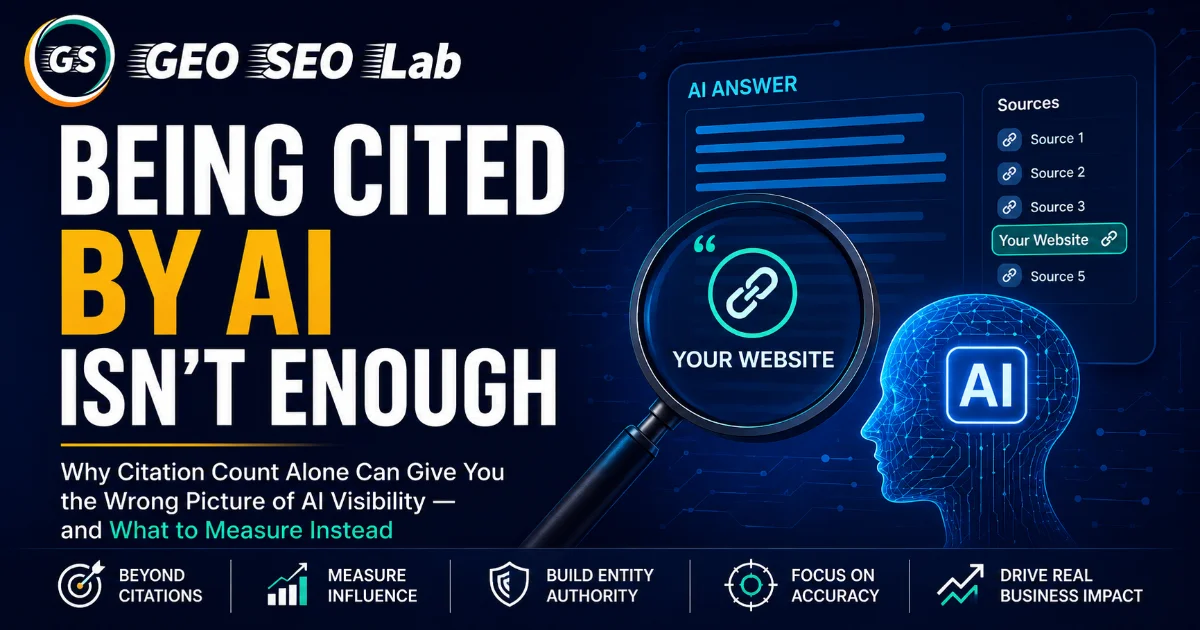
Being Cited by AI Isn't Enough: Why AI Visibility Needs Better Metrics
AI citation count can show that your content is being selected, but it does not reveal how much your knowledge actually influences AI generated answers. Learn why businesses need to measure informational contribution, content quality, entity authority, accuracy, competitive visibility, and real business impact.
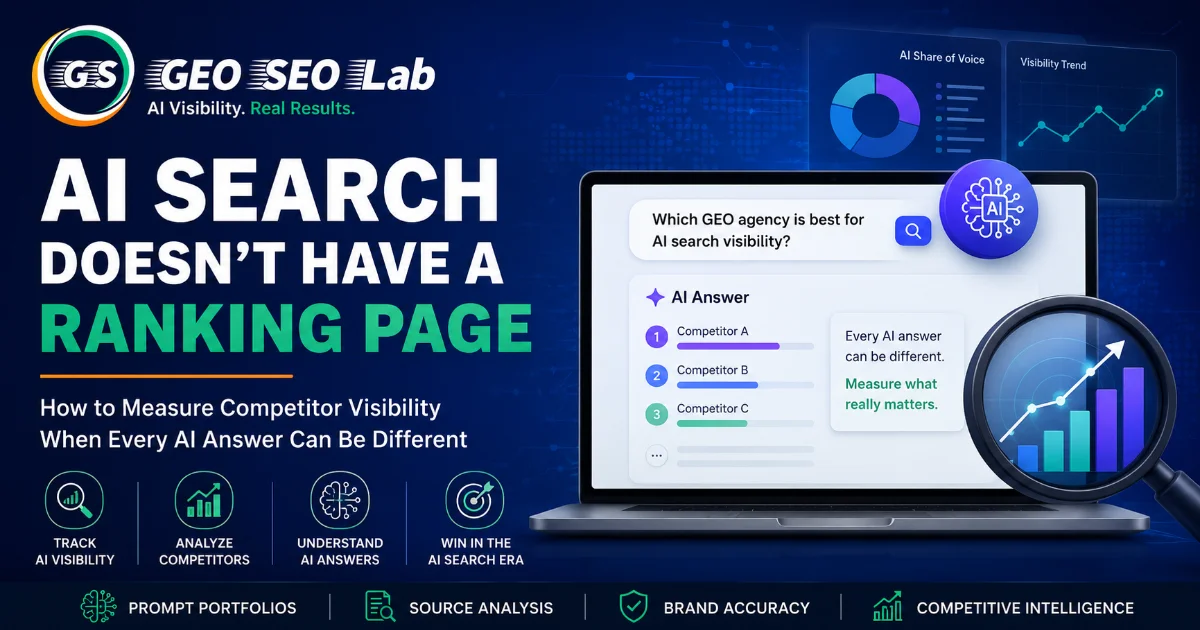
AI Search Doesn’t Have a Ranking Page: How to Measure Competitor Visibility
AI search has changed how businesses compete online. Learn how to measure AI competitor visibility, track AI Share of Voice, analyze brand mentions, monitor competitors, and build a practical AI competitive intelligence strategy.
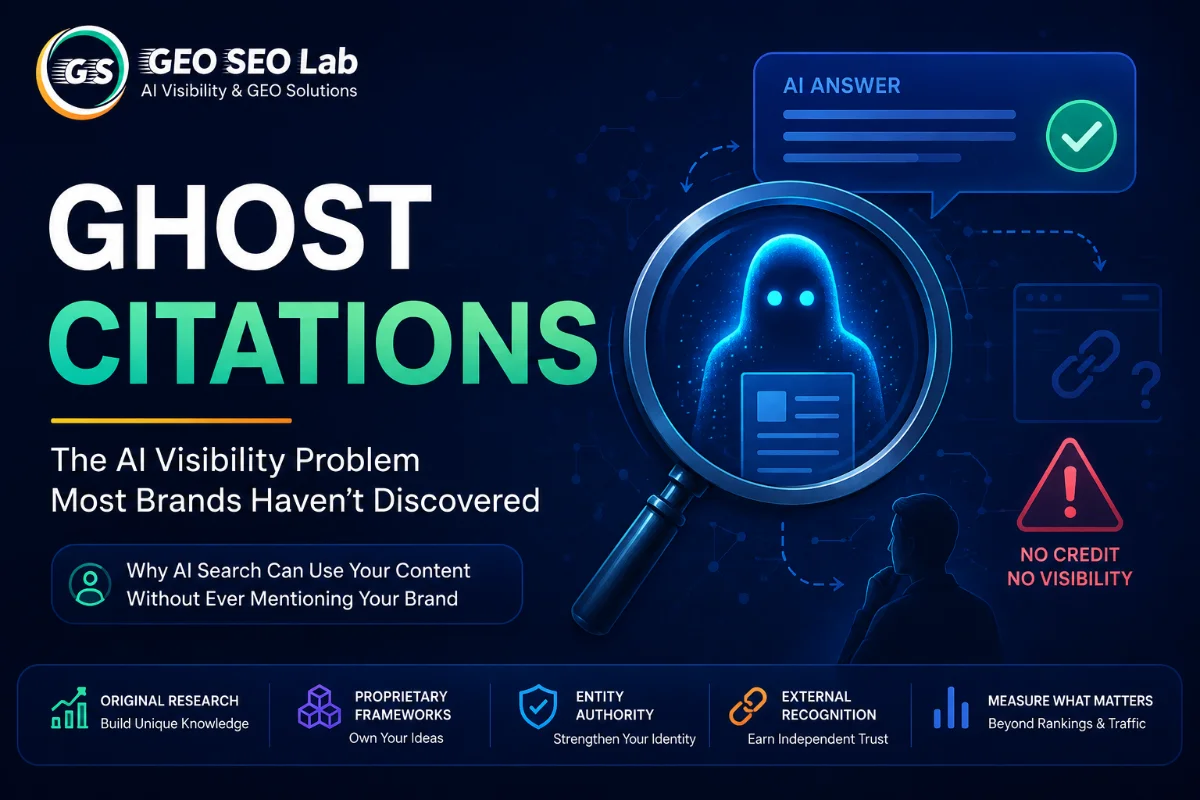
Ghost Citations: The AI Visibility Problem Most Brands Have Not Discovered
Ghost Citations happen when AI systems use a brand’s knowledge to answer user questions without giving meaningful recognition to the original source. Learn why this happens and how businesses can build stronger AI visibility through original research, proprietary frameworks, entity authority, and brand recognition.