Google Wants AI Search Users to Explore More Websites: Why AI Discovery Is the Future of SEO and GEO
Google's latest AI search updates are transforming how users discover websites. Learn why AI is shifting from answering questions to recommending trusted sources, how this impacts SEO and Generative Engine Optimization (GEO), and what businesses must do to build authority, topical expertise, and long-term AI visibility.
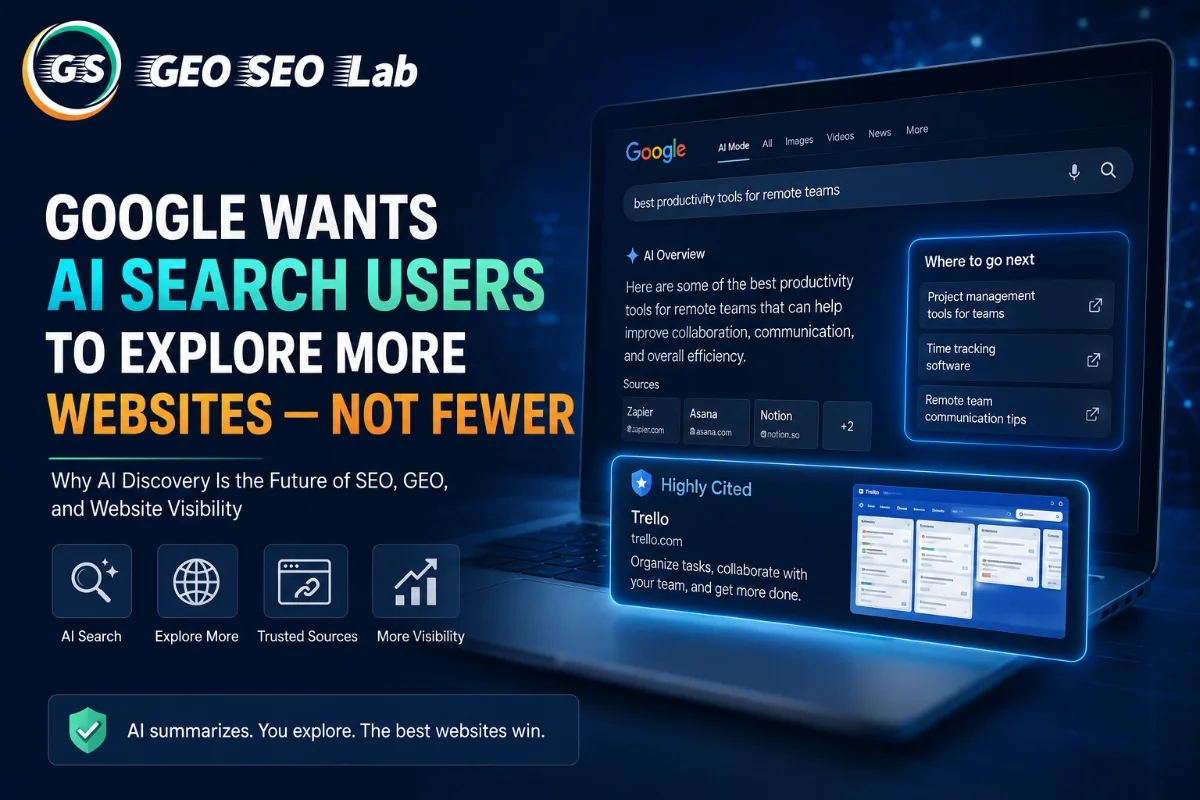
Google Wants AI Search Users to Explore More Websites — Not Fewer
Why Google's Latest AI Search Updates Are Changing GEO, SEO, and AI Visibility Forever
Introduction
For years, businesses followed one simple rule: rank higher on Google and more people would visit their websites. Search engine optimization became the foundation of digital marketing because better rankings usually meant better traffic. Companies invested in blogs, technical improvements, backlinks, and content strategies with one clear goal—earning clicks from search engines.Then AI-powered search changed everything.When AI-generated search experiences started appearing, many website owners immediately became worried. If artificial intelligence could answer questions directly on the search page, why would anyone visit a website anymore? It looked like the future of search would remove websites from the customer journey and replace them with instant AI answers. Many experts predicted that organic traffic would continue to decline and publishers would struggle to survive.That concern sounded reasonable at first, but the latest direction of AI-powered search tells a very different story.Instead of replacing websites completely, Google is gradually creating a discovery experience where artificial intelligence helps users understand a topic first and then encourages them to explore trusted sources for deeper information. This is a major shift because AI is no longer acting like a destination. Instead, it is becoming a guide that recommends the best websites based on quality, expertise, and authority.
This change creates both opportunities and challenges.Businesses that continue producing generic content simply to target keywords may find it increasingly difficult to earn visibility. At the same time, organizations that invest in original knowledge, trusted expertise, and comprehensive topic coverage are discovering entirely new opportunities to become recommended sources within AI-powered search experiences.Understanding this transition is no longer optional. Whether you run an ecommerce business, a SaaS company, a local brand, or an enterprise website, your visibility in the coming years will depend less on isolated keyword rankings and more on whether AI considers your website trustworthy enough to recommend.This guide explains why Google's newest AI search direction matters, what it means for SEO and Generative Engine Optimization, and how businesses can prepare for the future before competitors catch up.
What Is Google's New Vision for AI Search?
Many people assumed Google's goal was to keep users inside AI-generated answers forever. That assumption created the idea that websites would slowly become less important. However, recent product updates show a completely different direction.Google appears to be designing an ecosystem where artificial intelligence introduces a topic while trusted websites provide the detailed information users eventually need.Think about how people naturally research online.
Someone searching for a complex topic rarely stops after reading one short answer. They usually want examples, expert opinions, comparisons, practical guidance, research, or case studies before making a decision.AI can summarize information quickly, but genuine learning still requires reliable sources.
Google understands this behavior.Instead of forcing users to stay inside AI responses, newer search experiences encourage exploration by highlighting useful sources, showing previews of trusted websites, and helping users continue learning through additional recommendations.This approach benefits users because they save time finding reliable information while still accessing original research created by experts.It also benefits Google because the internet remains healthy. Without publishers creating valuable content, AI would eventually have fewer reliable sources to learn from.
The result is an ecosystem where websites continue to matter—but only if they consistently provide genuine value.
Why Did People Believe AI Would Kill Website Traffic?
The fear surrounding AI search was understandable.For decades, search worked in a predictable way. Users entered a query, received a list of links, opened several websites, and eventually found an answer.AI changed that process by placing a complete summary at the top of search results.From the outside, this looked like the end of traditional website visits.Many marketers immediately focused on declining clicks instead of understanding why Google introduced AI in the first place.Artificial intelligence was never designed only to reduce clicks.Its primary purpose is to reduce friction.
Users should spend less time searching and more time discovering trustworthy information.That difference completely changes how businesses should think about digital visibility.Instead of asking, "How do I rank number one?"
The better question becomes, "Why should AI trust my website enough to recommend it?"That single shift changes the future of SEO.
Is AI Replacing Search Engines?
The short answer is no.Search engines are evolving rather than disappearing.Traditional search depended on matching keywords with webpages.AI search depends on understanding meaning, context, relationships, expertise, and authority before deciding which sources deserve attention.Users still need websites because important decisions cannot be made from a few summarized paragraphs.Imagine someone researching cybersecurity software.An AI overview may explain what cybersecurity is, but buyers still need detailed comparisons, implementation guides, pricing information, customer experiences, compliance details, and expert recommendations before making a purchase.Those answers live on websites.AI simply helps users reach the best sources faster.This creates a future where fewer websites receive attention, but those that do become trusted destinations.
Why Website Authority Matters More Than Ever
Authority has always been important in search.The difference today is that authority is becoming visible to both AI systems and users at the same time.Previously, Google quietly evaluated hundreds of ranking signals behind the scenes.
Today, AI search increasingly identifies trustworthy sources during conversations and recommendations.That means your website is no longer competing only for rankings.It is competing for trust.When AI consistently recognizes your organization as an expert, every piece of content benefits.New articles gain credibility faster.Users develop greater confidence.Brand recognition grows naturally.Search visibility becomes more stable.This creates a long-term advantage that is difficult for competitors to copy simply by publishing more content.
What Does AI Look For Before Recommending a Website?
Artificial intelligence does not evaluate websites exactly like traditional search algorithms.Instead of focusing only on keywords, AI attempts to understand whether an organization truly deserves recognition within a specific subject.
It examines the consistency of information, the depth of knowledge, the quality of explanations, and whether content demonstrates real expertise instead of repeating information already available elsewhere.A website publishing dozens of shallow articles may appear active, but AI can recognize when those articles offer little unique value.
On the other hand, a company that consistently publishes thoughtful insights, practical experience, and original perspectives becomes easier for AI systems to identify as a reliable authority.This is why quality increasingly outweighs quantity.One exceptional knowledge resource can contribute more long-term authority than dozens of average blog posts written solely to target search traffic.
Why Generic SEO Content Is Losing Its Advantage
For many years, publishing keyword-focused articles was enough to generate visibility.Companies created hundreds of similar blog posts covering nearly identical topics because traditional search often rewarded topical coverage.AI changes that equation.When dozens of websites publish the same information using slightly different wording, artificial intelligence has little reason to recommend one over another.Generic content becomes interchangeable.Original knowledge becomes valuable.Businesses that simply summarize publicly available information will struggle to differentiate themselves.
Meanwhile, organizations that explain ideas through practical experience, original analysis, customer success stories, industry observations, or expert interpretation provide something AI cannot easily replace.That difference will define digital visibility over the next several years.
Why Businesses Need a Different Content Strategy
Publishing articles without a larger knowledge strategy is becoming less effective.Successful organizations are shifting from content production toward knowledge development.Instead of asking which keyword to target next, they begin by asking which problems their audience genuinely needs solved.
They identify important questions.They create comprehensive resources.They update information regularly.They connect related topics logically.They develop recognizable expertise around specific themes rather than chasing every trending keyword.This approach naturally creates stronger authority because every article supports a larger ecosystem of knowledge.AI recognizes those connections.Users appreciate them as well.As a result, both search visibility and customer trust improve together instead of competing with one another.
Why This Shift Creates New Opportunities
At first glance, AI search appears more competitive because fewer sources receive recommendations.In reality, it creates better opportunities for organizations willing to invest in quality.Traditional search often rewarded technical optimization.
AI increasingly rewards expertise.That means smaller companies with genuine knowledge can compete against much larger brands if they consistently publish valuable information that demonstrates real understanding.The playing field becomes less about who produces the most pages and more about who contributes the most useful knowledge.
For businesses willing to make that investment, the future is far more promising than many people initially expected.
The winners will not simply be the biggest publishers.They will be the organizations that become trusted educators within their industries.
How Google's Latest AI Search Features Are Transforming SEO
Why Are Google's New AI Features Different From Traditional Search?
For many years, search engines focused on matching a user's query with the most relevant webpages. The process was simple. A person searched for a topic, reviewed multiple blue links, clicked one or two websites, and continued researching until they found a satisfying answer.Artificial intelligence has changed this journey completely.Instead of immediately showing a long list of webpages, AI now attempts to understand the question first. It organizes information from multiple trusted sources, explains the topic in natural language, and then guides users toward websites that provide additional value.This is a subtle but powerful change.Google is no longer acting only as a search engine.It is becoming an intelligent research assistant.Rather than asking users to compare ten different websites themselves, AI helps narrow the choices by identifying sources that appear trustworthy, detailed, and relevant.For businesses, this means visibility is no longer only about appearing in search results.It is about becoming one of the sources AI feels confident recommending.
Why Source Visibility Matters More Than Rankings
Traditional SEO often celebrated rankings.If your webpage reached the first position, success usually followed through increased impressions, clicks, and conversions.AI-powered search introduces another layer.Even if a webpage ranks well, AI may choose a different source when generating its answer.This means businesses need to optimize for recommendation, not only for ranking.
Recommendation requires trust.Trust develops through consistent expertise.When AI repeatedly recognizes an organization as knowledgeable within a specific topic, it becomes easier for that website to appear during AI-generated conversations.Over time, this creates stronger brand recognition because users begin seeing the same trusted organizations across multiple AI-powered experiences.The companies that understand this shift early will have an important competitive advantage.
Why Inline Source References Change Everything
One of the most important developments in AI-powered search is the increased visibility of source references.Instead of hiding citations at the bottom of a response, AI now connects information directly with the websites that contributed it.
This changes user behavior.When readers become interested in a specific explanation, statistic, or insight, they can immediately identify where that information came from.Instead of searching again, they simply continue exploring the original source.For businesses, this creates an entirely new visibility opportunity.Every useful insight has the potential to become an invitation for users to visit the website behind it.This encourages organizations to publish clearer explanations, stronger research, and more trustworthy information because valuable knowledge becomes easier for AI to attribute correctly.
Why AI Wants Users to Continue Learning
Many people believed AI would eventually answer every question completely.The reality is much more practical.
Most important topics cannot be explained fully within a short conversation.Someone researching cloud computing may eventually want technical documentation.A business owner learning about SEO might need implementation guides.
A marketing manager exploring AI visibility could require detailed frameworks and examples.AI recognizes these situations.
Instead of pretending every answer is complete, it encourages users to continue learning from trusted publishers.
This behavior protects the quality of information across the internet.It also rewards organizations that create educational resources instead of publishing content purely for search traffic.
Why Trust Signals Are Becoming More Important
Search engines have always measured authority behind the scenes.Artificial intelligence brings those trust signals closer to the user experience.When AI repeatedly references certain organizations, readers naturally begin viewing those brands as industry experts.This creates a cycle where trust leads to visibility, and visibility strengthens trust even further.Businesses that consistently publish accurate, well-structured, and useful information become increasingly recognizable.Meanwhile, websites producing inconsistent or low-value content gradually lose opportunities to appear within AI-generated experiences.Trust is becoming a measurable competitive advantage rather than simply a branding goal.
What Makes AI Trust One Website Over Another?
Many websites discuss similar topics.The difference is not always the subject itself.The difference is how deeply the topic is explained.Artificial intelligence looks beyond simple keyword matching.It tries to understand whether an organization genuinely demonstrates expertise.A website covering a topic from multiple perspectives creates stronger confidence than one publishing a single isolated article.
Consistency matters. Depth matters. Accuracy matters. Regular updates matter. When all of these elements work together, AI gains stronger confidence that users will benefit from visiting that source.That confidence directly influences recommendation opportunities.
Why Topical Authority Is Becoming More Valuable
Publishing random articles across dozens of unrelated subjects may increase page count, but it rarely builds authority.AI understands relationships between topics.It recognizes when an organization consistently educates readers within a specific knowledge area.Imagine two companies.The first publishes one article about AI search.The second publishes dozens of connected resources explaining AI visibility, content strategy, structured data, entity optimization, search behavior, technical implementation, and practical case studies.Which organization appears more trustworthy?
The answer is obvious.The second website demonstrates sustained expertise rather than temporary interest.This is the foundation of topical authority.Instead of chasing every keyword opportunity, businesses should build complete knowledge ecosystems around the subjects where they genuinely excel.
Why a Content Hub Delivers Better Results Than a Single Article
A well-written article can attract visitors and even rank well in search results, but its impact is often limited when it stands alone. People rarely stop researching after reading one page. Once they understand the basics, they usually look for more detailed explanations, practical examples, implementation guides, and answers to related questions.
This is where a connected content strategy makes a real difference. When every article naturally leads to another helpful resource, readers spend more time exploring your website instead of returning to the search results. They move from beginner guides to advanced tutorials, discover case studies, read implementation advice, and find answers to common questions without leaving your site.
This connected learning experience benefits both readers and search systems. It shows that your website covers a topic from multiple angles rather than offering a single overview. As your collection of related content grows, search engines and AI systems begin recognizing your website as a reliable source of information instead of just another page targeting a keyword. That recognition can strengthen your overall search presence and help more of your content gain visibility over time.
Why Original Ideas Stand Out in AI Search
The internet is filled with articles that explain the same topics in almost identical ways. Publishing another version of information that already exists rarely gives readers a compelling reason to choose your website over countless others.
Instead of asking which keyword to target next, businesses should think about what unique value they can add to the conversation. Practical experience from real projects, lessons learned while solving customer problems, industry observations, original research, and actionable frameworks all provide insights that cannot be copied easily.
Content built on genuine experience offers something readers cannot find everywhere else. It answers questions with greater depth, shares practical knowledge, and helps people understand topics beyond basic definitions. This makes the content more useful, more memorable, and more trustworthy.
Search engines and AI systems are increasingly designed to highlight information that adds real value rather than repeating existing ideas. Websites that consistently publish original insights and practical expertise are therefore more likely to earn recognition, build credibility, and become trusted resources for future searches.
Why Content Quality Now Matters More Than Content Volume
There was a time when publishing more articles almost always led to better search visibility. Many businesses followed a quantity-first strategy, believing that a larger content library would automatically generate more traffic. While this approach delivered results in the past, today's search landscape has changed significantly. Modern AI-driven search systems are no longer impressed by the number of articles a website publishes. Instead, they focus on how useful, accurate, and valuable each piece of content is for the reader.
Creating hundreds of average-quality articles is no longer enough to build long-term visibility. Readers expect clear answers, practical guidance, and information they can actually use. Search systems have evolved in the same direction, rewarding websites that consistently provide well-researched and trustworthy content. A detailed article with real examples, logical structure, and actionable insights often delivers far more value than dozens of short posts covering similar topics.
Quality content also creates lasting benefits beyond rankings. It keeps visitors engaged, encourages them to explore additional pages, and increases confidence in the brand behind the content. Every strong resource strengthens the overall authority of the website, making future articles more likely to gain visibility. In the long run, investing in fewer but higher-quality resources produces better results than publishing large volumes of repetitive content.
Why Businesses Must Think Beyond SEO
Search engine optimization remains an essential part of online marketing because technical performance, website speed, and clear site structure still influence how search systems understand content. However, technical optimization alone cannot establish expertise or make a brand memorable. Businesses that rely only on SEO tactics without creating meaningful knowledge often struggle to build long-term authority.
The most successful organizations no longer think only like marketers trying to rank for keywords. They think like publishers who educate their audience and like industry experts who share valuable knowledge. Every article becomes an opportunity to answer important questions, explain complex ideas, and help readers make informed decisions instead of simply attracting clicks.
This shift benefits both users and search systems. When a website consistently solves real problems through educational content, it naturally earns trust and credibility. Over time, that trust becomes one of the strongest factors influencing search visibility because people are more likely to return to a source that has repeatedly provided useful information. Businesses that focus on teaching before selling are therefore much better positioned for long-term success in AI-powered search.
How Businesses Should Prepare Today
Waiting until AI-powered search becomes the primary way people discover information could leave many businesses struggling to catch up with competitors that started building authority much earlier. Trust and expertise cannot be developed overnight. They grow through consistent publishing, regular content improvements, and a long-term commitment to helping readers with accurate and practical information.
Rather than trying to cover every possible topic, businesses should concentrate on the areas where they already have genuine experience and knowledge. Building a strong collection of related resources around those subjects creates a clearer signal of expertise than publishing scattered articles across unrelated categories. Every new article should support existing content, answer additional questions, and strengthen the overall knowledge available on the website.
Organizations that begin investing in educational content today will be in a much stronger position as AI-driven discovery continues to evolve. By continuously improving existing resources, expanding important topics, and prioritizing user value over content volume, businesses can build lasting authority that benefits both traditional search and future AI-powered search experiences.
What Is Topical Authority and Why Does It Matter?
Many businesses still believe that publishing as many articles as possible is the fastest way to improve search performance. While that strategy once produced positive results, AI-powered search has shifted the focus from content quantity to subject expertise. Search systems are becoming better at recognizing whether a website truly understands a topic or simply publishes articles to target keywords.
Topical authority is built when a website consistently covers a subject from multiple perspectives with useful, accurate, and well-organized information. Instead of creating isolated articles on unrelated topics, successful businesses develop comprehensive content around the areas where they have genuine knowledge and experience. This approach helps readers find complete answers while showing search systems that the website has meaningful expertise.
As more high-quality resources are added over time, AI gains greater confidence in the website's ability to provide reliable information. That confidence improves the chances of being recommended during AI-powered search experiences because the website has demonstrated consistent value instead of relying on individual keyword-focused articles.
Conclusion
Google's latest approach to AI search makes one thing clear: the future of search is no longer based only on rankings but on trust, expertise, and meaningful content. AI is not replacing websites; it is helping users discover the most reliable sources for deeper information. This shift gives businesses a valuable opportunity to stand out by creating original, experience-driven content instead of relying on repetitive, keyword-focused articles.
To succeed in this new environment, businesses need to think beyond traditional SEO. Building topical authority, publishing high-quality educational resources, keeping content updated, and solving real user problems are becoming more important than simply increasing the number of published pages. Websites that consistently provide useful insights and demonstrate genuine expertise are more likely to earn visibility in both traditional search results and AI-powered recommendations.
The businesses that adapt early will have a significant advantage in the years ahead. By focusing on quality over quantity, sharing authentic knowledge, and creating content that genuinely helps readers, organizations can build lasting credibility and strengthen their online presence. As AI-powered search continues to evolve, the websites that educate, inform, and create real value will be the ones that attract both users and future search technologies.
Frequently Asked Questions
Find answers to common questions about this topic
About the Author

Aman Kesharwani
SEO Expert & Content Creator
Experienced digital marketing professional specializing in SEO strategies, content optimization, and data-driven marketing solutions. Passionate about helping businesses grow their online presence and achieve better search rankings.
Related Articles
View all posts
The AI Visibility Score: Measure Brand Presence Across AI Search
Learn how to measure and improve your AI Visibility Score across ChatGPT, Google AI Mode, Gemini, Claude, Perplexity, and modern AI search platforms.

Your Brand Can Win AI Search and Still Lose the Click
AI Search Zero Click, Zero Click Search, AI Search, AI Overviews, GEO SEO, Generative Engine Optimization, AI Visibility, SEO Traffic, Search Visibility, Brand Visibility, AI Search Optimization, Organic Traffic
How to Audit Your AI Entity Footprint Before Your Competitors Do
Learn how to audit and improve your AI Entity Footprint by checking business identity, digital profiles, topical authority, expert information, external recognition, and online consistency. This guide explains how businesses can build a clearer digital identity for GEO and AI search visibility.