Google AI Mode Is Changing SEO Forever: Here's What Brands Must Do Next
Google AI Mode Is Changing SEO Forever: Here's What Brands Must Do NextBy GEO SEO Lab ResearchEditorial note: This piece describes Google AI Mode as i...
Google AI Mode Is Changing SEO Forever: Here's What Brands Must Do Next
By GEO SEO Lab Research
Editorial note: This piece describes Google AI Mode as it existed in mid-2026. Google updates the product monthly, so details like model versions, country counts, and feature names will keep moving. The core argument about what brands need to do won't.
Executive Summary
Google Search worked the same basic way for roughly twenty-five years. You typed a query, Google handed back ten blue links, and you did the clicking, comparing, and deciding. That era just ended.
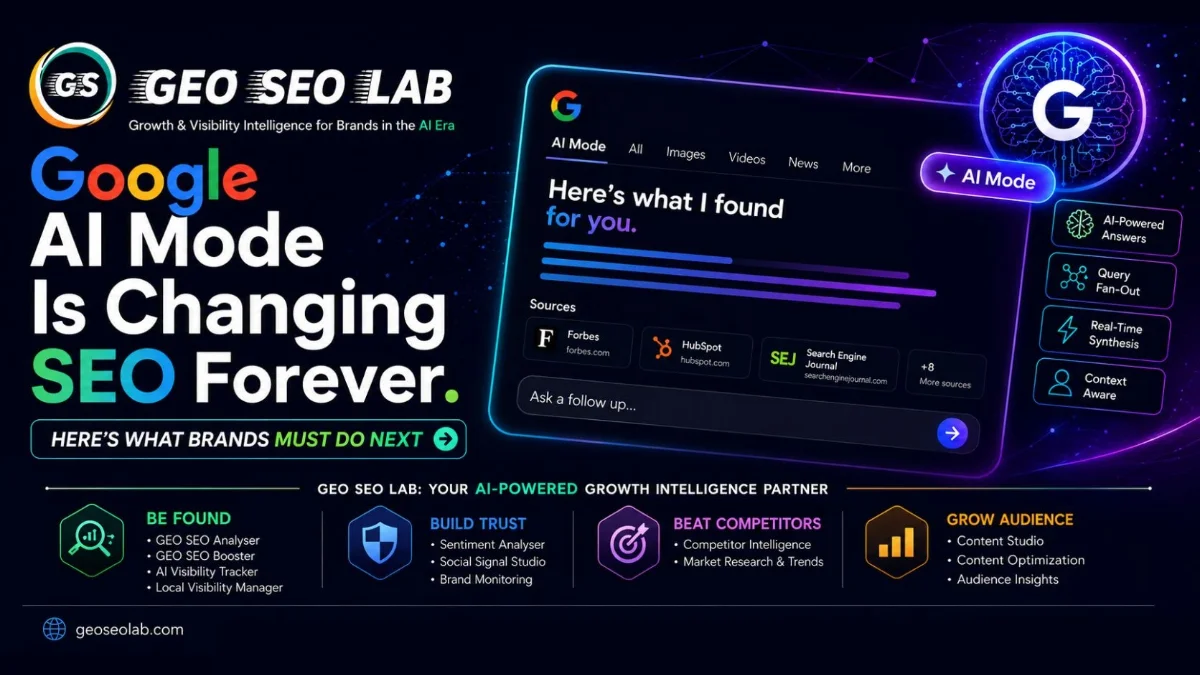
Google AI Mode isn't a bolt-on feature sitting off to the side of Search. By 2026, it's turning into the default way Search behaves for a growing slice of queries — a conversational experience, powered by Gemini, that reads your question, quietly runs it through several parallel searches (Google calls this "query fan-out"), and hands back one synthesized answer instead of a page you have to sort through yourself.
It started quietly, as a Search Labs experiment in March 2025. Two months later it was live for every US user with no signup needed. By the end of that year it had reached more than 180 countries. And at Google I/O 2026, Google confirmed AI Mode had crossed a billion monthly active users — one of the fastest adoption curves of any consumer product it has ever shipped, with query volume reportedly doubling every quarter since it went fully live.
That's not a small update. It's arguably the biggest change to how Google Search works in a decade, and it happened faster than most of the SEO industry expected.
The practical fallout for businesses is blunt: sitting at #1 on a results page fewer people are actually scrolling through doesn't carry the weight it used to. When Google itself is generating the answer, drawing from a handful of sources it decided to trust, the real fight isn't for a ranking slot anymore. It's for a spot inside the answer itself.
This piece covers what AI Mode actually is, how it's reshaping user behavior, why rankings on their own no longer guarantee visibility, and — the part that matters most — what brands should actually do about it.
What Is Google AI Mode?
Cut through the branding and Google AI Mode is a conversational search experience living in its own tab, right next to All, Images, Videos, and News. Rather than matching your query against a ranked list of pages, it uses Gemini — upgraded to a custom version of Gemini 3.5 Flash at I/O 2026 — to reason through what you asked and produce a direct answer, complete with inline citations and a nudge to keep asking.
Here's the piece that matters most for SEO: AI Mode doesn't fire off just one search per question. It fires several at once, splitting your query into subtopics — definitions, comparisons, examples, counterarguments, expert opinions — and pulling from all of them before Gemini weaves everything into a single response. That's query fan-out. In practice, one question from a user can trigger a dozen invisible background searches, and your content either surfaces as a source for one of those sub-questions or it simply isn't in the running.
What comes back isn't lifted from any single page — it's freshly generated from whatever sources made the cut. For meatier questions (comparisons, planning, research), Google sometimes builds what it calls Generative UI: a custom, interactive layout assembled on the spot for that exact query rather than a fixed template.
The system also holds onto context. Ask a follow-up and AI Mode carries the thread forward without you repeating yourself, which feels a lot more like talking to an informed assistant than querying a search engine one line at a time. Newer versions bring in multimodal input too — text, voice, images, even a live camera feed through a feature called Search Live — along with increasingly agentic capabilities: background "Search agents" that watch the web on a user's behalf, track prices, flag events, or work through multi-step tasks without a fresh search every time. Some versions can even tap into a user's Gmail, Photos, and YouTube history to personalize responses, something Google labels Personal Intelligence.
None of this erases traditional search — the "All" tab and its familiar link list are still right there. But AI Mode has moved past being a Labs experiment. It's becoming the default lens a growing share of users reach for first, and Google has signaled it wants that share to keep climbing.
How AI Mode Changes User Behaviour
What's shifting here isn't really the technology itself — it's what people now expect from a search, once they've experienced not having to do the comparing on their own.
People are asking fewer, bigger questions instead of a string of small ones. Classic SEO trained users to type in short, choppy queries — "best CRM small business," then "CRM pricing comparison," then "CRM reviews Reddit" — because that's what search boxes rewarded. AI Mode flips that. Now someone can ask something closer to "what's the best CRM for a 20-person startup outgrowing spreadsheets, and roughly what should I expect to pay," and get a real answer in one go. That collapses what used to be several searches, and several site visits, into a single exchange the brand never sees.
Clicking through is turning optional. When Google answers the question directly and cites its sources, a meaningful chunk of users won't click anything at all. This is the "zero-click" issue SEO teams have been flagging for years, and AI Mode makes it considerably worse — data through 2026 already shows measurable referral-traffic drops on the query types AI Mode handles well.
Trust now gets decided before the click, not after. In classic search, users still had to open a page and form their own view on whether to believe it. In AI Mode, Gemini has effectively already run that evaluation before the user sees anything. If your content wasn't deemed reliable enough to cite, the user may never even learn your brand was an option.
Sessions are turning into conversations, not one-off lookups. Because AI Mode holds context across follow-ups, people increasingly stay inside one extended exchange instead of hopping between tabs and sites. That means winning a single query isn't enough — a brand needs to hold up across an entire conversational thread, including whatever comparisons or objections come up later in that same session.
Some people are handing off decisions entirely, not just research. As agentic features mature — price tracking, planning help, multi-step task execution — some users are letting AI Mode make the call rather than researching and deciding themselves. That's a genuinely different relationship with search than the one SEO strategy has been built around for two decades.
Why Rankings Alone Aren't Enough Anymore
Traditional SEO ran on a simple bet: rank higher, get clicked more, win more business. That bet assumed an actual person was scrolling a results page and choosing among options. AI Mode undercuts that assumption in three distinct ways.
Sitting at #1 doesn't guarantee a citation, let alone a mention. AI Mode isn't simply re-serving whatever page ranks top for a keyword. It's running parallel searches across subtopics and deciding, one sub-query at a time, which sources are worth pulling in. A page that ranks well for the exact phrase someone typed can still get passed over if it doesn't answer the specific sub-question Gemini generated internally. Showing up in AI Mode is closer to getting selected as raw material than to being ranked.
The page stops being the sole unit of competition. Classic SEO optimizes one page to rank for one query. AI Mode often assembles its answer from pieces scattered across several sources rather than handing the whole exchange to a single winning page. A brand can produce exactly the kind of content AI Mode wants and still not "win" a query cleanly — it might end up as one of several sources cited in a blended answer, sitting right alongside competitors.
Being accurate now outweighs being optimized. Rankings historically rewarded technical SEO levers — keyword placement, backlink profiles, site architecture — that could be engineered somewhat separately from whether the content was genuinely the best answer out there. AI Mode's synthesis step leans harder on whether a source is accurate, well-sourced, and actually useful, because a bad or misleading citation shows up immediately, inside an answer a user is reading right now — not buried on page four of results nobody reaches.
None of this means rankings become irrelevant — a page Google can't find or doesn't trust at all still won't get cited. But ranking well is now table stakes for AI visibility, not a substitute for it. The real contest has moved up a level: from "can we rank" to "can we get picked as the source Gemini is willing to cite."
The Rise of AI Recommendations
There's a quieter shift happening alongside all this, and it may end up mattering more long-term than the mechanics of query fan-out: AI Mode is starting to act less like a search tool and more like a recommendation engine.
When a user asks AI Mode to compare software, suggest a provider, or recommend a product, Gemini isn't neutrally laying out ten options for the user to sort through. It's forming something closer to an opinion — a shortlist, a "best for X" framing, sometimes a single flat recommendation — built on whichever sources it judged most credible. That's a different kind of exposure than a ranking slot. Being the brand Gemini actually recommends inside a synthesized answer carries more weight than sitting at link #6 on a page a fraction of users bother scrolling to.
The personalization layer amplifies this further. As AI Mode's Personal Intelligence features mature — tapping into a user's Gmail, past searches, or app activity — recommendations start pulling in context a static results page never could: what this particular person has already looked at, booked, or shown interest in. Brands with a consistent, credible presence across a user's broader digital footprint hold a structural edge here that keyword optimization alone can't reproduce.
Agentic features add one more layer. As background Search agents start tracking prices, watching availability, and running multi-step tasks for users, getting recommended isn't just about winning attention once — it's about being the option an ongoing automated process keeps surfacing over and over. That's less like ranking for a keyword and more like becoming the default a system quietly keeps returning to.
Businesses taking this seriously aren't asking "how do we rank for this term" anymore. They're asking something closer to: if an AI system were building a shortlist of trustworthy options in our category today, would we make that list — and would it actually want to recommend us, not just mention us in passing?
Seven Strategies to Become AI-Visible
1. Structure content so a machine can extract it cleanly. Query fan-out works by pulling specific, well-bounded chunks of information out of pages, not by reading top to bottom the way a person would. Clear headers, direct answers placed early in a section, tidy data, and content built around one sub-question at a time all make it easier for Gemini to lift and cite accurately. Dense, wandering prose that never quite states the answer gets skipped in favor of a competitor who spelled it out.
2. Answer the real question, not just the keyword. Traditional SEO rewarded content built around a keyword phrase. AI Mode rewards content that resolves an actual question fully — including the natural follow-ups a curious reader would have next. A "CRM pricing" page that skips the obvious next questions — implementation costs, contract terms, hidden fees — leaves an opening a more complete competitor page can use to grab the citation instead.
3. Publish things that add something new, not summaries of what's already out there. Since Gemini is pulling from multiple sources, it has a built-in reason to favor ones that contribute something the others don't — original data, a proprietary benchmark, a firsthand case study, a methodology nobody's published before. Content that just restates established ideas gives an AI system little reason to cite you over an almost-identical alternative.
4. Keep your entity consistent everywhere it appears. AI systems are trying to figure out who you are and what you're actually expert in by cross-checking your website against LinkedIn, directories, press mentions, and anywhere else your name turns up. Positioning yourself one way on your own site and differently elsewhere creates ambiguity that makes an AI system less willing to cite you as an authority on anything specific.
5. Go earn citations and mentions you don't control. Independent validation — a journalist referencing you, another site citing you, an industry report mentioning your name — carries credibility that self-published content simply can't manufacture on its own. AI systems seem to weight sources more heavily once other corners of the web already treat them as credible, which turns earned press and third-party citations into a direct AI-visibility lever, not just good branding.
6. Stay accurate, stay current, and fix mistakes fast. A generated answer pulls whatever a source says at the exact moment someone asks. Stale pricing, deprecated features, or outdated statistics don't just look bad to a sharp-eyed reader — they risk misleading someone through an AI-generated answer, which is exactly the kind of failure that quietly erodes a source's standing over time. Treat accuracy as ongoing upkeep, not a one-and-done task.
7. Put an actual person behind the brand. A named founder, engineer, or specialist who consistently publishes useful, identifiable expertise reads as a credibility signal to both human readers and the AI systems synthesizing an answer. Faceless corporate copy is easy to produce and just as easy to ignore. A real person saying something specific and useful, again and again, is much harder to dismiss and much easier to trust.
How GEO SEO Lab Helps Brands Adapt
None of these seven strategies are a one-and-done project. AI Mode changes month to month — new model versions, new features, shifting ideas of what counts as a trustworthy source — and a strategy built for last quarter's version of AI Mode can quietly stop working before anyone notices the drop in traffic and citations.
That's the specific gap GEO SEO Lab exists to close. Instead of treating AI visibility as a one-time audit, the platform is built to track how a brand's content, entity information, and citation footprint actually perform against how generative search retrieves and synthesizes answers today — not how search worked two years ago.
In practice, that looks like checking whether existing content is structured in a way query fan-out can actually pull from, spotting where entity information is inconsistent across the web in ways that undercut AI confidence, and flagging the specific gaps — missing original data, thin coverage of obvious follow-ups, weak third-party citation — most likely costing a brand visibility in AI-generated answers right now.
The point isn't to chase whatever Google ships next. It's to build a durable, well-sourced, consistently credible presence that keeps earning citations no matter which model or feature comes out next. That's the same idea behind the Trust Layer™ framework: features and rankings keep changing, but genuine credibility is the one thing that keeps compounding regardless of what search looks like a year from now.
Final Thoughts
Search didn't shrink because of AI Mode — it got more decisive. Google isn't just pointing users toward information anymore; it's increasingly telling them what to believe, wrapped in one confident, cited answer that a growing number of users won't feel the need to double-check.
That's a genuine threat to any business whose entire strategy leaned on ranking position. But it's just as real an opportunity for businesses willing to do the harder, slower work AI Mode actually rewards — original research instead of recycled content, a consistent entity instead of scattered positioning, earned third-party credibility instead of self-promotion, and real named experts instead of anonymous brand voice.
Brands that treat this as "one more SEO update to react to" will keep losing ground every time Google ships something new. The ones that treat it as a genuine shift in what earns trust — and build accordingly — will be the ones Gemini keeps choosing to recommend, quarter after quarter, no matter what the platform looks like next.
Key Takeaways
- Google AI Mode replaces ranked links with a single Gemini-generated answer pulled from multiple parallel background searches (query fan-out), and it passed a billion monthly users within roughly a year of full availability.
- User behavior is shifting toward bigger, conversational questions and away from clicking through to individual sites, worsening the zero-click problem SEO teams already grapple with.
- Ranking well is now a prerequisite for AI visibility, not a substitute for it — the real competition is getting selected as a cited source, not just ranking for a keyword.
- AI Mode is starting to function like a recommendation engine as much as a search tool, raising the stakes on being genuinely trusted rather than simply visible.
- Structured content, original research, entity consistency, earned citations, accuracy, and visible human expertise are the levers that actually move AI visibility.
- AI Mode changes monthly, so AI visibility needs to be an ongoing practice, not a one-time optimisation project.
References
- Search Atlas — What Is Google AI Mode?: https://searchatlas.com/blog/google-ai-mode/
- Medianama — Google Search Adds AI Mode and Search Live Features: https://www.medianama.com/2026/05/223-google-search-redesign-ai-mode-2026/
- ALM Corp — Google AI Mode: Tips, Tricks & Features (2026 Guide): https://almcorp.com/blog/google-ai-mode-tips-tricks-features/
- Promodo — Google AI Mode 2026: How AI Is Transforming Search: https://www.promodo.com/blog/google-ai-mode
- Webtooltip — How Google AI Mode Works: https://webtooltip.com/artificial-intelligence/how-google-ai-mode-works/
Tags
Frequently Asked Questions
Find answers to common questions about this topic
About the Author

Anubhav
SEO Expert & Content Creator
Experienced digital marketing professional specializing in SEO strategies, content optimization, and data-driven marketing solutions. Passionate about helping businesses grow their online presence and achieve better search rankings.
Related Articles
View all posts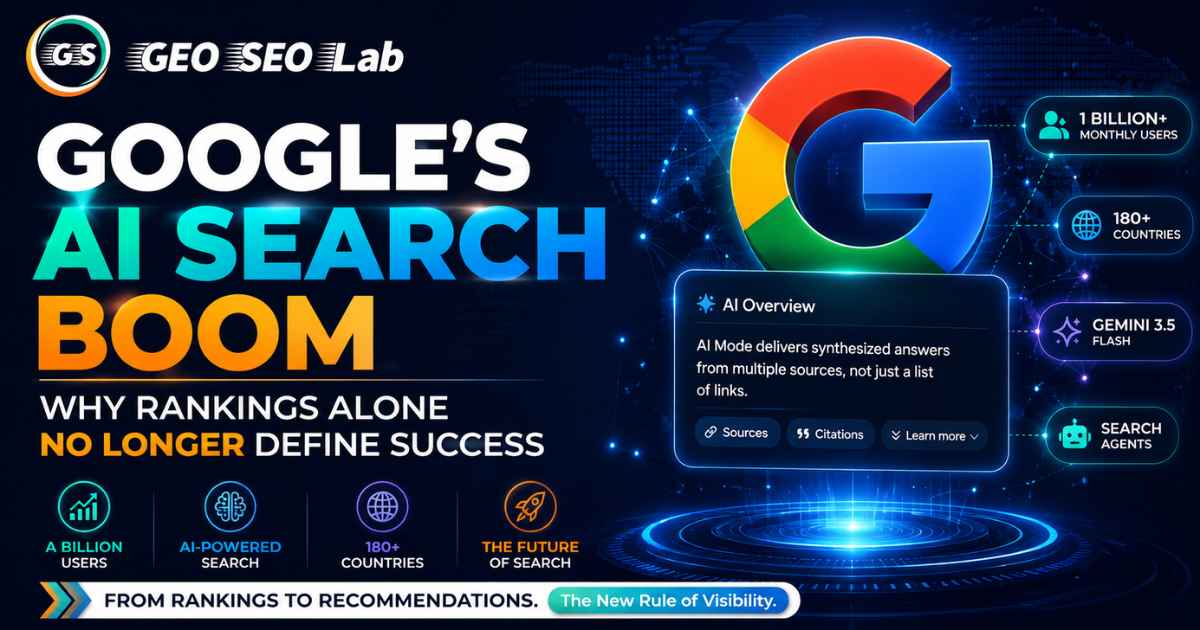
Google's AI Search Boom In 2026: How AI Mode, AI Overviews & Query Fan-Out Are Changing Rankings
Google's AI Search Boom: Why Rankings Alone No Longer Define SuccessCategory: AI Search Analysis & GEO Strategy | Published: July 2026 | Reading Time:...
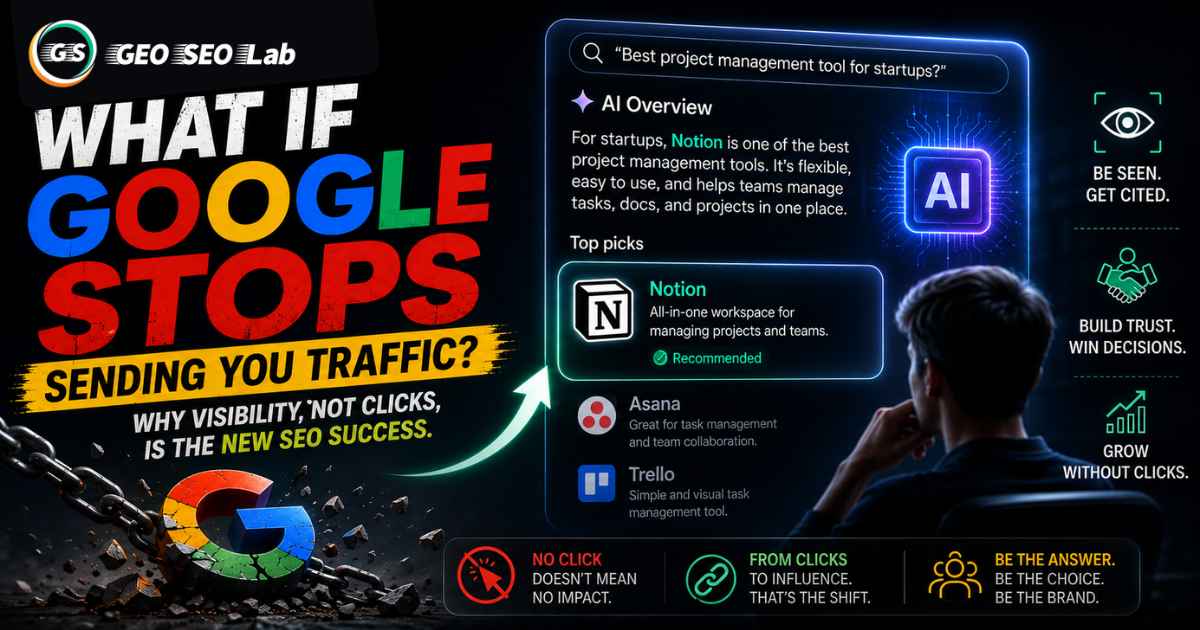
What If Google Stops Sending You Traffic?
Here's a scenario worth actually thinking through rather than rushing past. Your brand shows up inside an AI-generated answer. Your content gets cited...

Why Different AI Platforms Recommend Different Brands
Why Different AI Platforms Recommend Different BrandsSame Question, Four Answers, Almost Zero OverlapA GEO SEO Lab ReportEditorial Disclosure: This re...