Ghost Citations: The AI Visibility Problem Most Brands Have Not Discovered
Ghost Citations happen when AI systems use a brand’s knowledge to answer user questions without giving meaningful recognition to the original source. Learn why this happens and how businesses can build stronger AI visibility through original research, proprietary frameworks, entity authority, and brand recognition.
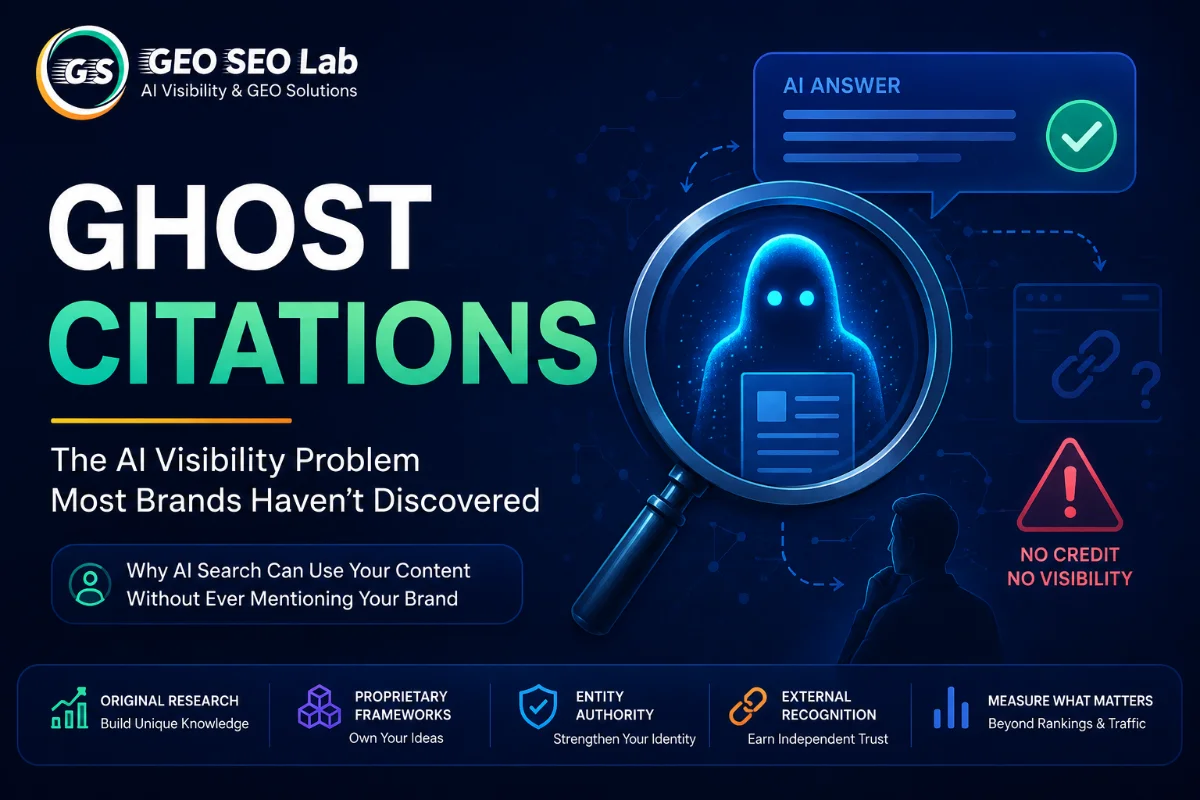
Ghost Citations: The AI Visibility Problem Most Brands Have Not Discovered
Why AI Search Can Use Your Content Without Mentioning Your Brand
Introduction: The Quiet Problem Nobody Is Talking About
Something unusual is happening across the digital world, and many businesses have not noticed it yet.Companies are spending years building useful content, conducting research, publishing detailed guides, and sharing the knowledge of their experts. Their teams spend time creating articles, studies, reports, frameworks, and educational resources that genuinely help people understand difficult topics.At the same time, AI systems are reading and processing enormous amounts of information available online.This creates an important question.What happens when people receive useful information that was influenced by your work, but they never learn that your company created it?This is the problem we describe as a Ghost Citation.A Ghost Citation happens when your knowledge helps shape an AI generated answer, but your company does not receive meaningful recognition for that contribution. The user gets the information, but the brand behind the information may remain completely unknown.This is becoming an important issue because the way people search for information is changing.For many years, the connection between content and brand awareness was relatively easy to understand. A company created an article. The article appeared in search results. A person saw the company name, clicked the website, read the content, and slowly started connecting that company with expertise.Even when the person did not click, the company could still receive some visibility from appearing in the search results.
AI search changes this process.A person can now ask an AI assistant a detailed question and receive a complete answer without opening several websites. The answer may contain ideas, research, explanations, or concepts that were influenced by content published by a particular company.But the person may never see that company's name.There may be no website visit.There may be no brand impression.There may be no direct interaction.The person simply gets the answer and continues with their day.This creates a gap between creating knowledge and receiving recognition for that knowledge.
That gap is becoming increasingly important for businesses that invest heavily in content, research, thought leadership, and online expertise.
Understanding the Ghost Citation Phenomenon
What Is a Ghost Citation?
A Ghost Citation happens when an organization's published knowledge contributes to an AI generated answer, but the organization receives little or no visible recognition in the answer.The important part is understanding what a Ghost Citation is not.It does not necessarily mean that an AI system failed to discover your content.In many cases, the opposite can happen.The system may have found information related to your work, understood the concepts, processed the information, and used knowledge similar to what your organization published.The information travelled.The brand did not.
Imagine that a company spends months researching a specific industry problem. It collects data, studies customer behavior, interviews experts, and publishes the findings in a detailed report.Later, someone asks an AI assistant a question related to that subject.The AI gives the user a useful explanation.The answer may reflect ideas, findings, or concepts that appeared in the company's research.But the user does not know where those ideas originally came from.They may never see the company's name.They may never visit its website.They may never search for the company.The company has influenced the answer but has not necessarily received recognition.That is the central idea behind Ghost Citations.
How the Process Works
The process usually starts with an organization creating original knowledge.This knowledge could be a research report, technical guide, industry study, educational article, original framework, white paper, benchmark report, or detailed analysis.
AI systems process large amounts of information from many sources. Over time, they develop an understanding of subjects, relationships, concepts, facts, and common patterns.When a person asks a question, an AI system generates an answer based on the information and patterns available to it.The user receives a useful response.But the final question is whether the organization that created valuable knowledge receives recognition.If the answer is no, the organization may be experiencing a Ghost Citation.This is different from simply having poor search visibility.With traditional search, a company could generally understand whether its content was ranking. If the website did not appear, the company knew that it had a visibility problem.Ghost Citations are more difficult because the content may still be useful and influential.The organization may continue receiving website traffic.Its articles may still rank.Its content may still receive engagement.Yet some of its knowledge may be reaching people through AI without those people knowing the original source.This makes the problem much harder to identify.
How Ghost Citations Differ From Traditional Search Attribution
Traditional Search Made the Source Visible
Traditional search engines mainly worked by finding relevant pages and showing those pages to users.When someone searched for a topic, they normally received a list of results.Each result showed a website, page title, and other information that helped the user understand where the information was coming from.Even if the user did not click the result, the company could still receive some brand exposure.For example, a person searching for information about a business topic might see results from well known companies, research organizations, universities, publications, or industry websites.
The source was visible.The user could see who published the information.This created a natural connection between information and brand.AI search changes that relationship.
AI Search Focuses on the Answer
AI systems can combine information from multiple sources and produce a single response.Instead of asking users to read several pages and compare the information themselves, an AI assistant can provide a direct explanation.This is one of the reasons people find AI search useful.However, the same process creates an attribution challenge.When information from many sources is combined into one response, the individual identity of each source can become less visible.One company's research may be combined with another organization's analysis and general industry knowledge.
The final response may be accurate and useful, but the user may not know which organization contributed which idea.
This creates what can be described as an AI Attribution Gap.The value of the knowledge reaches the user, but the recognition does not always travel with it.
Understanding the AI Attribution Gap
From Research to User Benefit
The journey starts with original research or knowledge creation.An organization invests time, money, expertise, and resources into creating something useful.The organization then publishes that information.AI systems encounter and process information available online.When a relevant question is asked, the system generates a response using its understanding of the subject.The user receives an answer.This is where the important question appears.Does the user also recognize the organization that created the original knowledge?If the answer is no, the knowledge has delivered value without delivering equivalent brand recognition.This is the heart of the AI Attribution Gap.The problem is not necessarily that AI systems are intentionally taking credit.The problem is that information generation and source attribution are separate parts of the process.AI systems are designed to provide useful answers.Attribution is not always handled with the same consistency.That difference creates the Ghost Citation problem.
Why Ghost Citations Happen
AI Does Not Operate Like a Traditional Search Engine
To understand Ghost Citations, it is important to understand the basic difference between traditional search and AI systems.Traditional search engines were mainly built around finding and organizing documents.A user searched for something.The search engine identified relevant pages.Those pages were displayed to the user.The relationship between the information and the source was therefore visible.AI systems work differently.They can generate new text based on patterns and information learned from large collections of data.Instead of simply showing a document, they can create an answer.This changes the relationship between the user and the original source.When an AI system produces an answer, the information may reflect knowledge from many different sources.It can be difficult to determine exactly which part came from which source.This creates a structural challenge for attribution.It is not necessarily a deliberate action by the system.
It is partly a result of how AI based information systems work.
The Synthesis Problem
Another major reason Ghost Citations happen is synthesis.AI systems can combine different pieces of information into one explanation.Imagine ten organizations have published useful information about the same topic.One company has conducted research.Another has published a detailed guide.A third has created a framework.Another organization has published industry statistics.An AI system can combine information from the wider knowledge environment and produce one simple explanation for the user.This makes the answer easier to understand.However, the process can make individual contributions less visible.A unique framework created by one organization may become part of a broader explanation.The user may understand the idea without knowing who originally created it.This is particularly important for companies that invest in intellectual frameworks and methodologies.Their biggest contribution may not be a single sentence.It may be the way they organize information and explain a difficult problem.When that structure is absorbed into a wider explanation, the original connection to the organization can become weaker.
The Commoditization of Common Knowledge
Another issue is common knowledge.Many companies publish content about the same subjects.If hundreds of organizations explain similar best practices, definitions, strategies, and general advice, the information gradually becomes common knowledge within the wider digital environment.AI systems can develop a broad understanding of these subjects.
When this happens, it becomes difficult for one company to be strongly associated with generic information.For example, if dozens of businesses publish articles explaining basic customer service practices, an AI system may understand those practices as general industry knowledge.There may be no strong reason for the system or the user to associate those ideas with one particular company.This is why generic content is especially vulnerable to Ghost Citations.A company can publish a very well written article and still fail to build strong brand recognition if the article simply repeats information that already exists everywhere.The important lesson is that quality writing alone may not be enough.The content also needs to be distinctive.
The Real Business Cost of Invisible Influence
When Knowledge Does Not Return to the Business
Companies invest in content because they expect business value from that investment.They want more awareness.They want stronger trust.They want more leads.They want recognition as experts.They want potential customers to remember their name when they need a solution.Ghost Citations can weaken that connection.Imagine a company spending months creating an original research report.The company invests in research, interviews, data collection, analysis, editing, design, and promotion.The final report contains information that is genuinely useful.In traditional search, the company could benefit from rankings, website visits, backlinks, brand exposure, and direct engagement.People could discover the company while reading the report.AI search introduces another path.People may encounter information related to the research through an AI generated answer.Those people may never visit the original report.They may never see the company name.The company has still contributed to the information environment, but part of the business value that normally comes from recognition may be missing.This makes content ROI more difficult to understand.A company might see normal traffic and ranking numbers while missing the larger question of how much of its knowledge is influencing AI based information experiences.
The Thought Leadership Problem
Thought leadership depends heavily on recognition.It is not enough for an organization to have good ideas.
People need to connect those ideas with the organization.Over time, repeated recognition creates a strong market position.When people repeatedly see a company's research, frameworks, analysis, and opinions, they begin to associate that company with expertise.This association can influence purchasing decisions, partnerships, media opportunities, and customer trust.Ghost Citations can interrupt that process.People may benefit from the company's ideas without knowing where those ideas came from.The company continues creating knowledge.The market continues learning from that knowledge.But the connection between the knowledge and the organization becomes weaker.Over time, this can create a strange situation.A company may have significant intellectual influence while having less market recognition than its influence deserves.That is a serious strategic problem.
The Measurement Blind Spot
Another challenge is measurement.Traditional SEO provides many visible signals.Companies can monitor rankings.They can monitor traffic.They can monitor clicks.They can monitor conversions.They can track backlinks.These measurements provide some understanding of how content is performing.Ghost Citations are much harder to measure.
If an AI system uses knowledge influenced by your content and a user reads that answer without visiting your website, your analytics may show nothing.There may be no session.There may be no referral.There may be no backlink.There may be no conversion.From the company's analytics system, the interaction may appear not to exist.This creates a measurement blind spot.A company could be influencing people through AI systems without having a clear way to see that influence.
Who Is Most Vulnerable to Ghost Citations
Why High Quality Content Can Create More Exposure
There is an important irony here.The organizations most likely to experience Ghost Citations may be organizations that are doing many things correctly.They are producing detailed research.They are publishing expert content.They are creating useful frameworks.They are investing in education.Their content is valuable.That is exactly why AI systems may find the information useful.Low quality content may contribute little to a broader understanding of a subject.High quality content can contribute much more.This creates a situation where the better the knowledge becomes, the more important attribution becomes.Organizations therefore need to think about two separate goals.The first goal is creating valuable knowledge.
The second goal is making that knowledge strongly connected to the organization that created it.Both are important.
Professional Services
Consulting firms, legal organizations, accounting firms, advisory companies, and similar businesses depend heavily on expertise.Their knowledge is often their main product.They publish research, guidance, reports, educational articles, and expert opinions.If that expertise reaches users through AI without strong recognition, the organization may lose an important opportunity to build relationships with potential customers.
Technology Companies
Technology companies publish technical documentation, guides, tutorials, implementation resources, research, and best practices.This type of information is particularly useful for people asking technical questions.It is also information that AI systems can process and summarize effectively.Technology companies with large content libraries therefore need to think carefully about how their technical knowledge is connected with their brand.
Research and Analytics Organizations
Research companies face an especially important version of the problem.Their business depends on producing valuable information.If their research becomes part of AI generated answers without strong recognition, their most important business asset may be reaching users without creating the expected brand connection.
Healthcare Organizations
Healthcare organizations publish educational information, patient resources, research, and health guidance.
People increasingly ask AI systems questions related to health and wellbeing.Because this information is highly valuable to users, healthcare content can receive significant exposure through AI systems.Strong source recognition is therefore especially important in this area.
Financial Services Companies
Financial organizations also publish large amounts of educational information.
Market analysis, investment education, personal finance information, economic commentary, and financial guidance are common examples.When users receive such information through AI, the original financial organization may not always receive the recognition that normally comes from direct content consumption.
Building a Brand That AI and Users Can Recognize
Moving From Content Creation to Knowledge Ownership
The answer to Ghost Citations is not simply publishing more content.The more important change is publishing content differently.Organizations need to think about knowledge ownership.Traditional content creation often asks questions such as what topics should we cover, what questions are people asking, and what type of content should we publish.
Knowledge ownership asks deeper questions.What ideas are uniquely associated with our organization?What research can only our organization produce?What framework can we develop?What knowledge can we contribute that is not already available everywhere?This changes the purpose of content.The goal is no longer only to answer a search query.The goal is to create intellectual assets that become strongly connected with the organization.This is especially valuable in an AI search environment because distinctive knowledge is easier to associate with a particular source than generic information.
Original Research as a Strong Attribution Strategy
Why Original Research Matters
Original research is one of the strongest ways to create knowledge that naturally connects back to a company.If an organization creates new data, findings, statistics, or analysis, the information has a clear origin.Other organizations cannot easily claim that same research because they did not conduct it.This creates stronger attribution opportunities.
Original research can also generate references from journalists, researchers, industry publications, and other companies.
Every independent reference can strengthen the relationship between the research and the organization behind it.
Original research is also more specific than generic educational content.Specific findings, statistics, observations, and conclusions are easier to distinguish from general industry knowledge.
This can help preserve the identity of the original source.
Original Research Does Not Always Mean a Huge Study
Not every company needs to conduct a massive multi year research project.Original research can take many forms.
A company might analyze its own customer data.It might publish an annual industry survey.It might study trends across a specific market.It might interview experts and identify common patterns.It might analyze performance data from its own projects.It might create an original benchmark.The important part is that the company contributes something that did not previously exist.That contribution becomes a knowledge asset.Over time, a collection of original studies can become a major part of the company's authority.
Proprietary Frameworks Make Ideas More Recognizable
Creating a Named Approach
Another strong strategy is developing proprietary frameworks.A framework is a structured way of understanding or solving a problem.When an organization creates a distinctive framework and gives it a memorable name, the framework itself can become associated with the organization.This is valuable because the name becomes part of the intellectual asset.
Instead of simply discussing a general concept, the organization creates its own structure around that concept.
People can refer to the framework.Other writers can discuss it.The organization can use it across articles, presentations, research reports, training programs, and client work.Over time, the framework can become an identifiable part of the brand.
Maturity Models
A company can create a maturity model that explains how organizations develop in a particular area.
For example, a business might define different stages of development in digital visibility, customer experience, data maturity, or another specialized area.A strong maturity model can become a useful reference because it provides a clear structure for understanding a complex subject.
Proprietary Indices
Organizations can also develop their own scoring systems or indices.A company could measure an important industry trend and publish the results every year.If the methodology is consistent and the data is valuable, the index can become a recognizable knowledge asset.Annual updates also create repeated opportunities for external references.
Research Methodologies
Companies conducting original research can develop their own research methodology.The methodology can explain how data is collected, analyzed, evaluated, and presented.When the process is distinctive and consistently used, it can become part of the organization's identity.
Entity Authority Is the Foundation of Recognition
What Entity Authority Means
Ghost Citation resistance is not only about individual articles.It is also about how clearly AI systems can understand the organization behind those articles.AI systems process information about companies, people, publications, organizations, and relationships between them.A company should therefore have a clear digital identity.AI systems should be able to understand what the organization does, what topics it specializes in, who works there, what it has published, and why it is considered knowledgeable in specific areas.
This is what makes entity authority important.
Consistency Across Platforms
The organization's name should remain consistent across its digital presence.Its description should also be consistent.
Its areas of expertise should be clearly represented.The same applies to important team members and authors.
If one platform describes a company one way and another platform describes it completely differently, it can create confusion.Consistency makes the organization's identity easier to understand.
Author Profiles
Authors are also important entities.
A company publishing expert content should clearly identify the people responsible for that content.
Author profiles can include professional experience, areas of expertise, education, publications, speaking activities, and other relevant information.When these profiles are consistent across the company website, professional networks, conference pages, and other trusted platforms, the relationship between the expert and the organization becomes stronger.
External Validation
Recognition from independent sources can strengthen authority.Media coverage, industry events, professional organizations, conferences, research collaborations, and other trusted references can provide evidence that the organization has expertise beyond its own website.This matters because a company saying that it is an expert is different from independent sources recognizing that expertise.External validation can therefore strengthen the overall entity profile.
Knowledge Graph Presence
Clear structured information about an organization can also help digital systems understand its identity.
Knowledge graphs and other structured information systems are designed to represent relationships between entities.
A company should aim to maintain accurate and consistent information about its organization, people, products, areas of expertise, and other important entities wherever appropriate.
Building Recognition Beyond Your Own Website
Why External Platforms Matter
A company's website is important, but it should not be the only place where its expertise exists.When a company is mentioned across several trusted independent sources, the broader information environment contains more evidence about its expertise.This can strengthen the company's overall digital identity.For example, an organization may publish research on its website.An industry publication may discuss that research.A podcast may interview one of its experts.
A conference may invite the same expert to speak.Another researcher may reference the study.These independent references create a wider knowledge footprint.The company's expertise is no longer represented in only one location.
Industry Publications
Contributing original articles and expert analysis to respected industry publications can create external references to a company's knowledge.The strongest opportunities are usually those where the organization contributes something genuinely useful rather than simply promoting its services.
Podcasts
Podcast appearances can also strengthen recognition.An expert explaining a difficult subject in a public discussion creates another association between that person, the company, and the area of expertise.
Conferences
Speaking at industry conferences can create additional recognition.Conference presentations may lead to recordings, articles, social discussions, event pages, and other references.These materials can expand the company's knowledge footprint.
Academic and Research Collaboration
Working with universities, researchers, or other credible institutions can create particularly strong external references.
Co authored studies, research partnerships, and academic references can strengthen the perception that an organization contributes meaningful knowledge to its field.
Professional Communities
Participation in professional communities can also help.The goal should not be simply to promote the company.
The organization should contribute useful answers, explanations, research, and expert opinions.Over time, consistent participation can create a wider reputation for expertise.
Measuring What Matters in AI Search
The Traditional Metrics Gap
Traditional SEO measurements remain useful.Rankings still matter.Website traffic still matters.Click through rates still matter.Conversions still matter.However, these measurements do not show the entire picture in an AI search environment.
A company also needs to understand whether people recognize its expertise.That requires additional measurements.
Branded Search
Branded search volume can provide an indirect indication of recognition.If people begin searching for a company's name together with relevant topics, it may suggest that they have become aware of the organization.The same principle can apply to proprietary frameworks, methodologies, research reports, and named concepts.If people search for a company's unique framework, that indicates that the concept has become connected with the brand.Tracking branded search trends over time can therefore provide useful information about recognition.
Entity Mentions
Companies can also monitor how often they are mentioned across relevant websites and publications.The quality of the mention matters.A simple mention is useful, but a reference describing the organization as an expert or original research source is more valuable.The context of the mention should therefore be considered alongside the number of mentions.
Direct Traffic
Direct traffic can also provide a rough indication of brand recognition.People who directly visit a website often already know the organization or have a strong enough reason to seek it out.Changes in direct traffic over time can therefore provide another signal of brand strength.
Qualitative AI Audits
Companies should also regularly check how AI systems represent their expertise.This can be done by asking relevant questions in the organization's strongest subject areas.The company can then observe whether its name appears, whether its research is recognized, whether its frameworks areassociated with it, and how the organization is described.This will not provide the same precision as traditional analytics.However, it can provide valuable practical information about the organization's position in AI search.
Building a Ghost Citation Resistant Strategy
Original Knowledge Creation
The foundation is original knowledge.Organizations need to consistently create information that contributes something new.This could come from research, analysis, customer experience, internal data, expert interviews, experiments, industry studies, or original frameworks.The goal is to create knowledge that is not simply a rewritten version of what everyone else has already published.Original knowledge can create long term value because each new research project can strengthen both the individual content asset and the wider reputation of the organization.
Intellectual Property Development
Organizations should also build a collection of intellectual assets.These can include named frameworks, models, methodologies, indices, research systems, and original concepts.These assets should be clearly documented and used consistently.The organization should also make it clear that these ideas are associated with its work.
Over time, this creates a recognizable intellectual identity.
Entity Signal Consistency
The organization should tell the same story everywhere.The website, professional profiles, author pages, company listings, publications, social profiles, conference pages, and other important digital locations should provide accurate and consistent information.The goal is to make the organization's identity easy to understand.
External Authority Building
Organizations should actively create opportunities for independent recognition.This can include media coverage, speaking opportunities, research collaborations, industry publications, awards, professional organizations, and expert interviews.
The goal is to create a network of trusted references around the organization.
Recognition Oriented Measurement
Finally, organizations need to measure recognition.Traditional SEO numbers should remain part of the reporting system.
But they should be supported by branded search, entity mentions, direct traffic, and qualitative AI audits.This creates a broader understanding of how content contributes to the business.
The Content Quality Standard Has Changed Again
Quality Alone Is Not Enough
There was a time when publishing large amounts of content could produce significant search visibility.Later, the focus moved toward better quality.Companies started investing in well researched, useful, clearly written articles.AI search creates another change.Even a high quality article may not create strong brand recognition if it covers the same information that hundreds of other organizations already discuss.The new challenge is distinctiveness.Content should provide something that readers cannot easily find everywhere else.That could be new data.It could be a different interpretation of an industry trend.It could be an original framework.It could be based on real experience.
It could contain findings from a company's own work.It could provide a perspective that is difficult to copy.
This type of content has greater potential to become associated with its source.
Why Generic Content Is Becoming Less Valuable
Generic content answers basic questions.
It often repeats definitions.It summarizes common advice.It follows familiar structures.It may still have value for readers, but it does not necessarily create a strong reason for users or AI systems to associate that knowledge with one company.
Companies therefore need to ask a more important question before publishing.What does this content add that was not already available?If the answer is nothing significant, the content may not create much intellectual differentiation.
The Future of AI Search Attribution
AI Platforms Are Improving Attribution
The AI search environment is still developing.Different AI platforms are experimenting with different approaches to source attribution.Some systems provide citations.Some provide source lists.Others are developing new ways to show where information comes from.This is encouraging because better attribution can reduce some of the Ghost Citation problem.
If users can clearly see the sources behind an AI generated answer, organizations have a better opportunity to receive recognition.However, companies should not depend entirely on AI platforms solving the problem.
Attribution systems differ.They can change over time.A citation may exist but receive very little attention from users.
A source may be technically displayed but still fail to create meaningful brand recognition.For this reason, organizations should build strong brand identity independently.
The Competitive Advantage
The Ghost Citation problem can also create an opportunity.Many businesses are still focused almost entirely on traditional SEO.They are measuring rankings and traffic.They are publishing content based primarily on keywords.They may not yet be thinking deeply about knowledge ownership or entity authority.Organizations that understand the shift early can build a different type of competitive advantage.They can invest in original research.They can create recognizable frameworks.
They can build strong expert profiles.They can develop external authority.They can measure brand recognition.
These assets can become stronger over time.The earlier an organization starts building them, the more difficult they may become for competitors to replicate.
The Era of Knowledge Identity
We are entering a new stage in the relationship between content and brand recognition.For many years, businesses assumed that creating valuable content would naturally lead to brand exposure.That connection is no longer guaranteed.A company's knowledge can reach a large number of people through AI systems while the company's name remains invisible.This creates a serious gap between influence and recognition.Ghost Citations are not simply a temporary technical problem.They are connected to the way AI systems process and present information.Generating an answer and identifying the original source are two different tasks.AI systems can be very good at combining information and explaining it.Attribution can be much less consistent.Organizations therefore need to make recognition a strategic goal.
Creating good content is still important.But businesses also need to create knowledge that is clearly connected to their identity.Original research can create unique information.Proprietary frameworks can make ideas recognizable.
Strong author profiles can connect expertise with real people.Consistent entity information can help establish a clear digital identity.External recognition can strengthen theorganization's authority.Better measurement can help businesses understand whether their content is generating recognition.The future of AI visibility will not simply belong to companies that publish the most information.It will increasingly favor organizations that create valuable information with a recognizable identity.The goal should not only be to create content that AI systems can understand.The goal should be to create knowledge that people and AI systems can associate with the organization that created it.Influence without recognition is incomplete.A company may shape how people understand an industry, but if nobody knows where those ideas came from, the company may not receive the full business value of its intellectual contribution.The Ghost Citation problem is real.Organizations can reduce its impact by creating original knowledge, developing strong intellectual assets, building entity authority, expanding their external presence, and measuring recognition alongside traditional SEO performance.
The organizations that begin making this shift early can build a stronger position in the changing search environment.
Executive Action Checklist
Before publishing a major piece of content, organizations should ask whether the content contains information that genuinely adds something new.The organization should also consider whether the content contains an original framework, methodology, named approach, research finding, or other distinctive intellectual contribution.The authors should be clearly identified so readers can understand who created the information and why those people are qualified to discuss the subject.The company should also make sure its identity is represented consistently across the platforms where the content appears.The content should include specific information, findings, data, examples, or insights that can naturally be connected to the organization.A useful question is whether someone who sees a summary of the content inside an AI generated answer could reasonably identify the organization behind the original knowledge.The content should also connect to the company's broader intellectual assets.Finally, the organization should have a plan for promoting the content through trusted external sources so that independent references can strengthen its authority.When these elements are present, content has a better chance of building recognition rather than simply providing invisible value.
Key Takeaways
Ghost Citations happen when an AI system uses knowledge from an organization's content but the organization does not receive meaningful recognition in the answer.The AI Attribution Gap exists because AI systems are designed to combine and explain information, while attribution to individual sources is not always consistent.Original research can create stronger attribution because the data and findings have a clear source.Proprietary frameworks can make ideas more recognizable because the framework itself becomes associated with the organization.Entity authority is important because AI systems need to understand who an organization is, what it knows, and why it should be considered authoritative.
Traditional SEO measurements are still useful, but businesses also need to monitor brand recognition through branded search, entity mentions, direct traffic, and qualitative AI audits.The Ghost Citation problem is also an opportunity because companies that build original knowledge and strong intellectual identities early may create advantages that competitors will find difficult to copy.The long term goal of GEO is not simply creating information that AI systems can use.
The goal is creating knowledge that AI systems and the people using them can recognize as being connected to your organization.
Final Thought
AI search is changing the way information moves from businesses to users.A company can spend years developing expertise and publishing useful information.That information can influence how people understand a topic.
But influence alone does not guarantee recognition.The Ghost Citation problem shows why businesses need to think beyond traditional content production.The future belongs to organizations that can combine useful knowledge with a strong and recognizable identity.Original research creates knowledge.Proprietary frameworks create recognizable ideas.
Expert authors create human identity.External recognition creates trust.Consistent entity signals create clarity.
Together, these elements help transform content from something that AI can simply use into knowledge that remains connected to the organization that created it.The goal is not only to be present in the information people receive.The goal is to be remembered as the source of valuable knowledge.That is the difference between invisible influence and lasting AI visibility.
Frequently Asked Questions
Find answers to common questions about this topic
About the Author

Aman Kesharwani
SEO Expert & Content Creator
Experienced digital marketing professional specializing in SEO strategies, content optimization, and data-driven marketing solutions. Passionate about helping businesses grow their online presence and achieve better search rankings.
Related Articles
View all posts
Being Cited by AI Isn't Enough: Why AI Visibility Needs Better Metrics
AI citation count can show that your content is being selected, but it does not reveal how much your knowledge actually influences AI generated answers. Learn why businesses need to measure informational contribution, content quality, entity authority, accuracy, competitive visibility, and real business impact.
Why Creator Content Is Becoming a Critical Ranking Signal for AI Search
Creator content is becoming an important part of AI search visibility. Learn why real experience, independent reviews, expert opinions, customer discussions and professional communities can influence how AI search systems understand a brand and its expertise.
AI Search Doesn’t Have a Ranking Page: How to Measure Competitor Visibility
AI search has changed how businesses compete online. Learn how to measure AI competitor visibility, track AI Share of Voice, analyze brand mentions, monitor competitors, and build a practical AI competitive intelligence strategy.