The Future of AI Visibility: 5 Critical Mistakes That Keep Businesses Invisible in ChatGPT, Google AI, Gemini, Claude, and Perplexity
Discover the five biggest AI visibility mistakes preventing businesses from appearing in ChatGPT, Google AI, Gemini, Claude, and Perplexity. Learn how to build trust, authority, and long-term visibility across AI-powered search.
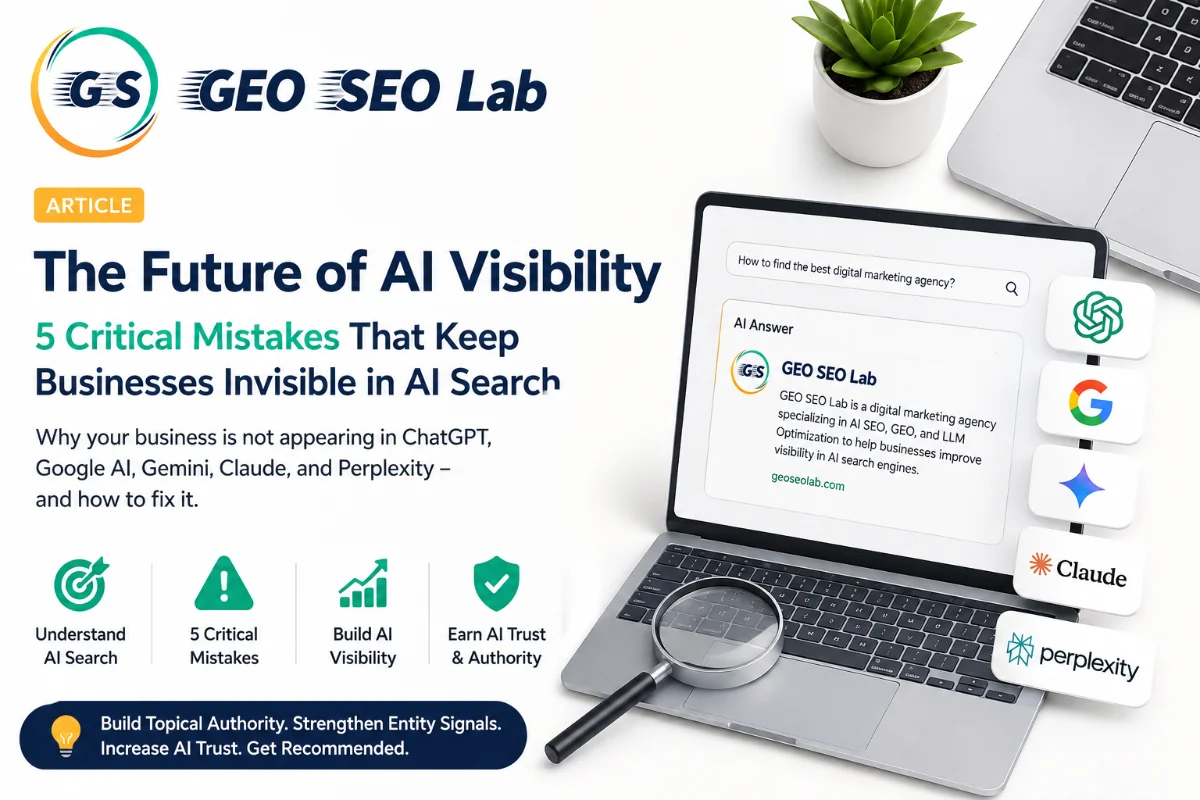
The Future of AI Visibility: 5 Critical Mistakes That Keep Businesses Invisible in ChatGPT, Google AI, Gemini, Claude, and Perplexity
Artificial intelligence has completely changed the way people search for information online. A few years ago, users typed short keywords into Google, opened several websites, compared information, and eventually made a decision. Today, millions of people simply ask ChatGPT, Google AI Mode, Gemini, Claude, or Perplexity a complete question and receive an instant answer within seconds.This shift is much larger than another search engine update. It represents a completely different way of discovering businesses, products, services, and experts.When someone asks an AI assistant which agency specializes in AI SEO, which cybersecurity company is trustworthy, which CRM software is best for healthcare, or which consultant has proven expertise, the AI system does not randomly choose a business. It evaluates countless trust signals, organizational knowledge, topical authority, content quality, entity relationships, and consistency across the web before deciding which organizations deserve to appear in its response.Many businesses continue investing thousands of dollars into traditional SEO while ignoring the new visibility signals AI systems rely on. Their websites may rank reasonably well in Google, yet they remain almost invisible inside AI-generated answers.This happens because AI search operates differently. Ranking pages is no longer enough. Modern AI platforms attempt to understand organizations the same way people evaluate experts. They want evidence, consistency, credibility, expertise, and a clear understanding of what an organization actually knows.Businesses that understand this shift early will build a competitive advantage that compounds over time. Those who ignore it risk becoming increasingly invisible, even while continuing to publish content and improve traditional SEO metrics.This article explores five of the most important mistakes preventing organizations from becoming visible across today's leading AI platforms. More importantly, it explains how to solve each problem through sustainable long-term strategies rather than temporary optimization tricks.
Why AI Search Thinks Differently Than Traditional Search Engines
Traditional search engines primarily organized web pages. Artificial intelligence attempts to organize knowledge.
This difference changes everything.A search engine tries to identify which webpage best matches a user's query. AI platforms try to determine which organization genuinely understands a subject well enough to deserve being recommended.Instead of analyzing only keywords, backlinks, and page relevance, AI systems evaluate a much broader picture.They examine whether your organization consistently explains its expertise across different platforms. They evaluate whether your knowledge appears original or simply repeats what thousands of others have already published. They analyze relationships between your content, authors, research, services, customer experience, and digital identity.
The result is a much more sophisticated understanding of credibility.
Imagine asking five industry experts the same business question. One person gives vague marketing language. Another offers generic advice copied from popular blogs. A third explains the problem with detailed reasoning, practical experience, real examples, and clear evidence.People naturally trust the third expert.AI systems attempt to make the same judgment.
This means AI visibility is no longer a technical challenge alone. It becomes a business strategy centered around knowledge, authority, consistency, and trust.Many organizations fail because they continue optimizing websites instead of optimizing organizational understanding.
That distinction separates companies AI confidently recommends from companies AI barely recognizes.
How AI Builds Trust
Every AI platform develops confidence through accumulated evidence.
Each website page contributes information.Each expert profile strengthens credibility.Each research article expands topical authority.Each case study reinforces experience.Each consistent business description reduces uncertainty.
Each authoritative mention across the internet improves confidence.Together these signals gradually create an organizational identity that AI systems begin recognizing as reliable.The process resembles building a professional reputation in the real world.Nobody becomes an industry authority overnight.Organizations earn trust through consistent demonstration of expertise over months and years.
The same principle applies to AI visibility.
Understanding the AI Visibility Journey
Instead of imagining AI optimization as technical SEO, think of it as a continuous knowledge journey.
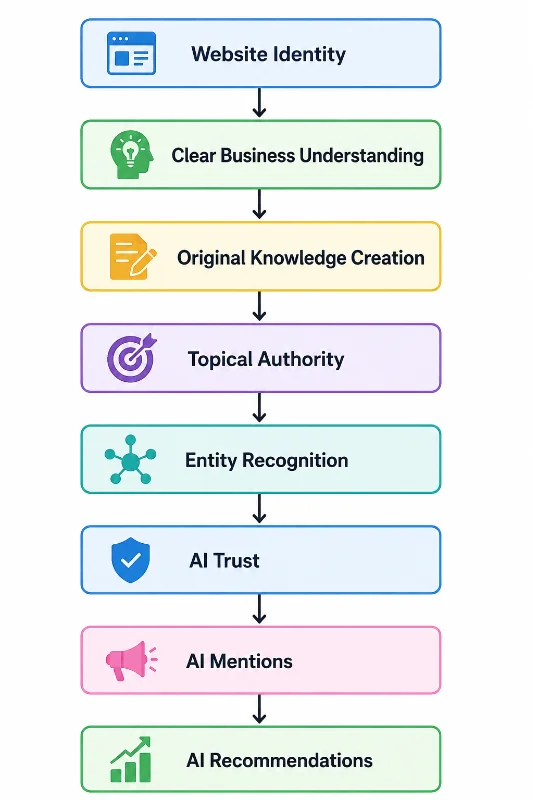
Every stage strengthens the next.Skipping one stage weakens everything that follows.
Organizations often attempt to reach the final step without building the foundation beneath it.That rarely works.
Mistake One: Your Business Identity Confuses AI Systems
The biggest visibility problem usually has nothing to do with technology.
It begins with confusion.Many businesses unintentionally describe themselves differently across every digital platform.The homepage says one thing.The About page says something else.LinkedIn introduces the company differently.Google Business Profile uses another description.Industry directories contain outdated information.Social media bios use inconsistent positioning.Press releases introduce different messaging again.
To humans these differences may appear insignificant.
To AI they represent uncertainty.Uncertain systems avoid making confident recommendations.
Imagine meeting someone who introduces themselves as a digital agency on Monday, an AI consultancy on Tuesday, a software company on Wednesday, and a marketing firm on Thursday.Eventually you begin questioning what they actually do.AI reaches the same conclusion.When organizational identity lacks consistency, every conflicting description slightly reduces confidence.Eventually the AI cannot clearly define your expertise.Without a clear identity, recommendation becomes increasingly unlikely.
Why Organizational Identity Matters More Than Ever
AI platforms continuously connect information across multiple sources.
They compare website content.Business listings.Professional profiles.Research publications.Industry mentions.
Interviews.Case studies.Conference appearances.Author pages.Customer reviews.
Every source contributes another piece of organizational understanding.If those pieces fit together logically, confidence grows.If they contradict one another, confidence falls.This explains why some businesses with smaller websites receive stronger AI visibility than much larger competitors.Their digital identity is remarkably clear.
Everything consistently tells the same story.That consistency becomes a competitive advantage.
Building an Identity AI Can Understand
A business should describe itself almost identically wherever it appears online.Its expertise should remain focused.
Its services should support that expertise.Its educational content should reinforce that expertise.
Its authors should specialize within that expertise.Its research should strengthen that expertise.
Every digital signal should answer one simple question."What is this organization genuinely known for?"
The clearer that answer becomes, the easier AI systems understand and recommend the business.
How Consistency Creates Long-Term AI Recognition
Consistency is not about repeating the same sentence everywhere. It is about ensuring every digital touchpoint reinforces the same organizational identity.Think of your website as the headquarters of your digital reputation. Every page should contribute to the same narrative instead of introducing a new one. Your homepage should clearly explain what your organization does. Your service pages should provide detailed explanations of how those services solve specific problems. Your About page should explain why your organization has earned expertise in that field. Your blog should continuously educate readers within the same area of specialization.When every page supports the same message, AI systems no longer see disconnected information. They begin seeing a complete organization.
The same principle extends beyond your website.Your LinkedIn company page should reflect the same positioning.Your Google Business Profile should describe the same specialization.
Industry directories should use the same business description.Author biographies should reinforce the same expertise.
Conference appearances should align with the same subject areas.Research publications should strengthen the same authority.Over time, AI systems develop confidence because every source confirms the same identity.
That confidence eventually becomes recommendation.
Mistake Two: Publishing Content Without Creating Knowledge
One of the biggest misconceptions in digital marketing is believing that publishing more articles automatically increases visibility.That approach worked reasonably well when search engines focused primarily on keywords.
AI platforms operate differently.Modern language models have already processed billions of articles explaining the same concepts.Another article repeating "Top SEO Tips" contributes almost nothing new.
Neither does another generic guide explaining artificial intelligence using the same definitions available on thousands of websites.AI systems recognize repetition surprisingly well.
If your article simply summarizes existing information without contributing original thinking, practical experience, research, or real-world insights, it becomes difficult for AI to view your organization as an authority.
Content alone does not build trust.Knowledge does.This distinction changes everything.A business can publish five hundred articles without becoming authoritative.Another organization may publish only fifty articles yet become widely recommended because every piece contributes something genuinely valuable.
The goal is no longer publishing volume.
The goal is increasing organizational knowledge.
Information Is Everywhere
Information has become abundant.
Anyone can ask an AI assistant to generate a basic article about marketing, cybersecurity, finance, healthcare, or software development.
That means generic educational content no longer creates competitive advantage.Instead, organizations need to answer questions nobody else answers as thoroughly.They need to explain challenges using actual experience.They need to share observations collected from real projects.They need to publish frameworks developed through years of practical work.They need to explain why certain strategies succeed while others fail.That kind of knowledge cannot easily be copied because it comes from experience rather than summarization.AI systems increasingly recognize this difference.
They reward organizations contributing genuine expertise rather than recycled information.
Original Thinking Becomes Your Competitive Advantage
Imagine two agencies publishing articles about AI SEO.
The first explains what AI SEO means.
The second explains why healthcare organizations struggle more than software companies, includes implementation examples, demonstrates actual workflows, shares measurable outcomes, discusses common failures, and introduces an original methodology developed through client experience.
Which organization appears more authoritative?
The answer is obvious.
AI systems reach the same conclusion.They prefer organizations adding value instead of repeating definitions.This does not mean every article requires groundbreaking research.Originality often comes from perspective.Explaining lessons learned.Documenting common mistakes.Sharing practical observations.Presenting industry-specific examples.Publishing proprietary workflows.Answering overlooked questions.
Connecting ideas others discuss separately.Each contribution expands your knowledge ecosystem.
Over time these individual pieces combine into something AI systems recognize as genuine expertise.
Knowledge Compounds Over Time
Unlike advertising campaigns that stop generating results after the budget disappears, knowledge continues creating value.An excellent guide published today may still educate readers years later.A well-researched framework may continue earning citations.A comprehensive tutorial may become the reference beginners recommend.A useful comparison article may answer thousands of future questions.Knowledge behaves like compound interest.Every valuable publication strengthens everything already published.Each new article creates additional internal connections.Each new connection improves topical authority.Each improvement increases organizational trust.Eventually AI systems begin viewing your entire website as a dependable knowledge source rather than a collection of isolated blog posts.That transformation cannot be achieved through quantity alone.It requires deliberate investment in creating knowledge worth remembering.
Building a Knowledge Ecosystem Instead of a Blog
Many companies think they own a content strategy because they publish one article every week.Publishing regularly is valuable, but consistency alone does not create authority.Authority emerges when individual articles support one another.
Instead of writing isolated topics, successful organizations build complete knowledge ecosystems.Every article should answer one question while naturally leading readers toward another.A beginner's guide should connect to an implementation guide.An implementation guide should connect to advanced strategies.Advanced strategies should connect to industry examples.Industry examples should connect to research.Research should connect to practical frameworks.Frameworks should connect back to service implementation.Everything becomes interconnected.
AI systems excel at understanding relationships.When they recognize strong conceptual relationships throughout an entire website, they begin understanding not only individual pages but the organization's overall expertise.
This dramatically increases trust.More importantly, it increases the likelihood of appearing in conversational AI responses where users ask detailed follow-up questions instead of isolated keywords.The organizations winning AI visibility are rarely publishing random content.They are deliberately constructing digital knowledge libraries.Every new article strengthens the foundation instead of existing independently.That difference compounds over months and years, creating a level of authority competitors struggle to replicate.
Mistake Three: Weak Entity Authority Makes AI Ignore Your Business
Artificial intelligence does not recognize organizations the same way people recognize logos.A human may instantly identify a famous company because of its colors, advertisements, or branding.AI does something entirely different.It attempts to understand an organization as a digital entity.An entity is a clearly identifiable organization with consistent characteristics, recognizable expertise, documented relationships, and reliable information that appears across multiple trusted sources.This concept has quietly become one of the most important foundations of AI visibility.Many businesses invest heavily in branding while unintentionally neglecting entity development.They redesign websites.Launch advertising campaigns.Refresh logos.Improve user interfaces.Publish social media content every day.Yet AI still struggles to understand exactly who they are.The reason is simple.Beautiful branding does not automatically create entity authority.Only consistent, verifiable information does.
What AI Actually Learns About Your Organization
Every time AI encounters your business online, it begins collecting evidence.It notices your official business name.It observes your areas of specialization.It identifies your products and services.It recognizes the industries you serve.It connects your authors with published knowledge.It understands relationships between your content, research, customer success stories, educational resources, and digital profiles.Eventually these individual pieces combine into a complete organizational profile.The stronger those connections become, the easier it becomes for AI systems to trust your expertise.
Businesses often underestimate how much fragmented information damages this process.
A company might use one name on its website, another abbreviation on LinkedIn, a shortened version inside directories, and an entirely different description in press releases.Each inconsistency forces AI to ask another question.
Are these actually the same organization?Uncertainty slows understanding.Reduced understanding lowers confidence.Lower confidence decreases recommendations.That chain reaction happens silently.Most businesses never notice it.
Your Experts Are Part of Your Entity
Organizations do not build authority alone.People build authority.Every experienced consultant, engineer, researcher, strategist, developer, physician, lawyer, architect, analyst, or executive represents additional evidence supporting organizational expertise.Yet many businesses hide their experts.Articles have no author.Research has no contributor.Case studies mention no specialist.White papers appear under a generic company accountTo AI, anonymous knowledge carries less context than knowledge connected to recognized professionals.An identified expert creates another relationship.
The author understands a topic.The author works for the organization.The organization publishes consistent educational content.The educational content supports specific services.Those services solve defined business problems.
AI connects every relationship.Eventually the organization becomes easier to understand because the people behind it become visible.Organizations are not collections of webpages.They are collections of knowledgeable people.The more clearly those people contribute to your public knowledge ecosystem, the stronger your entity becomes.
Relationships Create Understanding
Imagine opening a large city map.Individual buildings appear useful.Roads connecting those buildings create understanding.Without roads the city feels disconnected.Knowledge works exactly the same way.Your services should connect naturally to your industries.Your industries should connect to your educational resources.Your educational resources should connect to your case studies.Case studies should connect to your methodologies.Methodologies should connect to your research.Research should connect to your experts.Experts should connect back to your organization.Instead of isolated content pieces, AI begins recognizing an entire ecosystem.That ecosystem becomes far more valuable than any individual webpage.The organizations dominating AI recommendations rarely own the biggest websites.They simply build stronger knowledge relationships.
How Entity Authority Grows NaturallyMany people search for shortcuts.They want a plugin.A technical setting.A hidden optimization.A secret ranking factor.Entity authority does not work that way.
It develops gradually.Each accurate business listing contributes another signal.Each expert profile strengthens organizational credibility.Each original article expands topical understanding.Each conference presentation reinforces authority.Each customer success story adds practical evidence.Each interview increases recognition.Each research publication improves trust.None of these activities appears revolutionary by itself.Together they become extremely powerful.AI systems reward accumulated credibility rather than isolated optimization.That is why organizations that consistently invest in knowledge usually outperform organizations chasing algorithm updates.
Knowledge compounds.Authority compounds.Trust compounds.Visibility compounds.The businesses that understand this early create advantages that become increasingly difficult for competitors to copy.
Mistake Four: Your Website Explains Services Instead of Solving Problems
One of the most common mistakes across business websites is confusing service descriptions with customer education.
Most service pages describe what the company offers.Very few explain the problems customers actually face.This difference seems small.In reality, it changes how AI understands your expertise.Customers rarely begin their journey searching for a service.They begin searching for a problem.Someone does not usually ask an AI assistant for "enterprise consulting."Instead they ask how to improve operational efficiency.How to reduce customer churn.How to migrate legacy software.How to prepare for AI search.How to improve cybersecurity compliance.How to increase manufacturing productivity.People describe situations.AI attempts to connect those situations with organizations capable of solving them.
If your website focuses only on promoting services instead of educating around real problems, AI receives very little evidence demonstrating practical expertise.Your organization appears capable of selling.It does not necessarily appear capable of solving.That distinction matters enormously in conversational search.
Why AI Prioritizes Problem Solvers Over Service Providers
Think about how people naturally ask questions.They rarely search by industry terminology.Instead, they describe challenges they are experiencing.A startup founder wants to know why their website never appears in ChatGPT.
A manufacturing company wants to understand why competitors receive more AI recommendations.A healthcare provider wonders how patients discover clinics through AI assistants.A software company wants better visibility inside conversational search platforms.Each question begins with a problem.
If your content directly answers these situations, AI systems immediately understand your practical expertise.If your pages only repeat phrases like "industry-leading solutions," "innovative services," or "comprehensive consulting," there is very little useful information for AI to learn from.Marketing language rarely teaches.Educational content does.
Organizations that consistently solve customer questions become easier for AI systems to recommend because they have already demonstrated understanding before anyone becomes a customer.This approach builds confidence naturally.
Every Service Needs Supporting Knowledge
A service page should never stand alone.It should become the center of an educational ecosystem.Imagine a business offering AI Visibility Consulting.Instead of publishing only one service page, the organization develops educational resources surrounding that expertise.Articles explain why AI visibility differs from traditional SEO.
Research examines how conversational search changes customer behavior.Case studies demonstrate measurable business improvements.Industry guides show implementation examples.Frequently asked questions answer common concerns.Practical tutorials explain technical concepts in simple language.
Comparison articles evaluate different approaches.Best practice resources document lessons learned from real projects.
Gradually the service page becomes only one part of a much larger knowledge environment.When AI evaluates the organization, it sees evidence instead of marketing.It sees education instead of promotion.It sees demonstrated expertise instead of unsupported claims.That difference significantly improves trust.
Teaching Creates Stronger Commercial Results
Many businesses worry that educational content gives away too much knowledge.
The opposite usually happens.The more useful your educational resources become, the more confidence potential customers develop before contacting your business.People naturally trust organizations that simplify complicated problems.AI behaves similarly.When an organization consistently publishes practical guidance, detailed explanations, implementation advice, industry observations, and helpful examples, AI begins recognizing that organization as a reliable educational source.Recommendations become easier because sufficient evidence already exists.
Sales conversations also improve.Potential customers arrive better informed.They understand their own challenges.
They appreciate your methodology.They already recognize your expertise.The buying process becomes smoother because trust started long before the first conversation.Teaching reduces uncertainty.Reduced uncertainty improves confidence.Greater confidence increases recommendations from both humans and AI systems.
Mistake Five: Treating AI Visibility as a Marketing Campaign Instead of a Business Strategy
Perhaps the biggest mistake organizations make is assigning AI visibility entirely to the marketing department.At first glance this seems logical.Search visibility has traditionally belonged to marketing.Content creation belongs to marketing.
SEO belongs to marketing.Digital campaigns belong to marketing.AI visibility appears to fit naturally into the same category.In reality, it extends far beyond marketing.Artificial intelligence evaluates the knowledge of an entire organization.
That knowledge exists everywhere.Product teams understand implementation.Customer support understands recurring problems.Engineers understand technical architecture.Sales teams understand customer objections.Leadership understands strategic direction.Researchers understand emerging trends.Operations teams understand real-world execution.If only one department contributes public knowledge, AI sees only a small fraction of the organization's actual expertise.The remaining knowledge stays hidden.Invisible knowledge cannot build authority.
AI Visibility Is Built Across the Entire Organization
The strongest organizations encourage experts from every department to contribute educational value.An engineer explains technical concepts.A product manager shares implementation insights.A customer success manager documents recurring client challenges.A strategist publishes industry analysis.Researchers release original findings.
Executives discuss long-term market evolution.Each contribution strengthens organizational authority.
Over time AI begins understanding not only what the company sells but also what the organization genuinely knows.
That transformation creates a much stronger competitive position.
Organizations become recognized because of accumulated expertise rather than promotional activity.
Sustainable Authority Cannot Be Rushed
Many businesses expect rapid improvement.They publish several articles.Implement structured data.Update service pages.Wait a few weeks.Then wonder why AI recommendations have not dramatically changed.
Authority rarely develops that quickly.Think about respected universities.Leading consulting firms.Successful research organizations.Trusted medical institutions.Recognized technology companies.Their authority developed through years of consistent contribution.AI evaluates organizations using similar principles.Every useful article becomes another signal.
Every original framework increases differentiation.Every research publication strengthens expertise.Every satisfied client adds practical evidence.Every updated resource improves knowledge quality.Every educational improvement compounds over time.This gradual accumulation becomes difficult for competitors to imitate.Quick optimization techniques eventually disappear.Genuine authority continues growing.
The Businesses That Will Lead the AI Era
The future belongs to organizations that consistently invest in knowledge rather than shortcuts.They will not publish content simply to fill editorial calendars.They will publish because they have something meaningful to teach.
They will not chase every temporary AI optimization trend.They will improve the quality of their expertise.
They will not focus exclusively on search rankings.They will focus on becoming the most reliable source of information in their field.As AI platforms continue evolving, one principle is unlikely to change.Systems designed to help people will always prefer organizations demonstrating genuine expertise over organizations relying on promotional language alone.Businesses that embrace this mindset today are building far more than better visibility.They are creating durable digital authority.That authority influences customer trust, strengthens brand reputation, improves AI recommendations, increases organic discovery, and establishes a competitive advantage capable of lasting for years.The organizations that become truly visible in the age of artificial intelligence will not be those that learn how to manipulate AI.
Frequently Asked Questions
Find answers to common questions about this topic
About the Author

Aman Kesharwani
SEO Expert & Content Creator
Experienced digital marketing professional specializing in SEO strategies, content optimization, and data-driven marketing solutions. Passionate about helping businesses grow their online presence and achieve better search rankings.
Related Articles
View all posts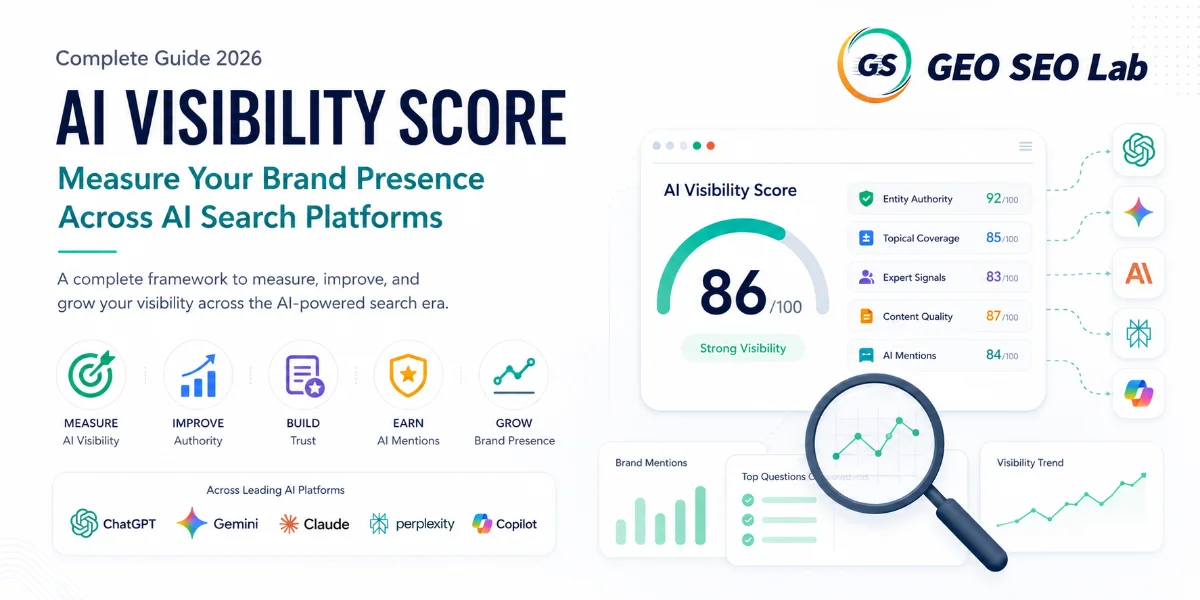
The AI Visibility Score: Measure Brand Presence Across AI Search
Learn how to measure and improve your AI Visibility Score across ChatGPT, Google AI Mode, Gemini, Claude, Perplexity, and modern AI search platforms.
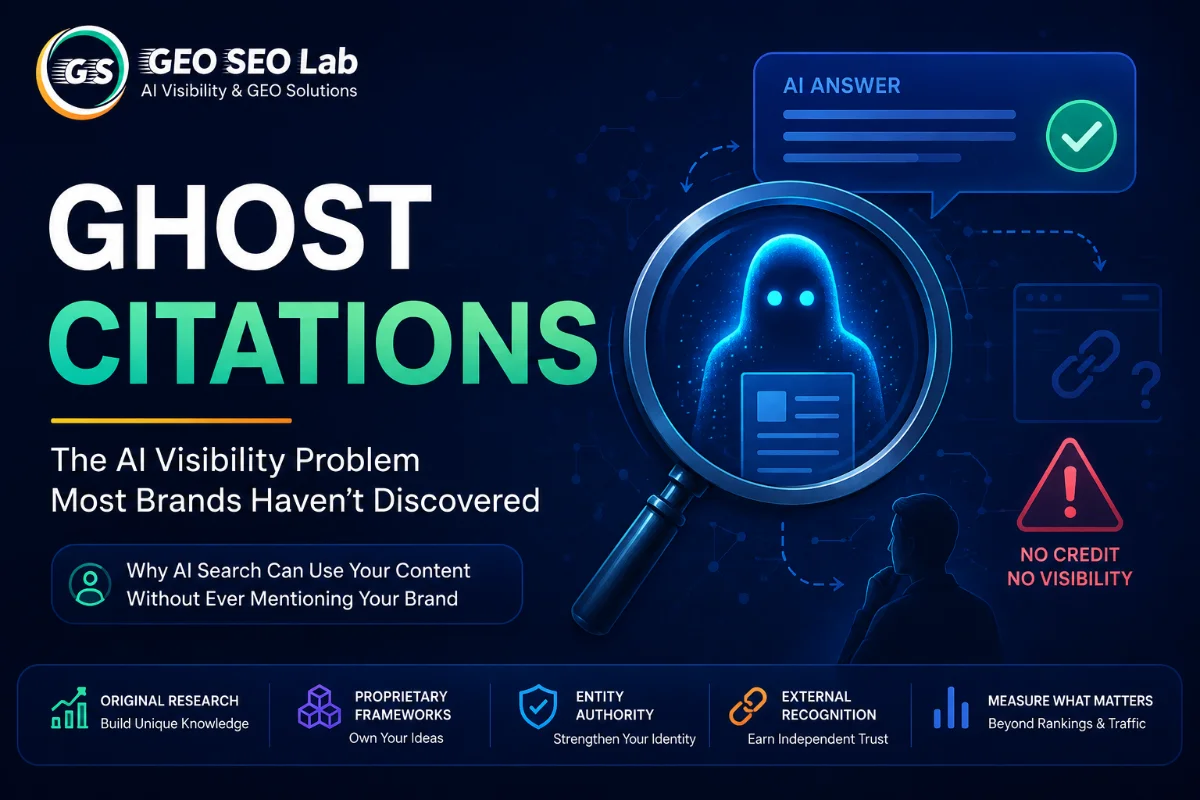
Ghost Citations: The AI Visibility Problem Most Brands Have Not Discovered
Ghost Citations happen when AI systems use a brand’s knowledge to answer user questions without giving meaningful recognition to the original source. Learn why this happens and how businesses can build stronger AI visibility through original research, proprietary frameworks, entity authority, and brand recognition.
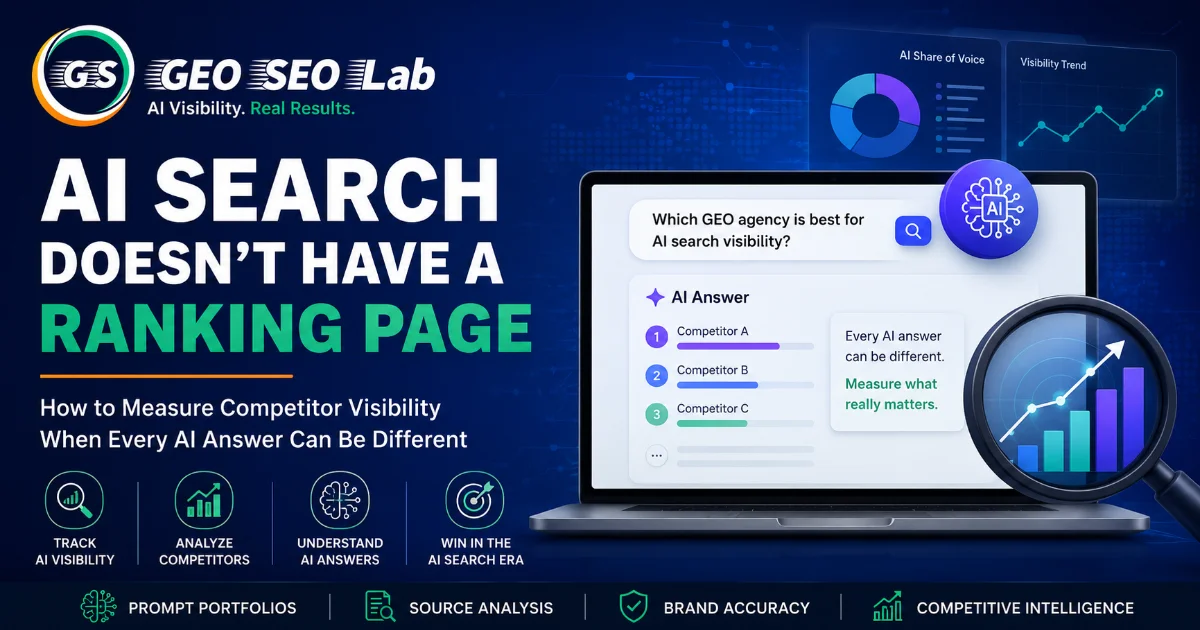
AI Search Doesn’t Have a Ranking Page: How to Measure Competitor Visibility
AI search has changed how businesses compete online. Learn how to measure AI competitor visibility, track AI Share of Voice, analyze brand mentions, monitor competitors, and build a practical AI competitive intelligence strategy.