Cloudflare's AI Monetization Gateway: Is the Free Web for AI Finally Ending?
Cloudflare's AI Monetization Gateway: Is the Free Web for AI Finally Ending?How Cloudflare's New Payment Model Could Reshape AI Search, Publisher Reve...

Introduction: The Fault Line Running Through the Modern Web
There's a tension sitting at the center of today's internet that most people have quietly ignored for about three years now.
On one side: publishers, researchers, journalists, documentation writers, and businesses who've spent years — sometimes decades — building the people and infrastructure needed to produce accurate, genuinely useful knowledge. That investment has always been paid for through a fairly clear exchange — make good content, attract visitors, earn money through ads, subscriptions, or sales.
On the other side: AI companies whose models were trained on that content, and whose assistants now retrieve and synthesize it constantly, handing users answers they may never trace back to a website at all. The AI companies have built genuinely valuable products. How much of that value should flow back to the people whose knowledge made it possible is a question the industry has been dodging.
Cloudflare just gave that question something concrete to argue about.
The company's Monetization Gateway, built on the open x402 payment protocol, lets website owners set payment policies for their content — creating a real path for AI agents and autonomous systems to pay for access instead of just taking it for free. Alongside it, Cloudflare rolled out analytics that show publishers how AI crawlers are actually behaving on their sites.
This is worth taking seriously not because it fixes the AI content economy overnight, but because it's one of the first technically credible attempts to rebuild that economy at the infrastructure level. Cloudflare sits at genuine internet scale — its network touches a huge slice of global web traffic. When a company like that introduces a new economic model at the network layer, it isn't a startup pitching a theory. It's a company that can actually make one happen.
This piece covers what Cloudflare built, why it matters, what it means for publishers and GEO practitioners, and where the economics of the AI web look headed over the next few years — without advocating for a particular outcome, just trying to be clear about what's actually changing.
The Web's Biggest AI Problem Finally Gets an Answer
The economic foundation AI is disrupting. For most of the internet's history, commerce ran on the idea that human attention is the scarce resource everything else gets built to capture. Someone searches, gets results, clicks a site, and that site earns something — ad revenue, a sale, a newsletter signup, brand recall built over repeat visits. That model wasn't perfect — it rewarded content built to rank rather than inform, and ad models that rewarded outrage because outrage got clicks — but it also funded a genuinely massive ecosystem of real knowledge creation. Newsrooms, research institutions, documentation teams, and countless businesses invested in content because the web's economics made it worthwhile.
AI assistants break that chain at its weakest link. Ask ChatGPT or Gemini a question and get a synthesized answer back, and you may never visit any of the sites that informed it. The knowledge got used. Value got created for the user. The publisher got nothing. As AI-assisted search becomes a bigger part of how people find things, the share of knowledge consumption happening without a matching site visit keeps growing — and for publishers whose income depends on those visits, that's not a sustainable trajectory without some new model underneath it.
What Cloudflare actually built. Think of the Monetization Gateway as infrastructure, not a consumer product. It gives organizations the technical foundation to define, enforce, and get paid for access to digital resources — without building custom billing or authentication systems from scratch. Anyone using Cloudflare can set payment policies on webpages, APIs, datasets, or documentation sitting behind its network. When something — a browser, an AI crawler, an autonomous agent — tries to access a resource with a payment policy attached, Cloudflare handles the verification and enforcement right at the network edge.
The mechanism runs on the x402 protocol, named after the HTTP 402 status code — "Payment Required" — that's existed in the web's spec since 1991 without ever getting properly implemented, because there was no real payment infrastructure to back it. x402 is built specifically for machine-to-machine micropayments: a software agent can discover that a resource costs something, verify the price, pay automatically, and access it — no human involved at any step. That's the real point here. This isn't mainly built for a person deciding whether to pay for a paywalled article. It's built for AI agents that need information as part of their own operation, negotiating access programmatically.
Cloudflare also shipped analytics alongside the payment layer — which AI systems are visiting a site, how often, which pages, and what that traffic might actually be worth. Not perfect answers, but far more visibility into AI crawler behavior than most publishers currently have, which is the prerequisite for deciding anything about monetizing it.
From attention economy to usage economy. The web's commercial history reads like a sequence of dominant models. Early on it was a simple access economy — pay to connect, that funds the infrastructure. As the web opened up, advertising took over, creating the attention economy — content free to consume because advertisers paid for the attention it generated. That model expanded access to information dramatically and funded a huge amount of content creation, but it also rewarded attention-grabbing over value-creating, and concentrated revenue in high-traffic platforms rather than the people actually making the valuable stuff — which left it exposed to exactly the disruption AI is now causing.
Cloudflare's Gateway points toward something different: a usage economy, where value gets recognized and paid for at the point of consumption, whether or not a human is doing the consuming. The question shifts from "how many people saw this page" to "how many times did something actually use this knowledge, and for what." That's not a small conceptual shift — it changes which content is most valuable, which organizations are positioned to benefit, and what's worth investing in over the next few years.
Why Cloudflare, specifically. Several companies could theoretically propose an AI monetization mechanism. Cloudflare's version deserves particular attention because of where it sits in the internet's plumbing. It runs one of the largest content delivery networks on earth, handling an enormous share of global traffic at the edge — the layer requests pass through before reaching an origin server. Organizations already using Cloudflare for security and performance don't need to bolt on a new payment system; they just configure a policy on infrastructure that's already there, which massively lowers the barrier compared to a standalone solution. There's also a network effect worth noting: if enough sites implement payment policies through Cloudflare, AI companies wanting access will need to build the technical capability to speak x402 — a capability that, once built, works for any other x402-compatible system too. None of this guarantees success (content payment schemes have been tried and mostly failed before), but Cloudflare's scale and position genuinely differ from most prior attempts.
The agentic internet as backdrop. One part of Cloudflare's framing deserves real attention: what it calls an "agent-first internet." Today's discussion mostly focuses on AI systems retrieving information to answer a question. But the systems being built now are increasingly agentic — capable of taking a whole sequence of actions, using tools, and completing tasks without a human directing every step. An agent might research a topic, hit APIs for real-time data, pull documentation, buy a dataset, and compile a report entirely on its own. That kind of autonomous operation is already starting to happen and will keep getting more common and more capable. When AI agents operate at scale, they become a genuinely new category of web user — one the current infrastructure wasn't built for, since payment systems assuming human authorization and ad models assuming human attention don't work cleanly when the "visitor" is a piece of software. x402 and the Monetization Gateway are explicitly built with this in mind — not just a convenience feature, but foundational plumbing for a web meant to serve both human and machine visitors.
Why This Could Change GEO and AI Search for Good
The knowledge supply chain AI depends on. Cloudflare's move forces attention onto something AI companies would rather not dwell on: how dependent these systems actually are on the human knowledge ecosystem underneath them. Every genuinely useful fact an AI assistant draws on came from somewhere — a journalist who did the reporting, a scientist who ran the experiment, a doctor who synthesized clinical evidence, an engineer who documented a system, a business that built up expertise over years. The AI didn't generate that knowledge — it learned from it, and keeps depending on retrieving more of it. Call that the knowledge supply chain: newsrooms employing journalists, universities funding researchers, healthcare organizations maintaining clinical data, businesses funding documentation teams, developers writing tutorials — an ongoing chain of investment that AI systems lean on but that AI consumption currently does nothing to fund. If AI consumption keeps growing while human traffic keeps declining, with no compensating revenue for the AI side, the incentive to keep investing in that supply chain weakens — and the AI systems depending on it end up with progressively thinner, staler material to draw from. This isn't hypothetical. Publishers are already adjusting content investment around the changed economics, and research organizations are actively questioning whether open knowledge-sharing still makes sense when it just feeds commercial AI products with no reciprocal benefit.
Attribution isn't the same thing as economic participation. A lot of the AI industry's response to publisher concerns has focused on attribution — citing sources inside generated answers, pointing users back toward the originals. That's genuinely valuable; it improves transparency and gives at least some path back to the publisher. But it doesn't solve the underlying economic problem, and treating it as if it does is misleading. Walk through the actual mechanics: an AI answer cites several sources, but only a small share of users ever click through, since the information they wanted has usually already been delivered. That residual traffic is meaningful in aggregate but far smaller than what traditional search would've sent. The value gap between what publishers contribute and what they get back through citation clicks stays substantial. Economic participation is a fundamentally different logic — not "we'll acknowledge you and send a few people your way," but "you created something we used, and that use itself should generate payment, independent of clicks." Whether the market will actually support that at scale is genuinely unclear. But as a description of what publishers are owed, it's a more complete one than attribution alone.
GEO's scope is expanding. Generative Engine Optimization, as practiced so far, has mostly asked one question: how do we get AI systems to discover, understand, and favorably include our content? That's legitimate — clarity, entity consistency, topical authority, and structured data genuinely matter for that kind of visibility. But Cloudflare's Gateway introduces something first-generation GEO doesn't really address: not just how to optimize content for discovery, but how to structure access to it in the first place. Which content should stay freely accessible to maximize discovery and authority, and which represents intellectual property valuable enough to justify controlled access and monetization? These are related questions but genuinely different ones, and GEO increasingly needs to cover both — deciding what's freely open, what needs authentication, what needs payment, and what stays proprietary. That's a harder strategic question than classic SEO ever asked, because it involves a real tradeoff between visibility and value capture, and the right balance differs by organization, industry, and content type.
How AI companies are likely to respond. A few plausible paths. One: compliance — if enough publishers gate content and users expect comprehensive, accurate answers, AI companies may find paying for quality content necessary to stay competitive. Two: circumvention — companies with the resources might lean harder on non-gated sources, negotiate direct licensing with big publishers, or reduce dependence on live web retrieval altogether, which would disadvantage smaller publishers without leverage to negotiate directly while benefiting large media incumbents. Three: negotiated licensing ecosystems — arrangements between AI companies and publisher groups similar to how streaming services negotiate with labels, several of which are already forming in various shapes, with Cloudflare's infrastructure potentially providing the technical rails underneath. The likeliest outcome is some blend of all three, varying by content category and platform.
A distributional concern worth naming. Large, well-resourced publishers are best positioned to negotiate favorable licensing and implement payment mechanisms smoothly. Smaller creators may find the overhead genuinely prohibitive. If the benefits flow mainly to big incumbents, this could concentrate digital publishing further rather than sustaining the diverse ecosystem the web has always supported. That's not an argument against AI content compensation as a principle — it's an argument for paying attention to how the implementation actually plays out for organizations that aren't large enough to negotiate their own deal.
What This Means for Businesses, Publishers, and Content Overall
Every industry's knowledge is on the table, not just media. Public conversation about AI content compensation tends to center on news organizations, which makes sense — they're the most visible and immediately affected. But that's a narrow picture. In the AI era, every organization producing digital knowledge is functionally a publisher. Software companies maintain documentation AI coding assistants query constantly. Healthcare organizations publish guidelines AI health tools draw on. Financial institutions produce research financial AI consumes. Law firms publish analyses legal AI assistants use. Educational institutions build resources AI tutors incorporate. None of these organizations think of themselves as being in "publishing," but they all create knowledge AI depends on — which makes the access-and-compensation question relevant to all of them.
News and media face the sharpest version of this. Journalism is genuinely expensive — investigative work and specialist beats need sustained investment in people whose work can't be cheaply automated. The economics that funded that work — mostly advertising, with subscriptions and institutional support layered on — have been under pressure since classified ads moved online, worsened as digital ad revenue concentrated in a few platforms, and now face a third hit as AI redirects information-seeking away from direct site visits. If AI companies can freely use journalism's output without funding its production, investment in that production declines, and the information available to AI systems declines with it. Cloudflare's mechanism offers one path to capture some value from that consumption — whether it's enough to offset lost traffic revenue, and whether the administrative overhead is manageable for organizations already under financial strain, nobody actually knows yet.
Software documentation sits in an interesting spot. Software companies both benefit from AI coding tools and supply the documentation those tools rely on. An AI coding assistant is valuable specifically because it can answer questions about libraries and APIs accurately — and that accuracy depends on documentation companies maintain at real ongoing cost, often built by a different company than the one selling the assistant, with no compensation flowing back for the value contributed. For some companies that's fine — good documentation drives adoption of their library, which drives revenue indirectly. For others, especially those with proprietary APIs or competitively valuable documentation, distinguishing free access for developers learning the platform from paid access for AI systems powering commercial products could matter a lot. Cloudflare's infrastructure could technically support that distinction, even though the actual policy calls stay complicated.
Healthcare carries stakes beyond commerce. AI health assistants get used constantly now for medical questions, and their answer quality depends entirely on the medical knowledge behind them — evidence-based guidelines, accurate patient education, current drug information — all of which requires real clinical expertise and institutional infrastructure to produce and maintain. Whether AI consumption of that content should generate direct payment is genuinely complicated by public health considerations: making high-quality health information harder to access, even for AI, could hurt patient outcomes. A middle path might keep public educational content freely accessible while gating specialized clinical resources meant for professional use — something Cloudflare's access controls could support technically, even if the policy line is hard to draw.
A practical way to think about your own knowledge assets. Split them into three rough categories. Public-facing educational content — articles and guides meant to build awareness and organic authority — is generally best left open; gating it undercuts the visibility it exists to generate. Licensed or partner-accessible content — specialized research, detailed documentation, premium tools with real commercial value — might reasonably sit behind authentication or licensing terms while staying protected from unrestricted commercial scraping. Proprietary intelligence — internal research, customer insights, trade secrets — is the most valuable and most protected tier, meant for internal systems and specific controlled use rather than open access. Most organizations haven't actually mapped their own content against these categories yet, and doing so is becoming a real strategic exercise, not a nice-to-have.
Content strategy itself is changing shape. For most of digital marketing's history, strategy centered on two questions: what should we publish, and how do we get people to find it — measured through sessions, rankings, time on site. Those questions still matter, but they're no longer sufficient on their own. New ones matter too: what makes our knowledge genuinely distinctive rather than merely accessible? Which assets are real intellectual property versus information freely available elsewhere? How should access be structured to balance visibility, authority, and value capture? These are harder questions than classic content strategy asked, because they require an honest read on what actually makes an organization's knowledge valuable, not just what happens to rank well.
Where AI Content Economics Is Headed, and How to Prepare
The web's fourth economic era. The commercial internet's history reads as a sequence of models. First, roughly through the early 2000s, the access economy — value from connecting users, revenue flowing to ISPs. Then the attention economy that's dominated the last two decades — search solved discovery, advertising funded free content at scale, concentrating power in the platforms that controlled attention. Alongside and after that, a subscription and SaaS economy, moving more of the internet toward direct payment relationships. Cloudflare's Gateway hints at a fourth era — an agent economy, where autonomous software systems become real economic participants, consuming resources and completing transactions without a human in the loop at each step. The infrastructure for this is being built right now, and the economic rules governing it are being negotiated through moves like this one. Whether it develops as fast as current AI enthusiasm suggests is uncertain, but the direction is clear enough to plan around.
What this means for content specifically. The audience for content is diversifying in ways that require different responses. Human readers remain the primary audience, and what serves them — clarity, relevance, real usefulness — hasn't changed. But AI systems synthesizing content into answers are a second audience, benefiting from explicit structure, consistent terminology, verifiable factual claims, and comprehensive subtopic coverage that lets them extract meaning reliably instead of inferring it. And autonomous agents acting as genuine economic participants are a third audience, needing to discover content, judge its relevance to a task, verify access requirements, and fold it into a workflow without a human involved. Designing for all three is more work than designing for human readers alone — it needs structured data, clear metadata, and accessible APIs on top of everything that's always mattered about good content.
Five trends worth planning around. AI licensing is becoming institutionalized — the era of free access for AI training and retrieval is ending, replaced by explicit agreements as legal and regulatory pressure builds; organizations that understand their own knowledge's value and negotiate from that footing will do better than those waiting for standards to be imposed on them. AI systems are starting to differentiate on knowledge quality — as the market gets more competitive, access to current, high-quality information becomes a real differentiator, which creates leverage for whoever produces that information. Agentic AI keeps expanding into more workflows, raising the economic stakes of the resources those agents access. Web infrastructure is consolidating around AI-aware capability — Cloudflare isn't alone in building AI-era economics into the internet's plumbing, and the standards being set now will shape this for years. And first-party knowledge — information only your organization has, from your own research and experience — becomes proportionally more valuable as AI gets better at synthesizing everything that's already public.
A practical way to prepare. Start with an honest audit of what your organization actually knows — not just what's published, but what expertise exists internally that could matter to AI systems or the people they serve. Then apply an access framework to that inventory: decide, category by category, what stays open for authority and discovery, what gets licensed or authenticated, and what stays fully proprietary — driven by actual strategic goals, not default habit. Invest specifically in original knowledge creation, since distinctive first-party material is the most defensible position available right now; check honestly whether your content investment is producing something genuinely new or just reorganizing what's already out there. Build the technical groundwork that makes knowledge accessible in AI-appropriate ways — structured data, documented APIs, clear metadata, and real monitoring of how AI systems interact with your resources. And treat this as an ongoing practice, not a one-time decision — review access policies regularly as the competitive landscape, available infrastructure, and your own goals keep shifting.
A few misconceptions worth clearing up. The idea that AI will replace content creators misreads the actual dependency — AI is good at synthesizing existing knowledge, not at generating the original reporting, clinical observation, or engineering insight that makes knowledge valuable in the first place; if anything, demand for real knowledge creation may be rising as AI makes people more effective at using it. The idea that every organization should immediately start charging AI companies ignores the real strategic value open access still has for visibility and trust — most organizations are better served keeping the bulk of content open while monetizing a few genuinely high-value assets. The idea that a payment mechanism alone solves publisher revenue is overly optimistic — infrastructure is necessary but not sufficient; the actual revenue depends on whether AI companies are willing to pay enough to matter. And the idea that SEO stops mattering once AI starts paying confuses two different goals — visibility and monetization are complementary, not substitutes; content AI systems can't find or understand in the first place won't benefit from a payment mechanism, because nobody will be accessing it to pay for.
Key Takeaways
- Cloudflare's Monetization Gateway is a genuine infrastructure-level intervention in AI content economics — its network position and the open x402 protocol give it more credibility and scale than most prior attempts at this.
- The real story is the shift from attention economy to usage economy — whether producing valuable knowledge stays economically sustainable once AI consumption supplements or replaces human visits.
- GEO needs to expand past visibility optimization into knowledge access strategy — deciding what stays open, what gets licensed, and what stays proprietary.
- Every knowledge-producing organization is affected, not just traditional publishers — documentation, clinical guidelines, research, and expert content all sit inside the same supply chain.
- First-party knowledge is the most defensible position in the AI era, and becomes more valuable as AI gets better at synthesizing what's already public.
- The agent economy is the real backdrop here — as autonomous agents get more capable, machine-to-machine payment infrastructure becomes more important, not less.
- Preparation should be systematic, not reactive — audit knowledge assets, set intentional access policies, invest in original knowledge, and build the technical groundwork.
About GEO SEO Lab
GEO SEO Lab helps brands become discoverable, trusted, and recommended in the AI era. Traditional SEO alone is no longer enough — businesses now need visibility across AI search engines, LLMs, local search, reviews, and digital platforms. Our platform continuously monitors website health, AI visibility, content performance, competitor movements, local presence, and customer sentiment while providing actionable recommendations that drive real traffic, qualified leads, and measurable growth. Built specifically for modern businesses and MSMEs, GEO SEO Lab transforms complex digital marketing into a clear, intelligent growth system.
References and Further Reading
Primary sources: Cloudflare Blog and Developer Documentation on the AI Monetization Gateway, the x402 protocol, and AI bot analytics (blog.cloudflare.com, developers.cloudflare.com).
Digital economics and web history: Jonathan Zittrain, The Future of the Internet — And How to Stop It; Tim Wu, The Attention Merchants; Scott Galloway, The Four.
AI and content economics: Reuters Institute Digital News Report on AI and publisher economics; Nieman Journalism Lab coverage of AI and news revenue; The Markup's reporting on AI use of journalism.
AI and information retrieval: Lewis et al., "Retrieval-Augmented Generation for Knowledge-Intensive NLP Tasks" (arXiv:2005.11401); Manning, Raghavan & Schütze, Introduction to Information Retrieval.
Tags
Frequently Asked Questions
Find answers to common questions about this topic
About the Author

Anubhav
SEO Expert & Content Creator
Experienced digital marketing professional specializing in SEO strategies, content optimization, and data-driven marketing solutions. Passionate about helping businesses grow their online presence and achieve better search rankings.
Related Articles
View all posts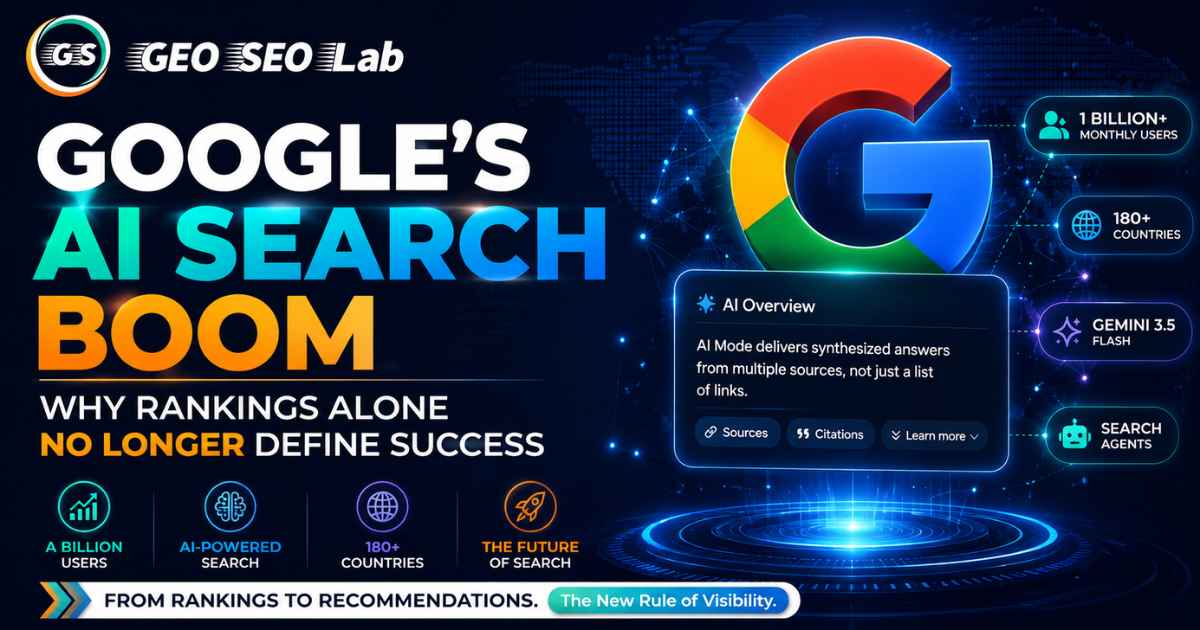
Google's AI Search Boom In 2026: How AI Mode, AI Overviews & Query Fan-Out Are Changing Rankings
Google's AI Search Boom: Why Rankings Alone No Longer Define SuccessCategory: AI Search Analysis & GEO Strategy | Published: July 2026 | Reading Time:...
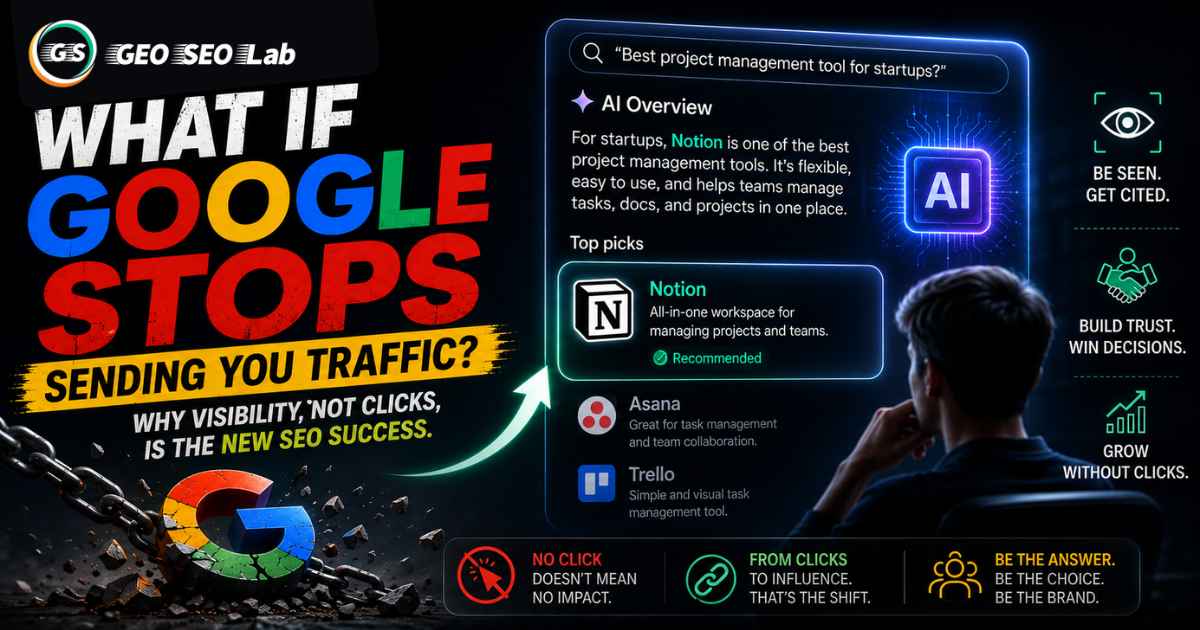
What If Google Stops Sending You Traffic?
Here's a scenario worth actually thinking through rather than rushing past. Your brand shows up inside an AI-generated answer. Your content gets cited...

Why Different AI Platforms Recommend Different Brands
Why Different AI Platforms Recommend Different BrandsSame Question, Four Answers, Almost Zero OverlapA GEO SEO Lab ReportEditorial Disclosure: This re...