The Discovery Economy: How AI Is Redefining Search, SEO & Digital Trust
Why Search Is No Longer About Finding Information—It's About Winning Every Step of the Customer Journey
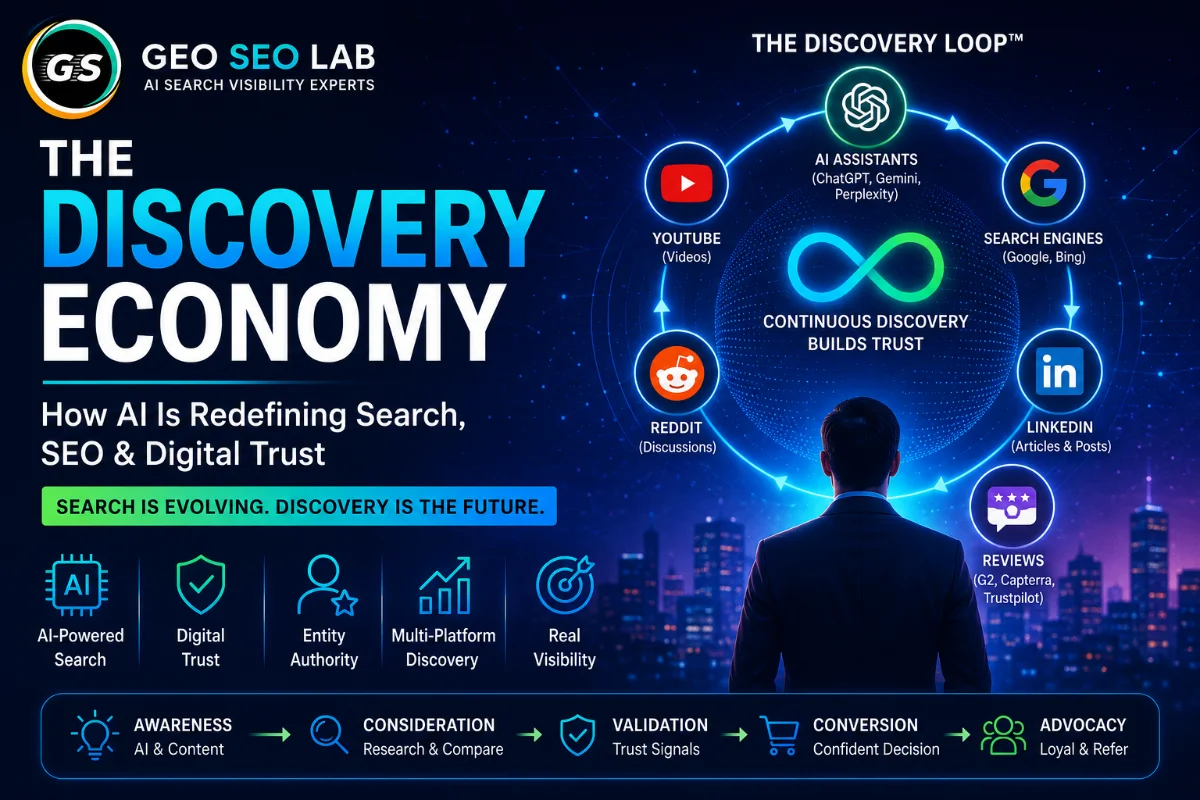
Every Generation Changes the Way People Discover Information
Every major technological shift changes how people answer one simple question:
"Where do I go when I need information?"
Twenty years ago, the answer was usually straightforward.People opened a browser, typed a query into Google, compared several websites, and gradually formed an opinion.Search engines acted as gateways.Websites acted as destinations.The customer journey was relatively linear.If someone wanted to buy accounting software, they searched Google.If they wanted to compare hospitals, they searched Google.If they wanted to learn about investing, they searched Google.The search engine introduced the options, and the websites completed the conversation.That model created one of the largest digital industries the internet has ever seen.Businesses invested billions of dollars into improving rankings because rankings determined visibility.Visibility determined traffic.Traffic determined opportunity.And opportunity created revenue.
For years, that formula worked remarkably well.It was measurable.It was predictable.And it became the foundation of modern digital marketing.But every successful system eventually reaches a point where the environment surrounding it begins to change.Search has now reached that point.Search Is No Longer the Beginning of Every Journey
Consider how people research a significant purchase today.Imagine a healthcare clinic owner searching for an AI visibility platform.Ten years ago, that journey might have looked something like this:The owner searched Google.They opened several websites.They compared pricing pages.They read customer testimonials.Eventually, they booked a demonstration.
The entire decision happened within a relatively small digital ecosystem.Now imagine the same person making the same decision today.The journey rarely begins and ends inside Google.Instead, they might ask ChatGPT for an overview of the leading platforms.Curious about one recommendation, they search Google for independent reviews.While researching, they discover a LinkedIn article written by the company's founder.They watch a YouTube interview discussing AI search trends.They read customer discussions on Reddit.They compare software ratings on G2.Only after building confidence through several different sources do they visit the company's website.The website has not become less important.
Its role has changed.Instead of introducing the business, it increasingly validates a decision that has already begun elsewhere.This distinction is subtle, but it changes how businesses should think about visibility.The customer no longer experiences digital marketing through isolated channels.They experience one continuous journey across multiple environments.Every interaction contributes to trust.Every platform answers a different question.Every touchpoint influences whether the customer continues moving forward or leaves to explore another option.The website is no longer the entire journey.It has become one chapter within a much larger story.
Businesses Are Still Measuring Yesterday's Internet
One of the most fascinating aspects of modern marketing is that customer behavior has changed faster than business measurement.Many organizations continue evaluating digital success using metrics that were designed for a world where websites dominated discovery.Monthly traffic.Organic rankings.Click-through rates.Bounce rates.Session duration.These measurements remain valuable.But they describe only what happens after someone reaches the website.They reveal very little about everything that happened before that visit occurred.Suppose a potential customer first learns about your business through an AI-generated answer.The following day they watch one of your YouTube videos.
A week later they see one of your founder's LinkedIn posts.Several days later they search directly for your brand and request a demonstration.Most analytics platforms will credit the final interaction.Very few explain the complete discovery journey.That creates an increasingly important blind spot.Businesses often celebrate traffic without understanding why that traffic exists.They measure conversions without understanding how trust was built.They optimize rankings without understanding whether customers even begin their research inside traditional search anymore.The internet has changed.Customer behavior has changed.Yet many reporting frameworks still assume that websites remain the center of digital discovery.Increasingly, they are not.The Quiet Rise of the Discovery EconomyThis changing behavior is what we at GEO SEO Lab describe as The Discovery Economy.The Discovery Economy is not another marketing channel. It is not a replacement for SEO.It is not a software platform. It is a different way of understanding how digital trust is created.In the Discovery Economy, customers rarely move in straight lines.Instead, they build confidence through repeated exposure across multiple trusted environments.A recommendation from ChatGPT creates awareness.A YouTube video builds understanding.A LinkedIn article demonstrates expertise.Customer reviews reduce uncertainty.A Google search validates credibility.The company website confirms the final decision.No single touchpoint owns the customer relationship.Instead, every touchpoint contributes a small piece of confidence until the customer feels ready to act.This explains why two companies with similar SEO performance often experience dramatically different business outcomes.One organization appears everywhere customers look.The other appears only where marketers measure.The difference is not always rankings.The difference is discovery
The GEO SEO Lab Discovery Loop™
For years, marketers have visualized customer acquisition as a funnel.People became aware of a brand.
Some developed interest.A smaller number evaluated the product.Eventually, a percentage converted into customers.
The model was useful because it reflected how businesses understood buying decisions at the time. Customers entered from the top, moved through a series of predictable stages, and eventually reached the bottom.The internet no longer behaves that way.Modern customer journeys rarely follow a straight line.Instead, they resemble a network of connected decisions.A customer may begin by asking ChatGPT a question, continue the journey through Google Search, validate the answer on LinkedIn, compare competitors on G2, watch product demonstrations on YouTube, read Reddit discussions, visit the company's website, leave, return through a branded search, and only then decide to book a demo.The customer isn't moving through a funnel.hey're moving through a series of trust-building interactions.
This observation led our research team at GEO SEO Lab to develop what we call the Discovery Loop™.
Unlike traditional marketing funnels, the Discovery Loop is designed to explain how digital discovery works in an environment where search engines, AI assistants, social platforms, creator content, review websites, and business websites all contribute to the same buying decision.The model does not replace the marketing funnel.It sits before the funnel.Its purpose is to explain how people decide which businesses deserve their attention before they ever become a lead.Stage One: Curiosity Creates the Journey
Every customer journey begins with uncertainty. Someone encounters a problem they cannot yet solve.A dentist wants to attract more patients.A retailer wants better local visibility.A founder notices declining organic traffic after AI Overviews begin answering more questions directly.At this stage, customers are not looking for vendors.They are looking for understanding.The first interaction may happen almost anywhere.A Google search.A conversation with ChatGPT.A LinkedIn post shared by a colleague.A YouTube video.A podcast.An industry newsletter.The important point is not which platform introduced the idea.The important point is that the customer has entered what we describe as the discovery loop.
Every interaction after this point contributes to how they understand the problem.The organization that educates first often becomes the organization that customers remember later.This is why educational content continues to matter, even if it doesn't generate immediate conversions.Education creates familiarity.Familiarity creates recall.Recall creates future opportunities.Stage Two: AI Compresses ResearchTraditional search rewarded patience.Users opened multiple tabs, compared articles, evaluated opinions, and gradually built confidence.Generative AI dramatically compresses that process.A single prompt can produce a summary that once required reading several websites.sers can immediately ask follow-up questions, request comparisons, or narrow recommendations.This changes the economics of attention.Instead of spending twenty minutes collecting information, customers may spend twenty minutes evaluating a single AI-generated conversation.That shift creates both an opportunity and a challenge.Businesses now compete not only for rankings, but for inclusion inside AI-generated understanding.Being mentioned during this stage is valuable because the customer has not yet chosen a preferred solution.
They are still constructing a mental map of the market.The brands that become part of that mental map gain a significant advantage.Not because AI guarantees sales. But because visibility influences familiarity.Stage Three: Trust Is Built Across Multiple Platforms One of the biggest misconceptions in digital marketing is the belief that trust is created through one outstanding interaction.In reality, trust is cumulative.People rarely believe a business because of a single webpage.Instead, confidence grows through repeated consistencyImagine discovering an unfamiliar company inside ChatGPT.You search Google.The company appears in respected industry publications.You visit LinkedIn.The founder regularly shares thoughtful insights.You watch a conference presentation on YouTube.The company's research is cited by others.Customers speak positively about their experience.Each interaction contributes only a small amount of confidence.Together, they create trust.This explains why businesses with similar products often experience dramatically different buying outcomes.The difference is the consistency of the digital footprint surrounding the business.Trust is no longer created in one place.It emerges from the relationship between many credible signals.
Stage Four: Validation Becomes the Most Important MomentOne of the most underestimated changes in modern search is the growing importance of validation.Customers increasingly assume that information found online may be incomplete.As a result, they actively seek confirmation.Someone who discovers a company through ChatGPT may immediately search for independent reviews.Someone who reads an article may look for evidence that the author has genuine experience.Someone impressed by a website may verify the company's reputation on LinkedIn or Google Business Profile.This behavior is not accidental.It reflects a broader shift in digital literacy.Customers understand that every platform has strengths and limitations.They compensate by combining multiple perspectives before making important decisions.Businesses that provide consistent, verifiable information across these environments reduce friction during this validation stage.Businesses that communicate different messages on different platforms introduce uncertainty.In today's digital environment, uncertainty often delays purchasing decisions more than price.Why This Changes SEO ForeverFor many years, SEO teams focused primarily on one objective: increasing qualified organic traffic.
That objective remains important.But the Discovery Loop suggests that organic traffic is increasingly becoming an outcome rather than the beginning of the journey.Cusomers may already know your brand before they click your website.They may have seen your founder's LinkedIn content.They may have encountered your research in an AI-generated answer.They may have watched one of your webinarsThey may have compared you against competitors through review platforms.The website visit simply confirms what they already believe.This fundamentally changes the role of SEO.
SEO is no longer responsible only for helping customers discover websites.Increasingly, it helps reinforce trust that has already been built elsewhere.That does not reduce the importance of search optimization.Instead, it expands its strategic role within a much broader digital ecosystem.
Discovery Creates Demand Before Search Creates Traffic Perhaps the most important implication of the Discovery Loop is that demand increasingly forms before traditional search begins.By the time customers type a branded query into Google, many have already completed much of their evaluation process.The search itself is not creating demand.It is expressing demand that already exists.Businesses that understand this distinction stop optimizing only for clicks.They begin optimizing for influence.They ask different questions.
Instead of asking:"How do we rank for this keyword?" They ask:"Where does our audience build confidence before making a decision?"That question changes content strategy.
It changes measurement.It changes investment priorities. Most importantly, it changes how organizations think about digital visibility.From Discovery to Visibility: Why Every Touchpoint Is Now Competing for Trust One of the biggest mistakes businesses make when discussing AI search is assuming that visibility and trust are the same thing.They are not.A brand can appear everywhere and still fail to earn confidence.Likewise, a company with a smaller digital footprint can become the preferred choice if every interaction consistently reinforces expertise, credibility, and reliability.This distinction has become increasingly important because modern customers rarely make decisions based on a single source of information.Instead, they assemble confidence. Every article they read, every AI-generated answer they receive, every customer review they encounter, every LinkedIn post they consume, and every recommendation they hear contributes another piece to that confidence.Trust is no longer created by one exceptional marketing asset.It is accumulated across dozens of digital interactions.
This observation led us to develop a second framework that complements the Discovery Loop.
We call it The GEO SEO Lab Visibility Stack™.Unlike traditional SEO models that focus almost exclusively on rankings, the Visibility Stack explains how different layers of digital presence work together to influence purchasing decisions.It is not designed to replace SEO.It is designed to show where SEO fits within a much broader discovery ecosystem.
Layer One: Search VisibilityEvery journey still needs a starting point.
For millions of users, Google reains one of the first places they turn when they encounter a question, a challenge, or a purchase decisionThat is why Search Engine Optimization continues to matter.Technical SEO, crawlability, structured data, page experience, topical authority, and useful content remain fundamental components of digital visibility.Without discoverability, businesses reduce the opportunities for customers to find them. But discoverability alone is no longer enough.Ranking first for a keyword does not automatically mean becoming the preferred choice.Search creates opportunity.It does not guarantee trust.For many organizations, this realization feels uncomfortable because SEO has traditionally been measured through rankings and traffic. Those metrics remain valuable.They simply represent the beginning of the modern customer journey rather than its conclusion.
Layer Two: AI Visibility
Once customers begin using AI systems to understand a topic, compare providers, or evaluate alternatives, a different type of visibility becomes important.This is where AI Visibility enters the picture.The objective is not simply to appear inside ChatGPT, Gemini, Claude, Perplexity, or Google's AI-powered experiences.The objective is to appear accurately.An incorrect recommendation can be as damaging as no recommendation at all.Businesses therefore need to think beyond presence.They need to think about representation.How does AI describe the company?Does it understand what the business actually does? Does it associate the brand with the right expertise?Does it confuse the organization with competitors?Does it recommend the company for the right use cases?These questions are becoming increasingly important because AI systems often act as interpreters rather than directories.They do not simply list information.
They synthesize it.That means businesses must optimize not only for visibility but also for clarity.
Layer Three: Entity AuthorityFor years, SEO discussions focused primarily on keywords.Modern search is increasingly focused on entities.Search engines and AI systems are attempting to understand businesses, people, products, organizations, and concepts as identifiable entities with relationships rather than isolated pages filled with keywords.This changes optimization significantly.A company is no longer represented only by its homepage.
It is represented by every consistent signal available across the public web.Its website.
Its Google Business Profile.Its LinkedIn presence.Industry publications.Conference presentations.Research papers.
Customer reviews.Media interviews.Open-source contributions.Public documentation.Every one of these signals contributes to what search engines and AI systems understand about that entity.When those signals remain consistent, confidence increases.When they contradict one another, uncertainty grows.Businesses often underestimate how important this consistency has become.Entity Authority is no longer built through backlinks alone.It is built through coherent digital identity.
Layer Four: Brand Trust
Visibility introduces a brand.Authority explains expertise.Trust determines whether customers continue the journey.
Trust is perhaps the most misunderstood component of modern digital marketing because it cannot be purchased directly.
Advertising may increase awareness.It cannot manufacture credibility.Customers evaluate trust through repetition.They observe whether a company's messaging remains consistent.They compare independent opinions.They examine customer experiences.They look for evidence rather than promises.Increasingly, they ask AI systems for additional perspectives before making important decisions.The brands that earn trust are usually those that make verification easy.Their expertise is visible.Their research is accessible.Their customer stories are authentic.Their positioning remains consistent regardless of platform.
Trust therefore becomes an operational outcome rather than a marketing slogan.
Layer Five: Recommendation Visibility
This is where the future of search begins to diverge most significantly from its past.Historically, success meant being found.
Increasingly, success means being recommended.There is an important difference.A search engine can help customers discover ten possible options.An AI assistant may confidently recommend only three.The competitive landscape immediately becomes smaller.Recommendation visibility therefore deserves its own measurement.Businesses should understand not only whether they appear in search results but whether they become part of meaningful recommendations when customers ask commercial questions.Appearing in educational queries is valuable.Appearing during buying decisions is transformational.The organizations that consistently earn recommendation visibility will likely enjoy disproportionate advantages as conversational search continues evolving.
Why Most Marketing Dashboards No Longer Reflect Reality
One consequence of this changing landscape is that many executive dashboards have become incomplete.Monthly traffic.Keyword rankings.Organic sessions.Conversion rate.These remain useful operational metrics.Yet none of them fully explain how digital trust develops across today's fragmented discovery environment.A company may receive fewer website visits while becoming significantly more influential through AI-generated recommendations, educational videos, executive thought leadership, customer communities, and industry research.Traditional dashboards rarely capture these interactions.
As a result, executives sometimes conclude that visibility is declining when, in reality, customer discovery has simply moved elsewhere.Measurement frameworks must evolve alongside customer behavior.Otherwise businesses risk optimizing for yesterday's internet while competing in tomorrow's marketplace.
Visibility Is Becoming a Business Strategy, Not a Marketing Channel
Perhaps the most important conclusion emerging from the Visibility Stack is that visibility should no longer be treated as a departmental responsibility.It affects marketing.It affects sales.It affects customer success.It affects product education.It affects public relations.It affects executive communications.Every public interaction contributes to how a business is understood by customers and increasingly by AI systems.Visibility is therefore becoming a strategic business capability rather than a collection of marketing tactics.The organizations that recognize this shift earliest will likely develop stronger resilience as search continues evolving.Because in the Discovery Economy, customers are not simply choosing products.
They are choosing the organizations they trust to solve important problems.
From Visibility to Business Impact
Every major technological shift eventually forces businesses to rethink how they measure success.When websites became mainstream, companies learned to measure page views.When search engines matured, they measured rankings and organic traffic.When social media emerged, engagement and followers became important indicators.
Today, AI-powered discovery is creating another measurement challenge.Many organizations still evaluate digital performance using metrics designed for an internet where websites were the primary destination. Those metrics continue to provide valuable operational insights, but they no longer explain the complete customer journey.
Imagine a potential customer who discovers your business through an AI-generated recommendation, validates your expertise through LinkedIn, watches a product demonstration on YouTube, reads customer reviews on Google, and finally visits your website two weeks later to request a demo.Which channel deserves the credit?Traditional attribution models often reward the final interaction because it is the easiest to measure.The earlier moments—the ones that introduced your brand, built trust, and influenced the buying decision—remain largely invisible.That invisibility is becoming one of the biggest strategic challenges in modern marketing.Businesses do not necessarily have a visibility problem.
Many have a measurement problem.
Introducing the Discovery Score™
To address this gap, GEO SEO Lab proposes another analytical model: The Discovery Score™.Unlike traditional SEO metrics that evaluate a single channel, the Discovery Score is designed to help organizations understand how effectively they are represented across the complete digital discovery ecosystem.It is not intended to replace organic traffic, keyword rankings, or conversion metrics.Instead, it complements them by asking a broader question:
"If a customer begins researching our category today, how consistently will they encounter our expertise before making a purchasing decision?"
That question reflects how discovery increasingly works.A Discovery Score is not calculated from one metric.It is influenced by multiple dimensions working together.Search visibility remains one component.AI Visibility becomes another.Entity consistency contributes another layer.Brand reputation, review quality, expert thought leadership, media mentions, educational content, and recommendation visibility all contribute additional evidence.
No single number can perfectly capture discovery.But organizations need a framework that encourages them to measure more than website visits.\The Discovery Score is intended to stimulate that broader conversation.
What Businesses Should Change Today
One of the easiest mistakes organizations can make is responding to AI search by producing more content.Volume is rarely the problem.Most businesses already publish more than they strategically manage.\The challenge is coherence.
Instead of asking,"How many articles should we publish this month?"leadership teams should ask, "Does every public touchpoint consistently communicate who we are, what we do, and why customers should trust us?"That question changes priorities.Content becomes more intentional.Research becomes more valuable.Expertise becomes easier to demonstrate.Brand positioning becomes more consistent.Companies should begin auditing every place where customers encounter them.Websites.Google Business Profiles.LinkedIn pages.Executive profiles.Industry directories.Customer review platforms.Conference presentations.Research publications.Educational videos.News coverage.Third-party citations.The objective is not simply to appear everywhere.The objective is to ensure that every touchpoint strengthens the same story.Consistency creates confidence.Confidence creates trust.Trust creates commercial advantage.
The Next Five Years of Search
Predicting technology is always difficult.Predicting human behavior is even harder.Yet several long-term trends are becoming increasingly visible.Customers are becoming more comfortable asking AI systems for advice.Search engines are becoming more conversational.Discovery journeys are becoming less linear.Content formats continue expanding.Traditional attribution becomes more difficult.Brand reputation becomes increasingly distributed across multiple platforms.These trends suggest that future competition will extend beyond rankings.Organizations will compete to become trusted entities within increasingly intelligent information systems.The companies that invest early in clarity, expertise, research, transparency, and consistent digital identities are likely to build advantages that become increasingly difficult for competitors to replicate.Not because algorithms reward them.Because customers do.Technology changes rapidly.Human trust develops much more slowly.The organizations that understand this distinction will adapt more successfully than those chasing every algorithm update.
GEO SEO Lab's PerspectiveAt GEO SEO Lab, we believe the industry is entering a new phase.For more than twenty years, digital marketing focused primarily on helping customers find information.The next decade will focus on helping customers make confident decisions.
That difference changes everything.Search will continue to matter.SEO will continue to evolve.Generative AI will continue transforming how information is consumed.But businesses that continue viewing every platform as an isolated marketing channel may struggle to understand how modern discovery actually works.
Our perspective is simple.The future belongs to organizations that optimize digital presence, not just webpages.
The businesses that consistently educate, demonstrate expertise, maintain strong entity signals, publish original research, earn independent credibility, and remain visible across the entire customer journey will be significantly better positioned than those focused exclusively on rankings.We do not believe SEO is disappearing.We believe SEO is becoming one component of something much larger.That larger discipline is understanding how trust is created in a world where customers move continuously between search engines, AI assistants, social platforms, communities, maps, videos, reviews, and owned digital properties.This is the future we call The Discovery Economy.
Final Thoughts
Every generation of marketers inherits a different internet.The generation before us learned how to optimize websites.
Our generation must learn how to optimize discovery.That requires a different mindset.The question is no longer:
"How do we rank first?"The more important question is becoming:"How do we become the organization customers trust regardless of where discovery begins?"Businesses that answer that question successfully will not simply improve their visibility.They will improve their resilience.Algorithms will continue changing.Platforms will continue evolving.
Artificial intelligence will continue advancing.Trust, however, will remain one of the few competitive advantages that compounds over time.That is why the future of search is ultimately not about search at all.
It is about understanding how people discover, evaluate, and choose the organizations they believe can solve their problems.The companies that master that journey will define the next era of digital growth.
Key Takeaways
The Discovery Economy reframes search as part of a broader digital discovery ecosystem rather than an isolated channel.
Customers increasingly move between AI assistants, search engines, creator platforms, review sites, and websites before making purchasing decisions.Modern SEO should expand beyond rankings to include entity authority, AI Visibility, recommendation visibility, and digital presence.Businesses that consistently communicate expertise across multiple trusted environments are more likely to earn long-term customer trust.The future of digital marketing belongs to organizations that optimize not just for clicks, but for confidence.
The Death of the Linear Journey: Search Is No Longer the Beginning
To truly grasp this shift, consider how a professional researches a significant, high-stakes purchase today.
Let’s imagine a healthcare clinic owner named Sarah. She is looking for a new AI-driven patient visibility platform.
Ten years ago, Sarah’s journey would have been entirely contained within a traditional search ecosystem. She would have typed "best AI visibility software for clinics" into Google. She would have opened five different tabs, read five different blog posts, compared pricing pages, scanned a few testimonials, and eventually filled out a "Request a Demo" form. The entire decision happened within a closed loop controlled by search rankings.
Now, let's look at Sarah's journey today. It rarely begins and ends inside Google.
The AI Primer: Sarah starts by opening ChatGPT. She asks, "What are the top AI visibility platforms for mid-sized healthcare clinics, and what are their pros and cons?" The AI generates a highly detailed, synthesized comparison of four tools, including yours.
The Social Verification: Intrigued by your platform's unique approach to patient privacy, Sarah opens LinkedIn. She searches for your CEO. She reads a recent post they wrote about healthcare data compliance. She feels a sense of alignment with your company's values.
The Community Check: Wanting unfiltered opinions, she goes to Reddit and searches for your brand name in a specialized medical software subreddit. She reads a thread where two actual clinic managers discuss your customer support response times.
The Visual Proof: She clicks over to YouTube and watches a 15-minute interview where your head of product explains the roadmap for the upcoming year.
The Final Validation: Only after building a robust foundation of confidence through four completely different platforms does Sarah finally type your exact URL into her browser. She visits your website, reads the case studies, and books a demo.
Your website has not become less important. But its role has fundamentally changed. Instead of introducing your business to Sarah, it validated a decision she had essentially already made.
This distinction is subtle, but it changes everything about how businesses should approach digital visibility. The customer no longer experiences your marketing through isolated channels. They experience one continuous, sprawling journey across multiple environments. Every interaction contributes to their baseline of trust. Every platform answers a different psychological question. Every touchpoint influences whether they move closer to you or pivot to a competitor.
Your website is no longer the entire story. It is just one chapter in a much larger, decentralized narrative.
The Measurement Crisis: Businesses Are Still Measuring Yesterday's Internet
One of the most fascinating—and dangerous—aspects of modern marketing is that customer behavior has evolved exponentially faster than business measurement tools.
Walk into the boardroom of almost any mid-sized or enterprise company today, and you will see executives evaluating digital success using metrics designed for a 2012 internet. They are obsessed with:
Monthly organic traffic
Keyword rankings on page one
Click-through rates (CTR)
Bounce rates
Session duration
Make no mistake: these measurements remain valuable. But they suffer from a fatal flaw. They only describe what happens after someone has already arrived at your website. They reveal absolutely nothing about the chaotic, multi-week journey that occurred before that visit took place.Let's return to Sarah. Suppose she first learned about your business through an AI-generated answer. The next day, she watched your YouTube video. A week later, she read your founder's LinkedIn post. Several days after that, she searched directly for your brand name and requested a demo.
If you look at Google Analytics 4, what do you see? You see a "Direct" or "Branded Organic" visit that resulted in a conversion. The analytics platform credits the final interaction. It tells you that your website did a great job closing the deal.
But what it fails to tell you is that the website didn't create the demand. The AI, the YouTube video, and the LinkedIn post created the demand. The website merely harvested it.This creates a massive, increasingly expensive blind spot. Businesses celebrate traffic spikes without understanding the underlying cultural drivers. They measure conversion rates without understanding how trust was actually built. They pour millions of dollars into optimizing for keywords, completely oblivious to the fact that their target customers are now starting their research inside conversational AI tools that don't even send traditional referral traffic.The internet has changed. Human psychology has adapted. Yet, our reporting frameworks still stubbornly assume that the website is the center of the digital universe. Increasingly, it is not.
The Quiet Rise of the Discovery Economy
This radical shift in consumer behavior is what we at GEO SEO Lab define as The Discovery Economy.
The Discovery Economy is not a new marketing channel you can buy ads on. It is not a software platform. It is not a replacement for SEO. Rather, it is an entirely new paradigm for understanding how digital trust is created, nurtured, and monetized in the age of artificial intelligence and decentralized media.
In the Discovery Economy, customers rarely move in straight lines. Instead, they build confidence through repeated, consistent exposure across multiple trusted environments.
A recommendation from an AI assistant creates initial awareness.
A deep-dive YouTube video builds technical understanding.
A thoughtfully written LinkedIn article demonstrates human expertise.
Peer reviews on third-party platforms reduce perceived risk.
A traditional Google search validates overarching credibility.
The company website confirms the final commercial decision.
No single touchpoint "owns" the customer relationship anymore. Instead, every touchpoint contributes a small, vital piece of confidence until the buyer finally feels secure enough to act.This explains a phenomenon that has baffled many traditional marketers: why two companies with nearly identical SEO performance and website traffic often experience dramatically different revenue outcomes. One organization appears everywhere the customer naturally looks. The other appears only where the marketing dashboard is measuring.The difference is rarely about who has better meta descriptions. The difference is mastery of discovery.
The GEO SEO Lab Discovery Loop™
For decades, marketers have visualized customer acquisition as a funnel. The "Marketing Funnel" is perhaps the most famous diagram in business. People entered at the wide top (Awareness), moved down through Interest and Consideration, and eventually dripped out of the narrow bottom as Conversions.
The funnel model was highly useful because it reflected how buying decisions worked in a broadcast-media world. But the internet no longer behaves like a funnel. Modern customer journeys resemble a complex, tangled web of connected decisions. A customer might enter the funnel, leave, ask an AI a question, watch a TikTok, return to the website, leave again, read a Reddit thread, and finally convert weeks later.
They aren't moving through a funnel. They are moving through a continuous cycle of trust-building interactions.
To map this new reality, our research team at GEO SEO Lab developed a proprietary framework: The Discovery Loop™. This model explains how people decide which businesses deserve their attention before they ever become a trackable lead.
Stage One: Curiosity Creates the Journey
Every single customer journey begins with a moment of uncertainty. Someone encounters a problem they cannot yet solve. A dentist wants to attract more high-value patients. A retail brand wants better local foot traffic. A SaaS founder notices declining organic traffic after Google rolls out AI Overviews.At this critical stage, customers are not looking for vendors. They are looking for understanding.Their first interaction could happen almost anywhere. A voice search on their phone. A prompt typed into Perplexity. A newsletter forwarded by a colleague. A podcast listened to during a commute. The specific platform matters less than the psychological state: the customer has entered the Discovery Loop.Every interaction from this point forward shapes how they define their problem. The organization that educates the market first often becomes the organization that the market remembers later. This is why deep, educational content continues to matter immensely, even if it doesn't generate an immediate, trackable conversion. Education creates familiarity. Familiarity creates mental recall. Recall creates future commercial opportunities. Stage Two: AI Compresses the Research Phase
Traditional search rewarded patience and stamina. Users had to open multiple tabs, read through SEO-optimized fluff, compare conflicting articles, and gradually piece together the truth.
Generative AI has dramatically compressed this cognitive load. A single, well-crafted prompt can produce a comprehensive summary that once required an hour of manual reading. Users can immediately ask follow-up questions, demand side-by-side comparisons, or request highly specific use-case recommendations.This fundamentally changes the economics of human attention. Instead of spending thirty minutes collecting fragmented information, a buyer might spend thirty minutes deeply evaluating a single, continuous AI-generated conversation.This shift creates a massive opportunity. Businesses now compete not just for a spot on page one, but for inclusion inside the AI's synthesized understanding of the market. Being mentioned during this exploratory stage is incredibly valuable because the customer has not yet anchored to a preferred solution. They are still drawing their mental map of the industry. The brands that become landmarks on that map gain an outsized advantage. AI doesn't guarantee a sale, but it guarantees that you are part of the conversation.
Stage Three: Trust Is Built Across Multiple Platforms
One of the most persistent myths in digital marketing is the idea of the "silver bullet"—the belief that a single, viral piece of content or a perfectly designed landing page can instantly generate trust.In reality, modern trust is cumulative. It is an aggregate score. People rarely believe a business because of a single webpage. Confidence grows through repeated, cross-platform consistency.Imagine discovering an unfamiliar software company via a ChatGPT recommendation. What do you do next? You play detective. You search Google to see if they are legitimate. You check LinkedIn to see if their employees look like real experts. You look for a YouTube interview to hear the founder speak. You check G2 to see if customers complain about hidden fees.Each of these interactions contributes only a micro-dose of confidence. But together, they compound into unshakeable trust. This explains why businesses with inferior products but superior digital footprints often win against better products with invisible footprints. Trust is no longer created in one place. It emerges from the harmony of dozens of credible signals. Stage Four: Validation Becomes the Ultimate Bottleneck
Perhaps the most underestimated change in modern search is the growing, almost paranoid, importance of validation.
Today's consumers possess a high degree of digital literacy. They inherently assume that information found online—especially on a brand's own website—might be biased, incomplete, or entirely fabricated by AI. As a result, they actively seek external confirmation.Someone who reads a glowing article about your service will immediately look for independent reviews to verify the claims. Someone impressed by your website's design will check your Glassdoor rating to see if your employees are happy.This behavior is a defense mechanism. Customers understand that every platform has its own biases, so they triangulate the truth by combining multiple perspectives. Businesses that provide consistent, verifiable, and transparent information across all these environments drastically reduce friction during the validation stage. Conversely, businesses that project one message on their website but have a contradictory reputation on Reddit introduce fatal uncertainty. And in today's digital economy, uncertainty kills more deals than high prices ever will.
Why This Changes SEO Forever?
For twenty years, SEO teams had one primary, unquestioned objective: increase qualified organic traffic to the website.
That objective remains important, but the Discovery Loop suggests that organic traffic is increasingly becoming an outcome of a broader strategy, rather than the beginning of it.By the time a user actually clicks a link to your website, they may already know your brand intimately. They may have debated your features with an AI. They may have seen your CEO speak on a webinar. They may have compared your pricing against three competitors on a review site. The website visit is simply the final handshake.This fundamentally elevates the role of SEO. Search optimization is no longer just about helping customers discover a URL. It is about reinforcing a narrative of trust that has already been built across the broader web. It expands SEO from a technical traffic-generation tactic into a holistic discipline of digital reputation management.
Discovery Creates Demand Before Search Creates Traffic
The most critical implication of the Discovery Loop is that demand now forms in the dark, long before traditional search begins.By the time a customer types a branded query like "GEO SEO Lab pricing" into Google, they have already completed 80% of their evaluation. The search itself didn't create the demand; it merely expressed demand that was cultivated elsewhere.Businesses that grasp this distinction stop obsessing solely over clicks. They start optimizing for influence. They stop asking, "How do we rank for this keyword?" and start asking, "Where does our target audience go to build confidence before they make a decision?"That single shift in questioning changes content strategy. It changes budget allocation. It changes how an entire organization defines digital visibility.
From Visibility to Trust: The GEO SEO Lab Visibility Stack™
One of the most common mistakes companies make when adapting to AI search is assuming that visibility and trust are the same thing. They are not. A brand can be highly visible and completely untrusted. Conversely, a niche company with a small footprint can become the preferred industry choice if every interaction consistently reinforces deep expertise.
Modern buyers assemble confidence like a mosaic. To help businesses understand how to build this mosaic, we developed a second framework: The GEO SEO Lab Visibility Stack™.Unlike traditional models that focus exclusively on search rankings, the Visibility Stack explains how five distinct layers of digital presence work together to influence buying decisions.
Layer 1: Search Visibility (The Baseline)
Every journey still requires a starting point, and for millions of users, traditional search engines remain a critical tool. Technical SEO, site architecture, structured data, page speed, and high-quality content remain foundational. Without basic discoverability, you reduce the surface area for customers to find you.However, discoverability alone is no longer a competitive moat. Ranking first for a keyword creates an opportunity, but it does not guarantee a conversion. Search visibility is the price of entry in the Discovery Economy, not the final prize.
Layer 2: AI Visibility (The New Frontier)
As buyers increasingly use Large Language Models (LLMs) like ChatGPT, Gemini, and Claude to research topics, a new type of visibility emerges.The goal here is not just to be mentioned by an AI; it is to be represented accurately. An AI hallucination or an incorrect summary of your product can be deeply damaging. Businesses must now think about "Algorithmic Representation."
How does the AI describe your core value proposition?
Does it associate your brand with the correct industry expertise?
Does it recommend you for the right use cases?
Because AI systems act as interpreters rather than mere directories, businesses must optimize for absolute clarity, ensuring that their public data is structured, factual, and easily digestible by machine learning models.
Layer 3: Entity Authority (The Knowledge Graph)
For years, SEO was a game of keywords. Today, it is a game of entities. Search engines and AI models are trying to understand businesses, founders, products, and concepts as distinct, identifiable "entities" with complex relationships.
Your company is no longer represented just by your homepage. It is represented by a massive web of public signals: your Wikipedia page, your Crunchbase profile, your podcast appearances, your published research, your open-source contributions, and your executive team's LinkedIn profiles.When these signals are consistent, search engines and AI models develop high "Entity Confidence." When they contradict each other, the algorithms view you as unreliable. Entity Authority is built through a coherent, unshakeable digital identity across the entire web.
Layer 4: Brand Trust (The Human Element)
Visibility introduces a brand. Authority explains its expertise. But trust determines if the customer actually buys.
Trust is the most misunderstood component of digital marketing because it cannot be bought via paid ads. It can only be earned through repetition and transparency. Customers evaluate trust by looking for evidence over promises. They want to see authentic case studies, unedited video demonstrations, transparent pricing, and honest discussions about product limitations.The brands that win in Layer 4 are those that make external verification effortless. They don't hide from criticism; they address it. They turn trust into an operational reality rather than a marketing slogan.
Layer 5: Recommendation Visibility (The Holy Grail)
This is where the future of search diverges most violently from its past. Historically, success meant being found among a list of ten links. Increasingly, success means being recommended as one of three definitive answers.
When a user asks an AI, "What is the best CRM for a 50-person real estate agency?", the AI doesn't provide a list of twenty options. It confidently recommends two or three. The competitive landscape instantly shrinks.
Recommendation Visibility requires a brand to be so authoritative, so well-cited, and so highly regarded that intelligent systems naturally surface it as the default solution. Appearing in educational queries is good; becoming the recommended answer during high-intent buying decisions is transformational.
The Dashboard Dilemma: Why Your Metrics Are Lying to You
One of the most frustrating consequences of the Discovery Economy is that it renders many traditional executive dashboards incomplete, if not entirely misleading.
Metrics like organic sessions, keyword rankings, and bounce rates remain useful for diagnosing technical website health. Yet, none of them explain how digital trust develops across a fragmented ecosystem.A company might experience a 20% drop in organic blog traffic, leading the CMO to panic. However, during that same period, the company's founder might have gone viral on LinkedIn, their proprietary research might have been cited by three major industry publications, and an AI assistant might have started recommending their tool as the top choice for enterprise buyers.Traditional dashboards are blind to these interactions. As a result, executives often make the fatal mistake of cutting investments in brand-building, original research, and cross-platform authority because those efforts don't immediately show up as "traffic" in Google Analytics.Measurement frameworks must evolve alongside human behavior. If you are optimizing for yesterday's metrics, you are competing in yesterday's marketplace.
Introducing the Discovery Score™
To bridge this measurement gap, GEO SEO Lab proposes a new conceptual metric: The Discovery Score™.
The Discovery Score is not a single number pulled from an API. It is a holistic auditing framework designed to answer one vital question: "If a high-intent customer begins researching our category today, how consistently and positively will they encounter our expertise before they ever reach our website?"
A robust Discovery Score evaluates multiple dimensions:
Search Presence: Are we visible for core problem-aware keywords?
AI Representation: Do LLMs accurately describe our product and cite our research?
Entity Consistency: Is our brand information identical across Crunchbase, LinkedIn, and industry directories?
Third-Party Validation: What is the sentiment and volume of our reviews on independent platforms?
Thought Leadership: Are our executives actively contributing to industry conversations on external platforms?
While you cannot perfectly track the ROI of a single Reddit comment, measuring your overall Discovery Score allows leadership to understand whether the brand's gravitational pull is strengthening or weakening over time.
Visibility Is Now a Business Strategy, Not a Marketing Channel
Perhaps the most profound conclusion emerging from the Visibility Stack is that digital presence can no longer be siloed within the marketing department.Visibility affects sales enablement. It affects customer success. It affects product development. It dictates public relations and executive communications. Every public interaction—whether it's a support ticket response on Twitter, a technical whitepaper, or a podcast interview—contributes to how the market and AI systems understand your business.Visibility is transitioning from a collection of tactical marketing chores into a core strategic business capability. The organizations that recognize this shift will build deep organizational resilience. In the Discovery Economy, customers aren't just buying a product; they are choosing an ecosystem they trust to solve their most pressing problems.
A Playbook for the C-Suite: What Businesses Should Change Today
One of the most common knee-jerk reactions to the rise of AI search is for companies to use AI to produce even more low-quality content. This is a race to the bottom. Volume is rarely the problem; coherence is.Instead of asking, "How many blog posts can we publish this month?" leadership teams must ask, "Does every single public touchpoint consistently communicate who we are, what we do, and why we are the safest, smartest choice?"
Here is how forward-thinking organizations are adapting:
1. Conduct a "Dark Social" and Discovery Audit
Stop looking only at your website. Map out every place a customer could possibly encounter your brand. Audit your Wikipedia page, your G2 reviews, your executives' LinkedIn profiles, your YouTube presence, and how ChatGPT responds to prompts about your industry. Identify the gaps, the contradictions, and the missing narratives.
2. Shift from Content Creation to Knowledge Contribution
The internet is drowning in AI-generated summaries of existing information. To win in the Discovery Economy, you must create original knowledge. Invest heavily in proprietary data, annual industry benchmark reports, deep-dive technical experiments, and unique frameworks. AI models are designed to cite authoritative, original sources. Become the source that the AI relies upon to train its answers.
3. Fortify Your Entity Authority
Ensure that your brand's "Knowledge Graph" is bulletproof. Use advanced Schema markup on your website to clearly define your organization, your founders, and your products to search engines. Ensure your NAP (Name, Address, Phone) and core messaging are perfectly consistent across every directory, social profile, and PR mention. Make it incredibly easy for algorithms to understand exactly who you are.
4. Optimize for Validation, Not Just Conversion
Assume that every visitor to your website is highly skeptical. Build your digital presence to withstand intense scrutiny. Highlight third-party reviews prominently. Be transparent about pricing and limitations. Showcase the real humans behind the brand. When a customer leaves your site to "do more research," ensure that the research they find on Reddit, YouTube, and LinkedIn perfectly mirrors the promises made on your homepage.
5. Redefine Marketing ROI
Work with your executive team to expand the definition of success. While organic traffic and lead volume remain important, introduce proxy metrics for brand influence. Track branded search volume, direct traffic, share of voice in AI summaries, mentions in industry publications, and the sentiment of third-party reviews.
The Next Five Years of Search: A Forecast
Predicting the exact trajectory of technology is a fool's errand, but the behavioral trends of the Discovery Economy are already cemented. Over the next half-decade, we will see:
The Rise of Multimodal Discovery: Customers won't just type queries; they will upload photos of broken parts, ask AI to diagnose the issue, and request a video tutorial on how to fix it, all in one continuous thread.
The Decline of the "Informational" Website Visit: Traffic for basic "how-to" and "what-is" queries will plummet as AI answers them directly on the search page. Websites will need to become destinations for deep community, proprietary tools, and high-level transactional intent.
The Premium on Human Proof: As AI-generated text becomes indistinguishable from human writing, verifiable human experience—video testimonials, live webinars, in-person event recordings, and transparent founder narratives—will command a massive premium.
Algorithmic Brand Loyalty: AI assistants will begin to learn individual user preferences. If a user consistently prefers a certain brand's methodology, the AI will begin proactively recommending that brand, creating a new form of algorithmic loyalty.
The companies that invest early in clarity, original research, transparency, and consistent digital identities will build moats that are incredibly difficult to cross. Not because a search algorithm arbitrarily rewards them, but because human psychology demands trust, and AI is simply learning to mimic human trust.
GEO SEO Lab's Perspective
At GEO SEO Lab, we believe the digital marketing industry is undergoing its most significant evolution since the invention of the search engine itself.For twenty years, our industry was obsessed with helping customers find information. The next decade will be entirely about helping customers make confident decisions in an ocean of infinite, AI-generated noise.
That difference changes everything.Search will continue to matter. SEO will continue to evolve. Generative AI will continue to disrupt traditional traffic models. But businesses that stubbornly view every platform as an isolated silo will fail to understand how modern buyers actually think.Our perspective is simple: The future belongs to organizations that optimize their entire digital presence, not just their webpages. The businesses that consistently educate the market, demonstrate undeniable expertise, maintain pristine entity signals, publish original research, and remain visible across the entire, messy customer journey will dominate their respective categories.We do not believe SEO is dying. We believe SEO is maturing into one vital component of a much larger, much more fascinating discipline: orchestrating trust in a decentralized world.
This is the reality of the Discovery Economy.
Final Thoughts: The Compounding Nature of Trust
Every generation of marketers inherits a completely different internet. The generation before us learned how to manipulate meta tags and build backlink profiles. Our generation must learn how to orchestrate discovery across intelligent machines and human communities alike.This requires a fundamental shift in mindset. The question is no longer, "How do we trick an algorithm into ranking us first?"The only question that matters now is: "How do we become the organization that customers trust, regardless of where their journey begins?"Businesses that successfully answer that question will do more than just improve their visibility. They will achieve true market resilience. Algorithms will inevitably change. Platforms will rise and fall. Artificial intelligence will become more advanced than we can currently comprehend.But human trust? Trust develops slowly, requires constant maintenance, and compounds exponentially over time.That is why the future of search is ultimately not about search at all. It is about deeply understanding how people discover, evaluate, and ultimately choose the organizations they believe can solve their problems. The companies that master that complex, beautiful journey will define the next era of digital growth.
Key Takeaways
A New Paradigm: The Discovery Economy reframes search not as an isolated marketing channel, but as part of a vast, interconnected digital ecosystem where trust is the primary currency.
The Non-Linear Buyer: Modern customers fluidly move between AI assistants, traditional search engines, social platforms, review sites, and dark social communities long before they ever visit your website.
Beyond Keywords: Modern SEO must expand its mandate. It is no longer just about rankings; it encompasses Entity Authority, AI Visibility, cross-platform reputation, and algorithmic recommendation.
The Power of Consistency: Businesses that consistently communicate deep expertise and transparency across multiple, independent environments are the ones that earn long-term, unshakeable customer trust.
Optimizing for Confidence: The future of digital marketing belongs to organizations that optimize not just for the initial click, but for the cumulative confidence required to close the deal.
Tags
Frequently Asked Questions
Find answers to common questions about this topic
About the Author

Aman Kesharwani
SEO Expert & Content Creator
Experienced digital marketing professional specializing in SEO strategies, content optimization, and data-driven marketing solutions. Passionate about helping businesses grow their online presence and achieve better search rankings.
Related Articles
View all posts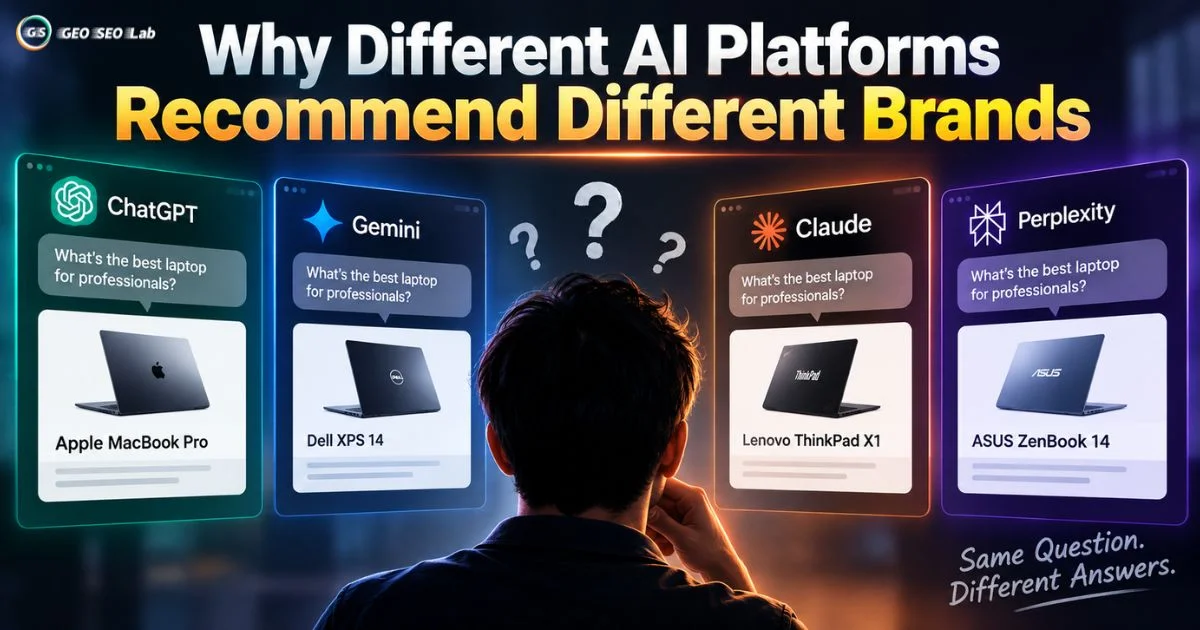
Why Different AI Platforms Recommend Different Brands
Why Different AI Platforms Recommend Different BrandsSame Question, Four Answers, Almost Zero OverlapA GEO SEO Lab ReportEditorial Disclosure: This re...
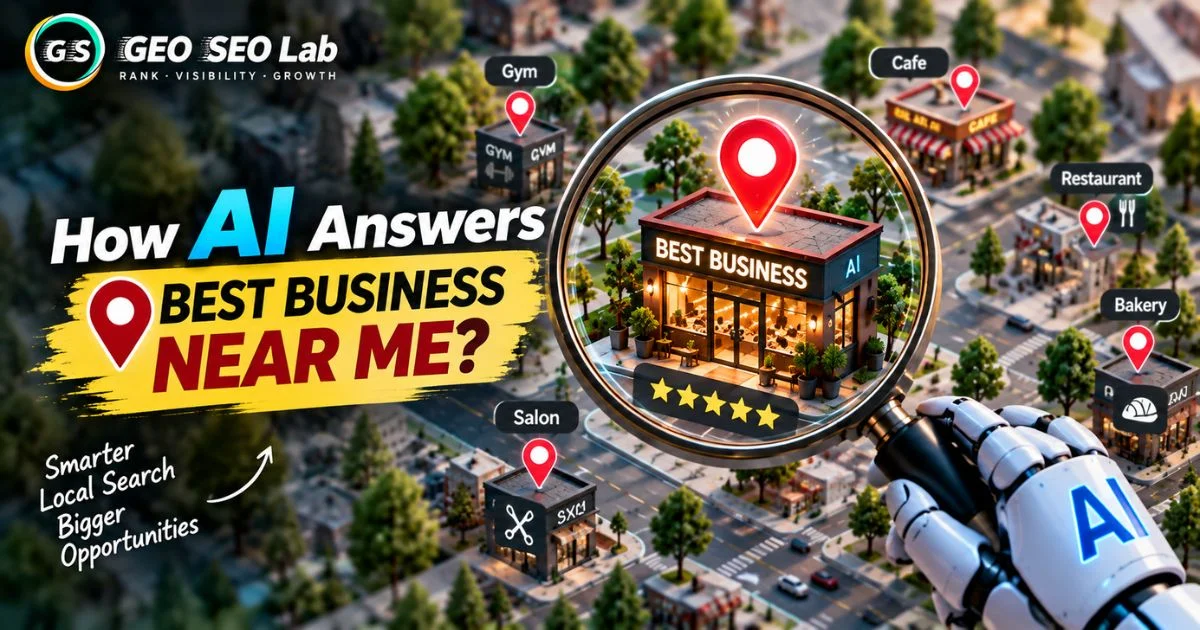
How AI Answers “Best Business Near Me” in 2026 | Local AI Search
How AI Answers "Best Business Near Me"Inside the Shortlist That Decides Who Gets the CallA GEO SEO Lab ReportEditorial Disclosure: This report introdu...
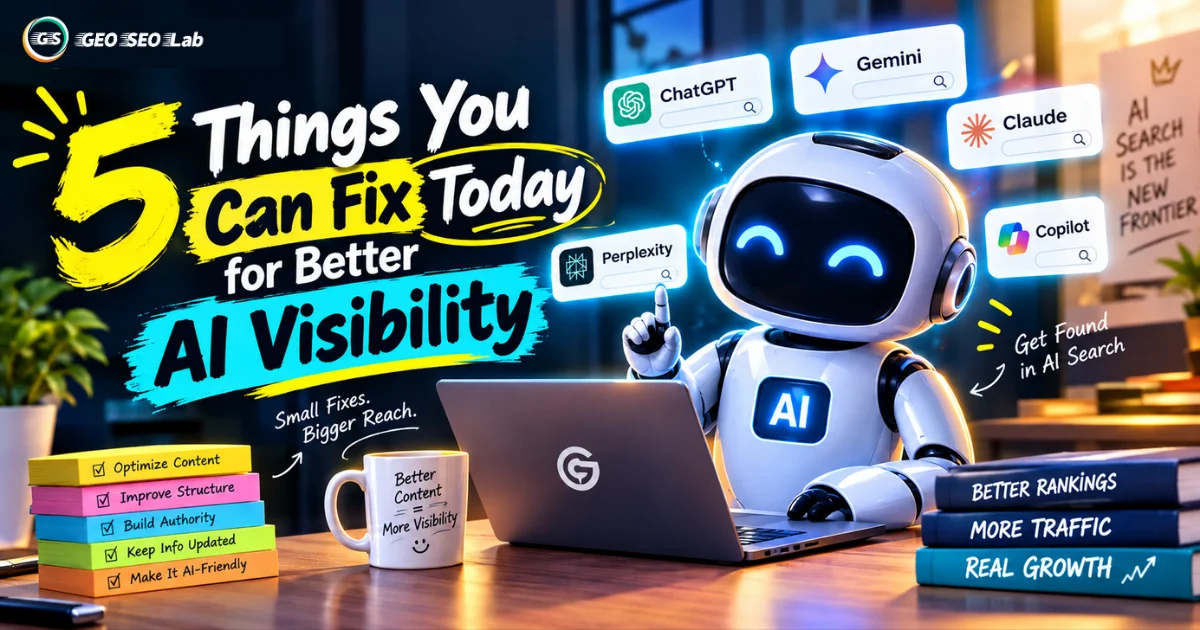
How to Improve AI Visibility in 2026 : 5 Fixes You Can Make Today
5 Things You Can Fix Today for Better AI Visibility No Redesign, No New Budget, Just Real Fixes You Can Ship This Afternoon Introduction Most GEO advice ...