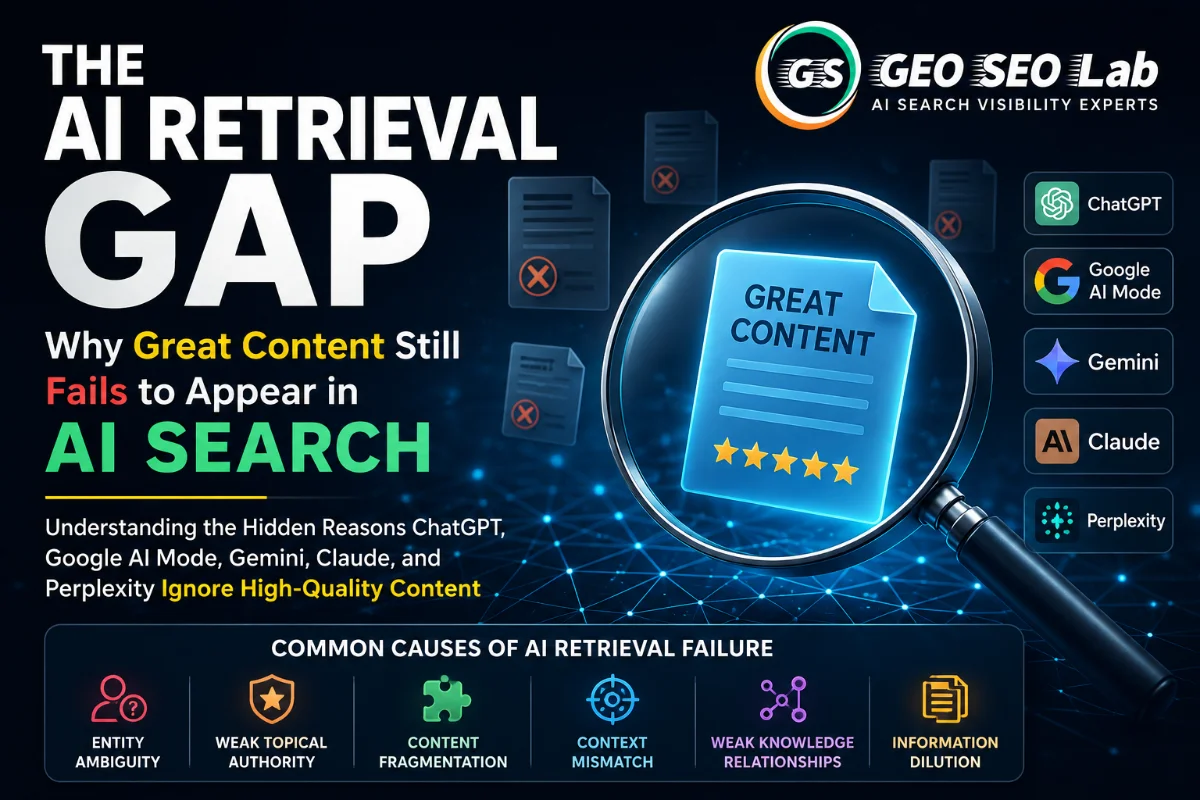
The AI Retrieval Gap: Why Great Content Still Fails to Appear in AI Search
Discover why even high-quality content often fails to appear in ChatGPT, Google AI Mode, Gemini, Claude, Perplexity, and other AI search platforms. Learn what the AI Retrieval Gap is, why indexing isn't enough, and how organizations can build retrieval-ready knowledge architectures that increase AI visibility.
Introduction: The Invisible Stage That Determines AI Visibility
There is a frustrating experience that a growing number of content teams and digital strategists are beginning to encounter, and it has no clean explanation within the frameworks that have guided search optimization for the past two decades.
An organization publishes a genuinely excellent piece of content. The writing is clear. The research is original. The expertise is real and deep. The technical SEO is solid — the page is indexed, the structured data is implemented, the internal links are thoughtfully placed. By every measure the team knows how to apply, the content should perform well.
And yet when someone asks ChatGPT, Gemini, or Perplexity a question that this content is specifically designed to answer, the response draws on other sources. Sources that are, in some cases, less comprehensive, less accurate, or less well-supported. The organization's carefully developed resource is nowhere to be seen.This situation is not an aberration or a fluke. It is one of the defining patterns of the current AI search environment, and it is happening to organizations across every industry and content category. The term that best describes it is the AI Retrieval Gap — the difference between the genuine quality and value of information that exists on the web and the probability that AI systems actually retrieve and consider that information when generating responses.Understanding the retrieval gap requires grappling with something that traditional SEO did not demand: a clear understanding of the difference between content being indexed and content being retrieved. These are not the same process. They serve different purposes. They are influenced by different factors. And confusing them — treating retrieval optimization as though it were simply another form of ranking optimization — leads to strategies that address the wrong problem.This article examines the AI Retrieval Gap from four angles. First, we establish what the gap is and why it exists. Second, we diagnose the specific causes of retrieval failure that organizations most commonly experience. Third, we explore the practical strategies that build genuine retrieval readiness. And fourth, we look at how organizations should measure retrieval performance and build toward a long-term AI-first knowledge strategy.The goal throughout is to provide the kind of concrete, actionable understanding that allows organizations to move from puzzlement about why their good content is not getting AI visibility to a clear-eyed assessment of what is actually required to close the gap.
Understanding the AI Retrieval Gap
Why Good Content Is Not Enough
The belief that content quality automatically produces AI visibility is one of the most widespread and consequential misconceptions in current GEO thinking. It is understandable — in traditional SEO, quality and visibility were substantially correlated, even if imperfectly. Better content tended to earn better links, which tended to produce better rankings, which tended to generate more traffic. Quality was not the only factor, but it was a powerful one that generally rewarded investment.In AI search, the relationship between content quality and AI visibility is more complex and more contingent. Quality is necessary but far from sufficient. Between the creation of excellent content and its appearance in AI-generated responses lies a series of processes — retrieval being the most fundamental — that each present their own requirements and their own failure modes. Content that fails at any of these stages never reaches the user, regardless of how well it was written.This is genuinely counterintuitive. Most of us have internalized the idea that the web is a meritocracy of quality — that better information eventually rises to the top because people and systems learn to prefer it. AI retrieval disrupts this intuition by introducing a stage of selection that occurs before quality evaluation. If content is not retrieved for consideration, its quality is never evaluated. It is effectively invisible within that AI interaction.
The AI Retrieval Gap is the name for this dynamic. It describes the structural disconnect between information that deserves to be included in AI-generated responses — because it is accurate, original, well-organized, and relevant — and information that actually is included, because it successfully navigated the retrieval process.The Distinction Between Indexing and RetrievalTo understand the retrieval gap clearly, it is essential to establish the distinction between two processes that practitioners sometimes conflate: indexing and retrieval.
Indexing is the process by which a search system becomes aware of content's existence and stores it in a form that makes future access possible. When Googlebot crawls a webpage and adds it to the search index, indexing has occurred. When an AI system's crawlers access content and incorporate it into training data or a retrieval database, indexing has occurred. Indexing is fundamentally about availability — after indexing, content exists within the system's accessible knowledge.
Retrieval is a completely different process. It occurs at query time, when a user asks a question and the system must determine which information from its available knowledge is most relevant and useful for constructing a response. Retrieval is not about what is available — it is about what gets selected from everything that is available, for this specific query, for this specific user intent, at this specific moment.
The critical insight is that the set of indexed content is enormous, while the set of retrieved content for any given query is small. An AI system may have access to billions of pieces of information. For any given question, it retrieves a fraction of those — the pieces that best match the user's intent through whatever retrieval mechanism the system uses. Most indexed content is not retrieved for most queries. The gap between indexed and retrieved is where the AI Retrieval Gap lives.
This distinction has direct practical implications. When organizations ask why their content does not appear in AI-generated responses, "it is not indexed" is one possible answer. But it is a relatively rare answer, because most content produced by established organizations is indexed. The more common answer is "it is not being retrieved" — and the reasons for retrieval failure are different from the reasons for indexing failure, requiring different diagnostic approaches and different solutions.
How AI Systems Actually Build Responses
To understand retrieval, it helps to understand the process by which AI systems construct responses to user queries — because retrieval is not a standalone step but an integrated stage in a multi-step process.
When a user asks a question, the AI system's first task is intent understanding — determining not just what words the user used but what they are actually trying to accomplish. A user asking "how should a physical therapy clinic market itself to AI search" is not just asking about AI search in general — they are asking about a specific application of AI search principles to a specific type of healthcare practice, probably with the goal of improving patient acquisition. The AI system that correctly identifies this intent is positioned to retrieve information that actually addresses it. The system that interprets the query more superficially may retrieve generically relevant content that misses the specific context entirely.
Following intent understanding comes the retrieval step itself — the selection of candidate information from available sources that might contribute to answering the query. Depending on the AI platform and its architecture, this might involve vector similarity search against an embedding database, keyword-based retrieval against an indexed corpus, retrieval from structured knowledge stores, or some combination of these approaches.
After retrieval comes evaluation — an assessment of the retrieved candidate information for accuracy, reliability, relevance, and quality. Not all retrieved information makes it into the final response. The system evaluates what has been retrieved and determines which pieces deserve to be incorporated.
Then comes synthesis — the construction of a coherent response that draws on the evaluated information and presents it in a way that serves the user's actual need. And finally, in systems that support attribution, comes citation — the identification of sources that contributed meaningfully to the response.
The retrieval gap matters most in the second stage of this process. If a piece of content is not retrieved during the candidate selection phase, it is excluded from every subsequent stage. It will not be evaluated. It will not be synthesized. It will not be cited. The quality of its writing, the accuracy of its claims, the depth of its expertise — none of these factors matter if retrieval fails.
Why AI Retrieval Differs From Traditional Search Ranking?
The most important conceptual shift required for understanding retrieval optimization is recognizing that AI retrieval and traditional search ranking are solving different problems using different approaches.
Traditional search ranking is primarily a document sorting problem. Given a set of documents that are relevant to a query, ranking algorithms determine which order to present them in. The evaluation is at the document level — which pages, on balance, deserve to appear at the top of the results for this query? The factors that influence ranking — link authority, content relevance, technical health, user engagement signals — are all properties of documents evaluated in the context of a query.AI retrieval is a knowledge matching problem. Given a query with a specific intent, which pieces of information from an available knowledge base best contribute to answering it? The evaluation is not at the document level but at the information level — which specific facts, explanations, examples, or characterizations contained within documents are relevant to the specific informational need expressed by the query?This distinction changes what optimization means. In traditional SEO, optimizing a document for ranking means improving the document's signals at a page level — its authority, its topical relevance, its technical health. In AI retrieval optimization, the relevant question is whether the information within documents is organized and expressed in ways that make it efficiently matchable to the specific user intents it is meant to serve.A long, comprehensive document might rank well in traditional search because its breadth of coverage and accumulated authority make it generally relevant to many queries. But in AI retrieval, that same document might be less efficiently retrieved than a more focused resource for specific queries, because the specific information relevant to a specific intent is harder to isolate within a dense, comprehensive document than within a targeted, clearly structured resource. AI retrieval rewards specificity and clarity of organization in ways that traditional ranking does not always require.
Diagnosing the Hidden Causes of AI Retrieval Failure
Retrieval Failure Is Usually Architectural, Not Editorial
When organizations discover that their content is not appearing in AI-generated responses, the instinct is often to improve the writing — to make the content more comprehensive, more engaging, or more technically polished. These instincts are not wrong, exactly, but they are often addressing symptoms rather than causes.
In the majority of cases where genuinely good content fails to be retrieved by AI systems, the failure is architectural rather than editorial. The content itself may be excellent. The problem is in how that content is organized, connected, and represented within the broader digital ecosystem — how clearly its topical territory is defined, how explicitly its relationships to related knowledge are established, how consistently its entity signals communicate organizational identity and expertise to AI retrieval systems.This is an important distinction because architectural problems require architectural solutions. You cannot fix an entity ambiguity problem by writing better prose. You cannot fix a topical fragmentation problem by publishing more articles. You cannot fix a knowledge relationship weakness by improving your keyword density. Each retrieval failure mode has its own characteristic cause and its own appropriate remediation.Entity Ambiguity: The Identity ProblemOne of the most fundamental causes of AI retrieval failure is entity ambiguity — the situation in which AI systems cannot confidently determine who or what an organization is, what it does, and how it relates to the topics a user is asking about.
AI systems organize their understanding of the world through entities — organizations, people, products, concepts, locations, and other identifiable things. When a user asks about a specific entity, the AI system needs to be able to identify that entity clearly and retrieve the information associated with it. When entity signals are ambiguous — when an organization's name is shared with other organizations, when its description varies across different sources, when its relationship to its domain of expertise is not explicitly established — retrieval confidence decreases.
The ambiguity problem is more common and more consequential than many organizations realize. Consider a company called "Advanced Analytics." Without extensive additional context, this name could refer to a data science consulting firm, a business intelligence software company, a sports performance analytics startup, a financial risk modeling firm, or dozens of other types of organizations. An AI system encountering this name in a query context has to work significantly harder to determine which entity is being referenced and what information about it is relevant — work that introduces uncertainty and reduces retrieval reliability.Organizations reduce entity ambiguity through consistent, specific, and comprehensive entity representation across their digital presence. Descriptive organizational names or very clear taglines that specify the domain. Consistent descriptions across all platforms — website, LinkedIn, business directories, press mentions — that use the same language to describe what the organization does. Schema markup that explicitly identifies the organization as a specific type of entity operating in a specific industry. Author profiles that clearly connect expertise to specific domains. The more consistently and specifically an entity is defined across the ecosystem, the more confidently AI systems can retrieve information associated with it.
Weak Topical Authority: The Depth Problem
The second major retrieval failure mode involves insufficient topical authority — a pattern in which an organization's content, while covering a topic, does not establish the kind of sustained, interconnected depth that AI retrieval systems can confidently treat as a reliable knowledge source.
Topical authority in the AI retrieval context is different from topical authority in traditional SEO. In traditional SEO, topical authority often functioned through a combination of content breadth and backlink signals — having many relevant pages and many external references contributed to being recognized as an authority on a topic. In AI retrieval, the relevant quality is something more like knowledge ecosystem coherence — the degree to which an organization's content on a topic forms an interconnected, mutually reinforcing body of knowledge rather than a collection of loosely related articles.
Consider two organizations both publishing content about enterprise data governance. The first has published fifteen articles on the topic, each addressing a different aspect of data governance, but the articles were written at different times by different authors with different terminology, they have minimal internal linking to each other, and together they do not form a coherent educational progression through the topic. The second organization has published seven articles, but those articles form a deliberate knowledge structure — introductory concepts link to explanatory deep dives, which link to implementation guidance, which link to case studies, all using consistent terminology and explicitly cross-referencing each other.AI retrieval systems attempting to identify a reliable source for data governance information are significantly better served by the second organization's content, even though its volume is lower. The coherence and interconnection of the second organization's knowledge signals sustained, organized expertise rather than scattered engagement with a topic.
Content Fragmentation: The Architecture ProblemClosely related to the topical authority problem, content fragmentation deserves its own treatment because it is so prevalent and because its effects on retrieval are particularly severe.
Content fragmentation occurs when knowledge that should be organized together is instead scattered across multiple disconnected pages, each covering a piece of the picture without helping users or AI systems see the whole. This pattern emerges organically in content strategies that are keyword-driven — each keyword gets its own page, and over time the site accumulates hundreds of narrowly focused pages that collectively cover a domain but do not together constitute a coherent account of it.From an AI retrieval perspective, fragmented content creates several specific problems. First, no single resource provides the context-rich, comprehensive treatment of a topic that AI systems prefer to retrieve when generating substantive responses. Instead of retrieving one authoritative resource, the system must piece together information from multiple narrowly focused pages — a process that is less efficient and less reliable than retrieving a well-organized comprehensive treatment.Second, fragmentation obscures the relationships between concepts that are essential for AI systems to understand a domain fully. If the connection between concept A and concept B is not made explicit within the content — if a user has to follow multiple internal links to understand how they relate — AI retrieval systems may not reliably capture that relationship, limiting their ability to retrieve the right information for queries that involve both concepts.Third, heavily fragmented content often leads to duplicate content problems — multiple pages covering the same ground with slightly different angles, which creates confusion about which resource is the authoritative one for any given query.The remediation for fragmentation is deliberate knowledge architecture — reorganizing content into topic clusters and comprehensive resources that explicitly establish relationships between concepts and guide both users and AI systems through a coherent account of a domain.
Context Mismatch: The Relevance Problem
Context mismatch is a retrieval failure mode that is particularly difficult to diagnose because the content experiencing it is genuinely relevant to the general topic being asked about — just not relevant enough to the specific context, constraint, or user type expressed in the particular query.
Modern AI systems are increasingly sophisticated at intent interpretation, which means they are increasingly capable of distinguishing between queries that seem similar at the keyword level but reflect very different specific informational needs. A query asking about AI visibility for "a solo healthcare practitioner building their first digital presence" is genuinely different from a query asking about AI visibility for "a large hospital system with an established content team." Both queries involve AI visibility in healthcare, but they are asking about different problems, different constraints, and different solutions.
Content that addresses AI visibility in healthcare generically — without specifying the context of practice size, budget, existing infrastructure, or competitive environment — is less likely to be retrieved for either query than content that is specifically written for the context expressed in the query. The AI system can tell that the generic content is topically relevant, but it cannot tell that it specifically addresses the user's situation.
This context mismatch problem is why audience specificity in content development produces such significant retrieval benefits. Content that is written for a specific type of user, addressing a specific type of situation, with specific attention to the constraints and concerns relevant to that situation, aligns far more precisely with the actual queries that target audience asks. The precision of the alignment between content context and query context is a strong retrieval signal.
Weak Knowledge Relationships: The Connection Problem
AI systems increasingly understand and organize knowledge through relationships between entities and concepts — not just through the presence of relevant keywords. When these relationships are implicit or absent from an organization's content, retrieval confidence is reduced even for content that is topically relevant.
The knowledge relationship problem shows up in specific ways. An organization that publishes content about its products without explicitly connecting those products to the use cases they address, the industries they serve, the problems they solve, and the alternatives they compare to is publishing content that is harder for AI systems to retrieve for queries about those specific contexts. The connection between product and use case, which may be obvious to a human reader with industry knowledge, needs to be made explicit in the content for AI retrieval systems to reliably make that connection.
Similarly, organizations that do not explicitly connect their expert authors to their areas of expertise — through detailed author profiles, bylined content, and consistent attribution — are missing knowledge relationship signals that influence retrieval in domains where expertise credibility is important. The connection between "this organization" and "expertise in X domain" is established through accumulated, consistent signals across many content assets, not just through a single page claiming expertise.
Strengthening knowledge relationships means making the implicit explicit: explicitly stating how products relate to use cases, how methodologies relate to outcomes, how expertise relates to domains, how concepts relate to each other. This explicit statement of relationships, woven consistently through an organization's content ecosystem, significantly improves the retrieval reliability of that content for the queries that depend on those relationships.
Information Dilution: The Volume Problem
The final retrieval failure mode worth examining is information dilution — the counterintuitive dynamic in which publishing more content on a topic can actually weaken rather than strengthen retrieval performance.
Information dilution occurs when an organization publishes multiple overlapping pieces of content on the same or very similar topics, creating confusion about which resource is the authoritative one for any given query. From a human reader's perspective, having multiple articles that cover similar ground from different angles might seem like comprehensive coverage. From an AI retrieval perspective, it creates an unclear signal about which resource to retrieve for a specific query.
The dilution dynamic is particularly common in organizations that have been producing SEO-driven content for several years. Early keyword research identified high-volume topics. Different team members wrote different takes on the same topics over time. "The Complete Guide to X" from 2023 and "Everything You Need to Know About X" from 2025 cover much of the same ground without clearly superseding each other. An AI retrieval system encountering both faces a choice that reduces retrieval confidence — it is not clear which resource is the current, authoritative treatment of the topic.
The remediation involves content consolidation — identifying overlapping resources, merging and updating them into single authoritative treatments, and establishing clear canonical versions of important knowledge assets. This is often uncomfortable work because it involves taking content off the site or substantially restructuring it. But the retrieval benefit of having one excellent, authoritative resource is generally greater than the benefit of having several adequate, overlapping ones.
How to Close the AI Retrieval Gap and Become Retrieval-Ready
Retrieval Readiness as an Organizational Capability
The most important reframe for organizations approaching AI retrieval optimization is understanding that retrieval readiness is an organizational capability — not a single optimization tactic, a technical checklist, or a content format requirement. It is the result of sustained, coordinated investment in how an organization's knowledge is structured, connected, expressed, and maintained across its entire digital presence.
This framing matters because it shapes the nature of the work required. If retrieval readiness were a technical checklist, organizations could address it with a project that has a clear completion point. Because it is an organizational capability, it requires the kind of ongoing investment and continuous improvement that serious competitive advantages always require.
The good news is that building retrieval readiness is also building something genuinely useful for human readers. The characteristics that make content easily retrievable by AI systems — clear organization, explicit concept relationships, consistent terminology, contextual specificity, evidence-based claims — are also the characteristics that make content genuinely useful to human readers trying to understand a complex topic. Investing in retrieval readiness is not a trade-off against user experience. It is an investment in information quality that benefits both audiences simultaneously.
Building Topic Clusters That AI Systems Can Navigate
The most impactful structural intervention for improving retrieval readiness is the development of deliberate topic clusters — organized groups of related content that together cover a domain comprehensively, with explicit internal connections that communicate the relationships between component topics.
A well-designed topic cluster for AI retrieval differs from a traditional SEO content cluster in important ways. Traditional content clusters were often organized primarily around keyword groups — a pillar page for a broad keyword surrounded by supporting pages for related long-tail keywords. The organizational logic was primarily keyword taxonomic rather than genuinely conceptual.
An AI retrieval-optimized topic cluster is organized around a conceptual learning journey — the sequence of understanding that a user needs to develop to move from basic awareness of a domain through to sophisticated practical application. Each component of the cluster builds on the previous ones. The connections between components are made explicit in the content, not just in the navigation. Terminology is consistent throughout the cluster. Each component addresses a specific stage of the journey rather than overlapping with adjacent components.
This kind of deliberate conceptual organization serves AI retrieval in several specific ways. It makes the cluster's coverage of the domain more comprehensive in ways that AI systems can recognize — not just broad, but structured. It makes the relationships between topics explicit, which helps AI systems understand the domain's conceptual structure. It reduces the ambiguity about which component to retrieve for which type of query, because the components are differentiated by their place in the learning journey rather than by subtle keyword variations.
The Knowledge Hub as Retrieval Infrastructure
For organizations with substantial domain expertise, knowledge hubs — centralized, comprehensive resources that establish the organization as an authoritative reference on a specific topic or domain — serve a particularly important retrieval function.
A knowledge hub is not simply a collection page that links to various content assets. It is a substantive resource in itself — one that provides a clear, authoritative account of a domain, establishes the organization's perspective and approach, and serves as the navigational anchor for the organization's full knowledge ecosystem on that topic.
From a retrieval perspective, a well-developed knowledge hub serves as a strong signal of topical authority. When an AI retrieval system is looking for reliable sources on a topic, it benefits from encountering a resource that clearly and comprehensively establishes an organization's investment in and perspective on that topic. The hub communicates at a glance that this organization has developed sustained, organized expertise — not just published a few articles — and this signal increases retrieval confidence for the hub itself and for the connected content within the cluster.
Knowledge hubs are most valuable in domains where the organization has genuinely distinctive perspectives or approaches — where the hub can communicate not just "we cover this topic" but "here is how we think about this topic, and here is the body of evidence and analysis that informs our perspective." This level of intellectual specificity makes the hub more retrievable for queries that seek substantive engagement with the topic rather than generic coverage.
Designing Content for AI Interpretability
At the content level, retrieval readiness is significantly influenced by how well content is structured for AI interpretability — the degree to which an AI retrieval system can efficiently extract the specific information it needs from a piece of content without extensive parsing work.
Several specific structural practices improve AI interpretability. Clear, descriptive headings that accurately signal the specific content of each section allow retrieval systems to identify relevant sections within longer documents without processing the entire document. Explicit definitions of key terms — especially terms that might be used differently in different contexts — reduce ambiguity about what the content is claiming. FAQ sections that directly state important questions and provide concise, specific answers create efficient retrieval targets for query-intent matching.
Explicit statement of claims and conclusions, rather than burying them within extended discussion, helps AI retrieval systems extract the core informational content of a resource. Evidence labeling — clearly identifying when a claim is supported by specific research, when it represents analytical interpretation, and when it is a forward-looking prediction — helps AI systems represent the epistemic status of information accurately in their responses.
Consistent terminology throughout a piece of content, and across the organization's full content ecosystem, dramatically improves retrieval reliability. When the same concept is referred to by different names in different places — "AI search" in one article, "generative search" in another, "AI-powered search" in a third — retrieval systems may treat these as different concepts rather than recognizing them as synonymous. Consistent terminology reduces this fragmentation and ensures that retrieval signals accumulate coherently rather than dispersing across inconsistent vocabulary.
Strengthening Entity Signals for Reliable Retrieval
Entity signal strengthening is the systematic work of ensuring that AI retrieval systems can confidently identify and retrieve information associated with an organization's entities — the organization itself, its products, its experts, its methodologies, and its relationships to its domain.
For the organization entity, this means ensuring consistent, specific description across every platform where the organization appears — the same name, the same concise description of what it does and who it serves, the same categorization within industry taxonomies. Schema markup implementing Organization, LocalBusiness, or other appropriate schema types provides machine-readable entity definition that directly supports AI retrieval. Consistent NAP (Name, Address, Phone) information across business directories reduces ambiguity for local entities.
For expert entities — the people whose knowledge the organization is publishing — clear, consistent author profiles that explicitly connect individual expertise to specific domains significantly improve retrieval reliability for queries where source credibility matters. An author profile that clearly states "Dr. Sarah Chen is a board-certified oncologist specializing in immunotherapy approaches to lung cancer, with fifteen years of clinical and research experience" provides far stronger entity signals for health-related retrieval than a generic bio that mentions "healthcare professional."
For product and service entities, explicit connection to use cases, industries, and problem types — rather than just describing features in isolation — improves retrieval for the queries that real users ask when they are trying to determine whether a product or service addresses their specific situation.
Original Knowledge as a Retrieval Differentiator
Beyond structural and entity-level improvements, the most durable driver of retrieval readiness is the ongoing production of genuinely original knowledge — information that exists only in an organization's content because it reflects that organization's unique access to data, experience, expertise, or perspective.
Original knowledge is a retrieval differentiator because it solves a specific AI retrieval problem: how to provide value when many sources address the same topic. If an AI system is trying to answer a question about best practices in a specific domain and many sources provide essentially the same set of recommendations, the system has limited basis for preferring any one of them. But if one source provides original data — a proprietary survey, an analysis of the organization's own operational data, a case study from real implementation experience — that source provides something no other source can: genuinely unique informational value.
The specific forms of original knowledge most valuable for retrieval purposes vary by industry and organizational type, but the principle is consistent. For professional services firms, this might be original research on client outcomes, proprietary frameworks developed through consulting practice, or benchmark data collected from engagements. For software companies, it might be analysis of usage patterns from their own product data, case studies from real customer implementations, or technical benchmarks from controlled experiments. For healthcare organizations, it might be clinical outcome data, patient experience research, or evidence syntheses that synthesize complex research for specific clinical decision-making contexts.
Whatever form it takes, original knowledge signals to AI retrieval systems that an organization is not just a consumer and republisher of existing knowledge — it is a contributor to the knowledge ecosystem, generating information that could not be obtained from any other source.
Measuring Retrieval Success and Building an AI-First Knowledge Strategy
Why Standard Analytics Cannot Measure Retrieval Performance
Building a measurement framework for AI retrieval performance requires confronting an uncomfortable reality: standard web analytics tools were not designed for this purpose and cannot directly measure the most important aspects of retrieval performance.
Standard analytics measure what happens after a website visit occurs. They capture session counts, page views, time on site, conversion rates, and the traffic sources that generated visits. These measurements are valuable for understanding on-site behavior and post-click performance. They are largely blind to the pre-visit dynamics that determine whether an organization participates in AI-generated responses at all.
AI retrieval performance is primarily a pre-visit phenomenon. Whether an organization's content is retrieved and incorporated into an AI response influences user awareness and consideration before any website visit occurs. The AI interaction that shapes a user's understanding of a topic and their impression of relevant organizations leaves no trace in the website analytics of those organizations — unless the user subsequently visits the website directly, and even then the AI interaction that preceded the visit is not attributed.
This measurement gap is not a minor inconvenience. It means that organizations relying exclusively on standard analytics have a systematically incomplete and potentially misleading picture of their AI search performance. A site might be appearing regularly in AI-generated responses and influencing significant numbers of user decisions without any of this showing up in organic traffic metrics. Conversely, a site might have strong organic traffic from traditional search while having essentially zero AI retrieval presence for the same queries.
Closing this measurement gap requires developing supplementary measurement approaches that specifically target the retrieval dynamics that standard analytics miss.
Building a Practical Retrieval Monitoring Practice
The most direct approach to measuring retrieval performance is systematic AI response monitoring — regularly querying major AI platforms with queries that the organization's content is designed to address, and evaluating the responses for evidence of retrieval and citation.
An effective AI response monitoring practice involves several components. First, developing a representative set of test queries — queries that reflect the actual questions users in the target audience are likely to ask, at multiple levels of specificity and from multiple user perspectives. Second, systematically testing these queries across major AI platforms — ChatGPT, Gemini, Perplexity, Claude, and others relevant to the organization's audience — on a regular schedule. Third, evaluating responses for mentions of the organization, citations of its content, characterizations of its products or expertise, and the accuracy of how it is represented.
The qualitative dimension of this monitoring is as important as the quantitative. It is not just about whether the organization is mentioned, but about how it is mentioned. Is the characterization accurate? Is the organizational expertise represented correctly? Is the recommendation context appropriate? Are competitors being mentioned that should not be the primary reference for queries where the organization has stronger expertise?
Monitoring across multiple platforms is essential because retrieval behavior varies significantly. A source that is consistently retrieved by Perplexity may be rarely retrieved by Claude, and vice versa. Understanding these platform-specific patterns helps organizations identify which retrieval gaps are most urgent to address and which platforms are most important for their specific audience.
Expanding the KPI Framework for Retrieval Readiness
Beyond direct AI response monitoring, several indirect indicators can help organizations assess their retrieval readiness and track improvement over time.
Knowledge architecture quality provides a measurable proxy for retrieval readiness. This can be assessed through internal linking analysis — measuring the density and quality of internal links between related content assets — as well as through topic cluster completeness assessment and terminology consistency audits. These measures do not directly measure retrieval probability, but they reflect the architectural quality that underlies it.
Brand search volume growth is an indirect indicator of AI-mediated brand awareness development. When AI systems consistently mention an organization by name in responses to relevant queries, some proportion of users who encounter those mentions will subsequently search for the brand directly. Sustained growth in branded search volume — particularly growth that is not easily explained by other marketing activities — can indicate growing AI retrieval presence.
Referral quality metrics — the engagement depth, conversion rate, and customer quality of organic referral traffic — provide an indirect indicator of whether AI-mediated orientation is improving the intent-level of website visitors. If AI systems are accurately characterizing an organization's expertise and recommendations, the users who arrive following AI interactions should be more qualified, more specific in their questions, and more likely to convert than the average organic visitor.
Expert recognition indicators — invitations to speak, contribute to publications, participate in industry events, or serve as sources for media coverage — reflect the kind of external credibility that both influences and results from AI retrieval performance. Organizations that AI systems consistently retrieve as authoritative tend to attract the kind of external recognition that further reinforces their authority.
The Enterprise Retrieval Intelligence Framework™
For organizations seeking a comprehensive approach to AI retrieval optimization, the Enterprise Retrieval Intelligence Framework™ provides a strategic structure that integrates knowledge creation, architecture, retrieval readiness, and business impact.
The framework begins with organizational expertise — the genuine domain knowledge, original insights, and practical experience that an organization possesses and that forms the raw material for retrieval-ready content. This expertise is systematically documented and organized through a knowledge creation process that prioritizes the characteristics — originality, specificity, evidence quality, contextual relevance — that drive retrieval performance.
Knowledge architecture work ensures that the resulting content assets are organized into coherent clusters, connected through explicit relationships, and structured for AI interpretability. Entity strengthening work ensures that the organization's entities are unambiguously defined and consistently represented across the digital ecosystem.
These investments in retrieval readiness produce AI retrieval — the organization's content being selected during the candidate evaluation phase for relevant queries. Successful retrieval leads to AI citations and mentions that build brand awareness and credibility. This brand development contributes to customer trust and qualified demand, which ultimately drives business growth.
The framework's value is in its integration — it shows how each element of retrieval readiness connects to the business outcomes that justify the investment, and how improvements at each stage compound into stronger performance across the whole system.
A Four-Phase Roadmap for Closing the Retrieval Gap
Organizations approaching retrieval optimization as a strategic priority benefit from a phased approach that builds systematically from foundational prerequisites toward advanced retrieval capabilities.
The audit phase is the necessary starting point. Before investing in new content creation or structural reorganization, organizations need a clear picture of their current retrieval performance and the specific gaps that exist. This means conducting systematic AI response monitoring to establish baseline performance, assessing current content architecture for fragmentation and coherence issues, auditing entity representation for consistency and completeness, and identifying where topical authority is strong versus where it is thin.
The architectural improvement phase addresses the structural issues identified in the audit. This may involve consolidating duplicate or overlapping content, establishing explicit topic cluster structures, improving internal linking to communicate relationships between concepts, standardizing terminology across the content ecosystem, and implementing or improving schema markup. These changes do not require producing new content — they improve the retrievability of what already exists.The knowledge development phase focuses on building the content assets that most significantly improve retrieval performance for priority topic areas. This means identifying the queries for which the organization most wants to be retrieved, assessing what content would best serve those queries, and developing that content with specific attention to retrieval-readiness characteristics — contextual specificity, complete question answering, evidence quality, and explicit knowledge relationships.The continuous improvement phase establishes the ongoing practices — systematic monitoring, regular content audits, knowledge architecture reviews, and entity representation maintenance — that sustain and improve retrieval performance over time. Retrieval readiness is not a project that completes; it is a capability that requires ongoing investment to maintain and develop.
Long-Term Trends That Will Shape Retrieval
Several developments already visible in the AI search landscape will continue to shape retrieval dynamics over the coming years, with significant implications for how organizations should be investing now.
The trend toward more semantically sophisticated retrieval — AI systems that understand not just topical relevance but conceptual relationships, contextual appropriateness, and user intent nuance — will increasingly reward content that is organized around genuine conceptual structure rather than keyword patterns. Organizations that have invested in knowledge architecture that reflects real conceptual relationships are better positioned for this development than those whose content organization was primarily keyword-driven.
The trend toward richer entity understanding in AI systems — the ability to connect organizations to their specific domains, products, experts, and relationships with increasing precision — will make entity signal strength an increasingly important competitive factor. Early investment in comprehensive, consistent entity representation across the digital ecosystem will compound in value as AI systems become more sophisticated entity reasoners.
The trend toward more diverse AI retrieval sources — with AI systems drawing on structured knowledge bases, specialized databases, and licensed data partnerships in addition to general web retrieval — will change the landscape of what information AI systems can access. Organizations that have knowledge represented in multiple formats and locations within the broader digital information ecosystem are better positioned than those relying exclusively on web content.
And the trend toward retrieval becoming a function that operates not just in consumer search but across enterprise AI assistants, autonomous agents, and AI-powered workflows will expand the strategic importance of retrieval readiness well beyond public search visibility. Organizations that build retrieval-ready knowledge ecosystems now are building assets that will be valuable across a widening range of AI-powered applications.
Key Takeaways
The AI Retrieval Gap is the foundational challenge of GEO. The difference between indexed content and retrieved content is where most AI visibility is won or lost. Organizations that understand this distinction and invest in bridging it have a significant advantage over those who conflate indexing with retrieval.
Retrieval failure is usually architectural, not editorial. When good content fails to be retrieved, the cause is more often structural — entity ambiguity, topical fragmentation, weak knowledge relationships, context mismatch — than editorial quality. Improving writing without addressing architectural problems rarely closes the retrieval gap.
Indexing and retrieval are fundamentally different processes. Content can be thoroughly indexed and still rarely retrieved. The evaluation criteria for retrieval — contextual relevance, entity clarity, knowledge coherence, information quality at the query-specific level — are different from the criteria that determine indexing.
Knowledge architecture matters as much as content quality. How information is organized, connected, and expressed across an organization's full content ecosystem significantly influences retrieval reliability. Connected, coherent knowledge ecosystems are more retrievable than collections of isolated, disconnected pages.
Standard analytics cannot measure retrieval performance. The most important retrieval dynamics occur before website visits, making them invisible to standard analytics tools. Organizations need supplementary measurement approaches — AI response monitoring, brand search trend analysis, referral quality tracking — to understand their actual retrieval performance.Retrieval readiness is a long-term organizational capability. Building strong AI retrieval performance requires sustained investment in knowledge architecture, entity management, original knowledge creation, and continuous monitoring. It cannot be achieved through a one-time optimization project.
Original knowledge is the most durable retrieval differentiator. Content that synthesizes widely available information competes with many alternatives for retrieval. Content that reflects genuinely original insights, data, or expertise provides something that AI systems cannot obtain from other sources, which is the strongest possible retrieval signal.
References and Further Reading
Information Retrieval Research and Theory
Manning, C. D., Raghavan, P., & Schütze, H. (2008). Introduction to Information Retrieval. Cambridge University Press.
Mitra, B., & Craswell, N. (2018). An introduction to neural information retrieval. Foundations and Trends in Information Retrieval, 13(1), 1–126.
Robertson, S., & Zaragoza, H. (2009). The probabilistic relevance framework: BM25 and beyond. Foundations and Trends in Information Retrieval, 3(4), 333–389.
Karpukhin, V., Oguz, B., Min, S., Lewis, P., Wu, L., Edunov, S., Chen, D., & Yih, W. (2020). Dense passage retrieval for open-domain question answering. arXiv:2004.04906.
Retrieval-Augmented Generation
Lewis, P., Perez, E., Piktus, A., et al. (2020). Retrieval-Augmented Generation for Knowledge-Intensive NLP Tasks. arXiv:2005.11401.
Guu, K., Lee, K., Tung, Z., Pasupat, P., & Chang, M. (2020). REALM: Retrieval-augmented language model pre-training. arXiv:2002.08909.
Borgeaud, S., Mensch, A., Hoffmann, J., et al. (2022). Improving language models by retrieving from trillions of tokens. arXiv:2112.04426.
Shi, W., Min, S., Yasunaga, M., Seo, M., James, R., Lewis, M., Zettlemoyer, L., & Yih, W. (2023). REPLUG: Retrieval-augmented language model pre-training. arXiv:2301.12652.
Semantic Search and Embedding Models
Reimers, N., & Gurevych, I. (2019). Sentence-BERT: Sentence embeddings using Siamese BERT-networks. arXiv:1908.10084.
Thakur, N., Reimers, N., Rücklé, A., Srivastava, A., & Gurevych, I. (2021). BEIR: A heterogeneous benchmark for zero-shot evaluation of information retrieval models. arXiv:2104.08663.
Knowledge Graphs and Entity-Based Retrieval
Singhal, A. (2012). Introducing the Knowledge Graph: Things, not strings. Official Google Blog. googleblog.com
Noy, N., Gao, Y., Jain, A., Narayanan, A., Patterson, A., & Taylor, J. (2019). Industry-scale knowledge graphs: Lessons and challenges. Queue, 17(2), 48–75.
Hogan, A., Blomqvist, E., Cochez, M., et al. (2021). Knowledge graphs. ACM Computing Surveys, 54(4), Article 71.
AI Search Platform Documentation
Google Search Central. (2026). Creating Helpful, Reliable, People-First Content. developers.google.com/search/docs/fundamentals/creating-helpful-content
Google. (2026). Search Quality Rater Guidelines. google.com/search/howsearchworks
OpenAI. (2026). ChatGPT Technical Documentation and Research. openai.com/research
Anthropic. (2026). Claude Documentation and Model Research. anthropic.com/research
Microsoft. (2026). Bing AI and Copilot Technical Documentation. microsoft.com/research
Perplexity AI. (2026). How Perplexity Retrieves and Cites Sources. perplexity.ai/about
Content Architecture and Topical Authority
Moz. (2026). Topic Clusters and Topical Authority Research. moz.com/blog
Semrush. (2026). Content Architecture and AI Search Performance Studies. semrush.com/research
Search Engine Land. (2026). GEO and Retrieval Optimization Research. searchengineland.com
Information Quality Research
Wang, R. Y., & Strong, D. M. (1996). Beyond accuracy: What data quality means to data consumers. Journal of Management Information Systems, 12(4), 5–33.
Floridi, L. (2010). Information: A Very Short Introduction. Oxford University Press.
Naumann, F., & Rolker, C. (2000). Assessment methods for information quality criteria. Proceedings of the 5th International Conference on Information Quality.
Knowledge Management
Nonaka, I., & Takeuchi, H. (1995). The Knowledge-Creating Company. Oxford University Press.
Davenport, T. H., & Prusak, L. (1998). Working Knowledge: How Organizations Manage What They Know. Harvard Business School Press.
GEO SEO Lab Research
GEO SEO Lab. (2026). AI Citations: The New Currency of Visibility in AI Search. geoseolab.com
GEO SEO Lab. (2026). The AI Search Quality Framework: How AI Systems Evaluate Information Before Generating Answers. geoseolab.com
GEO SEO Lab. (2026). Google Zero: Is the Traditional Search Traffic Model Coming to an End? geoseolab.com
GEO SEO Lab. (2026). The AI Search Experimentation Handbook: How to Design, Measure, and Validate GEO Strategies. geoseolab.com
GEO SEO Lab. (2026). The AI Search Experimentation Handbook: How to Design, Measure, and Validate GEO Strategies. geoseolab.com
About GEO SEO Lab
GEO SEO Lab is a research and strategy organization dedicated to helping businesses understand and improve their visibility across the full landscape of AI-assisted search and discovery — including Google Search, Google AI Mode, ChatGPT, Gemini, Claude, Perplexity, Grok, and the evolving ecosystem of AI platforms that are reshaping how people find, evaluate, and engage with information online.Our research spans Generative Engine Optimization, AI Visibility strategy, AI retrieval dynamics, entity optimization, knowledge architecture, information quality, and the evolving relationship between AI systems and the organizations whose knowledge those systems depend on.The AI Retrieval Gap represents one of the most practically important and least well-understood dimensions of the current AI search landscape. Our research in this area is driven by the conviction that helping organizations understand what is actually happening in AI retrieval — rather than offering simplified frameworks that miss the underlying complexity — produces more durable competitive advantage than any collection of optimization tactics.
Tags
Frequently Asked Questions
Find answers to common questions about this topic
About the Author

Aman Kesharwani
SEO Expert & Content Creator
Experienced digital marketing professional specializing in SEO strategies, content optimization, and data-driven marketing solutions. Passionate about helping businesses grow their online presence and achieve better search rankings.
Related Articles
View all posts
Why Different AI Platforms Recommend Different Brands
Why Different AI Platforms Recommend Different BrandsSame Question, Four Answers, Almost Zero OverlapA GEO SEO Lab ReportEditorial Disclosure: This re...

How AI Answers “Best Business Near Me” in 2026 | Local AI Search
How AI Answers "Best Business Near Me"Inside the Shortlist That Decides Who Gets the CallA GEO SEO Lab ReportEditorial Disclosure: This report introdu...

How to Improve AI Visibility in 2026 : 5 Fixes You Can Make Today
5 Things You Can Fix Today for Better AI Visibility No Redesign, No New Budget, Just Real Fixes You Can Ship This Afternoon Introduction Most GEO advice ...