OpenAI and Yelp Partnership: Why AI-Powered Local Search Will Change SEO Forever
OpenAI's partnership with Yelp marks a major shift in local search. Learn how AI assistants are transforming local SEO, why structured business data matters, and how businesses can prepare for AI-powered recommendations.
Introduction: When the Rules of Local Search Change
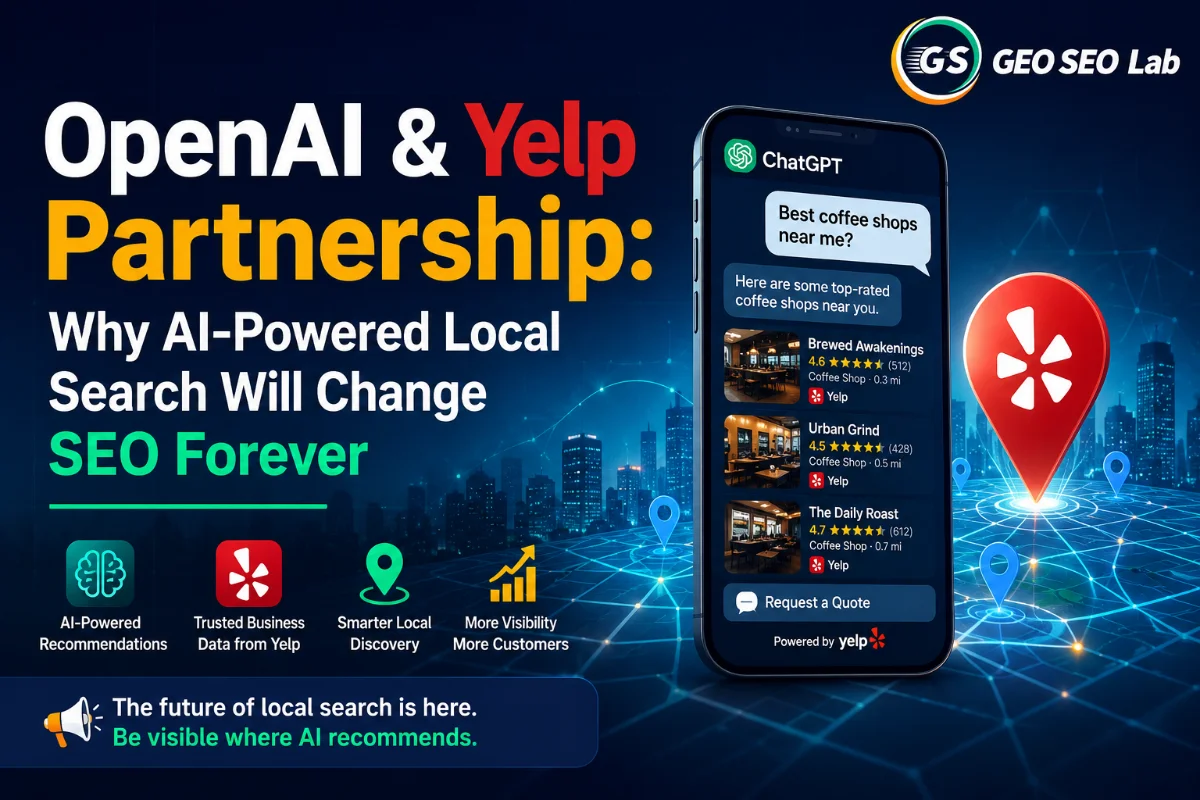
Every few years, something happens in the search industry that does not merely change best practices it changes the underlying logic of the game. The introduction of Google Maps changed how people thought about local business discovery. The rise of mobile search changed where and when people made local queries. The emergence of review platforms changed what customers needed to see before making decisions. Each of these transitions produced the same pattern: practitioners who recognized the shift early adapted and gained advantage, while those who treated it as incremental noise eventually found themselves optimizing for a world that no longer existed. The recent partnership between OpenAI and Yelp has the characteristics of exactly this kind of structural shift, and it deserves examination that goes considerably deeper than the headlines it generated. On the surface, the announcement seems modest enough. Yelp has licensed its business data reviews, ratings, photos, business attributes, and descriptions to OpenAI, allowing ChatGPT to incorporate this information into responses for local recommendation queries. Yelp's branding will appear in those responses. Links will direct users to Yelp for additional detail. And the platform's "Request a Quote" feature is being integrated into ChatGPT, allowing users to contact local service providers directly through a conversational interface.
Read that description quickly and it sounds like another content licensing deal of the kind that has been quietly negotiated across the AI industry for the past two years. Read it carefully and something more significant comes into focus.
What this partnership actually represents is one of the first clear examples of a major AI assistant choosing to anchor its local recommendation capability not in web crawling and general information synthesis, but in a structured, trusted, purposebuilt data ecosystem. OpenAI is not trying to understand local businesses by reading their websites and aggregating whatever it can find. It is partnering with an organization that has spent years building exactly the kind of verified, organized, reviewrich, locationaware business data that local recommendation genuinely requires.
That choice the decision to partner rather than crawl, to trust rather than synthesize is what makes this announcement meaningful for anyone whose business depends on being found and chosen by local customers. This article explores that significance in full. We examine what the partnership actually entails and what context surrounds it, analyze how it changes the logic of local SEO, walk through the practical implications for different types of local businesses, and look ahead at the trajectory of AIpowered local discovery over the next several years. Throughout, the goal is to move past the initial excitement of the announcement toward the kind of strategic clarity that helps businesses make good decisions in response to a genuinely evolving landscape.
A New Era for Local Search Begins
The Long Reign of Google in Local Discovery
To understand why the OpenAIYelp partnership matters, it helps to appreciate just how thoroughly Google has dominated local search for the past two decades. When someone wanted to find a local business a restaurant for a birthday dinner, a plumber for an emergency, a dentist accepting new patients the journey almost invariably began at Google. The Local Pack of mapbacked results. The Google Business Profile with its hours, photos, and reviews. The Google Maps interface that allowed visual browsing of neighborhoods and realtime routing to chosen destinations. This dominance was not accidental. Google invested enormously in building the infrastructure of local discovery the verification systems, the review infrastructure, the mapping capabilities, the business categorization systems that allowed it to connect users with nearby businesses at scale. Businesses, responding rationally to where their customers were looking, invested correspondingly in Google Business Profile optimization, local citation building, review acquisition, and the various technical and content practices that improve local search visibility within Google's ecosystem. The result was a remarkably stable competitive landscape, at least from the perspective of which platform controlled local discovery. Individual businesses competed fiercely with each other for visibility within Google's local results, but the platform itself faced essentially no meaningful competition for the role of primary local search interface.
That stability is now showing its first significant cracks.
What the Partnership Actually Entails ?
Yelp's announcement of its partnership with OpenAI is worth understanding in some detail, because the specifics matter for how businesses should interpret it strategically. The partnership gives ChatGPT access to Yelp's local business data, including customer reviews, star ratings, business descriptions, photographs, and business attributes such as accessibility features, parking availability, payment methods, and the dozens of other data points that Yelp collects to characterize businesses comprehensively. When users ask ChatGPT questions that involve local business recommendations, the system can now draw on this structured Yelp data to provide richer, more grounded responses. Critically, the partnership includes attribution. When Yelp data contributes to a ChatGPT response, Yelp's branding appears and links direct users to Yelp for additional information. This is not a case of AI silently consuming someone else's content it is a structured data relationship with clear attribution and an ongoing business arrangement between the parties. The inclusion of Yelp's "Request a Quote" functionality is perhaps the most forwardlooking element of the announcement. This feature, when integrated, would allow users interacting with ChatGPT about a local service need to directly initiate contact with service providers without leaving the conversational interface. The implication is that the partnership is not conceived as a static information display arrangement. It is conceived as the beginning of a transactional pathway one where the AI assistant plays an active role not just in helping users find businesses, but in helping them engage with those businesses.
Why OpenAI Chose Structured Partnership Over General Web Crawling ?
The most strategically interesting aspect of this announcement is not what the partnership includes it is what the choice of partnership reveals about how OpenAI is thinking about local knowledge. Large language models are genuinely impressive at many things, but they have welldocumented limitations when it comes to timesensitive, locationspecific, factual information. A restaurant might have closed six months ago. A clinic might have changed its hours. A contractor might have accumulated fifty new reviews since the last training data update. General web crawling can help with some of this recency problem, but it does not fully solve the deeper issue: local business information is not primarily organized in the kind of narrative, webpage format that LLMs were trained to process. It lives in structured databases, usergenerated review systems, geographic information systems, and business directory platforms that have been purposebuilt for exactly this kind of information. Yelp is one of the most extensive of those purposebuilt systems. It contains tens of millions of reviews accumulated over two decades, organized around business entities with consistent attributes, maintained through ongoing user activity, and structured in ways that make the information interpretable and reliable. That is not something OpenAI could replicate quickly or cheaply through web crawling, regardless of how sophisticated its retrieval systems become.
The decision to partner with Yelp rather than attempting to approximate Yelp's capabilities through general web crawling reflects a broader philosophy about how AI assistants should approach knowledge that requires genuine structure and ongoing maintenance. Rather than pretending generalpurpose systems can do everything equally well, the partnership model acknowledges that specialized knowledge benefits from specialized stewardship. This philosophy, if it proves successful, is likely to replicate across other domains. Local reviews are one category of specialized knowledge. Healthcare information is another. Financial data is another. Legal databases are another. The pattern of AI platforms partnering with specialized, trusted knowledge providers rather than attempting to extract all knowledge from the general web could reshape how multiple industries think about digital visibility.
The Evolution of Local Discovery as a Framework
It is useful to place this partnership in the context of how local discovery has evolved over time, because each stage of that evolution required a corresponding adaptation from businesses. The telephone directory era was the starting point. Local discovery depended on physical books organized alphabetically, which meant business naming decisions and category placements had direct consequences for discoverability. Being listed, being categorized correctly, and having a memorable name were the primary optimization levers. The early internet era digitized the directory model but maintained much of its logic. Online business directories, yellow pages equivalents, and early local search engines organized businesses similarly to their print predecessors, just with the added ability to search by keyword rather than browse alphabetically. The Google Maps era introduced a fundamentally different model. Proximity, relevance, and prominence the three pillars Google articulated for local ranking replaced simple directory structure. The ability to earn reviews, accumulate citations, and maintain accurate business information became competitive differentiators. Businesses that invested in these signals gained meaningful advantages. The AI recommendation era, which the OpenAIYelp partnership exemplifies, introduces yet another layer of logic. The system is no longer primarily organizing information for users to evaluate. It is attempting to evaluate information on behalf of users and surface recommendations that match their stated needs. This requires a qualitatively different kind of information not just accurate facts about businesses, but rich contextual understanding of what those businesses provide, who they serve well, and what distinguishes them from alternatives. Each transition in this evolution rewarded businesses that understood the new logic early and adapted accordingly. There is no reason to expect the AI recommendation era to be different.
What This Means Beyond Yelp Specifically ?
One final point about the broader significance of this announcement deserves emphasis before moving into the practical implications. The OpenAIYelp partnership is not primarily important because of Yelp. It is important because of what it signals about the direction of AI assistant development more broadly. The pattern established by this partnership AI assistants building structured relationships with specialized, trusted data providers to deliver domainspecific knowledge is likely to proliferate. Healthcare AI assistants will partner with medical databases and verified provider directories. Travel AI assistants will integrate with booking platforms and hospitality databases. Legal AI assistants will connect with case law repositories and bar association directories. Financial AI assistants will incorporate licensed market data and regulatory filings. Each of these partnerships will create new questions for businesses and organizations operating in the relevant domains: are we represented accurately in the trusted data sources that AI systems are drawing on? Is our information consistent and complete? Does the picture of our organization that emerges from these structured data partnerships align with how we want to be understood? For local businesses, the immediate practical question is Yelpspecific. For the strategically minded, the broader question is about the entire ecosystem of trusted data sources that AI systems are beginning to integrate.
Why This Partnership Changes Local SEO Forever?
Local Search Is Becoming Local Intelligence
The phrase that best captures what is changing in local discovery is the shift from local search to local intelligence. Traditional local search is fundamentally a retrieval task: the user specifies a location and a business category, and the system retrieves relevant results ranked by proximity, relevance, and quality signals. The user then does the work of evaluating those results reading reviews, comparing ratings, checking hours, assessing relevance to their specific need.
AIpowered local discovery changes this in a fundamental way. The system is no longer trying to retrieve results for the user to evaluate. It is trying to evaluate on the user's behalf and surface a recommendation that already accounts for the user's specific context, preferences, and constraints. The difference between these two tasks might seem subtle at first, but its implications for what kind of information matters are significant.
Consider the difference between these two queries.
The first: "dentists in [city]." This is a retrieval query. The appropriate response is a list of dentists, organized by some combination of proximity and quality signals, with enough information for the user to begin their own evaluation.
The second: "I need a pediatric dentist who is experienced with children who have dental anxiety, accepts Saturday appointments, and has great reviews from parents. Ideally close to the north part of the city." This is an intelligence query. It requires the system to understand not just what a pediatric dentist is but what distinguishes one from another on dimensions that are almost never expressed as business category keywords: experience with anxious patients, Saturday availability, the sentiment expressed by parents specifically in reviews, and geographic specificity that goes beyond simple proximity ranking. Answering the second query well requires exactly what Yelp provides: structured business attributes, semantically rich review content, and the kind of organized local knowledge that allows an AI system to make meaningful distinctions between options.
Why Keyword Optimization Is Not Enough for AI Recommendations?
Traditional local SEO placed enormous weight on keyword relevance. Getting the right keywords into business names, categories, service descriptions, and website content was foundational to local visibility. The logic was straightforward: Google's systems needed to understand what a business offered, and keywords were the primary language for communicating that. AIpowered local recommendations require a much richer kind of understanding, and keyword optimization provides only a fraction of the information needed to generate them. Think about what customers actually value when choosing a restaurant for a special occasion. They want to know about the atmosphere whether it is romantic or familyoriented, loud or intimate, formal or casual. They want to know about the experience of being there whether service is attentive, whether wait times are reasonable, whether the food consistently matches the menu's promises. They want to know about specific dishes that are particularly wellregarded. They want to know whether the restaurant handles dietary restrictions gracefully. None of these considerations are wellcaptured by keywords. But all of them emerge clearly from a corpus of hundreds of detailed customer reviews analyzed for recurring themes, sentiments, and specific experiences. An AI system with access to that review corpus can generate a genuinely useful recommendation. An AI system limited to the keywords on a restaurant's website cannot. This is why the Yelp data partnership matters so much for local businesses. Review content is not simply a reputation signal anymore. It is the primary raw material from which AI systems can construct an accurate and nuanced understanding of what a business is like to patronize. Businesses that have invested in customer experience and earned rich, detailed, authentic reviews have built an asset that is becoming more valuable in the AI recommendation era, not less.
The Entity Consistency Problem at Scale
One of the most practically important implications of AIpowered local discovery is the heightened importance of entity consistency ensuring that information about a business is coherent and consistent across every platform and data source where it appears. In the traditional local SEO framework, inconsistency was a problem primarily because it confused Google's local ranking systems and occasionally confused users who encountered contradictory information. These were real problems, but they were relatively contained: the inconsistency affected visibility in a specific system, and fixing it meant correcting information in a finite set of places. In the AI recommendation framework, inconsistency creates a more pervasive problem. AI systems attempting to understand a business are drawing on information from multiple sources simultaneously the business's own website, its Google Business Profile, its Yelp listing, its presence in industry directories, mentions in news articles and blog posts, information in government records, data from review aggregators, and many other sources. When these sources present contradictory information different versions of the business name, different addresses, different service descriptions, different understandings of what the business offers the AI system faces genuine uncertainty about which representation is accurate. That uncertainty has a direct consequence: the AI system becomes less confident about the business as a recommendation candidate. A system uncertain about whether a business is reliably described cannot confidently recommend it to users who are relying on that recommendation. The practical implication is that businesses need to audit their digital presence with much greater comprehensiveness than traditional local SEO required. It is not sufficient to maintain a clean Google Business Profile. Every significant platform where the business appears every directory listing, every social media profile, every industry association membership, every review platform entry needs to present consistent, accurate, and complete information. This is more work than many businesses have historically invested in, but the payoff is becoming more significant as AI systems rely on this distributed information ecosystem to form their understanding of local businesses.
Reviews as AI Knowledge, Not Just Reputation Signals
Reviews have been part of local SEO since Google began incorporating them into local ranking signals years ago. Businesses have long understood that accumulating positive reviews improves local visibility. What is changing in the AI recommendation era is the way reviews are used not as a ranking signal but as a knowledge source. When an AI system processes a large collection of customer reviews for a business, it is not simply counting positive versus negative sentiment to produce a confidence score. It is extracting information. It is learning what customers find distinctive about this business. What they find reliable. What frustrates them. What they recommend to friends. What they specifically mention coming back for. This semantic extraction from review content creates a kind of profile that goes far beyond a star rating. A restaurant with four hundred reviews does not just have a number associated with it. It has, embedded in those four hundred reviews, a richly textured description of what it is like to eat there the specific dishes that regulars love, the service style, the atmosphere at different times of day, the handling of special requests, the consistency across visits.
An AI system with access to that review corpus can understand the restaurant in ways that would previously have required a human to read all four hundred reviews themselves. And it can use that understanding to match the restaurant to users whose expressed needs align with what those reviews reveal. This changes the strategic logic of review acquisition. The question is no longer simply "how do we get more positive reviews?" It becomes "how do we generate reviews that accurately and richly describe the experience of engaging with our business?" Detailed, specific, experiencerich reviews are more valuable in the AI era than generic positive endorsements, because they provide the semantic content that AI systems can use to understand and accurately represent what the business offers.
AI Assistants and the MultiPlatform Visibility Requirement
The OpenAIYelp partnership exemplifies something that local businesses need to genuinely internalize: the gatekeepers of local discovery are multiplying, and the information they draw on comes from a broader ecosystem than any single platform. Google remains dominant in local search. That dominance is not going to disappear quickly. But ChatGPT is now incorporating Yelp data into local recommendations. Apple Maps has its own local business data ecosystem. Microsoft's Copilot draws on Bing's local information. Perplexity synthesizes local information from multiple sources. Future AI assistants will bring additional platforms and data partnerships into the mix. In this environment, optimizing exclusively for Google is increasingly analogous to a business in 2005 optimizing exclusively for Yellow Pages because that was where most people were looking at the time. The logic was defensible then. By 2010, it had become a significant strategic limitation. Businesses that understand this shift will invest in their presence across the full ecosystem of platforms that AI systems draw on for local information. This does not mean trying to be everywhere simultaneously, which is neither practical nor necessary. It means being comprehensively and accurately represented in the major platforms that constitute the trusted data ecosystem from which AI recommendations are increasingly drawn.
How Businesses Should Prepare for AIPowered Local Search
The New Strategic Question
The most important reframe for local businesses adapting to AIpowered discovery involves changing the question they are trying to answer. The old question was: "How do we rank higher in local search results?" This question led to strategies organized around ranking signals review volume, citation consistency, keyword optimization, Google Business Profile completeness, backlink acquisition. These remain relevant, but they are no longer sufficient as organizing principles.
The new question is: "Would an AI assistant confidently recommend our business to a user whose needs we are genuinely wellsuited to meet?" This question leads to different and broader strategic investments not just in ranking signals but in the overall quality and richness of the information ecosystem that surrounds the business. The shift from ranking to recommendation readiness is not cosmetic. It requires genuinely different thinking about what local visibility means and how it is built.
IndustrySpecific Implications
The practical implications of AIpowered local search vary meaningfully across different types of businesses, and generic advice serves most industries poorly. What follows is an examination of how several major categories of local business are specifically affected and what they should prioritize in response.
Restaurants and Food Service
Restaurants have always been among the most reviewintensive local businesses, which means they have the most to gain from AI systems that are good at extracting semantic meaning from review content and the most to lose if their review profiles are thin, outdated, or dominated by generic rather than specific feedback. The shift in how AI systems handle restaurant discovery is captured clearly by the difference between keyword searches and conversational queries. A user searching "Italian restaurant near me" is doing keyword search. A user asking "recommend a quiet Italian restaurant with good vegetarian options and outdoor seating for a first date" is doing something qualitatively different they are expressing preferences that would have previously required them to read through dozens of listings individually. For restaurants, the appropriate response is investment in the richness of their digital representation. Complete and detailed menus, not just cuisine category. Thorough business attribute completion on every platform that supports it dietary options, ambiance characteristics, accessibility features, parking, reservation policies. Highquality photographs that communicate atmosphere, not just food. And, most importantly, consistent cultivation of genuine customer reviews that capture the actual experience of dining at the establishment. The goal is to ensure that an AI system processing available information about the restaurant develops an accurate and nuanced understanding one that can be matched effectively to users whose expressed preferences align with what the restaurant genuinely offers.
Healthcare and Professional Medical Services
Healthcare represents perhaps the higheststakes category in local search, because the consequences of poor recommendations can extend well beyond inconvenience. Trust, accuracy, and expertise are paramount, and AI systems navigating healthcare recommendations need highconfidence signals before surfacing specific providers.
The conversational queries that characterize AIpowered healthcare search reflect genuine patient complexity: not just "dermatologist near me" but "dermatologist experienced with adult acne who accepts [insurance type] and has appointments available within two weeks." These queries require information that general web crawling handles poorly current appointment availability, insurance participation, specific clinical areas of emphasis, and the kind of patient experience insights that emerge from reading through many reviews carefully. Healthcare organizations preparing for this environment should invest in several complementary areas. Physician and practitioner profiles that accurately represent clinical training, areas of specialization, and professional experience provide the kind of expertlevel information that AI systems need to match providers to patients with specific needs. Patient education content that clearly explains what different conditions and treatments involve helps AI systems understand what the practice actually does, not just what category it belongs to. And verified presence on the healthcarespecific directories and databases that AI systems are likely to trust not just general business platforms ensures that information is available in forms that AI retrieval can use effectively.
Hotels and Hospitality
Travel decisions have always involved significant research because they require imagining an experience rather than evaluating a product in hand. AI assistants are exceptionally wellsuited to this kind of research assistance synthesizing information about a property from dozens of sources to give a traveler a clear picture of what staying there would be like.
The conversational queries that characterize AIpowered hotel discovery tend to be rich with specificity: "familyfriendly hotel near the old town with a pool and good breakfast, ideally under $200 per night." Matching this kind of query to the right property requires information about amenities, guest experience patterns from reviews, proximity relationships to local attractions, and pricing that goes well beyond what a simple Google search typically surfaces.
Hotels should approach this environment by ensuring their digital representation is comprehensive across all the platforms that AI systems for travel queries are likely to consult. Room and amenity details should be accurate and complete. Guest reviews should be actively solicited and meaningfully responded to. Proximity to local attractions and the quality of those relationships should be clearly documented. And the specific aspects of the property that make it genuinely distinctive whether that is a specific architectural feature, an exceptional restaurant, a location advantage, or a service philosophy should be communicated clearly enough that an AI system synthesizing available information can identify and articulate that distinctiveness to prospective guests.
Legal Services and Professional Consulting
Legal services occupy an interesting position in the AI local search landscape. On one hand, the stakes of legal decisions are high enough that trust and demonstrated expertise are absolutely central to the recommendation process. On the other, the regulatory constraints on attorney advertising in many jurisdictions create real limitations on what can be said and how. Conversational queries for legal services reflect the specificity that matters: not "lawyer near me" but "lawyer experienced in commercial lease disputes for small businesses" or "attorney specializing in employment discrimination cases with experience representing healthcare workers." These queries require AI systems to understand both the area of law and the specific context within that area distinctions that are invisible to keywordbased matching. Law firms preparing for this environment should invest in practice area content that goes beyond naming specialties to actually explaining what the firm does, what kinds of matters it handles, what its approach to client relationships involves, and what differentiates its work. Attorney profiles should accurately represent the specific experience that distinguishes each practitioner not just bar admissions and law school affiliations but the actual types of matters they handle regularly and the specific expertise they have developed.
Retail and Local Commerce
The retail implications of AIpowered local discovery deserve particular attention because retail is simultaneously one of the largest categories of local search and one of the most complex in terms of how AI changes the discovery dynamic.
The shift in retail search is from category browsing to needmatching. Traditional local retail search involved users identifying a product category, finding nearby stores that carried it, and then visiting to evaluate options in person. AIpowered discovery increasingly involves users describing a specific need, having the AI system identify the stores most likely to satisfy it, and arriving at a specific store with a much clearer sense of what they want.
This changes what information is valuable for retail businesses. Product category listings were sufficient for traditional search. For AIpowered discovery, what matters is specific product information, inventory characteristics, the expertise of staff in particular product areas, and the kinds of customer service differentiation that distinguish one retailer from another within the same category. Retailers should be investing in detailed product information that goes beyond category labeling, clear communication of what makes their particular selection distinctive within their category, and staff expertise documentation that helps AI systems understand the level of guidance customers can expect when they visit.
Building the Business as a Trusted Entity
One of the most important conceptual shifts for local businesses to internalize is the move from thinking about websites and listings as the unit of digital presence to thinking about the business as a digital entity an organization that is represented across dozens of platforms and data sources, all of which collectively constitute what AI systems understand about it. In this entitycentric view, every place the business appears online is a data point that contributes to or detracts from the AI system's confidence in its understanding. Consistent, accurate, and comprehensive representation across all of these data points builds what might be called entity authority the degree to which AI systems can confidently understand, accurately represent, and comfortably recommend the business. Building entity authority requires systematic attention to several interconnected dimensions. The business's own website must clearly, accurately, and comprehensively describe what the business is, what it offers, who it serves, and what makes it distinctive. Its presence on major review platforms must be complete, active, and maintained. Its listings in relevant industry directories must be accurate and current. Its social media profiles must be consistent with its other digital representations. And the informal mentions of the business that appear in news coverage, blog posts, and community discussions should broadly align with how the business represents itself. None of this happens automatically. Building robust entity authority requires intentional, ongoing effort. But for businesses that invest in it, the payoff is a digital presence that AI systems can navigate confidently one that provides clear, consistent signals that support accurate representation and strong recommendation readiness.
Review Strategy in the AI Recommendation Era
Given the importance of review content as AI knowledge rather than simply as reputation signal, businesses need to think more carefully about how they cultivate and manage their review ecosystems.
The primary shift is from quantityfocused to qualityfocused review acquisition. A business with three hundred generic fivestar reviews and a business with one hundred detailed, experiencerich reviews covering different aspects of the customer experience will perform differently when AI systems attempt to understand what the business is actually like. The generic reviews tell the AI system very little beyond positive sentiment. The detailed reviews tell it about specific service characteristics, product qualities, staff expertise, and customer experience patterns that allow for meaningful recommendation matching. Encouraging detailed reviews requires creating the conditions under which customers naturally want to write them which means delivering customer experiences that are genuinely distinctive enough to be worth describing specifically. It also means asking for feedback in ways that invite specificity: not "please leave us a review" but "if you have a moment, we would love to hear what specifically you enjoyed about your visit." Review response strategy also matters more than many businesses appreciate. When businesses respond to reviews thoughtfully acknowledging specific experiences, addressing concerns substantively, expressing genuine appreciation for detailed feedback they add to the semantic richness of the review ecosystem. A business's responses are part of the AIaccessible text that contributes to its overall understanding. Responses that demonstrate expertise, attentiveness, and genuine engagement with customer feedback reinforce the impression created by the reviews themselves.
The Future of AI Local Search and LongTerm Preparation
The Trajectory Is Already Visible
Strategic planning is always complicated by uncertainty about how technologies will evolve. In the case of AIpowered local search, however, the trajectory is less uncertain than it might appear. The direction of development is already visible in the current state of the technology, and understanding that trajectory helps organizations make investment decisions today that will compound in value as the technology matures. The OpenAIYelp partnership is not a mature end state. It is an early step in a direction that is already clearly defined. AI assistants that can provide rich, contextually appropriate local recommendations based on structured, trusted data are now demonstrating their capability. The development agenda from here is reasonably predictable: better personalization, broader data partnerships, deeper integration of transactional capabilities, and extension of this model into additional domains and geographies. For businesses, this trajectory implies that investments made now in the foundations of AI recommendation readiness entity consistency, review richness, content quality, trusted data presence will be relevant not just for the current state of AI local search but for where it is going over the next three to five years.
The Coming Integration of Discovery and Transaction
The most forwardlooking element of the OpenAIYelp partnership is the planned integration of Yelp's "Request a Quote" functionality. This feature represents a meaningful expansion of what AI assistants do in the local discovery process moving from information provision toward transaction facilitation.
In the current state of the technology, AI assistants help users understand their options and make betterinformed decisions, but the actual engagement with a chosen business happens through a separate interface visiting the business's website, calling the phone number, clicking through to a booking platform. The "Request a Quote" integration begins to collapse that separation, allowing the transaction to initiate within the conversational interface itself. This is a significant change in the nature of AI assistants' role in the local commerce ecosystem. An assistant that can not only recommend a local plumber but also send that plumber a quote request on the user's behalf is not just a discovery tool it is becoming an agent that actively facilitates the business relationship. For businesses, this evolution has practical implications that go beyond information quality. The transactional dimensions of the business how quickly quotes are provided, how clearly services are described, what the onboarding experience is for new customers, how smoothly the initial engagement goes become part of the AImediated experience. Businesses that operate these processes smoothly will benefit from the AI facilitation layer. Those with slow or unclear response processes may find that the AIfacilitated contact creates expectations they cannot meet.
Local Authority Is Becoming Distributed Authority
One of the clearest longterm trends in AIpowered local search is the distribution of authority away from a single dominant platform toward an ecosystem of trusted data sources. This trend has obvious implications for how businesses should think about where they invest in their digital presence.
In the Googledominated era of local search, authority was relatively concentrated. What Google thought about a business as expressed through its local ranking was the primary determinant of local visibility. Businesses that understood this focused their efforts on the signals Google weighted: Google Business Profile completeness, Google review volume, Google Maps integration, and so on. In the AI recommendation era, authority emerges from the coherence and credibility of a business's representation across the full ecosystem of platforms and data sources that AI systems consult. A business that ranks well on Google but has a thin or inconsistent presence elsewhere in the ecosystem may find its AI recommendation readiness compromised. A business that has invested thoughtfully in its presence across multiple trusted platforms even if any single one of those platforms provides only modest individual traffic may find those investments compounding in value as AI systems synthesize a clearer and more confident picture of the business.
This argues for a portfolio approach to local visibility investment one that allocates effort across the ecosystem rather than concentrating it on any single platform, while maintaining appropriate prioritization based on where customers are currently looking.
The Differentiation Premium in an AICurated World
One consequence of AIpowered local discovery that businesses should think carefully about is the differentiation premium the increasing value of being genuinely distinctive in ways that AI systems can identify and communicate.
In a world where AI systems are synthesizing available information about businesses and generating recommendations based on that synthesis, businesses that are clearly and distinctively good at something specific will be more recommendable than businesses that are adequately good at many things. The AI recommendation process is fundamentally a matching process: matching user needs to business capabilities. Matching works better when both the needs and the capabilities are clearly defined. Businesses that have invested in developing and communicating genuine specializations a restaurant known specifically for its woodfired Neapolitan pizza and its ability to accommodate large groups, a law firm that focuses exclusively on intellectual property disputes for technology companies, a salon that specializes in color correction and has trained staff specifically in this area are more recommendable in the AI era because the match between their capabilities and specific user needs can be made clearly and confidently.
This creates a strategic incentive that runs counter to the instinct to be everything to everyone. Clarity of specialization, combined with genuine excellence in that specialization, makes a business more recommendable. Breadth without distinction makes a business harder to recommend specifically, even if it is generally acceptable.
Avoiding the Common Misconceptions
Several misconceptions about AIpowered local search are already circulating in the digital marketing community, and businesses that act on these misconceptions risk making poor strategic investments. The claim that Local SEO is dead or becoming obsolete misreads what is actually happening. The technical foundations of local SEO accurate and complete business information, structured data implementation, review acquisition, citation building remain essential inputs to AI recommendation systems. What is changing is not whether these things matter but how they are used and what additional investments are needed alongside them. Local SEO is not dying. It is being subsumed into a broader discipline of AI local visibility that includes traditional local SEO as a necessary foundation.
The claim that Google no longer matters similarly overstates the degree of disruption. Google remains the dominant platform for local search, and that dominance will not evaporate quickly. What is changing is that Google is no longer the only platform that matters meaningfully. The investment logic shifts from singleplatform optimization to ecosystemwide presence with Google as the most important component of that ecosystem but no longer the only important one.
The suggestion that simply creating a Yelp profile in response to this announcement is sufficient is perhaps the most seductive oversimplification. Yelp matters more now that it provides data to ChatGPT, but the broader principle is ecosystemwide consistent presence. A business that creates a Yelp profile while maintaining inconsistent information across its other digital touchpoints has not addressed the fundamental challenge.
Practical LongTerm Actions
For businesses that want to build genuine AI local visibility over the next three to five years, the most important investments are in the foundational dimensions that will remain relevant regardless of how the specific platforms and partnerships evolve. Investing in consistent, comprehensive, and accurate digital entity representation across the full ecosystem of local platforms is the most durable investment available. Whatever AI systems come to dominate local discovery, they will draw on the information ecosystem that represents local businesses. Being wellrepresented in that ecosystem is a prerequisite for recommendation readiness that no specific platform change can make obsolete.
Investing in the customer experience that generates rich, detailed, authentic reviews is equally durable. Reviews will remain a primary input to AI understanding of local businesses because they provide a kind of semantic richness that no other information source can replicate. The way to win in a reviewdriven AI recommendation environment is the same as it has always been: deliver experiences worth writing about specifically.
Investing in expert content that demonstrates genuine domain knowledge positions businesses for the increasing role that expertise plays in AI recommendation systems. An organization that publishes thoughtful, accurate, genuinely helpful content about the domain it operates in a physical therapy clinic publishing educational content about rehabilitation approaches, a financial planning firm writing clearly about retirement planning considerations, a kitchen and bath retailer providing detailed guides to renovation decisions builds the kind of knowledge asset that AI systems can draw on to understand and accurately represent the organization's expertise.
References and Further Reading
Primary Sources and Official Announcements
Yelp Inc. (2026). Yelp and OpenAI Partnership Announcement. Official Yelp Newsroom. yelppress.com
OpenAI. (2026). ChatGPT and Local Business Discovery Capabilities. OpenAI Blog. openai.com/blog
OpenAI. (2026). ChatGPT Features and Product Documentation. openai.com
Local Search and Digital Marketing Research
BrightLocal. (20252026). Local Consumer Review Survey: Annual Research on Review Behavior and Local Search. brightlocal.com/research
Moz. (20252026). Local Search Ranking Factors Study. moz.com/localsearchrankingfactors
Search Engine Land. (2026). AI Search and Local SEO Coverage. searchengineland.com
Search Engine Journal. (2026). Local SEO and AI Discovery Analysis. searchenginejournal.com
AI Systems and Information Retrieval
Lewis, P., Perez, E., Piktus, A., et al. (2020). RetrievalAugmented Generation for KnowledgeIntensive NLP Tasks. arXiv:2005.11401. arxiv.org/abs/2005.11401
Manning, C. D., Raghavan, P., & Schütze, H. (2008). Introduction to Information Retrieval. Cambridge University Press.
Consumer Behavior in Local Search
Anderson, M., & Magruder, J. (2012). Learning from the crowd: Regression discontinuity estimates of the effects of an online review database. The Economic Journal, 122(563), 957989.
Luca, M. (2016). Reviews, reputation, and revenue: The case of Yelp.com. Harvard Business School Working Paper, 12016. hbs.edu/research
Srivastava, R. (2019). The impact of online reviews on consumer decision making. Journal of Retailing and Consumer Services, 46, 301307.
EntityBased Search and Knowledge Graphs
Singhal, A. (2012). Introducing the Knowledge Graph: Things, not strings. Google Official Blog. googleblog.com
Noy, N., Gao, Y., Jain, A., Narayanan, A., Patterson, A., & Taylor, J. (2019). Industryscale knowledge graphs: Lessons and challenges. Queue, 17(2), 4875.
PlatformSpecific Documentation
Google. Google Business Profile Help Center. support.google.com/business
Google Search Central. (2026). Local Business Structured Data Guidelines. developers.google.com/search/docs/appearance/structureddata/localbusiness
Apple. Maps Connect for Business. mapsconnect.apple.com
Microsoft. Bing Places for Business. bingplaces.com
GEO and AI Visibility Research
GEO SEO Lab. (2026). The AI Search Quality Framework: How AI Systems Evaluate Information Before Generating Answers. geoseolab.com
GEO SEO Lab. (2026). Google Says AI Search Now Sends Billions of Clicks Every Week: What It Means for SEO, GEO, and Publishers. geoseolab.com
GEO SEO Lab. (2026). Generative Engine Optimization Research, Frameworks, and Methodologies. geoseolab.com
Knowledge Management and Trust in Digital Systems
O'Reilly, T. (2005). What is Web 2.0: Design patterns and business models for the next generation of software. O'Reilly Media. oreilly.com
Fogg, B. J. (2003). Persuasive Technology: Using Computers to Change What We Think and Do. Morgan Kaufmann.
Resnick, P., & Varian, H. R. (1997). Recommender systems. Communications of the ACM, 40(3), 5658.
About GEO SEO Lab
GEO SEO Lab is a research and strategy organization dedicated to helping businesses understand and improve their visibility across the full landscape of AIassisted search and local discovery including Google Search, Google Maps, ChatGPT, Gemini, Claude, Perplexity, Grok, and the emerging AI platforms that are reshaping how consumers find, evaluate, and choose local businesses. Our research covers Generative Engine Optimization, AI Local Visibility, entity optimization, semantic search, knowledge architecture, review strategy in AI environments, and the evolving relationship between AI systems and the local businesses that want to be found, trusted, and recommended within them.
Tags
Frequently Asked Questions
Find answers to common questions about this topic
About the Author

Aman Kesharwani
SEO Expert & Content Creator
Experienced digital marketing professional specializing in SEO strategies, content optimization, and data-driven marketing solutions. Passionate about helping businesses grow their online presence and achieve better search rankings.
Related Articles
View all posts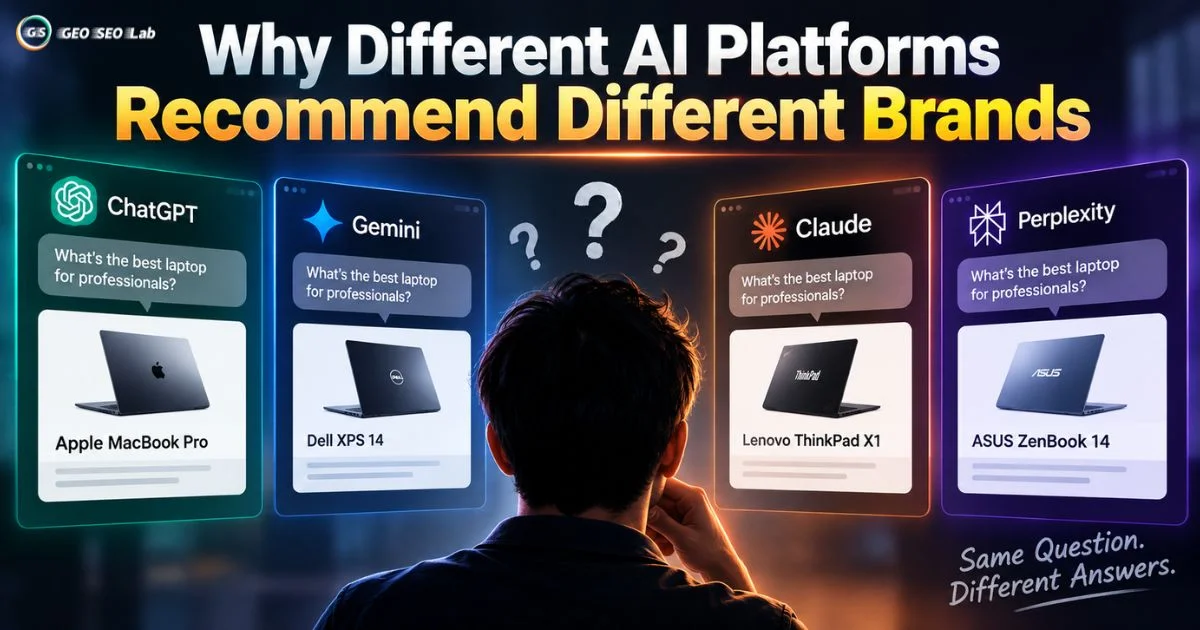
Why Different AI Platforms Recommend Different Brands
Why Different AI Platforms Recommend Different BrandsSame Question, Four Answers, Almost Zero OverlapA GEO SEO Lab ReportEditorial Disclosure: This re...
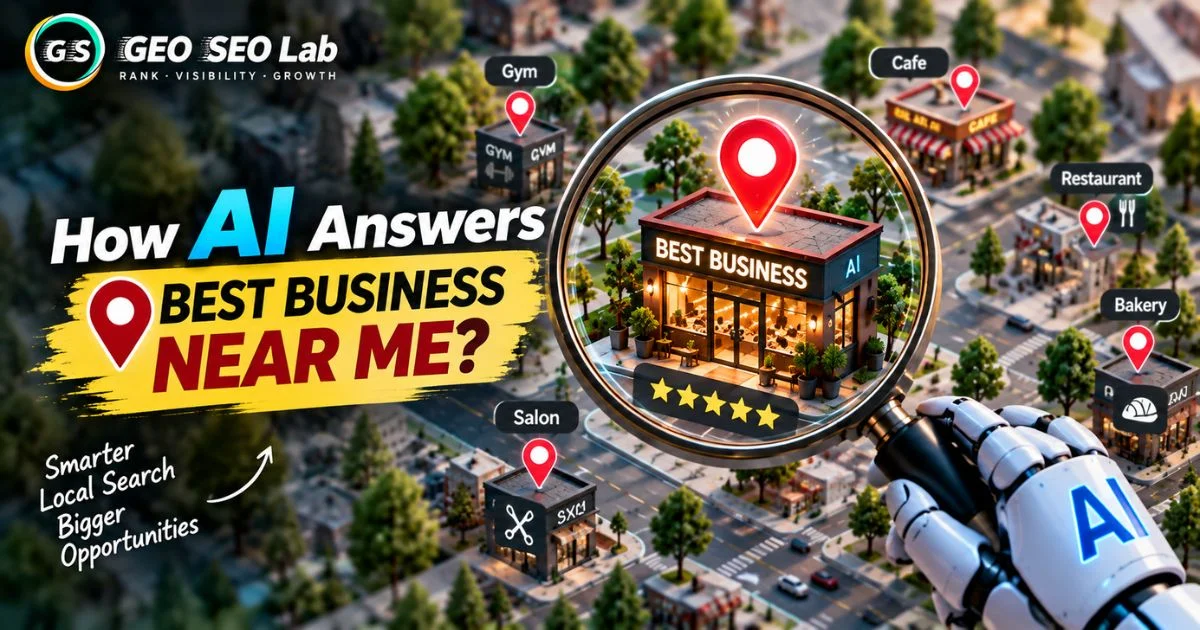
How AI Answers “Best Business Near Me” in 2026 | Local AI Search
How AI Answers "Best Business Near Me"Inside the Shortlist That Decides Who Gets the CallA GEO SEO Lab ReportEditorial Disclosure: This report introdu...
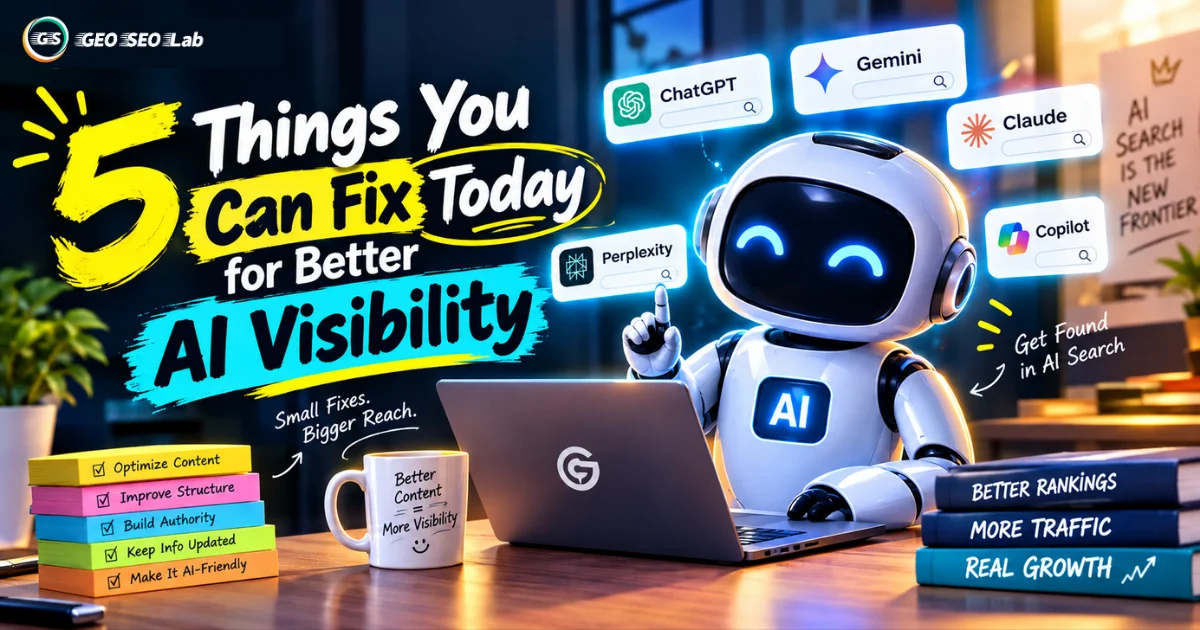
How to Improve AI Visibility in 2026 : 5 Fixes You Can Make Today
5 Things You Can Fix Today for Better AI Visibility No Redesign, No New Budget, Just Real Fixes You Can Ship This Afternoon Introduction Most GEO advice ...