India's Robotics Funding Nearly Doubles in H1 2026: A Positive Sign, But the Global Gap Remains
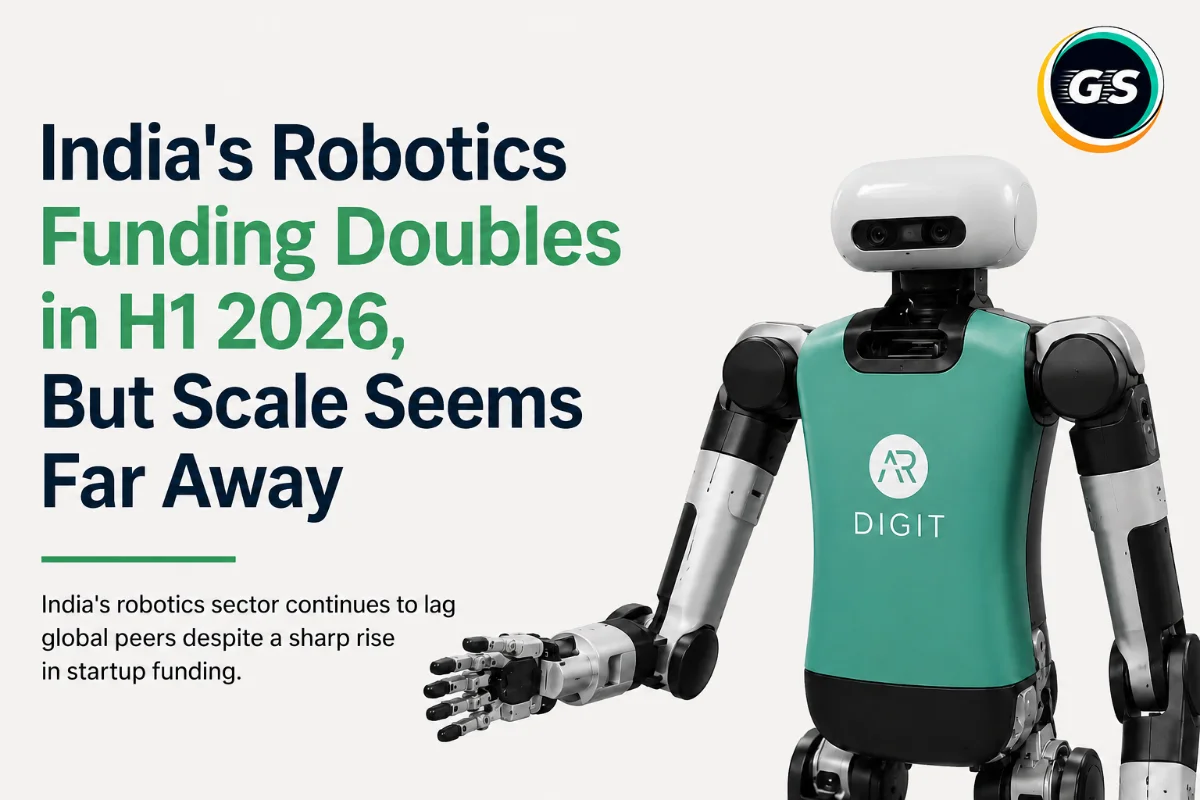
India's robotics startup ecosystem is witnessing remarkable momentum in 2026, with funding nearly doubling during the first half of the year. According to Tracxn, Indian robotics startups raised $42.1 million between January and June 2026, up from $22.7 million in H1 2025, reflecting an impressive 85% year-on-year growth. The average funding round also increased by approximately 94.4%, highlighting growing investor confidence in Artificial Intelligence, industrial automation, smart manufacturing, and robotics innovation. As businesses accelerate digital transformation and Industry 4.0 adoption, India's robotics sector is emerging as one of the country's fastest-growing deep-tech industries with strong long-term growth potential.
Why Are Investors Becoming More Interested?
Several factors are driving this renewed momentum. Rapid advancements in Artificial Intelligence (AI), growing demand for industrial automation, expansion of warehouse and logistics automation, rising adoption of robots in healthcare and manufacturing, government focus on advanced manufacturing and Industry 4.0. Industry experts believe that as global robotics companies demonstrate commercial success, Indian entrepreneurs are becoming more confident about building innovative robotics solutions.
How Artificial Intelligence Is Accelerating Robotics Investment
Artificial Intelligence has become one of the strongest forces behind the rapid growth of robotics worldwide. Modern robots are no longer designed to perform only repetitive mechanical tasks. They are increasingly capable of understanding their environment, identifying objects, making decisions, learning from data, and improving their performance over time. This transformation has significantly increased investor confidence because AI-powered robots can solve complex real-world business problems rather than simply replacing manual labor. Indian startups developing intelligent robotic systems for factories, hospitals, warehouses, agriculture, and public infrastructure are attracting greater attention as businesses seek automation solutions that deliver measurable efficiency gains. Investors recognize that AI and robotics together represent one of the fastest-growing technology markets globally, making Indian innovation an attractive long-term opportunity.
Increasing Digital Transformation Across Indian Industries
Businesses across India are accelerating digital transformation to remain competitive in both domestic and international markets. Organizations are investing in technologies that improve productivity, reduce operational costs, enhance quality control, and minimize human error. Robotics has emerged as an essential component of this transformation because automated systems can operate continuously with greater consistency than manual processes. Manufacturing companies are introducing robotic production lines, logistics firms are automating warehouse operations, healthcare providers are deploying robotic assistance, and retail businesses are exploring intelligent inventory management. This widespread digital adoption creates significant commercial opportunities for robotics startups, encouraging investors to support companies capable of delivering scalable automation solutions.
Growing Confidence Among Venture Capital Firms
Over the past few years, venture capital firms have become increasingly interested in deep technology sectors that offer long-term growth potential. Robotics combines hardware innovation, software engineering, Artificial Intelligence, computer vision, embedded systems, and cloud connectivity, creating high-value businesses with strong competitive advantages. Investors understand that while robotics companies may require longer development cycles, successful products often establish substantial market leadership. The improving funding environment during H1 2026 reflects growing confidence that Indian startups can build globally competitive robotics technologies capable of serving multiple industries both within India and internationally.
India Still Has a Long Way to Go
Despite the encouraging growth, India's robotics ecosystem remains relatively small compared to global leaders.
During 2025, Indian robotics startups raised less than 1% of the funding secured by US robotics startups. They attracted only around 2% of the investment received by Chinese robotics companies. This highlights the need for larger investments, stronger research infrastructure, and better collaboration between academia, industry, and government.
Understanding India's Position in the Global Robotics Market
Although funding has increased significantly, India's robotics ecosystem is still in the early stages compared with mature global markets. Countries such as the United States, China, Japan, South Korea, and Germany have spent decades building advanced manufacturing capabilities, robotics research centers, university partnerships, semiconductor industries, and innovation ecosystems. These nations have established strong relationships between government agencies, private companies, research institutions, and venture capital firms, allowing robotics startups to commercialize new technologies more rapidly. India is now beginning to strengthen these foundations, creating opportunities for long-term growth even though current investment levels remain comparatively smaller.
Why International Competition Matters
Global competition plays an important role in shaping the future of India's robotics industry. As international companies continue introducing more advanced autonomous systems, Indian businesses must accelerate innovation to remain competitive. Strong domestic robotics capabilities can reduce dependence on imported automation technologies while creating high-value intellectual property within the country. Increased investment, better infrastructure, and continuous research can help Indian startups compete internationally by developing affordable, reliable, and scalable robotic solutions suitable for emerging markets.
Why Robotics Matters for India's Future?
Robotics is expected to play a crucial role in India's digital transformation.
Key sectors benefiting include Manufacturing, Healthcare, Agriculture, Logistics, Warehousing, Defence, Retail, Smart Cities.
As labour shortages increase and businesses seek higher productivity, intelligent robots can improve efficiency, reduce operational costs, and enhance workplace safety.
Robotics Will Shape the Next Generation of Indian Industry
The future of industrial growth will depend heavily on intelligent automation. As customer expectations continue rising and global competition intensifies, companies require faster production, greater precision, lower operational costs, and improved quality assurance. Robotics enables businesses to achieve these objectives while maintaining consistent performance across large-scale operations. Automated inspection systems can detect manufacturing defects more accurately, robotic arms can perform repetitive assembly tasks continuously, autonomous vehicles can optimize warehouse movement, and AI-powered monitoring systems can improve workplace safety. These capabilities make robotics one of the most valuable technologies supporting India's long-term industrial development.
Building High Value Employment Opportunities
A common misconception is that robotics simply replaces human workers. In reality, the industry creates significant demand for highly skilled professionals including robotics engineers, software developers, AI researchers, mechanical designers, electronics specialists, automation consultants, cybersecurity experts, cloud engineers, data scientists, quality assurance professionals, maintenance engineers, system integrators, and product managers. As robotics adoption expands across industries, educational institutions and technology companies will need to develop specialized training programs that prepare India's workforce for these emerging careers. This shift can contribute to higher-value employment opportunities while strengthening India's knowledge-based economy.
Robotics Can Improve Global Manufacturing Competitiveness
Manufacturing competitiveness increasingly depends on automation, precision engineering, production efficiency, and consistent product quality. Companies capable of integrating robotics into production processes often achieve lower defect rates, improved throughput, shorter delivery timelines, and greater customer satisfaction. For India, expanding robotics adoption can strengthen export competitiveness by enabling manufacturers to meet international quality standards while controlling production costs. This advantage becomes increasingly important as global supply chains seek reliable manufacturing partners capable of delivering large volumes without compromising quality.
Challenges Facing the Indian Robotics Industry
While funding is improving, several obstacles remain. Limited venture capital compared to global markets, high hardware development costs, dependence on imported components, shortage of robotics engineers and researchers, longer product development cycles. Addressing these challenges will be essential for India to compete with leading robotics nations.
Why Hardware Startups Need Patient Capital
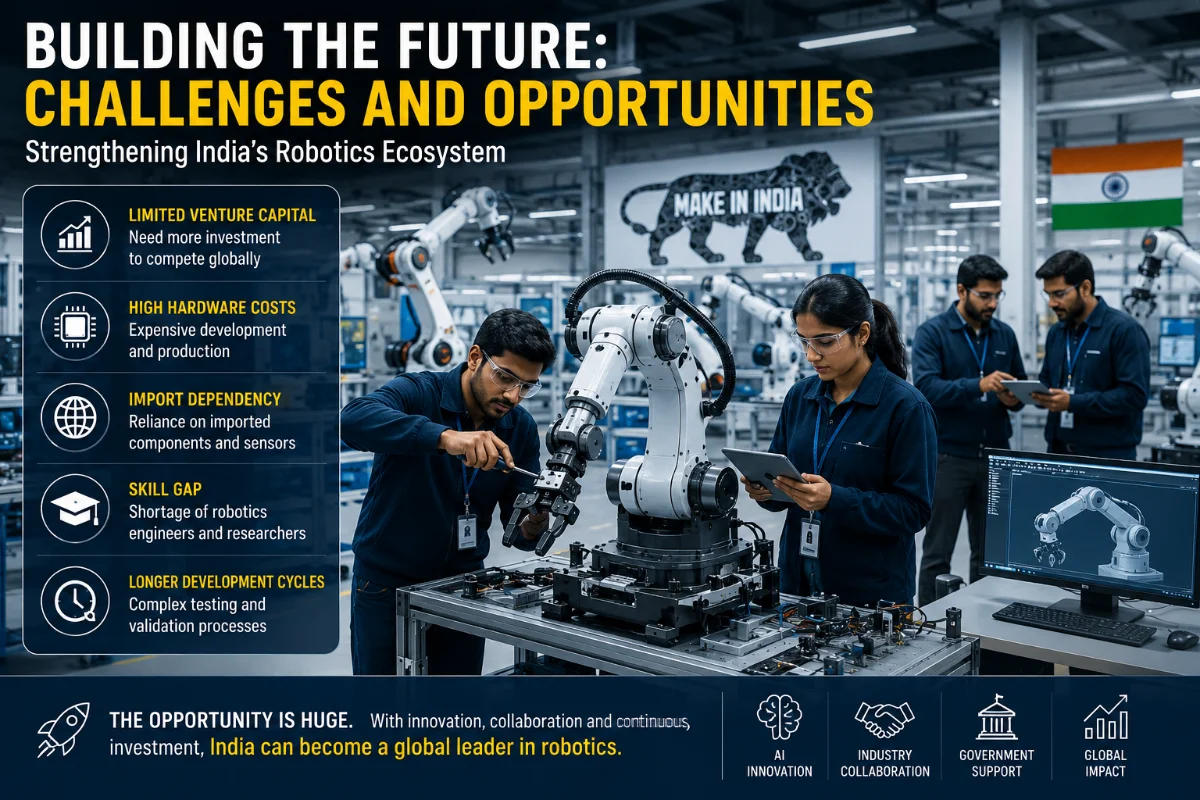
Unlike software startups that can build, test, and launch products within a relatively short period, robotics companies often require years of engineering, testing, certification, and manufacturing before reaching commercial scale. Building a robot involves mechanical design, electronics, embedded software, sensors, safety testing, AI model training, manufacturing, and continuous field validation. This increases development costs and delays revenue generation, making robotics startups more capital intensive than traditional technology businesses. Investors who understand these longer innovation cycles are more likely to support sustainable robotics ventures capable of creating long-term market value rather than expecting rapid short-term returns.
Supply Chain Challenges Continue to Affect Robotics Companies
Many Indian robotics companies continue to rely on imported sensors, processors, precision motors, cameras, industrial controllers, batteries, and specialized electronic components. Global supply chain disruptions, geopolitical uncertainties, shipping delays, and fluctuating currency exchange rates can significantly increase production costs. Reducing dependence on imported hardware through domestic manufacturing and component innovation would improve cost efficiency while strengthening India's technological independence. A stronger local supplier ecosystem can also shorten product development timelines and encourage more startups to enter the robotics sector.
The Need for Advanced Research and Development
Research and development remain the foundation of every successful robotics ecosystem. Continuous innovation in artificial intelligence, autonomous navigation, machine learning, computer vision, robotics software, sensor fusion, human machine interaction, and intelligent control systems determines how competitive robotics companies become in the global market. India has world-class engineering talent, but greater investment in university research, government laboratories, private innovation centers, and collaborative industry projects will accelerate the commercialization of advanced robotics technologies. Long-term research funding also encourages breakthrough innovation instead of incremental product improvements.
Closing the Robotics Skills Gap
One of the biggest challenges facing India's robotics industry is the shortage of professionals with multidisciplinary expertise. Successful robotics development requires knowledge across mechanical engineering, electronics, embedded programming, Artificial Intelligence, cloud computing, cybersecurity, computer vision, mathematics, simulation, and industrial automation. Expanding robotics education through universities, engineering colleges, technical institutes, vocational training centers, online learning platforms, and industry partnerships can help create a highly skilled workforce capable of supporting future industry growth. As demand for robotics professionals increases, continuous upskilling will become essential for maintaining global competitiveness.
Government Policies Supporting Robotics Growth
Government initiatives have played an increasingly important role in encouraging technology innovation across India. Programs focused on digital transformation, advanced manufacturing, startup development, semiconductor production, research funding, and industrial modernization are creating a stronger environment for robotics companies. As policy support continues expanding, startups receive better opportunities to collaborate with research institutions, manufacturing partners, and private investors. Stable policy frameworks also improve investor confidence because they indicate long-term national commitment toward innovation-driven economic growth.
Industry 4.0 Is Transforming Indian Manufacturing
Industry 4.0 represents the integration of intelligent machines, connected devices, cloud computing, Industrial Internet of Things, Artificial Intelligence, robotics, predictive analytics, and digital manufacturing systems. Indian manufacturers increasingly recognize that future competitiveness depends on adopting these advanced technologies. Robotics serves as one of the central technologies within Industry 4.0 by enabling automated production, real-time monitoring, predictive maintenance, intelligent quality inspection, and flexible manufacturing processes. Companies embracing Industry 4.0 are likely to achieve higher productivity while responding more effectively to changing market demands.
Startup Ecosystems Are Encouraging Robotics Innovation
India's growing startup ecosystem has created an environment where entrepreneurs can transform innovative ideas into commercial products more efficiently than before. Incubators, accelerators, technology parks, engineering institutions, corporate innovation programs, and venture capital networks provide mentorship, infrastructure, funding opportunities, and business guidance to robotics founders. Collaboration between startups and established enterprises allows new technologies to reach customers faster while reducing commercialization risks. As more success stories emerge, investor confidence in robotics startups is expected to strengthen further.
Emerging Technologies Driving Robotics Innovation
Robotics continues evolving because multiple advanced technologies are progressing simultaneously. Artificial Intelligence enables robots to make intelligent decisions, computer vision allows machines to understand visual information, machine learning improves performance through continuous learning, edge computing reduces response time, cloud robotics enables centralized data processing, Digital Twins support simulation before deployment, autonomous navigation enhances mobility, and advanced sensors improve environmental awareness. The combination of these technologies is making robots smarter, safer, more reliable, and more commercially valuable across industries.
Computer Vision Is Expanding Robot Capabilities
Computer vision has become one of the most influential technologies within modern robotics. By interpreting images and video captured through cameras, robots can identify products, recognize defects, avoid obstacles, read labels, inspect manufacturing quality, monitor infrastructure, and assist healthcare professionals with greater accuracy. Advances in deep learning have dramatically improved image recognition performance, enabling robots to operate effectively even in dynamic environments where traditional automation would struggle. This capability expands robotics applications far beyond repetitive factory tasks.
Machine Learning Enables Continuous Improvement
Machine learning allows robotic systems to improve performance by analyzing operational data instead of relying entirely on fixed programming. Robots can identify patterns, optimize movement, predict failures, improve object recognition, and adapt to changing conditions over time. This ability increases productivity while reducing maintenance costs and improving operational reliability. Businesses increasingly value intelligent robotic systems that continue becoming more efficient as they gain practical experience in real-world environments.
Cloud Robotics Is Creating Connected Automation
Cloud connectivity enables robots to access centralized computing resources, share operational data, receive software updates, and collaborate with other intelligent systems. Instead of processing every task locally, cloud robotics combines onboard computing with remote infrastructure to improve performance and scalability. Businesses managing large robotic fleets benefit from centralized monitoring, predictive maintenance, software management, performance analytics, and operational optimization across multiple locations. This connected approach supports more efficient deployment of automation solutions across large enterprises.
Robotics Adoption Across Indian Businesses Is Accelerating
Organizations across multiple industries increasingly recognize robotics as a strategic investment rather than an experimental technology. Rising labor costs, increasing customer expectations, growing quality standards, and international competition encourage businesses to adopt intelligent automation wherever measurable operational improvements can be achieved. Companies implementing robotics often experience better production efficiency, improved consistency, enhanced workplace safety, faster order fulfillment, lower operational costs, and greater scalability. As these benefits become more widely demonstrated, robotics adoption is expected to expand across businesses of all sizes rather than remaining limited to large enterprises alone.
Future Outlook
The funding growth seen in 2026 is an encouraging sign that India's robotics ecosystem is entering a new phase of development. As AI, machine learning, computer vision, and automation technologies continue to mature, robotics startups are likely to attract larger investments and broader industry adoption.
If government support, private investment, and research initiatives continue to expand, India has the potential to become a significant player in the global robotics market over the next decade.
Why the Next Decade Could Define India's Robotics Industry
The coming decade is expected to determine how successfully India establishes itself within the global robotics economy. Businesses are investing in automation not only to reduce costs but also to improve operational resilience, increase productivity, maintain consistent product quality, and respond quickly to changing market conditions. As robotics technologies become more affordable and easier to deploy, adoption will extend beyond large enterprises to medium sized businesses and eventually smaller organizations. This wider adoption can significantly expand the domestic robotics market while encouraging greater private investment, international partnerships, and technology exports.
Rising Demand for Intelligent Automation
Automation is evolving beyond repetitive manufacturing tasks into intelligent decision making systems capable of supporting complex business operations. Organizations increasingly require robots that can understand their environment, collaborate safely with human workers, analyze operational data, identify defects, optimize workflows, and improve performance through continuous learning. This shift toward intelligent automation creates opportunities for Indian startups developing advanced robotics platforms designed specifically for industries facing labor shortages, increasing production demands, and growing customer expectations.
India Can Become a Global Robotics Innovation Hub
India possesses several long term advantages including a large engineering workforce, rapidly growing digital infrastructure, expanding startup ecosystem, competitive software expertise, increasing Artificial Intelligence capabilities, and one of the world's fastest growing technology markets. By combining these strengths with stronger hardware manufacturing and sustained investment, India can gradually establish itself as an important destination for robotics research, product development, and commercial innovation. Success will depend on continuous collaboration among industry, government, academic institutions, investors, and technology entrepreneurs.
Robotics Will Influence Every Major Industry
The future impact of robotics extends well beyond manufacturing. Intelligent machines are becoming valuable tools across healthcare, agriculture, logistics, retail, infrastructure management, education, mining, construction, energy, transportation, hospitality, public safety, and environmental monitoring. Each industry presents unique opportunities where robotics can improve efficiency, accuracy, safety, and operational consistency. As organizations increasingly recognize these benefits, robotics adoption is expected to become an essential component of digital transformation strategies rather than an optional investment.
Healthcare Robotics Will Continue Expanding
Healthcare organizations continue exploring robotic technologies that improve patient care, support medical professionals, enhance surgical precision, automate laboratory operations, manage hospital logistics, assist rehabilitation programs, and improve diagnostic accuracy. As healthcare systems experience growing patient demand and increasing operational complexity, robotics can help improve efficiency while allowing medical professionals to focus on higher value clinical responsibilities. Continued innovation within medical robotics also creates significant opportunities for Indian startups developing specialized healthcare automation solutions.
Smart Agriculture Can Benefit From Robotics
Agriculture remains one of India's largest economic sectors, making it an important area for robotics innovation. Intelligent agricultural robots can support crop monitoring, soil analysis, precision spraying, harvesting assistance, irrigation management, weed detection, and farm data collection. These technologies enable farmers to improve productivity while reducing resource consumption and operational costs. As precision agriculture gains momentum globally, robotics solutions tailored for Indian farming conditions may become an increasingly valuable market opportunity.
Logistics Automation Will Continue Growing
The rapid growth of ecommerce, supply chain modernization, and consumer expectations for faster deliveries are encouraging logistics companies to invest heavily in warehouse automation. Autonomous mobile robots, robotic sorting systems, intelligent inventory management, automated packaging solutions, and AI driven warehouse optimization help organizations process orders more efficiently while reducing operational costs. India's expanding logistics sector is therefore expected to remain one of the strongest drivers of robotics adoption throughout the coming years.
Global Robotics Market Trends Supporting India
International demand for robotics continues increasing as businesses seek greater operational resilience following supply chain disruptions experienced over recent years. Companies worldwide are investing in automation to reduce dependency on manual processes, improve production flexibility, strengthen quality control, and maintain competitiveness within rapidly changing markets. These global trends create export opportunities for Indian robotics companies capable of delivering innovative, affordable, and reliable automation solutions suitable for international customers.
Increasing Collaboration Between AI and Robotics
Artificial Intelligence and robotics are becoming increasingly interconnected rather than developing as separate technologies. Modern robots rely on AI for perception, navigation, decision making, predictive maintenance, natural language interaction, object recognition, and autonomous learning. As AI models continue improving, robotics capabilities will expand further across industrial, commercial, and consumer applications. Indian companies specializing in AI software therefore possess a significant opportunity to strengthen domestic robotics innovation through integrated intelligent automation platforms.
Sustainability Will Encourage Automation
Sustainability has become an important consideration for businesses across the world. Robotics contributes by optimizing energy consumption, reducing production waste, improving material utilization, increasing manufacturing precision, and supporting environmentally responsible industrial operations. Companies seeking to meet sustainability goals increasingly recognize automation as a practical investment that delivers both economic and environmental benefits. Robotics therefore aligns with broader global priorities surrounding resource efficiency and responsible industrial growth.
Investment Opportunities Continue Expanding
The significant increase in robotics funding during H1 2026 demonstrates that investors increasingly recognize automation as a long term growth opportunity rather than a temporary technology trend. Investment interest extends across industrial robotics, warehouse automation, medical robotics, agricultural automation, autonomous mobility, AI powered inspection systems, collaborative robots, service robotics, educational robotics, defense technologies, and intelligent infrastructure solutions. As commercialization accelerates, investors are expected to evaluate robotics companies based on technological differentiation, scalable business models, experienced leadership teams, intellectual property, and demonstrated customer adoption.
Why Global Investors Are Watching India
International investors increasingly view India as one of the world's fastest growing innovation ecosystems. Strong software capabilities, expanding Artificial Intelligence expertise, government support for technology entrepreneurship, improving digital infrastructure, and a rapidly growing domestic market make India an attractive destination for long term investment. As Indian robotics startups demonstrate successful commercialization, global venture capital firms may increase participation within the country's deep technology ecosystem, bringing additional funding, international partnerships, and global market access.
India's Robotics Industry at a Glance (2026)
Category Key Insight Funding Growth Indian robotics startups raised $42.1 million in H1 2026, compared to 2.7 million in H1 2025, reflecting 85% year-on-year growth. Average Funding Round The average funding round increased by approximately 94.4%, indicating stronger investor confidence. Key Growth Drivers Artificial Intelligence, industrial automation, smart manufacturing, warehouse automation, healthcare robotics, Industry 4.0 initiatives, and digital transformation. High-Potential Industries Manufacturing, healthcare, agriculture, logistics, warehousing, defence, retail, automotive, pharmaceuticals, and smart cities. Major Challenges Limited venture capital, high hardware development costs, dependence on imported components, shortage of skilled robotics engineers, and longer product development cycles. Emerging Technologies Artificial Intelligence, Machine Learning, Computer Vision, Industrial IoT, cloud robotics, edge computing, autonomous navigation, and advanced sensors. Government Support Policies promoting startup innovation, advanced manufacturing, semiconductor development, Industry 4.0, and digital infrastructure are strengthening the robotics ecosystem. Global Position India's robotics ecosystem is expanding rapidly but still trails global leaders such as the United States and China in total investment and research scale. Future Outlook Continued investment, research, AI adoption, and public-private collaboration could position India as a major global robotics and intelligent automation hub over the next decade. Key Takeaway The sharp rise in robotics funding during H1 2026 signals growing investor confidence and marks an important milestone in India's journey toward becoming a technology-driven, innovation-led economy.
Final Thoughts
Although India's robotics funding remains lower than that of the United States and China, the significant growth seen in 2026 highlights the sector's rising momentum and investor confidence. Ongoing technological advancements, government support, and sustained investment will play a key role in establishing India as a leading force in robotics and intelligent automation.
For businesses, investors, and innovation leaders, robotics is no longer just a vision of the future, it is rapidly evolving into one of the most influential industries driving India's digital transformation and economic growth.
Conclusion
India's robotics ecosystem is moving through an important period of transformation. The sharp increase in funding during the first half of 2026 reflects improving investor confidence, stronger technological capabilities, expanding startup activity, and rising industry demand for intelligent automation. Although challenges such as limited capital availability, hardware development costs, research infrastructure, and skilled talent remain, the overall direction of the industry is increasingly positive. Continued collaboration between government organizations, academic institutions, private enterprises, investors, and technology innovators can accelerate the development of globally competitive robotics solutions built in India.
As Artificial Intelligence, computer vision, machine learning, cloud robotics, and advanced automation continue evolving together, robotics will become an increasingly important driver of industrial productivity, economic growth, innovation, and global competitiveness. Businesses that begin adopting intelligent automation today will be better positioned to compete within tomorrow's technology driven economy, while investors supporting this transformation may benefit from one of the fastest growing deep technology sectors of the coming decade. India's robotics journey has only begun, but the momentum created in H1 2026 suggests that the country is steadily moving toward becoming an influential participant in the future of global intelligent automation.
Tags
Frequently Asked Questions
Find answers to common questions about this topic
About the Author

Aman Kesharwani
SEO Expert & Content Creator
Experienced digital marketing professional specializing in SEO strategies, content optimization, and data-driven marketing solutions. Passionate about helping businesses grow their online presence and achieve better search rankings.
Related Articles
View all posts
How to Turn FAQ Content Into GEO Content
How to Turn FAQ Content Into GEO ContentThink about the last time you searched for a complex product or a nuanced troubleshooting step. Did you type a...

How AI Decides Which Websites to Cite: Inside the Hidden Selection Process
Introduction: The New Gatekeepers of VisibilityPicture this. Someone types a question into ChatGPT, Perplexity, or Google's AI Overview box. Within se...

Why Does AI-Generated Content Need Humanization for SEO?
Why Does AI-Generated Content Need Humanization for SEO?The Real Reason Raw AI Drafts Underperform, and What Actually Fixes ItA GEO SEO Lab ReportEdit...