How AI Search Decides What to Cite — And What That Means for Your Business
AI search doesn't rank content the same way traditional search engines do—it retrieves, evaluates, and synthesizes information from multiple trusted sources before generating an answer. This in-depth guide explains how platforms like ChatGPT, Google AI Overviews, Gemini, Claude, and Perplexity decide what to cite, why some businesses gain visibility while others are overlooked, and the long-term strategies that build authority, trust, and AI search visibility. Learn how original research, entity consistency, technical SEO, and credible content can help your organization become a source AI systems are more likely to reference.
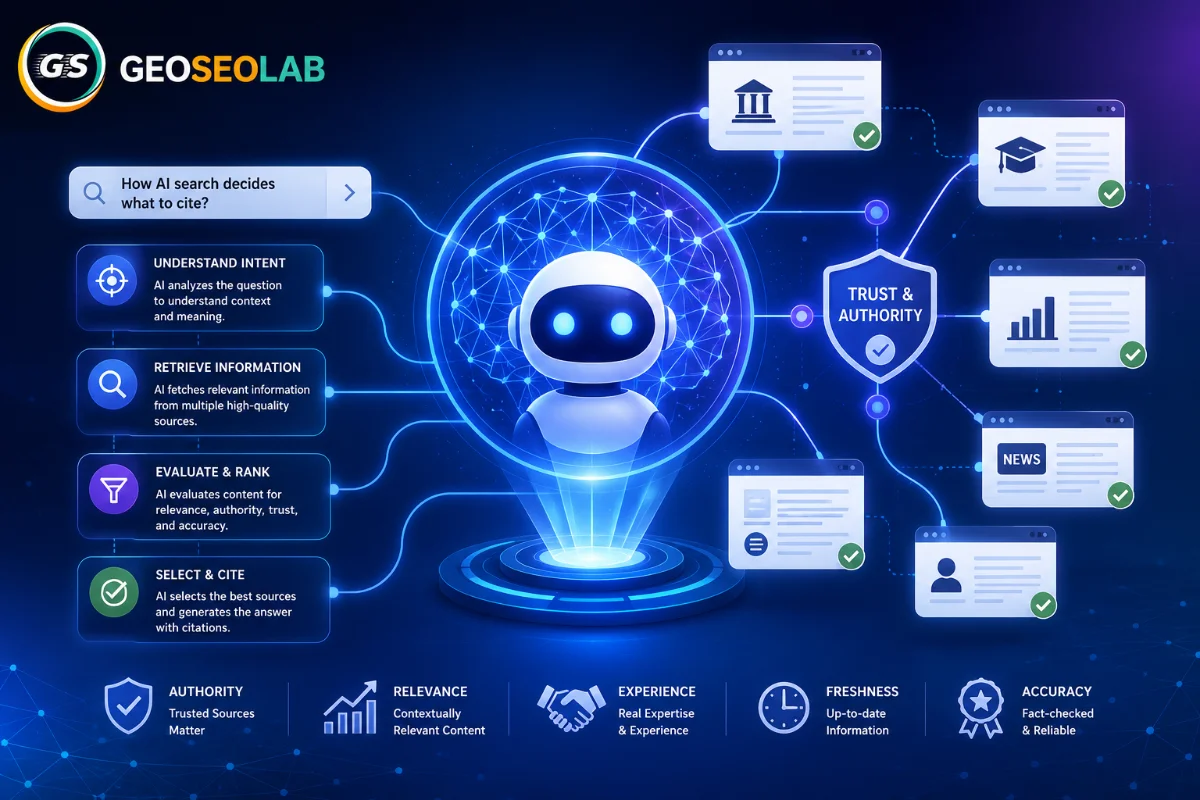
Part One: The Biggest Myth About AI Search — And Why It Persists
Why the "One Algorithm" Idea Is So Appealing
The traditional SEO model was elegant in its simplicity. Someone typed a query. Google evaluated webpages. The algorithm ranked them. The business that appeared first earned the most clicks. The entire industry grew around the project of understanding and influencing that evaluation process.
That model trained a generation of marketers to think about search visibility as a ranking problem. There is one list. The goal is to appear as high on that list as possible. There are known factors that influence position. Optimize for those factors and visibility improves.
When AI-powered search experiences arrived, it was natural to apply the same mental model. There must be a ranking system for AI citations. Find the factors, optimize for them, climb the invisible list. It is the same game with a different interface.
The problem is that AI-assisted search is not a more sophisticated version of the same game. It is a fundamentally different activity that produces a fundamentally different kind of output.
A traditional search engine returns a list of pages it has evaluated as relevant. The user decides which pages to visit and does the interpretive work themselves. An AI-assisted search system does something considerably more complex. It interprets the user's question, retrieves potentially relevant information from multiple sources, evaluates that information, synthesizes it into a coherent response, and generates natural language. Sometimes it cites sources. Sometimes it does not. Sometimes the same question asked on different days produces meaningfully different answers.
The "one algorithm" model cannot account for this complexity. Which is why businesses that have built their AI visibility strategy around the assumption of a simple ranking formula consistently struggle to explain what they observe, and consistently fail to produce results that hold up over time.
Five Different Platforms, Five Different Realities
Part of what makes this conversation so confusing is that "AI search" is used as a single category to describe what are actually very different products with different architectures, different retrieval systems, different safety frameworks, and different product objectives.
Google's AI Overviews are deeply integrated with Google's existing search infrastructure. They draw on Google's understanding of web content developed over decades, combined with AI synthesis capabilities. The integration between traditional search signals and AI generation is tighter here than almost anywhere else.
ChatGPT, depending on the version and whether web browsing is enabled, may draw on pre-trained model knowledge, live web retrieval, or a combination. The same question can produce different answers depending on whether retrieval is active, what the retrieval system can access, and what the model's training included.
Perplexity is built around the idea of citing sources explicitly. Its product design emphasizes showing users where information came from. This makes it distinctive both as a user experience and as a context in which citation patterns are highly visible and therefore frequently studied by marketers.
Gemini, Google's AI assistant, has its own integration patterns with Google's information ecosystem and its own product design choices about when and how to surface sources.
Claude, developed by Anthropic, approaches the task with different training, different safety frameworks, and different default behaviors around factual claims and source attribution.
These are not interchangeable. The optimization logic that produces results in one context does not necessarily transfer to another. A business that has reverse-engineered Perplexity's citation patterns may still be invisible in Google AI Overviews. A brand that appears prominently in ChatGPT responses may not appear at all in Gemini.
This is not a failure of optimization. It is the predictable result of trying to apply a universal solution to genuinely different systems.
The Honest Answer About AI Citation Formulas
No major AI platform has published a comprehensive, complete specification of exactly how it determines which sources to cite in generated responses. This is not an oversight. These systems are proprietary, complex, and under continuous development. The organizations that build them regularly publish research papers on components of their systems, but no complete ranking formula exists in the public domain.
This means that anyone who claims to know the definitive formula for AI citation ranking is making a claim that outstrips the available evidence. The confident checklists circulating on social media, the prompt engineering tricks promised to boost citations, the structured data templates sold as AI visibility guarantees — none of these rest on the kind of documented evidence that would justify the certainty with which they are promoted.
This does not mean systematic thinking about AI visibility is impossible. It means the thinking has to be grounded in what is actually known rather than in what would be convenient to believe.
What is known — from official documentation, published research, and carefully interpreted observable behavior — is substantial enough to guide strategic decisions. It just leads to different priorities than the shortcut-hunting approach. And those different priorities are exactly what the rest of this article is about.
How AI Search Evaluates Information
Stage What AI Does Why It Matters Intent Understanding Understands the user's actual question and context Helps deliver relevant answers Information Retrieval Collects information from websites, documents, and trusted sources Builds the evidence base Source Evaluation Checks relevance, authority, accuracy, and trustworthiness Filters low-quality information Cross-Source Validation Compares multiple sources for consistency Reduces misinformation risk Response Generation Synthesizes information into a readable answer Creates the final AI response Citation Selection Chooses sources to reference when appropriate Improves transparency and credibility
Part Two: How AI-Assisted Search Actually Works
The Fundamental Shift From Document Retrieval to Answer Generation
The easiest way to understand why AI-assisted search is different from traditional search is to focus on what the system is actually trying to produce.
A traditional search engine is trying to produce a ranked list of relevant documents. The user then visits those documents and does their own interpretive work. The search engine's job is evaluation and ranking. The user's job is synthesis and sense-making.
An AI-assisted search system is trying to produce a useful answer. Not a list of places where an answer might be found, but an actual synthesized response to the question the user asked. This requires the system to do the interpretive work that users previously did for themselves.
That seemingly small shift creates an entirely different workflow. Instead of asking "which document should appear first?", the system is asking "what information, assembled from potentially many sources, will best help this person?" The inputs, the process, and the output are all different. And the implications for how businesses should think about visibility are different as well.
Stage One: Understanding What Was Actually Asked
Before any information is retrieved, something important has to happen. The system needs to understand what the user is actually trying to accomplish.
This sounds simple. In practice, it is one of the more sophisticated aspects of modern AI-assisted search. Consider what actually needs to be understood when someone asks "how can a small healthcare clinic improve its visibility in AI search?"
The user is asking for practical recommendations. They have specified that they run a small clinic, which means enterprise-scale solutions are probably not relevant. They are asking specifically about AI search, not traditional SEO, which means the context is a particular kind of discovery experience. The question implies they want actionable guidance, not a theoretical overview.
All of that context shapes what a useful answer looks like before a single piece of information has been retrieved. Now compare that to how a keyword-oriented search system would have processed the same question: it would identify the key terms, match them to indexed pages, and return results. No attempt to understand intent, no recognition of the healthcare clinic context, no adjustment for the scale of the business.
The intent-understanding stage affects everything that follows. Which sources are retrieved, which information is considered relevant, what format the answer takes, what follow-up questions the system might anticipate — all of these downstream decisions depend on how well the system understands what was actually being asked.
Stage Two: Retrieving Information From the Open Web and Beyond
Once intent is established, many modern AI-assisted systems retrieve information from external sources rather than relying exclusively on what was learned during model training.
This is worth pausing on, because it is genuinely counter to how many people imagine AI systems working. The popular mental model is of a system that has absorbed the entire internet during training and now retrieves answers from its own vast memory. That model is not wrong exactly, but it is incomplete in ways that matter for businesses.
Large language models do encode significant knowledge during training. They develop an understanding of language, concepts, relationships, and a great deal of specific information. But training has a cutoff point. Training data is not comprehensive across all topics. And for many types of questions — particularly those involving current events, specific product details, local business information, or rapidly evolving fields — model knowledge alone is insufficient for producing accurate, trustworthy answers.
The general approach that many production AI systems use to address this limitation involves retrieving relevant information at query time rather than relying exclusively on training. This retrieval-augmented approach allows the system to incorporate current, specific, and verifiable information into its responses. The concept of Retrieval-Augmented Generation, or RAG, describes this general architectural pattern and is discussed extensively in published AI research, though specific implementations vary significantly across platforms and are generally proprietary.
For businesses, the practical implication is significant. If AI systems are retrieving information from the web when generating responses, then the quality, clarity, accessibility, and credibility of information on the public web remains directly relevant to AI visibility. The website is not obsolete. The character of what the website contains and how it compares to other available sources has simply become more consequential.
Stage Three: Selecting From What Was Retrieved
Retrieval surfaces more information than any answer could incorporate. A question about content strategy in healthcare might retrieve dozens of relevant articles, research papers, official guidelines, and product documentation. The system needs to select which of this retrieved material is actually useful for constructing a good response.
This selection process involves evaluating multiple characteristics of the retrieved information. How closely does this material address the specific question asked? How current is the information? Is the information consistent with what other credible sources say, or does it make unusual claims that no other reliable source supports? Is the content clearly and specifically written, or does it hedge so heavily that it provides little useful signal? What is the apparent credibility of the source?
Importantly, none of these criteria are based on which brand has the largest market share, which company spent the most on advertising, or which website has the most pages. They are based on characteristics of the information itself and the credibility of the source that produced it. That is why smaller organizations with genuine expertise can and do appear in AI-generated answers while larger competitors with weaker content do not.
Stage Four: Evaluating Evidence Across Multiple Sources
Here is one of the aspects of AI-assisted search that differs most significantly from traditional document ranking, and that has the most interesting strategic implications.
When a traditional search engine evaluates a webpage, it is largely asking questions about that page in isolation. How relevant is this page to the query? How authoritative is this domain? How well does this page match search intent? The page is evaluated on its own terms.
When an AI system is assembling a response, it is often working across multiple retrieved sources simultaneously. It is asking not just "is this source relevant?" but "does this source's information align with what other credible sources say?" and "does this information help resolve any uncertainties in my understanding of the topic?" and "does this source contribute something that the other sources do not?"
This cross-source evaluation has an important implication. Being cited by an AI system is not just about your content being good. It is about your content being part of a coherent information landscape. Sources that consistently align with what other reliable sources say — that are part of the mainstream of accurate information on a topic — are easier to incorporate into a synthesized response than sources that contradict established understanding.
This also explains something that confuses many marketers. Why does original, genuinely novel research sometimes generate significant AI citation, even from relatively small or unknown sources? Because novel research contributes something that the existing information landscape does not yet contain. It is not redundant. It resolves uncertainty rather than duplicating existing understanding. That makes it valuable for synthesis in a way that another article covering well-trodden ground simply is not.
Stage Five: Generating the Response
After retrieval and evaluation, language generation begins. This is the stage most visible to users — the actual text of the response — but in many ways it is the last step in a complex prior process.
The generation stage takes the evaluated evidence and produces a coherent, readable, appropriately formatted response. This involves balancing multiple objectives simultaneously: the response should be accurate given the available evidence, it should match the format and length that fits the question, it should be readable and natural rather than mechanical, and it should stay within the platform's safety and quality guidelines.
What the generation stage is not doing is searching for a brand to promote. It is not rewarding the company that paid for premium placement. It is not selecting sources based on the size of the organization's marketing budget. It is producing the best available response to the question, given the information that was retrieved and evaluated.
That is why "thinking like a journalist" — being accurate, specific, clear, and well-sourced — turns out to be more useful preparation for AI visibility than most of the platform-specific optimization checklists circulating in the marketing space.
Why Citations Appear Sometimes But Not Always
One of the consistent sources of confusion in AI visibility discussions is the unpredictability of citation behavior. Sometimes AI responses include prominent citations. Sometimes similar responses include none. The same platform will cite sources in one response and provide what appears to be equivalent information without attribution in another.
This variability is not random, but it is not the result of a simple rule either. Citation behavior is a product design decision, and different platforms have made different choices. Some platforms, like Perplexity, have built their product identity around explicit citation. Others treat citation as situation-dependent — citing sources when the information is particularly specific, recent, or factual, and omitting citations when the response draws on general knowledge that does not point clearly to one authoritative source.
The practical implication is that optimizing for citation count across all platforms is not a coherent strategy. Different citation behaviors reflect different product designs, not different levels of visibility. A business that appears in an AI Overview as context for a recommendation without an explicit link may be influencing that user's understanding just as much as a business that receives a direct citation in Perplexity
Factors That Increase AI Citation Potential
Factor Impact on AI Visibility Original Research High Expert-Led Content High Technical SEO Medium to High Entity Consistency High Structured Data Medium Brand Authority High Customer Reviews Medium to High Content Freshness Depends on Topic Backlinks from Trusted Sites Medium to High
Part Three: Where AI Gets Its Information — And Why Some Sources Are Chosen More Often
The Internet Is Not One Library, and AI Is Not Reading All of It
When people wonder where AI gets its answers, they tend to imagine some comprehensive database that AI systems query in real time. The reality is more fragmented and more interesting.
Different AI platforms have different access to different types of information. Some have built extensive web crawling infrastructure. Some have partnerships with specific publishers or data providers. Some prioritize certain types of sources for certain types of questions. Some have knowledge that was current as of a training cutoff and may not reflect recent developments without retrieval.
This means asking "what source does AI use?" is usually the wrong question. A more useful question is: given this specific platform, this specific type of question, and this specific moment in time, what information ecosystem is likely to be available and weighted for this query?
That question is harder to answer definitively, but it is more honest about the complexity of the actual situation — and it leads to better strategic decisions.
The Types of Information That Carry the Most Weight
While no comprehensive public documentation exists for any platform's complete source weighting, some categories of information consistently emerge from research, official guidance, and careful observation as particularly valuable across AI-assisted search contexts.
Official and primary source documentation carries significant weight for factual questions. When someone asks about Google's guidelines for helpful content, the authoritative source is Google's own documentation. When someone asks about a company's product features, the company's own documentation is the primary source. When regulations or clinical guidelines are involved, official documentation from regulatory bodies or medical organizations matters. This is not surprising — primary sources reduce the risk of information being distorted through repeated interpretation, which is exactly what AI systems trying to produce accurate responses need.
Original research and proprietary data have become increasingly valuable as AI-generated content has proliferated. A system trying to synthesize information across sources has a clear interest in sources that contribute something that does not already exist in the information landscape. An article that repackages widely available information about, say, the importance of mobile page speed is drawing on information available in thousands of other sources. A study that presents original data from testing across hundreds of websites is contributing something that exists nowhere else. The latter creates unique citation value.
Expert knowledge grounded in firsthand experience occupies a similar position. The internet is increasingly well-supplied with content that explains concepts at a general level. It is less well-supplied with accounts of what implementing those concepts actually looks like in practice, what unexpected challenges arise, what the results look like across different contexts. Practitioners who write about their direct experience create a kind of knowledge that generated content cannot replicate and that AI systems attempting to give practically useful answers have genuine reason to incorporate.
Structured and clearly organized information is not a citation guarantee, but it does reduce friction in the process of machine interpretation. When information about a business, its products, its services, and its location is clearly and consistently organized — across the website, in structured data where appropriate, in business profile listings — that information becomes easier for systems to process accurately. Ambiguity requires resolution, and resolution requires additional processing. Clear information is simply more efficient to work with.
External reputation signals matter because AI systems do not evaluate sources purely in isolation. The reputation of a source within the broader information ecosystem — evidenced by being cited by other credible sources, being referenced in authoritative publications, earning genuine customer recognition — contributes to an assessment of credibility that goes beyond the content of any single page.
Why Original Knowledge Has Become the Scarce Asset
Here is something worth sitting with for a moment. The rise of AI-generated content has made producing information dramatically cheaper. Any organization with access to AI writing tools can now publish articles that read fluently, cover topics comprehensively (at a surface level), and are formatted appropriately for web consumption.
What that means, over time, is that the web is becoming increasingly dense with information that says roughly the same things in slightly different ways. Generic explanations of industry concepts. Topic-covering articles that hit all the expected subheadings. Content that exists primarily because someone thought a keyword cluster deserved a page.
In that environment, genuinely original knowledge becomes scarcer and therefore more valuable. Not original in the sense of an unusual take on a familiar topic, but original in the more fundamental sense: based on data that does not exist elsewhere, reporting firsthand experience that has not been described before, developing a framework or analysis that did not previously exist.
AI systems attempting to synthesize useful responses from the available information landscape have obvious reason to incorporate sources that contribute unique evidence. There is limited reason to incorporate the seventeenth article making the same point that the first sixteen already made.
This is not an argument for abandoning all informational content. Some questions have established, well-documented answers, and providing clear, accurate, well-organized versions of those answers remains genuinely useful. But organizations that invest in genuine knowledge creation — in research, in documenting firsthand experience, in developing original frameworks — are building the kind of assets that become more valuable over time as the surrounding information environment becomes more crowded.
The Clarity Principle That Most Businesses Underestimate
There is a writing quality that correlates with AI visibility more reliably than almost any technical optimization, and most businesses invest surprisingly little attention in it. That quality is clarity.
Think about what an AI system is actually trying to do when it incorporates information into a synthesized response. It is trying to understand what a source is saying, assess whether that understanding is accurate, and integrate it with information from other sources into a coherent response. Every source of ambiguity in a piece of content adds friction to that process.
Dense jargon requires additional processing to interpret. Long paragraphs that mix multiple ideas together make it harder to identify which specific claim is relevant to which specific question. Hedged writing that says something might be important in certain contexts depending on various factors does not give a clear signal about what is actually being claimed. Inconsistent use of terminology — using three different phrases to describe the same concept throughout an article — creates genuine interpretive difficulty.
Contrast that with content that leads with a clear claim, supports it with specific evidence, uses consistent terminology, structures information so that related ideas are grouped together, and makes it easy for any reader — human or machine — to understand exactly what is being said and why.
That kind of clarity is not dumbing down. It is precision. And it makes content easier to work with in almost every context — for the human reader trying to understand a complex topic, for the journalist looking for a quotable passage, for the researcher trying to cite a specific claim, and for the AI system trying to incorporate relevant information into a synthesized response.
Freshness: What It Actually Means and When It Matters
The topic of content freshness generates a lot of well-intentioned but imprecise advice. The general claim — that fresh content performs better — is too blunt to be useful, because freshness matters very differently depending on the type of question being asked.
For questions about current events, recent developments, or rapidly evolving situations, freshness is genuinely critical. An article about AI search developments published eighteen months ago may be substantively wrong about the current state of the tools it describes. An article about yesterday's policy announcement needs to have been written after that announcement. For these types of questions, recency is part of accuracy.
For questions about enduring concepts and principles, freshness matters much less. A thorough, accurate explanation of how search engines evaluate content quality, written three years ago and still accurate today, is not made worse by its age. An explanation of fundamental statistical concepts does not need to be updated annually. For these types of content, accuracy and depth are the primary considerations, not recency.
The practical implication is not "publish as frequently as possible." It is "maintain accuracy rigorously." Content that was once accurate but has become outdated should be updated. Content that remains accurate does not require freshening for its own sake. The question to ask is not "when was this written?" but "is this still accurate?"
Part Four: Why Some Sources Get Cited and Others Are Ignored — And What Your Organization Should Do About It
AI Doesn't Choose Brands. It Assembles Evidence.
Let's address directly the question that opened this article. Why does AI recommend some companies and not others?
The framing of that question assumes that AI systems are making choices about companies. A more accurate description is that AI systems are assembling evidence for answers. The companies that appear in those answers are the ones whose information was part of the evidence that best supported the response.
That distinction is not semantic. It changes the entire strategic response.
If AI systems are choosing brands, then the goal is brand promotion — making your company visible and recognizable so that AI systems associate it with positive attributes. If AI systems are assembling evidence, then the goal is knowledge contribution — producing information that is accurate, clear, credible, and useful enough to become part of the evidence base for questions in your domain.
The second goal leads to completely different activities. It emphasizes publishing research that advances understanding rather than publishing content that promotes the brand. It prioritizes accuracy over cleverness. It values being cited by other credible sources over accumulating social media mentions. It focuses on answering the questions customers actually struggle with rather than targeting the keywords with the highest search volume.
Why Consistency Across Your Entire Digital Presence Matters More Than You Think
Consider how an AI system encounters your organization across the web. It may retrieve your website. It may encounter your company listed in an industry directory. It may find a news article that mentions your product. It may process a LinkedIn post from your CEO. It may encounter customer reviews on a specialist platform.
If all of these encounters tell a consistent story — the same description of what your company does, the same positioning, the same characterization of your expertise — the system can construct a clear, confident understanding of your organization. That clarity is useful when your company is relevant to a question being answered.
If those encounters tell contradictory stories — your website says you are an enterprise AI platform, your LinkedIn says you are a boutique consultancy, your directory listing from four years ago describes a service you no longer offer — the system has to work harder to reconcile conflicting signals. That ambiguity may reduce confidence in including information about your organization in responses where it would otherwise be relevant.
This is why consistency audits are worth doing, and why they are worth doing across the full range of digital touchpoints rather than just on the primary website. The inconsistencies that cause the most strategic damage are often the ones that went unnoticed for years because no one thought to check.
A Strategic Framework for Building AI Visibility Over Time
At GEO SEO Lab, we have developed a framework for thinking about AI visibility as a layered, cumulative capability rather than a collection of individual tactics. We call it the AI Visibility Blueprint, and we want to be explicit that it represents our analytical perspective rather than a documented ranking system from any platform.
The framework has six layers, and the critical principle is that the layers are interdependent. Investing heavily in upper layers while neglecting lower ones produces consistently disappointing results.
Technical SEO forms the foundation. None of the other layers matter if AI systems and search engines cannot efficiently access and interpret your content. This means fast loading times, clean site architecture, logical internal linking, appropriate use of structured data, and consistent crawlability across all important pages. This is not glamorous work, but it is genuinely foundational. Technical debt at this layer limits the return on every other investment.
Content clarity is the next layer. Once content is accessible, it needs to be understandable — not just to search engines, but to human readers trying to make decisions and to AI systems attempting to extract and synthesize information. This means clear structure, consistent terminology, specific claims supported by specific evidence, and writing that respects the reader's time and intelligence.
Original knowledge is where genuine differentiation begins. Content that contributes something new to the information landscape — original research, documented firsthand experience, proprietary data, novel frameworks developed from practical expertise — creates citation value that derivative content cannot match. Building this layer requires genuine investment in knowledge creation rather than content production.
Entity consistency is the layer that many organizations neglect while focusing entirely on their primary website. This involves ensuring that your organization is described coherently and accurately across all the places it appears on the web — directories, social platforms, review sites, press coverage, partner websites, employee profiles. Inconsistency at this layer undermines the clarity of organizational identity that makes an organization easy to understand and reference.
Authority is the accumulated external recognition that comes from producing genuinely valuable work over time. Other credible sources citing your research. Industry publications requesting your perspective. Professional communities referencing your frameworks. Organizations that earn this kind of recognition do so through the quality of their contributions rather than the sophistication of their promotion.
Digital trust sits at the apex because it is the layer that converts visibility into commercial outcomes. Trust develops through the alignment between what an organization claims and what customers actually experience. It is built slowly through consistent, positive interactions and damaged quickly through the gap between promise and reality.
What This Actually Looks Like Across Different Types of Organizations
Abstract frameworks become more useful when applied to specific contexts.
For a healthcare practice, building AI visibility means going beyond ranking for treatment-related keywords. It means physicians contributing educational content based on their clinical experience. It means treatment pages that explain procedures in accessible language with appropriate references to established clinical evidence. It means patient questions getting honest, specific answers rather than general disclaimers. It means consistent business information across Google Business Profile, healthcare directories, and the practice website. It means patient reviews that reflect genuine experiences and that receive thoughtful responses.
For a B2B software company, the path is similarly specific. Publishing annual benchmark reports based on actual customer data. Maintaining technical documentation that is accurate, detailed, and regularly updated. Engineering blogs written by the people who actually built the product. Case studies that are specific about what was implemented, what challenges arose, and what the actual results were. A consistent product description across all the channels where potential customers encounter the brand.
For a law firm, the differentiation comes from demonstrating expertise rather than describing it. Attorneys publishing analyses of relevant cases and regulatory developments. Guides that walk clients through genuinely complex compliance questions with specific, actionable information. Explanations of legal concepts in language that non-lawyers can actually understand and use. A consistent representation of practice areas and expertise across the firm's website, attorney profiles, and bar association listings.
For a local service business, the priorities are somewhat different but the underlying logic is the same. Accurate, complete, and consistent information across all local listing platforms. Genuine customer reviews that reflect actual service quality. Content that specifically addresses the questions potential customers in the local area actually have. Evidence of community involvement and local expertise that distinguishes the business from national competitors.
In all of these cases, the common thread is that AI visibility emerges from organizational quality made visible — not from optimization of a distinct AI-visibility marketing channel.
The Myths That Keep Businesses From Making Progress
The AI visibility conversation is unfortunately dense with confident-sounding advice that does not hold up to scrutiny. Addressing the most persistent myths directly seems worth doing.
The idea that structured data alone determines AI citation is probably the most technically-oriented myth. Structured data — implementing schema markup to help machines understand specific types of content — is genuinely useful. It reduces ambiguity about what certain elements of a page represent. But it does not transform weak content into citation-worthy content. It is a clarity tool, not a visibility shortcut.
The claim that backlinks have become irrelevant overstates the case dramatically. The way external links factor into AI-assisted search is genuinely more complex than it was in traditional search, and the precise weighting is not publicly documented. But the underlying logic — that links from credible external sources constitute a signal that other authoritative parties found this source worth referencing — has not disappeared. It has become one signal among many rather than the primary determinant of ranking.
The advice to create separate "AI-optimized" content versions fundamentally misunderstands the situation. The qualities that make content valuable for AI synthesis — clarity, accuracy, specificity, expert grounding — are the same qualities that make content valuable for human readers. Creating a separate version optimized for AI involves optimizing for a behavior that no platform has publicly documented, while potentially creating redundancy and inconsistency.
The belief that AI systems are ignoring websites in favor of some other information layer misreads the actual situation. Websites remain one of the primary sources of structured, authoritative, publicly available information on the web. AI systems that retrieve information from the open web are retrieving it from websites. The website is not obsolete — the standard for what a website's content needs to accomplish has simply risen.
And the recurring promise of a secret citation formula deserves direct and final dismissal. No such formula exists in the public domain. The organizations selling confidence about guarantees they cannot actually make are asking businesses to invest based on claims that the available evidence does not support.
Part Five: Looking Forward — What the Next Several Years Are Likely to Bring
AI Systems Will Get Better at Understanding Organizations as Entities
Search systems have been developing entity understanding for years — the ability to recognize that a query about "Apple" in a technology context is about a company, not a fruit, and to connect that entity to relevant information about its products, leadership, and history. This capability is still developing, and it is developing quickly.
As AI systems become more sophisticated at understanding entities — organizations, products, people, and the relationships between them — the coherence and consistency of an organization's entity profile across the web will become an increasingly significant factor in visibility. Organizations that have clear, consistent, well-documented digital identities will be easier for these systems to understand, categorize, and represent accurately in responses where they are relevant.
This makes entity management — historically a secondary consideration in most SEO strategies — a primary strategic priority for organizations that are thinking seriously about the next several years.
Volume Will Matter Less. Depth and Originality Will Matter More.
The proliferation of AI-generated content is accelerating a dynamic that was already developing. As generic, informational content becomes cheaper and more abundant, its marginal value decreases. The information landscape fills with competent explanations of familiar concepts and the value of any individual contribution to that category approaches zero.
Original knowledge — based on research, direct experience, proprietary data, or genuinely novel synthesis — becomes scarcer in this environment and therefore more valuable. Organizations that have built content practices around genuine expertise contribution will find their assets appreciating in relative value as the surrounding environment fills with content that says the same things in slightly different words.
This is not a call to publish less. It is a call to invest differently — in fewer pieces of content that contribute more, rather than more pieces of content that contribute little.
AI Visibility Will Become a Cross-Functional Responsibility
One of the organizational adjustments that the AI era will force is a recognition that visibility can no longer be treated as primarily a marketing department responsibility.
The knowledge that makes content worth citing comes from product teams, engineering teams, customer success teams, research teams, and the leadership that shapes organizational strategy. The external reputation that builds authority develops through the quality of customer experiences, not just the quality of content production. The consistency that makes entity profiles coherent requires coordination across every team that touches any public-facing communication.
Marketing can coordinate and execute, but it cannot manufacture the organizational substance that AI visibility ultimately depends on. The organizations that recognize this earliest and build genuinely cross-functional approaches to knowledge contribution will build advantages that are difficult for marketing-only competitors to replicate.
Trust Will Become a Boardroom Metric
For most of digital marketing's history, executive decision-making has been driven primarily by acquisition metrics: traffic, rankings, leads, conversions, revenue. These metrics remain important and will continue to be.
What the AI era is adding is a growing strategic interest in a different kind of metric: how consistently and credibly an organization is represented across the broader digital ecosystem. How reliably are customers recommending the organization to others? How coherently is the brand described across all the places potential customers encounter it? How frequently does the organization appear as a cited source in discussions of relevant topics? What do customer review profiles, analyzed seriously rather than monitored casually, reveal about the gap between organizational promises and customer experiences?
These are harder to measure than rankings. They matter more for long-term competitive position. Organizations that develop the analytical capability to track them and the strategic commitment to improve them will build advantages that persist across technological transitions rather than advantages that depend on one platform's current behavior.
GEO SEO Lab AI Visibility Blueprint
Layer Objective Technical SEO Ensure content can be crawled and understood Content Clarity Make information easy to interpret Original Knowledge Contribute unique insights and research Entity Optimization Maintain consistent brand information Authority Building Earn recognition from trusted sources
Conclusion: The Organization That Deserves to Be Cited
Let's return one final time to the question that opened this article. Why does AI recommend a competitor instead of you?
The honest answer, for most organizations asking that question, is not that the competitor has discovered a technical secret or implemented the right schema markup or figured out the AI citation formula. The honest answer is that the competitor has done more of the work that makes an organization genuinely worth citing.
They have published information that contributes something the information landscape didn't already contain. They have maintained a digital presence that is coherent and consistent enough to be clearly understood. They have built external recognition through the quality of their work rather than the volume of their promotion. They have earned customer trust through the alignment between what they promise and what they deliver.
None of that is a marketing tactic. It is organizational quality expressed through digital channels.
The question that will drive success in AI-assisted discovery is not "how do we optimize for AI?" It is a set of harder, more fundamental questions. Are we contributing knowledge that is worth knowing? Is our digital presence clear and coherent enough that any person or system encountering it can quickly understand who we are and why we might be relevant? Have we earned external recognition through the quality of our work? Do customers who engage with us have experiences that match what our digital presence promises?
Organizations that pursue those questions seriously will find, as a byproduct, that they become more visible in AI-assisted search. Not because they have gamed a system, but because they have built something worth finding.
That is the sustainable version of AI visibility. It is built slowly, it compounds over time, and it holds up when the platforms change — because it is based on the organization itself, not on the optimization of one platform's behavior at one moment in time.
The future of AI-assisted search belongs to organizations that are genuinely worth citing. The path to becoming one of those organizations runs through knowledge contribution, consistency, earned authority, and customer trust — not through the search for a formula that doesn't exist.
About GEO SEO Lab
GEO SEO Lab works with organizations to improve their visibility across Google Search, Google Maps, ChatGPT, Gemini, Perplexity, Claude, and other AI-assisted discovery platforms. Our approach integrates technical SEO, Generative Engine Optimization, AI Visibility analysis, Local SEO, entity optimization, and digital trust strategy to help businesses build the kind of digital presence that remains valuable as search continues to evolve.
References and Further Reading
For primary source guidance, readers are encouraged to consult official documentation directly:
Google Search Central documentation on creating helpful, reliable, people-first content; Google Search Central guidance on AI features including AI Overviews; the Google Search Quality Evaluator Guidelines; OpenAI published research on large language model capabilities and retrieval; Microsoft Research publications on AI integration in search systems; Anthropic research publications on AI development principles; and Perplexity's publicly available product documentation where applicable.
Tags
Frequently Asked Questions
Find answers to common questions about this topic
About the Author

Aman Kesharwani
SEO Expert & Content Creator
Experienced digital marketing professional specializing in SEO strategies, content optimization, and data-driven marketing solutions. Passionate about helping businesses grow their online presence and achieve better search rankings.
Related Articles
View all posts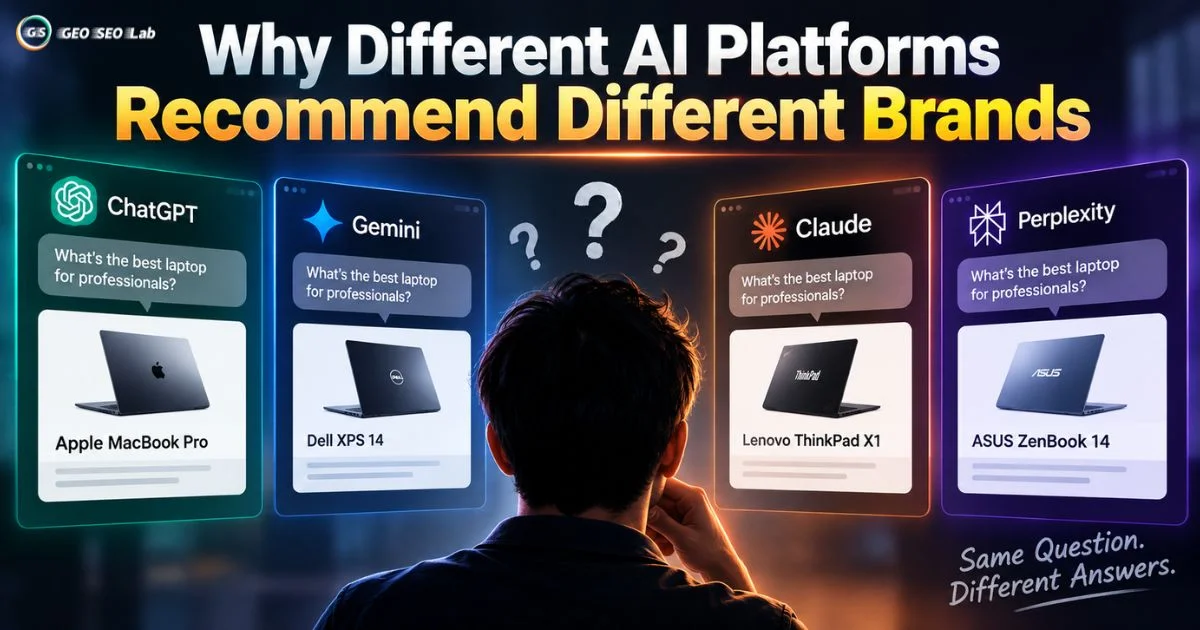
Why Different AI Platforms Recommend Different Brands
Why Different AI Platforms Recommend Different BrandsSame Question, Four Answers, Almost Zero OverlapA GEO SEO Lab ReportEditorial Disclosure: This re...
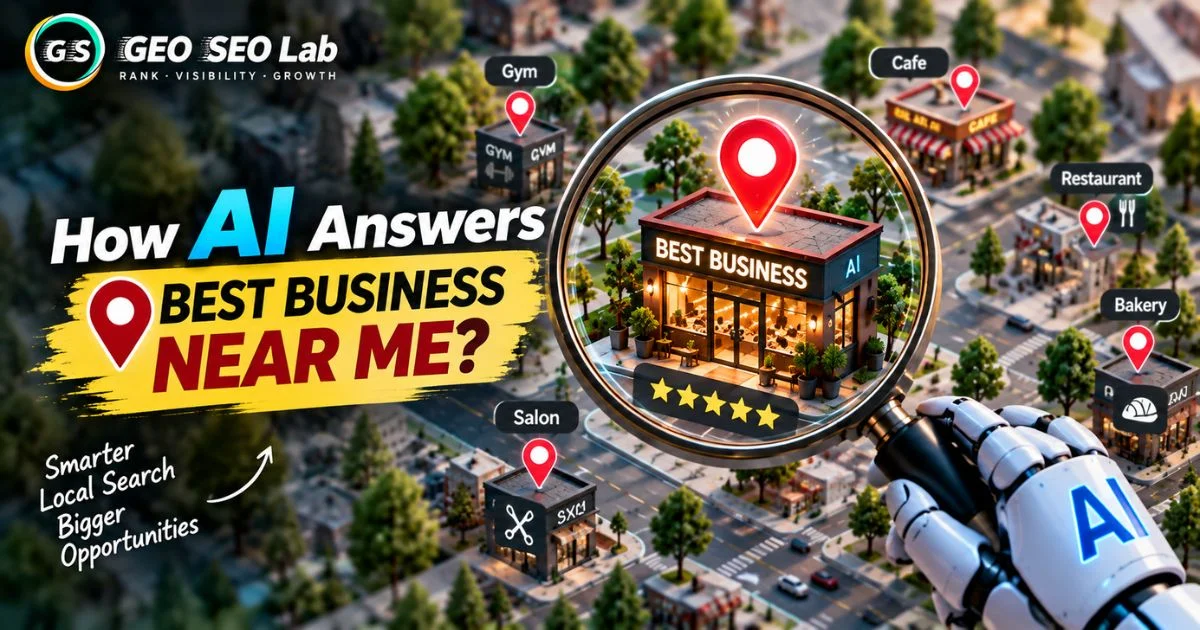
How AI Answers “Best Business Near Me” in 2026 | Local AI Search
How AI Answers "Best Business Near Me"Inside the Shortlist That Decides Who Gets the CallA GEO SEO Lab ReportEditorial Disclosure: This report introdu...
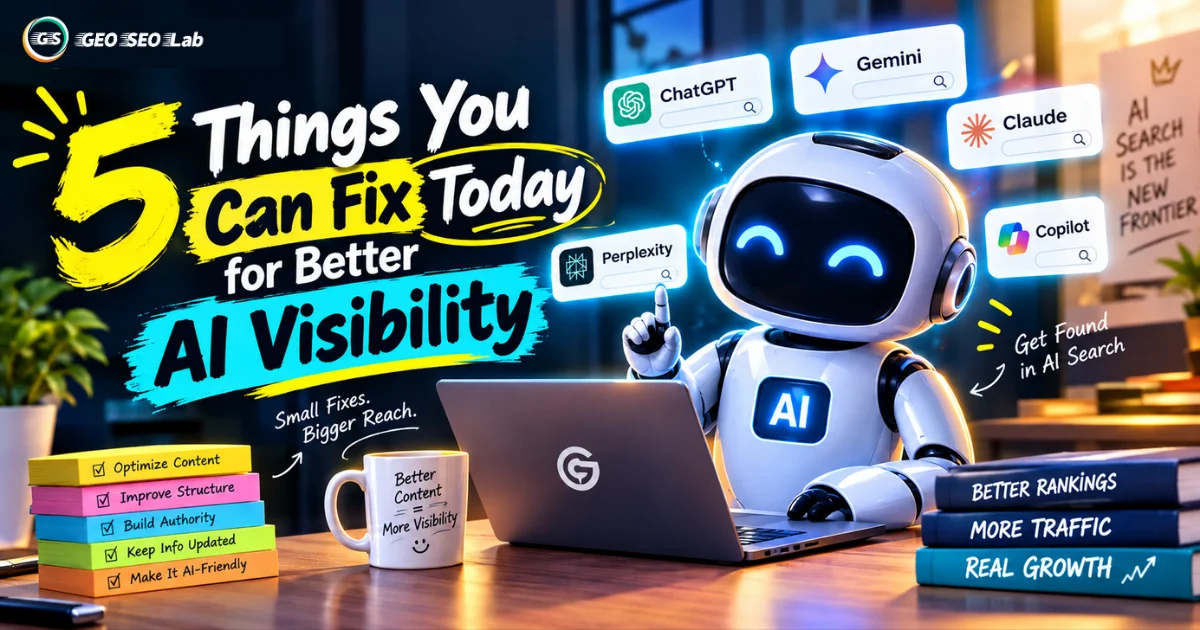
How to Improve AI Visibility in 2026 : 5 Fixes You Can Make Today
5 Things You Can Fix Today for Better AI Visibility No Redesign, No New Budget, Just Real Fixes You Can Ship This Afternoon Introduction Most GEO advice ...