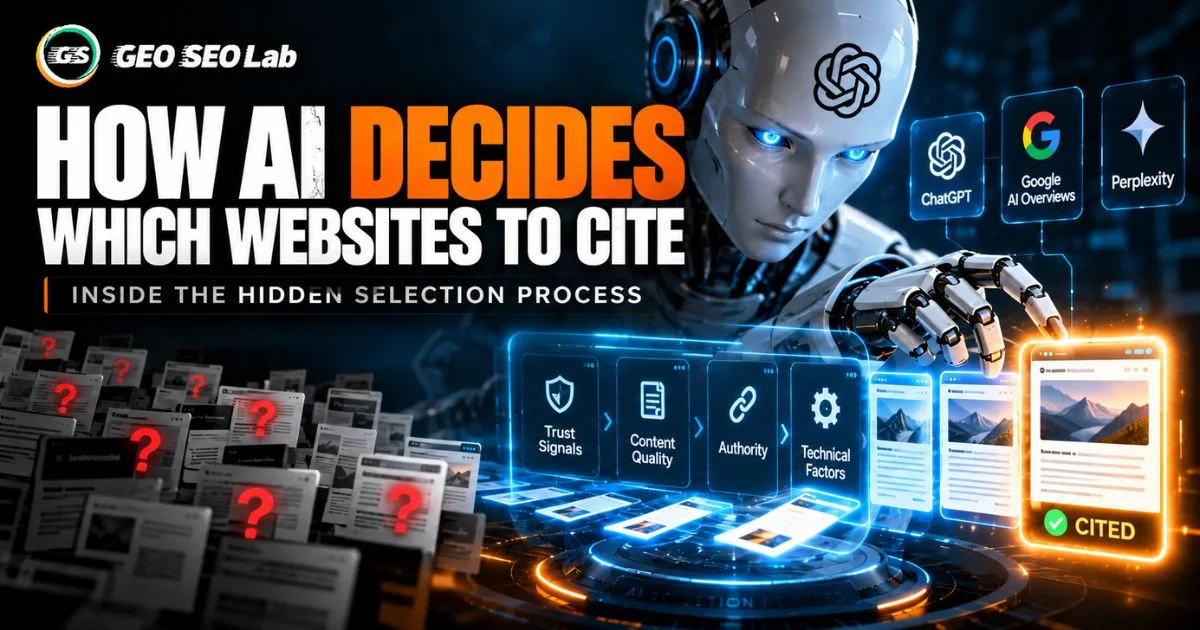
How AI Decides Which Websites to Cite: Inside the Hidden Selection Process
Introduction: The New Gatekeepers of VisibilityPicture this. Someone types a question into ChatGPT, Perplexity, or Google's AI Overview box. Within se...
Introduction: The New Gatekeepers of Visibility
Picture this. Someone types a question into ChatGPT, Perplexity, or Google's AI Overview box. Within seconds, an answer appears, often with two or three or five small citations tucked beneath it, little blue links pointing to the websites the AI decided were worth trusting.
Out of the millions of pages that could theoretically answer that question, only a handful got picked. Why those sites? Why not yours? Why not the page you spent three weeks researching, fact-checking, and polishing until it practically glowed?
This is one of the most pressing questions in digital publishing right now, and it does not have a simple answer. There is no single ranking factor you can tweak and watch your citation rate climb. There is no magic meta tag. What exists instead is a layered, somewhat opaque, constantly shifting set of signals that AI systems use to decide, in the space of a few hundred milliseconds, which sources deserve a spot in the answer and which ones get quietly left out.
Here is the uncomfortable truth that a lot of SEO content glosses over: nobody outside the companies building these systems knows the exact formula. OpenAI, Google, Anthropic, and Perplexity have not published a precise algorithm for citation selection, and they almost certainly never will, for the same reasons Google never published its full search ranking algorithm. But that does not mean the process is a total black box. Through careful observation, pattern analysis, published research papers, developer documentation, and a genuinely large number of real-world tests, clear patterns have emerged. We can see what tends to get cited repeatedly and what tends to get ignored, and from that, we can build a reliable working model.
This article walks through exactly that model. We will cover how AI systems actually retrieve and evaluate content, the specific trust and credibility signals that influence citation decisions, the structural and technical factors that matter more than most people realize, and the practical steps you can take to meaningfully improve your odds of being the website an AI system decides to trust.
If you publish content and care whether AI systems ever mention your name, this is worth reading slowly.
The Two-Stage Process Most People Don't Understand
Before diving into specific ranking signals, it helps to understand that AI citation is not a single event. It is a two-stage process, and most confusion about why certain sites get cited comes from people conflating these two stages.
The first stage is retrieval. When an AI system like Perplexity, ChatGPT with browsing enabled, or Google's AI Overview receives a query, it does not search its entire training data for an answer. It runs a live or near-live search operation, similar in some ways to a traditional search engine query, to pull a set of candidate documents that seem relevant to the question. This retrieval stage uses many of the same signals traditional search engines have used for years: keyword relevance, semantic matching, domain authority, content freshness, and crawlability.
If your content does not even make it into this initial candidate pool, it has no chance of being cited, no matter how well written or authoritative it is. This is why traditional SEO fundamentals still matter enormously in the AI era. You cannot skip search visibility and jump straight to AI citation. The retrieval stage is essentially a search engine results process happening behind the scenes, invisible to the end user.
The second stage is selection and synthesis. Once the AI system has a pool of candidate documents, often somewhere between five and twenty pages depending on the platform and query complexity, it evaluates each one for specific qualities: does this source directly and clearly answer the question, is the information accurate and consistent with other retrieved sources, does the source appear credible and trustworthy, and can the relevant information be extracted cleanly enough to summarize without losing accuracy.
This second stage is where the content-level factors we will discuss throughout this article really come into play. Being retrieved gets you into the room. Being selected and cited is about what happens once you are there.
Understanding this two-stage structure immediately clarifies why some technically excellent, well-optimized content never gets cited: it is failing at the retrieval stage, often due to weak domain authority, poor crawlability, or insufficient topical relevance signals. And it clarifies why some surprisingly modest websites do get cited regularly: they are nailing the selection stage by providing exactly the kind of clear, extractable, trustworthy answer the AI is looking for, even if their overall domain authority is modest.
What Actually Happens Inside an AI Citation Decision
Let's get more specific about what AI systems are actually evaluating when they decide whether to cite a source. This is where the GEO Citation Selection Model becomes useful as a way of organizing the many factors at play into something you can actually act on.
The model breaks citation decisions into four weighted categories: source credibility, content clarity, factual alignment, and extraction feasibility. Every AI platform weighs these categories somewhat differently, and the exact weighting is proprietary and almost certainly varies by query type. But across our observation of citation patterns on ChatGPT, Perplexity, Gemini, and Google's AI Overviews, these four categories consistently emerge as the dominant factors.
Source credibility is about whether the AI system has reason to trust the website as a reliable information source in general, independent of the specific page being evaluated. This includes domain-level signals like how long the site has existed, how frequently it publishes, whether it has established topical authority in a specific niche, and whether other credible sources link to and reference it. It also includes page-level signals like clear authorship, visible credentials, and transparent publication dates.
Content clarity is about whether the specific page being evaluated communicates its information in a way that is easy to parse, extract, and summarize accurately. This connects directly to the structural and semantic practices covered extensively in our companion article on making content easier for AI to understand. Clear headings, direct answers, unambiguous language, and logical organization all improve content clarity scoring.
Factual alignment is about whether the claims made in the content are consistent with other credible sources the AI system has access to, including its training data and other retrieved documents for the same query. Content that makes claims wildly inconsistent with the broader information ecosystem is flagged as potentially unreliable, even if it is well-written and well-structured. This is one reason why genuinely accurate, well-sourced content tends to outperform content that makes bold or contrarian claims without strong supporting evidence, at least in terms of citation frequency.
Extraction feasibility is about whether the AI system can pull a clean, accurate, appropriately-sized piece of information from the content without significant risk of misrepresentation. Pages where the key information is buried deep in unrelated content, split across multiple disconnected sections, or wrapped in so much qualification and hedging that no clear claim emerges, score poorly here even if the underlying information is accurate and the source is credible.
A website does not need to score perfectly across all four categories to get cited. But weakness in any one category significantly reduces citation likelihood, and the categories interact. A highly credible source with poor content clarity may still get cited occasionally because the AI system trusts the domain enough to extract information even from a messier page. A less established source with exceptional content clarity and extraction feasibility can punch above its weight by making the AI's job unusually easy.
Domain Authority Still Matters, But Not the Way You Think
There is a persistent myth in SEO circles that AI citation has made traditional domain authority irrelevant, that we have entered some new meritocracy where great content from brand-new websites competes on equal footing with established publishers. This is only partially true, and the partial truth is important to understand correctly.
Domain authority, in the traditional sense of accumulated backlinks and historical search ranking signals, remains a meaningful factor in the retrieval stage of AI citation. AI systems that perform live web searches, which includes most of the major AI platforms with browsing or search capability, are drawing on search indexes that still weight domain authority heavily. If your site has weak overall authority, it is less likely to surface in the initial candidate pool for competitive queries, which means it never even gets a chance at the selection stage.
However, the relationship between domain authority and citation is less linear and less dominant than it is in traditional organic search rankings. We have observed numerous cases where a relatively modest, niche-focused website gets cited by AI systems for specific, well-covered questions over much larger and more authoritative competing domains. This tends to happen when the smaller site has published content that scores exceptionally well on content clarity and extraction feasibility for that specific query, while the larger site's content on the same topic is more generic, less directly structured, or buried within broader, less focused pages.
The practical implication is important: domain authority gets you into the conversation, but it does not guarantee you win it. For established sites with strong authority, this means you cannot coast on reputation alone. Your actual content still needs to be structured and written in ways that make AI extraction easy and accurate. For newer or smaller sites, this means there is genuine opportunity to earn citations in specific topical niches by producing content that is more precise, more clearly structured, and more directly useful than what larger competitors have published on the same narrow question, even without matching their overall domain authority.
Topical authority, which is distinct from overall domain authority, plays an increasingly significant role. A website that has published extensively and consistently on a specific subject area builds a kind of specialized credibility that AI systems appear to weight favorably for queries within that specific domain. A site focused entirely on nutrition science, for example, may get cited for nutrition-related queries over a much larger general health website with broader but shallower coverage of the same specific topic. This rewards focus and genuine specialization over breadth, which is a meaningfully different dynamic from traditional domain-wide authority metrics.
The Freshness Factor: Why Publication Date Matters More Than You'd Expect
One of the clearest and most consistently observable patterns in AI citation behavior is a strong preference for recently published or recently updated content, particularly for queries involving statistics, current events, pricing, product features, or anything else that changes over time.
This makes intuitive sense when you think about how these systems are designed. An AI system answering a question wants to provide accurate, current information. If it has to choose between a comprehensive article published three years ago and a solid article published two months ago covering the same topic, it will generally lean toward the more recent source, especially for any query where the underlying facts could plausibly have changed.
This freshness preference creates a genuine opportunity and a genuine obligation for content publishers. The opportunity is that regularly updating existing content, rather than only producing new content, can meaningfully improve your citation odds on topics you have already covered well. Going back to a comprehensive piece you published eighteen months ago, updating the statistics, refreshing the examples, confirming the claims are still accurate, and updating the published or modified date, can restore that content's competitiveness in AI retrieval and citation without requiring you to start from scratch.
The obligation is that content with stale or outdated information, even if it was excellent when published, becomes a liability over time if left unmaintained. AI systems cross-referencing your claims against more current information elsewhere will deprioritize your source when it conflicts with more recent data, and in some cases, flag your content as less reliable overall.
It is worth noting that freshness matters more for some query types than others. Evergreen conceptual content, explanations of how something fundamentally works, historical analysis, or foundational educational material, is less sensitive to publication date because the underlying information does not change much over time. Time-sensitive content, anything involving statistics, current pricing, recent developments, or rapidly evolving fields like AI itself, is highly sensitive to freshness, and content more than a year or two old is at real risk of being deprioritized regardless of its original quality.
A practical takeaway here is to maintain a deliberate content refresh schedule, particularly for your highest-performing and most citation-worthy pieces, rather than treating publication as a one-time event followed by neglect.
Author Credibility and the E-E-A-T Connection
Google's E-E-A-T framework, which stands for Experience, Expertise, Authoritativeness, and Trustworthiness, has been part of search quality evaluation guidelines for years. What is less widely understood is how directly this framework appears to translate into AI citation behavior, even on platforms that are not Google products.
AI systems appear to place meaningful weight on clear signals of who created a piece of content and what qualifies them to speak on the subject. This is not simply about having an author byline, though that matters as a baseline. It is about whether the content and the broader site provide verifiable signals that the author or organization has genuine expertise and direct experience relevant to the topic.
For individual authors, this includes a visible author bio with specific, relevant credentials, links to other published work or professional profiles that corroborate the claimed expertise, and a body of published content on the same general subject area rather than a single isolated piece. For organizational content published without an individual byline, it includes clear information about the organization itself, its history, its stated mission and area of focus, and ideally some form of third-party recognition or citation from other credible sources.
The experience component of E-E-A-T deserves particular attention because it is often overlooked. AI systems, like Google's search quality raters, appear to weight content differently when it demonstrates direct, first-hand experience with a topic rather than purely theoretical or researched knowledge. A product review written by someone who has actually used the product extensively, including specific details that could only come from genuine use, is treated differently than a generic summary of features assembled from the manufacturer's marketing materials. This is genuinely difficult to fake convincingly, which is precisely why it functions as a meaningful trust signal.
Trustworthiness extends to transparency about potential conflicts of interest, clear disclosure of sponsored content or affiliate relationships, and accuracy in representing information rather than exaggerating claims for marketing purposes. Content that reads as objectively informative, even when published by a company with a commercial interest in the topic, tends to be treated as more trustworthy than content that reads as thinly veiled promotion.
Building these credibility signals is not a quick fix. It requires consistent publication over time, genuine investment in author expertise and transparency, and a track record that AI systems and the broader web ecosystem can observe and corroborate. But for publishers willing to make that investment, the citation benefits compound significantly over time.
Why Some AI Platforms Cite Differently Than Others
It is a mistake to assume that ChatGPT, Perplexity, Gemini, and Google's AI Overviews all select citations using identical logic. Each platform has distinct priorities, technical architectures, and business incentives that shape how it approaches source selection, and understanding these differences helps explain why your content might get cited frequently on one platform and rarely on another.
Perplexity AI has built its entire product identity around transparent, heavily cited search results, and it tends to cite a larger number of sources per answer than most competitors, often drawing from a genuinely diverse mix of established publishers, niche blogs, forums, and even social media discussions when relevant. Perplexity's retrieval appears to weight topical relevance and content freshness particularly heavily, and it has shown a willingness to cite smaller, more specialized sources when they provide the clearest and most directly relevant answer to a specific query.
Google's AI Overviews operate within the broader Google Search ecosystem and therefore inherit much of Google's existing search ranking infrastructure, including its historical weighting of domain authority, backlink profiles, and established E-E-A-T signals. AI Overviews tend to favor well-established, high-authority domains more consistently than Perplexity, though this is shifting as Google continues to iterate on the feature. Google has also shown a pattern of favoring content that closely matches its existing structured data and featured snippet eligibility criteria, which rewards publishers who have already invested in strong technical SEO practices.
ChatGPT, when using its browsing or search capability, draws on Bing's search infrastructure through its partnership with Microsoft, which creates somewhat different retrieval patterns than Google-based systems. ChatGPT's citation behavior in search-enabled contexts has shown a reasonably strong preference for content that directly and concisely answers the specific question asked, sometimes prioritizing clarity and directness over raw domain authority in ways that create opportunities for smaller, more focused publishers.
Claude, when accessing web content through its tool use capabilities, has historically been more conservative about citation and more likely to synthesize information from multiple sources into original analysis rather than directly quoting and attributing specific passages, reflecting Anthropic's broader emphasis on careful, considered responses over rapid information retrieval.
Grok's connection to X gives it access to real-time social content that other platforms simply do not have, and it shows a distinct pattern of citing social media discussions, breaking news coverage, and real-time commentary alongside more traditional web sources, particularly for queries about current events or trending topics.
This platform diversity means that a genuinely effective AI citation strategy cannot be built around optimizing for a single system. Content that performs well across multiple platforms tends to share the core qualities discussed throughout this article: strong credibility signals, clear and directly extractable answers, factual accuracy, and genuine topical depth, rather than tricks specific to any one platform's particular algorithm.
The Role of Structured Data in Citation Decisions
Schema markup and structured data deserve specific attention in any discussion of AI citation because they provide a direct, machine-readable channel for communicating exactly the kind of information AI systems are trying to extract through natural language processing alone.
When a page includes properly implemented FAQ schema, for example, it is explicitly labeling specific question-and-answer pairs in a format that AI systems can read directly without having to infer the question-answer relationship from unstructured prose. This appears to meaningfully increase the likelihood that those specific question-answer pairs get surfaced and cited when a user asks a closely matching question.
Article schema, which communicates authorship, publication date, and organizational information in structured form, reinforces the credibility signals discussed in the previous section by making them explicitly machine-readable rather than requiring the AI system to parse them from a visible author bio or footer text. This redundancy, saying the same credibility information in both natural language and structured data, appears to strengthen the overall trust signal rather than being purely duplicative.
HowTo schema, Review schema, and Product schema serve similar functions for their respective content types, providing explicit structural confirmation of what the content is and how its key information should be interpreted.
It is worth being honest about the limits of structured data's influence, though. Schema markup does not substitute for genuinely high-quality, well-structured content. It supports and reinforces signals that should already exist in the content itself. A page with excellent FAQ schema but genuinely poor, vague, or inaccurate answers within that schema will not get cited simply because the markup is technically correct. Structured data amplifies good content; it does not create good content where none exists.
That said, for publishers who have already invested in strong content, implementing relevant schema markup is one of the highest-return, lowest-effort technical investments available for improving AI citation performance, because it removes interpretive guesswork for AI systems and replaces it with explicit, structured confirmation.
Why Being Cited Once Doesn't Mean Being Cited Forever
A pattern that confuses many publishers is inconsistent citation behavior over time. A page gets cited reliably for a particular query for several weeks, then stops appearing in AI answers entirely, even though nothing about the page has changed. Understanding why this happens requires recognizing that AI citation is not a static, one-time ranking decision the way a traditional backlink might be.
Each time a user asks an AI system a question, the retrieval and selection process runs fresh. The candidate pool of relevant content may shift as new content is published elsewhere on the same topic, as competing pages get updated, or as the underlying search index that feeds the AI system's retrieval changes. A page that was the best available answer six months ago may face new competition today from content that has since been published or updated by other sites.
This means that maintaining citation performance is an ongoing process rather than a one-time achievement. Competitors updating their content, new authoritative sources entering the space, shifts in the AI platform's underlying search infrastructure, and even changes to the AI model itself can all affect whether your previously-cited content continues to be selected.
The practical response to this reality is to treat your highest-value content as a living asset that requires periodic review and refreshing rather than a finished project. Checking in on your most important pages every few months, verifying that the information remains accurate and current, confirming that the structure still reflects current best practices, and monitoring whether competing content has emerged that might be outperforming yours, is a necessary ongoing practice rather than optional maintenance.
What Doesn't Work: Common Misconceptions About AI Citation
Given how much uncertainty surrounds AI citation behavior, a number of misconceptions have taken hold that are worth directly addressing.
The idea that keyword density or exact-match keyword stuffing improves AI citation is false and increasingly counterproductive. AI systems process semantic meaning rather than matching exact keyword strings, and content that reads as artificially keyword-stuffed is more likely to be flagged as lower quality than content that discusses the topic naturally using varied, contextually appropriate language.
The idea that submitting your content to AI platforms directly, or using paid promotion to increase visibility, guarantees citation is also false, at least for the organic citation behavior discussed throughout this article. While some platforms have begun exploring sponsored or partnership-based content arrangements, the core organic citation selection process described here is based on the content and credibility signals discussed, not on payment or direct submission.
The belief that longer content automatically outperforms shorter content in citation frequency does not hold up to scrutiny. What matters is whether the content thoroughly and clearly answers the relevant question, which sometimes requires significant length for complex topics and sometimes does not. Padding content to hit an arbitrary word count without adding genuine value tends to dilute extraction feasibility rather than improving it.
The assumption that AI citation is purely a numbers game, where publishing more content increases your odds proportionally, misses the more important point that quality and precision matter more than volume. A smaller number of genuinely excellent, well-structured, deeply researched pieces on topics you have real expertise in will generally outperform a much larger volume of generic, surface-level content, both for citation purposes and for building the genuine topical authority that supports long-term citation performance.
Key Takeaways
AI citation selection happens in two distinct stages: retrieval, which determines whether your content even enters the candidate pool, and selection, which determines whether it actually gets cited from within that pool. Both stages matter, and strong performance in one does not compensate for weakness in the other.
The GEO Citation Selection Model identifies four core factors influencing citation decisions: source credibility, content clarity, factual alignment, and extraction feasibility. Strong performance across all four categories significantly improves citation likelihood.
Domain authority still matters for retrieval, but topical authority and content-level clarity can allow smaller, more focused publishers to outperform larger competitors for specific queries within their area of genuine specialization.
Content freshness is a significant and sometimes underappreciated factor, particularly for time-sensitive topics. Regularly updating existing high-value content is often more effective than only producing new content.
Author credibility and E-E-A-T signals translate directly into AI citation behavior, with genuine expertise, first-hand experience, and transparency functioning as meaningful trust signals that are difficult to fake convincingly.
Different AI platforms weight citation factors differently based on their underlying technical architecture and product priorities, which means the most resilient citation strategy focuses on core quality fundamentals rather than platform-specific tricks.
Structured data and schema markup support and reinforce strong content signals but do not substitute for genuine content quality, credibility, and clarity.
Citation performance is not permanent. It requires ongoing content maintenance and monitoring because the competitive landscape and underlying AI systems both continue to evolve.
About GEO SEO Lab
GEO SEO Lab is an independent research and content publication focused on the evolving relationship between content strategy, search technology, and artificial intelligence. We study how AI systems retrieve, evaluate, and cite web content, and we translate that research into practical guidance for publishers, SEO professionals, and content strategists navigating a rapidly changing digital landscape.
The GEO Citation Selection Model and related frameworks referenced in this article represent original analytical work developed through sustained observation of AI platform behavior, review of published technical research, and extensive practical testing across multiple content categories and industries. We are transparent about the inherent uncertainty in reverse-engineering proprietary AI systems, and we update our frameworks as new evidence and platform changes emerge.
Our mission is to help content creators understand not just what to do, but why it works, grounded in genuine analysis rather than speculation dressed up as certainty.
References and Sources
Google Search Central. (2024). AI Overviews: How Google Generates and Sources AI-Powered Answers. Google Search Central Documentation.
Perplexity AI. (2024). How Perplexity Sources, Ranks, and Cites Information. Perplexity AI Official Documentation.
OpenAI. (2024). ChatGPT Search: Technical Overview and Source Attribution. OpenAI Documentation.
Google. (2024). Search Quality Rater Guidelines: E-E-A-T Framework. Google Search Quality Evaluation Documentation.
Microsoft. (2024). Bing Search API and Content Retrieval for AI Integration. Microsoft Developer Documentation.
Lewis, P., Perez, E., Piktus, A., et al. (2020). Retrieval-Augmented Generation for Knowledge-Intensive NLP Tasks. Neural Information Processing Systems Conference Proceedings.
Stanford HAI. (2024). AI Index Report 2024: Information Retrieval and Search Technology Trends. Stanford Human-Centered AI Institute.
Schema.org. (2024). Structured Data Vocabulary for Web Content. Schema.org Official Documentation.
Ahrefs. (2024). How AI Search Tools Select and Cite Sources: Industry Research. Ahrefs Research Blog.
Search Engine Land. (2024). Generative Engine Optimization: Early Patterns in AI Citation Behavior. Search Engine Land.
Moz. (2024). Domain Authority and Topical Authority in the Age of AI Search. Moz Research Blog.
Bommasani, R., Hudson, D.A., Aditi, E., et al. (2021). On the Opportunities and Risks of Foundation Models. Stanford Center for Research on Foundation Models.
Anthropic. (2024). Claude's Tool Use and Web Content Integration: Technical Documentation. Anthropic Documentation.
xAI. (2024). Grok's Real-Time Data Integration with X: Technical Overview. xAI Documentation.
MIT Technology Review. (2024). The Hidden Rules Governing What AI Chooses to Cite. MIT Technology Review.
All frameworks and analytical models described as original to GEO SEO Lab reflect independent research and observation rather than disclosed proprietary information from AI companies. Platform behaviors described in this article are based on observed patterns as of early 2025 and are subject to change as AI systems continue to evolve. GEO SEO Lab has no commercial relationship with any AI platform referenced in this article.
Tags
Frequently Asked Questions
Find answers to common questions about this topic
About the Author

Anubhav
SEO Expert & Content Creator
Experienced digital marketing professional specializing in SEO strategies, content optimization, and data-driven marketing solutions. Passionate about helping businesses grow their online presence and achieve better search rankings.
Related Articles
View all posts
How to Turn FAQ Content Into GEO Content
How to Turn FAQ Content Into GEO ContentThink about the last time you searched for a complex product or a nuanced troubleshooting step. Did you type a...
Why Does AI-Generated Content Need Humanization for SEO?
Why Does AI-Generated Content Need Humanization for SEO?The Real Reason Raw AI Drafts Underperform, and What Actually Fixes ItA GEO SEO Lab ReportEdit...

How to Make Content Easier for AI to Understand: The Complete Guide for 2026
Publication: GEO SEO LabCategory: Content Strategy / AI Optimization / SEOReading Time: Approximately 19 minutesLast Updated: 2026Editorial Disclosure...