Google's AI Search Has Grown Up — And Most Businesses Are Still Playing by Yesterday's Rules
Google Search has evolved into an AI-powered discovery platform where customers increasingly receive answers before visiting websites. This shift means businesses must move beyond traditional SEO and focus on building trust, expertise, and consistent visibility across the entire digital ecosystem. The organizations that invest in high-quality content, technical excellence, and AI-ready digital presence will lead the future of search.
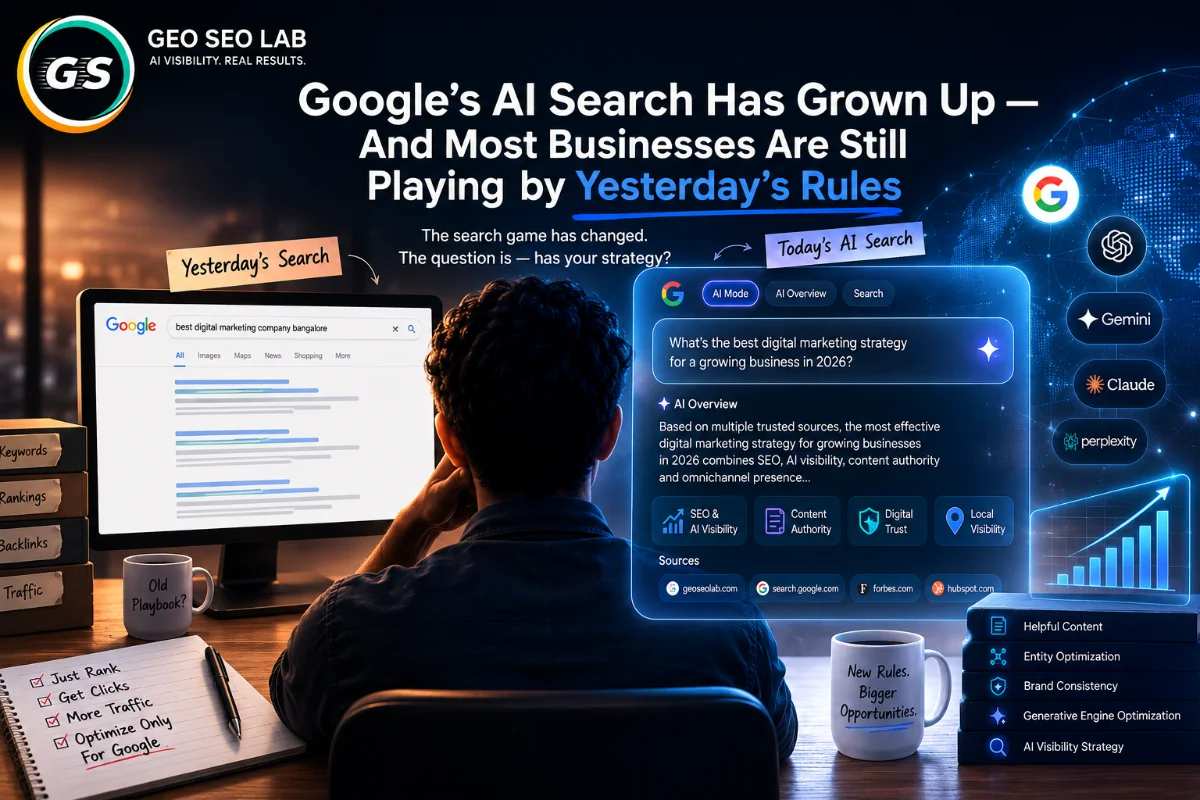
Google's AI Search Has Grown Up — And Most Businesses Are Still Playing by Yesterday's Rules
Before We Begin: A Word on How This Article Is Written
Every claim in this piece falls into one of two clear categories. Either it comes directly from documented, publicly available guidance — from Google, Microsoft, or other platform providers — or it is explicitly marked as original analysis from the GEO SEO Lab research team.We made that choice deliberately. The AI search conversation has become so polluted with speculation dressed up as fact that readers deserve to know exactly what they are dealing with. When we share our perspective, we will tell you so. When we reference established guidance, we will tell you that too.With that said, let's talk about what is actually happening to search — and why so many smart businesses are quietly falling behind.
The Uncomfortable Truth About Where Most SEO Investment Is Going
Walk into almost any digital marketing review meeting today, and you will hear the same conversation. Teams are debating keyword rankings. Leadership is asking why organic traffic dipped last month. Agencies are presenting slides full of position tracking data.Meanwhile, a growing percentage of the customers those businesses want to reach are having an entirely different experience.They are typing long, conversational questions into Google and receiving organized, synthesized answers before they visit a single website. They are asking follow-up questions without starting a new search. They are forming opinions about which companies seem most credible before they have ever seen a homepage.
The gap between how businesses measure search success and how customers actually experience search has never been wider. And it keeps growing.This is not a crisis that requires panic. But it does require an honest rethinking of some assumptions that the industry has treated as permanent truth for the better part of twenty years.
Every Search Revolution Felt Gradual Until It Suddenly Wasn't
Why We Keep Getting Caught Flat-Footed
There is a peculiar kind of denial that settles in during periods of technological transition. It is not ignorance exactly — most marketing professionals are aware that things are changing. The denial is more subtle than that. It is the belief that change is happening slowly enough that there will be time to adapt later.Search history repeatedly proves that instinct wrong.
Consider what happened in the mid-1990s. The dominant model for finding information online was the directory. Yahoo had built an enormous business around the idea that human editors would organize the internet into neat categories, and users would navigate through those categories to find what they needed. Businesses competed for inclusion. Visibility meant being listed in the right place.Then Google arrived with an entirely different philosophy. Rather than relying on human curation, it used algorithmic signals — most famously, the relationships between websites — to determine which pages were genuinely authoritative versus which ones simply claimed to be. The shift felt gradual to many businesses because Google's early market share was modest. Then it wasn't modest anymore. And suddenly, an entirely new discipline called search engine optimization had become essential infrastructure for commercial survival online.The businesses that had spent years refining their directory listing strategies did not see the transition coming. Or more accurately, they saw it coming and assumed they had more time than they did.The same pattern played out when smartphones transformed search. Typing queries into a desktop computer at home was a very different activity from searching while standing in a store aisle trying to decide between two products. Location became meaningful in ways it had never been before. Page loading speed went from a technical nicety to a competitive necessity. Businesses that had built their digital presence entirely around the desktop experience suddenly found themselves disadvantaged in a world where the majority of searches were happening on screens that fit in a pocket.Voice search introduced yet another layer of complexity. The difference between typing "best coffee Bangalore" and asking "Where can I find a good coffee shop near me that has outdoor seating and is open on Sunday mornings?" is not just about convenience. It is about how people naturally express their actual needs when they are not forced to compress their questions into a search box. Search engines had to evolve from matching text strings to understanding conversational intent.Now, artificial intelligence is changing the game again. And the pattern is identical to every previous transition. It feels gradual. Many businesses assume they have time to adapt. The evidence suggests the window is narrowing faster than most people realize.
What Makes This Transition Different From Previous Ones
Previous search transitions changed where people searched, how they typed their queries, or which devices they used. Artificial intelligence is changing something more fundamental: what people expect search to do for them.
There is a meaningful difference between wanting to find information and wanting to understand a topic. Traditional search was built entirely around the first objective. You typed a query, the engine retrieved pages that seemed relevant, and the cognitive work of evaluating and synthesizing those pages was entirely your responsibility.AI-powered search is attempting to address the second objective. When someone asks a complex research question, the system is not just pointing them toward pages that might help. It is organizing, synthesizing, and presenting an initial understanding — and then inviting the person to go deeper in whichever direction seems most relevant.
That is a fundamentally different kind of assistance. And it changes the role that websites play in the customer journey in ways we will explore in detail throughout this piece.
What Google Is Actually Saying (And Why Businesses Keep Ignoring It)
Before going further, it is worth addressing a misconception that has become surprisingly widespread.
A significant portion of the marketing content being published about AI search implies — sometimes explicitly, sometimes through insinuation — that Google's AI features represent a completely separate optimization discipline. The message is that everything businesses learned about SEO is now obsolete, and a whole new set of techniques is required to survive.
Google's own documentation says something quite different.According to Google's publicly available guidance, the fundamentals that have always defined good SEO remain the foundation for eligibility in AI-powered search experiences, including AI Overviews and AI Mode. Websites do not need special AI-specific tags, schema types, or technical configurations to appear in these features. The qualities that have always mattered — helpful content, strong technical foundations, genuine expertise, reliable information — continue to be the baseline.This does not mean nothing has changed. The way search results are presented is evolving rapidly. User behavior is shifting. The customer journey looks different than it did three years ago. But the core inputs that determine whether a business is worthy of being surfacedhave not been replaced by some new secret formula.Understanding this distinction matters because it changes how businesses should allocate their attention and resources. The companies spending significant money chasing unverified "AI ranking hacks" are almost certainly being better served by investing that same energy into producing genuinely excellent content and fixing their technical SEO foundations.
The Customer Journey Has Been Quietly Restructured
How Discovery Actually Worked for Two Decades
To appreciate how significantly the customer journey has shifted, it helps to be specific about how it used to work.
For the majority of Google's commercial history, digital discovery followed a reliable sequence. A person recognized that they had a need or a question. They opened a search engine and typed a keyword or phrase that roughly captured that need. The engine returned a list of results. The person scanned the titles and descriptions, opened several that looked promising in separate tabs, read through them, compared the information, and gradually assembled their own understanding.The entire industry of digital marketing was structured around this process. SEO was about increasing the probability that your page would appear in that initial list and that its title and description would be compelling enough to earn a click. Content marketing was about creating pages valuable enough to justify the click once it happened. Conversion rate optimization was about ensuring that visitors who arrived took some desired action.
Every metric on every marketing dashboard reflected these assumptions. Rankings tracked how prominently pages appeared in results lists. Traffic counted how many times people clicked through to the website. Time on page suggested whether visitors were engaging with the content. Bounce rate offered a rough signal of whether they found what they were looking for.The entire measurement framework assumed that the website was the primary place where understanding was formed and decisions began to take shape.
How Discovery Increasingly Works Now
The same customer with the same need today often has a very different experience.
They ask a complete question — not a compressed keyword, but the kind of question they might ask a knowledgeable colleague. The search engine attempts to understand the full context of that question and provides an initial, synthesized response. For complex topics, this response might draw from multiple sources, explain different perspectives, compare options, and flag areas of genuine disagreement or uncertainty.The customer reads this overview. They may ask follow-up questions. They may refine their thinking based on what the AI surfaces. At some point, they decide whether they need to explore specific websites for additional detail, or whether they have gathered enough to proceed.
The website has not disappeared from this journey. But its position in the sequence has changed. It has moved from being the primary place where understanding develops to being the place where customers go to verify, deepen, or act on understanding they have already begun to form.This is a significant structural shift. The first impression — the one that shapes how customers think about a topic, which options seem worth considering, which brands feel credible — increasingly happens before any individual website is visited.Organizations that are not thinking about this earlier stage of the journey are ceding enormous influence over how potential customers perceive them before those customers ever arrive at their door.
The Compression of Research Time and Its Consequences
One of the most practically significant changes introduced by AI-assisted search is compression. What previously required thirty minutes of opening tabs, reading articles, and manually synthesizing information can now happen in a much shorter timeframe.This might sound like straightforwardly good news for customers. And in many ways it is. But it has an important consequence for businesses.When customers were doing their research manually, they encountered many pieces of content in sequence. Each piece had the opportunity to make an impression. Businesses that produced multiple pieces of helpful content on related topics could appear repeatedly during that research journey, building familiarity over time.
When AI synthesizes information, only the sources that contributed to the synthesis maintain significant influence over that initial understanding. Everything else effectively disappears from that stage of the journey.
This increases the stakes for content quality dramatically. Being one of thirty results that appear for a relevant keyword is very different from being among the handful of sources that shape how AI systems understand and present a topic.
The Four Stages of Modern Digital Discovery
Note: The framework described in this section — The Four Stages of Modern Digital Discovery — is original strategic thinking developed by GEO SEO Lab. It is not based on official documentation from Google or any other platform provider. We are sharing it because we believe it helps organizations think more clearly about where customer journeys are evolving.
Why a New Framework Is Necessary
Most marketing frameworks were designed for a world where digital discovery was a relatively linear process. Awareness, consideration, and decision mapped neatly onto top-of-funnel content, middle-of-funnel content, and bottom-of-funnel content. The website was the central hub through which all meaningful interactions passed.That model is not wrong exactly. It is increasingly incomplete.Customers today move through an ecosystem of touchpoints that includes search engines, AI assistants, social platforms, video channels, review sites, professional communities, newsletters, podcasts, and direct word-of-mouth. The sequence in which they encounter these touchpoints varies. The website might be visited early, late, multiple times, or not at all before a purchase decision is made.The Four Stages of Modern Digital Discovery attempts to capture this more complex reality. The four stages are:
Awareness → Discovery → Validation → Decision
Let's spend time on each one.
Stage One: Awareness — The Stage That Marketing Consistently Underinvests In
Every purchase decision begins somewhere. For the overwhelming majority of purchases, that beginning is not a search query. It is a much more diffuse experience: a conversation overheard at a conference, a LinkedIn post that keeps appearing in a feed, a podcast interview from an expert who mentions a concept three times in twenty minutes, a colleague casually recommending something during a team meeting.
At this point, no decision is forming. But something important is happening. Certain names and concepts are becoming familiar. Certain problems are being identified as real and worth solving. Certain sources are beginning to feel like credible voices on relevant topics.Psychology has a term for what happens during this phase: the mere exposure effect. Research consistently shows that humans develop more positive associations with things they encounter repeatedly, even when those encounters are brief and unmemorable. Familiarity creates a kind of cognitive warmth. When a brand name shows up later in a more deliberate search context, it does not feel like an unknown. It feels recognizable. That recognition carries implicit credibility.Traditional marketing attribution almost completely ignores this stage because it cannot easily connect a podcast mention or a shared research paper to a closed deal six months later. But ignoring it does not make it less real. It just means businesses are making investment decisions based on incomplete information.Organizations that show up consistently and helpfully during the awareness stage — through published research, executive visibility, community participation, educational content, and media presence — build a form of competitive advantage that compounds slowly but proves enormously durable. By the time a competitor decides to try to build the same kind of presence, they are months or years behind.
Discovery — Where Intent Meets the Ecosystem
Discovery begins the moment curiosity becomes purposeful. The customer now has an active problem they are trying to solve, and they are taking deliberate steps to understand it.
Historically, this meant a Google search. It still often means a Google search. But "Google search" is no longer a complete description of how discovery happens.The same customer might begin with a Google query, then take that initial understanding into a conversation with an AI assistant to ask follow-up questions, then watch a few YouTube videos to see how different approaches work in practice, then check a subreddit or professional forum to see what people with direct experience have to say, then return to Google for a more specific search, then ask a colleague.Each of these steps is discovery. Each of them involves the customer forming opinions about which sources are credible, which companies seem to understand the problem, and which options are worth deeper investigation.Businesses that think about discovery only in terms of keyword rankings are missing most of this ecosystem. The question that matters is not just "do we rank on page one for our target keywords?" It is "when someone is actively trying to understand the problem we solve, are we present and helpful across the many places they look?"That is a much more demanding standard. It requires thinking about content in terms of genuine usefulness rather than just search engine optimization. It requires presence and consistency across platforms where target customers actually spend time. It requires the kind of expertise that holds up across different formats and contexts, not just carefully optimized blog posts.
Validation — The Stage Where Most Businesses Quietly Lose
If we had to identify the single stage where the largest number of business opportunities quietly evaporate, it would be validation. And it is the stage that receives the least strategic attention from most organizations.Here is how it typically unfolds. A customer has gone through awareness and discovery. They have encountered a company that seems like it might be a good fit. Maybe they read something the company published. Maybe it appeared in an AI-generated summary of options. Maybe a colleague mentioned it. Whatever the source, there is initial interest.Now the customer starts doing what any thoughtful person does before making a significant commitment: they investigate.They visit the website to get a fuller picture of the company's positioning and approach. They search for reviews — not just star ratings, but the kind of detailed accounts that reveal what it is actually like to work with this organization. They look at the company's presence on LinkedIn, checking whether the team seems real and whether the leadership shares genuine expertise. They search for independent mentions — articles, interviews, conference appearances, industry recognition.
They are assembling a composite picture. They are looking for coherence.
This is where fragmentation destroys businesses. Consider a company that has invested heavily in SEO and has an attractive, well-designed website. But their LinkedIn profile last posted eight months ago. Their Glassdoor reviews suggest internal culture problems. The documentation on their website has not been updated in two years. The CEO has no visible professional presence. There are no case studies. The only reviews they have are from a two-year-old product launch campaign.None of these individual signals would necessarily disqualify the company on its own. But together, they create a picture of inconsistency. They raise questions. And in a world where the customer has multiple alternatives to consider, raising questions is enough to push them toward a competitor whose digital presence tells a more coherent story.
The painful part is that many businesses experiencing this problem diagnose it as a traffic problem. They double down on content production and advertising spend to drive more visitors. But they are sending more potential customers into the same leaky validation experience. The fill rate stays low regardless of how much more traffic they pour in.
Fixing the validation stage requires honestly assessing the full picture a customer would assemble through independent investigation, then systematically addressing every element that introduces doubt or inconsistency.
Decision — Why It Almost Never Happens as Suddenly as It Seems
There is a common illusion in sales and marketing: the moment of decision. It shows up in CRM pipelines as a deal moving from "consideration" to "decision." It appears in attribution models as the final touchpoint before conversion. It is treated as the pivotal moment.But real human decision-making almost never works that way.
What appears in the data as a sudden decision is almost always the final, small movement across a threshold that has been approaching for a long time. The customer has been building confidence gradually — through every useful piece of content they read, every credible review they encountered, every interaction with the company's digital presence that reinforced trust rather than introducing doubt.By the time they fill out a contact form or click the purchase button, the decision is in many ways already made. The form is not where the decision happened. It is where the decision was confirmed.This has an important practical implication. Most conversion optimization work focuses on the final moments of the journey — the landing page, the call-to-action button, the checkout flow. These elements matter and are worth optimizing. But they represent only a small fraction of the actual work of moving a customer toward a decision.
The larger work happens throughout the entire Four Stages. Every interaction either builds confidence or erodes it. Every touchpoint either reinforces the brand's coherence or introduces a small crack of uncertainty. The organization that understands this and manages the entire journey rather than just the final steps will consistently outperform competitors who are optimizing only for the last click.
What Actually Needs to Change in Your Strategy
Starting With What Google Has Actually Confirmed
Before talking about what businesses should consider doing differently, it is worth being precise about what we know from authoritative sources.Google's documentation is consistent on several points. The qualities that earn visibility in traditional search results — helpfulness, accuracy, expertise, technical accessibility — are the same qualities that determine eligibility for AI-powered search features. There is no secret AI optimization framework separate from good SEO practice. Businesses are encouraged to continue focusing on content written genuinely for human readers, clear site structure, strong technical foundations, and consistent demonstration of expertise and reliability.Google also explains that AI Overviews are designed to help users quickly develop understanding of complex topics, with links to sources for deeper exploration. AI Mode supports more conversational interactions that build on web-based information.These are not radical departures from how search has always worked. They are evolutions of the same fundamental principle: search engines try to connect people with the most helpful, credible information available. The interface is changing. The underlying evaluation is not.
Expanding the Definition of What Needs Optimizing
With that foundation established, here is where the strategic evolution becomes necessary.
The traditional scope of SEO work is largely about pages. Which pages should we create? How should we structure the content on those pages? How should they link to each other? What technical signals do they send?
The expanded scope that AI-assisted discovery requires is about organizational knowledge. Not just which pages you have, but what your organization genuinely knows, how that knowledge is expressed across different formats and platforms, how coherently the same story is told everywhere someone might encounter your brand, and how clearly your expertise is demonstrated to anyone — human or machine — who encounters your digital presence.
This changes the scope of questions worth asking.Rather than asking only "what keywords should we target?" also ask what questions your customers genuinely struggle to answer and what unique perspective your organization has on those questions.Rather than asking only "how can we improve our rankings?" also ask what a customer who has never heard of you would think if they spent twenty minutes investigating your brand across every platform where you have a presence.
Rather than asking only "how can we get more traffic?" also ask whether the traffic you are already getting is encountering a digital presence that builds confidence at every touchpoint.
These are harder questions. They require more than a technical checklist. They require honest assessment of what your organization actually offers that is worth discovering.
The Content Quality Problem That Most Businesses Underestimate
Let's be direct about something that the industry tends to dance around.
A very large proportion of the content published on business websites today is derivative. It covers topics that hundreds of other websites have already covered, in formats that closely resemble what those other websites have done, saying things that do not differ meaningfully from what any informed person could find in the first five search results.
This content can perform adequately in traditional search because search rankings are determined partly by authority metrics that reward established domains, and partly by technical optimization signals. A large, established website publishing derivative content can still rank reasonably well.But AI systems are in the business of synthesis and summary. When an AI is attempting to construct a useful answer to a complex question, derivative content that repeats what many other sources already say contributes very little to that synthesis. There is no unique perspective to incorporate, no original data to cite, no firsthand insight to draw on.The content that matters most for AI-assisted discovery is content that actually says something — that presents original research findings, that offers a perspective grounded in genuine expertise and direct experience, that addresses questions other sources have not addressed, that provides specific and actionable guidance rather than generic platitudes.Creating this kind of content is significantly harder than producing derivative content at scale. It requires actual domain expertise. It requires primary research or at minimum deep synthesis of primary sources. It requires editorial standards that prioritize substance over optimization.But this is exactly where a real competitive advantage can be built. Derivative content is increasingly a commodity. Original, expert-driven content is increasingly rare and increasingly valuable.
Consistency as a Competitive Asset
One of the most consistently underinvested areas in digital strategy is brand consistency across the full range of platforms where potential customers encounter a business.Most organizations have put significant thought into their website. Many have made investments in their core social media presence. But what about the dozens of secondary touchpoints that customers investigate during the validation stage?Industry directories that may contain outdated information. Review platforms that have not been monitored or responded to. Executive profiles that were created years ago and never updated. News mentions that reference old company positioning. Forum discussions that may include complaints that were never addressed.Each of these represents a potential crack in the story a customer assembles during validation. Customers do not experience these as separate channels. They experience them as different windows into the same organization. Inconsistency between what any of these windows shows creates uncertainty.This is not glamorous work. It does not generate the kind of easily measurable results that make great marketing dashboards. But it is the kind of foundational investment that determines whether the traffic and content investments elsewhere in the strategy actually convert.
The Measurement Gap That Most Leaders Are Not Talking About
Here is a structural problem worth naming explicitly: most digital marketing measurement frameworks are optimized for measuring what is easy to measure rather than what is most important.Rankings are easy to measure. Traffic is easy to measure. Conversions are relatively easy to measure. These metrics have real value and should absolutely be tracked.
But the four-stage customer journey described in this piece includes many interactions and touchpoints that never show up in standard analytics. The podcast someone listened to before ever searching for you. The LinkedIn post that made your company feel credible before a potential customer visited your website. The review that either reinforced or undermined confidence during validation. The industry discussion where your published research was referenced.
None of these interactions appear neatly in a marketing attribution dashboard. But they collectively determine much of the outcome.The absence of these signals from measurement frameworks is not a reason to ignore the activities that drive them. It is a reason to develop better frameworks for understanding the full customer journey — through qualitative research, customer conversations, and more comprehensive journey mapping rather than relying exclusively on analytics data that captures only the portions of the journey that happen to touch tracked digital properties.
The Practical Work Ahead
An Honest Assessment of Where Most Organizations Stand
Based on GEO SEO Lab's analysis, we find that most organizations currently have meaningful gaps in at least one of the following areas:Technical foundations that have been neglected. Speed issues on mobile devices. Crawl errors that prevent important pages from being indexed. Internal linking structures that do not support the most important content. These are not exciting problems to solve, but they are genuinely limiting.Content depth that does not match stated expertise. Organizations that position themselves as experts in a domain but whose content library contains mostly short, surface-level pieces that do not demonstrate that expertise to any reader who pushes past the headline.Entity inconsistency across the digital ecosystem. Different descriptions of the company's services on different platforms. Outdated information in directories. Inconsistent positioning between the website and LinkedIn and press coverage.
Validation gaps that erode conversion. Review profiles that have not been actively managed. Case studies that are vague or dated. Thought leadership that has gone dormant. Executive visibility that does not reflect the team's actual expertise.
A content strategy oriented around keywords rather than genuine questions. Targeting search terms that drive traffic without asking whether the people who find that content are actually getting the understanding they need to move toward a decision.Most organizations do not have severe problems in all of these areas simultaneously. But almost all have meaningful room for improvement in at least two or three.
Where to Direct Energy First
If we had to prioritize for an organization with limited resources, we would suggest the following order of focus.
Start with technical foundations. An otherwise excellent content strategy delivers dramatically reduced results if search engines cannot efficiently crawl and index your most important pages. This is not optional infrastructure — it is the floor on top of which everything else is builtThen assess entity consistency. Before investing significantly in new content creation, take stock of how consistently your organization is described across the full range of platforms where potential customers might encounter you. Fix inconsistencies systematically. Claim and update profiles that have been neglected.
Then invest in content depth and originality. Identify the questions that your most valuable potential customers genuinely struggle to answer. Develop content that addresses those questions with specificity and genuine expertise. Accept that producing fewer, higher-quality pieces is more valuable than maintaining a high cadence of derivative content.
Then focus on validation experience. Map the journey a skeptical potential customer would take when investigating your company independently. Identify every point where they might encounter information that raises doubt or introduces inconsistency. Prioritize fixing those points.Finally, expand your thinking about awareness. Consider how your organization can build visible expertise across the channels where your target customers spend time and develop their thinking. This might mean executive publishing, speaking at industry events, contributing to relevant communities, or other forms of presence that extend beyond your owned digital properties.
A Note on Patience and Time Horizons
One of the reasons that speculative "AI SEO hacks" attract so much attention is that they promise quick results. Businesses are understandably attracted to tactics that might generate measurable outcomes within weeks.
The honest reality is that the work described in this article produces results on a different time horizon. Building genuine expertise and making it visible across a digital ecosystem is a slow process. Developing a reputation for original, authoritative content takes months or years, not days. Earning consistent positive reviews through genuinely excellent customer experiences is not a campaign that can be run and finished — it is an ongoing operational commitment.
This is not a reason to defer starting. The opposite is true. Because this work compounds over time, organizations that begin now will have built meaningful advantages by the time the competitive pressure becomes undeniable. Organizations that wait until the urgency is unmistakable will find themselves attempting to build in months what their competitors built over years.
Closing Thoughts: The Opportunity Hidden Inside the Disruption
Let's end where we began, with an honest observation.
Most businesses are still optimizing for the search landscape that existed several years ago. They are measuring the metrics that made sense when search was primarily about ranking in a list of results and earning the click. They are producing content at the cadence and quality level that was adequate when algorithmic signals were relatively easy to game.That approach is becoming less and less effective as search evolves into something more sophisticated.
But here is what the disruption-focused coverage tends to miss: the organizations that have always done this work properly — the ones that have invested in genuine expertise, that have produced content worth reading, that have built consistent and credible digital presences — are well-positioned for the changes ahead.The new rules are not as new as they seem. Help people understand complex topics. Be honest about what you know and what you do not know. Build trust through consistent, reliable information over time. Make your website easy for both humans and machines to navigate and understand.These principles have not changed. The environments in which they need to be expressed have expanded. The stakes for doing the work properly have increased. The consequences for not doing it are arriving faster.
The path forward is not mysterious or technically exotic. It is demanding, and it rewards organizations that treat their digital presence as a reflection of genuine organizational quality rather than a separate game to be optimized in isolation.
Search is growing up. The businesses that meet it at its current level of maturity — rather than chasing its past — will be the ones that customers, and the intelligent systems increasingly helping those customers, consider worth exploring.
That is the opportunity. And it has never been more directly tied to simply being excellent at what you actually do.
Tags
Frequently Asked Questions
Find answers to common questions about this topic
About the Author

Aman Kesharwani
SEO Expert & Content Creator
Experienced digital marketing professional specializing in SEO strategies, content optimization, and data-driven marketing solutions. Passionate about helping businesses grow their online presence and achieve better search rankings.
Related Articles
View all posts
Why Different AI Platforms Recommend Different Brands
Why Different AI Platforms Recommend Different BrandsSame Question, Four Answers, Almost Zero OverlapA GEO SEO Lab ReportEditorial Disclosure: This re...
How AI Answers “Best Business Near Me” in 2026 | Local AI Search
How AI Answers "Best Business Near Me"Inside the Shortlist That Decides Who Gets the CallA GEO SEO Lab ReportEditorial Disclosure: This report introdu...
How to Improve AI Visibility in 2026 : 5 Fixes You Can Make Today
5 Things You Can Fix Today for Better AI Visibility No Redesign, No New Budget, Just Real Fixes You Can Ship This Afternoon Introduction Most GEO advice ...