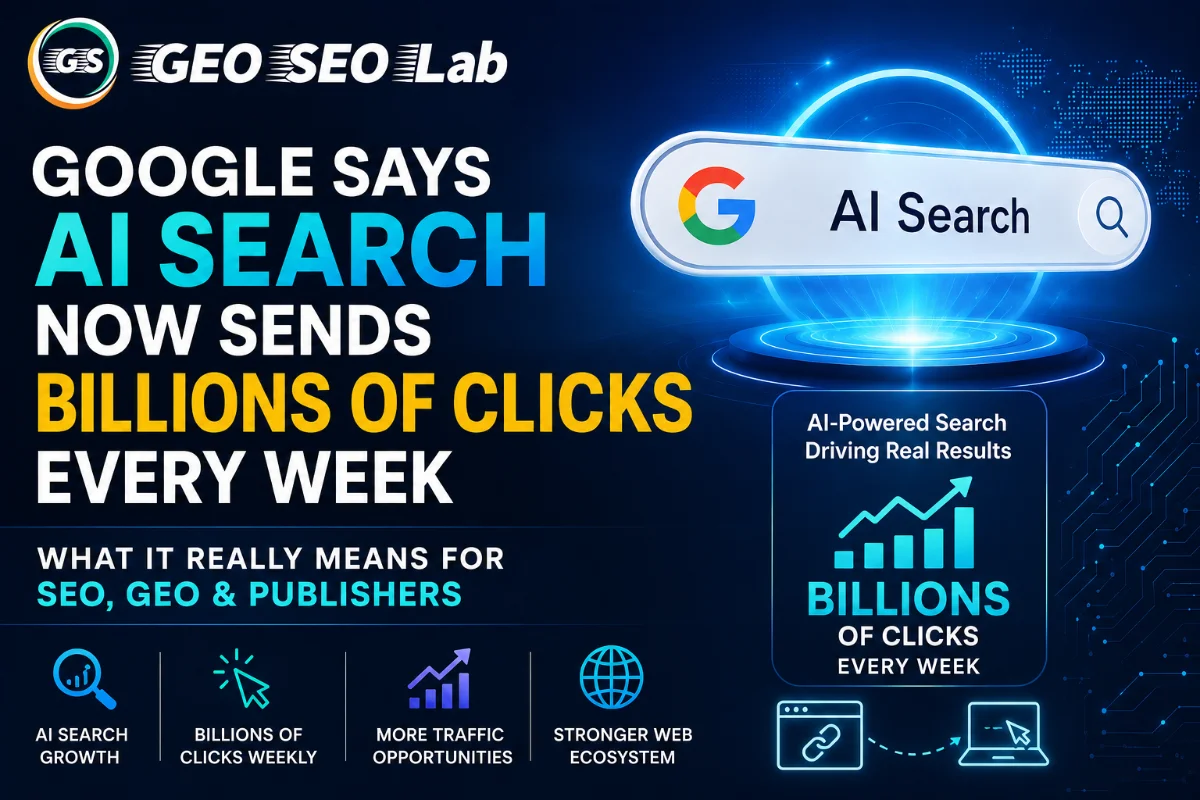
Google Says AI Search Now Sends Billions of Clicks Every Week: What It Really Means for SEO, GEO & Publishers (2026 Analysis)
Google has announced that AI-powered Search now sends billions of clicks to websites every week while AI Mode has surpassed 1 billion monthly active users. This in-depth analysis explains what Google's announcement really means for SEO, Generative Engine Optimization (GEO), publishers, marketers, and businesses. Learn how AI Search is changing traffic quality, user behavior, and the future of digital visibility.
Introduction: The Announcement That Changed the Conversation
For the better part of two years, a single anxiety has shadowed nearly every conversation about AIpowered search: the fear that AI would quietly drain traffic away from the open web, leaving publishers, businesses, and content creators stranded on the wrong side of a fundamental technological shift.That fear was not irrational. When Google introduced AI Overviews, the logic was straightforward enough to understand and uncomfortable enough to worry about. If an AI system could read thousands of webpages and synthesize their content into a single, coherent, immediately visible answer, why would any user bother clicking through to the underlying sources? The entire value proposition of traditional search the ranked list of links that directed users to websites where they would read, explore, compare, and decide seemed suddenly vulnerable.The subsequent months produced a complicated mixture of evidence. Some publishers reported stable or improved traffic. Others described meaningful declines in organic visits, particularly for informational content. SEO professionals debated whether the old rules still applied. Researchers published analyses that were frequently contradictory, sometimes reassuring, often alarming, and almost always contested.Into this unsettled environment, Google recently delivered its most direct response yet.During Alphabet's latest earnings discussion, CEO Sundar Pichai offered several announcements that immediately rippled through the SEO and digital marketing community. AI Mode, Google's most conversational search interface, has now surpassed one billion monthly active users. More strikingly, Google stated that AIpowered Search experiences are now generating billions of clicks to websites every single week. And Search engagement, user activity, and advertising revenue are all continuing to grow suggesting, at least from Google's perspective, that AI is expanding the Search ecosystem rather than cannibalizing it.These statements provoked immediate and predictably divergent responses. Some practitioners read them as vindication proof that concerns about AI eliminating web traffic were overstated, that the open web was not dying, that publishers could exhale. Others were more skeptical, questioning what exactly "billions of clicks" means in context, which websites are benefiting, which are not, and whether aggregate growth at the Search ecosystem level translates into anything meaningful for the average business trying to sustain its organic traffic.Both sets of responses contain legitimate points. And that is precisely why this announcement deserves examination that goes well beyond the headlines.This article works through four interconnected dimensions of Google's announcement. We start with what Google actually said and what context surrounds it. We then examine the harder question of whether AI Search is truly sending more traffic to more websites, or whether that claim obscures important distributional complexity. From there, we explore what these developments mean practically for SEO, GEO, publishers, ecommerce businesses, professional service firms, and local organizations. And we close by looking ahead at where AI Search appears to be going over the next several years and how businesses can position themselves intelligently for that future.
Google's Biggest AI Search Statement Yet
The Anxiety That Preceded the Announcement
To understand why Google's announcement landed with such force, it helps to revisit what the digital marketing community has been experiencing since AIpowered search features became more prominent.The introduction of AI Overviews fundamentally changed what a Google search results page looks like for many queries. Where users previously encountered a list of ranked links blue hypertext, descriptive snippets, familiar URLs they now increasingly encounter a synthesized prose response at the top of the page, drawing on multiple sources, providing a selfcontained answer, and relegating the underlying source links to secondary visibility.The concern this generated was not theoretical. Publishers whose traffic was built substantially on informational queries howto content, definitional explanations, comparison guides, factual summaries began noticing changes in their analytics. Some of those changes were modest. Others were significant. And because the rollout of AI features happened at different rates across different query types, industries, and geographic markets, the experiences being reported across the industry were genuinely varied and difficult to synthesize into a single coherent narrative.Meanwhile, the rise of competing AI search platforms ChatGPT with its browsing capabilities, Perplexity with its sourceciting approach, Gemini with its deep integration into Google's broader product ecosystem added additional complexity. The question was no longer just about one feature within Google Search. It was about a broader shift in how people were beginning to seek information online.Against this backdrop, Google's announcement arrived with unusual clarity and directness.
What Google Actually Said?
The specifics of Google's announcements during Alphabet's recent earnings discussion are worth stating precisely, because they have already been subject to considerable interpretation some of it more careful than others.
Google confirmed that AI Mode has now surpassed one billion monthly active users. This is a milestone that places AI Mode among the most rapidly adopted consumer technology products in recent history, and it signals that conversational AI search has moved well beyond early adoption into genuine mainstream usage.More consequentially for the traffic debate, Google stated that AIpowered Search experiences are now driving billions of clicks to websites every week. This is a direct, public assertion that AI Search is not a net drain on the open web that the clicks are flowing, that publishers are receiving visits, that the ecosystem remains connected.Google also reported continued growth across Search engagement metrics, user activity, and advertising revenue. These are meaningful signals because they suggest that AI Search is not cannibalizing Google's own business metrics, which in turn implies that users are engaging more, not less, with the broader Search ecosystem.The cumulative message from these statements is deliberate and coherent: AI is expanding the Search experience, drawing more users into more engagement, and continuing to connect those users with external websites and businesses. This is Google's public position, stated during a context an earnings call where accuracy matters enormously to investor relations and regulatory scrutiny.
What the Announcement Signals Beyond the Numbers?
The significance of these announcements extends beyond the specific figures. What Google is communicating, through both the content and the timing of these statements, is a philosophy about what AI Search is intended to be.
Traditional search skeptics of AI might argue that AI's natural tendency is to absorb information and deliver it directly to users, progressively reducing the role of the original sources. Google's announcement pushes back against that framing. The assertion that AIpowered experiences generate billions of weekly clicks is, implicitly, a claim that AI Search and the open web are complementary rather than adversarial.This matters for how businesses should think about their relationship with Google's AI ecosystem. If Google's intent is to use AI to improve discovery and connection to help users find more relevant sources more efficiently, rather than to replace those sources then the appropriate strategic response is not retreat but engagement. The question shifts from "how do we protect our traffic from AI?" to "how do we become the kind of source that AIpowered experiences want to connect users with?"That is a meaningfully different strategic posture, and it is one that the concept of Generative Engine Optimization GEO is specifically designed to address.
Why the Debate Will Continue?
Google's announcement does not, and cannot, settle every concern about AI Search's impact on website traffic. The statement that AI Search drives "billions of clicks" weekly is an aggregate figure covering an enormous and enormously diverse ecosystem. It tells us something important about the overall system. It tells us considerably less about any particular website, industry, or category of content.A publisher whose traffic has declined significantly since AI Overviews expanded will not find their experience refuted by an aggregate figure. Their experience is real. What the aggregate figure suggests is that decline in some areas may be offset by growth in others that the distribution of traffic is changing even as the total may be growing. Understanding that distributional shift, and positioning within it intelligently, is the work that lies ahead.
Does AI Search Really Send More Traffic? Separating Facts from Assumptions
Why the Same Question Produces Different Answers?
One of the most genuinely confusing aspects of the AI Search traffic debate is that highly credible people, looking at real data, reach opposite conclusions. Publishers report declining informational traffic. Google reports growing clicks. Researchers produce studies that cut in multiple directions. Practitioners share case studies that seem to contradict each other.This is not primarily a problem of bad faith or bad data. It is primarily a problem of scope and measurement. Google is looking at an entire ecosystem containing billions of queries, millions of websites, and hundreds of different industry verticals. A publisher reporting declining traffic is looking at one organization's analytics, filtered through the particular mix of topics, content types, and audience behaviors specific to their situation.Both perspectives can be simultaneously accurate. Aggregate clicks can grow while individual publishers experience decline, if the distribution of those clicks shifts significantly away from informational content toward transactional, navigational, or highintent queries, for instance. Understanding this distinction is foundational to making sense of the current landscape.
Separating Confirmed Facts from Reasonable Inferences
Any serious analysis of Google's announcement should begin by distinguishing between what was actually stated and what we can reasonably infer from it.What Google confirmed is clear: AI Mode exceeds one billion monthly active users, AIpowered Search experiences generate billions of clicks to websites weekly, and Search engagement and revenue continue to grow. These are public statements made by the CEO of Alphabet in a context where accuracy is legally and reputationally essential.From those confirmed facts, several things can be reasonably inferred. AI Search users are continuing to visit external websites in very large numbers. Publishers remain meaningfully integrated into Google's AIpowered information ecosystem. AIgenerated answers are not functioning as complete replacements for website visits across the board. And the categories of queries that drive website visits complex research, transactional decisions, professional service discovery, detailed documentation remain active in ways that AI responses do not fully satisfy.
What remains unknown is equally important. We do not have public data on how click volumes compare with preAISearch baselines. We do not know the distributional breakdown across industries, query types, or content categories. We do not know what proportion of queries now result in zero clicks compared with historical rates. And we do not have full clarity on how AIassisted referrals are being captured and attributed in standard analytics implementations.
The intellectually honest position acknowledges both what the announcement tells us and what it leaves unresolved.
How AI Search Changes the User Journey?
The traffic question cannot be answered in isolation from a broader understanding of how AI Search is changing the way people interact with information. The shift is not simply about whether users click or do not click. It is about when they click, why they click, and what they are looking for when they arrive.Traditional search followed a relatively predictable sequence. A user had a question. They entered a query. Google returned a list of results. The user scanned the list, selected what looked most relevant, visited that page, assessed whether it answered their question, and either stayed or returned to the results to try another link. The website was the primary discovery mechanism the place where users encountered information for the first time.AI Search changes this sequence in ways that are consequential for how website visits should be understood. Increasingly, AI provides a synthetic introduction to a topic before any website is visited. Users arrive at a site having already received a contextual orientation knowing the basic concepts, understanding the landscape of options, aware of the most important considerations. The website is no longer where discovery begins. It is where deeper engagement happens after a degree of understanding has already been established.This change has important implications for what a website visit means in an AI Search context. A user who arrives at your site after an AI interaction has already filtered themselves. They are not casually browsing. They are not exploring whether this topic is relevant to their needs. They have been oriented, engaged, and they have chosen to go further. That is a qualitatively different kind of visitor than the one who stumbled onto your page by clicking the third result without reading the snippets carefully.The practical consequence is that a meaningful portion of what AI Search is doing is not eliminating website visits but changing their character. Fewer visits, potentially, from lowintent explorers. More visits from people who already understand what they want and are ready to engage substantively with what you offer.
The Reality of ZeroClick Searches
A balanced treatment of this topic requires honest engagement with zeroclick searches, because they are real, they are growing, and pretending otherwise serves no one.Zeroclick searches interactions in which users receive sufficient information within the search experience itself, without visiting any external website have been a feature of Google Search since well before the AI era. Featured snippets, knowledge panels, direct answers, weather widgets, calculator tools: these have been delivering onSERP information for years.AI expands the range of queries that can receive satisfying onSERP answers. Basic definitional questions, simple factual lookups, general conceptual overviews these are increasingly being addressed within AIgenerated responses without requiring a click. For websites whose traffic was built primarily on these types of queries, the impact is real and should not be minimized.What is equally true, however, is that a substantial and important category of human information needs cannot be satisfied by AI synthesis alone. When someone needs to make a significant purchasing decision, they want to see the actual product pages, read genuine customer reviews, understand pricing structures, and assess the brand's credibility through direct engagement. When someone needs professional services, they need to evaluate the specific human beings who would serve them. When someone needs original research, they need access to the primary sources, the methodology, the data. When someone needs detailed technical documentation, they need the complete, versioned, authoritative documentation from the organization that built the system.AI can orient users toward these resources. It cannot substitute for them. And for the businesses that create genuinely irreplaceable content original research, expert professional insight, authentic transactional experiences, specialized technical documentation the zeroclick concern is substantially less acute than for those whose content was primarily a restatement of widely available information.
The Traffic Quality Dimension
One of the most important reframes in thinking about AI Search and traffic involves the distinction between traffic volume and traffic quality. These are related but distinct, and optimizing for one without regard to the other has always been a mistake a mistake that AI Search is making more visible.When a website received ten thousand monthly visitors under traditional search dynamics, those ten thousand visitors represented an extremely wide range of intents, engagement levels, and proximity to any meaningful action. A portion were genuinely interested and ready to engage. A larger portion were casually browsing, quickly scanning, and bouncing without any meaningful interaction. The raw traffic number obscured this reality.If AI Search filters some of that casual traffic handling the quick definitional questions, the basic orientation queries, the "just checking" searches and sends to websites a higher proportion of users who are genuinely ready for substantive engagement, the absolute traffic number might decline while businessrelevant outcomes remain stable or improve. Conversion rates might rise. Average session quality might improve. The visitors who arrive might be substantially more likely to become leads, customers, or return visitors.This is not a theoretical possibility. It is a pattern that a meaningful number of businesses are already reporting fewer total sessions, stronger business metrics, lower cost of customer acquisition because AI is doing some of the qualification work that websites previously had to do on their own.The measurement implication is clear: businesses that evaluate their AI Search performance using only total session counts are measuring with a tool calibrated for a different era. The question is not only how many people are arriving. It is what those people are doing when they get there, and what happens to them afterward.
The Attribution Gap
One of the lessdiscussed but practically significant challenges in understanding AI Search's impact is the attribution problem. Standard analytics platforms were designed for a world where the user journey was relatively linear and the referral source was readily identifiable. Search engine referred the user. The user arrived. The session was counted. The conversion was attributed.AI Search complicates this in several ways. A user might encounter your brand through an AIgenerated response, then close the interface, then search for your brand by name the following day, then visit directly and convert. In that scenario, the AI interaction was genuinely influential in the acquisition process but the analytics would attribute the conversion to either direct traffic or brand search, with no record of the AI's role.This attribution gap means that businesses trying to measure AI Search's contribution to their business outcomes will systematically undercount it using standard tools. The AI's influence on brand awareness, consideration, and eventual conversion is real and consequential, but much of it is invisible in conventional analytics reporting.This does not make measurement impossible. It does mean that organizations need to think more expansively about their measurement frameworks tracking brand search trends, monitoring direct traffic patterns, conducting customer surveys about discovery pathways, and recognizing that assisted conversions involving AI interaction may not be captured in lastclick attribution models.
What This Means for SEO, GEO, Publishers, and Businesses?
The Strategic Question That Actually Matters
Since AI Search features became prominent, the industry has been organized around one central question: will AI reduce website traffic? That question is understandable and practically relevant. But it is also too narrow to serve as the organizing principle for strategic planning.The more useful question is broader and more fundamental: how is AI changing the way people discover, evaluate, and trust organizations online? Traffic is one measure of one outcome in that process. But the process itself the customer journey from initial awareness through consideration to decision and action is what businesses actually care about. Traffic is instrumental to that journey. It is not the journey itself.AI Search is reshaping every stage of that journey. It is changing how users first encounter organizations. It is changing how they evaluate competing options. It is changing what questions they arrive at websites already having answered. It is changing what they expect when they get there. Businesses that understand and respond to these changes throughout the full customer journey not just at the traffic measurement point will be better positioned than those whose entire AI response consists of trying to protect their search ranking positions.
Why Traditional SEO Remains Essential but Insufficient?
The announcement that AI Search generates billions of clicks does not make traditional SEO obsolete. It does clarify something that practitioners have been debating: traditional SEO provides the technical and content foundation that AIpowered search depends upon, but it no longer represents the complete picture of digital visibility.
Technical SEO clean crawlability, logical site architecture, appropriate structured data, fast loading, mobile optimization remains as foundational as ever. AI systems need to be able to access and understand websites before they can reference them. Organizations with poor technical fundamentals are not competitive in either traditional or AI Search.
Content quality the depth, accuracy, originality, and usefulness of what organizations publish continues to matter enormously and may matter more in AI Search than in traditional search, precisely because AI systems are attempting to evaluate the genuine quality of information rather than simply its optimization characteristics.
What traditional SEO frameworks do not fully address is the question of how AI systems evaluate and represent organizations, entities, and knowledge not just individual pages. This is where GEO extends the conversation.
Understanding Generative Engine Optimization in Context
GEO is frequently mischaracterized as "SEO for ChatGPT" a new set of tricks for a new set of systems. That framing misses what is actually important about it.GEO is concerned with a fundamentally different question than traditional SEO. Traditional SEO asks: how do we get a webpage to rank highly in a list of results? GEO asks: how do we create information that AI systems can retrieve accurately, understand correctly, verify confidently, and present usefully in response to the questions users are actually asking?These questions require different thinking. Traditional SEO primarily focuses on signals that influence ranking algorithms. GEO focuses on the qualities of information itself its clarity, its consistency, its completeness, its verifiability, its connection to related knowledge that determine whether AI systems can use it confidently as a source.Google's announcement reinforces the strategic importance of GEO. If AIpowered Search experiences are generating billions of clicks weekly, then the organizations that appear within those AIpowered experiences that are cited, referenced, recommended, or otherwise associated with the answers AI provides are receiving meaningful earlyfunnel influence over user behavior, before any click occurs. Being present in that preclick environment, as a trusted and recognizable source, is a competitive position worth actively building toward.
What Publishers Need to Understand Right Now?
The publishing industry faces AI Search's consequences more directly and immediately than most other sectors. Publishers whose revenue depends on advertising, and whose advertising depends on traffic volume, have a legitimate and urgent concern about any technology that might divert users away from their pages.The honest assessment is that AI Search creates genuine pressure for publishers whose value proposition is primarily aggregation and summarization the kind of content that compiles publicly available information, explains common concepts, or restates knowledge that appears in many other places. This content is the most directly substitutable by AI synthesis, and publishers who have relied heavily on it face the most acute strategic challenge.What AI Search cannot easily substitute is the journalism, analysis, research, and expertise that genuinely adds to the information that exists in the world. Investigative reporting that reveals facts that no one else has uncovered. Research that produces original data. Expert commentary that draws on years of specialized experience to contextualize events that generalpurpose AI cannot evaluate with equivalent depth. Firstperson accounts and human narratives that connect with readers in ways that synthesized prose cannot.
Publishers who have invested in these capabilities are better positioned. Publishers who built their audiences primarily through SEOoptimized summaries of widely available information face a more difficult path, because AI is better at that task than they are and does not require a click to deliver it.The strategic implication is uncomfortable but clear: publishers need to invest more in what makes them genuinely irreplaceable, and less in what AI can do adequately without them.
ECommerce and the New Discovery Dynamic
Ecommerce sits in an interesting position relative to AI Search. The transactional core of ecommerce the moment when a user selects a product, adds it to a cart, and completes a purchase cannot happen within an AIgenerated response. Purchases require websites, and the click that initiates a purchase is not going away.What is changing is how users arrive at the consideration phase. Increasingly, users are using conversational AI to conduct what amounts to a preshopping consultation. They are asking questions like "what should I look for in a project management tool for a small architecture firm" or "which wireless earbuds have the best noise cancellation under $200" before they ever visit a retailer's page. The AI response shapes their mental model of what they want, which options they are aware of, and which brands they approach with existing favorable impressions.This creates a new kind of competitive surface for ecommerce businesses. Winning at traditional search for broad category keywords remains valuable. But appearing favorably in the AImediated consideration phase having your products and brand appear in the synthetically generated orientations that users are developing before they search for specific products requires a different kind of investment.
That investment involves comprehensive, wellstructured product information, genuine customer reviews, detailed comparison guides that help users understand the tradeoffs involved in purchasing decisions, and the kind of brand consistency that allows AI systems to reference your organization accurately and favorably across diverse query contexts.
Professional Services and the Trust Premium
For professional services healthcare providers, legal firms, financial advisors, management consultants, and others whose business depends fundamentally on trust AI Search creates dynamics that are different from those in publishing or ecommerce.AI can explain general concepts in these fields with considerable competence. It can describe what estate planning involves, explain the general process of personal injury litigation, or outline the typical structure of a financial plan. What it cannot provide is a personalized professional relationship, legal advice specific to an individual's circumstances, a physical examination, or fiduciary responsibility.This distinction is protective for professional services in a way it is not for publishers. The core service cannot be substituted. But the discovery pathway is changing. Users who previously searched for "financial advisor near me" and received a list of local firms may now begin with an AI conversation that helps them understand what to look for in a financial advisor, what questions to ask, and what distinguishes different approaches. They arrive at a professional services website better informed about what they need and better equipped to evaluate whether this provider can offer it.For professional services firms, this argues for investment in expertauthored educational content that helps users understand the domain not to substitute for professional engagement, but to demonstrate expertise, build trust in advance of the first conversation, and appear as a credible source in the AImediated research phase that precedes direct contact.
Local Businesses in an AIFirst Discovery Environment
Local search is undergoing its own transformation under the influence of conversational AI. The shift is subtle but strategically important. Traditional local search was primarily locationtriggered: "coffee shops near me," "dentist in [city]," "plumber available today." These queries are simple, geographic, and relatively easy to satisfy with a map and a list of results.Conversational AI enables a more sophisticated form of local discovery. Users are beginning to ask questions like "which pediatric dentist in my area has the most experience with anxious children" or "what is the best familyowned Italian restaurant in [neighborhood] that takes reservations." These queries require AI systems to synthesize information from multiple sources business profiles, customer reviews, website content, thirdparty mentions and construct a recommendation based on specifics rather than proximity alone.For local businesses, this evolution argues for comprehensive, consistent, and richly detailed digital presence across all the platforms where AI systems gather information. This means not only maintaining an accurate and complete Google Business Profile, but ensuring that the business's website clearly and specifically describes what it offers, who it serves, what makes it distinctive, and what customers have experienced. It means actively managing reviews and responding to them in ways that reinforce the business's character and values. And it means ensuring consistency that the name, address, services, hours, and descriptions are identical across every platform where the business appears, because inconsistency creates uncertainty in AI systems attempting to synthesize a reliable picture.
The Future of AI Search and How Businesses Should Prepare
AI Search Is No Longer Experimental
There is a category of technology developments that practitioners can reasonably treat as speculative or peripheral interesting to monitor, worth understanding conceptually, but not yet urgent enough to warrant significant strategic response. AI Search has exited that category.One billion monthly active users of AI Mode is not a pilot program. Billions of clicks weekly is not a beta feature generating marginal traffic. Google's continued investment in AI Search capabilities, the integration of AI features across its core products, and the sustained growth in engagement metrics all point in the same direction: AIpowered search is becoming the standard experience for a large and growing proportion of users, not an alternative experience for techforward early adopters.Businesses that are still treating AI Search as a future consideration something to revisit when the landscape clarifies are already operating with a strategic lag. The landscape will not pause while organizations deliberate. The users are already there, the behavior is already changing, and the competitive consequences of early versus late adaptation are already accumulating.This does not mean responding with panic or making large, poorlyconsidered investments in AI optimization tactics whose effectiveness is not yet well understood. It means incorporating AI Search into strategic planning with appropriate seriousness, beginning with a cleareyed assessment of current AI visibility and a deliberate process for improving it.
The Coming Shift Toward Agentic Search
The current generation of AI Search is primarily responsive it answers questions, synthesizes information, and connects users with sources. The next generation is beginning to become agentic, meaning it will increasingly help users not just understand their options but act on them.Early versions of this are already visible. Some AI systems can help users draft emails, book appointments, compare prices across multiple sources, or initiate transactions. As these capabilities mature, the role of AI in the customer journey will extend well past information delivery into task execution.For businesses, this evolution has significant implications. Organizations that make their products, services, and processes accessible to AIassisted action through wellstructured information, clear transactional pathways, and integration with the platforms where agentic AI operates will be positioned to benefit as agentic capabilities grow. Those whose digital presence was designed entirely for humannavigated browsing may find themselves less compatible with a world where AI can help users move from interest to action in a single session.This is an emerging consideration rather than an immediate urgency, but it is worth beginning to think about now. The organizations that understand how agentic AI changes the customer journey will be better positioned to design for that journey as the technology matures.
Websites Becoming Knowledge Sources
One of the most significant conceptual shifts in the AI Search era is a change in what websites are for. Historically, the primary purpose of a website was to attract visitors to be the destination where users arrived and engaged with content, products, or services. Traffic was the measure of success because it represented the number of users who made the website their destination.In the AI era, websites increasingly serve a dual function. They remain destinations for users who choose to engage directly. But they also function as knowledge sources repositories of information that AI systems retrieve, interpret, and incorporate into their responses, potentially reaching users who never visit the website at all.
This second function is genuinely new, and it requires different thinking about what websites should contain and how that content should be structured. An organization that publishes content solely to attract organic clicks is optimizing for one function. An organization that thinks about its website as a knowledge source asking what information it contributes to the broader digital information ecosystem, how clearly and completely that information is expressed, how verifiable and consistent it is is optimizing for both.The shift toward websites as knowledge sources argues for investing in content quality and completeness over content volume, for ensuring that definitions, explanations, and organizational descriptions are clear and consistent across the entire site, and for treating structured data not as a technical checkbox but as a genuine communication of machinereadable meaning to AI systems attempting to understand what the organization is, what it offers, and why it matters.
Building Authority Across a Distributed Ecosystem
Traditional SEO focused authoritybuilding efforts primarily on one platform: Google's search ranking algorithm. Backlinks pointed to your website, building authority signals that influenced rankings within one system. The game was wellunderstood, even if it was competitive.AI Search draws on a far more distributed ecosystem of signals and sources. When AI systems form representations of organizations, products, and expertise, they are drawing on information from company websites, published research, industry coverage, customer reviews, business directory listings, social media presence, professional profiles, government and regulatory filings, academic citations, and many other sources. Authority in this ecosystem is built across a much broader surface than traditional SEO required.This distributional shift argues for a corresponding expansion of authoritybuilding strategy. An organization's digital presence strategy should encompass not just its website but its consistent representation across the full range of sources that AI systems consult. Professional profiles should accurately represent expertise. Industry publications should carry attributable contributions. Business listings should be complete and consistent. Customer review platforms should reflect genuine experience. And everywhere the organization appears, the description of who it is, what it does, and what makes it valuable should be coherent and consistent.Inconsistency is the enemy of AI authority. When different sources describe an organization in meaningfully different ways, AI systems face uncertainty about which description is accurate. That uncertainty reduces the confidence with which AI systems can reference the organization, which in turn reduces the visibility benefits that accurate AI representation could provide. Consistency painstaking, detailoriented, across every platform where the organization appears is one of the most practically important investments organizations can make in their AI Search visibility.
A Practical Roadmap for the Months Ahead
Organizations that want to respond to the AI Search landscape with intelligence rather than anxiety can approach it through a phased process that builds on existing foundations rather than abandoning them.
The first priority is ensuring technical fundamentals are solid. Before any AIspecific optimization is meaningful, websites must be technically accessible, properly structured, appropriately marked up with structured data, and free of the crawlability and indexability issues that prevent AI systems from accessing content effectively. Technical SEO is not optional in an AI Search world it is the prerequisite for everything else.
The second priority is investing in content quality with genuine seriousness. This means asking honestly whether each significant piece of content on the site represents the best available explanation of its topic, whether it provides original value rather than restating widely available information, whether it addresses the questions users actually have rather than the questions that are convenient to answer, and whether it would be genuinely useful to a sophisticated reader who could access any source available. Content that fails these tests should either be improved or reconsidered.
The third priority is building entity authority ensuring that the organization's digital identity is clear, consistent, and wellrepresented across the ecosystem of sources that AI systems draw on. This includes reviewing all major platforms where the organization appears for accuracy and consistency, investing in authoritative author and expert profiles, and developing the kind of external recognition through media coverage, research citations, industry mentions, and professional recognition that signals genuine expertise to AI systems evaluating sources.
The fourth priority is expanding the measurement framework to capture dimensions of AI visibility that traditional analytics miss. This means tracking brand search trends as an indicator of AImediated awareness, monitoring how the organization is described in major AI platforms, paying attention to referral quality metrics alongside referral quantity, and developing processes for understanding the full customer journey including the preclick AI interactions that standard attribution models do not capture.
What the Next Several Years Will Reward?
The trajectory of AI Search, viewed from the perspective of mid2026, suggests several characteristics that will be consistently rewarded over the coming years regardless of how specific features and systems evolve.Genuine expertise will be increasingly valuable. As AI becomes better at synthesizing commonly available information, the information that genuinely requires human expertise deep domain knowledge, original analysis, specialized professional judgment becomes more distinctive and more valuable as a source. Organizations with real expertise and the capacity to express it clearly in their content have a durable advantage.Consistency will be increasingly important. As AI systems draw on more distributed information sources, the coherence of an organization's representation across those sources becomes a signal of reliability. Inconsistency creates friction; consistency builds confidence. The organizations that invest in coherent, consistent representation across every platform and touchpoint will be better positioned as AI systems become more sophisticated in how they synthesize distributed information.Trustworthiness will be increasingly consequential. AI systems evaluating sources are increasingly attempting to assess credibility, not just relevance. Signals of trustworthiness transparent authorship, clear evidence attribution, honest acknowledgment of limitations and uncertainty, consistent behavior over time will become more important as AI systems become better at detecting and discounting sources that prioritize appearances over substance.And adaptability will be critical. AI Search is evolving rapidly, and the specific tactics that are most effective in mid2026 may be less effective in 2028. Organizations that build the research and learning capabilities described throughout this analysis that are genuinely curious about how AI Search behavior is changing and capable of adjusting their approach based on evidence will navigate that evolution more successfully than those committed to fixed tactical playbooks.
Key Takeaways
Google's announcement signals a philosophical position, not just a data point. The claim that AI Search drives billions of weekly clicks is Google's public statement that AI and the open web are complementary, not adversarial. Understanding that positioning matters for how businesses think about their relationship with Google's AI ecosystem.Aggregate figures and individual experiences can both be true simultaneously. Total clicks in the ecosystem can grow while individual publishers experience declines, if the distribution of clicks shifts across query types, content categories, and industries. Businesses should evaluate their own analytics carefully rather than assuming aggregate trends apply uniformly to their situation.Traffic quality is becoming more important than traffic quantity. AI Search's tendency to handle routine informational queries while sending higherintent users to websites means that session quality metrics deserve as much attention as session volume. Businesses optimizing solely for maximum traffic may be optimizing for the wrong thing.
GEO extends SEO rather than replacing it. Technical SEO provides the foundation for AI Search visibility. GEO extends that foundation by addressing entity authority, information quality, crossplatform consistency, and the characteristics of information that determine whether AI systems can use it confidently as a source.Publisher survival requires genuine originality. Content that aggregates or restates widely available information is increasingly substitutable by AI synthesis. Original reporting, exclusive data, expert professional analysis, and content that draws on capabilities unavailable to AI systems become more distinctive and valuable as AI capabilities grow.
Attribution models need to evolve. Standard lastclick attribution systematically undercounts AI's role in customer acquisition. Businesses that do not adapt their measurement frameworks will have incomplete and potentially misleading pictures of how AI Search is affecting their business outcomes.
The trajectory is clear even if the specifics are not. AI Search is becoming the standard experience for a growing proportion of users. Organizations that treat it as a future consideration rather than a present reality are already accumulating strategic lag.
References and Further Reading
Primary Sources and Official Announcements
Alphabet Inc. (2026). Q2 2026 Earnings Call Transcript and Investor Materials. Available through Alphabet Investor Relations at abc.xyz/investor
Google. (2026). Google AI Mode and AI Search Updates. Official Google Blog. blog.google
Google Search Central. (2026). Creating Helpful, Reliable, PeopleFirst Content. developers.google.com/search/docs/fundamentals/creatinghelpfulcontent
Google. (2026). How Search Works. google.com/search/howsearchworks
Google. (20252026). Search Quality Rater Guidelines. Available at google.com/search/howsearchworks/howsearchworks/quality
AI Search and Information Retrieval
Lewis, P., Perez, E., Piktus, A., et al. (2020). RetrievalAugmented Generation for KnowledgeIntensive NLP Tasks. arXiv:2005.11401. arxiv.org/abs/2005.11401
Mitra, B., & Craswell, N. (2018). An introduction to neural information retrieval. Foundations and Trends in Information Retrieval, 13(1), 1126.
Manning, C. D., Raghavan, P., & Schütze, H. (2008). Introduction to Information Retrieval. Cambridge University Press.
Digital Marketing and SEO Research
Fishkin, R., & SparkToro Research Team. (20242026). ZeroClick Search Studies and Organic Traffic Research. SparkToro. sparktoro.com/research
Search Engine Land. (2026). AI Search Coverage and Industry Analysis. searchengineland.com
Search Engine Journal. (2026). AI Search Impact Reports. searchenginejournal.com
Consumer Behavior and Customer Journey Research
Edelman, D. C., & Singer, M. (2015). Competing on customer journeys. Harvard Business Review, 93(11), 88100.
Lemon, K. N., & Verhoef, P. C. (2016). Understanding customer experience throughout the customer journey. Journal of Marketing, 80(6), 6996.
AI Platform Research and Documentation
OpenAI. (2026). Research and Model Documentation. openai.com/research
Anthropic. (2026). Claude Research and Model Cards. anthropic.com/research
Perplexity AI. (2026). About Perplexity and How It Works. perplexity.ai/about
Microsoft Research. (2026). Search and Information Retrieval Research. microsoft.com/research
GEO and AI Visibility
GEO SEO Lab. (2026). The AI Search Quality Framework: How AI Systems Evaluate Information Before Generating Answers. geoseolab.com
GEO SEO Lab. (2026). The AI Search Experimentation Handbook: How to Design, Measure, and Validate GEO Strategies. geoseolab.com
GEO SEO Lab. (2026). Generative Engine Optimization Research, Frameworks, and Methodologies. geoseolab.com
Knowledge Management and Information Quality
Davenport, T. H., & Prusak, L. (1998). Working Knowledge: How Organizations Manage What They Know. Harvard Business School Press.
Wang, R. Y., & Strong, D. M. (1996). Beyond accuracy: What data quality means to data consumers. Journal of Management Information Systems, 12(4), 533.
About GEO SEO Lab
GEO SEO Lab is a research and strategy organization focused on helping businesses and publishers understand and improve their visibility across the full landscape of AIassisted search and discovery including Google Search, Google AI Mode, ChatGPT, Gemini, Claude, Perplexity, Grok, and the emerging platforms that will define the next generation of digital discovery.Our research covers Generative Engine Optimization, AI Visibility strategy, entity optimization, semantic search, knowledge architecture, information quality, and the evolving relationship between AI systems and the organizations that want to be found, understood, and trusted within them.We believe that sustainable visibility in the AI era begins with a genuine commitment to quality not content that is designed to game systems, but information that is accurate, clear, consistently organized, and genuinely useful to the people who encounter it. That commitment is the foundation of everything we research, write, and recommend.
Tags
Frequently Asked Questions
Find answers to common questions about this topic
About the Author

Aman Kesharwani
SEO Expert & Content Creator
Experienced digital marketing professional specializing in SEO strategies, content optimization, and data-driven marketing solutions. Passionate about helping businesses grow their online presence and achieve better search rankings.
Related Articles
View all posts
Why Different AI Platforms Recommend Different Brands
Why Different AI Platforms Recommend Different BrandsSame Question, Four Answers, Almost Zero OverlapA GEO SEO Lab ReportEditorial Disclosure: This re...
How AI Answers “Best Business Near Me” in 2026 | Local AI Search
How AI Answers "Best Business Near Me"Inside the Shortlist That Decides Who Gets the CallA GEO SEO Lab ReportEditorial Disclosure: This report introdu...
How to Improve AI Visibility in 2026 : 5 Fixes You Can Make Today
5 Things You Can Fix Today for Better AI Visibility No Redesign, No New Budget, Just Real Fixes You Can Ship This Afternoon Introduction Most GEO advice ...