Gemini Just Reached 1 Billion Users
One Company. Two Massive Front Doors. Same Homepage Problem.On August 11, 2026, Sundar Pichai posted a simple, blunt number on X. The Gemini app had c...
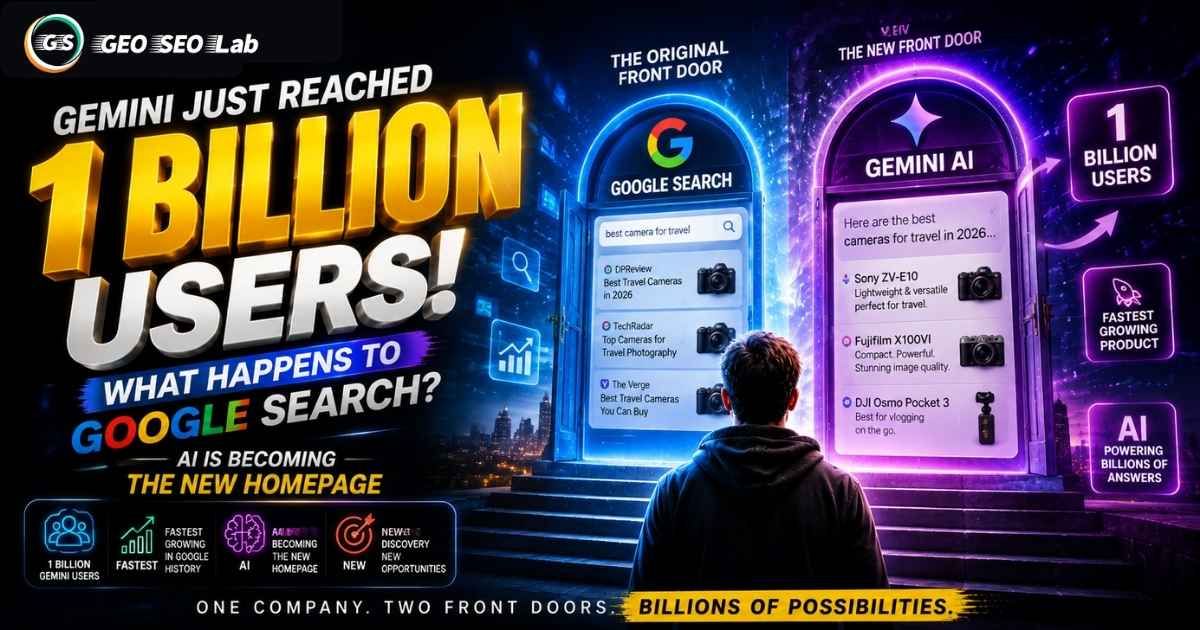
On August 11, 2026, Sundar Pichai posted a simple, blunt number on X. The Gemini app had crossed one billion monthly active users. Google confirmed it the same day with an official blog post from Josh Woodward, the executive who runs the Gemini app, calling it the fastest growing product in the company's twenty eight year history, and the fourteenth Google product ever to reach that scale, joining a list that includes Search, Gmail, Android, Maps, Chrome, Play, and YouTube.
Read that list again slowly, because it matters more than it looks like at first glance. Search sits on that list. Gemini just joined it. Both products, run by the same company, both now operating at genuine billion user scale, both increasingly capable of answering the exact same question a person might ask.
That's the real story hiding underneath the milestone headline, and it's a bigger story than another chart showing a hockey stick growth curve. Google didn't just grow a chatbot. It quietly built a second front door into its own business, standing right next to the original one, and the two doors don't always lead to the same room anymore. This piece is about what that actually means, for search behavior, for advertising, for publishers, and for every business that's spent years building a strategy around the assumption that Google Search was the only discovery surface Google actually cared about.
Gemini Has Crossed 1 Billion Users, and the Timeline Is the Real Headline
Numbers alone rarely tell a story. The pace they arrived at usually does, and Gemini's pace is genuinely unusual even by the standards of an industry that's gotten used to fast growth.
Google reported roughly 400 million monthly active Gemini users at its developer conference in May 2025. By that October, Alphabet's own quarterly earnings disclosures put the number at 650 million. It reached 750 million by February 2026, climbed to 900 million when Pichai took the stage again at Google I/O in May, and hit 950 million in the company's second quarter earnings report on July 22. Then, in roughly three weeks, it closed the remaining gap and crossed a billion.
For comparison, Gmail took approximately fourteen years to reach an audience that size. YouTube needed about eight years. Gemini did it in a little over two years from its public launch, and the final fifty million users arrived in under a month. Google didn't slowly build an audience for Gemini the way it built one for Gmail or YouTube. It distributed Gemini directly into products that already had billions of existing users, Android, Chrome, Search, Workspace, and let that existing distribution machine do most of the heavy lifting.
It's also worth being precise about what this specific billion actually represents, because Google's own reporting has gotten genuinely complicated to parse. The one billion figure announced on August 11 refers specifically to the standalone Gemini app, not Google Search as a whole. Google's AI Mode inside Search has separately crossed one billion monthly active users of its own, a different number entirely. And Gemini powered AI Overviews, the AI generated summaries sitting above traditional search results, reportedly reach something closer to two and a half billion monthly users, according to figures Google has shared. Three genuinely massive numbers, three at least partially overlapping but distinct surfaces, all operating simultaneously inside the same company.
Why This Is Bigger Than a User Milestone
It would be easy to read all of this as Google simply having a good quarter for its chatbot app. That undersells what's actually happening here in a fairly significant way.
For essentially its entire history, Google has operated with one dominant, unambiguous front door for discovery. You had a question, you went to Google Search, you got a list of results, and everything downstream, ads, publisher traffic, brand discovery, flowed from that single, well understood entry point. Every SEO strategy, every advertising budget, every piece of conventional marketing wisdom about how to reach a customer through Google was built on top of that one assumption holding steady.
That assumption doesn't hold as cleanly anymore. Gemini isn't a side project living quietly off in its own corner of Google's app portfolio. It's deeply woven into Android, into Chrome, into Workspace, into Search itself, and it's now demonstrably capable of pulling in a billion people a month on its own, independent of the traditional search box entirely. A meaningful and growing share of the questions people used to type into Google Search are now just as likely to get typed, or spoken, directly into Gemini instead, sometimes without the person even thinking of it as a separate decision from searching.
This is genuinely different from Google adding another feature to Search. It's Google operating two, arguably three, massive discovery surfaces simultaneously, each with its own interface, its own behavior patterns, and increasingly, its own logic for what gets shown to a user asking a question.
Google Search vs Gemini Ai
It's worth being specific about how these two surfaces actually differ in practice, rather than treating them as interchangeable versions of the same underlying product.
Google Search, even with AI Overviews and AI Mode layered on top of it, still fundamentally starts from a query, retrieves from the open web, and in most cases still shows a mix of AI generated synthesis alongside traditional ranked links a person can click through directly. It remains, at its core, a search experience, even a genuinely transformed one.
Gemini, as a standalone app, behaves more like a genuine assistant than a search engine in the traditional sense. It holds context across an ongoing conversation, can take real actions across connected apps and services, generates images, processes live camera and screen sharing input, and increasingly leans toward completing a task rather than simply answering a question and handing the person back to the open web to finish the job themselves. Google's own usage data backs this up directly. Sixty three percent of Gemini users now interact with it primarily through voice rather than typing, one in five Gemini Live interactions involve screen sharing or a live camera feed rather than text at all, and the app generates more than 150 million images every single day.
That's a meaningfully different behavior pattern than someone typing a keyword into a search box. It's closer to how a person might actually talk to a genuinely capable assistant, and it suggests Gemini's own trajectory is heading further away from classic search behavior over time, not converging back toward it.
Are They Competing or Becoming One Search Ecosystem?
This is the honest, complicated question sitting at the center of all of this, and the honest answer is probably both at once, depending on which specific product decision you're looking at.
In one very real sense, Search and Gemini are internal competitors, at least for a person's attention in any given moment. Every question someone asks Gemini directly is, in some sense, a question that didn't get typed into the traditional Search box that day, and every minute spent inside the Gemini app is a minute not spent scrolling a traditional results page with its familiar mix of ads and organic listings sitting alongside each other.
At the same time, Google has been deliberately blurring the line between the two products rather than keeping them cleanly separate. Gemini increasingly powers the AI experiences inside Search itself, AI Overviews and AI Mode both run on Gemini model technology under the hood, and Google has been steadily pulling Gemini's capabilities directly into the Search interface rather than keeping them walled off in a separate app. The most likely trajectory, based on everything Google has actually done rather than said, points toward these two surfaces continuing to converge technically, even while remaining genuinely distinct in how people actually experience and use them day to day.
For a business trying to plan around this, the practical takeaway matters more than the philosophical one. Whether Google eventually merges these experiences into something with one unified name, or keeps running them as parallel products indefinitely, the discovery landscape a business needs to show up well inside has already split into more than one surface, and treating them as a single, unified target is increasingly a mistake regardless of how the underlying technology eventually shakes out.
Where Will Users Discover Brands Now?
The honest answer is considerably more distributed than it used to be, and that distribution is exactly what makes this moment genuinely harder to plan around than the search landscape of even three years ago.
A person might discover a brand through a traditional organic Search result, exactly as they always have. They might discover it through an AI Overview sitting above those same organic results, reading a synthesized answer that names a specific business by name. They might discover it through a full AI Mode conversation, one that breaks their question into several sub questions and pulls from a wider range of sources than a single search ever would. Or increasingly, they might discover it entirely inside the standalone Gemini app, in a conversation that never touches a traditional search results page at all, asking Gemini directly to compare options, summarize reviews, or recommend a specific choice.
Each of these paths draws on a different mix of underlying signals, and each one represents a genuinely separate opportunity, and a genuinely separate risk, for any business trying to be found. A brand that's optimized entirely around traditional organic ranking, with no real attention paid to how it shows up inside Gemini specifically, is increasingly leaving a real and growing slice of actual discovery opportunity completely unaddressed.
What Happens to Traditional SEO
Traditional SEO doesn't disappear in this environment, but its job changes in a way that's worth being precise about rather than vague.
Technical accessibility, crawlability, page structure, and content quality remain the genuine foundation everything else still depends on, since none of these AI powered surfaces, Gemini included, can meaningfully draw on content they can't properly access and interpret in the first place. What changes is that clearing that foundational bar stops being sufficient on its own. A page that ranks well in traditional Search has no guarantee of being pulled into a Gemini conversation happening in a completely separate app, since Gemini's retrieval and synthesis choices don't necessarily mirror Search's ranking logic even when both are drawing from the same underlying web.
This means SEO teams increasingly need to think about visibility as a genuinely multi surface problem rather than a single ranking position to defend. Showing up well in traditional organic results is necessary but no longer sufficient. Showing up well inside AI Overviews and AI Mode requires the kind of clear, well sourced, extractable content synthesis systems actually favor. And showing up well inside Gemini specifically, as its own increasingly assistant like product with its own usage patterns, may require thinking about content and entity presence in ways traditional keyword focused SEO never had to consider at all.
What Happens to Google Ads
This is where the stakes get genuinely commercial, and it's worth naming directly rather than glossing over. Google's entire advertising business has historically been built around the traditional Search results page, the auction that runs when someone types a query, and the paid placements that sit above and alongside organic results.
If a meaningful and growing share of queries are increasingly happening inside Gemini instead, in a genuinely conversational format that doesn't obviously map onto the classic search ads auction model, Google faces a real structural question about how advertising actually works inside that experience going forward. Google has already begun testing advertising formats inside AI powered surfaces, and it would be genuinely surprising if the company didn't continue extending some version of paid placement into Gemini itself over time, given how central advertising revenue remains to its overall business model.
For advertisers and performance marketers, the practical implication is worth preparing for now rather than reacting to later. The advertising playbook built entirely around traditional Search auction dynamics is likely to need real, structural adaptation as more discovery volume shifts toward conversational, assistant style interfaces where the classic idea of bidding on a keyword may not translate cleanly at all.
What Happens to Publishers
Publishers are arguably facing the sharpest version of this shift, and it's worth being honest about why rather than softening it. Traditional Search has always sent some meaningful share of clicks outward to publisher websites, even as that share has been under real pressure from AI Overviews and zero click behavior for the past couple of years already.
A conversation happening entirely inside the Gemini app represents an even more contained experience than an AI Overview sitting above traditional results. There's often no obvious results page sitting just below it, no familiar list of blue links a curious user might scroll down to anyway out of habit. If Gemini increasingly becomes where a meaningful share of research and discovery actually happens, publishers face a genuine risk of losing not just some clicks, but the entire surrounding context that used to make a click likely to happen at all.
This doesn't mean publisher content stops mattering. It still needs to exist, and it still needs to be genuinely good, since Gemini, like every other AI system, still depends on real, credible source material to construct a trustworthy answer in the first place. What it means is that a publisher's value increasingly gets captured further upstream, as the trusted source behind a citation or a recommendation, rather than downstream, as a destination someone actually visits and generates a pageview against.
The New Google Discovery Funnel
The Dual Surface Model
Put simply, the old model assumed one funnel. Someone had a question, went to Google Search, saw a list of results, and clicked through to a destination. The emerging model looks more like two, increasingly three, parallel funnels running simultaneously inside the same company. Traditional Search still exists, still sends real clicks, and still runs the classic ads and organic ranking system marketers have spent decades learning to work with. AI Overviews and AI Mode sit layered on top of that same Search experience, increasingly synthesizing answers before a click ever needs to happen. And the standalone Gemini app represents a genuinely separate funnel entirely, one where a meaningful and growing share of questions now start and finish without touching a traditional search results page at all. A business trying to show up well across Google's ecosystem now needs a real, deliberate strategy for all three, not just the one it's spent the most years getting comfortable with.
The Discovery Funnel Framework
Practically, this means mapping a business's actual visibility across each of these three surfaces independently, rather than assuming strength in one implies strength in the others. It means testing how a business shows up inside a genuine Gemini conversation specifically, not just checking traditional rankings or a Search based AI Overview. And it means recognizing that Gemini's own usage patterns, heavily voice driven, increasingly action oriented, are pulling it further from classic search behavior over time, which means the content and entity work that helps a business succeed there may need to look somewhat different from the work that's always driven traditional SEO success.
What Marketers Should Prepare For
Stop assuming Google Search visibility automatically covers Gemini visibility. These are increasingly separate surfaces with separate retrieval logic, and a strong position in one carries no guarantee of a strong position in the other.
Start testing directly inside the Gemini app itself, not just Search's AI features. Since a real and growing share of discovery is happening inside a genuinely separate product now operating at a billion user scale, understanding how a business actually gets represented inside that specific experience deserves its own dedicated attention.
Watch how Google handles advertising inside Gemini closely, and prepare early rather than reactively. Given how central ad revenue remains to Google's business, some version of paid placement inside Gemini seems like a matter of when rather than if, and businesses that understand the format early will have a real advantage over those caught off guard once it arrives broadly.
Reconsider what publisher and content value actually means in an increasingly upstream world. If Gemini increasingly captures research and decision making before a click ever becomes relevant, the strategic value of being the trusted, cited source behind that decision deserves the same serious investment that page level traffic has always received.
Keep watching the subscriber and revenue question Google has been notably quiet about. Google's own billion user announcement conspicuously left out how many of those users actually pay for anything, and that gap between reach and revenue is likely to shape how aggressively Google pushes advertising and monetization into Gemini over the coming year, which in turn will shape how much businesses need to actually invest in showing up there.
Google's Search Strategy for 2027
Reading between the lines of everything Google has actually done this year, rather than just what it's said, a reasonably clear direction emerges heading into next year. Google isn't choosing between Search and Gemini. It's running both simultaneously, deliberately, at genuine billion user scale, while continuing to blur the technical line between them under the surface. The company that built its entire empire on one dominant front door has spent the past two years quietly building a second one, and by the numbers it announced this August, that second door is now just as large as some of the company's other billion user products took over a decade to become.
The most reasonable expectation for 2027 is further convergence at the technology layer, Gemini models continuing to power more of what Search itself does, alongside continued divergence at the experience layer, with the standalone Gemini app continuing to develop its own distinct, increasingly assistant like identity separate from the classic search box. Businesses that plan for one Google are increasingly planning for a company that no longer quite exists in that singular form anymore.
Closing Thought
A single number rarely tells a complete story on its own, but this one is worth sitting with a little longer than the headline invites. Google just added a second billion user front door right next to its original one, built it faster than almost anything the company has ever shipped, and gave no real sign of slowing that momentum down. For businesses that have spent two decades treating Google Search as one single, well understood target, that target just quietly became at least two, and planning a strategy around only one of them is no longer a safe assumption to make.
Key Takeaways
- The Gemini app crossed one billion monthly active users on August 11, 2026, becoming the fourteenth Google product to reach that scale and the fastest growing product in the company's history, reaching the milestone in roughly two years compared with Gmail's fourteen and YouTube's eight.
- This billion user figure covers the standalone Gemini app specifically, separate from Google's AI Mode in Search, which has also crossed one billion monthly users, and separate again from Gemini powered AI Overviews, reportedly reaching around two and a half billion monthly users.
- Gemini's usage patterns, sixty three percent voice driven, heavily action oriented, are increasingly distinct from classic search behavior, suggesting the app is evolving further away from a traditional search experience over time rather than converging back toward it.
- Traditional SEO, Google Ads, and publisher strategy all face genuine structural questions as discovery volume increasingly splits across multiple Google surfaces rather than concentrating inside one familiar search results page.
- Businesses need a deliberate, separate strategy for visibility inside Gemini specifically, rather than assuming strong traditional Search performance automatically extends into this increasingly distinct and rapidly growing surface.
About GEO SEO Lab
GEO SEO Lab is a research and strategy group focused on helping businesses understand and improve visibility across AI assisted search and discovery, including Google Search, Google AI Mode, Gemini, ChatGPT, Claude, Perplexity, and the broader ecosystem reshaping how people find and evaluate information. Our work spans Generative Engine Optimization, AI visibility strategy, entity optimization, and measurement research aimed at helping businesses navigate a search landscape that increasingly runs through more than one front door, even inside a single company's own ecosystem.
References and Further Reading
- Google, The Gemini app hits 1 billion monthly active users, official Google blog, August 11, 2026
- TechCrunch, Google's Gemini app surges to 1 billion users, August 2026
- Forbes, Gemini becomes Google's fastest growing product ever after hitting 1 billion monthly users, August 2026
- Tech Times, Gemini reaches 1 billion users, subscriber count left out of announcement, August 2026
- GEO SEO Lab, Google's AI Search Boom, why rankings alone no longer define success
- GEO SEO Lab, The New Rules of AI Visibility, why rankings alone won't win in 2026
Tags
Frequently Asked Questions
Find answers to common questions about this topic
About the Author

Anubhav
SEO Expert & Content Creator
Experienced digital marketing professional specializing in SEO strategies, content optimization, and data-driven marketing solutions. Passionate about helping businesses grow their online presence and achieve better search rankings.
Related Articles
View all posts
How to Turn FAQ Content Into GEO Content
How to Turn FAQ Content Into GEO ContentThink about the last time you searched for a complex product or a nuanced troubleshooting step. Did you type a...

How AI Decides Which Websites to Cite: Inside the Hidden Selection Process
Introduction: The New Gatekeepers of VisibilityPicture this. Someone types a question into ChatGPT, Perplexity, or Google's AI Overview box. Within se...
Why Does AI-Generated Content Need Humanization for SEO?
Why Does AI-Generated Content Need Humanization for SEO?The Real Reason Raw AI Drafts Underperform, and What Actually Fixes ItA GEO SEO Lab ReportEdit...