Entity SEO vs Traditional SEO: Why AI Search Understands Entities Instead of Keywords
Learn the difference between Entity SEO and Traditional SEO and discover why modern AI search engines like Google AI Mode, ChatGPT, Gemini, Claude, Perplexity, and Grok understand entities instead of keywords. This comprehensive guide explains entity-based search, knowledge graphs, semantic relationships, and how businesses can build AI visibility through Entity SEO.
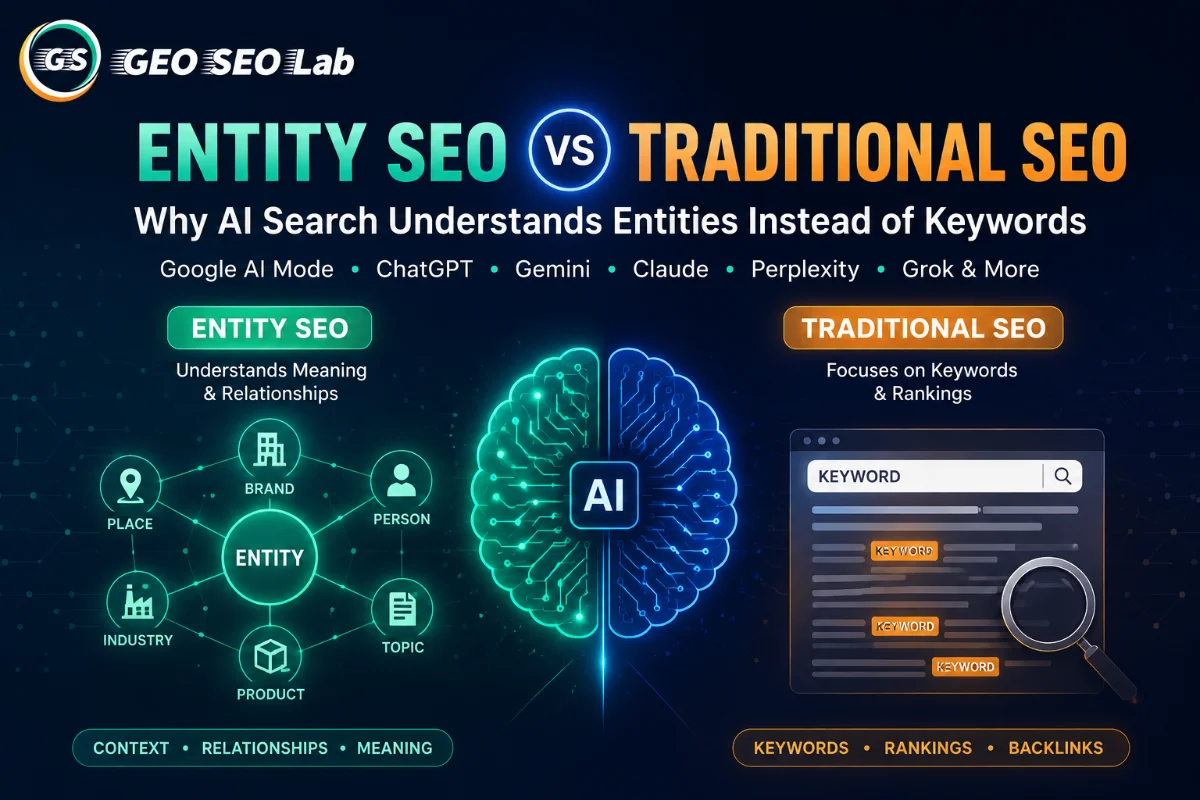
Entity SEO vs Traditional SEO: Why AI Search Understands Entities Instead of Keywords
How Google, ChatGPT, Gemini, Claude, Perplexity, and Modern AI Search Engines Understand Meaning Beyond Words
For twenty years, we taught ourselves to think like search engines counting keywords, chasing rankings, and building links. Now search engines are learning to think like us. The question is whether our digital presence is ready for that shift.
The Day Keywords Stopped Being Enough
Spend five minutes with any experienced SEO professional and they'll tell you a version of the same story. They remember when keyword density was a genuine ranking factor. When stuffing a target phrase into a page title, three header tags, the first paragraph, the last paragraph, and the alt text of every image was considered sophisticated optimization. When the primary question in every content brief was "how many times should we use this exact phrase?"
Those days feel distant now, but the deeper assumptions behind them that search is fundamentally about matching words to words have persisted far longer than they should have. Many organizations still build their digital strategies around keyword lists, still evaluate content by whether target phrases appear in the right places, and still measure success almost entirely through rankings and traffic reports. Meanwhile, something fundamental has changed beneath the surface of how search actually works. When a user opens ChatGPT and types "Which company helps healthcare organizations improve their visibility in AIgenerated answers?", the system processing that question is not scanning an index for pages containing those specific words. It is doing something considerably more sophisticated. It is attempting to understand what the user is actually looking for identifying the type of organization being described, recognizing the industry context, connecting concepts like AI visibility and healthcare to the broader knowledge it has developed about who operates in that space, and generating a response that reflects an understanding of meaning rather than a matching of words. This is the shift that separates traditional search from AIpowered search. And it's the shift that makes understanding entities not just keywords one of the most strategically important topics in digital marketing today. This article makes that case in full. It explains what entities are, why they matter more than keywords in AIpowered search, how modern AI systems recognize and connect entities, and what organizations can do to build the kind of entity authority that earns sustained visibility across Google AI Mode, ChatGPT, Gemini, Claude, Perplexity, Grok, and the platforms that will follow them.
The Evolution from Keywords to Entities
Two Decades of KeywordCentered Thinking
The SEO industry was built on a remarkably durable foundation. For more than twenty years, the central workflow looked something like this: identify the words your potential customers type into search engines, figure out which of those words represent achievable ranking opportunities, create content that targets those words, build links that signal authority, and monitor where your pages appear in search results. This approach worked. It produced entire industries content marketing, technical SEO, link building, rank tracking and it generated enormous commercial value for businesses that executed it well. The keywordcentered model isn't being dismissed here. It remains relevant, and elements of it will remain relevant for years to come. But it was always a proxy for something deeper. Keywords were never really the point. They were approximations imperfect ways of capturing what users actually wanted to know, find, or do. The search engines of the early internet couldn't understand what users meant, so they relied on what users literally typed. Keywords were the best available bridge between human intent and machine comprehension.
A Different Kind of Intelligence
Modern AI systems the large language models underlying ChatGPT, Gemini, Claude, and similar platforms were not designed around keyword matching. They were trained to understand language in a way that resembles, at least functionally, how humans process meaning. They learn from vast amounts of text not to count words but to grasp concepts, recognize relationships, and reason across ideas. When these systems process a query, they're not asking "which documents contain these terms most frequently?" They're asking something closer to "what does this person want to understand, and what entities, concepts, and relationships are relevant to answering their question?"
This distinction changes almost everything about how digital visibility works.
Search has evolved through recognizable stages. Early search relied on raw keyword matching the more times a page contained a term, the more relevant it was presumed to be. The introduction of linkbased ranking signals added a layer of credibility evaluation, rewarding pages that other pages pointed to as worthy of attention. Semantic search introduced natural language processing and began moving beyond exact phrase matching toward conceptual understanding. Entitybased search built on this by organizing information around realworld things rather than words that describe things. And now AI reasoning layers are adding the ability to synthesize across entities, connect relationships, and generate contextually appropriate responses rather than simply retrieving preexisting documents. Each stage reduced dependence on lexical matching and increased dependence on meaning. The latest stage reduces it further still.
What Is an Entity and Why Does It Matter?
An entity is a uniquely identifiable thing that exists independently of the specific words used to describe it. Organizations, people, products, places, events, technologies, medical conditions, industries, concepts all of these can be entities. What makes something an entity, in the sense that matters for search, is that it has a distinct identity that persists across different ways of talking about it.
This independence from specific language is precisely what makes entities so valuable for AI systems.
Consider a simple example. The word "Apple" could refer to the technology company responsible for the iPhone and Mac computers. It could refer to the fruit. It could refer to the record label that released early Beatles albums. It could refer to the streaming service. These are four distinct entities that happen to share a label. A keywordbased system struggles with this ambiguity it sees "Apple" and must guess from context which one is relevant. An entitybased system has already learned to distinguish between Apple Inc., the fruit, Apple Records, and Apple TV+ as separate things with different attributes, relationships, and contexts.
Now scale that disambiguation challenge across millions of queries and billions of documents, and the advantage of entitybased understanding becomes clear. AI systems that reason about entities rather than keywords can handle ambiguity, recognize intent, and connect concepts in ways that produce dramatically more useful responses.
The table below illustrates the core differences between thinking in keywords and thinking in entities:
Why the KeywordFirst Mindset Creates Blind Spots ?
Organizations that continue to optimize primarily through a keyword lens aren't doing anything wrong, exactly but they're missing a significant portion of what determines visibility in AIpowered search. Imagine a user asking an AI assistant: "What's the best CRM system for a small dental practice?" A keywordoriented content strategy might have produced separate pages targeting "CRM for dentists," "dental clinic software," "best dental CRM," and "patient management system." Each page targets a different phrase, each lives in relative isolation from the others, and together they don't necessarily communicate to an AI system that the organization has deep, coherent expertise in practice management software for dental healthcare providers. An entityoriented approach produces something different. The organization defines itself clearly as a software company with specific expertise in healthcare practice management. Its products are clearly connected to the dental clinic entity. Its knowledge assets cover the full landscape of concerns a dental practice manager might have scheduling, patient communication, billing, compliance, team management. The relationships between these concepts are explicit and interconnected. When an AI system considers which organization to mention in response to a healthcare CRM query, the entityoriented organization presents a much clearer picture of relevance and expertise. This is what keyword optimization often misses: the network of meaning that surrounds specific terms, and the importance of being a coherent, welldefined participant in that network rather than just a collection of keywordtargeted pages.
How AI Search Engines Actually Recognize and Process Entities
Beyond the Index: How AI Systems Build Understanding
Traditional search engines maintain indexes enormous catalogs of documents, their content, and the links between them. When a query arrives, the engine searches this index for relevant matches, applies ranking algorithms, and returns a list of results. The index is the core infrastructure. AIpowered search works differently. Rather than primarily indexing documents, these systems develop internal representations of knowledge complex mathematical structures that encode relationships between concepts, the attributes of entities, and the patterns of meaning that connect them. When a query arrives, the system doesn't just look up documents; it reasons across its knowledge representations to construct a response.
This distinction is crucial for understanding why entity signals matter. An organization trying to influence a traditional search index needs to produce documents that the crawlers can find, parse, and rank. An organization trying to influence AI understanding needs to build a coherent, consistent, wellconnected knowledge presence that AI systems can model with confidence.
How Google Has Built Toward Entity Understanding?
Google's journey toward entitybased search is one of the most significant stories in the history of the web. The company has spent years developing technologies that move its systems beyond keyword matching toward genuine semantic understanding. The Knowledge Graph, introduced in 2012, was an early public signal of this direction. Rather than treating the web purely as a collection of documents, Google began explicitly modeling realworld entities people, places, organizations, concepts and the relationships between them. When you search for a wellknown person or company and see a knowledge panel with structured information alongside the regular search results, you're seeing the Knowledge Graph at work. Since then, Google has layered natural language processing capabilities, structured data interpretation, and machine learningbased semantic analysis on top of this foundation. The result is a system that increasingly evaluates pages not just for the words they contain but for the entities they're about, the expertise they demonstrate, and the relationships they establish. For organizations trying to improve their visibility in Google Search and Google AI Mode, this evolution has practical implications. It means that defining your organization's identity clearly, maintaining consistency across your digital presence, building comprehensive topic coverage, and establishing relationships between related concepts matters as much arguably more than optimizing individual pages for specific keyword phrases.
How ChatGPT and Similar Systems Process Queries ?
ChatGPT and other large language modelbased assistants approach entity recognition somewhat differently from traditional search engines, though the underlying goal understanding meaning is the same.
When processing a user's prompt, these systems analyze the language to identify what entities are involved: who or what is the subject, what relationships exist between them, what context the user has provided, and what the likely intent is. This analysis happens through the learned representations encoded in the model's parameters patterns extracted from massive amounts of text during training. The quality of an AI system's response to any query that involves a specific organization depends heavily on what that organization's identity looks like in the AI's training data and retrieval systems. Organizations that have built rich, consistent, wellconnected knowledge ecosystems tend to be represented more accurately and confidently. Organizations with thin, inconsistent, or contradictory digital presences tend to be represented poorly, or not at all. This is why the work of Entity SEO defining identity clearly, building relationships explicitly, maintaining consistency rigorously, and expanding knowledge systematically directly influences how well AI systems can represent an organization in their responses.
The Role of Relationships in Entity Recognition
One of the most important insights about entitybased AI search is that individual entities don't exist in isolation. They exist within networks of relationships, and those relationships are central to how AI systems understand meaning.
Consider an organization that specializes in AI visibility consulting for healthcare companies. The entity network surrounding this organization might include its specific service offerings, the industries it serves, the methodologies it has developed, the research it has published, the experts associated with it, the clients it has helped, and the broader concepts AI search, generative engine optimization, entity SEO that define its domain. Each of these connections adds information to the AI system's model of what this organization is and does. When a user asks about AI visibility consulting for healthcare, the AI system doesn't just look for those exact words. It maps the query to a network of related entities and finds the organizations that sit most credibly and clearly within that network. Organizations with rich, wellstructured entity networks tend to emerge from this process more visibly than those with sparse or poorly connected ones.
This relational dimension of entity authority is what separates it most sharply from traditional keyword optimization. Keywords are evaluated individually this page targets this phrase. Entities are evaluated in context this organization fits within this network of related concepts in this particular way.
Building Entity Authority That AI Systems Trust
The Difference Between Having an Entity and Being an Entity
Here's a distinction that many organizations miss when they first encounter Entity SEO: every organization already has an entity, in the technical sense that it exists as a realworld thing that could theoretically be modeled by an AI system. But there's an enormous difference between technically having an entity and being a clearly, consistently, authoritatively represented entity that AI systems can model with confidence. An entity that AI systems struggle to model might exist in scattered, contradictory forms across the web. The company name might be spelled slightly differently in different places. Products might be described with inconsistent terminology. The organization's areas of expertise might not be clearly defined or interconnected. Its knowledge contributions to its domain might be thin or generic. In this case, the entity exists, but its AI representation is weak, ambiguous, and unlikely to produce confident citations or recommendations.
An entity that AI systems can model with confidence looks quite different. It has a consistent, clearly defined identity across all digital touchpoints. Its products and services are explicitly connected to its organizational identity. Its areas of expertise are covered comprehensively through interconnected knowledge assets. It has contributed original insights research, frameworks, analysis that don't exist anywhere else. Its relationships with related concepts, industries, and knowledge domains are explicit and navigable. The work of Entity SEO is the work of moving from the first description toward the second. Identity Consistency: The Foundation That Everything Else Rests On The most foundational element of entity authority is also one of the most frequently neglected: simple consistency. Organizations often accumulate digital inconsistencies gradually, without noticing. The company might be "Acme Solutions" on its website, "Acme Solutions LLC" on LinkedIn, "Acme Solutions Inc." in press releases, "AcmeSolutions" on Twitter, and "Acme" in most internal references. Each variation introduces a degree of ambiguity. AI systems dealing with this inconsistency have to work harder to confirm that these are all the same organization and that work reduces their confidence in making strong associations.
The solution isn't complicated, but it requires deliberate attention. Establish canonical forms for the company name, product names, service descriptions, and key terminology. Apply those canonical forms consistently across the website, social profiles, business listings, press materials, author bylines, and structured data implementations. Treat inconsistency as a signal problem, because that's exactly what it is. This consistency work extends to the terminology used for concepts, not just names. If the organization's core service is described as "AI visibility consulting" in some places and "generative engine optimization services" in others and "AI search optimization" in still others, these variations even if they refer to the same thing create additional modeling challenges for AI systems. Standardizing terminology doesn't mean using the same phrase to the exclusion of all others, but it does mean having a clear primary vocabulary and using it consistently in the most important places.
Knowledge Depth: Moving from Pages to Expertise
Most organizations have websites. Far fewer have genuine knowledge ecosystems interconnected collections of expertise that demonstrate comprehensive, authoritative understanding of a domain.
The distinction matters enormously for entity authority. A website with ten service pages and a blog containing occasionally published articles gives AI systems very little to work with when modeling the organization's expertise. A knowledge ecosystem with comprehensive educational resources, original research, detailed methodologies, practical frameworks, case studies, and indepth coverage of every significant topic in the organization's domain gives AI systems a rich, detailed model to work from. Building knowledge depth is not primarily about publishing more content. It's about publishing more meaningful content resources that genuinely advance understanding in a domain, that answer questions in more complete and useful ways than existing sources, that reflect real expertise and direct experience rather than surfacelevel familiarity.
Original research is particularly valuable here. When an organization publishes findings that don't exist anywhere else a proprietary survey of industry practices, a benchmark study based on client data, an analysis of trends drawn from direct observation it creates knowledge assets that AI systems cannot source from any other organization. This uniqueness is strategically significant: it makes the organization a necessary citation for anyone trying to understand that specific aspect of the domain. Frameworks and methodologies serve a similar function. When an organization develops a named, clearly articulated approach to solving a problem in its domain and publishes comprehensive documentation of that approach it creates a distinctive intellectual fingerprint that AI systems can associate specifically with that organization. Over time, as the framework is referenced and built upon, the organization's entity authority in that area deepens considerably.
Relationship Mapping: Connecting Your Entity to Its Ecosystem
Entity authority is relational, not just attributional. It's not enough to define who you are and what you know you also need to make explicit how your organization connects to the broader ecosystem of entities in your domain.
This relationship mapping happens at several levels. At the organizational level, it means clearly connecting your brand to your products, services, industries served, geographic locations, expert personnel, and research outputs. At the knowledge level, it means building topic clusters where related concepts are explicitly linked and where the relationships between ideas are navigable. At the ecosystem level, it means participating in the broader conversation about your domain contributing to the knowledge networks that AI systems use to understand the landscape.
Think about the entity network of a wellestablished organization in any professional field. It's not a single node it's a hub with spokes reaching in multiple directions: products connected to use cases, use cases connected to industries, industries connected to specific challenges, challenges connected to solutions, solutions connected back to products. Each connection adds information about what the organization is, what it does, and where it belongs in the domain.
Internal linking on a website is one of the most practical tools for building this kind of explicit relationship structure. Pages that connect to related pages, topic clusters where a central hub connects to detailed subtopic resources, navigation that helps both users and AI systems understand how different pieces of knowledge relate all of these create the kind of connected knowledge structure that supports strong entity representation.
The Entity Authority Pyramid: Understanding Progression
Entity authority doesn't appear fully formed. It develops through stages, and understanding those stages helps organizations prioritize their efforts appropriately.
Digital Identity is the starting point. The organization has established a clear, consistent online presence with accurate information about who it is and what it does. This is necessary but nowhere near sufficient for AI visibility.
Entity Consistency builds on this by ensuring that the digital identity is represented uniformly across all touchpoints. Inconsistencies have been identified and resolved. Canonical terminology has been established and applied.
Relationship Richness develops as the organization explicitly connects its entity to related concepts, products, industries, and knowledge assets. The entity begins to exist within a network rather than in isolation.
Knowledge Depth comes as the organization builds out comprehensive, authoritative coverage of its domain. Educational resources, research, frameworks, and detailed documentation create a substantive knowledge ecosystem.
Topic Authority emerges when the knowledge ecosystem becomes comprehensive and wellconnected enough that AI systems reliably associate the organization with specific subject areas. Queries about these subjects increasingly surface the organization. Industry Recognition represents the apex where the organization is not just associated with topics but recognized as a defining voice in its field, cited by other sources, referenced in discussions of domain knowledge, and recommended confidently by AI systems across a wide range of relevant queries. Progress through these stages is sequential, not arbitrary. Organizations that try to achieve industry recognition without establishing strong knowledge depth, or to build topic authority without first achieving relationship richness, tend to find their efforts producing limited results.
Measuring Entity Strength and Building Enterprise Entity SEO Strategy
The Measurement Gap in Entity SEO
One of the practical challenges of Entity SEO is that it doesn't lend itself to the same clean, numerical measurement that traditional keyword SEO does. You can't check your "entity authority score" in a dashboard the way you check a domain authority metric. There's no direct equivalent of a keyword ranking report that tells you how well AI systems understand your organization. This measurement gap is real, but it's not an excuse for abandoning systematic evaluation. Organizations can develop meaningful ways to assess their entity strength and track progress over time, even if the measures are more qualitative than traditional SEO metrics. The most useful approach is to evaluate entity strength across multiple dimensions simultaneously, recognizing that weaknesses in any one dimension can limit overall AI visibility even when other dimensions are strong. An organization with deep knowledge assets but poor entity consistency will have AI systems struggling to associate that knowledge confidently with the organization. An organization with excellent consistency and clear identity but thin knowledge depth will have AI systems recognizing who they are without having enough information to cite them confidently.
Key Measurement Dimensions
Entity Consistency Assessment involves systematically auditing the organization's digital footprint for inconsistencies in naming, terminology, descriptions, and identity signals. This is largely a qualitative exercise reviewing the website, social profiles, business listings, press materials, and structured data implementations to identify variations that might create ambiguity. Knowledge Coverage Mapping asks how comprehensively the organization addresses the topics central to its domain. This can be approached by mapping out the full landscape of questions a target audience might ask, then evaluating honestly how thoroughly the organization's knowledge assets address each area. Gaps represent opportunities. Areas of depth represent assets. Relationship Strength Analysis examines how well the organization's entity is connected to related concepts, industries, and knowledge areas. Onsite, this involves reviewing internal linking structures and topic cluster organization. Offsite, it involves looking at where the organization appears in broader conversations about its domain whether it's referenced by other credible sources, cited in discussions of relevant topics, and present in the knowledge networks that AI systems draw from. Structured Data Audit evaluates whether the organization's key pages include appropriate schema markup. Organization schema, Person schema for key authors and experts, Article schema for knowledge assets, Product and Service schema for offerings, and FAQ schema for common questions all contribute to machine readability. Schema alone doesn't create authority, but its absence represents a missed opportunity to provide explicit entity signals. AI Recognition Testing is the most direct measurement of entity SEO effectiveness, and also the most methodologically complex. Testing how different AI platforms respond to queries about the organization's domain whether they mention the organization, how accurately they describe it, and in what contexts they recommend it provides direct evidence of current entity visibility. This testing should be systematic, covering multiple platforms and diverse query types, and should be repeated regularly to track trends.
The Enterprise Entity Maturity Model
Just as the AI Visibility Score framework describes maturity levels for overall AI presence, entity SEO has its own maturity progression that organizations can use to locate their current position and understand what advancement requires.
Level One Identified: The organization has a basic digital presence and can be found online, but entity signals are weak and inconsistent. AI systems have minimal reliable information about the organization. The work at this level is foundational: establishing clear identity, resolving major inconsistencies, implementing basic structured data, and building the minimum knowledge base needed to be coherently understood.
Level Two Connected: The organization has improved its internal consistency and begun connecting its entity to related concepts through topic organization, internal linking, and clearer product and service definitions. AI systems can recognize the organization and associate it with general topic areas, though depth and confidence remain limited. The work here is about strengthening semantic connections and beginning to build genuine knowledge depth.
Level Three Recognized: Comprehensive topic clusters are in place, entity representation is consistent across the digital footprint, author expertise is clearly signaled, and educational resources demonstrate genuine knowledge. AI systems regularly associate the organization with its core subject areas and occasionally cite it in relevant responses. The work at this level focuses on developing original research and proprietary frameworks that build distinct authority.
Level Four Trusted: The organization has established itself as a credible source through sustained original research, industryrecognized frameworks, and comprehensive knowledge assets. AI systems cite it with confidence and recommend it with increasing frequency for relevant queries. The strategic work here is expanding into adjacent topic areas while maintaining depth and authority in the core domain.
Level Five Authoritative: The organization is recognized by AI systems as a defining voice in its field. It is cited by other credible sources, referenced in industry discussions, and recommended broadly across a wide range of related queries. Maintaining this level requires continuous investment in original knowledge creation, monitoring of emerging topics in the domain, and sustained attention to entity consistency across an expanding digital presence.
Building an EntityFirst Content Architecture
One of the most practical implications of entity SEO for content strategy is the shift from pagelevel optimization to ecosystemlevel architecture. Instead of asking "how do we optimize this page for this keyword?", the organizing question becomes "how does this asset contribute to and connect with our overall knowledge ecosystem?"
An entityfirst content architecture typically organizes knowledge around topic clusters, where a central hub page covers a major topic area comprehensively and is explicitly linked to detailed subtopic resources that explore specific aspects in depth. The hub and the subtopic pages reinforce each other the hub demonstrates breadth, the subtopic pages demonstrate depth, and the links between them make the relationships between concepts explicit and navigable.
This architecture serves both users and AI systems. Users benefit from intuitive navigation that helps them explore a topic from general concepts to specific details. AI systems benefit from explicit relationship signals that make it easier to model the organization's expertise and understand how different pieces of knowledge connect.
Extending this architecture to include different asset types not just articles but research reports, frameworks, glossaries, case studies, and educational resources creates the kind of multidimensional knowledge ecosystem that supports strong entity authority. Each asset type contributes something different: research contributes original evidence, frameworks contribute structured methodology, glossaries contribute conceptual clarity, case studies contribute applied demonstration, and educational resources contribute breadth of coverage.
IndustrySpecific Entity Strategies
While the principles of entity SEO apply universally, the specific tactics that implement those principles look different across industries. Understanding these variations helps organizations allocate their efforts most effectively.
Healthcare organizations face particularly high stakes in entity authority because AI systems apply rigorous credibility standards to healthrelated information. The entities most relevant to a healthcare organization medical specialties, treatment approaches, patient populations, clinical evidence standards, regulatory frameworks require accurate, wellsourced, expertreviewed representation. Healthcare organizations build entity authority most effectively through evidencebased educational content developed in collaboration with clinical experts, clearly attributed to specific healthcare professionals, and updated regularly to reflect current evidence and guidelines.
Technology companies, particularly those in SaaS, have a natural advantage in the form of technical documentation. Comprehensive, accurate documentation covering products at the feature level, explaining integrations with related tools and platforms, addressing security and compliance requirements, and providing implementation guidance creates deep knowledge assets that AI systems reference heavily when answering questions about software capabilities. Technology organizations that treat documentation as a strategic visibility asset rather than a support cost tend to develop strong entity authority relatively efficiently.
Professional services firms consulting, legal, financial, and similar organizations build entity authority most effectively through thought leadership that reflects genuine practitioner expertise. The distinction between genuine thought leadership and marketingdressedasthoughtleadership is increasingly apparent to AI systems: real expertise produces insights that advance the field, while manufactured thought leadership merely restates what's already known. Original research, honest case studies that include lessons learned alongside successes, and frameworks developed from direct experience all contribute more effectively than polished but contentlight marketing materials.
Local businesses operate in an entity context where geographic relationships are particularly important. The connections between a local organization, its specific service area, the community it serves, and the local industry ecosystem it participates in are all relevant entity signals. Local organizations build entity authority through locationspecific knowledge guides to local resources, community expertise, locationqualified service information as well as through consistent local business information across all platforms and directories.
The Compounding Nature of Entity Authority
Perhaps the most strategically important characteristic of entity authority is that it compounds over time in ways that traditional keyword rankings don't.
A keyword ranking is a current state it reflects where a page sits in search results right now, but it doesn't necessarily make future rankings easier to achieve. Entity authority is cumulative each new knowledge asset builds on the foundation of previous ones, each new relationship strengthens the overall network, and each AI citation creates a small additional signal of credibility that makes future citations slightly more likely.
This compounding dynamic has significant implications for timing. Organizations that begin building entity authority now are accumulating an asset that becomes more valuable over time and increasingly difficult for later entrants to replicate. An organization that has spent three years building a comprehensive knowledge ecosystem, establishing consistent entity signals, developing original research, and maintaining topical authority has an AI visibility foundation that a competitor starting today will need years to approximate even with significant investment.
This doesn't mean that organizations starting late can't build meaningful entity authority. It means that waiting has a compounding cost, just as starting early has a compounding benefit.
The Future of EntityCentered AI Search
Trends Shaping the Next Decade
The trajectory of AIpowered search points clearly toward increasing sophistication in entity understanding and an increasing premium on genuine, wellstructured organizational knowledge. Several specific trends are worth tracking.
AI systems are getting better at evaluating the quality of knowledge, not just its presence. Early AI systems trained on large text corpora sometimes struggled to distinguish between authoritative expertise and confidentsounding approximation. As these systems improve, the gap in visibility between organizations with genuine knowledge depth and those with surfacelevel content will likely widen. Organizations that have invested in authentic expertise will benefit disproportionately from this improvement. The diversity of AI platforms that matter for visibility is expanding rather than consolidating. Rather than one or two dominant AI search channels, organizations face an increasingly varied ecosystem of AI assistants, specialized tools, verticalspecific platforms, and AI features integrated into existing products. Entity authority built on clear identity, comprehensive knowledge, and strong relationships tends to transfer across platforms more reliably than keyword optimization tactics, which often need to be adapted for each platform's specific ranking signals.
Knowledge graphs and structured knowledge representations are becoming more sophisticated and more central to how AI systems reason. Organizations that explicitly structure their knowledge through schema markup, clear content architecture, explicit relationship signals, and wellorganized knowledge ecosystems will find it easier to participate in AI reasoning as these systems evolve.
Entity SEO will increasingly be recognized as a foundational pillar of Generative Engine Optimization more broadly, not a specialized subfield. As GEO matures as a discipline, the role of entity clarity, knowledge architecture, and semantic relationship building in overall AI visibility will become more explicitly recognized and more systematically practiced.
Clearing Up Persistent Misconceptions
Several misconceptions about Entity SEO continue to circulate in ways that lead organizations to misallocate their efforts.
The most common misconception is that Entity SEO replaces keyword research. It doesn't, and understanding why matters for strategy. Keyword research tells you how people describe their needs what language they use, what questions they ask, what terms they associate with the problems they're trying to solve. This information is valuable regardless of how AI systems process those words. Entity SEO tells you how to build the knowledge ecosystem that gives AI systems confidence in your organization's expertise. The two work together: keyword research informs what topics to cover, entity SEO informs how to structure and connect that coverage. Another common misconception is that implementing structured data markup is sufficient for entity authority. Schema markup provides machinereadable signals that help AI systems parse certain types of information more easily, and implementing it correctly is genuinely worthwhile. But schema is a signal, not a substance. It makes existing entity clarity easier for machines to read; it doesn't create entity clarity where none exists. An organization with rich, consistent, wellconnected knowledge assets will build entity authority with or without perfect schema implementation, while an organization with thin, inconsistent content won't solve those problems through schema alone. The belief that Entity SEO is only relevant for large brands is also worth addressing directly. The underlying principle that AI systems evaluate organizations based on the clarity and quality of their entity signals applies regardless of size. A small professional services firm with deep, wellorganized expertise in a specific niche can develop stronger entity authority in that niche than a large firm with generic, broadly targeted content. The playing field in entity authority is leveled more by knowledge quality than by organizational scale.
Bringing It Together: From Keywords to Knowledge
The shift from keywordcentered to entitycentered search is not a sudden disruption. It's the culmination of a trajectory that search engines have been following for years, accelerated now by the capabilities of large language models and the widespread adoption of AIpowered search assistants.
For organizations trying to maintain and grow their digital visibility, the practical implications are significant but navigable. The core work of Entity SEO defining organizational identity clearly, building comprehensive and interconnected knowledge assets, maintaining consistency across all digital touchpoints, developing original research and frameworks, and connecting the entity to the broader knowledge ecosystem of the domain is work that builds genuine organizational value beyond just search visibility. An organization that knows what it stands for, covers its domain with depth and integrity, and communicates its expertise clearly is better positioned for almost every form of digital discovery, not just AIpowered search. The organizations that will be most visible across the next generation of AIpowered discovery platforms won't necessarily be those with the highest domain authority scores or the most keywordtargeted content. They'll be the ones that AI systems can most confidently understand whose identity is clear, whose expertise is deep, whose relationships to related concepts and entities are explicit and navigable, and whose knowledge contributions to their domain are substantial enough to earn consistent citation and recommendation.
That's what it means to be an entity that AI systems trust. And that trust, once built, compounds over time in ways that make it one of the most durable competitive advantages available in the digital landscape.
Key Takeaways
Keywords describe; entities represent. AI systems are moving beyond matching words to understanding meaning recognizing realworld things and the relationships between them rather than counting phrase occurrences.
AI visibility depends on entity clarity. How well AI systems can model your organization its identity, expertise, relationships, and domain contributions directly determines how confidently they cite and recommend you.
Consistency is foundational. Inconsistent naming, terminology, and identity signals across digital touchpoints create ambiguity that weakens entity recognition. Resolving these inconsistencies is prerequisite work.
Knowledge depth matters more than content volume. Comprehensive, interconnected, original knowledge assets give AI systems more to work with than large quantities of generic content. Quality and connectivity outperform quantity.
Entity authority compounds over time. Each knowledge asset strengthens previous ones; each relationship enriches the overall network; each citation makes future citations more likely. Starting early has compounding benefits.
Entity SEO is GEO's foundation. Generative Engine Optimization depends on AI systems understanding organizations well enough to recommend them. Entity clarity, knowledge architecture, and semantic relationships are the infrastructure that makes this possible.
Measurement requires a multidimensional approach. Entity strength cannot be captured in a single metric. Identity consistency, knowledge depth, relationship richness, structured data coverage, and AI recognition testing together provide a meaningful picture.
References
Google. How Google Search Works: Understanding Entities and the Knowledge Graph. Google Search Central. developers.google.com/search/docs.
Google. Search Quality Evaluator Guidelines. google.com/search/docs/fundamentals/creatinghelpfulcontent.
Singhal, A. (2012). Introducing the Knowledge Graph: Things, Not Strings. Google Blog. blog.google.
OpenAI. GPT4 Technical Report. openai.com/research/gpt4. 2023.
Anthropic. Claude's Constitution and Model Documentation. anthropic.com/research. 2024.
Vrandečić, D., & Krötzsch, M. (2014). Wikidata: A Free Collaborative Knowledgebase. Communications of the ACM, 57(10), 7885.
Pan, S., Luo, L., Wang, Y., Chen, C., Wang, J., & Wu, X. (2024). Unifying Large Language Models and Knowledge Graphs: A Roadmap. IEEE Transactions on Knowledge and Data Engineering.
Noy, N., Gao, Y., Jain, A., Narayanan, A., Patterson, A., & Taylor, J. (2019). IndustryScale Knowledge Graphs: Lessons and Challenges. Queue, 17(2), 4875.
Reinanda, R., Meij, E., & de Rijke, M. (2020). Knowledge Graphs: An Information Retrieval Perspective. Foundations and Trends in Information Retrieval, 14(4), 289444.
Lewis, P., Perez, E., Piktus, A., Petroni, F., Karpukhin, V., Goyal, N., ... & Kiela, D. (2020). RetrievalAugmented Generation for KnowledgeIntensive NLP Tasks. Advances in Neural Information Processing Systems, 33.
Nadeau, D., & Sekine, S. (2007). A Survey of Named Entity Recognition and Classification. Lingvisticae Investigationes, 30(1), 326.
World Wide Web Consortium (W3C). Schema.org Structured Data Vocabulary. schema.org.
Microsoft Research. Entity Linking and Knowledge Base Population in the Context of Large Language Models. microsoft.com/research. 2023.
Metzler, D., Tay, Y., Bahri, D., & Najork, M. (2021). Rethinking Search: Making Domain Experts Out of Dilettante. SIGIR Forum, 55(1).
About GEO SEO Lab
GEO SEO Lab helps businesses build meaningful visibility across the full landscape of AIpowered discovery including Google Search, Google AI Mode, ChatGPT, Gemini, Claude, Perplexity, Grok, and the platforms that will follow them.
Through Generative Engine Optimization (GEO), Entity SEO, AI Visibility Engineering, knowledge architecture design, authority development, and researchbacked strategic frameworks, GEO SEO Lab enables organizations to build digital identities that AI systems can confidently understand, retrieve, cite, and recommend.
Search has changed. The organizations that recognize this shift early that invest in building genuine entity authority rather than simply optimizing individual pages will develop competitive advantages that compound over time. In the era of AIpowered discovery, being understood is becoming just as important as being found.
Tags
Frequently Asked Questions
Find answers to common questions about this topic
About the Author

Aman Kesharwani
SEO Expert & Content Creator
Experienced digital marketing professional specializing in SEO strategies, content optimization, and data-driven marketing solutions. Passionate about helping businesses grow their online presence and achieve better search rankings.
Related Articles
View all posts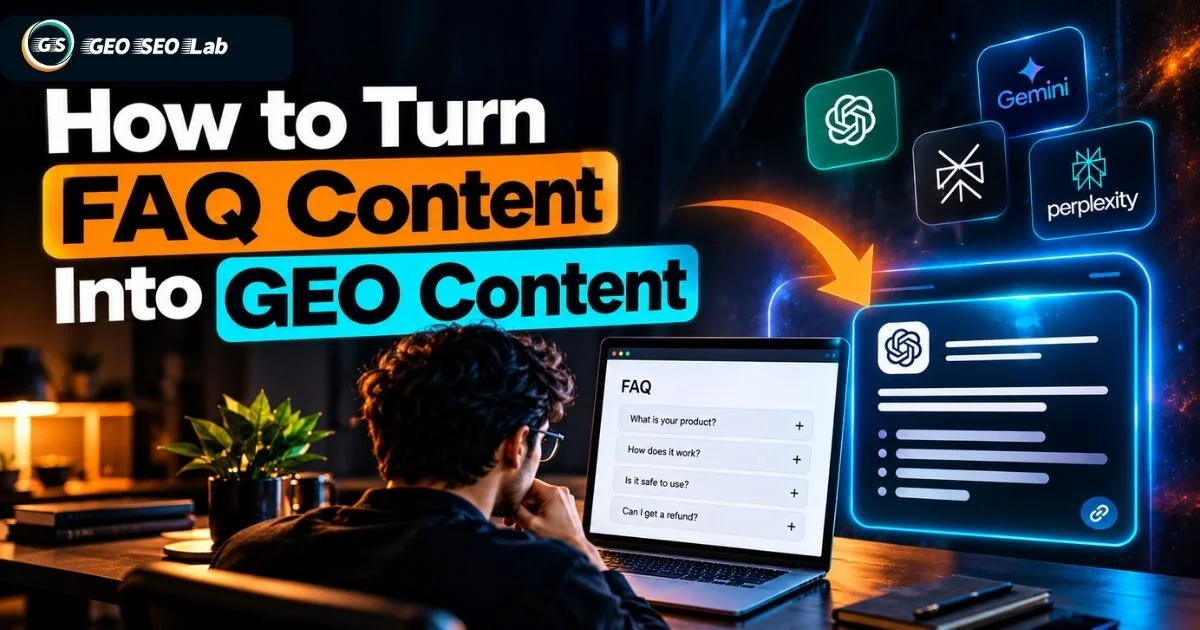
How to Turn FAQ Content Into GEO Content
How to Turn FAQ Content Into GEO ContentThink about the last time you searched for a complex product or a nuanced troubleshooting step. Did you type a...
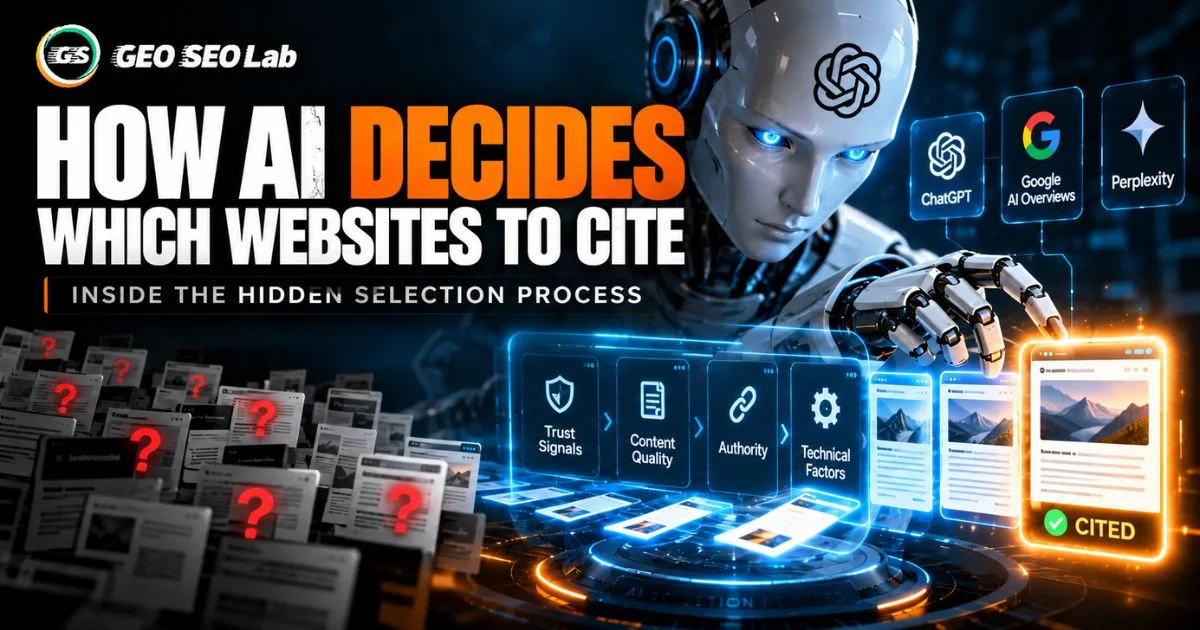
How AI Decides Which Websites to Cite: Inside the Hidden Selection Process
Introduction: The New Gatekeepers of VisibilityPicture this. Someone types a question into ChatGPT, Perplexity, or Google's AI Overview box. Within se...
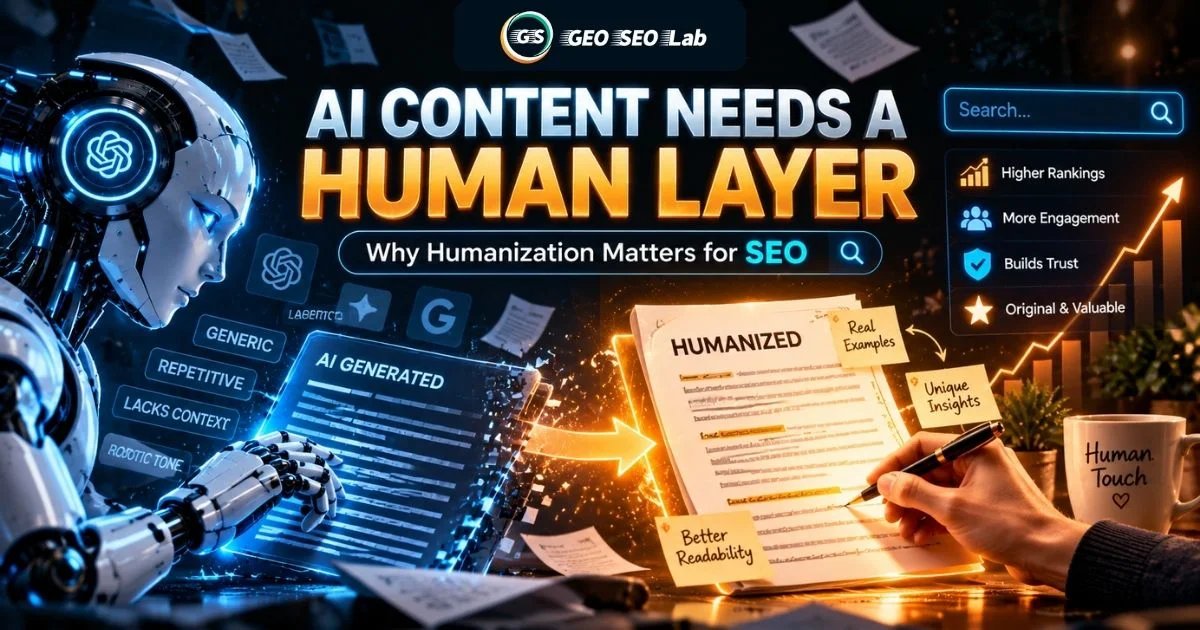
Why Does AI-Generated Content Need Humanization for SEO?
Why Does AI-Generated Content Need Humanization for SEO?The Real Reason Raw AI Drafts Underperform, and What Actually Fixes ItA GEO SEO Lab ReportEdit...