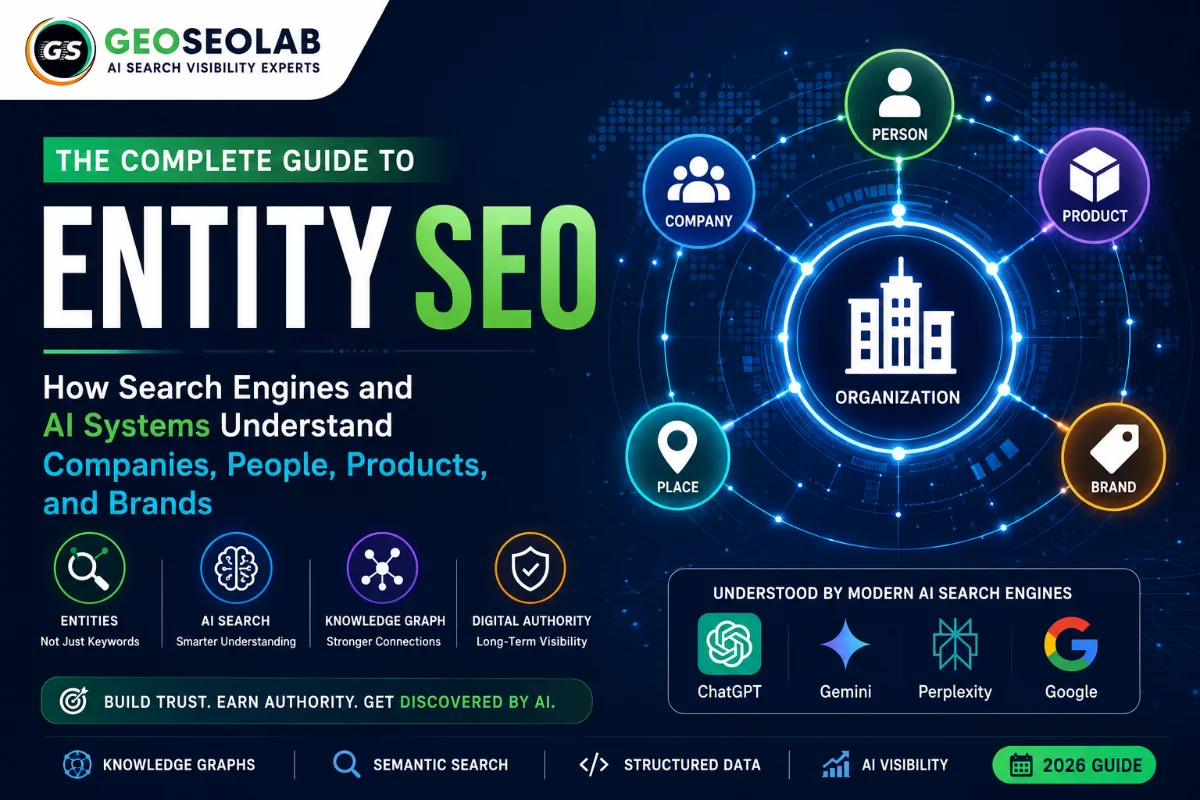
The Complete Guide to Entity SEO: How Search Engines and AI Systems Understand Companies, People, Products, and Brands
Entity SEO is the foundation of modern search visibility in the AI era. This comprehensive guide explains how Google, ChatGPT, Gemini, Perplexity, and other AI-powered search systems understand companies, people, products, and brands through entities, Knowledge Graphs, semantic search, and structured data. Learn practical strategies, original GEO SEO Lab frameworks, and proven best practices to build entity authority, improve AI visibility, and create a trusted digital presence that stands out in search results in 2026 and beyond.
Why Most Businesses Are Optimizing for a Version of Search That No Longer Exists
Spend a few hours in almost any SEO strategy meeting and you will hear a familiar conversation. Someone pulls up a rank tracking report. The team discusses which keywords improved and which dropped. Someone proposes a content plan targeting the next cluster of search terms. The discussion circles around metadata, link building, and page-level optimization.All of that work has genuine value. None of it is wrong.But it is increasingly incomplete. And the gap between what most businesses are optimizing for and what modern search systems are actually trying to do has grown wider than most people in the industry are willing to acknowledge.The gap exists because search has undergone a conceptual shift that did not announce itself with a single landmark update. It happened gradually, across years of investment in semantic understanding, knowledge graph construction, and increasingly sophisticated language processing. The shift is this: modern search systems are no longer primarily trying to understand the text on your webpages. They are increasingly trying to understand the things those words represent.That is the foundation of Entity SEO. And it changes what businesses should be building, what they should be measuring, and how they should be thinking about digital visibility for the decade ahead.This guide explains what that shift actually means, why it matters for businesses of every size and type, and what practical work follows from understanding it properly.
Part One: From Keywords to Entities — The Shift Most Businesses Haven't Noticed
How Keywords Shaped Two Decades of Digital Marketing
To appreciate why entity-oriented thinking represents a meaningful departure, it helps to be specific about what keywords actually were and what problem they solved.In the early years of commercial search, computers struggled to understand language in any meaningful way. The solution was elegant in its simplicity: match the words a user typed with the words appearing on webpages. If someone searched for "running shoes," pages containing "running shoes" would be considered relevant. If a page contained the phrase more frequently, in more prominent positions, and with other contextual words nearby, it would typically rank higher.This model worked remarkably well for its time. It democratized access to information. It allowed small businesses to compete with large ones based on the quality of their content. It gave rise to an entire industry dedicated to understanding how search engines evaluated relevance.But the keyword model embedded assumptions that would eventually become limitations. It treated language as a collection of strings rather than a system of meaning. It could not reliably distinguish between "Apple" the technology company and "apple" the fruit. It could not understand that "best laptop for video editing" and "top notebook computer for filmmakers" expressed nearly identical intent. It could not recognize that a user asking about "Python" in a programming forum was almost certainly not asking about snakes.These ambiguities were manageable when search was primarily a document retrieval exercise. As the expectations users brought to search became more sophisticated — and as the technology for addressing those expectations improved — the limitations of pure keyword matching became increasingly apparent.
What an Entity Actually Is
The concept of an entity comes from the field of information retrieval, and it is worth defining precisely because it gets used loosely in marketing discussions.An entity is a uniquely identifiable thing — a specific, distinct item in the world that exists independently of any particular words used to describe it. The crucial distinction from a keyword is that an entity has a persistent identity across different descriptions, languages, contexts, and forms of expression.
Consider OpenAI as an entity. It can be described as "OpenAI," "the company behind ChatGPT," "the organization Sam Altman founded and returned to," "the AI lab that developed GPT-4," or any number of other phrases. Each of these descriptions points to the same underlying entity. A system that understands entities recognizes that all of these phrases refer to the same organization. A system that only understands keywords sees them as distinct textual strings.
This distinction matters enormously for how search behaves in practice. When a user asks "who created ChatGPT?", a keyword-based system matches the words in that query against words on indexed pages. An entity-aware system recognizes that "ChatGPT" is a product entity, understands the relationship type "created by," and retrieves the organization entity that stands in that relationship to the product — which is OpenAI, whether or not the word "OpenAI" appears in the query at all.That is a fundamentally different kind of intelligence. And it has been developing inside search systems for longer than most businesses realize.
The Historical Transition in Search Intelligence
The evolution from keyword matching to entity understanding did not happen overnight. It unfolded in stages, each building on the previous.The first stage was keyword matching — straightforward text comparison between queries and indexed content. This is where commercial search began.The second stage was semantic search — moving beyond exact word matches to understand meaning, context, and intent. Search systems began recognizing synonyms, understanding that different phrasings could express the same need, and using surrounding context to interpret ambiguous terms. Google's Hummingbird update in 2013 represented a significant milestone in this direction.The third stage — the one we are in the middle of now — is entity understanding. Search systems are actively building and refining structured representations of real-world things and the relationships between them. They are attempting to understand not just what words mean but what things those words represent and how those things connect to each other.The fourth stage, which is actively developing, is AI-assisted search. Large language models, combined with retrieval systems that can access current web content, are enabling search experiences that can answer complex questions, maintain context across follow-up queries, and synthesize information from multiple sources into coherent responses. Entity understanding is a prerequisite for this kind of AI-assisted search to work well — you cannot reliably answer "compare the pricing models of Salesforce and HubSpot" without first understanding those as distinct product entities with specific attributes.
Each stage has expanded what search can do without discarding what came before. Keywords still matter. Semantic relevance still matters. Entities are the next layer of the same ongoing development.
Why the Ambiguity Problem Is More Consequential Than It Seems
One of the clearest ways to understand why entity-oriented search is valuable is to sit with the ambiguity problem that keyword-based search struggled to solve.Consider a few examples. Someone searching for "Jaguar performance" might want information about the automotive brand's vehicles, about the animal's physical capabilities, or about the formula E racing team. Someone searching for "Mercury rising" might be looking at weather information, a movie title, a song, or a reference to the planet. Someone searching for "Python" needs the system to determine from context whether they want programming documentation, information about a type of snake, or something about Monty Python.
Humans resolve these ambiguities almost instantaneously and without conscious effort. We use context — surrounding words, our own prior knowledge, the platform we're using, the time of day, our recent search history — to determine which meaning fits. We rarely even notice ourselves doing it.Search systems have been developing increasingly sophisticated mechanisms for replicating this disambiguation ability. Named Entity Recognition — the process of identifying which words in a piece of text refer to specific entities and what type of entity they are — is one of the foundational technologies enabling this. When a system can recognize "Jaguar" in a technology context as a company entity rather than an animal entity, it can retrieve and rank information that is actually relevant to what the user wanted.For businesses, the implication is direct. Organizations with clear, unambiguous digital identities are easier to distinguish from other entities that might share similar names or operate in adjacent spaces. Organizations whose digital presence is internally inconsistent or contradictory are harder to understand — and harder to represent accurately in search results and AI-generated responses.
Part Two: How Search Engines Actually Build Entity Understanding
Editorial Note: This section explains entity understanding using concepts documented in Google's published materials about the Knowledge Graph, established information retrieval research, and publicly observable search behavior. The Entity Ecosystem Model introduced at the end of this section is an original GEO SEO Lab framework.
The Knowledge Graph: A Fundamentally Different Way of Representing Information
In 2012, Google introduced what it described as the Knowledge Graph — a structured representation of information about real-world entities and the relationships between them. The announcement included a phrase that has since become something of a touchstone in search industry discussions: "things, not strings."The Knowledge Graph represented a conceptual shift in how Google thought about information. Rather than treating the web as a collection of text documents to be matched against text queries, the Knowledge Graph treated the web as a source of information about real-world things — and the goal was to build structured understanding of those things that would persist across different queries, different contexts, and different forms of expression.Think about how this changes the representation of information. In a keyword-based model, information about Google's CEO exists scattered across thousands of individual articles, each representing a separate document. In a knowledge graph model, "Sundar Pichai" exists as a single entity with defined attributes — his role, his nationality, his educational background, his business relationships — and those attributes are queryable directly rather than requiring the system to read through articles.The practical manifestations of this are visible every day. When you search for a well-known person, organization, or landmark, Google often displays a structured panel of information — a Knowledge Panel — that aggregates key attributes in a clean, organized format. That panel is not generated by parsing a specific webpage. It is drawn from the structured entity representation in the Knowledge Graph.Knowledge Panels are visible evidence of entity understanding, but they are not the full picture. The entity understanding that produces Knowledge Panels also influences how search results are ranked, how featured snippets are generated, and how AI-assisted experiences like AI Overviews synthesize information. The visible surface is the tip of a much larger infrastructure.
Named Entity Recognition: How Systems Identify Entities in Text
Before a search system can build understanding of an entity, it needs to recognize when a piece of text is referring to that entity. This is the domain of Named Entity Recognition, or NER — a computational approach to identifying references to specific entities within unstructured text.The process involves both identifying that a reference to an entity exists and classifying what type of entity it is. A system processing the sentence "Microsoft released a new version of Copilot at its annual developer conference in Seattle" needs to recognize that "Microsoft" is an organization entity, "Copilot" is a product entity, and "Seattle" is a location entity — and that the sentence describes a relationship between these entities involving an event.That capability has direct consequences for how content is processed and what understanding it contributes to. When your website's content clearly references your organization, your products, your team members, and your location in ways that NER systems can reliably identify and classify, you are creating content that contributes to accurate entity understanding. When your content uses inconsistent naming, vague descriptions, and ambiguous references, you are creating content that is harder to parse reliably.This is one of the reasons that clarity in content writing is not merely a stylistic preference. It is a structural characteristic that affects how the content is understood by automated systems. The clearer the references to specific entities, the more reliably those references contribute to the entity understanding that drives modern search.
Entity Attributes: The Building Blocks of Identity
Recognizing that an entity exists is only the beginning. The value of entity understanding comes from the attributes and relationships associated with each entity — the information that distinguishes it from all other entities and connects it meaningfully to the broader knowledge graph.For an organization entity, attributes might include the organization's name, its founding date, the industry it operates in, the products and services it offers, its headquarters location, its leadership team, its website, and its relationships to other organizations (as a subsidiary, a partner, a competitor). For a person entity, attributes might include their name, their professional role, their organizational affiliations, their published work, and their areas of expertise.The consistent, accurate representation of these attributes across the web is one of the primary levers that organizations have for strengthening their entity understanding. When the same attributes are represented consistently across the organization's own website, its business directory listings, its social media profiles, its press coverage, and its knowledge graph entries, the system can build a high-confidence representation of the entity.
When those attributes conflict — when the website says the organization was founded in 2015, a directory says 2017, and a press release says 2016 — the system faces an evidence resolution problem. It has to decide which source to trust, or represent the attribute with lower confidence, or simply leave it as ambiguous. None of those outcomes serve the organization's visibility goals.
Relationships as Information: The Network That Connects Entities
One of the most important conceptual shifts in moving from keyword thinking to entity thinking is the recognition that relationships between entities are themselves a form of information — not just a byproduct of describing entities, but a primary source of meaning. Consider what it means to say that GEO SEO Lab is a company that specializes in AI Visibility. That statement establishes a relationship between an organization entity and a service category entity. It connects GEO SEO Lab to the broader concept of AI search optimization, which in turn connects to related entities like Google AI Overviews, Generative Engine Optimization, and the organizations whose visibility is being addressed.
Each of these connections carries meaning. An organization that is connected through documented relationships to relevant concepts, industries, products, and other organizations is richer, more informative, and more useful to a system trying to answer questions involving those concepts than an organization that exists in relative isolation.
This is why content that situates an organization within its broader context — explaining how its products relate to its industry, how its expertise connects to adjacent topics, how its team members' backgrounds inform its approach — is contributing something beyond keyword coverage. It is building the relational context that makes entity understanding meaningful.
The GEO SEO Lab Entity Ecosystem Model
Editorial Note: The following framework is original to GEO SEO Lab. It is a conceptual tool for strategic thinking, not an official model from any search or AI platform.One of the persistent misconceptions about entity optimization is that it primarily happens on the organization's own website. The reality is that an entity exists wherever information about it exists — across every platform, directory, publication, review site, social network, and knowledge base where the organization, its people, and its products appear.The Entity Ecosystem Model visualizes an organization's digital presence as an interconnected web of information nodes, with the organization itself at the center and various information sources as nodes connected to it. The organization's official website, its Google Business Profile, its social media presence, its team members' professional profiles, its product documentation, its press coverage, its customer reviews, its industry directory listings, and its research publications are all nodes in this ecosystem.Each node contributes information about the entity. Each connection between nodes reinforces identity. When all nodes tell a consistent story — when the organization's description, products, expertise, and attributes are coherent across the entire ecosystem — the accumulated signal creates strong, unambiguous entity understanding. When nodes conflict — when different parts of the ecosystem describe the organization differently — the conflicts create noise that reduces the confidence of entity understanding.
The strategic implication is that entity optimization requires thinking beyond the website. The organization's digital identity is distributed across dozens of information sources, many of which are outside the organization's direct control. Actively managing that distributed identity — ensuring consistency, updating outdated information, building new connections through original content and earned coverage — is the ongoing work of entity SEO.
Part Three: Building Strong Entity Identity — From Recognition to Authority
Recognition Is the Floor, Not the Ceiling
Understanding the mechanics of entity recognition is useful. But it is worth being clear about something: being recognized as an entity is the minimum requirement for entity SEO, not the goal. The goal is becoming an entity that is understood deeply, represented accurately, and associated with genuine authority in a relevant domain.The difference between recognition and authority is roughly analogous to the difference between having a listing in a phone book and being the first name that comes to mind when someone needs a specific kind of help. Both involve being findable. Only one involves being preferred.Search systems are increasingly capable of distinguishing between entities that are merely present in the information landscape and entities that have demonstrated consistent expertise and earned credible external recognition. Building toward the latter is the long-term project of entity SEO.
The GEO SEO Lab Entity Authority Framework
The foundation of everything that follows is a clear, stable answer to the most basic questions about an organization. Who are you? What do you do? Which industries or customer types do you serve? What problems does your organization exist to solve? Where are you based? Who leads you?These seem like trivially easy questions. In practice, a surprising number of organizations cannot answer them consistently. Different team members describe the company differently. The website presents one positioning, LinkedIn presents another, and industry directory listings reflect a version of the company that existed several years ago. The product names used internally do not match what appears on the website or in customer-facing materials.The inconsistency often develops organically as organizations grow and pivot. Nobody deliberately decided to create conflicting descriptions of the company — it happened because different teams made independent decisions at different times without coordinating their impact on organizational identity.Resolving these inconsistencies is the first stage of entity SEO work. Before investing in any other layer of the framework, organizations need a stable, agreed-upon foundation of identity that can be consistently represented across all digital touchpoints.
Stage Two: Consistency
Once identity is established, it needs to be maintained consistently across every place where the organization has a digital presence.Consistency does not mean repeating identical language verbatim everywhere. It means ensuring that the underlying facts, positioning, and attributes of the organization are coherent across all representations. The company's industry should be the same whether you find it on the company website, a LinkedIn profile, a Crunchbase entry, or an industry directory. The founder's name, the founding date, the location, the core service categories — these factual attributes should agree across sources.The practical work of consistency maintenance is less glamorous than it sounds. It involves auditing every significant digital touchpoint where the organization appears, identifying inconsistencies, updating outdated information, and establishing processes to keep information current as the organization evolves. It is tedious, detail-oriented work. It is also foundational — inconsistency at this stage undermines everything built above it.
Stage Three: Recognition
Recognition develops when search systems — and the users whose behavior informs those systems — repeatedly encounter accurate representations of the entity across multiple, independent sources.This goes beyond the organization's own digital properties. Recognition builds when the organization is mentioned in industry publications, when its team members appear in professional directories with accurate affiliations, when its products are listed and reviewed on specialist platforms, when its location is consistently represented in mapping services, when its research is cited by other sources, when its leadership is profiled by media outlets.Each of these encounters reinforces the entity's presence in the information landscape. Taken together, they create the kind of multi-source confirmation that enables high-confidence entity understanding.The key word in that last sentence is "independent." An organization asserting its own attributes on its own website is providing one data point. Those same attributes being reflected by multiple independent sources is a qualitatively different signal — it suggests that the attributes are accurate and recognizable rather than self-serving.
Stage Four: Authority
Authority is where entity SEO moves from being recognized to being trusted as a meaningful source of expertise. The distinction is significant, and it is entirely outcome-based rather than input-based.
Recognition tells a search system that your organization exists and has certain attributes. Authority tells it that your organization has something worth knowing — that its perspectives, research, and expertise have been independently validated as credible by others in the information ecosystem.The signals of authority are familiar to anyone who has thought carefully about traditional SEO: links from credible, topically relevant sources; citations in research and educational content; references in journalism and industry publications; recommendations in professional communities; invitations to speak at respected industry events; endorsements from recognized practitioners.What distinguishes entity-level authority from page-level authority is the scope. Authority that accumulates at the organizational entity level — recognized not just for one piece of content but for consistent, meaningful contribution across a domain over time — is significantly more durable than authority associated with individual pages or campaigns.Building this kind of authority is slow. It cannot be manufactured through technical manipulation. It is the reward for consistently doing work that other people in a field find genuinely valuable. That makes it frustratingly difficult to accelerate and enormously difficult for competitors to replicate once established.
Stage Five: Trust
Trust occupies the top of the entity authority framework because it is the layer that converts everything below it into lasting commercial value. An organization might be recognized, consistent, and even authoritative in some sense — and still fail to earn the trust that converts potential customers into actual ones.Trust at the entity level develops through the accumulation of consistent, positive experiences over time. Every customer interaction that aligns with what the organization's digital presence promises — every piece of content that proves accurate and useful, every product that delivers on its specifications, every service engagement that meets or exceeds expectations — contributes a small increment of trust.
The inverse is also true. Trust erodes through experiences that expose the gap between organizational claims and reality. A customer review describing an experience that contradicts what the website promises. Press coverage that reveals practices inconsistent with stated values. Product documentation that proves inaccurate. These experiences do not just damage individual relationships — they create publicly available evidence that other potential customers encounter during their own evaluation processes.In an environment where customers research organizations extensively before committing — and where AI systems are synthesizing information from across that evidence base to inform user understanding — organizational trust has become a critical competitive variable, not just a nice aspiration.
Part Four: The Practical Work of Entity SEO — What Actually Needs Doing
Entity SEO Requires Thinking About Types of Entities, Not Just the Organization
Most discussions of entity SEO focus on the organization as the primary entity of concern. That focus is appropriate — the organizational entity is the anchor of everything else. But complete entity SEO requires attending to several distinct types of entities, each of which contributes to and connects with organizational entity understanding.
People entities have become increasingly important as search systems improve at understanding the relationship between individual expertise and organizational credibility. Content attributed to identifiable people with demonstrated expertise in relevant fields carries different signals than anonymous or weakly attributed content. Author profiles that clearly establish someone's professional background, institutional affiliations, published work, and areas of expertise are creating a person entity that can be connected meaningfully to both the content they produce and the organizations they are associated with.
This matters for organizations because the strength of individual people entities within an organization reflects on the organizational entity itself. A law firm whose attorneys have well-developed professional profiles, published legal commentary, verifiable bar memberships, and records of speaking at legal conferences is building a richer network of entity relationships than one whose attorneys have minimal professional visibility. The same principle applies across industries.
Product entities deserve more deliberate attention than most organizations give them. Each significant product should have a clear, consistently described identity — what it is, who it is for, what problems it addresses, how it differs from alternatives, and how it relates to other products and services in the organization's portfolio. Weak, generic product descriptions create thin entities that are difficult to understand and represent. Detailed, specific, well-structured product documentation creates rich entities that can be reliably connected to relevant user needs.
Service entities present a similar opportunity and similar risks. Many organizations collapse all their services into a single generic services page, which creates a vague entity associated with a broad category rather than clear entities for specific services that can be connected to specific user needs. Breaking services into distinct, well-described entities — each with its own clear identity, target audience, and distinguishing characteristics — creates a richer network of connections and makes each service more discoverable in contexts where users are looking for exactly what that service offers.
Location entities are particularly relevant for businesses that serve specific geographic areas. A well-developed location entity involves more than having a Google Business Profile. It includes consistent representation across all location-relevant directories, clear geographic context in website content, accurate and complete NAP (Name, Address, Phone) information, and connections to relevant local community entities through coverage, partnerships, and participation.
Structured Data: A Clarity Tool, Not a Visibility Shortcut
Structured data — implementing markup from established vocabularies like Schema.org — is one of the most discussed practical elements of entity SEO, and one of the most frequently misunderstood.The misunderstanding typically goes in one of two directions. Some practitioners treat structured data as a minor technical nicety with marginal practical impact. Others treat it as a primary driver of entity visibility, essentially a machine-readable signal that guarantees better representation. Both positions miss the mark.Structured data is most accurately described as a clarity tool. Its primary function is to reduce the interpretive work required to understand what specific pieces of content represent. A LocalBusiness schema tells a crawling system unambiguously that this page represents a local business, what its name is, where it is located, what its hours are, and how to contact it. Without that markup, the system still extracts this information from the page content — but with more interpretive effort and potentially more uncertainty.That reduction in uncertainty has real value. Consistent, accurate structured data across all relevant pages contributes to the confidence with which entity attributes can be associated with a business. But structured data cannot compensate for poor content, inaccurate information, or weak organizational substance. A business with excellent Schema markup and thin, generic content has not solved its entity visibility problem. It has clarified a thin identity — which is better than an ambiguous thin identity, but not nearly as valuable as a clear, rich, authoritative identity.The practical guidance is to implement structured data consistently and accurately for the entity types relevant to your organization — Organization, Person, Product, LocalBusiness, Article, FAQPage, and others as appropriate — while understanding that this work supports and enables entity understanding rather than creating it independently.
Managing Entity Consistency at Scale
For organizations with complex digital presences — multiple products, multiple locations, multiple team members, multiple service lines — maintaining entity consistency becomes a significant ongoing operational challenge.
The scope of the challenge is worth mapping explicitly. A mid-sized professional services firm might have a primary organizational entity with several location entities, dozens of individual person entities for its practitioners, multiple service area entities, and various content entities representing its published work. Each of these entities has attributes that need to be represented accurately across multiple platforms — the firm's own website, LinkedIn profiles, professional directory listings, bar association or professional certification databases, review platforms, and whatever media coverage exists.
Maintaining consistency across that landscape requires treating entity management as an operational function rather than a one-time optimization project. Someone needs to own the responsibility for knowing what the current accurate attributes of each significant entity are, monitoring where those entities appear across the digital landscape, identifying when representations become inaccurate or outdated, and maintaining processes for keeping information current when attributes change.This is organizational work as much as it is technical work. When a company rebrands, launches a new product, adds or loses a key executive, opens or closes a location, or pivots its service positioning, those changes need to propagate across all the places where the entity is represented — not just the company website. The gap between what has changed internally and what is still being presented externally is one of the most common and most damaging sources of entity ambiguity.
Content That Builds Entity Relationships
One of the most practically impactful things an organization can do for its entity SEO is create content that explicitly and clearly establishes meaningful entity relationships. This sounds abstract, but in practice it is quite specific.
Content that explains how your products relate to each other, and how they collectively address different aspects of a customer's problem, is building product entity relationships. Content that clearly attributes expertise to specific named individuals within your organization, and explains the background that makes their perspective credible, is building person-to-organization entity relationships. Content that situates your organization's work within the context of industry developments, and explains your approach relative to established practices and alternative approaches, is building organizational relationships to industry-level entities and concepts.The consistent thread is specificity. Vague content — "we provide comprehensive solutions for modern businesses" — contributes almost nothing to entity understanding. Specific content — "our approach to healthcare data security certification involves three distinct phases aligned with HIPAA requirements, which differ from standard enterprise security frameworks in the following specific ways" — creates a rich network of associations between your organization entity, specific product or service entities, regulatory entities, and industry concept entities.Creating this kind of specific, substantive content is harder than creating generic content. It requires genuine knowledge, real expertise, and careful attention to what is actually being said. It is also significantly more valuable — both for the entity understanding it builds and for the human readers it serves.
Part Five: Evaluating Entity Strength and Building Toward Long-Term Authority
Why Entity Strength Cannot Be Measured by a Single Metric
One of the practical challenges of entity SEO is that it does not lend itself to the kind of simple metric that traditional SEO produced. There is no "entity score" analogous to domain authority. There is no leaderboard showing how your organizational entity compares to competitors. There is no tracking tool that tells you your entity recognition improved by 12% last month.This creates a real problem for organizations accustomed to managing digital strategy through dashboards and metrics. The absence of a clean single number does not mean entity strength cannot be evaluated — it means it requires a multi-dimensional assessment rather than a single-point measurement.The evaluation needs to cover several distinct dimensions: the clarity and completeness of the organizational identity as represented across digital touchpoints, the consistency with which that identity is maintained across different platforms and information sources, the depth of connection between the organizational entity and the specific products, services, expertise, and industry concepts relevant to it, the extent of independent external recognition that the organization has earned, and the quality and recency of customer and community trust signals.
The GEO SEO Lab Entity Strength Audit
We find it useful to structure entity strength evaluation around five interconnected audit dimensions. Each dimension asks a set of questions that surface both strengths and gaps in the organization's entity presence.Identity Clarity Audit: Start with the most fundamental question — if someone encountered your organization for the first time through each of your major digital touchpoints in isolation, would they get the same answer to "who are these people and what do they do?" Test this by actually visiting each major digital presence in turn. Your website, your LinkedIn company page, your Google Business Profile, your primary industry directory listings, the LinkedIn profiles of your key executives and practitioners. Note every inconsistency in how the organization is described, what products or services are featured, how the leadership is characterized, and what the geographic scope and target market appear to be. This inconsistency map is your starting point.Attribute Accuracy Audit: Once you have mapped inconsistencies, assess their severity. Some attribute differences are cosmetic — slightly different phrasing that still accurately describes the same thing. Others are substantive — conflicting founding dates, different addresses, service descriptions that no longer reflect current offerings, leadership information that does not reflect current team. Prioritize resolving substantive conflicts, starting with the highest-authority and highest-traffic platforms where the conflicts will be encountered most often.Relationship Depth Audit: Move beyond the organizational entity itself and assess how well your products, services, team members, and locations are established as distinct entities connected to the parent organization. Do your key products have their own well-developed web presences with complete descriptions, clear value propositions, and accurate specifications? Do your practitioners have professional profiles that clearly connect them to the organization and establish their individual areas of expertise? Are your service lines individually distinguishable rather than collapsed into a generic services category? Each gap here represents an entity relationship that could be contributing to organizational understanding but is not.External Recognition Audit: Search for your organization, its products, and its key team members across a range of contexts that your digital marketing team does not directly control. What does independent press coverage say? What are industry directory descriptions communicating? What do customer reviews reveal about how the organization is being experienced? Are your practitioners showing up in professional community discussions as recognized voices on relevant topics? The external recognition audit often reveals either assets that are being under-leveraged or gaps that explain why entity authority feels weaker than expected.
Trust Signal Audit: Systematically review the trust signals that potential customers and search systems alike encounter. Are customer reviews being monitored and responded to thoughtfully? Are there patterns in negative reviews that reveal consistent gaps between what the organization promises and what it delivers? Is the content the organization publishes consistently accurate when checked against external sources? Does the case study content include specific, verifiable results rather than vague claims? Trust signal audits often surface the kind of evidence problems that undermine conversion even when discovery is working well.
The GEO SEO Lab Entity Maturity Model
Editorial Note: The Entity Maturity Model is an original GEO SEO Lab framework for understanding the progressive development of organizational entity authority.Rather than treating entity SEO as a checklist to be completed, it helps to understand it as a progression through stages of maturity — each stage unlocking different levels of visibility and different kinds of competitive advantage.Level One: Basic Website Presence. At this level, the organization exists on the web but with minimal supporting infrastructure. The website may be technically adequate, but the organization has little presence beyond it. Entity understanding is largely limited to whatever the website itself communicates, and the organization has few external references to reinforce its identity.Level Two: Consistent Digital Presence. The organization has claimed and updated its major platform presences — Google Business Profile, LinkedIn, primary industry directories — and is maintaining reasonably consistent information across them. Business information agrees across platforms. The organization is recognizable and findable, though not yet richly understood.Level Three: Well-Defined Entity. This is where entity SEO begins producing meaningful differentiation. Products and services are established as distinct entities with clear, detailed descriptions. Team members have developed professional profiles that connect meaningfully to the organization. The organization's content consistently situates its work within relevant industry context. The entity has enough relational richness that search systems can understand not just that it exists, but what it does, who it serves, and how it connects to relevant concepts.Level Four: Recognized Expert. Organizations at this level have moved beyond self-description into earned recognition. Original research, frameworks, and expertise are being independently referenced by other credible sources. Team members are recognized voices in professional communities on relevant topics. The organization's work is cited when industry observers discuss the topics it specializes in. This external validation creates authority signals that significantly expand the contexts in which the organization is considered relevant.
Level Five: Trusted Industry Authority. This is the level that creates genuinely durable competitive advantage. The organization is not just recognized within its immediate competitive category — it is understood as a meaningful contributor to a broader field. Its research advances industry understanding. Its frameworks are adopted by practitioners. Its perspectives are sought by journalists covering relevant developments. Its customer outcomes are well-documented and widely known. At this level, the organization's entity has become part of the knowledge infrastructure of its domain.
Most organizations are at Level One or Two. Reaching Level Three requires deliberate, sustained effort over months. Levels Four and Five develop over years and cannot be manufactured through any technical shortcut — they are earned through genuine contribution.
Adapting Entity SEO Thinking to Different Business Types
The principles of entity SEO apply across business types, but the specific priorities look different in different contexts.
For a healthcare practice, entity strength involves the organizational entity of the practice itself, person entities for each practitioner, service entities for each distinct treatment area, and a location entity for each physical location. The authority dimension is particularly important in healthcare — search systems and AI assistants are under significant pressure to surface trustworthy health information. Practitioners with well-documented credentials, clear institutional affiliations, and published educational content create stronger person entities that reflect positively on the organizational entity.
For a software company, product entity development is often the most significant opportunity. Many software companies have organizational marketing that is significantly more developed than their product documentation. Users asking AI systems about specific software capabilities or use cases need detailed, accurate, well-structured product information to get useful responses. Investing in comprehensive, technically accurate product documentation builds product entities that support discovery across a wide range of user queries.For a professional services firm — law, accounting, consulting — the person entities of key practitioners are often the primary discovery vehicle. People search for attorneys by specialty, accountants by industry experience, consultants by specific methodology. Practitioners who have developed clear professional identities through published commentary, conference participation, and professional community involvement create strong person entities that drive organizational discovery.For a local business, the location entity and its connections to local community context are particularly important. Consistent NAP information across all local directories, an actively maintained Google Business Profile, connection to local community entities through sponsorship and participation, and a steady stream of genuine customer reviews all contribute to a well-developed location entity.
Part Six: Looking Ahead — Entity SEO and the Future of Discovery
Search Systems Will Develop Deeper Organizational Understanding
The trajectory of the past decade in search development points clearly toward increasingly sophisticated entity understanding. Google's investment in the Knowledge Graph, the rapid advancement of large language model capabilities, and the integration of retrieval-augmented generation into production AI systems all represent steps toward search experiences that can answer complex questions about organizations, products, and people with increasing accuracy and completeness.As these systems improve, the depth of entity understanding they can support will grow. A search system that currently knows an organization exists, operates in a certain industry, and has certain products may eventually be capable of understanding the nuances of that organization's approach compared to alternatives, the specific contexts in which its products outperform or underperform competitors, and the qualities of its customer relationships based on accumulated review and feedback data.Organizations that have invested in building rich, consistent, well-documented digital identities will be better positioned as these systems develop than organizations that have optimized primarily for keyword rankings on individual pages.
The Knowledge Gap Between Leading and Lagging Organizations Will Widen
There is a compounding dynamic at work in entity SEO that differs from traditional keyword competition. In keyword SEO, a competitor who outranks you today can be overtaken by a focused six-month optimization effort on the relevant pages. Entity authority develops more slowly and is harder to replicate quickly.An organization that has spent three years building its practitioners' professional profiles, publishing original research, earning independent media coverage, and maintaining consistent entity information across its digital ecosystem has developed something that a competitor cannot match in three months. The entity authority accumulates — each additional reference, each additional piece of original research, each additional positive customer review adds to a foundation that becomes increasingly solid over time.This means the competitive landscape for entity authority tends to advantage early movers significantly. Organizations that begin building entity strength seriously now will have meaningful advantages by the time the importance of entity SEO becomes common knowledge and widespread practice. By then, the early movers will have built something that requires years to replicate.
AI-Assisted Discovery Will Increase the Stakes for Entity Clarity
Perhaps the most significant near-term trend is the continued development and adoption of AI-assisted search. As more users turn to AI-powered experiences for research and decision-making, the quality of entity understanding becomes directly tied to commercial outcomes in ways that were previously more indirect.When a user asks an AI assistant to compare professional services firms in a specific category, or to recommend project management tools for a specific use case, or to explain the differences between competing approaches to a technical problem, the AI system's ability to produce useful responses depends entirely on the quality of entity understanding it has access to. Organizations with clear, richly documented, consistently represented entities are the ones that can be incorporated into useful, accurate responses. Organizations whose entity understanding is thin or ambiguous are simply left out.The practical upshot is that investment in entity SEO is increasingly investment in AI visibility — not as a separate discipline requiring separate tactics, but as the foundational work that makes AI visibility possible.
Conclusion: Becoming an Organization Worth Understanding
The evolution of search from keyword matching to entity understanding is sometimes described as a technical development — a change in how search engine algorithms work. That description is accurate but incomplete. It is also a shift in what search is fundamentally trying to do.Keyword-based search was trying to find pages that matched queries. Entity-aware search is trying to understand the world those queries are asking about, and provide information accordingly. The difference is between a filing system and genuine comprehension.For businesses, that shift changes what it means to be optimized for search. Being optimized in a keyword-based model meant having the right words in the right places on your pages. Being optimized in an entity-aware model means being genuinely, consistently, clearly understood — as an organization, as a set of products and services, as a collection of people with real expertise, as a participant in an industry with relationships to other organizations and concepts.That kind of understanding cannot be manufactured through technical tricks or achieved through any single optimization campaign. It develops through the sustained, disciplined work of maintaining a coherent digital identity, contributing genuine expertise to a domain, earning independent recognition through the quality of that contribution, and building customer trust through the consistency of customer experience.
The organizations that invest in this work are building something that holds up as search continues to evolve — because they are not optimizing for any particular platform's current behavior. They are building the kind of identity that any sophisticated system trying to understand the world will find worth understanding.That is not a new principle. It is the same principle that has always differentiated organizations with durable reputations from those with temporary visibility. What is new is that the stakes have risen, the systems are getting smarter, and the organizations that have not yet begun building genuine entity authority are falling further behind with every passing month.The time to start is not when entity SEO becomes impossible to ignore. The time to start is now, while the competitive landscape still rewards early investment with meaningful advantage.
About GEO SEO Lab
GEO SEO Lab works with organizations to build stronger digital presence across Google Search, Google Maps, ChatGPT, Gemini, Perplexity, Claude, and other AI-assisted discovery platforms. Our approach combines technical SEO, Generative Engine Optimization, Entity Optimization, Local SEO, AI Visibility analysis, and digital trust strategy to help businesses develop the kind of clear, authoritative, consistent organizational identity that search systems and potential customers can understand, trust, and recommend.
References and Further Reading
Readers seeking foundational technical guidance should consult primary sources directly: Google Search Central documentation on entity-related search features and the Knowledge Graph; Schema.org documentation on structured data vocabulary and implementation; academic research on Named Entity Recognition and information retrieval from leading AI and information science journals; and W3C documentation on semantic web principles. These primary sources provide the technical foundation on which the strategic frameworks in this guide are built.
Tags
Frequently Asked Questions
Find answers to common questions about this topic
About the Author

Aman Kesharwani
SEO Expert & Content Creator
Experienced digital marketing professional specializing in SEO strategies, content optimization, and data-driven marketing solutions. Passionate about helping businesses grow their online presence and achieve better search rankings.
Related Articles
View all posts
How to Turn FAQ Content Into GEO Content
How to Turn FAQ Content Into GEO ContentThink about the last time you searched for a complex product or a nuanced troubleshooting step. Did you type a...
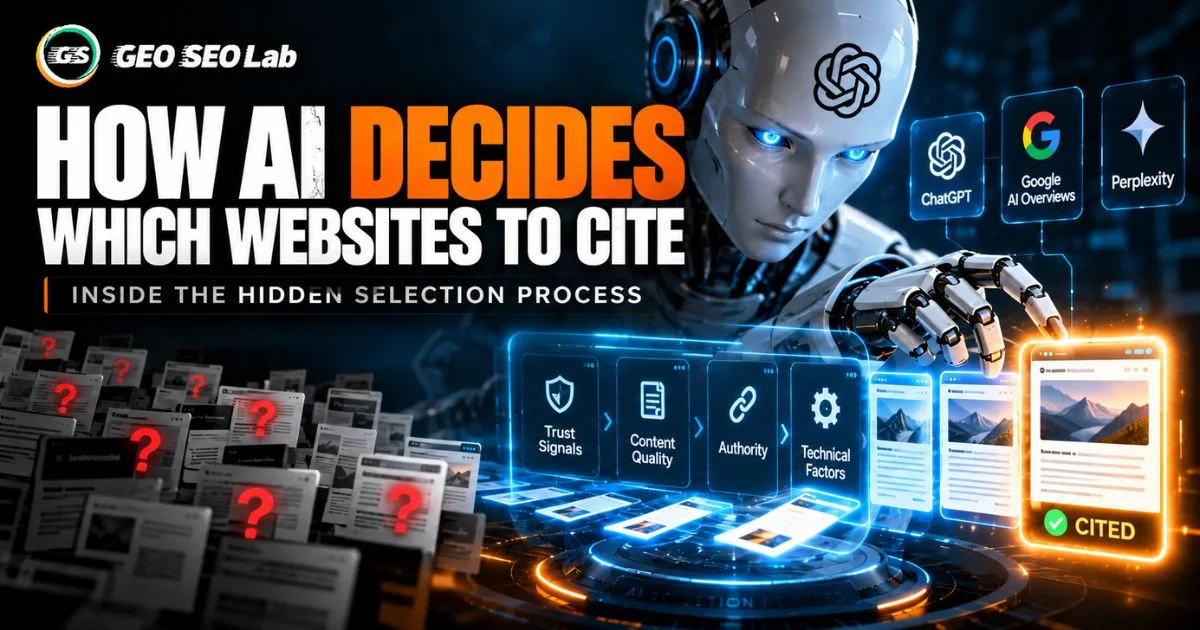
How AI Decides Which Websites to Cite: Inside the Hidden Selection Process
Introduction: The New Gatekeepers of VisibilityPicture this. Someone types a question into ChatGPT, Perplexity, or Google's AI Overview box. Within se...
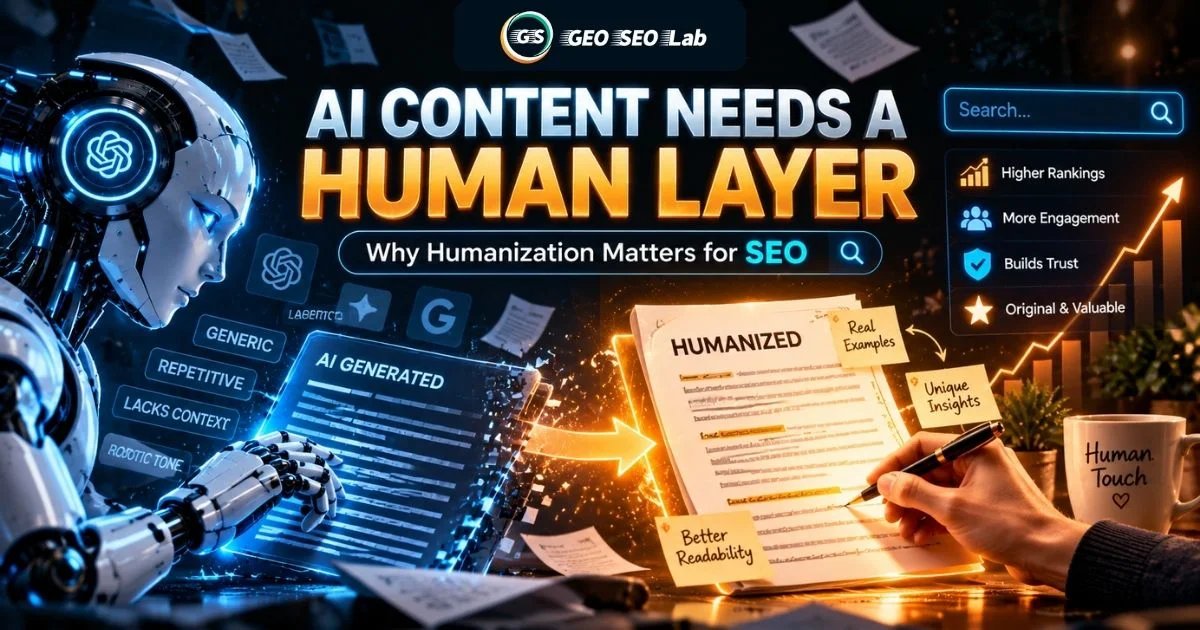
Why Does AI-Generated Content Need Humanization for SEO?
Why Does AI-Generated Content Need Humanization for SEO?The Real Reason Raw AI Drafts Underperform, and What Actually Fixes ItA GEO SEO Lab ReportEdit...