Do You Really Need Big Backlinks to Rank in ChatGPT Search?
Every SEO has heard some version of the same warning by now. If you want to show up in ChatGPT, you'd better have the backlinks, the domain authority,...
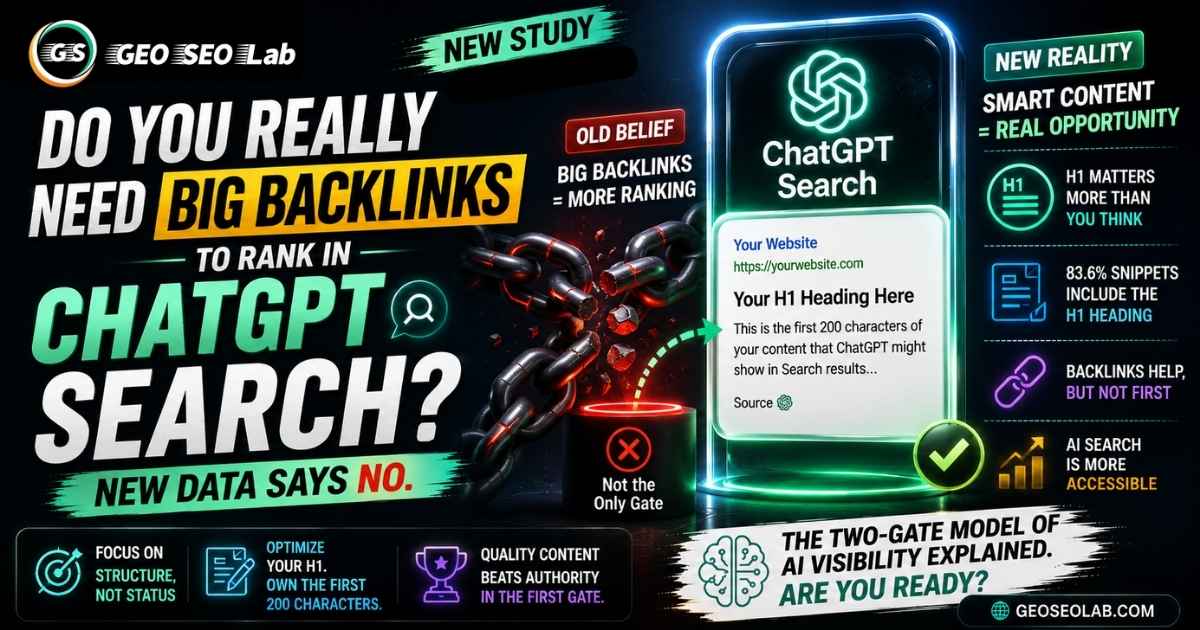
Every SEO has heard some version of the same warning by now. If you want to show up in ChatGPT, you'd better have the backlinks, the domain authority, the years of accumulated trust that Wikipedia, Reddit, and the major publishers have already banked. Small sites need not apply, or so the story goes.
New data published this month tells a genuinely more interesting story, and it's one that deserves a much closer look than it's gotten so far. An independent analysis reviewed 534 pages that ChatGPT actually cited and compared each one against the snippet OpenAI's own search index had stored for it. What it found wasn't a system quietly favoring big, licensed publishers over everyone else. It found a mechanical, almost blunt process for building snippets, one that leans on a page's H1 heading and the text sitting right around it, not on domain authority, not on a content licensing deal, and not on the polished meta description a marketing team spent an afternoon writing.
That raises a genuinely different question than the one most SEO content keeps asking. Instead of "how do I rank in ChatGPT," the more useful question is this: does a small website actually need massive authority to get discovered and cited by ChatGPT Search in the first place, or is that assumption inherited wholesale from Google-era thinking that doesn't fully apply here?
This report walks through what the new data actually shows, how ChatGPT's search index is really building the snippets it hands back to users, why your H1 heading might matter more than anything else on the page, and where the honest limits of this opportunity sit, because it would be dishonest to pretend backlinks and authority have become irrelevant just because one specific mechanism turns out to be more structural than reputational. The real picture is more nuanced, and more genuinely useful for small sites, than either the doom-and-gloom "you need Forbes-level authority" narrative or an oversimplified "backlinks don't matter anymore" take would suggest.
The Study That's Worth Taking Seriously
The research at the center of this comes from Resoneo, which reviewed 534 pages that ChatGPT had actually cited in real responses and compared each one against the corresponding snippet stored inside OpenAI's search index. Out of the 463 pages in that sample that actually had an H1 heading, 387 of the resulting snippets included that H1 somewhere in the text, a rate of 83.6%. That's not a marginal correlation. That's the large majority of cited pages having their H1 show up directly inside what ChatGPT actually surfaced.
The snippet itself gets cut off just after 200 characters, and it's almost always pulled starting from the beginning of the page's visible content, not from the meta description, which the research found only showing up around one in three times, through what looks like a separate Google-scrape pipeline rather than the primary mechanism doing the heavy lifting. The median H1 length across the sample came out to 51 characters, which leaves roughly 150 characters of actual body content squeezed into whatever's left of that 200-character window before the snippet cuts off.
There's more texture in the data worth noting too. A section kicker, the small label sitting above a headline, appeared before the H1 on 29% of pages and ate up around 18 characters of that limited space. A visible publication date showed up on 11% of pages, using about 25 characters. The alt text of the first image on the page appeared in 9% of cases and could take up to 50 characters on its own. And notably, one out of every seven sampled pages had no H1 markup at all, meaning ChatGPT's snippet builder simply grabbed whatever subheading or template element happened to sit in that position instead.
None of that reads like a system carefully weighing domain reputation before deciding what to show. It reads like a fairly mechanical process, cutting a fixed character window starting from a predictable structural anchor point, regardless of whether the page belongs to a Fortune 500 company or a two-person startup that launched last month.
How ChatGPT's Search Index Actually Builds a Snippet
A separate, deeper look at ChatGPT's retrieval stack helps explain exactly why the H1 carries so much weight, and the picture that emerges is honestly a bit cruder than most SEOs would probably expect from one of the most widely used AI products in the world.
The snippet is anchored on the page's H1, rendered in capital letters, plus whatever visible text happens to sit immediately around it in the page's structure. That "whatever's around it" part matters, because it can include things a content team never deliberately chose to feature: a category label sitting above the title, the alt text of an image positioned right below it, a byline, a publication date, even a table of contents. One documented case found a snippet that ended up being 100% table of contents and 0% actual article content, purely because of where that table of contents happened to sit in the page's rendered layout relative to the H1.
Whatever occupies that 200-character window is what gets used. Nothing else about the page factors into the snippet itself. And critically, this snippet doesn't change based on what the user actually asked. The same URL returns the exact same frozen snippet whether someone's asking about pricing, history, or side effects, because it gets cut once at indexing time and served as-is until the page gets crawled again. By the standards of modern search technology, that's a genuinely blunt approach, the kind of query-independent snippet generation that Google itself moved past roughly two decades ago. And yet here it is, quietly powering one of the most widely used AI products on the planet in 2026.
Understanding this mechanism changes how a content team should think about the opening section of any page they actually want ChatGPT to be able to represent accurately. If the system is grabbing a fixed 200-character window anchored on the H1, then what physically sits in that specific zone of the page, not the page's overall authority, not its backlink profile, is what determines whether ChatGPT ends up representing that content accurately or garbles it into something closer to a table of contents than a real answer.
Why Your H1 May Matter More Than You Think
Given how mechanically the snippet gets built, the H1 heading turns out to be doing far more work than most content teams have ever given it credit for. It's not just a stylistic header sitting at the top of a page for readability's sake anymore. It's functionally the anchor point an entire external AI system uses to decide what a page is about and what to show a user who never even visits that page directly.
A vague, cute, or overly clever H1 that doesn't actually describe what the page covers becomes a real liability under this mechanism, in a way it never quite was for traditional SEO, where a page's full content, internal links, and surrounding context could still communicate meaning even if the headline itself was a little abstract. Here, if the H1 doesn't clearly state what the page is about, roughly the first 150 to 170 characters following it are the only real opportunity a page has to communicate anything meaningful before the snippet gets cut off entirely.
That median H1 length of 51 characters is worth treating as a genuinely practical benchmark rather than just a curious statistic. A meaningfully longer H1 eats directly into the already-tight remaining character budget, leaving less room for the actual substance that follows it to register inside the snippet at all. It's a real tradeoff between writing a fully descriptive headline and preserving enough space afterward for the page's actual content to get represented.
The finding that one in seven pages had no H1 at all deserves attention too, because it's a surprisingly common and entirely avoidable gap. A page missing proper H1 markup isn't failing because of weak authority or a thin backlink profile. It's failing on a purely structural, fixable technical detail, the kind of gap that a quick site audit could catch and correct in an afternoon, long before anyone needs to think about a broader link-building campaign.
The First 200 Characters Problem
Once you understand that ChatGPT's snippet is built from a fixed character window immediately following the H1, a genuinely different kind of content problem comes into focus, one that most SEO advice from the Google era never had to seriously grapple with.
For years, the opening paragraph of a page was mostly about hooking a human reader and satisfying search intent broadly enough to keep them scrolling. Under this mechanism, that opening stretch of text is doing something closer to standing in for the entire page whenever ChatGPT decides to cite it. If that opening 150 to 170 characters is vague throat-clearing, a generic "in this article we'll cover" framing sentence, or a scene-setting anecdote before getting to the actual point, that's exactly the material ChatGPT ends up surfacing to a user who's relying on that snippet to understand what the page actually says.
This creates a genuinely practical rewrite priority for any page a brand actually wants represented well inside ChatGPT's answers. The sentence immediately following the H1 should state, plainly and specifically, what the page is actually about and what the reader will get from it, rather than easing into the topic gradually the way a lot of traditional blog writing still does out of habit. That's a real, structural difference from writing purely for a human reader who's willing to keep scrolling regardless of how the first sentence lands, and it's a difference small sites can act on immediately, without needing a single new backlink.
There's also a genuine risk buried in this mechanism that's worth naming directly. Because the snippet is frozen at indexing time and doesn't update based on what a user actually asked, a page can end up misrepresented to a user asking about something the snippet's fixed 200-character window simply doesn't cover. A product page that opens with company history before getting to actual pricing information risks having ChatGPT's frozen snippet show that history to someone asking a pricing question entirely unrelated to it. Getting the opening content right isn't just an optimization nicety under this system. It's closer to a basic accuracy requirement.
Do OpenAI Partnerships Actually Give Sites an Advantage?
This is where the research gets genuinely surprising, and where it's worth being precise about what the data actually shows rather than what a lot of SEO folklore assumes.
The sites sampled in the Resoneo study included both pages from publishers with formal OpenAI content licensing deals and pages from sites with no such arrangement at all. Both groups showed up inside the same search index, built through the same mechanical H1-anchored snippet process, without any evidence that licensed partners received preferential snippet treatment or a fundamentally different retrieval pathway. The snippet-building mechanism itself didn't appear to distinguish between a page from a major licensed publisher and a page from an unlicensed small business site.
That's a meaningful finding, because it cuts against the reasonable assumption that OpenAI's content partnerships function as a kind of paid or negotiated fast lane into search visibility, the way some observers speculated when those licensing deals first started getting announced. Based on this specific mechanism, at least, that doesn't appear to be how it actually works. The licensing deals seem to matter for training data access and legal clarity around content use, not for whether a given page's snippet gets built or how prominently that page's information gets represented once it does show up.
That said, it's worth being careful not to overcorrect into the opposite oversimplification either, and this is exactly where the honest, more complicated picture comes into focus.
The Data That Complicates This Story, and Why That's Worth Taking Seriously
It would be irresponsible to stop at "small sites get treated the same as big ones" without addressing a separate, credible body of research that tells a genuinely different part of this same story, because both pieces of data are true simultaneously, and understanding how is the whole point of this report.
A separate large-scale study, analyzing roughly 1.2 million ChatGPT responses, found that 67% of citations within a given topic concentrate on just 30 domains. A related analysis covering 129,000 domains found referring domain count functioning as the strongest predictor of citation frequency, with pages on domains carrying 350,000 or more referring domains averaging 8.4 citations, compared to just 1.6 to 1.8 citations for domains with fewer than 2,500 referring domains. That's a real, substantial gap, and it points toward exactly the kind of authority concentration the "you need big backlinks" narrative has been warning about all along.
So which is it? The honest answer is that these two findings are measuring genuinely different stages of the same overall process, and reconciling them is the actual insight worth taking away from all of this.
Introducing the Two-Gate Model of AI Visibility
This is where GEO SEO Lab's original framework comes in. We call it the Two-Gate Model of AI Visibility, and it's a way of explaining why both datasets above can be simultaneously accurate without contradicting each other.
Gate One is retrieval eligibility, the purely structural, mechanical question of whether a page can be indexed, parsed, and correctly snippet-built by ChatGPT's search infrastructure at all. This gate doesn't appear to care about domain authority, backlink count, or licensing status. It cares about whether a page has a clear H1, whether that H1 accurately describes the content, whether the text immediately following it communicates something substantive within roughly 150 to 170 characters, and whether the page is technically accessible to OpenAI's crawlers in the first place. The Resoneo snippet study is essentially a study of Gate One, and it found genuinely encouraging news for small sites, since this gate doesn't discriminate by authority the way traditional Google ranking often has.
Gate Two is citation frequency, the separate, downstream question of how often a page that has successfully cleared Gate One actually gets selected and surfaced across a large volume of real user queries over time. This is where authority, backlink profiles, brand recognition, and accumulated trust signals still appear to matter enormously, which is exactly what the 1.2-million-response study and the 129,000-domain referring-domains analysis are actually measuring. A small site can absolutely clear Gate One, get correctly indexed, get its H1 and opening content pulled into a clean, accurate snippet, and still end up cited far less often across the full range of queries in its category than an established domain with hundreds of thousands of referring domains behind it.
Understanding this two-gate structure resolves what looks, on the surface, like a genuine contradiction between two credible studies. Small sites aren't locked out of ChatGPT's index the way conventional SEO wisdom often assumes. That part of the pessimistic narrative is genuinely overstated, and the new data is real evidence of that. But small sites also shouldn't expect to compete for citation frequency at the same rate as an established authority purely by fixing their H1 tags, because that's a different gate entirely, governed by different, still authority-weighted dynamics.
Small Site Versus Big Site, What a Practical Test Would Actually Show
Given this two-gate structure, the most useful next step for any team trying to act on this data isn't debating the theory further. It's running a direct, practical comparison across a real sample of sites and seeing exactly where the gates diverge in practice.
A genuinely useful version of this test would take a spread of small SaaS sites, enterprise sites, established blogs, and brand-new websites, then compare each one across the specific variables both studies point to as meaningful: domain authority and referring domain counts, whether the page has a proper H1, what the first 200 characters after that H1 actually contain, whether relevant schema markup is present, whether the page is technically indexable by OpenAI's crawlers, and finally, whether and how often that page actually shows up inside real ChatGPT citations over a sustained testing period rather than a single spot-check.
Running that kind of test would very likely surface exactly the pattern the two-gate model predicts. Small, technically well-structured sites should clear Gate One at a rate genuinely comparable to much larger, better-known sites, since nothing about the H1-anchored snippet mechanism appears to discriminate based on authority. But those same small sites should show meaningfully lower citation frequency at Gate Two, particularly for broad, competitive, high-volume topics where established domains with deep referring-domain profiles dominate the 67% concentration the 1.2-million-response study documented.
The genuinely actionable insight sitting inside that predicted pattern is this: a small site's realistic opportunity isn't necessarily competing head-to-head with major domains on broad, high-competition topics. It's winning Gate One cleanly and consistently, then focusing citation-frequency effort on narrower, more specific, less contested queries where the field of competing domains at Gate Two is thinner to begin with, exactly the kind of long-tail, specific questions where a well-structured small site has a genuinely fair shot at showing up regularly.
Which Pages ChatGPT Actually Tends to Find
Beyond the mechanics of the snippet itself, it's worth thinking practically about which pages on a typical small site are best positioned to clear Gate One reliably in the first place, since not every page type benefits equally from this structural opportunity.
Pages built around a single, clearly defined topic tend to perform better under this mechanism than sprawling, multi-topic pages trying to cover several distinct subjects under one H1. Because the snippet only captures a fixed, narrow window right after the headline, a page trying to introduce three or four different subtopics before getting into any of them in depth ends up with a snippet that represents none of them particularly well. A page with one clear H1 and one clear, front-loaded point tends to translate into a far more useful, accurate snippet.
Pages with clean, semantic HTML structure, real H1 tags rather than styled text pretending to be a heading, straightforward layout without heavy JavaScript rendering hiding content until a user scrolls or interacts, also stand a much better chance of being parsed correctly in the first place. This overlaps meaningfully with broader technical SEO practices that have mattered for years, which is genuinely good news for small sites, since these are exactly the kinds of structural fixes that don't require a large marketing budget or an extended link-building campaign to address.
Freshness plays a role here too, worth mentioning even though it sits somewhat outside the specific snippet-building mechanism this report has focused on. Separate research has found the substantial majority of ChatGPT citations skewing toward relatively recently published or updated content, reinforcing that even a technically well-structured page benefits from being kept current rather than published once and left untouched indefinitely.
How to Structure a ChatGPT-Friendly Page, Practically
Bringing this together into something genuinely actionable, a handful of concrete structural priorities emerge directly from the data covered in this report.
Write a clear, specific H1 that states plainly what the page is actually about, aiming for something in the general range of the 51-character median the research identified, without treating that number as a rigid rule to hit exactly. The goal is descriptive clarity within a reasonably tight character budget, not an arbitrary length target.
Front-load the sentence immediately following the H1 with the page's actual core point, rather than easing into the topic with scene-setting or throat-clearing language. Given that roughly 150 to 170 characters is often all that's left inside the snippet window after the H1 itself, that space needs to carry real substance, not a transitional sentence that could apply to almost any article on the topic.
Audit existing pages specifically for missing H1 tags, since roughly one in seven pages in the sampled research had none at all, a purely structural gap that's genuinely easy to identify and fix without touching a page's actual content or authority profile.
Be deliberate about what visually sits immediately around the H1 in the page's rendered layout, since category labels, image alt text, bylines, and publication dates can all end up occupying part of that limited 200-character snippet window depending on how a template happens to be built. A page where a lengthy category label or an unrelated image caption sits directly above or below the H1 risks having that irrelevant text eat into the snippet space that should be carrying the actual point of the page.
Keep core informational and product pages narrowly focused around one clear topic rather than trying to cover multiple distinct subjects under a single H1, since the fixed-window snippet mechanism rewards focus in a way it doesn't reward broad, multi-topic coverage.
None of these steps require a backlink campaign, a content licensing negotiation, or months of accumulated domain authority. They're structural, largely one-time fixes any site, regardless of size or budget, can genuinely act on this week.
What This Means for Startup and Small Business SEO
For startup founders and small business owners who've been told, correctly in a lot of traditional SEO contexts, that competing against established players requires years of link-building and content investment before seeing meaningful search visibility, this data offers a genuinely different, more immediate opportunity, provided it's understood accurately rather than oversold.
The realistic takeaway isn't that backlinks and domain authority have stopped mattering in AI search. The 1.2-million-response citation study and the 129,000-domain referring-domains analysis make clear they still matter enormously for how often a page gets surfaced across the full range of competitive queries in a category. What's genuinely different, and genuinely actionable in the near term, is that getting indexed and accurately represented inside ChatGPT's search infrastructure in the first place doesn't appear to require that same accumulated authority. That's Gate One, and it's a gate a well-structured small site can clear just as reliably as a major publisher, starting essentially immediately.
That reframes the practical priority order for a resource-constrained small team. Rather than treating a long-term link-building campaign as the necessary prerequisite before AI search visibility becomes possible at all, a small business can address Gate One structural fixes now, at low cost, and start showing up accurately inside ChatGPT's index for the specific, narrower queries where Gate Two competition is thinner, while still building toward the broader authority signals that matter for competing on higher-volume, more contested topics over the longer term.
The New ChatGPT Search Optimization Checklist
Pulling everything in this report together into a single practical reference, here's what a team can genuinely act on based on the data covered above. Confirm every important page carries a real, semantic H1 tag rather than styled text mimicking one. Write that H1 to clearly and specifically state the page's actual topic, staying reasonably close to the 51-character median where it makes sense without sacrificing clarity for the sake of hitting a number. Front-load the text immediately following the H1 with the page's core point rather than transitional or scene-setting language. Check what visually surrounds the H1 in the rendered page, category labels, image alt text, bylines, dates, since any of it could end up inside the snippet's limited character window. Keep individual pages focused on one clear topic rather than several loosely related ones. Confirm the page renders cleanly without heavy JavaScript hiding key content from crawlers. Keep content reasonably current, since freshness continues to correlate with citation likelihood separately from the snippet mechanism covered here. And treat backlink and authority building as a genuinely separate, longer-term Gate Two investment, not something that needs to be solved before a small site can start showing up accurately inside ChatGPT's index at all.
Key Takeaways
- New research reviewing 534 ChatGPT-cited pages found 83.6% of snippets containing an H1 actually included that H1 directly, with the snippet cut off around 200 characters, usually pulled from the page's opening content rather than its meta description.
- ChatGPT's snippet-building mechanism appears purely structural rather than authority-weighted, meaning small, unlicensed sites showed up in the same index, built the same way, as sites with formal OpenAI content licensing deals.
- A separate body of research found 67% of citations within a topic concentrating on just 30 domains, with referring domain count functioning as the strongest predictor of overall citation frequency, a genuinely different finding that doesn't contradict the snippet study once both are understood correctly.
- The Two-Gate Model resolves this apparent tension: Gate One (retrieval eligibility) is largely structural and accessible to small sites, while Gate Two (citation frequency) still favors established authority, particularly on broad, competitive topics.
- One in seven sampled pages had no H1 markup at all, a purely fixable structural gap unrelated to domain authority or backlink profile.
- Small sites have a genuine, immediate opportunity to clear Gate One through structural fixes alone, while continuing to build toward the authority signals that matter for Gate Two over a longer timeframe.
About GEO SEO Lab
GEO SEO Lab researches the evolution of search and discovery across Google Search, Google AI Mode, ChatGPT, Gemini, Claude, Perplexity, and other AI-powered platforms. Our mission is helping businesses, from major publishers to small startups, understand and improve their visibility inside AI-mediated search and discovery, combining current industry research with original, practical frameworks for technical structure, content strategy, and long-term AI visibility.
References
- Search Engine Journal, ChatGPT's Search Index Serves Small Sites Too, Data Shows
- Search Engine Land, Inside ChatGPT's Retrieval Stack: The Index, Cache, and Pages It Actually Reads
- Startup News, Shocking ChatGPT Citation Study Revealed: 67% Go to Just 30 Domains
- Dualmedia, Netlinking 2026: Backlinks, AI, and Citations, What Should You Do?
- Redback Optimization, How to Get Referenced on ChatGPT? 2026 Guide
- Layer3 Labs, ChatGPT SEO: The 2026 Playbook for Ranking in ChatGPT
- ClickRank, How to Get Indexed in ChatGPT Search with Proven Steps 2026
Tags
Frequently Asked Questions
Find answers to common questions about this topic
About the Author

Anubhav
SEO Expert & Content Creator
Experienced digital marketing professional specializing in SEO strategies, content optimization, and data-driven marketing solutions. Passionate about helping businesses grow their online presence and achieve better search rankings.
Related Articles
View all posts
How to Turn FAQ Content Into GEO Content
How to Turn FAQ Content Into GEO ContentThink about the last time you searched for a complex product or a nuanced troubleshooting step. Did you type a...

How AI Decides Which Websites to Cite: Inside the Hidden Selection Process
Introduction: The New Gatekeepers of VisibilityPicture this. Someone types a question into ChatGPT, Perplexity, or Google's AI Overview box. Within se...
Why Does AI-Generated Content Need Humanization for SEO?
Why Does AI-Generated Content Need Humanization for SEO?The Real Reason Raw AI Drafts Underperform, and What Actually Fixes ItA GEO SEO Lab ReportEdit...