Can a Small Business Beat a Big Brand in AI Search? 2026 Research
Can a small business beat a big brand in AI search? Explore how specificity, consistency and genuine customer trust can help smaller businesses compete with established brands in AI-powered search. This article breaks down the Underdog Advantage Model, a practical local business case study and actionable strategies to improve AI search visibility in 2026.
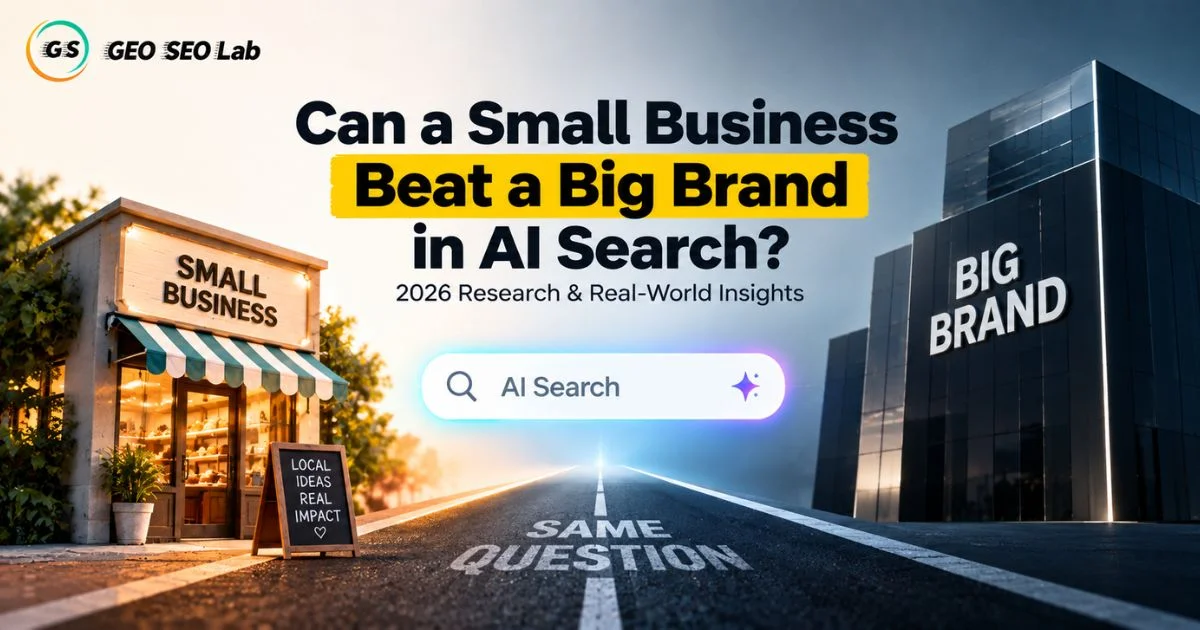
Can a Small Business Beat a Big Brand in AI Search? 2026 Research
Introduction
Yes, a small business can beat a big brand in AI search — but usually not by competing on brand recognition. AI systems can favour smaller businesses when they provide more specific, consistent and verifiable information for a particular customer need, location or use case.
That creates an important opportunity for small businesses in AI search. A national brand may dominate broad prompts such as “best bakery” or “best software,” while a smaller business can become more relevant for questions with clear constraints, such as location, service type, integration requirements, budget or availability.
This article examines the research behind that pattern, explains where small businesses can gain an advantage, shows how the strategy works through a practical local-business example, and outlines what businesses can do to improve their AI search visibility.
That single finding is really the whole story of this report, and it's worth building out properly rather than leaving it as a single interesting statistic. Small businesses genuinely can beat famous brands inside AI search, but not by trying to out-shout them on fame, budget, or backlink count. They win, when they win, by being specific, verifiable, and consistent in exactly the ways a much larger, more generic competitor structurally struggles to be. This report walks through the research behind that dynamic, builds out a realistic mini case study showing what it looks like in practice, and gets honest about exactly where that advantage runs into a real ceiling.
Why AI Search Often Favors Big Brands
It's worth understanding the actual mechanism behind that Trine and Texas A&M result, because it explains a lot about how this whole dynamic plays out in the real world. When every option in front of an AI system looks essentially identical on paper, it falls back on the one name it already recognises from its training data, because a familiar brand functions as the safest, lowest-risk answer to give when nothing else in the prompt actually distinguishes the choices available.
That's a genuinely rational strategy on the AI's part, in a strange way. If a system has no real information differentiating ten options, defaulting to reputation is a reasonable hedge against being wrong. The problem for a big brand banking entirely on that fallback is that it only holds up under exactly those conditions, when nothing else in the picture actually differentiates the choices. The moment real, specific information enters the equation, the calculation changes considerably. VerseOdin's research on this exact dynamic found that once real product information entered the picture in their testing, brand identity barely moved the outcome at all. Recognition matters most precisely when there's nothing else to go on, which turns out to be a genuinely narrow and shrinking set of real-world situations.
This is corroborated by a separate, larger-scale study worth walking through in detail. MaxAEO ran a monitoring panel across May and June 2026, tracking 1,248 English-language commercial-investigation prompts across 52 B2B SaaS and technology categories, checked across eight different AI experiences, ChatGPT, Gemini, Perplexity, Claude, Copilot, Grok, Google AI Mode, and Google AI Overviews. The panel produced nearly 140,000 answer observations over fourteen days, and the pattern that emerged was strikingly consistent with the smaller Trine and Texas A&M experiment. Challenger brand share rose from just 14% in generic, broad prompts up to 38% once the prompt contained specific constraints, a particular use case, a particular integration requirement, a particular regulatory need. A prompt asking simply "best observability platform" favoured the recognised incumbents heavily. A prompt asking "best observability platform for a Series B fintech moving from Datadog with SOC 2 requirements" produced a considerably more diverse, genuinely contestable answer set. The researchers were direct about why: it wasn't prompt trickery. It was evidence matching. Vendors who'd actually built migration pages, fintech-specific case studies, SOC 2 documentation, and integration guides simply had more concrete ways to actually get selected for that narrower, more specific question.
When Small Businesses Can Win in AI Search
Everything covered so far comes from B2B software research, but the same underlying dynamic shows up even more clearly, and arguably more favourably for small businesses, in local and service-based categories.
BrightLocal's 2026 Local Consumer Review Survey found something genuinely striking about how fast this shift has moved. AI tools now account for 45% of local business discovery in the US, up from just 6% a year earlier. Google's own share of local discovery dropped in that same window, from 83% down to 71%. That's an extraordinarily fast reallocation of where people actually go to find a local business, and it means the stakes of this whole conversation are considerably higher for a small, local operation than they might initially seem.
What's particularly encouraging in this specific segment is research from SOCi's 2026 Local Visibility Index, which found something that runs directly against the "big brands always win" assumption. AI systems often actually favour independent, single-location businesses over large multi-location chains, specifically because an independent business's reviews, hours, and business information tend to be considerably more consistent than a national chain's, where different locations often have wildly inconsistent listings, review patterns, and operational details scattered across dozens of directory profiles. A national brand's sheer size, in other words, can become a genuine liability at exactly the moment an AI system is trying to verify basic, reliable facts about a specific nearby option.
There's a structural reason this favours local businesses specifically, worth stating plainly. A national brand has to optimise for volume across an enormous number of markets and queries simultaneously. A local business only has to be the clearest, most consistent answer for its own specific market. That's a fundamentally smaller, more winnable problem, and it's exactly the kind of problem a small operation with genuine, consistent local information can solve far more completely than a sprawling national competitor ever realistically can.
Why Specificity Matters More Than Brand Fame
This is where GEO SEO Lab's original framework comes in. We call it the Underdog Advantage Model, and it organises the conditions under which a smaller brand can genuinely outperform a larger one into four specific ingredients: specificity, consistency, corroboration, and constraint matching.
Specificity refers to how narrowly and concretely a business describes exactly what it does, who it serves, and where, rather than relying on broad, generic category language a much bigger competitor can match effortlessly. Consistency refers to whether a business's core information- name, hours, location, pricing, service area reads identically everywhere it appears online, since inconsistency is precisely the kind of gap a large, multi-location brand struggles with structurally in a way a small, single-location business often doesn't. Corroboration refers to independent, verifiable evidence backing up what a business claims about itself, genuine reviews, third-party mentions, and community discussion an AI system can lean on as trustworthy confirmation. And constraint matching refers to how well a business's actual content addresses the specific, narrow version of a question a real customer is asking, rather than only the broad, generic version of that same question.
A small business doesn't need to win on all four simultaneously to start showing up ahead of a bigger name. It needs to be genuinely strong on whichever of these four dimensions the specific query in question actually rewards, and the research above suggests that's a considerably more achievable bar than out-competing a famous brand on raw recognition ever would be.
The Local Business Advantage in AI Search
To make all of this concrete, it helps to walk through a realistic scenario built from the patterns documented across the research above. This isn't a claim about any specific, named business. It's a composite case study reflecting exactly the kind of situation we see repeatedly across real GEO audits.
Picture a small, independent bakery, we'll call it Riverside Bakehouse, operating a single location in a mid-sized city, competing in the same local search results as a well-known national bakery and coffee chain with thousands of locations across the country. On pure brand recognition, there's no contest. Nearly everyone has heard of the national chain. Almost nobody outside the immediate neighbourhood has heard of Riverside Bakehouse.
Now picture two different questions someone might ask an AI assistant. The first is broad and generic: "Where can I get good pastries?" Under the dynamics documented in the Trine and Texas A&M research, and the MaxAEO panel's finding on generic prompts, this is exactly the kind of question where the national chain's recognition advantage genuinely holds. There's nothing in the question distinguishing one bakery from another, so the AI system reasonably falls back on the name it already recognises and trusts.
The second question is considerably narrower: "which bakery near downtown does gluten-free birthday cakes with same-day pickup?" This is where the entire dynamic flips, and it flips for reasons that map directly onto the Underdog Advantage Model. Riverside Bakehouse, if it's done the basic work of specifically describing this exact service on its own website, has directly addressed the constraint-matching dimension in a way the national chain's generic, broadly written product pages almost certainly haven't. If Riverside Bakehouse's name, address, hours, and specific menu offerings are described identically across its website, its Google Business Profile, and local directory listings, it's winning on consistency in a way a location of a thousand-store chain, where individual franchise information often varies location to location, structurally struggles to match. And if Riverside Bakehouse has a genuine base of specific, recent reviews mentioning gluten-free options and birthday cakes by name, it's winning on corroboration in a way the national chain's generic, aggregated brand-level reviews simply don't address at that level of specificity.
Put those three ingredients together against a specific, narrow question, and Riverside Bakehouse has a genuinely realistic shot at being the name an AI system surfaces first, not despite being small, but precisely because being small let it build a considerably more specific, more verifiable answer to that exact question than a national chain, optimised for breadth across thousands of locations, ever bothered to construct.
The Underdog Advantage Model: Factors That Matter
Stepping back from the specific example, a few genuinely important patterns emerge that apply well beyond bakeries.
1. Specificity
The first is that the fight isn't happening on a single, universal battlefield. A small business isn't trying to beat a famous brand at being famous. It's trying to win a specific, narrower question that the famous brand hasn't bothered to answer with the same level of specificity, because answering every narrow question specifically simply doesn't scale for an organisation operating at national volume. That's not a small business's weakness turned into a strength through some clever trick. It's a genuine structural advantage that comes directly from being small enough to actually specialise.
2. Consistency
The second is that this advantage is fragile and conditional, not permanent or universal. VerseOdin's research found a brand's own visibility swinging by four times or more from one topic to another inside the same broad category, which is exactly the kind of variance a tightly scoped, specific page can close even when a business genuinely can't compete on the broad head term at all. Winning the narrow, specific version of a question doesn't guarantee winning the broad version too, and a smart small business strategy accepts that tradeoff deliberately rather than trying to compete everywhere at once.
3. Corroboration
The third, and this connects directly back to the local business research covered earlier, is that consistency across the open web often matters more than most small business owners realise. A citation analysis covering tens of thousands of domains earning at least one AI citation found that the large majority carried only modest general web authority, and most were cited only a handful of times each. Being specific and easy to retrieve mattered more than being huge, a finding that should be genuinely reassuring to any small business owner assuming they need a massive digital footprint before AI visibility becomes realistic.
Small Business vs Big Brand: A Local SEO Case Study
It would be dishonest to end this on pure optimism, because the research is equally clear about where this advantage runs into a real, hard ceiling, and pretending otherwise would do small business owners a disservice.
Broad, generic, category-defining prompts still favour recognised incumbents, and that MaxAEO panel's 14% challenger share on generic prompts is worth taking seriously as a genuine limit rather than glossing over. A small business hoping to win "best bakery in America" against a household name is fighting a battle the underlying mechanics genuinely don't favour. The realistic strategy isn't ignoring that reality. It's deliberately shifting energy toward the specific, narrow, local, and use-case-driven questions where the actual research shows the odds meaningfully improving.
There's also a genuine consistency risk worth naming directly, since it cuts both ways. A recent analysis of how businesses get discovered through AI made a point worth repeating plainly: you don't write the summary an AI system generates about you, and if your information is thin or inconsistent, the model fills the gap with whatever it happens to find elsewhere. That's not a reason to avoid this whole effort. It's a reason to be deliberate about making sure what an AI system finds about your business is accurate and consistent, because the same openness that lets a small business win on specificity can just as easily work against it if that specificity is inaccurate, outdated, or contradicted somewhere else online.
And it's worth being honest about a genuinely strange feature of this whole landscape that complicates any simple "just do these three things and win" narrative. Research from Princeton found that only about 11% of cited domains were actually shared across ChatGPT, Gemini, and Perplexity for the same queries, meaning a business that dominates one AI platform's answers can be genuinely invisible in another platform's answers to the same question. Each platform runs its own scoring system on its own data pipeline, weighting different signals in different ways, which means there's no single, universal "win AI search" outcome to chase. There's a set of separate, platform-specific battles, and a small business realistically wins some of them, not necessarily all of them at once.
Where Big Brands Still Have the Advantage
It's worth returning to local businesses one more time, because the research here is genuinely more favourable than almost any other category examined in this report, and it deserves its own clear explanation of why.
Local businesses face structurally less competition for geo-specific queries than national brands competing for broad, generic category terms, since a national brand is competing against every other national brand for the same broad terms across the entire country simultaneously, while a local business is only really competing against the handful of other genuinely local options actually serving its specific area. That's a fundamentally smaller, more winnable competitive set. Combine that with the SOCi finding about independent businesses often having more consistent underlying data than sprawling multi-location chains, and local categories represent probably the single most favourable battlefield in this entire report for a small operation genuinely willing to do the specificity and consistency work covered above.
How Small Businesses Can Improve AI Search Visibility
Bringing this together into something genuinely actionable, a few concrete moves emerge directly from the research covered throughout this report.
Write content around the narrow, specific version of the questions your actual customers ask, not just the broad category term a much bigger competitor is already fighting over. If you're a bakery, write directly and specifically about gluten-free birthday cakes with same-day pickup, not just "our pastries," since that specificity is exactly what let the underdog win in the case study above.
Get your core business information, name, address, hours, service area, pricing, identical everywhere it appears online, your own website, your Google Business Profile, relevant directories, and any third-party listings. This consistency work is unglamorous, but it's precisely the dimension where a large, sprawling competitor structurally struggles the most.
Actively build genuine, specific reviews and third-party mentions that reference the actual services and details you want to be found for, not just generic star ratings. A review that specifically mentions gluten-free cakes and same-day pickup does considerably more work for AI corroboration than a generic five-star rating with no detail attached.
And test your actual visibility across multiple AI platforms individually rather than assuming success on one translates to success everywhere. Given how little citation overlap exists between ChatGPT, Gemini, and Perplexity according to the Princeton research, checking your visibility on just one platform gives you a genuinely incomplete, and potentially misleading, picture of where you actually stand.
Key Takeaways
- Small businesses can compete in AI search, especially for specific, local and use-case-driven queries
- Brand recognition still matters, particularly for broad generic searches
- Specificity makes a difference because detailed queries give AI systems more information to match
- Consistency matters across websites, business profiles and third-party sources
- Reviews and third-party mentions provide corroborating evidence
- Local businesses have a particularly strong opportunity because location and service constraints can narrow the competitive field
- AI visibility is platform-specific, so businesses should measure more than one AI search experience
- The best GEO strategy complements SEO rather than replacing it
About GEO SEO Lab
GEO SEO Lab researches the evolution of search and discovery across Google Search, Google AI Mode, ChatGPT, Gemini, Claude, Perplexity, and other AI-powered platforms. Our mission is to help businesses of every size, from independent local operations to growing companies, understand and improve their visibility inside AI-mediated discovery, combining current industry research with original, practical frameworks for building genuine, evidence-backed AI search presence.
References
- Trine University and Texas A&M, controlled experiment on brand recognition versus product evidence in AI recommendations, 2026
- MaxAEO, Does ChatGPT Favour Big Brands? Evidence and 2026 Tests
- BrightLocal, 2026 Local Consumer Review Survey
- SOCi, 2026 Local Visibility Index
- VerseOdin, How to Improve Brand Visibility in ChatGPT: How AI Recommendations Work and How Smaller Brands Can Compete
- Princeton University, citation overlap research across ChatGPT, Gemini, and Perplexity, 2026
- Spartan SEM, How AI Search Recommends Local Businesses
- Globerunner, How Small Businesses Can Compete with Big Brands in AI Search
- Fast Hippo Media, ChatGPT Search vs Google: How Businesses Will Be Found in 2026
- Monroya, Can Small Companies Compete with Big Brands in AI Search Results?
All statistics reflect publicly available research current as of mid to late 2026. The case study in this report is a composite illustration built from recurring patterns across multiple studies and audits, not a description of any specific named business. Given how quickly AI recommendation behaviour continues to evolve, findings are worth reverifying against sources before quoting them elsewhere.
Tags
Frequently Asked Questions
Find answers to common questions about this topic
About the Author

Anubhav
SEO Expert & Content Creator
Experienced digital marketing professional specializing in SEO strategies, content optimization, and data-driven marketing solutions. Passionate about helping businesses grow their online presence and achieve better search rankings.
Related Articles
View all posts
Why Different AI Platforms Recommend Different Brands
Why Different AI Platforms Recommend Different BrandsSame Question, Four Answers, Almost Zero OverlapA GEO SEO Lab ReportEditorial Disclosure: This re...
How AI Answers “Best Business Near Me” in 2026 | Local AI Search
How AI Answers "Best Business Near Me"Inside the Shortlist That Decides Who Gets the CallA GEO SEO Lab ReportEditorial Disclosure: This report introdu...
How to Improve AI Visibility in 2026 : 5 Fixes You Can Make Today
5 Things You Can Fix Today for Better AI Visibility No Redesign, No New Budget, Just Real Fixes You Can Ship This Afternoon Introduction Most GEO advice ...