AI Visibility vs. SEO: Understanding the Difference Without Choosing Sides
Search is evolving, but SEO isn't disappearing. Discover the real difference between SEO and AI Visibility, why they complement rather than replace each other, and how businesses can build stronger digital trust, entity authority, and long-term visibility across Google, ChatGPT, Gemini, Perplexity, and other AI-powered search platforms.
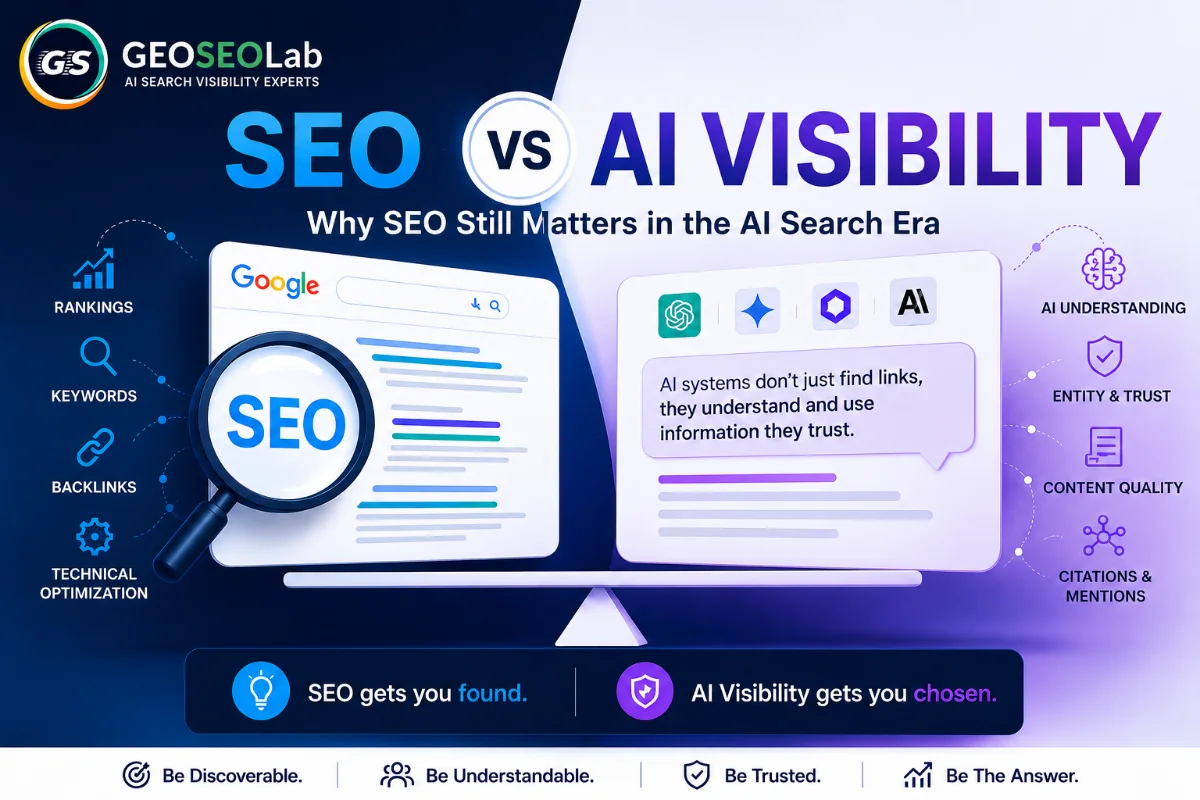
Search engine optimization has been declared dead more times than most marketing disciplines have been born.
It happened when social media exploded and everyone assumed conversation would replace search. It happened when smartphones shifted the majority of internet usage to mobile and people assumed apps would make websites obsolete. It happened when voice assistants arrived and commentators confidently predicted that keyword research was finished. It happened when featured snippets began answering questions directly in results pages and the zero-click conversation consumed entire conference agendas.Now it is happening again, this time with artificial intelligence at the center of the story.Every wave of technological change brings the same headline. SEO is dead. The evidence never quite catches up with the prediction.What makes the current moment genuinely different from previous cycles — and why it deserves serious attention rather than dismissal — is that AI is not simply changing how search results are displayed. It is changing what people fundamentally expect search to do for them. That is a more substantive shift, and it warrants a more substantive response than either panic or complacency.This editorial makes a specific argument. SEO and AI Visibility are not competing disciplines. They are not even really comparable in the way the debate usually frames them. One is a discipline with a specific technical function. The other is an outcome that depends on many things, only some of which involve traditional SEO. Treating them as adversaries creates confusion that serves nobody except the vendors selling the confusion.What actually matters — to businesses trying to make smart decisions about their digital strategy — is understanding what each concept does, where one ends and the other begins, and how they work together inside a coherent long-term approach.That is what this piece is for.The Great SEO Debate, and Why the Question Itself Is the ProblemA Brief History of Predicting SEO's DemiseLet's spend a moment with the historical record, because it is genuinely instructive.When Facebook began its ascent in the late 2000s and social media traffic started climbing, a significant portion of the marketing world concluded that organic search was becoming irrelevant. Why optimize for Google when your audience was spending hours every day on platforms that did not rely on traditional search at all? Social media would replace search as the primary discovery mechanism.
Google continued processing billions of queries every day throughout that entire period, and it has never stopped.
When mobile surpassed desktop usage, a different version of the same argument emerged. Mobile users behaved differently. They used apps. They relied on location-based recommendations. Traditional keyword-driven search seemed increasingly mismatched with how people used their phones. SEO seemed tethered to a desktop paradigm that was quietly becoming obsolete.SEO adapted. Mobile optimization became a core discipline. Local search grew into one of the most commercially significant segments of the entire industry. The discipline did not die. It expanded.
Voice search prompted particularly confident predictions. If people were speaking queries rather than typing them, keyword research as it had always been practiced seemed genuinely threatened. Long-tail keyword strategy, search volume data, position tracking — all of it seemed to assume a typed query that voice interaction was making less common.
Voice search did change the character of queries in meaningful ways. It accelerated the shift toward conversational, intent-driven content. But it did not eliminate search. It evolved it.The pattern across all of these transitions is consistent. A genuine technological change prompts genuine adaptation within SEO. The change is real. The death is not.
Artificial intelligence represents the most significant technological shift search has experienced since Google itself transformed the directory model in the late 1990s. But the historical pattern suggests our first question should not be whether SEO is dying. It should be what SEO is becoming, and what new capabilities are necessary to complement it.
The Terminology Problem Is Making Everything HarderOne of the practical obstacles to having a productive conversation about AI and search is that the industry cannot agree on what to call what is happening.
Spend a week reading marketing publications and you will encounter AI SEO, LLM SEO, LLM Optimization, Generative Engine Optimization, Answer Engine Optimization, Conversational Search Optimization, AI Visibility, and Knowledge Optimization, among others. Some of these terms are used interchangeably. Others describe meaningfully different ideas. Most are used without definition, which means readers frequently assume shared understanding that does not actually exist.The consequences of this terminological chaos are not just semantic. When terms are undefined, businesses cannot evaluate competing claims. When consultants use different terms to describe the same practice, organizations cannot assess whether they are being offered something new or simply something familiar with a fresh label. When frameworks conflict with each other because they are using the same words to mean different things, strategy becomes incoherent.
At GEO SEO Lab, we have made a deliberate choice about language. We use "AI Visibility" to describe an outcome — specifically, how effectively an organization is represented and understood across modern AI-assisted discovery environments. We use "GEO" or Generative Engine Optimization to describe a set of practices focused on organizing and structuring knowledge so that AI systems can interpret it accurately. We use "SEO" in its established sense: the discipline of helping search engines discover, understand, and rank web content.
These are not competing things. They operate at different levels and address different aspects of digital discovery. The organization that understands this clearly will make better decisions than the organization trying to choose between them.
The Questions Businesses Are Actually Asking
When we speak with founders, CMOs, and marketing teams navigating this transition, the questions they ask share a consistent underlying anxiety. They are not really asking about technology. They are asking about resource allocation.
Should we keep investing in SEO or shift that budget toward AI optimization? Does ranking first still matter when AI answers arrive before the results? Should we stop publishing blog content and focus on something else? How do AI assistants decide which companies to mention? Are we about to lose the visibility we spent years building?
These are legitimate concerns. The challenge is that many of the answers being offered in the market are designed to amplify the anxiety rather than resolve it. The "SEO is dead" framing benefits vendors selling new services. The "nothing has changed" framing benefits agencies protecting existing retainers. Neither position actually helps the business leader trying to make smart decisions with a finite budget.The honest answer, which we will develop throughout this article, is that search is genuinely evolving in ways that require expanded thinking. The foundations of that expanded thinking, however, are not mysterious or technically exotic. They involve doing the work of digital discoverability and knowledge contribution at a higher level of quality and across a broader range of touchpoints than most organizations have been accustomed to.
That is demanding. It is not a crisis.
Why Search Keeps Surviving Its Own Funerals?
The reason SEO has outlasted every prediction of its demise comes down to something simple. Search addresses a fundamental human need that does not go away.People encounter problems. They seek information to help resolve those problems. The internet is where most of that information lives. Search is the mechanism that connects the need with the information. As long as those three conditions hold — problems, digital information, and the need to find one through the other — search will matter.What changes is the character of the search experience. The interface evolves. The query format shifts. The kinds of responses people find satisfactory become more sophisticated. The definition of a good search result expands.Artificial intelligence is changing the character of search, specifically by enabling search engines to do more interpretive work on behalf of the user. Instead of retrieving a list of pages and leaving the user to synthesize them, AI-assisted search increasingly performs initial synthesis, presents organized understanding, and invites the user to go deeper in specific directions.That is a meaningful change. It affects the customer journey in ways that matter strategically. It does not, however, eliminate the need for discoverable, high-quality, authoritative content on the open web. If anything, it makes that content more important, because AI systems need material worth synthesizing.
What SEO Actually Does — And Why This Matters More Now Than Before
The Misunderstanding That Has Distorted the DebateHere is a statement that surprises many marketing professionals: SEO has never really been about rankings.This seems counterintuitive given how much of the industry's conversation, tooling, and reporting infrastructure revolves around position tracking. But rankings are not the purpose of SEO. They are a byproduct of it.The actual purpose of SEO — the problem it was designed to solve — is communication. Specifically, helping search systems understand content well enough to connect that content with users who would benefit from it.
Every individual element of SEO serves that communication objective. Keywords help search engines understand what a piece of content is about. Technical optimization ensures that content is accessible and interpretable by crawlers. Internal linking helps search engines understand the relationships between pieces of content. Structured data provides additional context about what different types of content represent. Backlinks provide external evidence about the credibility and relevance of a source.Rankings emerge from successful communication. They are not the goal — they are the signal that the goal has been achieved.This distinction matters enormously when thinking about AI-assisted search. AI systems also need to understand content. They also rely on signals of credibility and relevance. They also benefit from clear, well-structured, accessible information. The communication objective that SEO has always served does not disappear in an AI-assisted search environment — it becomes even more consequential, because AI systems are making interpretive decisions that were previously left to individual users.The Five Foundations That Have Not Changed
For all the genuine evolution that has occurred in SEO, its foundational requirements have remained remarkably stable. Every sustainable SEO strategy rests on five interconnected capabilities.Discovery is where everything begins. Before a search engine can evaluate, rank, or surface content, it needs to know that content exists. Search engines crawl the web continuously, following links and indexing pages. If content cannot be efficiently discovered — because of broken links, poor site architecture, crawl budget problems, or misconfigured technical settings — it cannot appear in results regardless of its quality. Discovery is the unglamorous foundation that supports everything else.
Understanding comes next. Finding a page is necessary but not sufficient. The search engine also needs to comprehend what the page actually covers and what it is intended to communicate. This has always been true, but the sophistication with which search systems evaluate meaning has increased dramatically over the past decade. Today's systems are substantially better at distinguishing between content that genuinely explains a topic and content that merely includes relevant keywords. That distinction has become more, not less, consequential.
Relevance is dynamic in ways that early SEO practice often did not account for. The same search query can be relevant to very different content depending on who is asking, where they are, what they have searched for recently, and what stage of a decision they are at. Optimizing for relevance means understanding not just what topics your content covers but who actually benefits from it and under what circumstances.Authority is the accumulated credibility signal that distinguishes established, trustworthy sources from new or unreliable ones. It develops over time through the accumulation of genuine endorsements — other credible sources linking to content, independent publications referencing expertise, customer communities recommending products and services. Authority cannot be manufactured or rushed. It is the long-term reward for consistently contributing value.User experience closes the loop. SEO does not end when a user clicks a result. If the page that appears loads slowly, is difficult to navigate, fails to deliver on the promise its search result made, or provides a frustrating mobile experience, those signals feed back into how the page is evaluated for future searches. Technical performance and content quality are not separate considerations — they function as a unified system.
These five foundations have not been rendered obsolete by AI. They have become prerequisites for participating in an environment where AI systems need reliable, well-structured, high-quality information to synthesize.
Where SEO's Responsibility Naturally Ends?
Understanding what SEO does exceptionally well makes it easier to see clearly where its scope naturally stops.
SEO is fundamentally oriented around webpages. It asks whether a specific piece of content on a specific domain can be found, understood, and trusted by search systems. It optimizes the relationship between individual pieces of content and search engine evaluation.Consider a realistic customer journey for a significant B2B purchase. A potential customer discovers a company through a Google search — SEO contributes there. They then visit the company's LinkedIn profile to understand the team and culture. They search for independent reviews on specialist platforms. They look for the company in industry publications and conference speaker lineups. They ask colleagues whether anyone has experience with the vendor. They may query an AI assistant to compare several options side by side.SEO directly addresses one portion of that journey — the initial discovery through search. The customer's confidence, however, is being shaped by everything they encounter across the entire sequence. The quality of the LinkedIn profiles. The consistency between how the company describes itself on its website and how it is described in press coverage. The character of the customer reviews. The credibility visible in the team's professional backgrounds.None of those things are SEO in the traditional sense. But all of them influence the outcome that SEO was deployed to support.This is not a criticism of SEO. It is a description of its scope. Recognizing where SEO's responsibility ends is the first step toward understanding what needs to exist alongside it.Understanding AI Visibility — What It Actually Means and Why the Definition Matters?
Editorial Note: The Visibility Pyramid™ introduced in this section is an original strategic framework developed by GEO SEO Lab. It is a conceptual model for thinking about digital visibility, not an official framework from Google, OpenAI, Microsoft, Anthropic, or Perplexity. Defining the Term That the Industry Has Left Undefined
"AI Visibility" has become one of those phrases that everyone uses and nobody defines. It appears in conference presentations, agency pitches, and vendor marketing materials with the confidence of a well-established concept, despite the fact that different people mean entirely different things when they say it.Some use the phrase to mean appearing in ChatGPT responses. Others use it specifically in reference to Google's AI Overviews. Some treat it as a technical challenge involving prompt engineering or schema optimization. Others use it as a synonym for traditional SEO with an AI adjective attached.This ambiguity is not just semantically frustrating. It leads organizations to make strategic decisions based on a misunderstanding of what they are actually trying to achieve.At GEO SEO Lab, we define AI Visibility as an outcome: specifically, how effectively an organization is represented, understood, and trusted across the range of AI-assisted discovery experiences that potential customers use during their research journeys.Notice what that definition includes and what it excludes.It is outcome-oriented rather than tactic-oriented. AI Visibility is not a specific set of technical actions. It is the result of many different organizational activities and capabilities.
It is broad in scope. It extends beyond any single platform or feature. A customer might encounter AI-assisted search through Google's AI Overviews, through a conversation with ChatGPT, through Perplexity, through Gemini integrated into workspace tools, or through AI features embedded in other applications. AI Visibility describes how well an organization is represented across that range of encounters, not just in one of them.It includes trust explicitly. Representation and understanding are necessary but not sufficient. Customers need to encounter an organization as credible, not merely as present.The Difference Between Presence and VisibilityOne of the most common mistakes organizations make when thinking about digital strategy is conflating presence with visibility.Having accounts and profiles across multiple platforms is presence. Presence is relatively easy to establish and almost universally insufficient on its own.
Visibility is what happens when all of those presences work together to create a coherent, credible, recognizable picture of who an organization is and what it offers. Visibility requires consistency, depth, and quality across the full range of touchpoints where potential customers might encounter a brand.The fragmentation problem is more widespread than most organizations realize. A company might have a polished, professionally designed website that positions it as an enterprise-grade AI platform. Its LinkedIn page, last updated fourteen months ago, describes it in language that emphasizes a consultancy model. An industry directory it claimed years ago categorizes it under a product segment it no longer serves. Its founder's profile is focused on previous work at a different company. The reviews on specialist platforms include several unanswered complaints.Each individual element might seem like a minor issue. Collectively, they create a fractured picture. A customer doing due diligence — and customers doing significant due diligence almost always look across multiple sources — assembles these fragments into a composite impression. When the fragments contradict each other, the impression is uncertainty.AI systems increasingly operate within this same broad information ecosystem. They do not evaluate a single webpage in isolation. They process signals from across the web and attempt to synthesize a coherent understanding of entities — organizations, products, people, and the relationships between them. An organization whose digital footprint is fragmented and inconsistent gives those systems less coherent material to work with.
The Visibility Pyramid: A Framework for Building on Solid GroundTo help organizations think systematically about the different layers of digital visibility and how they relate to each other, GEO SEO Lab developed the Visibility Pyramid. The framework has five layers, each building on the one beneath it. Attempts to strengthen an upper layer without addressing weaknesses in lower layers consistently produce disappointing results.Layer One — Technical SEO: The Foundation Everything Else Rests OnEvery sustainable visibility strategy begins with ensuring that content can actually be found. Search engines and AI systems alike depend on the open web for information, and they can only work with content that is accessible and interpretable.Technical SEO addresses the infrastructural elements that make this possible. Crawlability ensures that search engine bots can reach all important content. Site architecture helps search systems understand how content is organized and which pages are most significant. Internal linking supports the discovery of related content and reinforces the relative importance of different pages. Page performance — loading speed, mobile responsiveness, stability of layout elements — affects both user experience and search engine evaluation. Structured data, where appropriate, provides additional machine-readable context about what content represents.These elements are unglamorous. They rarely generate the kind of visible, immediately attributable wins that make marketing presentations exciting. They also rarely receive the sustained attention they deserve, which is why technical debt quietly accumulates in the SEO foundations of many organizations while investment flows toward more visible activities.No amount of content excellence, brand authority, or customer trust compensates for a website that search systems cannot efficiently access and understand. This is the floor, and it is non-negotiable.Layer Two — Knowledge: The Substance That Makes Visibility MeaningfulOnce content can be discovered, the next question is whether it is actually worth discovering.
The internet has never been short of information. AI has made it dramatically easier to generate more of it. What the internet is genuinely short of — and what is becoming increasingly scarce and increasingly valuable as AI-generated content proliferates — is original knowledge.
There is a meaningful distinction between information and knowledge. Information is the transfer of existing content from one place to another. Most of what appears in blog post production pipelines across most industries is information — a repackaged version of what other sources have already said, optimized for search engines but not contributing anything new to the collective understanding of the topic.
Knowledge emerges from original research, direct experience, proprietary data, deep expertise, and the synthesis of observations that have not been organized in this way before. Knowledge contributes something that did not previously exist in the public domain.The distinction matters more than it ever has. AI systems are quite capable of synthesizing existing information. They are not capable of replacing firsthand expertise, proprietary research, or the kind of perspective that comes from years of direct work in a domain. Organizations that produce genuine knowledge rather than information-shaped content are creating assets that AI systems can cite and synthesize, rather than simply replicating.
This layer requires genuine organizational investment. It cannot be outsourced to a content production agency operating without domain expertise. It requires the involvement of people who actually know things — subject matter experts, practitioners, researchers — in the content creation process. That involvement is more expensive and more demanding than producing derivative content at scale. It is also the only path toward differentiated knowledge assets.
Layer Three — Entity Understanding: The Layer Where AI Visibility BeginsThis is where the conversation shifts from traditional SEO into territory that is genuinely new.Modern search systems — and AI systems in particular — are increasingly oriented around entities rather than documents. An entity, in this context, is a coherent thing in the world: an organization, a product, a person, a place, a concept. Search systems are attempting to build knowledge graphs that represent the relationships between entities and the attributes that characterize each one.When someone searches for your company — or when an AI system encounters a question where your company might be a relevant answer — the system is not just evaluating your homepage. It is attempting to construct an understanding of your organization from across everything it knows about you. What you do. Who leads you. Who your customers are. What problems you solve. How you are described across different sources. What other credible sources have said about you.
Entity understanding is therefore about organizational coherence across the full digital footprint. Is the description of your company consistent across your website, your LinkedIn page, industry directories, press coverage, and customer reviews? Are your products and services described in language that clearly communicates what they do and who benefits from them? Are your team members' professional profiles visible and accurate? Is there meaningful agreement between how you describe yourself and how independent sources describe you?
Strong entity understanding reduces ambiguity for both human researchers and AI systems. It makes an organization easier to understand, easier to categorize, and easier to recommend in contexts where it is relevant.
Layer Four — Authority: The External Validation That Presence Cannot Replace
Authority occupies its own layer in the pyramid because it operates fundamentally differently from everything beneath it.
Technical SEO, knowledge quality, and entity consistency are largely within an organization's direct control. Authority is not. Authority is the accumulation of external recognition — the signal that independent third parties have evaluated your expertise and found it credible.In traditional SEO terms, backlinks from credible external sources have always been a primary authority signal. That remains true. But authority in a broader digital visibility context extends to the full range of independent validation: press coverage that treats the organization as a credible expert source, customer reviews that reflect genuine satisfaction, industry recognition earned through demonstrated capability, references in professional communities, citations in research or educational content, speaking invitations from respected organizations.
What these have in common is that they cannot be manufactured. They can be positioned for — organizations can publish research worthy of citation, pursue relationships with journalists who cover relevant topics, maintain customer experiences that generate genuine positive reviews. But the recognition itself comes from outside the organization, and its value lies precisely in that independence.Authority is also cumulative and slow-building in ways that create real competitive advantages. An organization that has spent five years consistently earning external recognition has built something that a competitor cannot replicate quickly with a sudden increase in content production or an advertising campaign. The slow pace of building is exactly what makes genuine authority valuable.Layer Five — Digital Trust: The Conversion of Visibility Into OutcomesTrust occupies the apex of the pyramid because it is where visibility becomes commercially meaningful. An organization might be discoverable, knowledgeable, clearly understood, and externally recognized, and still lose business to competitors that customers feel more comfortable choosing.Trust is the accumulated confidence that a customer develops through repeated, consistent, positive encounters with an organization's digital presence. It develops gradually, through a long series of small confirmations. A piece of educational content that turns out to be accurate and practical. A pricing page that is clear rather than obscure. A case study that is specific and honest rather than vague and self-congratulatory. A customer review that reflects an experience consistent with what the organization promises. A follow-up from the sales team that respects boundaries rather than pressuring.None of these individual interactions is decisive. Together, they lower the psychological barrier to commitment. They create the conditions under which a customer feels that choosing this organization carries acceptable risk.Trust is also the layer most sensitive to damage. Years of trust-building can be undermined by sustained inconsistency, by overpromising and underdelivering, or by allowing the gap between how an organization presents itself and how it actually operates to become visible. In a digital environment where customer experiences are shared publicly and persistently, that damage is difficult to contain.
SEO, GEO, AI Visibility, and Digital Trust — The Unified Strategy That Actually Works
Why the Industry Does Not Need Another Acronym War
Every few years, digital marketing introduces a wave of new terminology, and a predictable debate follows about which new concept replaces which old one. The debate almost always obscures more than it reveals.
The current wave — GEO, AEO, LLM SEO, AI Visibility, Answer Engine Optimization — is generating its own version of this debate. Thought leaders compete to establish which acronym will become the industry standard. Vendors build products around whatever terminology seems to be gaining traction. Businesses try to figure out whether they need to restructure their entire approach or whether this is simply another iteration of what they have always done.
The practically useful answer is usually quieter than the debate suggests. New terminology is sometimes genuinely useful when it captures something real that existing language does not describe adequately. It is often not useful when it simply renames existing practices, creating the impression of novelty without the substance.At GEO SEO Lab, the way we think about the relationship between different disciplines looks something like this:SEO addresses discoverability. It answers the question of whether search engines can find, access, interpret, and evaluate your content. This is technical and content-oriented work, and it remains foundational.GEO — Generative Engine Optimization as we use the term — addresses knowledge organization. It asks whether information is structured and expressed in ways that AI systems can interpret accurately and use effectively. It extends beyond individual pages to consider how knowledge is represented across an organization's digital presence.AI Visibility is an outcome that both SEO and GEO contribute to, along with many other factors including brand authority, entity consistency, and the quality of customer experiences. It describes how well an organization is represented and trusted across AI-assisted discovery environments.Digital Trust is the conversion mechanism. It describes the accumulated confidence that transforms visibility into commercial outcomes — the difference between being seen and being chosen.
These are not competing disciplines. They are complementary layers of a coherent strategy. An organization that masters SEO but neglects entity consistency will struggle with AI Visibility. An organization with strong AI Visibility but weak Digital Trust will see visits that do not convert. An organization investing in Digital Trust without adequate SEO foundations will build credibility that potential customers cannot find.
What This Looks Like in Practice Across Different Industries?
The abstract framework becomes more useful when applied to specific contexts.
For a healthcare organization, technical SEO ensures that treatment information, practitioner profiles, and patient education content can be found. Knowledge contribution might involve physicians creating educational resources that reflect current clinical evidence. Entity consistency means that the organization's descriptions across all platforms — directories, Google Business Profile, social media, review sites — agree on what the practice does, where it is located, and who it serves. Authority develops when independent publications reference the organization's clinical expertise. Trust accumulates through patient reviews that reflect genuine care experiences and through the transparency of information provided to patients before they arrive.
For a B2B SaaS company, SEO addresses product pages, comparison content, and educational resources. Knowledge contribution might involve engineering blogs, benchmark research, or implementation documentation that genuinely advances the understanding of practitioners in the field. Entity consistency means that the company's positioning is coherent whether a prospect encounters it on the website, a review platform, a LinkedIn post, or an industry publication. Authority grows when analysts reference the product, when customers speak at conferences about their results, and when the engineering team's insights are cited by peers. Trust develops through the quality and transparency of case studies and through customer support experiences that reinforce the promises made during sales.
For a local professional services firm — a law practice, an accounting firm, a specialist clinic — the same principles apply at a different scale. Technical SEO and local search optimization ensure the firm appears when people in the relevant geography search for relevant services. Knowledge contribution might involve the practitioners writing about their areas of expertise in ways that are genuinely useful to clients navigating unfamiliar territory. Entity consistency means that contact information, service descriptions, and practitioner profiles agree across all the places a potential client might look. Authority develops through client reviews and through visibility in local professional communities. Trust is built through every interaction from first inquiry through engagement.
Across all of these contexts, the structure is the same even if the tactics differ. The pyramid operates at every scale and in every sector.
A Framework for Evaluating Where You Actually Stand
One of the most practically useful things an organization can do is conduct an honest assessment of its current standing across each layer of the pyramid. The following questions are intended to prompt that assessment. They are not a technical checklist — they are strategic questions that require organizational honesty to answer well.
Technical Foundation Questions
Can search engines efficiently access all the content that matters to our business? Do we have any significant crawl errors, indexing problems, or technical barriers that are preventing important pages from being discovered? Does our site perform adequately across mobile devices? Is our internal linking structure helping search systems understand which content is most important?
When we look honestly at our content, does it contribute anything that could not be found in essentially the same form from multiple other sources? Do we have access to genuine expertise — practitioners, researchers, people with direct experience — who are involved in creating content? Are we producing anything based on original research, proprietary data, or firsthand observation? Is our content being updated when the underlying information changes?
Entity Consistency Questions
If a potential customer spent twenty minutes investigating our organization across a range of platforms — our website, our LinkedIn presence, industry directories, review sites, press coverage, our team's professional profiles — would they receive a consistent, coherent picture? Are there contradictions between how we describe ourselves in different contexts? Is our business information accurate and current everywhere it appears?
Authority Development QuestionsWhen independent sources — journalists, researchers, analysts, customers — encounter our organization, do they treat us as a credible expert source? Are we earning external recognition through the quality of our work, or are we primarily claiming expertise internally? What does the quality and recency of our external validation signal to a skeptical evaluator?
Trust Building Questions
Does the experience a customer has when they interact with our organization reinforce the promises our digital presence makes? Are our case studies specific and honest? Is our pricing transparent? Are customer reviews reflected accurately in our public profiles and actively managed? Do our educational resources serve the reader's genuine interests rather than primarily serving our sales objectives?
Most organizations will find meaningful gaps somewhere in this assessment. That is not a failure — it is an accurate diagnosis. The gaps are opportunities, and the pyramid structure suggests a sequence for addressing them. Start with the foundation and work upward. Investing heavily in authority-building while ignoring technical accessibility is like decorating a house whose structural foundations have not been addressed.
A Practical Checklist for the Year Ahead
This checklist represents GEO SEO Lab's strategic recommendations. It is not an official framework from any platform provider.
On the technical side, the priorities are consistent with what good SEO has always required: accessible, crawlable pages; logical site architecture; clean internal linking; adequate mobile performance; appropriate use of structured data where it genuinely helps search systems understand your content.
On knowledge quality, the most important shift is from volume to depth and originality. Fewer pieces of content that contribute genuine insight are worth more than many pieces that repackage existing information. Involving actual subject matter experts in content creation — not just in reviewing finished drafts, but in shaping the ideas — is the difference between derivative and differentiated.
On entity consistency, a practical first step is a systematic audit. Search for your organization across all the platforms where you have a presence, and compare what you find. Look at your own website, your LinkedIn company page, your team members' individual profiles, industry directories, review platforms, and any press coverage. Note every inconsistency and prioritize resolving them by starting with the platforms your potential customers are most likely to encounter.
On authority development, resist the temptation to treat this as a PR campaign. Authority develops through genuine contribution. Publish research worth citing. Create educational resources that practitioners actually reference. Build relationships with journalists through genuine helpfulness over time. The visible authority you want in two years starts with the quality of contributions you are making today.
On digital trust, the most important principle is alignment. The experience a customer has when they actually engage with your organization must match the picture your digital presence paints. Overpromising in content and underdelivering in practice does not just cost individual customers — it generates the kind of negative review activity and word-of-mouth that systematically undermines the trust you are trying to build.
Looking Ahead — What the Next Several Years Are Likely to Bring
This section reflects GEO SEO Lab's analysis and forward-looking perspective. It should not be read as documented guidance from any platform provider.
Search Will Become Substantially More Conversational
The shift toward conversational search is not a future trend — it is already well underway. But the degree to which this changes both user behavior and content strategy has not yet fully played out.
As AI-assisted search becomes more capable and more widely adopted, users will increasingly interact with search as an ongoing conversation rather than a series of independent queries. They will ask follow-up questions. They will refine their understanding iteratively. They will expect search systems to maintain context across a session rather than treating each query in isolation.
For content strategy, this means the value of comprehensive, well-structured content that addresses a topic from multiple angles — including the angles that readers commonly explore as follow-ups — will increase. Content that answers one specific query well but leaves adjacent questions unaddressed is less valuable in a conversational search environment than content that serves as a reliable anchor for a broader topic.
Entity Understanding Will Become a Primary Competitive Dimension
Search systems have been developing entity understanding for years, but the pace is accelerating. As these systems become better at recognizing and categorizing organizations, products, and people, the clarity and consistency of an organization's entity profile will become an increasingly significant competitive differentiator.
Organizations that have clear, consistent, richly documented digital identities — whose products are described coherently everywhere they appear, whose team members have visible and credible professional profiles, whose positioning is coherent across all public touchpoints — will be better positioned to be recognized and represented accurately across AI-assisted discovery experiences.
The practical implication is that entity management — something that has historically been treated as a secondary concern in many SEO strategies — deserves deliberate, ongoing attention.
Original Knowledge Will Be the Sustainable Moat
The proliferation of AI-generated content is creating a paradox. Content production has never been easier, which means the overall volume of published content is accelerating. At the same time, the proportion of that content that is genuinely original and expert-driven is declining. AI can produce plausible, well-formatted information quickly. It cannot produce firsthand expertise, proprietary research, or the specific insights that come from direct experience in a domain.
Organizations that invest in genuine knowledge creation — that build content practices around expert involvement, original research, and the documentation of firsthand experience — are building assets that become more valuable as the surrounding content environment fills with derivative material. This is not a short-term tactic. It is a long-term strategic positioning decision.
Trust Metrics Will Become Organizational KPIs
For most of the digital marketing era, the metrics that informed executive decision-making were primarily acquisition metrics: traffic, rankings, leads, conversions, revenue. These metrics are valuable and will remain so.
What the AI era is likely to add is a growing organizational interest in trust metrics: the consistency and quality of customer reviews across platforms, the coherence of brand representation across the digital footprint, the rate at which earned media treats the organization as a credible expert source, the share of customer decisions that involve the organization being recommended by someone the buyer trusts.
These metrics are harder to measure than rankings or traffic. They matter more for long-term competitive position. Organizations that develop the capability to track and improve them will be better positioned to make the decisions that create durable advantages.
Conclusion: The Organization Worth Discovering
Let's return to where we started.
SEO is not dead. The evidence for this remains exactly what it has always been — search is still the mechanism through which billions of people every day connect needs with information. That mechanism is evolving, sometimes rapidly. It is not disappearing.
AI Visibility is not a replacement for SEO. It is an expanded outcome that depends on SEO as its foundation, and on many other organizational capabilities built above that foundation. The organizations trying to achieve AI Visibility while neglecting their technical SEO foundations are building ambitious structures on unstable ground.
The genuine strategic challenge that AI-assisted search introduces is a higher bar for organizational quality. When a customer's initial understanding of a topic — including which organizations seem credible and worth considering — is increasingly shaped before they visit any individual website, the threshold for becoming one of the organizations that shapes that understanding is higher than it has ever been.
That higher bar is not met by technical tricks or optimization hacks. It is met by organizations that genuinely deserve to be discovered. Organizations that know things worth knowing and communicate that knowledge clearly. Organizations whose digital presence is coherent and consistent across all the places their customers look. Organizations that have earned external recognition through the quality of their work rather than the aggressiveness of their self-promotion. Organizations that have built trust through the alignment between their promises and their actual practice.
The question worth asking is not "how do we optimize for AI?" It is "how do we become an organization that AI systems, search engines, and real human beings consistently identify as a credible, valuable source of knowledge in our domain?"
That question does not have a shortcut answer. It has a sustained, demanding, rewarding answer — and the organizations that commit to pursuing it now will have built meaningful advantages by the time the competitive pressure becomes undeniable for everyone.
SEO remains the foundation. GEO strengthens the knowledge layer. AI Visibility reflects how well the whole picture is understood. Digital Trust is what converts that understanding into customers who stay and recommend you to others.
The most successful organizations of the next decade will not choose between these. They will build all four, together, with patience and discipline and genuine commitment to the expertise that makes each of them real.
About GEO SEO Lab
GEO SEO Lab works with organizations to improve their visibility across Google Search, Google Maps, ChatGPT, Gemini, Perplexity, Claude, and other AI-assisted discovery platforms. Our approach combines technical SEO, Generative Engine Optimization, AI Visibility analysis, Local Visibility, entity optimization, and digital trust strategy to help businesses navigate the evolving landscape of digital discovery.
Tags
Frequently Asked Questions
Find answers to common questions about this topic
About the Author

Aman Kesharwani
SEO Expert & Content Creator
Experienced digital marketing professional specializing in SEO strategies, content optimization, and data-driven marketing solutions. Passionate about helping businesses grow their online presence and achieve better search rankings.
Related Articles
View all posts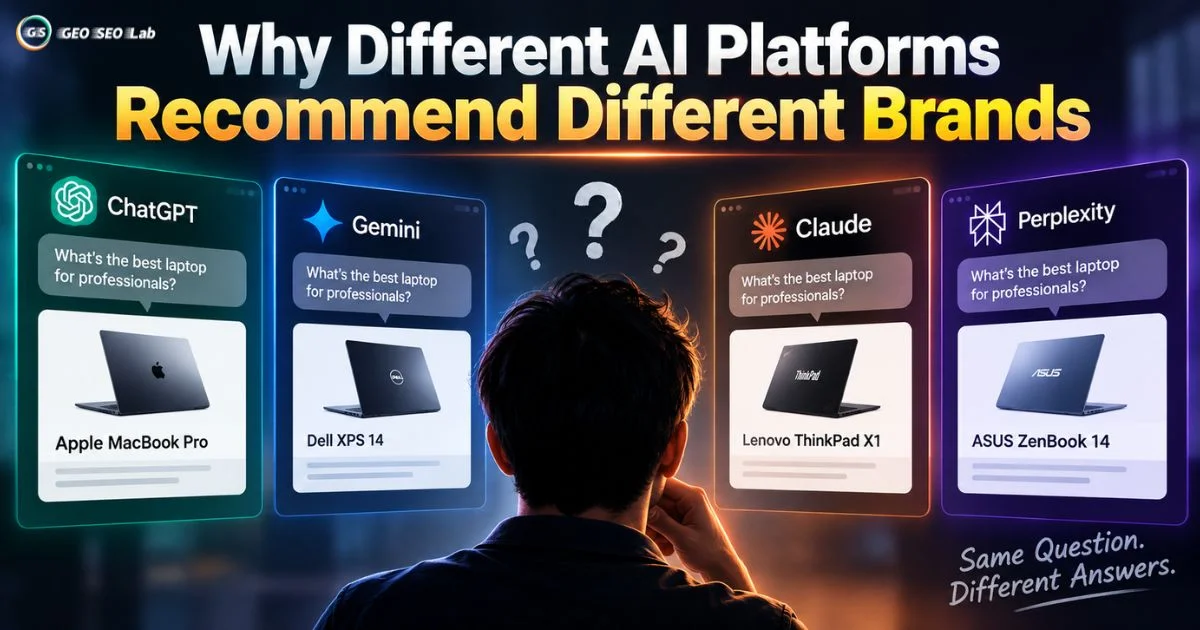
Why Different AI Platforms Recommend Different Brands
Why Different AI Platforms Recommend Different BrandsSame Question, Four Answers, Almost Zero OverlapA GEO SEO Lab ReportEditorial Disclosure: This re...
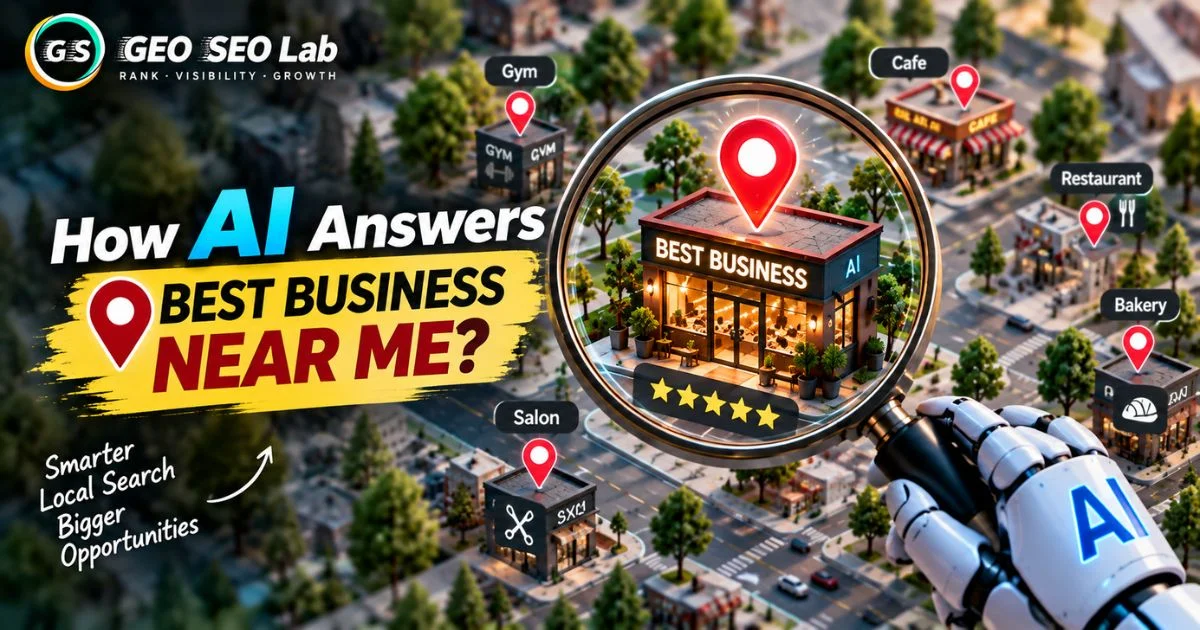
How AI Answers “Best Business Near Me” in 2026 | Local AI Search
How AI Answers "Best Business Near Me"Inside the Shortlist That Decides Who Gets the CallA GEO SEO Lab ReportEditorial Disclosure: This report introdu...
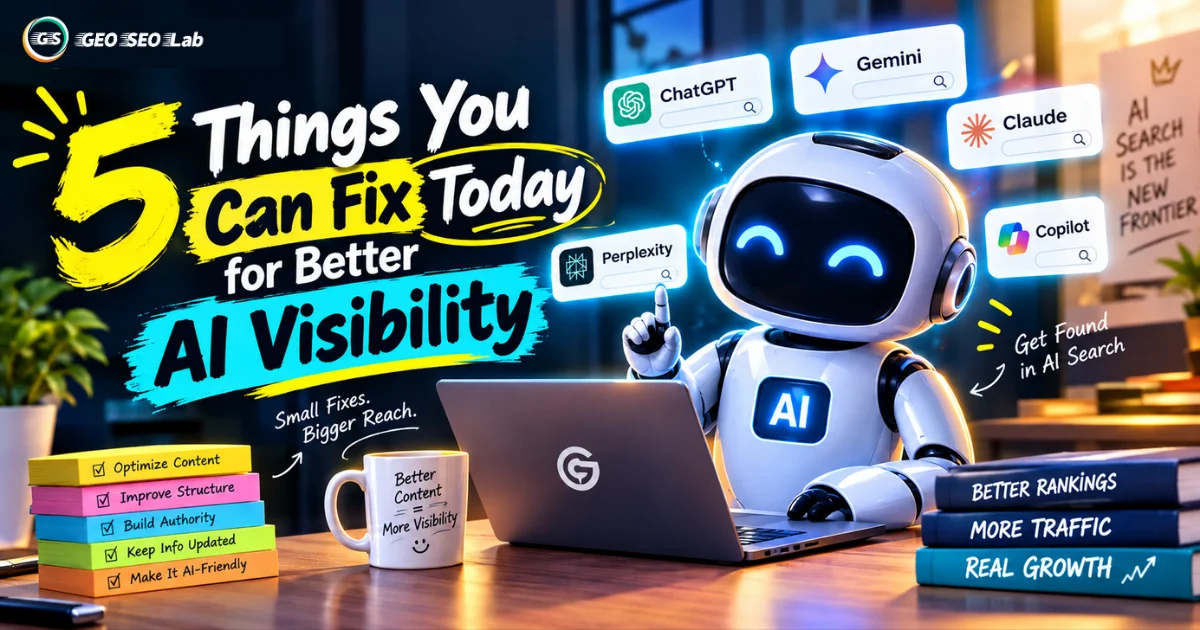
How to Improve AI Visibility in 2026 : 5 Fixes You Can Make Today
5 Things You Can Fix Today for Better AI Visibility No Redesign, No New Budget, Just Real Fixes You Can Ship This Afternoon Introduction Most GEO advice ...