The AI Visibility Score: A New Framework for Measuring Brand Presence Across AI Search
Learn how to measure your brand's presence across ChatGPT, Google AI Mode, Gemini, Claude, Perplexity, and Grok with the AI Visibility Score™. Discover a practical framework for evaluating AI citations, recommendations, retrieval readiness, authority, and overall AI search visibility.
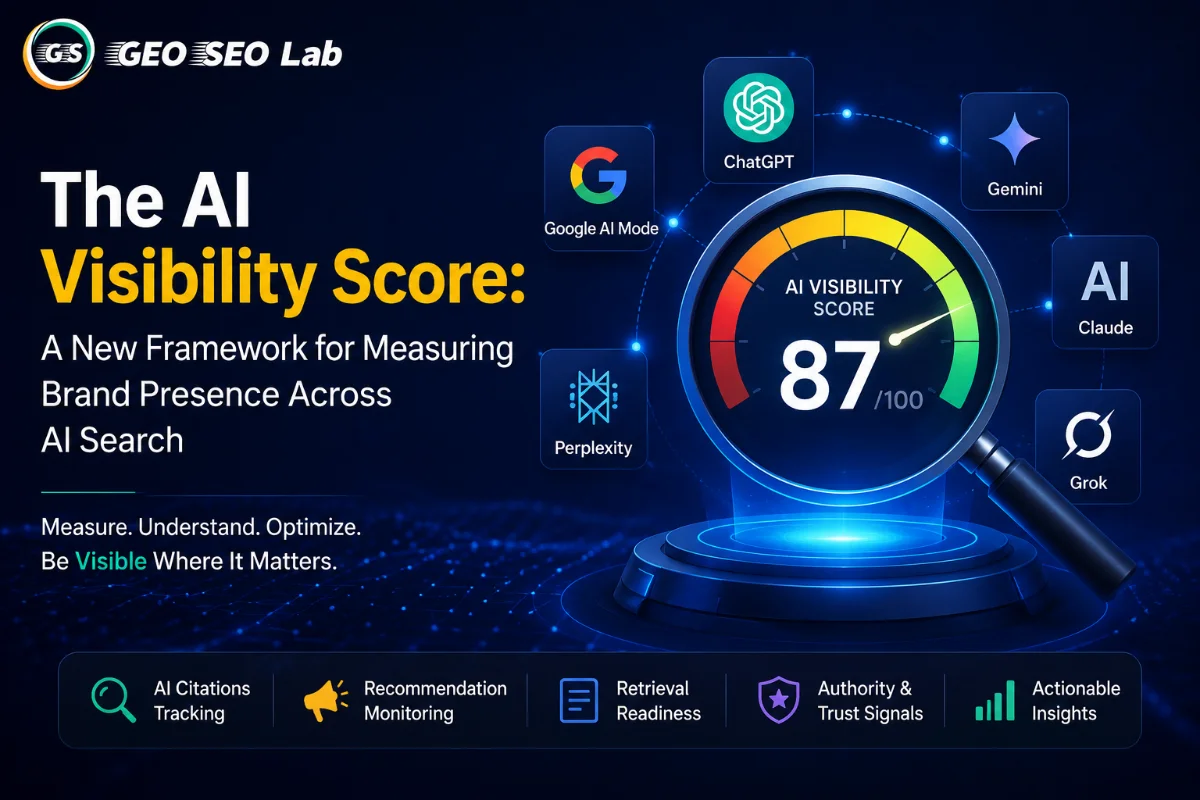
The AI Visibility Score: A New Framework for Measuring Brand Presence Across AI Search
How Businesses Can Measure Their Visibility Across ChatGPT, Google AI Mode, Gemini, Claude, Perplexity, Grok, and the Next Generation of AI Search The rules of digital discovery have quietly shifted beneath our feet. Most businesses haven't noticed yet but the ones that have are already pulling ahead.
Opening Thoughts: A Measurement Problem Nobody Saw Coming
Picture a potential customer sitting at their desk with a specific problem to solve. Three years ago, they would have typed a few keywords into Google, scanned a list of blue links, clicked through to a handful of websites, and eventually landed on a business that seemed credible enough to contact. The journey was imperfect, but it was predictable. Businesses understood it. They optimized for it. They built entire departments around it. That same customer today does something subtly different. They open ChatGPT, or Google AI Mode, or Perplexity, and they ask a question in plain language. They describe their situation in full sentences, the same way they would talk to a knowledgeable colleague. Within seconds, they receive a structured, thoughtful answer that synthesizes information from dozens of sources and that answer either mentions a business by name or it doesn't.
No list of links. No ranking page to scroll through. No second chance if the brand wasn't part of the response.
This is the reality that most marketing dashboards aren't equipped to measure. And it represents one of the most significant strategic challenges businesses have faced in the digital era. For more than two decades, organizations built their digital strategies around a relatively stable set of questions. Where do we rank on Google? How much traffic does our website receive? How many backlinks have we accumulated? What is our clickthrough rate from search results? How many conversions can we trace back to organic search? These questions drove enormous investment in SEO, content marketing, technical optimization, and link acquisition and they still matter. Nobody is suggesting they don't.
But they no longer tell the complete story. When a user receives a direct answer from an AI assistant, the traditional search funnel collapses. There's no impression, no click, no visit. The business either influenced the answer or it didn't. It was either mentioned, recommended, cited, or summarized or it was completely absent. And here's what makes this genuinely disorienting for strategists: a company can rank first on Google for every target keyword while simultaneously receiving zero mentions across AIgenerated responses. Those two realities can coexist. Traditional SEO metrics would never flag this as a problem. This is precisely why a new measurement framework is necessary. Not as a replacement for SEO, but as an essential companion to it. GEO SEO Lab developed The AI Visibility Score™ to address this gap to give organizations a structured, repeatable way to evaluate how effectively they participate in AIgenerated discovery across the platforms their customers increasingly rely on.
Why Traditional Metrics Fall Short in an AIPowered World
The Dashboard Designed for a Different Era
Most marketing dashboards were architected around a specific assumption: that visibility meant appearing in a list of webpage results, and that success meant users clicking through to those pages. Every major metric in the traditional SEO toolkit reflects this assumption. Rankings tell you where a page appears in search results. Impressions tell you how often it was shown. Clicks tell you how many users acted on those impressions. Traffic tells you how many visitors arrived. Bounce rate tells you whether they stayed. Conversions tell you whether they took a desired action. Cost per acquisition tells you what that conversion cost you. Each of these metrics assumes a user who navigated through a search results page. Each one depends on a click happening somewhere in the journey.
AIpowered search breaks this chain entirely. Consider what actually happens when someone asks Google AI Mode to recommend accounting software for a midsized manufacturing company. The AI system doesn't return a list of links for the user to evaluate. It synthesizes available knowledge, weighs the credibility of various sources, considers the specific context of the query, and generates a response that might name two or three solutions, explain the relevant strengths of each, and offer a recommendation based on the described use case. The user reads the answer. They may never click a single link. If your brand appeared in that response, you influenced a purchasing consideration without generating a single pageview. If your brand didn't appear, you were effectively invisible to that customer at a critical decision point and your traditional dashboard would show no evidence of this gap whatsoever. This is not a theoretical concern. It is happening right now, across every industry, at a scale that will only grow as AI assistants become more capable and more deeply integrated into how people find information.
Visibility Has Become MultiDimensional
One of the most important conceptual shifts in understanding AI visibility is moving away from a binary view of presence. In traditional search, a page either ranked or it didn't. It appeared or it didn't. You were on page one or you weren't. The measurement was blunt, but it was simple. AI search introduces gradations of visibility that require more sophisticated thinking. A business might be retrieved by an AI system during its research phase without ever appearing in the final response. It might be used as background knowledge that shapes an answer without receiving explicit attribution. It might be cited as a source but not recommended as a solution. It might be recommended in some contexts but not others. Or it might be entirely absent from AI consideration across all platforms and query types.
Each of these represents a meaningfully different level of presence, and each requires different strategies to improve.
The journey from organizational expertise to AIgenerated answer looks nothing like the traditional search funnel. Instead of ranking leading to impressions leading to clicks, the chain runs from knowledge to retrieval to evaluation to AI response to brand visibility. Organizations without a structured way to measure each link in this chain are flying blind.
Introducing the AI Visibility Score
A Framework Built for the AI Era
The AI Visibility Score is not a single number generated by a crawler. It is a structured evaluation framework that assesses an organization's overall presence across AIpowered search ecosystems by examining multiple dimensions of visibility simultaneously. The core insight behind this framework is that AI systems don't randomly surface information. They make evaluative judgments about which sources are credible, which knowledge is comprehensive, which entities are consistently represented, and which organizations have demonstrated genuine expertise in a domain. By understanding the factors that drive these judgments, businesses can take deliberate, measurable steps to improve how AI systems recognize and represent them.
The framework operates through five interconnected layers:
Knowledge Quality forms the foundation. Without meaningful, accurate, comprehensive knowledge assets, no other optimization effort produces sustainable results. AI systems are increasingly good at distinguishing between genuinely informative content and content designed purely to rank. Retrieval Readiness comes next. Even excellent knowledge must be organized in ways that allow AI systems to find it, understand its structure, and connect it to relevant queries. Poor information architecture can render valuable expertise effectively invisible. Authority Signals matter because AI systems weight information sources according to credibility indicators. Organizations with demonstrated expertise through original research, consistent publishing, industry recognition, and subject matter depth are more likely to be trusted as sources.
AI Recognition represents the moment when these inputs combine to produce actual visibility. The system has retrieved the knowledge, evaluated its authority, and is now incorporating it into a response. Business Influence is the outcome the tangible effect of AI visibility on brand perception, customer consideration, and ultimately commercial outcomes.
Why One Score Isn't Enough ?
There's an understandable executive desire for a single dashboard number. "What's our AI Visibility Score?" is a clean, reportable question. And while a summary score does have strategic value for highlevel tracking and executive communication, relying on a single number alone creates dangerous blind spots. Consider a business that performs exceptionally well on knowledge quality but has weak entity consistency. AI systems may trust the information it publishes while simultaneously struggling to confidently associate that information with the specific organization. The result: the knowledge gets used, but the brand doesn't get credit. A single aggregate score might look acceptable while this specific problem goes undiagnosed. Or consider the reverse: a business with strong entity signals and good retrieval architecture but shallow topical coverage. AI systems know who they are, but don't have enough substantive knowledge to cite them confidently on highvalue queries. The AI Visibility Score™ is designed to surface these nuances rather than hide them behind an average. The goal isn't a flattering number it's an honest picture that enables strategic action.
The Six Dimensions That Define AI Visibility
Dimension One Knowledge Visibility
Everything in AIpowered search begins with knowledge. Not content. Knowledge.
The distinction matters. Content is what gets published. Knowledge is what gets understood, verified, and incorporated into AI reasoning. The two overlap, but they are not identical. A website can contain thousands of pages of content while contributing very little knowledge that AI systems find worth referencing. Conversely, a business with a smaller but more carefully constructed knowledge base can achieve disproportionate AI visibility because every asset it publishes adds something genuine to the conversation. Knowledge visibility measures how effectively an organization contributes meaningful, accurate, and original information to its domain. Strong knowledge visibility requires several things to work together. The organization's expertise must be comprehensive enough to address the full range of questions its audience is likely to ask. The depth must match the sophistication of its target queries surfacelevel treatments of complex topics rarely satisfy AI systems trained to recognize genuine expertise. The knowledge must remain current, updated as industries evolve and new information emerges. And it must be presented clearly enough that both human readers and AI systems can extract meaning from it without difficulty. Original research is particularly valuable here. When an organization publishes findings that don't exist anywhere else proprietary survey data, internal case studies, novel frameworks developed from direct experience it creates knowledge assets that AI systems cannot source from competing organizations. This is one of the most durable competitive advantages available in AIpowered search.
Dimension Two Entity Visibility
AI systems increasingly organize their understanding of the world around entities rather than keywords. An entity is a distinct, identifiable thing a person, a company, a product, a concept, a location that can be connected to other entities through meaningful relationships. When an AI system encounters a query about enterprise data security software, it doesn't just look for pages containing those words. It considers what it knows about organizations operating in this space, their products and services, their reputations, their connections to industry publications and expert voices, and how other entities in the knowledge ecosystem relate to them.This is why entity visibility matters as a distinct dimension. An organization might publish excellent content while maintaining inconsistent entity signals across its digital footprint using slightly different brand names in different contexts, describing products with inconsistent terminology, failing to connect expert authors to the organization they represent, or neglecting the structured data implementations that make entity relationships explicit. A welldefined entity ecosystem looks something like this: the organization at the center, connected clearly to its brands, products, services, geographic locations, expert personnel, published research, and the industries it serves. The richer and more consistent these connections, the easier it becomes for AI systems to build a confident understanding of who the organization is and what it genuinely knows.
Dimension Three Retrieval Visibility
Publishing excellent knowledge in a clear entity framework doesn't automatically make that knowledge accessible. Retrieval visibility addresses a practical question: when an AI system goes looking for information relevant to a given query, how easily can it find, parse, and connect the organization's expertise? This dimension covers the structural and architectural decisions that determine discoverability. Wellorganized topic clusters help AI systems understand how different pieces of knowledge relate to one another. Clear internal linking signals the relationships between concepts. Consistent terminology reduces ambiguity. Logical information hierarchies make it easier to navigate from broad concepts to specific details. Poor retrieval architecture is a common and often overlooked problem. Organizations invest substantially in producing highquality content, then structure it in ways that make it difficult for AI systems to follow the threads of expertise from one asset to another. The knowledge is technically available, but the path to it is unclear.
Improving retrieval visibility often involves auditing existing content architecture rather than creating new content identifying where connections are missing, where terminology is inconsistent, where topic clusters have gaps, and where the navigation logic doesn't match how users (or AI systems) actually explore a knowledge domain.
Dimension Four Authority Visibility
Authority in the context of AI visibility is not simply a matter of having many backlinks, though external signals remain relevant. It reflects something more fundamental: has the organization consistently demonstrated genuine expertise over time, in ways that AI systems can recognize and trust? Several factors contribute to authority signals. Original research is among the most powerful organizations that regularly publish findings based on real data and direct experience create a track record that's difficult to fake and difficult to replicate. Proprietary frameworks and methodologies demonstrate applied expertise rather than just theoretical familiarity with a subject. Technical documentation shows depth of practical knowledge. Educational resources that help audiences understand complex topics demonstrate both expertise and a willingness to share it. Authority also accumulates over time rather than appearing overnight. An organization that has consistently published substantive, accurate knowledge about a domain for several years will typically carry more authority than one that published a large batch of content recently. This temporal dimension is one reason why organizations benefit from starting early authority compounds in ways that create compounding visibility advantages.
Dimension Five Citation Visibility
Retrieval and authority together create the conditions for citations, but they don't guarantee them. Citation visibility measures the frequency with which organizational knowledge actually appears either with explicit attribution or as clearly sourced information within AIgenerated responses. Citations can take several forms. An AI system might directly name a piece of research as the basis for a factual claim. It might reference an organization as having published relevant findings without quoting them directly. It might describe a framework or methodology in terms that closely trace back to an organization's published work. Each of these represents a different expression of citation visibility.
Improving citation visibility requires understanding how AI systems decide what to attribute. Generally, explicit, wellsourced, clearly structured information with strong authority signals is more likely to receive attribution than vague, poorly sourced, or anonymously published content. Organizations that take their credibility seriously naming authors, citing their own research sources, maintaining publication dates, and updating outdated information create better conditions for AI citation.
Dimension Six Recommendation Visibility
This is where AI visibility becomes most commercially significant. Recommendation visibility measures how frequently AI systems actively suggest an organization's products, services, or expertise as a preferred solution to a described problem.
When a user asks an AI assistant which cybersecurity platform they should consider for a growing startup, or which accounting software works best for small manufacturers, or which CRM has the best integration capabilities for healthcare organizations, the AI's response reflects a highconfidence judgment about what genuinely serves the user's needs. Organizations that appear in these recommendations have achieved something that no amount of traditional SEO can directly produce: they have been evaluated by an AI system and found trustworthy enough to recommend.
This is the highest expression of AI visibility because it reflects not just recognition or citation but active endorsement. Building toward recommendation visibility requires strength across all the preceding dimensions it's the outcome of an integrated system working well, not a tactic that can be optimized in isolation.
The AI Visibility Maturity Model
Understanding Where You Stand
Not every organization enters this landscape at the same level of readiness. Some businesses have been building knowledge assets, establishing clear entity signals, and accumulating authority signals for years without necessarily framing these efforts through the lens of AI visibility. Others are starting with relatively thin digital footprints. The maturity model provides a structured way to locate an organization's current position and understand what progress looks like from there. Level One Discoverable At this level, an organization has a functional digital presence but limited depth. It has a website, perhaps some basic content, and enough online footprint that AI systems are at least aware of its existence. However, knowledge coverage is shallow, entity signals are inconsistent, and AI systems rarely reference it with confidence. The primary goal at this stage is to become reliably understandable to create the foundational clarity that allows AI systems to categorize and comprehend the organization correctly. Level Two Recognizable Organizations at this level have built a more substantial content foundation. AI systems can recognize them and connect them to their primary topic areas. Entity signals have improved. Retrieval architecture is cleaner. The organization begins to receive occasional AI mentions, primarily for straightforward informational queries in its core domain. The work here focuses on deepening authority across strategic topics and expanding topical coverage. Level Three Trusted At this level, the organization has developed genuine depth. It publishes original research. Its educational resources are thorough and wellregarded. AI systems cite it with reasonable consistency, particularly for queries where its specific expertise is directly relevant. Citation frequency has grown noticeably. The focus shifts toward increasing the frequency and range of recommendations. Level Four Recommended This level represents a significant milestone. AI systems are actively recommending the organization for relevant queries not just referencing its knowledge but presenting it as a preferred solution. Citation visibility is high. Topical authority spans multiple related subjects. The organization is building the kind of AI presence that directly influences customer acquisition. Strategic work here focuses on maintaining and expanding leadership across adjacent domains. Level Five Industry Reference At this highest level, the organization has become a defining voice in its field as recognized by AI systems. Its research is widely cited. Its frameworks are referenced by other sources. Its entity signals are strong and consistent across the broader knowledge ecosystem. It is the organization that gets mentioned when AI systems are asked who the leading voices in a domain are. Maintaining this position requires continuous investment in original knowledge, fresh research, and emerging topic coverage.
Using the Maturity Model Strategically - The value of the maturity model isn't just in knowing your current level. It's in understanding which specific capabilities need strengthening to advance to the next level. An organization at Level Two doesn't need to be doing Level Four work. It needs to focus tightly on the transitions that move it from recognizable to trusted usually a combination of knowledge depth improvement, entity consistency work, and early investment in original research. This sequencing discipline prevents a common mistake: organizations that try to pursue recommendation visibility before establishing the authority and knowledge foundations that make recommendations credible. AI systems don't recommend organizations that haven't demonstrated sustained expertise. Trying to shortcut the maturity ladder rarely produces durable results. Part Five: Building an AI Visibility Engine That Compounds Over Time Moving from Campaigns to Systems There's a structural problem with how most organizations approach content and visibility. They think in campaigns. Plan a campaign. Produce assets. Publish on schedule. Report on performance. Plan the next campaign. This rhythm produces episodic rather than cumulative results. Each campaign starts largely from scratch. The knowledge built during one effort doesn't reliably amplify the next. AI visibility rewards a fundamentally different approach. It favors organizations that build systems rather than run campaigns interconnected processes that continuously generate, organize, validate, and expand organizational knowledge in ways where each contribution strengthens everything that came before.
The difference in outcomes is substantial. An organization running content campaigns might publish consistently for two years and find that its AI visibility improves in fits and starts strong during periods of heavy production, stagnant during gaps. An organization building an AI visibility engine during the same period finds that its visibility compounds early assets create the foundation for authority, authority makes new citations more likely, citations strengthen the entity signals that make recommendations possible, and recommendations build the brand trust that attracts the expert contributors who make original research possible. This is the AI Visibility Flywheel in practice: each component feeds the next, and the system accelerates rather than requiring constant effort to restart.
The Components of an AI Visibility Engine
Knowledge Production sits at the core. This means establishing consistent processes for generating genuinely valuable information not just editorial content, but research, frameworks, technical documentation, educational resources, and analysis that advances understanding in the domain. Organizations that treat knowledge production as an ongoing operational function rather than a projectbased marketing activity build visibility advantages that become increasingly difficult for competitors to close. Knowledge Organization determines how effectively produced knowledge supports AI retrieval. This encompasses information architecture decisions how content is structured, how topics cluster around central concepts, how internal linking connects related expertise, how terminology is standardized across assets. Without deliberate organization, even excellent knowledge production produces fragmented results.
Entity Development is a continuous process of clarifying and strengthening the digital identity signals that help AI systems understand who the organization is. This includes maintaining consistent naming conventions, connecting expert authors to their organizational affiliations, implementing appropriate structured data, and ensuring that product and service definitions remain clear and consistent across the organization's digital footprint.
Authority Expansion requires sustained investment in the kinds of assets that build genuine credibility over time. Original research particularly research that generates findings not available elsewhere creates unique value that AI systems recognize and cite. Proprietary frameworks demonstrate applied expertise. Benchmark studies establish the organization as a source of comparative data that practitioners rely on. Each of these builds authority more durably than volume publishing alone. AI Visibility Monitoring is the feedback loop that makes the entire system adaptive. Organizations should regularly test their visibility across multiple AI platforms, tracking mention frequency, citation patterns, recommendation rates, and competitor presence across different topic areas and query types. Without this monitoring, it's impossible to know which investments are producing results and where the most significant gaps remain.
Continuous Optimization closes the loop. Monitoring reveals opportunities. Optimization acts on them updating outdated content, filling topic coverage gaps, strengthening weak entity signals, improving content architecture in areas where retrieval seems to be underperforming. This isn't a onceperquarter activity. For organizations serious about AI visibility, it's an ongoing operational discipline.
IndustrySpecific Visibility Strategies
The principles of AI visibility apply universally, but the tactics that implement those principles look different across industries.
Healthcare organizations face unique challenges around accuracy and trust. In healthrelated queries, AI systems apply particularly rigorous standards for source credibility. Healthcare businesses build AI visibility most effectively through evidencebased educational resources, physicianreviewed content, clearly sourced clinical information, and transparent expertise signals. Patient journey content that genuinely helps people understand their situations rather than just promoting products or services tends to perform well because it demonstrates authentic commitment to user benefit.
SaaS and technology companies have a significant advantage in the form of documentation. Comprehensive technical documentation, API references, integration guides, security information, and implementation tutorials create deep, authoritative knowledge assets that AI systems reference heavily when answering user questions about software capabilities. Organizations that treat their documentation as a strategic visibility asset rather than a customer service obligation tend to develop strong AI presence.
Local businesses operate in a slightly different AI visibility landscape where geographic context plays a substantial role. Communityspecific content, local expertise demonstrations, servicearea FAQs, and locationspecific knowledge help AI systems confidently recommend local businesses to users asking locationqualified queries. The entity work for local businesses also involves ensuring consistent name, address, and service information across all digital touchpoints.
Ecommerce organizations benefit enormously from educational content that complements their product catalogs. Buying guides, comparison resources, compatibility information, maintenance guidance, and usecasespecific recommendations help AI systems understand not just what a business sells but who should buy it and why. This contextual understanding is what enables AI systems to make confident product recommendations.
B2B professional services firms build AI visibility most effectively through thought leadership that reflects genuine industry expertise. White papers grounded in real data, case studies that document specific outcomes, benchmark reports that establish industry context, and decision frameworks that reflect deep practitioner knowledge position professional services organizations as credible advisors rather than generic vendors.
Part Six: Measuring AI Visibility at Scale When AI Visibility Becomes a Boardroom Metric
The question of who owns AI visibility within an organization is evolving quickly. Initially, it was treated as an extension of SEO a technical optimization challenge for digital marketing teams. That framing is increasingly inadequate.
AI visibility reflects the collective knowledge ecosystem of an entire organization. Research teams generate the original insights that become citable expertise. Subject matter experts provide the depth that distinguishes genuine authority from generic content. Product teams document capabilities that define how AI systems describe products and services. Customer success teams understand the use cases and outcomes that make AI recommendations credible. Sales teams know the questions customers actually ask the ones that eventually become AI queries.
This breadth means AI visibility is increasingly an executive concern. When AIgenerated answers influence customer perception at scale, when purchasing decisions are shaped by what ChatGPT or Google AI Mode recommends, when competitive advantage increasingly accrues to organizations that AI systems confidently reference these are strategic business outcomes, not just marketing metrics.
Forwardlooking executive dashboards will increasingly include AI visibility metrics alongside traditional performance indicators. The organizations that begin building these measurement capabilities now will have the historical data and institutional knowledge to interpret trends meaningfully when AI visibility becomes a routine boardlevel topic.
Key Performance Indicators for AI Visibility
Knowledge Coverage Score measures how comprehensively an organization addresses its strategic topic areas. This isn't just a count of published assets it's an assessment of topical completeness, depth, freshness, and educational quality. Full topic coverage reduces the likelihood that AI systems will bypass an organization because its knowledge doesn't address a specific angle of a query. Entity Consistency Score tracks how consistently the organization's digital identity is represented across its ecosystem. Brand naming, product terminology, author affiliations, service descriptions, and structured data implementations are all evaluated. Inconsistency here creates the ambiguity that causes AI systems to assign lower confidence to an organization's claims. Retrieval Readiness Score evaluates the structural accessibility of organizational knowledge. Content architecture, internal linking density, topic clustering clarity, and semantic coherence all contribute. High retrieval readiness means that when an AI system goes looking for expertise in a domain, the organization's knowledge is easy to find and interpret. Authority Score aggregates the credibility signals that influence AI confidence in an organization as a source. Publication history, research quality, expert credentials, external citations, and consistency of expertise signals over time all factor into this dimension. AI Citation Rate tracks how frequently organizational knowledge appears in AIgenerated responses as a referenced or attributed source. This metric requires ongoing testing across multiple platforms and query types to be meaningful, but trends over time reveal whether authority investments are translating into actual AI presence. AI Recommendation Rate monitors the highestvalue visibility outcome how often AI systems actively suggest the organization's products, services, or expertise as a preferred choice for specific user needs. This metric most directly connects AI visibility to business outcomes.
Measuring Across Platforms
One of the most common mistakes in early AI visibility efforts is testing performance on a single platform and drawing broad conclusions. Different AI systems retrieve, evaluate, and generate responses in meaningfully different ways. An organization that performs well on ChatGPT may have significantly different visibility in Google AI Mode, Gemini, Claude, Perplexity, or Grok. These differences arise from variations in training data, retrieval architectures, response generation approaches, and the relative weight given to different credibility signals. A comprehensive AI visibility measurement program tests across multiple platforms systematically, identifying where the organization performs strongest and where significant gaps exist. This crossplatform perspective also reveals competitive dynamics that singleplatform testing misses. A competitor might dominate AI recommendations in Perplexity while an organization leads on Gemini. Understanding these nuances allows for more targeted and effective strategic responses.
Measuring Across Topics
Just as crossplatform measurement reveals important variations, measuring visibility at the topic level rather than only at the brand level produces much more actionable insight. An organization might have strong AI visibility for its primary product category while being almost entirely absent from adjacent topics where potential customers are making earlystage decisions. Or it might perform well on informational queries but poorly on commercial queries where AI recommendations directly influence purchase intent. Topiclevel measurement surfaces these patterns and enables resource allocation decisions that improve visibility where it matters most commercially.
Navigating the Future of AIPowered Discovery
What the Next Decade Will Bring
AIpowered search is not a temporary phenomenon or a technology novelty. It represents a structural shift in how people find information, evaluate options, and make decisions. The trajectory suggests several developments that will shape AI visibility strategy over the coming years. The most predictable shift is continued improvement in AI system sophistication. Current AI assistants are impressive but imperfect. They sometimes hallucinate, occasionally misattribute information, and don't always surface the most authoritative sources on a given topic. As these systems improve, the premium on genuine expertise will increase. Organizations that have built authentic knowledge depth will benefit disproportionately as AI systems become better at distinguishing real expertise from superficial content. The diversity of AI platforms will also continue to grow. Rather than one or two dominant AI search channels, organizations will likely need to maintain visibility across a broader ecosystem of specialized AI assistants, verticalspecific tools, and integrated AI features within existing platforms. This makes crossplatform measurement not just useful but essential. Proprietary knowledge will become an increasingly important differentiator. As AI systems improve at identifying and surfacing unique information, organizations that consistently generate original research, novel frameworks, and firsthand expertise will hold significant advantages over those relying primarily on synthesizing publicly available information. Perhaps most significantly, AI visibility engineering will emerge as a recognized business discipline with its own methodologies, tools, and professional expertise. Organizations that begin developing these capabilities now building internal knowledge, establishing measurement systems, and iterating on what works will be substantially ahead of those who wait until the discipline is fully mature and the competitive landscape is already established.
Clearing Up Common Misconceptions
Several persistent misconceptions are shaping organizational thinking about AI visibility in ways that lead to misdirected effort. The first is the belief that strong Google rankings guarantee strong AI visibility. Rankings certainly help with discoverability a wellranked page is more likely to be in AI systems' training data and retrieval indexes. But AI systems don't simply mirror search rankings. They make independent judgments about knowledge quality, authority, and contextual relevance. Organizations that have dominated traditional search results sometimes find that their AI visibility is weaker than expected because their content strategy optimized for ranking signals rather than genuine knowledge depth.
The second misconception is that publishing more content will improve AI visibility. Volume is not the problem for most organizations struggling with AI presence. The issue is usually knowledge depth, entity clarity, retrieval architecture, or authority signals problems that more content creation without strategic direction will not solve. In some cases, organizations with large content libraries actually benefit from consolidating and improving existing assets rather than producing additional ones. The third misconception is that AI visibility is only relevant for companies in techforward industries. Healthcare providers, professional services firms, local businesses, manufacturers, and consumer brands all face AI visibility questions that will increasingly influence their commercial outcomes. The query types differ by industry, but the fundamental dynamic AI systems influencing customer discovery and decisionmaking is universal.
Bringing It Together: Your Path Forward
AI visibility is not a distant future concern. It is a presentday commercial reality that will only grow in strategic importance. Businesses that move early that begin measuring their current AI presence, identifying the gaps that most limit their visibility, and building the knowledge ecosystems that AI systems reward will accumulate advantages that compound over time. The work is not entirely different from what strong content and SEO organizations have always done. Create genuinely useful knowledge. Establish clear organizational identity. Build credibility through consistent expertise. Structure information so it can be found and understood. What's different is the measurement framework needed to evaluate success, the specific signals that AI systems weight most heavily, and the systemic rather than campaignbased orientation that produces durable results. The AI Visibility Score™ provides a structured foundation for this work a way to evaluate where an organization currently stands, identify which dimensions most need strengthening, and track whether investment is producing meaningful progress over time. The businesses that will be most visible across the next generation of AIpowered discovery are not necessarily those with the largest content libraries or the highest current search rankings. They are the organizations that most effectively communicate genuine expertise in ways that AI systems can confidently understand, retrieve, cite, and ultimately recommend to users who are asking exactly the questions those organizations are best equipped to answer. That's the goal. The measurement framework is how you know whether you're getting there.
Key Takeaways
Traditional SEO metrics cannot measure AI visibility businesses need a supplementary framework designed specifically for AIpowered search ecosystems.
AI visibility operates across six interconnected dimensions: knowledge quality, entity clarity, retrieval readiness, authority, citations, and recommendations each requiring distinct measurement and improvement strategies.
Visibility exists on a maturity continuum from Discoverable through Recognizable, Trusted, Recommended, and ultimately Industry Reference with different strategic priorities at each level.
AI visibility is built through systems, not campaigns organizations that treat knowledge production, organization, and measurement as ongoing operational functions develop compounding advantages over those who approach it episodically.
Measurement should span multiple platforms and topic areas crossplatform and crosstopic analysis reveals strategic patterns that singleplatform or brandlevel evaluation cannot surface.
AI visibility is increasingly an executive metric when AIgenerated answers influence customer acquisition at scale, visibility across AI platforms becomes a boardlevel strategic concern.
Starting early matters enormously authority signals, entity consistency, and knowledge depth all accumulate over time, making early movers increasingly difficult to displace.
References
Google Search Central. Creating helpful, reliable, peoplefirst content. developer.google.com/search/docs.
OpenAI. ChatGPT and retrievalaugmented systems: Technical documentation. openai.com/research.
Google. Search Quality Evaluator Guidelines and AIpowered search experiences. google.com/search/docs.
Anthropic. Claude model documentation and principles for trustworthy AI. anthropic.com/research.
Microsoft Research. Retrievalaugmented generation and large language model behavior in search contexts. microsoft.com/research.
Perplexity AI. How Perplexity retrieves and evaluates information for answer generation. perplexity.ai/hub.
Lewis, P., Perez, E., Piktus, A., Petroni, F., Karpukhin, V., Goyal, N., ... & Kiela, D. (2020). Retrievalaugmented generation for knowledgeintensive NLP tasks. Advances in Neural Information Processing Systems, 33.
Metzler, D., Tay, Y., Bahri, D., & Najork, M. (2021). Rethinking search: Making domain experts out of dilettante. SIGIR Forum, 55(1).
Pan, S., Luo, L., Wang, Y., Chen, C., Wang, J., & Wu, X. (2024). Unifying large language models and knowledge graphs: A roadmap. IEEE Transactions on Knowledge and Data Engineering.
Spina, D., Trippas, J. R., & Cavedon, L. (2022). Conversational search and recommendation: Challenges and future directions. ACM SIGIR Forum, 56(2).
Voss, J., & Blanco, R. (2023). Entitycentric search in the era of large language models. Proceedings of the European Conference on Information Retrieval.
World Wide Web Consortium (W3C). Schema.org structured data documentation. schema.org.
About GEO SEO Lab
GEO SEO Lab helps businesses build meaningful visibility across the full landscape of AIpowered discovery including ChatGPT, Google AI Mode, Gemini, Claude, Perplexity, Grok, and emerging platforms.
Through Generative Engine Optimization (GEO), AI Visibility Engineering, entity strategy, authority development, knowledge architecture design, and researchbacked strategic frameworks, GEO SEO Lab enables organizations to build the expertise ecosystems that AI systems can confidently understand, retrieve, cite, and recommend. The shift from search engines to AIpowered answer engines is one of the defining strategic transitions of this decade.
Tags
Frequently Asked Questions
Find answers to common questions about this topic
About the Author

Aman Kesharwani
SEO Expert & Content Creator
Experienced digital marketing professional specializing in SEO strategies, content optimization, and data-driven marketing solutions. Passionate about helping businesses grow their online presence and achieve better search rankings.
Related Articles
View all posts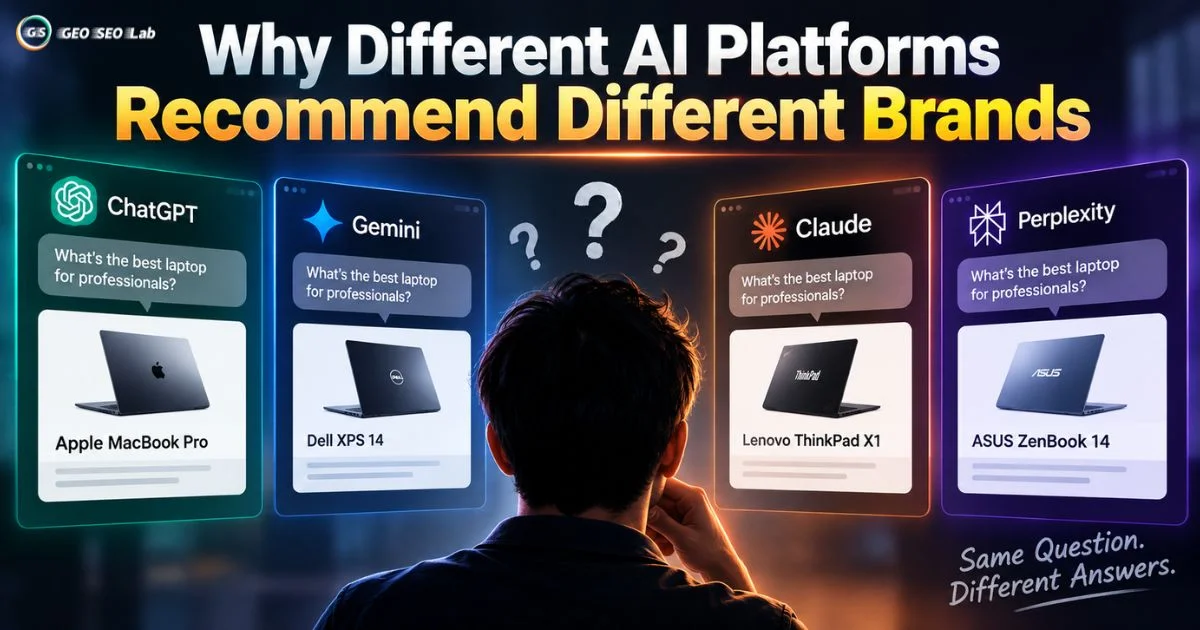
Why Different AI Platforms Recommend Different Brands
Why Different AI Platforms Recommend Different BrandsSame Question, Four Answers, Almost Zero OverlapA GEO SEO Lab ReportEditorial Disclosure: This re...
How AI Answers “Best Business Near Me” in 2026 | Local AI Search
How AI Answers "Best Business Near Me"Inside the Shortlist That Decides Who Gets the CallA GEO SEO Lab ReportEditorial Disclosure: This report introdu...
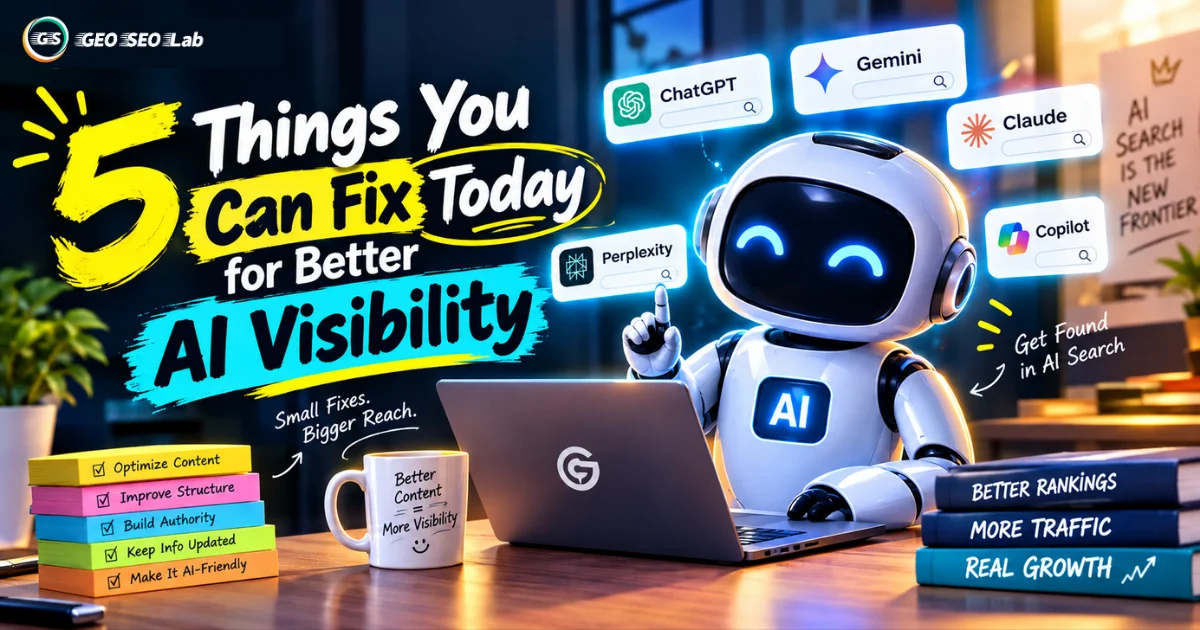
How to Improve AI Visibility in 2026 : 5 Fixes You Can Make Today
5 Things You Can Fix Today for Better AI Visibility No Redesign, No New Budget, Just Real Fixes You Can Ship This Afternoon Introduction Most GEO advice ...