The AI Visibility Audit Framework: A Practical Guide to Measuring Brand Visibility Across Google, ChatGPT & AI Search
Discover how to evaluate your organization's visibility across Google AI Overviews, ChatGPT, Gemini, Claude, and Perplexity using the AI Visibility Audit Framework. Learn the six-pillar methodology for improving AI search readiness, entity authority, citation strength, and digital trust.
The Problem With Every Audit You Have Run Until Now
Somewhere in your organization's shared drive, there is probably a folder containing SEO audit reports. Maybe several of them, from different years or different agencies. Each one has a health score at the top, a list of critical issues, a longer list of warnings, and a set of recommendations that range from immediately actionable to aspirationally ambitious.
Those reports have real value. The technical issues they identify are genuine. The recommendations they contain are often sound. The scores they generate provide a useful shorthand for comparing website health over time.
But here is what none of those audits can tell you.They cannot tell you whether an AI assistant, when asked about a complex question in your industry, would consider your organization a credible enough source to draw on. They cannot tell you whether AI Overviews generated for queries relevant to your business include your content or systematically bypass it. They cannot tell you whether your competitors have built the kind of organizational authority that causes AI systems to treat them as default reference points while you remain invisible despite clean code and respectable rankings.
The traditional SEO audit was built to answer one question: can search engines discover and rank this website effectively? That question is still worth asking. It is just no longer the only question worth asking. And in the context of AI-assisted search, it is not even the most strategically consequential one.This article introduces a different kind of audit — one designed to evaluate not just whether your website is technically healthy but whether your organization is genuinely ready for the era of AI-assisted discovery. The difference in scope is significant, and the difference in what you discover about your business may be more significant still.
Part One: Why Traditional SEO Audits Are No Longer Enough
The Gap That Has Been Growing QuietlyConsider two companies operating in the same industry.
The first has invested heavily in technical SEO. Their Core Web Vitals scores are excellent. Their site architecture is clean. Their internal linking is logical. They have thousands of indexed pages and a solid backlink profile. By every conventional audit metric, they are performing well.The second company has a smaller website with fewer pages. Their technical SEO is adequate but not exceptional. However, they have published original research for three consecutive years using their own customer data. Their practitioners regularly speak at industry conferences. Their educational resources are cited by journalists covering their sector. Their organization is clearly and consistently described everywhere it appears online.
Now someone asks an AI assistant: "Which companies in this industry produce the most reliable research on implementation challenges?"The first company's technical superiority provides no advantage whatsoever in answering that question. The AI system is not evaluating page speed or crawlability. It is evaluating which organizations have demonstrated sustained, original, credible contribution to the domain. On that measure, the second company has built something that the first company's SEO investment entirely missed.This gap — between technical website optimization and organizational authority — is not new. But it has become more consequential as AI-assisted search has matured. And it is not visible in any conventional SEO audit.
The Shift From Pages to Organizations
The fundamental conceptual shift required to understand AI Visibility auditing is the move from evaluating pages to evaluating organizations.Traditional SEO audits are built around pages as the primary unit of analysis. Which pages are indexed? Which pages are loading slowly? Which pages have missing metadata? Which pages need more backlinks? The page is the thing being optimized.AI-assisted search systems are increasingly built around entities — organizations, people, products, places, and the relationships between them. When an AI system generates a response to a complex question, it is not just retrieving the most relevant pages. It is drawing on an accumulated understanding of which organizations are credible sources on which topics, which individuals have demonstrated expertise in specific domains, which products have been consistently represented as serving specific needs, and which information has been independently corroborated enough to be treated as reliable.An audit designed around pages cannot evaluate these organizational dimensions. It can tell you whether your pages are technically accessible. It cannot tell you whether your organization is genuinely understood, credibly established, or trustworthy enough to be incorporated into AI-generated responses as a reliable source.This is not a criticism of traditional audits. They were designed for a specific purpose and they serve that purpose well. The argument is that organizations now need a second, complementary type of audit that evaluates the organizational dimensions that technical audits were never designed to assess.
Why Rankings Can Mislead?
Here is a scenario that illustrates the measurement gap clearly.
A business ranks in the top three positions for several competitive, high-value keywords. Their traffic from organic search is healthy. Their conversion rates from that traffic are reasonable. By every conventional metric, their SEO is working.
But when their sales team talks to prospects, they hear an increasing number of conversations that start with something like "I asked ChatGPT about this and it mentioned these companies" — and their company is not among them. When they look at which companies get referenced in AI-generated comparisons of their industry, they see competitors appearing consistently while their organization is absent.The ranking data suggested everything was fine. The AI visibility picture told a different story. The company was visible in traditional search but had not built the organizational authority that AI systems draw on when synthesizing responses to complex questions.This scenario is not hypothetical. It is the situation many businesses are discovering as they begin paying attention to how they appear in AI-assisted search contexts rather than just how they rank for keywords. The traditional metrics were not wrong — they just were not measuring everything that now matters.
What an AI Visibility Audit Actually Measures?
An AI Visibility Audit is not a replacement for technical SEO evaluation. It is an expansion of the evaluation scope to include dimensions that technical audits were never designed to assess.Specifically, it attempts to answer questions like these.When an AI system encounters information about your organization across the web, does it form a clear, accurate, and consistent picture of who you are, what you do, and why you might be credible in your domain? Or does it encounter contradictory descriptions, inconsistent positioning, and ambiguous identity?Does your organization demonstrate expertise in a way that is publicly visible — through identified experts with documented credentials, through original research that shows you know things others do not, through educational resources that reflect genuine depth? Or is your expertise primarily internal, invisible to any system that can only evaluate what you have made public?Have you contributed something to the information ecosystem that causes others to reference your work? Or does your digital presence exist primarily as a destination for people already looking for you, contributing nothing that other sources would draw on?
How consistently do the signals about your organization across all the places it appears — your website, your social profiles, your directory listings, your press coverage, your review profiles — tell the same story? Or does a customer doing independent research encounter a fragmented, sometimes contradictory picture?These are the questions an AI Visibility Audit is designed to answer. They require looking at your organization's entire digital presence rather than just your website, and they require evaluating organizational quality rather than just technical health.
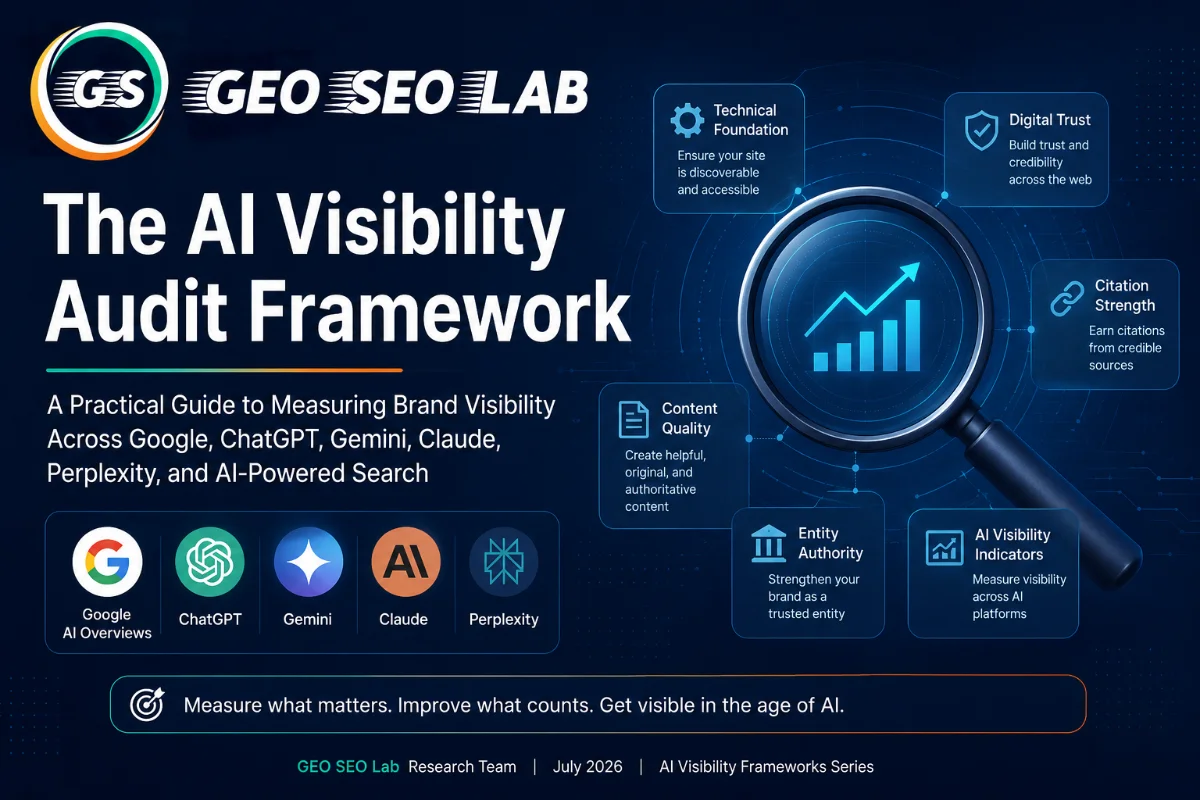
Part Two: The Six Pillars of the AI Visibility Audit Framework
Editorial Note: The Six Pillars of the AI Visibility Audit Framework are an original GEO SEO Lab methodology. They represent our strategic synthesis of what contributes to strong organizational presence in AI-assisted discovery environments. They are not official ranking factors or evaluation criteria published by any AI platform.
Why One Metric Cannot Capture AI Visibility?
There is an understandable desire for simplicity in measurement. Executives want a single score. Marketing teams want a single metric to track over time. The appeal of a health score between zero and one hundred is that it reduces a complex situation to something immediately comprehensible.The problem is that AI Visibility is genuinely multidimensional in ways that make single-metric measurement actively misleading. An organization might have perfect technical health and minimal organizational authority. Another might have exceptional research output and a website that search engines cannot fully crawl. A third might rank well for competitive keywords while remaining completely absent from AI-generated comparisons in their industry.Each of these organizations would receive very different scores on different dimensions of an AI Visibility evaluation. Collapsing those dimensions into a single number would produce a score that suggests a coherent overall picture when the reality is a specific pattern of strengths and weaknesses that have very different strategic implications.
The Six Pillars framework maintains the dimensional complexity because that complexity is where the strategic insight lives. Understanding that your organization scores well on technical foundation but poorly on citation strength tells you something specific and actionable. Knowing your combined score is 68 out of 100 tells you almost nothing useful.
Pillar One: Technical Foundation
The decision to include technical SEO as the first pillar of an AI Visibility audit might seem redundant — surely this is covered by existing technical audits? The reason it belongs here is that it frames technical health specifically in terms of its role in AI-assisted discovery, not just traditional search ranking.AI systems that retrieve web content to ground their responses depend on that content being accessible, crawlable, and accurately indexed. Before any AI system can consider your content as evidence for a response, search infrastructure needs to have successfully discovered, crawled, rendered, and indexed it. Every technical barrier between your content and Google's index is also a barrier between your content and AI Overview eligibility.The technical evaluation within an AI Visibility Audit should cover crawlability and indexation of all important content, page performance and Core Web Vitals scores, mobile usability, HTTPS implementation and security signals, site architecture and logical organization, internal linking structure that supports content discovery, XML sitemap accuracy and submission, canonical tag implementation, and structured data implementation for relevant entity types.
What distinguishes this technical evaluation from a standard audit is the interpretive framing. The question is not just "are there technical issues?" but "are these technical issues preventing important content from contributing to our AI Visibility?" A crawl error on an unimportant page is a lower priority than a crawl error on your primary research publication. The AI Visibility lens changes the triage.
Pillar Two: Content Quality
Content quality evaluation within an AI Visibility audit goes considerably further than traditional content audits typically do. It is not just asking whether pages have sufficient word count, appropriate keyword coverage, or updated publication dates. It is asking whether the content actually advances understanding and contributes something of genuine value to the information ecosystem.The evaluative questions here are substantive: Does this content answer real questions that real users have in ways that are clear, specific, and accurate? Does it go beyond summarizing what other sources have already said, or is it primarily a repackaging of familiar information? Does it reflect actual expertise, or does it produce the surface appearance of expertise without the underlying depth? Is it structured in ways that make it easy to extract specific claims and evidence — the kind of structure that is useful both for human readers and for AI systems attempting to synthesize across multiple sources?The information gain concept is particularly important here. Content that adds something new to the information landscape — whether through original data, a distinctive framework, documented firsthand experience, or a level of specificity that other sources lack — has a fundamentally different value in AI-assisted search contexts than content that covers familiar ground in familiar ways. An AI system synthesizing a response to a complex question has limited reason to draw on the nineteenth article covering the same topic in essentially the same way.
Content quality evaluation should also assess whether content supports the kinds of conversational, multi-step queries that AI Mode enables. Content that answers one specific question well but does not help users explore related questions leaves opportunities unexploited.
Pillar Three: Entity Authority
Entity authority is the pillar that most clearly extends the audit beyond the website. It evaluates whether your organization has a clear, consistent, and credibly established identity across the full range of places it appears in the digital ecosystem.
An entity authority evaluation begins with the organization itself. Is your company described consistently across your website, your LinkedIn profile, your Google Business Profile, your industry directory listings, your Crunchbase entry, and any other platforms where you are listed? Do these descriptions agree on what your organization does, which industries it serves, what its products and services are, and who leads it? Or does someone doing independent research encounter a different story depending on which source they look at? It then extends to the people within the organization. Are key practitioners and subject matter experts publicly identifiable as individuals with specific, verifiable credentials and expertise? Do their professional profiles connect clearly to the organization and to the specific topics the organization publishes about? Is their expertise expressed through public contributions — articles, presentations, research — that allow external evaluation?Entity authority evaluation also covers products and services as distinct entities with their own clear, consistent identities. Each significant product should have a well-documented presence that explains what it is, who benefits from it, how it differs from alternatives, and how it connects to the organization's broader offering. Generic, undifferentiated product descriptions create weak entities that contribute little to organizational understanding.
Structured data implementation belongs within entity authority evaluation specifically because of its function — it is primarily a clarity tool that helps machines interpret entity attributes more reliably. The evaluation question is not just "is Schema markup present?" but "does the implemented structured data accurately reflect the organization's current identity and relationships?"
Pillar Four: Citation Strength
Citation strength evaluation looks outward from the organization to assess how the broader information ecosystem responds to its presence. This is fundamentally different from backlink analysis, though it overlaps with it. The question is not just how many external links point to your site, but whether your organization's work is being meaningfully referenced by other credible sources in ways that validate your expertise and extend your reach.
Strong citation signals include being referenced as a source in journalism covering your industry — not just mentioned in news about your company, but contacted for expert perspective or cited for specific data. Having your research quoted in other organizations' publications, reports, or presentations. Having frameworks or methodologies you have developed adopted by practitioners who attribute them to your organization. Being listed as a recommended resource by professional associations or educational institutions. Receiving speaking invitations from respected industry events — an indication that organizers consider your team's expertise valuable enough to put before their audience.
These forms of citation reflect independent validation of organizational expertise. They are fundamentally more valuable as authority signals than citations that originated from your own marketing activity, precisely because their independence makes them credible evidence rather than claims.The citation strength evaluation should also assess what your organization has done to create citation-worthy assets. Original research reports using proprietary data. Benchmark studies that generate findings unavailable from other sources. Comprehensive frameworks that organize domain knowledge in distinctive ways. Case studies with specific, verifiable outcomes. These are the categories of content that generate meaningful citations as a natural consequence of their genuine usefulness.
Pillar Five: Digital Trust
Digital trust is the pillar that most directly connects AI Visibility to customer experience. It evaluates whether the signals that potential customers and external evaluation systems encounter about your organization suggest reliability, accuracy, and consistent alignment between claims and reality.The evaluation covers several dimensions. Review quality and distribution — not just whether you have positive reviews, but whether they consistently reflect experiences that match what your digital presence promises, and whether negative reviews reveal systematic gaps between organizational claims and customer reality. Response patterns — whether review activity is monitored and whether responses demonstrate genuine engagement rather than template defensiveness.Information accuracy across all platforms — whether the facts stated about your organization, its products, its people, and its services are consistently correct and kept current as the organization evolves. Content accuracy — whether the educational and informational content your organization publishes proves reliable when readers attempt to apply it, or whether it overpromises and underdelivers on specificity.
Transparency signals — whether your organization's expertise, methodology, authorship, and limitations are clearly disclosed rather than obscured. The organizations that are most trusted tend to be those that are honest about what they know and what they do not, who is writing what and why, and what their products can and cannot do.
Brand consistency — whether every touchpoint in the customer journey, from the first AI-generated mention through the first website visit through the first sales conversation through the actual product or service experience, tells a coherent and consistent story. Inconsistency between any of these stages introduces doubt that erodes the trust being built at other stages.
Pillar Six: AI Visibility Indicators
The final pillar assesses direct evidence of how the organization currently appears in AI-assisted search contexts. This is where the audit moves from evaluating inputs to evaluating outcomes — though with the important caveat that AI-assisted search behavior is variable, platform-specific, and subject to change.Direct assessment involves querying major AI platforms with relevant questions and systematically noting whether and how the organization appears. This includes informational queries about the organization directly, comparative queries where the organization might reasonably be mentioned alongside competitors, topic queries where the organization's expertise would make it a relevant reference, and product or service queries where the organization's offerings might be recommended.The assessment should span multiple platforms — Google AI Overviews, ChatGPT with web browsing, Gemini, Perplexity, Claude — because appearances vary significantly across these systems. An organization that appears frequently in Perplexity citations might be absent from Google AI Overviews, and vice versa.Indirect indicators are also valuable because they are more consistent than the variable behavior of specific AI queries. Branded search growth — the trend in searches specifically for your organization's name — reflects increasing unprompted awareness that correlates with AI mention. Third-party references to your specific research findings, frameworks, or methodologies in other organizations' public content indicate that your original knowledge is propagating through the information ecosystem. Media inquiries received rather than initiated suggest that your organization has developed the kind of recognized expertise that causes journalists to seek it out rather than wait to be pitched.
Part Three: How to Actually Conduct an AI Visibility Audit
Starting With the Right Question
The most common mistake in AI Visibility auditing is starting with data collection before establishing what you are actually trying to understand. Organizations instinctively move toward gathering metrics, running tools, and generating reports — because that is what audits look like. But an audit that collects a lot of data without a clear evaluative framework will produce findings that are difficult to interpret and recommendations that are difficult to prioritize.Before collecting any evidence, every AI Visibility Audit should begin with a clear statement of what success means for this specific organization. This seems obvious, but the definition of success varies considerably across different organizations and should shape everything that follows.A healthcare practice trying to attract new patients from local searches has different success criteria than a B2B software company trying to establish category authority nationally. A law firm trying to develop recognized expertise in a specific practice area has different objectives than a retail brand trying to improve local visibility. A startup trying to build initial credibility has different priorities than an established organization trying to defend a leadership position against newer competitors.The audit structure, the competitive benchmarks selected, the pillar weights applied, and the recommendations prioritized should all reflect the specific success definition established at the beginning. An audit that ignores this context will produce generic recommendations that fit every organization in principle and serve no specific organization particularly well.
Mapping the Full Digital Footprint
Once objectives are established, the next step is systematic evidence collection across the organization's complete digital presence — not just its primary website.This means the official website across all important page types, including the homepage, about and company information pages, product and service pages, blog and resource sections, team and author pages, and technical documentation. It means social media profiles including LinkedIn, YouTube, and any other platforms with active presence. It means business directory listings — Google Business Profile for any organization with a physical location, industry-specific directories relevant to the sector, general business directories like Crunchbase and similar platforms. It means press coverage both recent and historical, including whether coverage treats the organization as a source or just reports on it as a subject. It means review profiles including the quality, recency, and response patterns of customer reviews. It means research and educational publications including any reports, studies, whitepapers, or guides published under the organization's name.The purpose of this breadth is to assemble the same picture that an AI system or a diligent human researcher would assemble when investigating your organization. Evaluating only your primary website gives you an incomplete picture because your organization exists in the digital world as something much larger than your primary website.A useful practical approach is to conduct this investigation from the perspective of a skeptical potential customer who has heard your organization's name and is trying to determine whether you are credible. What would they find? Does everything they find tell a coherent, consistent, credible story? Or do they encounter inconsistencies, outdated information, ambiguous positioning, and thin expert profiles that introduce doubt?
Evaluating Each Pillar With Specific Questions
The evidence gathered during the mapping phase should then be systematically evaluated against each of the six pillars. For each pillar, a set of specific evaluative questions produces a structured assessment.
Technical Foundation questions should establish whether all important content is crawlable and indexed, whether page performance meets current expectations across device types, whether site architecture is logical and supports the discovery of related content, whether internal linking reinforces the hierarchy of content importance, and whether structured data is implemented accurately and consistently for relevant entity types.Content Quality questions should assess whether the organization's published content provides genuine depth beyond surface coverage, whether content answers the real questions practitioners in the field actually have, whether there is meaningful original knowledge contribution or primarily synthesis and summarization of existing material, whether content is current and accurate, and whether the structure and specificity of content makes it useful as evidence for AI synthesis rather than requiring extensive interpretation.Entity Authority questions should examine whether the organization's core identity — what it does, who it serves, what its products are, who leads it — is consistent across all major platforms, whether key team members have professional profiles that genuinely establish their expertise rather than just listing their titles, whether product and service descriptions are specific and consistent, and whether structured data implementation accurately reflects current organizational reality.Citation Strength questions should evaluate whether the organization has published content that generates independent references, whether third-party sources cite the organization's research or frameworks, whether media coverage treats the organization as an expert source rather than just a news subject, whether the organization is recommended by professional associations or educational institutions, and whether speaking invitations indicate recognized expertise.Digital Trust questions should assess the quality and consistency of customer reviews, whether reviews reveal systematic gaps between organizational promises and customer experiences, whether information across all platforms is current and accurate, whether authorship and methodology are transparently disclosed, and whether brand messaging is consistent across every touchpoint in the customer journey.AI Visibility questions should document direct evidence of organizational appearance in AI-generated responses across major platforms, assess the frequency and nature of those appearances, evaluate indirect indicators including branded search trends and third-party framework references, and compare the organization's AI presence against competitors in the same evaluation.
The Gap Matrix: Prioritizing What Matters Most
Editorial Note: The AI Visibility Gap Matrix is an original GEO SEO Lab tool for audit prioritization.
After evaluating all six pillars, organizations typically face a list of potential improvements that exceeds what can be reasonably addressed simultaneously. The Gap Matrix provides a framework for prioritization by evaluating each potential improvement on two dimensions: the expected impact on AI Visibility if the improvement is made, and the effort required to make it.High-impact improvements that require relatively low effort should be addressed immediately. These typically include fixing technical barriers that prevent important content from being discovered, correcting factual inaccuracies or significant inconsistencies in entity information across major platforms, completing or improving professional profiles for key experts, and implementing basic structured data where it is clearly missing.
High-impact improvements that require significant effort represent the most important strategic investments. These typically include developing original research programs, building comprehensive expert thought leadership programs, systematically pursuing media and professional community recognition, and constructing comprehensive knowledge hubs around core topics.Lower-impact improvements that require high effort may be worth deferring or deprioritizing until higher-impact work is complete. Spending significant organizational energy on marginal improvements while high-impact work remains undone is a common source of suboptimal outcomes in digital strategy.
Building a Practical Improvement Roadmap
An audit that does not produce a clear implementation path has limited practical value. The final output of an AI Visibility Audit should be a structured roadmap that translates findings into specific, time-bounded actions.
A practical roadmap structure divides improvements into three time horizons.
Immediate actions, addressable within thirty days, typically focus on the technical foundation and entity consistency pillars. These include fixing crawl errors and indexation issues that are preventing important content from being discovered, correcting significant factual inconsistencies in organizational descriptions across major platforms, updating outdated information that misrepresents the current organization, and improving basic structured data implementation where it is clearly missing or inaccurate. These actions establish the foundation that everything else depends on.
Strategic priorities, addressable within thirty to ninety days, typically focus on content quality and expert visibility. These include developing comprehensive content coverage for topics central to the organization's expertise, creating and populating professional profiles for key practitioners, implementing systematic internal linking that reinforces topical authority, improving the specificity and depth of existing content that is structurally sound but lacks distinctive substance, and addressing the most significant trust signals including review monitoring and response practices.
Long-term investments, developing over three to twelve months, focus on citation strength and the authority dimensions that require sustained effort over time. These include launching original research programs using proprietary data, developing systematic expert thought leadership through publishing, speaking, and professional community participation, building media relationships based on genuine expertise contribution, creating the kind of landmark educational resources that generate independent references over time, and pursuing the professional association participation and industry recognition that provides independent validation.The roadmap should be realistic about timeline expectations. Organizations that approach authority-building with the same mindset they apply to campaign planning — sprint hard, expect results within a quarter, move on to the next thing — will be disappointed. The compound nature of reputation and authority development means that early investments produce modest visible returns while establishing the foundation for increasingly significant returns over longer time horizons.
Part Four: Measuring Progress and Building Long-Term AI Visibility
Why This Requires a Different Measurement Mindset
The measurement challenge in AI Visibility work is real and worth addressing directly. Most digital marketing measurement infrastructure was designed to capture acquisition events — visits, clicks, conversions, leads. These metrics capture what happens at the bottom of the discovery funnel, when a potential customer is actively engaging with your organization.
The investments that build AI Visibility primarily affect the top of the funnel and the period before the funnel even begins — the stage where someone who will eventually become a customer is forming their understanding of a topic and developing awareness of which organizations are credible in that space. These pre-funnel influences are systematically undercaptured by conventional analytics.
This creates a measurement gap that can cause well-intentioned leadership teams to undervalue exactly the investments that produce the most durable competitive advantages. If the only things being measured are the things that appear on standard dashboards, the only things that will receive sustained investment are the things that produce measurable results on short time horizons. Authority-building investments almost never do this.
Addressing the measurement gap requires both adding new metrics and extending the time horizons over which improvement is evaluated. Progress on knowledge contribution can be measured by the quantity and quality of original research publications, the rate at which those publications generate independent citations, and the growth in third-party references to organizational frameworks and methodologies. Progress on expert visibility can be measured by the growth in speaking invitations, media inquiries, and professional community recognition. Progress on digital trust can be tracked through review quality trends and brand sentiment indicators.
None of these replace conventional analytics. They complement them by capturing forms of organizational development that conventional analytics cannot see.
The AI Visibility Maturity Model
Rather than treating AI Visibility as a binary achievement — either you have it or you do not — it is more useful and more accurate to understand it as developing through progressive stages of organizational maturity. Each stage builds on the previous, and understanding which stage describes your current position clarifies both what has been accomplished and what needs to happen next.Level One: Basic Digital Presence. At this stage, the organization has the fundamental digital infrastructure — a website, basic social profiles, perhaps a Google Business Profile — but has not yet invested significantly in authority development. Content primarily describes the organization's products and services. Educational resources are minimal or absent. Expert profiles are incomplete or nonexistent. Very little has been done to build the kind of presence that would cause any external source to reference the organization as an expert. Being at Level One is not a failure; it is simply the starting point.Level Two: Foundational Readiness. The organization has begun making deliberate investments in digital presence quality. Technical SEO is solid. Educational content exists and is genuinely useful, though primarily synthesizing existing knowledge rather than contributing original insights. Brand messaging is becoming consistent across major platforms. There are some expert profiles, though they may not be fully developed. The organization is becoming more discoverable but has not yet established distinctive authority.Level Three: Growing Visibility. This is where intentional organizational investment in authority starts producing visible results. Content coverage is comprehensive in relevant topic areas. Experts are identifiable and have developed some public presence. Entity consistency is maintained across major platforms. The organization participates in relevant professional communities and begins attracting some independent recognition. At this level, organizations are frequently discovered in relevant searches and are building a reputation that extends beyond their owned channels.Level Four: Established Authority. Organizations at this level are recognized as genuine experts in their domain. They publish original research that others reference. Their practitioners are invited to speak at respected events and sought for media commentary. Their frameworks are in use by practitioners who may not always explicitly attribute them. Customer trust is strong and reflected in consistent review quality. The organization is frequently mentioned in AI-generated responses relevant to its domain. The authority is becoming self-reinforcing — each new contribution builds on an established foundation.Level Five: AI Authority. This is the stage where citation-worthy status reaches its most durable form. The organization has become part of the shared knowledge infrastructure of its field. Its research is treated as baseline reference material. Its frameworks shape practitioner thinking. Its perspective is expected in important industry conversations. Journalists contact it proactively for expert commentary rather than the other way around. Customers and practitioners recommend it independently. AI systems regularly incorporate its content into responses about relevant topics because its information is genuinely among the most useful available.
Most organizations reading this article are at Level One or Two. Reaching Level Three typically requires twelve to eighteen months of consistent, deliberate effort. Levels Four and Five develop over years, not months, and cannot be manufactured through any concentrated tactical effort.
A Practical Scorecard for Quarterly Review
Rather than tracking hundreds of metrics, executive teams building AI Visibility should focus on a balanced set of indicators that collectively reflect progress across all six pillars.For technical health, track crawlability and indexation coverage for important content, Core Web Vitals scores across key pages, and the rate at which technical issues are identified and resolved.For content quality, track the quantity of original research publications per year, the number of pillar content resources covering core topic areas, and the rate at which existing content is updated and improved.
For entity authority, track consistency scores across major digital platforms through regular manual audits, the completeness and quality of key expert profiles, and structured data implementation coverage.
For citation strength, track independent media mentions per quarter, the rate of third-party references to original research and frameworks, and speaking invitations received from respected industry events.
For digital trust, track review quality trends and distribution across platforms, response rates and quality for customer reviews, and any instances of significant factual inaccuracies in public-facing information.
For AI Visibility, track direct appearance in AI-generated responses across major platforms through regular systematic testing, branded search volume trends as a proxy for growing unprompted awareness, and the spread of original frameworks and research findings through third-party content.
The objective of this scorecard is not achieving perfect scores on every indicator. It is understanding the trajectory across all dimensions simultaneously, identifying where progress is strong and where investment has not yet produced results, and making informed decisions about where to focus attention in the next period.
Common Mistakes That Limit Progress
Organizations that approach AI Visibility auditing and improvement seriously still frequently make mistakes that limit their progress. Understanding these patterns can help avoid the most common pitfalls.Treating AI Visibility as a single department's responsibility is probably the most common structural mistake. The dimensions of AI Visibility span the entire organization. Technical SEO is an engineering and marketing function. Content quality depends on subject matter expertise that may live in product, research, or services teams. Expert visibility requires the cooperation of practitioners who may not see public contribution as part of their professional role. Digital trust depends on customer experience quality that is shaped by every team that touches customer relationships. Organizations that assign AI Visibility entirely to the marketing team will systematically underperform on the dimensions that require broader organizational participation.
Expecting rapid results from long-term investments is the second most common mistake. Authority development is a slow process that rewards persistence and punishes impatience. Organizations that invest intensely in knowledge contribution for one or two quarters, see modest immediate results, and then redirect investment to faster-acting channels are abandoning the compounding process before it has had time to produce meaningful returns. The organizations that build durable AI Visibility are almost universally those that make a multi-year commitment to consistent, high-quality contribution rather than cycling through concentrated sprints.Measuring only the things that are easy to measure leads to optimizing for visible metrics at the expense of strategic progress. Publishing more content is easy to measure. Publishing content that is actually more valuable and distinctive is harder to measure but more important. Increasing website traffic is easy to measure. Developing organizational recognition that drives branded search and media inquiries is harder to measure but more strategically significant. Audits that rely entirely on conventional analytics tools will systematically reward the wrong activities.Ignoring the expertise that already exists within the organization is a particularly frustrating mistake because it wastes what is often the most valuable asset available. Most organizations already employ practitioners with genuine, differentiated expertise. Making that expertise visible — through published writing, speaking, professional community participation — does not require developing new expertise. It requires creating contexts in which existing expertise can be expressed. Organizations that invest heavily in content creation while leaving their genuine experts invisible are producing the appearance of knowledge contribution without its substance.
The Practical Starting Point: Where to Begin Next Week
The scope of a comprehensive AI Visibility Audit and the depth of the improvement roadmap it produces can feel overwhelming when viewed all at once. The gap between a Level One organization and a Level Five organization is significant, and the path between them is measured in years rather than weeks.But the starting point is not a multi-year strategy. It is a clear-eyed assessment of where you currently stand.Before you invest in original research programs or media relationship development or comprehensive expert thought leadership, you need to know what you actually have right now. What do your technical foundations look like? How consistently is your organization described across your major digital presences? Are your key experts publicly identifiable as experts? What content do you have that might be considered genuinely valuable rather than derivative? What does independent recognition of your organization look like today?These questions can be answered through a structured audit process that takes a committed team a few weeks to complete. The findings from that process will tell you far more about where your AI Visibility investments should focus than any generic best practices list. The specific gaps that a rigorous audit reveals about your specific organization — not the gaps that some other organization faces — are what should drive your specific priorities.The AI era of search is not coming. It is here. The organizations that begin systematic, evidence-based investment in their AI Visibility now will be building compounding advantages over the next three years. The organizations that wait until the urgency is undeniable will find themselves attempting to close gaps in months that their competitors built over years.
An audit will not solve the problem. But it will tell you exactly what the problem is — and what solving it actually requires from your organization.
About GEO SEO Lab
GEO SEO Lab works with organizations to improve their visibility across Google Search, Google Maps, ChatGPT, Gemini, Claude, Perplexity, Grok, and other AI-powered discovery platforms. Our approach combines technical SEO, entity optimization, Generative Engine Optimization, local SEO, AI visibility strategy, and original research to help organizations build the kind of digital authority that remains valuable as search continues to evolve.
References and Further Reading
The concepts underlying this framework draw on publicly available research and official documentation from multiple sources. Readers seeking foundational material should consult Google Search Central documentation on helpful content and technical SEO best practices, the Google Search Quality Evaluator Guidelines, published academic research on information retrieval and entity understanding, literature on knowledge graphs and named entity recognition, and research on digital trust and organizational reputation. These primary sources provide the documented foundation for the strategic frameworks developed and applied in this guide.
Tags
Frequently Asked Questions
Find answers to common questions about this topic
About the Author

Aman Kesharwani
SEO Expert & Content Creator
Experienced digital marketing professional specializing in SEO strategies, content optimization, and data-driven marketing solutions. Passionate about helping businesses grow their online presence and achieve better search rankings.
Related Articles
View all posts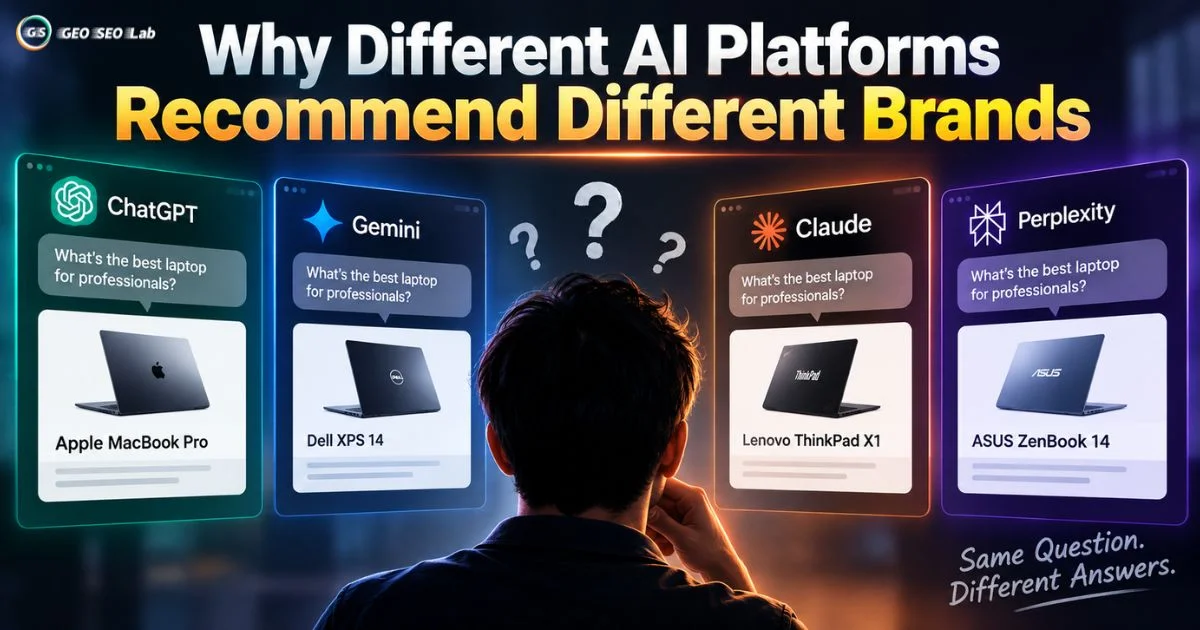
Why Different AI Platforms Recommend Different Brands
Why Different AI Platforms Recommend Different BrandsSame Question, Four Answers, Almost Zero OverlapA GEO SEO Lab ReportEditorial Disclosure: This re...
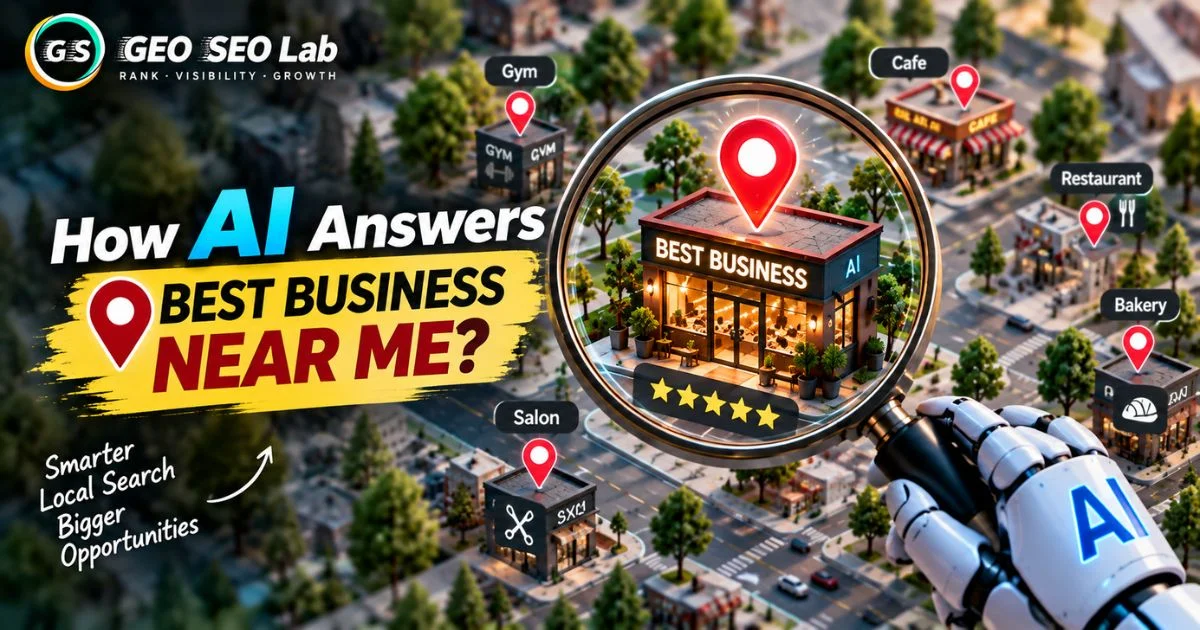
How AI Answers “Best Business Near Me” in 2026 | Local AI Search
How AI Answers "Best Business Near Me"Inside the Shortlist That Decides Who Gets the CallA GEO SEO Lab ReportEditorial Disclosure: This report introdu...
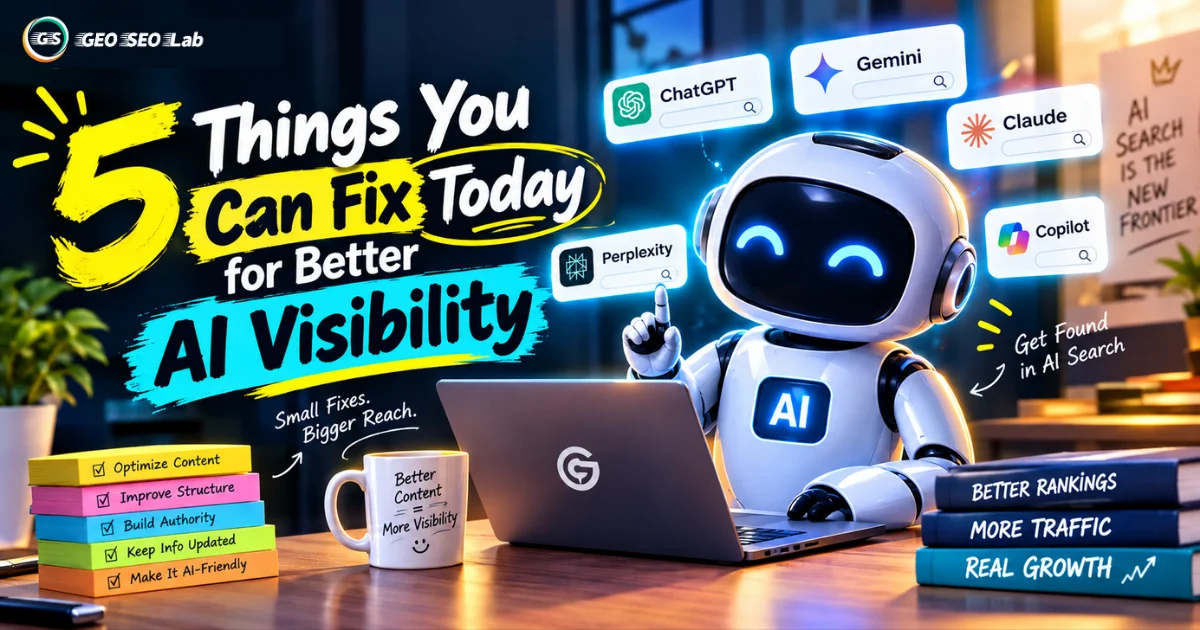
How to Improve AI Visibility in 2026 : 5 Fixes You Can Make Today
5 Things You Can Fix Today for Better AI Visibility No Redesign, No New Budget, Just Real Fixes You Can Ship This Afternoon Introduction Most GEO advice ...