AI Search Visibility and GEO: A Complete Guide for Businesses
AI Search Visibility and GEO: A Complete Guide for BusinessesSearch doesn't look like it used to. Sure, people still type queries into Google, but mor...
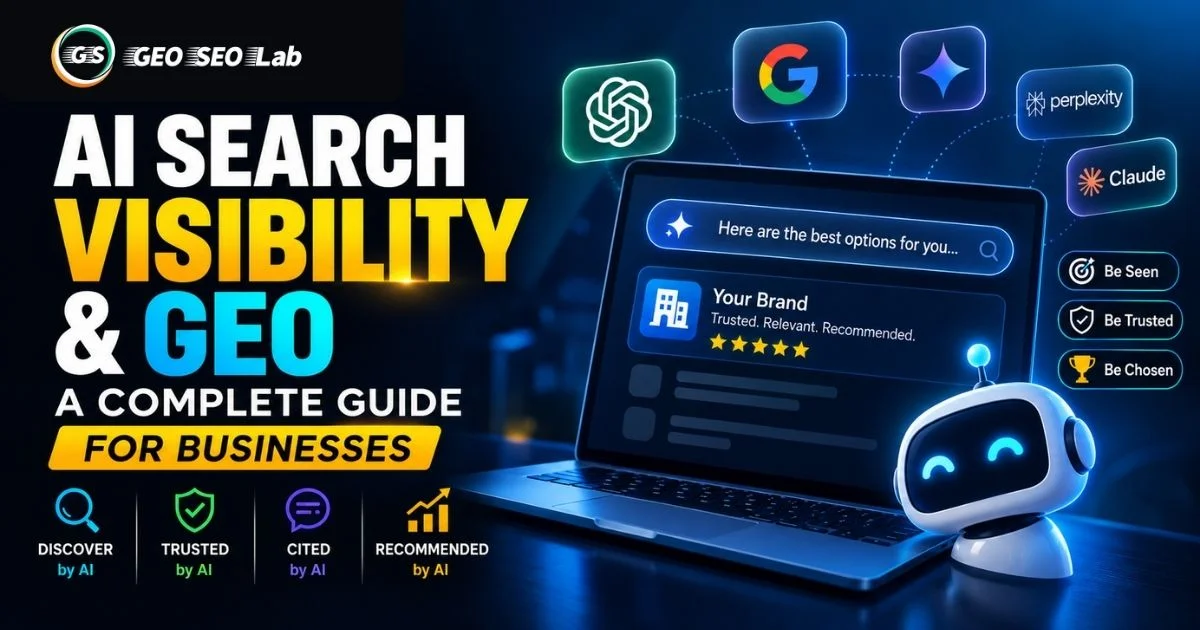
AI search visibility is how easily a brand can be discovered, understood, cited, and recommended across AI-powered search, AI search engines, and other AI discovery experiences. It is becoming an increasingly important part of AI search optimisation, alongside traditional search engine optimisation (SEO).
That's a real shift, and it's changing what "being visible" even means for a business. Rankings, clicks, and organic traffic still matter- don't get us wrong- but they're no longer the whole picture. A brand might get mentioned inside an AI-generated answer long before anyone lands on its website. Or it might do great in traditional search and still be nowhere to be found when someone asks an AI assistant for a recommendation.
In this guide, you’ll learn what AI search visibility means, how it relates to SEO and GEO, how to measure it, and how to build a practical AI search visibility strategy, how it connects to SEO and something called Generative Engine Optimization (GEO), what's worth measuring, and how to build a real visibility strategy without falling for gimmicks or "guaranteed AI ranking" claims. Because honestly, there's no such thing.
So, What Is AI Search Visibility?
In simple terms, AI search visibility is how well a brand gets found, understood, trusted, cited, and ultimately recommended inside AI-generated answers, AI-powered answers, and AI-powered discovery tools. It includes AI brand visibility, the frequency of your brand mentions, the sources behind AI citations, and how often your business appears in AI recommendations.
AI search visibility is not a single fixed position you can point to and say “that’s us, ranked #3.” Unlike traditional organic rankings, AI search rankings are not represented by one universal position across every platform, prompt, or user. Results shift depending on the platform, the exact prompt someone uses, their location, the language, what sources happen to be available, even the time of day. Because of that, it makes more sense to think of AI visibility as a pattern you track across many questions and platforms, rather than a spot you land on once and keep forever.
Why This Matters More Than Ever
Think about how traditional search used to work. Someone types a query, reviews the organic search results, clicks a link, and decides what to do next. AI search can compress several of those steps into a single response. The system might summarise the options, weigh brands against each other, point out strengths and weaknesses, drop in some citations, and suggest what to look at next, all in one response.
That opens up a new layer of visibility for pretty much every industry, whether that's tech, SaaS, ecommerce, healthcare, finance, education, hospitality, professional services, or local shops.
None of this means traditional SEO is fading out. It just means the playing field got bigger. There are more surfaces now, and more ways to earn attention, whether that's through a search ranking, a citation, a glowing review, a comparison mention, or a nod from a trusted third party.
How Traditional SEO and GEO Actually Work Together
Traditional SEO is mostly focused on one core question: where does the page rank? It leans on signals like technical health, relevance, backlinks, content quality, and how users behave on the page. The typical payoff is an impression, a click, or a visit, and it's usually measured at the keyword and URL level.
AI search visibility, or GEO, asks a different question: how is the brand actually being shown inside the answer? It still cares about the fundamentals, but it also weighs things like how clearly an entity is defined, whether credible sources back it up, how often it's mentioned, the sentiment surrounding it, and whether the details are accurate. The payoff can look different too. Instead of just a click, you might get awareness, a spot on a shortlist, trust, a citation, or a recommendation, sometimes all before anyone visits the site. And rather than being judged by keyword and URL alone, it gets evaluated by brand, use case, platform, and the actual prompt someone typed in.
GEO, short for Generative Engine Optimisation, is the term people are using to describe the work of making sure a brand gets represented clearly and fairly inside AI-generated answers. Think of it as a partner to SEO, not a replacement for it.
5 Stages of AI Search Visibility
Getting to "recommended" status doesn't happen in one step. It tends to unfold in stages.
First, there's being discoverable, which really just asks whether the system can find reliable information about you at all. That depends on things like site accessibility, having solid business profiles set up, and keeping your sources consistent.
Next comes being understandable, meaning it's obvious what you do, who you serve, and where you operate. This is about clear entity information and plain-language descriptions of your categories and services.
Then there's credible, which asks why anyone should trust what's being said about you. Reviews, real expertise signals, third-party mentions, and the quality of your sources all play into this.
After that is citable, which comes down to what's actually backing up the answer. Genuinely useful pages, authoritative content, and consistent references all help here.
And finally, there's recommended, the stage where you actually show up when the use case fits. That depends on your reputation, relevance, local signals, and how consistently you're being tracked and monitored over time.
What AI Search Engines Look At When Evaluating a Brand
Different AI platforms pull from different places: language models, retrieval systems, search indexes, product data, public websites, reviews, directories, news coverage, online communities, and more. The exact process varies by platform, so it's a mistake to assume there's one magic factor driving every answer.
That said, a few things keep showing up again and again in a strong visibility foundation. A clear, honest description of what the business does, who it's for, and what it offers goes a long way. So does keeping your name, address, category, and contact info consistent across the web. Pages that genuinely answer the questions customers are asking matter too, along with real signs of expertise and experience rather than just claims of it. Credible mentions from third parties, reviews, or media help build trust, and accurate structured data adds another layer of clarity where it applies. On top of all that, you'll want a technically sound site that's easy for systems to crawl and understand, plus regular monitoring of how your brand is being mentioned, and by whom.
How to Measure AI Search Visibility: 8 Key Metrics
A useful AI visibility dashboard blends your usual search metrics with structured observations pulled from AI tools themselves.
Start with your brand mention rate, which tells you how often you show up across a set of relevant prompts, giving you a sense of your baseline presence. Your recommendation rate goes a step further by showing how often you're actually suggested or shortlisted, which separates a passing mention from a real endorsement. Prominence looks at where you land within the answer itself, whether you're front and centre or buried near the bottom. Citation rate tracks how often relevant sources back up the mention, telling you whether there's visible support behind the claim. Sentiment and context flag whether the framing is positive, neutral, mixed, or negative, which helps you catch reputation issues early. Accuracy checks whether the details about you are actually correct, catching potentially damaging misinformation before it spreads. Competitive share shows how you stack up against rivals for the same questions. And AI-referred traffic ties all of this back to something concrete: the visits and conversions you can actually trace back to AI platforms.
How to Run an AI Search Visibility Audit
You don't need a massive research team to get started. A focused audit can surface useful gaps pretty quickly.
Begin by listing the questions customers actually ask, covering discovery, comparison, local intent, buying intent, and reputation-related questions. From there, pick the AI tools and search engines your audience actually uses, and note which version or model you're testing. Run the same set of neutral prompts across each platform without nudging the system toward your own brand, and log everything: the prompt, the timestamp, location, the full response, mentions, citations, and any notable wording. Once you've got that, check the representation closely, looking at category accuracy, how your offering is described, sentiment, and factual correctness, and take note of which competitors show up for the same questions. From there, prioritise your fixes, starting with the biggest gaps in clarity, consistency, authority, or reputation. And since AI answers shift over time, plan to run this whole process again later rather than trusting a single snapshot.
How Content Optimisation Improves AI Search Visibility
Stuffing a page with keywords or churning out generic AI-written content doesn't move the needle much. What actually helps is content that's useful, specific, accurate, and easy for a system (and a human) to make sense of.
Answer the real question early instead of burying the lede, and explain terms and category differences in plain language. Lean on concrete facts, examples, and step-by-step detail, and show real expertise instead of recycling the same generic points everyone else makes. Keep your pricing, product, and location details current, and link related pages so your site tells a coherent story rather than a scattered one. Where you can, add original research or first-hand experience, and don't forget to go back and clean up outdated or inconsistent older pages.
For AI-driven discovery specifically, clarity counts for a lot. A page that plainly explains what you do, who you help, where you operate, and why you're worth trusting will always beat a page built purely to repeat the same phrase over and over.
Local SEO and AI Search Visibility
Local search is a big part of this conversation. Someone might ask an AI tool for the best coffee shop, dentist, lawyer, or contractor in their city, and the answer could depend on local listings, reviews, business categories, location data, reputation, and whatever relevant web content is out there.
If you run a local or multi-location business, it's worth keeping your name, address, phone number, and hours consistent everywhere, and making sure your categories and service descriptions are accurate. Build location-specific pages with genuinely useful, non-generic info, and actually respond to reviews, good and bad. Try to get coverage or mentions from local or industry sources, and pay attention to any differences between how you show up locally versus nationally. It's also worth watching for changes in how AI tools describe your business or suggest alternatives to it over time.
AI Search Reputation, Reviews and Online Reputation
AI-generated answers can be wrong, outdated, or missing context, and that becomes a real problem when someone's asking whether your company is reliable, affordable, or trustworthy.
The right response isn't to try to game the system or push misleading content. It's to audit how you're actually being described, fix inaccurate information wherever it's public, strengthen the credible sources that reference you, and make sure your own channels clearly say what's true.
8 AI Search Visibility Mistakes to Avoid
Mistake 1: Treating AI visibility as a single ranking
Mistake 2: Assuming Google rankings guarantee AI recommendations
Mistake 3: Publishing generic AI-generated content
Mistake 4: Chasing artificial mentions
Mistake 5: Ignoring local SEO
Mistake 6: Measuring only clicks
Mistake 7: Reporting percentages without methodology
Mistake 8: Ignoring accuracy
A lot of businesses treat AI visibility as if it were one single ranking, when really it makes more sense to track a representative set of prompts across platforms. Others assume that a number one spot on Google guarantees an AI recommendation too, but these two environments need to be measured separately. Flooding a site with generic AI-written content rarely helps either; building content around real customer needs works far better. Be cautious of anyone selling a "secret formula" or a guarantee, and stick to transparent measurement and realistic goals instead. Ignoring local listings and third-party mentions is another common misstep, since managing your whole digital footprint matters more than just your website alone. When reporting numbers, always share sample size, dates, and methodology rather than percentages with no context. Try not to label every imperfect answer a "hallucination" either; use a clear accuracy standard and describe the actual error instead. And finally, don't measure success by clicks alone. Add mentions, recommendations, citations, sentiment, and accuracy to the mix for a fuller picture.
How GEO SEO Lab Helps Improve AI Search Visibility
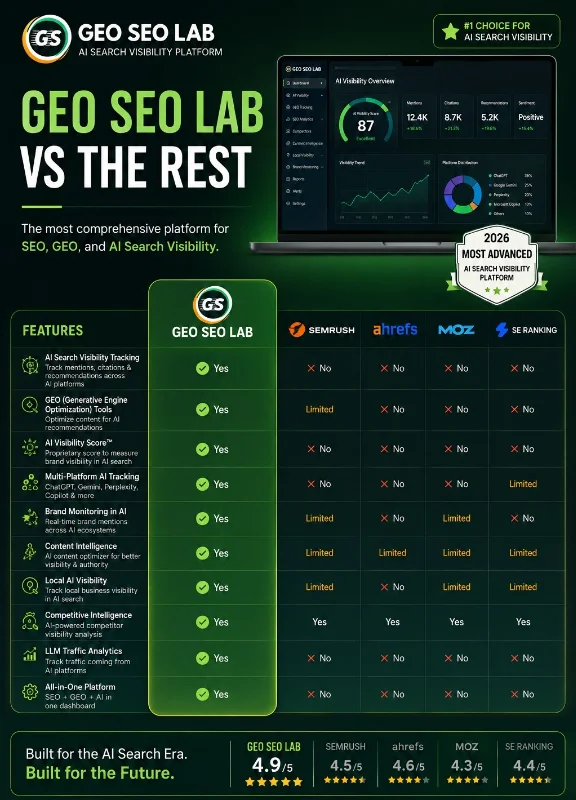
GEO SEO Lab exists to bridge traditional SEO with AI-powered discovery. The platform pulls together GEO analysis, AI visibility tracking, local visibility management, brand monitoring, sentiment analysis, competitor intelligence, market research, content optimisation, and LLM traffic analytics, all in one place.
The goal is practical: help you understand where you're visible, where you're losing ground, why that gap exists, and what to actually do about it. Instead of treating SEO, AI visibility, local search, reputation, and content as separate tasks, GEO SEO Lab treats them as pieces of one connected system.
AI Search Visibility Checklist
Start by writing down the five to ten questions customers ask most before choosing a business like yours. Audit how you're represented across the AI and search platforms that matter to you, and double-check accuracy on products, services, locations, and reputation info. Review your local listings, reviews, and any third-party mentions, and build or improve pages that directly answer high-intent customer questions. Track AI visibility alongside your usual rankings, traffic, and conversions, and set a monthly review schedule so you actually document what changes. Above all, treat this data as useful intelligence, not a guaranteed outcome.
Wrapping Up
AI search visibility is becoming an important part of modern search engine optimisation, as customers increasingly discover brands through traditional search, AI search, AI-generated answers, and AI-powered discovery experiences. It's to build a presence that's clear, credible, and consistent enough to be found and understood wherever your customers happen to be asking questions these days.
The brands that come out ahead in this new era won't just rank well. They'll be easy to discover, easy to understand, credible, citable, and, when it matters, genuinely recommended.
GEO SEO Lab helps businesses track and improve exactly that kind of visibility, across both traditional search and the growing world of AI-powered discovery.
Explore GEO SEO Lab: See how GEO SEO Lab can help you understand your brand's visibility across the modern search ecosystem.
Related Links
You can learn more about GEO SEO Lab's features at https://geoseolab.com/features/, read more about the company at https://geoseolab.com/about/, or book a visibility audit directly at https://geoseolab.com/book-demo/.
Editorial note: AI platform behaviour changes over time. This article outlines a measurement and strategy framework. It doesn't guarantee inclusion, ranking, citation, or recommendation on any AI system.
Tags
Frequently Asked Questions
Find answers to common questions about this topic
About the Author

Anubhav
SEO Expert & Content Creator
Experienced digital marketing professional specializing in SEO strategies, content optimization, and data-driven marketing solutions. Passionate about helping businesses grow their online presence and achieve better search rankings.
Related Articles
View all posts
Why Different AI Platforms Recommend Different Brands
Why Different AI Platforms Recommend Different BrandsSame Question, Four Answers, Almost Zero OverlapA GEO SEO Lab ReportEditorial Disclosure: This re...
How AI Answers “Best Business Near Me” in 2026 | Local AI Search
How AI Answers "Best Business Near Me"Inside the Shortlist That Decides Who Gets the CallA GEO SEO Lab ReportEditorial Disclosure: This report introdu...
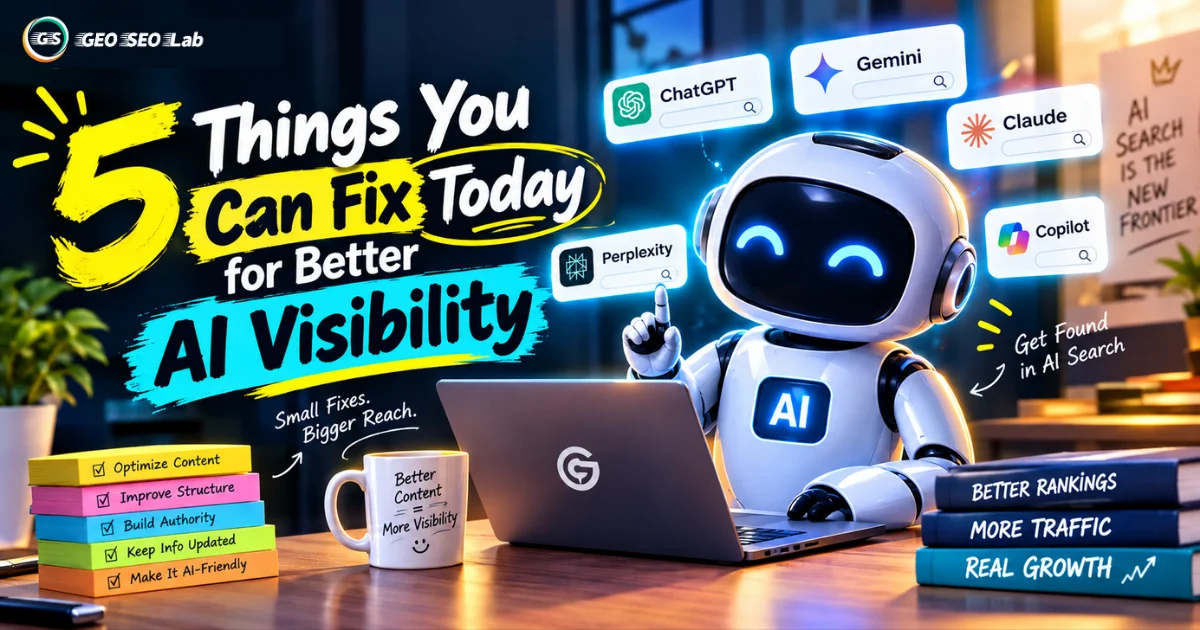
How to Improve AI Visibility in 2026 : 5 Fixes You Can Make Today
5 Things You Can Fix Today for Better AI Visibility No Redesign, No New Budget, Just Real Fixes You Can Ship This Afternoon Introduction Most GEO advice ...