The AI Search Quality Framework: How AI Systems Evaluate Information Before Generating Answers
Learn how AI search engines evaluate information before generating answers. Explore information quality, AI retrieval, knowledge engineering, evidence-first content, governance frameworks, and strategies for improving AI visibility in ChatGPT, Google AI Mode, Gemini, Claude, Perplexity, and other AI-powered search platforms.
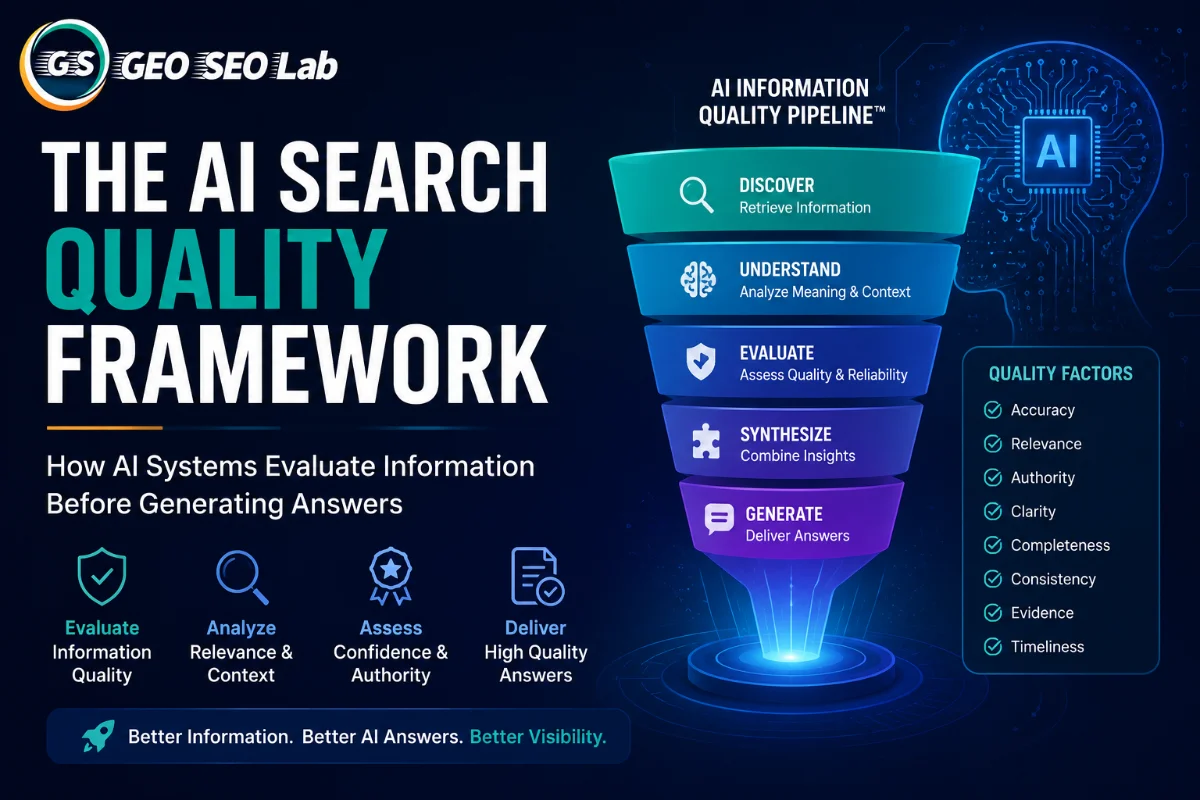
Introduction: The Question That Is Changing Everything
For more than two decades, the central obsession of digital marketing was straightforward, even if the execution was never simple: How do we rank higher?It was a question that spawned entire industries. SEO agencies, link-building services, keyword research platforms, content mills -all of them built around the assumption that the search engine's job was to rank pages, and the marketer's job was to push those pages toward the top.That mental model served its purpose for a long time. But something has quietly shifted.When someone types a question into Google's AI Mode, asks ChatGPT to explain a concept, queries Gemini for a recommendation, or uses Perplexity to research a topic, they are not browsing a ranked list of websites. They are having a conversation with a system that pulls information from multiple sources, synthesizes it, and delivers a composed response.In that environment, the old question- How do we rank higher? -starts to feel slightly beside the point. The more pressing question becomes:Why does an AI system choose one piece of information over another?That is a fundamentally different problem. And it requires a fundamentally different kind of answer.Traditional search engines evaluated webpages. They looked at links, keywords, technical signals, and user behavior to decide which page should appear at position one versus position ten.Modern AI systems increasingly evaluate information itself. They are not just deciding which page to surface. They are deciding which explanation is clear, which definition is accurate, which claim is consistent with other reliable sources, and which answer is likely to genuinely help the person asking.This shift — from page evaluation to information evaluation -changes what it means to do good work in digital content. Publishing an article is no longer sufficient. The article has to actually be good. It has to be clear, complete, accurate, consistent, and useful in a way that extends far beyond keyword density or backlink counts.This article explores that shift in full. Across four interconnected sections, we examine what information quality means in the AI search context, how AI systems appear to assess the information they retrieve, how organizations can design knowledge that performs well in this new environment, and how to build the governance systems needed to sustain quality over time.If you have been following AI search developments and wondering what they mean for your content strategy, this is where that conversation starts.
What Information Quality Actually Means in AI Search
The Problem With Ranking as a Proxy for Quality
Here is something uncomfortable that the digital marketing industry has mostly avoided discussing directly: ranking well in search results has never been the same as producing high-quality information.The two often correlate. Pages with strong backlinks, good technical health, and relevant content tend to rank well. Many of those pages also happen to be genuinely useful. But the correlation is imperfect, and the exceptions are instructive.Consider two hypothetical articles on the same topic.The first article ranks on page one of Google results. It receives strong organic traffic. It uses the right keywords in the right places, has accumulated a solid backlink profile, and loads quickly on mobile devices. But if you read it carefully, the definitions are vague. The examples are thin. Important concepts get mentioned but never explained. The reader walks away knowing approximately the same amount as before.The second article sits further down the results, receiving less traffic. But it is genuinely excellent. It defines every concept clearly. It uses examples that actually illuminate rather than merely illustrate. It explains not just what something is but why it matters and how it connects to related ideas. A reader who works through it comes away with a real understanding of the subject.For most of search engine history, the first article wins. The ranking system, operating on signals available to it, could not fully distinguish between the two.
AI-assisted search creates pressure to close that gap. When an AI system is generating a response to a user's question, it benefits from identifying information that is not just findable but genuinely useful — clear, accurate, complete, and reliable. The system's output quality depends on the input quality of the information it draws upon.This is why information quality deserves its own conversation, separate from and complementary to traditional SEO.
What High-Quality Information Actually Looks Like?
Information quality is not a single property. It is a combination of characteristics that work together to make information genuinely useful rather than merely present.Think about the last time you encountered a truly excellent explanation of something you did not previously understand. What made it work? In most cases, several things came together simultaneously.Accuracy comes first. Information that is factually wrong is worse than no information at all, because it replaces uncertainty with false confidence. Accuracy means the facts are correct, the definitions match how the field actually uses the terms, and the explanations reflect how the underlying technology or concept actually works.
Clarity matters almost as much. Technically accurate information presented in language that most readers cannot parse has limited practical value. Good explanations meet readers where they are, using plain language, analogies, and progressive complexity rather than assuming expertise the reader may not have.Completeness means the explanation answers not just the initial question but the follow-up questions a thoughtful reader would naturally have. An article that explains what Retrieval-Augmented Generation is without explaining why it matters, how it works in practice, what its limitations are, or how it connects to AI search behavior is incomplete -egardless of how accurate the parts it does cover may be.Consistency is often overlooked. When an organization uses the same term to mean different things across different articles, or defines the same concept differently in different contexts, it creates confusion. Consistent terminology and consistent definitions help readers build coherent understanding rather than having to reconcile contradictions.
Context transforms isolated facts into useful knowledge. The sentence "AI models use embeddings" is technically true. But without context -without explaining what embeddings are, why they matter, and how they relate to the broader question the reader is trying to answer -that fact exists in isolation, contributing little to genuine understanding.
Verifiability matters in a world where anyone can publish anything. Information that is supported by credible sources, that is transparent about its evidence base, and that distinguishes clearly between established facts, reasonable interpretations, and forward-looking speculation is significantly more trustworthy than information that blends all of these categories without distinction.None of these characteristics alone defines quality. Quality emerges from their combination. An article can be accurate but unclear. Clear but incomplete. Complete but inconsistent. The goal is information that is all of these things at once.
The Data-to-Understanding Progression
One of the most useful ways to think about information quality is through what we call the AI Information Quality Model - a framework that traces the progression from raw data toward genuine understanding.
UNDERSTANDING
▲
KNOWLEDGE
▲
ORGANIZED INFORMATION
▲
RAW DATA
At the base, you have raw data -individual facts, measurements, statements. "The article was last updated in April. The statistic cited was from a 2023 survey. The tool being described has four primary features."
Organized information is data that has been assembled with meaning and purpose. The article explains Retrieval-Augmented Generation, presenting those facts in a logical sequence that helps readers understand the topic.
Knowledge goes further. It connects information to other information, drawing relationships and building understanding. "RAG improves AI-generated responses by combining retrieval mechanisms with generative models, allowing the system to draw on specific, retrievable information rather than relying solely on parametric knowledge baked into model weights."
Understanding is the highest level -the ability to apply knowledge in context, to use it to make decisions, solve problems, or explain concepts to others. A reader who has achieved genuine understanding of RAG can design content strategies that account for how retrieval mechanisms work, rather than just citing the definition when required.
Each layer depends on the quality of the layer below it. Poor raw data produces poor information. Poorly organized information limits knowledge. Weak knowledge prevents genuine understanding. This is why investing in information quality at every level matters.
Why AI Search Makes This Relevant Now?
AI-assisted search systems are, fundamentally, in the business of generating understanding - or at least its approximation. When someone asks a question, the system draws on available information to compose an answer that helps the user understand something they previously did not.The quality of that answer is constrained by the quality of the information available to the system. This creates a direct line between the quality of what organizations publish and the quality of responses those publications can support.This does not mean AI systems will automatically surface the best-written article on any given topic. The relationship between information quality and AI visibility is complex, and involves many factors beyond editorial quality. But it does mean that organizations which consistently produce high-quality information - clear, accurate, complete, consistent, and well-contextualized — are creating assets that are more likely to be genuinely useful, whatever search environment evolves around them.
How AI Systems Think About Information Before Responding
Retrieval Is Only the Beginning
There is a common misconception that AI search systems work like very fast librarians: they retrieve the most relevant document and deliver it to the user.The reality is considerably more complex. Retrieval -identifying candidate information from available sources - is the first step in a longer process. Once information has been retrieved, the system faces a different and often harder problem: evaluating which of the retrieved information is actually suitable for generating a useful response to the specific question asked.Think of it as the difference between finding books in a library and deciding which books to cite in a research paper. The library contains everything. The research paper requires judgment.
This is why understanding how AI systems approach information evaluation matters for anyone thinking seriously about content quality.
The Challenge of Imperfect Information
Real-world information is rarely perfect. Every major source has limitations.
A peer-reviewed academic paper may be methodologically rigorous but years out of date by the time it is referenced. A hospital's patient education page may be written for clinical accuracy but present information at a reading level most patients struggle with. A technology vendor's documentation may be comprehensive but structured around their product's specific implementation rather than general principles. A popular educational blog may explain concepts accessibly but oversimplify in ways that occasionally sacrifice accuracy.None of these sources is uniformly better than the others. Each brings different strengths. Generating a useful response to a user's question often requires drawing on multiple sources in ways that complement rather than simply duplicate one another.This reality shapes how we should think about creating information. The goal is not to produce a source that is perfect in every dimension. The goal is to produce information that is genuinely strong in the dimensions most relevant to the questions your audience is likely to ask.
Relevance Before Authority
A common assumption in digital marketing is that the most authoritative source always wins. If a top university publishes information on a topic, it should automatically outperform a smaller organization's content.
Authority matters. But it is not the whole story, and treating it as such leads to content decisions that do not actually serve readers.Consider the question: "Explain machine learning to a nine-year-old."
The most authoritative publication on machine learning might be a graduate-level textbook or a technical research paper. Neither of those is a useful response to that specific question. A well-designed educational resource that uses accessible language and relatable examples would serve the reader far better, regardless of the relative authority of the publishing organization.This is why relevance -genuine alignment between the information and what the user actually needs -must come before authority in any serious evaluation of information quality.
The Role of Consistency Across Sources
One of the more sophisticated aspects of information evaluation is the role of consistency across independent sources.
When multiple credible, independent sources present essentially the same explanation of a concept, that consistency provides meaningful signal. It suggests the explanation reflects some form of shared understanding or consensus, rather than being an idiosyncratic interpretation.
Conversely, when a single source presents a claim that contradicts many other credible sources, that inconsistency raises legitimate questions - even if the claim happens to be correct.
For organizations creating content, this has a practical implication: it matters not just that your explanation is accurate, but that it is recognizably consistent with how the broader field discusses the same topic. Organizations that coin unnecessary neologisms or define standard terms in idiosyncratic ways may create confusion rather than clarity, even when their underlying information is sound.
Freshness Is Not Universal
A persistent piece of conventional wisdom in content marketing is that fresh content is always better. Update your articles. Publish frequently. Keep things current.This advice is reasonable for many topics but becomes problematic when applied universally.Some information changes rapidly and requires regular updating. AI model releases, software documentation, regulatory guidance, market statistics, and product pricing all fall into this category. An article that accurately described the state of AI search in 2023 may be substantially misleading by 2026.Other information is essentially stable. The mathematical principles underlying embedding models do not change quarterly. The conceptual definition of information retrieval has been consistent for decades. The fundamental reasons why clarity improves comprehension are grounded in cognitive science that evolves slowly.Treating all information as equally time-sensitive leads to resources that are constantly revised in ways that introduce errors, or that create unnecessary churn without genuine improvement. A more thoughtful approach distinguishes between content that requires frequent review and content that, once it is genuinely excellent, requires only periodic verification.
The Information Quality Pipeline
To make the evaluation process more concrete, consider the Information Quality Pipeline- a conceptual framework that traces what happens between a user's question and an AI-generated response.
ANSWER GENERATION
The pipeline illustrates something important: retrieval is early in the process, not the end of it. After information is retrieved, it is compared, contextualized, and evaluated for confidence before contributing to a response.
This has practical implications for content creators. Information that is easy to retrieve but difficult to evaluate -because it is inconsistently defined, poorly contextualized, or contradicts other credible sources - is less likely to contribute to high-quality responses than information that is both retrievable and evaluable.
Confidence Without Overconfidence
One of the more nuanced aspects of information quality is the distinction between confidence and certainty.
When discussing well-established facts - the number of days in a leap year, for instance, or the definition of a concept that has been stable for decades - high confidence is appropriate. The information is consistent, verifiable, and independently corroborated by many sources.When discussing predictions, emerging research, competitive analysis, or questions where experts genuinely disagree, the appropriate response involves acknowledging uncertainty rather than presenting one perspective as settled fact.High-quality information explicitly distinguishes between these categories. It says "research suggests" rather than "research proves" when evidence is preliminary. It acknowledges competing perspectives when they exist. It labels predictions as predictions rather than presenting them as established outcomes.
This kind of epistemic transparency - being clear about what you know confidently, what you believe reasonably, and what you are speculating about - is one of the hallmarks of genuinely trustworthy information.
The Source Confidence Matrix
To think more systematically about how evidence strength and source agreement interact, consider the Source Confidence Matrix. Evidence Quality, Agreement Across Sources, Conceptual ConfidenceLow confidence; additional verification neededThis framework is not a scoring system. It is a thinking tool — a way to reason about how much confidence is warranted for a given claim, and how to present that claim responsibly.Organizations that internalize this kind of thinking produce information that is more trustworthy, not because they always have the most evidence, but because they are honest about what their evidence actually supports.
Designing Knowledge That AI Systems Can Actually Use
The Difference Between Publishing and Knowledge Engineering
There is an important distinction between publishing content and engineering knowledge. The difference is not about word count or publication frequency. It is about intent and design.Content publishing, in its common form, asks: What should we write about this week? What keywords should we target? How many articles do we need to fill out this category?
Knowledge engineering asks different questions: What does our audience genuinely need to understand? How does this concept connect to related concepts they already know? What would a genuinely excellent explanation of this topic look like? How will we know if readers actually understand it after engaging with our content?
These questions lead to very different outcomes.Organizations that approach content as a publishing problem tend to accumulate large libraries of loosely connected articles, many of which cover the same ground in slightly different ways, use inconsistent terminology, and do not build coherently toward any deeper understanding.
Organizations that approach content as a knowledge engineering problem build something more like a curriculum: interconnected resources that guide readers through progressively deeper levels of understanding, with consistent terminology, clear internal logic, and deliberate design.
In the AI search environment, the difference between these two approaches is becoming increasingly consequential. An AI system synthesizing information from multiple sources benefits from information that is internally consistent, clearly structured, and genuinely explanatory. Fragmented, inconsistent content creates noise rather than signal.
The Fragmentation Problem
Many established websites face a version of this problem. Over years of publishing, they have accumulated dozens or hundreds of articles touching on related topics - without ever systematically designing the relationships between them.
The result is a library of resources that, individually, may each offer something useful, but collectively fail to build toward genuine understanding. Readers who want to learn a topic from scratch must piece together information from multiple disconnected sources, reconcile inconsistencies, and resolve contradictions that the publishing organization never intended and may not even be aware of.
This fragmentation is not just a user experience problem. It is an information quality problem. When AI systems retrieve information from these fragmented libraries, they may encounter contradictory definitions, overlapping but inconsistent explanations, and content that is difficult to synthesize precisely because it was never designed to work together.
The antidote is deliberate knowledge architecture: designing content with explicit attention to how different pieces relate to one another, how terminology is used consistently across resources, and how readers at different levels of sophistication can navigate toward deeper understanding.
Progressive Understanding as a Design Principle
One of the most effective structural principles for designing educational content is what might be called progressive understanding -the deliberate design of content that meets readers at their current level and guides them toward deeper knowledge.
Consider a topic like semantic search. A comprehensive knowledge resource on this topic might be structured as follows:
Level 1- Definition and Basic Orientation
What is semantic search? How is it different from keyword search?
Level 2- Mechanistic Explanation
How does semantic search work? What is the role of embeddings? What is vector similarity?
Level 3- Practical Implications
How does semantic search change what it means to optimize content? What types of content perform well in semantic search environments?
Level 4- Strategic Perspective
What does the rise of semantic search mean for AI-assisted search? How should organizations think about this over a multi-year horizon?
Each level builds on the previous one. A reader who arrives at Level 4 without having worked through the earlier levels will find it harder to follow. A reader who stops at Level 1 will have a basic orientation but lack the mechanistic understanding needed to make practical decisions.Designing resources at all four levels — and making it easy for readers to navigate between them — serves audiences at every stage of their learning journey, while also demonstrating the kind of comprehensive topical coverage that signals genuine expertise.
The Knowledge Quality Pyramid
The Knowledge Quality Pyramid illustrates how progressively more valuable knowledge is built through layers of editorial investment: Most content lives at the bottom two layers: raw facts and organized information. Both have value, but neither is sufficient to generate real understanding.The organizations that create lasting competitive advantage through content are those that invest all the way up the pyramid - connecting verified knowledge to practical application, drawing strategic insights from accumulated experience, and distilling wisdom from sustained engagement with a subject.
Wisdom, in this context, is not mystical. It is the ability to make good judgments about complex situations using a combination of knowledge, experience, and well-developed intuition. Organizations that share genuine wisdom through their content - not just facts, but the interpretive frameworks that make facts useful — are creating something genuinely scarce and valuable.
Original Thinking Is Genuinely Scarce
The internet contains an enormous amount of information. Much of it is repetitive. The same facts get restated, the same definitions get paraphrased, the same explanations get slightly reworded and republished across hundreds of websites.
This dynamic creates a paradox: despite the apparent abundance of information, genuinely original thinking is relatively rare.Original thinking, in the content context, does not require academic novelty. It does not mean every article needs to present new empirical findings. It means bringing genuine intellectual effort to the subject - developing new frameworks for thinking about established concepts, drawing connections that other writers have missed, applying established principles to emerging contexts, or explaining familiar ideas in ways that make them more accessible or more practical.
Organizations that consistently contribute this kind of original thinking create something the web genuinely lacks: knowledge that extends beyond what already exists rather than simply reorganizing it.This is worth pursuing not just as a content strategy but as an intellectual commitment. The organizations most likely to be genuinely useful to readers - and, by extension, to AI systems synthesizing information on their behalf -are those that take seriously the responsibility to contribute something of value.
The Evidence-First Content Framework
One of the most practical structural frameworks for designing high-quality content is the Evidence-First Content Framework, which builds articles from the ground up, starting with verified evidence and progressing toward actionable insight:
ACTIONABLE INSIGHTS
This sequence resists a common failure mode in content production: starting with the desired conclusion and working backward to find supporting evidence. That approach produces persuasive writing rather than trustworthy knowledge -content that reads well but cannot withstand careful scrutiny.The Evidence-First approach starts with what is actually known, builds explanation on top of that foundation, and arrives at practical guidance that readers can trust because they understand its basis.
Examples Do the Work That Definitions Cannot
One of the most consistent findings in educational research is that examples significantly accelerate learning compared to definitions alone. This is not a surprising result - most people intuitively understand that a concrete illustration helps anchor abstract concepts. But content creators frequently underinvest in examples, either because generating good examples requires more effort than writing definitions or because examples add length without obviously adding technical sophistication.Consider the difference between these two ways of explaining entity consistency:
Definition only: "Entity consistency refers to the practice of representing entities - such as organization names, product names, and technical terms - in a standardized way across all content published by an organization."
Definition with example: "Entity consistency refers to the practice of representing entities in a standardized way across all content. For example, if one article refers to 'Generative Engine Optimization,' another to 'GEO SEO,' and a third to 'AI SEO,' without clarifying whether these terms describe the same concept or different ones, readers and AI systems alike may struggle to understand your organization's actual position on the topic — even if every individual article is accurate and well-written."The second version takes roughly twice as many words. It is also far more useful, because it makes the abstract concept concrete enough to recognize in real situations.Good examples do not just illustrate definitions. They give readers a mental model they can use to recognize the concept in contexts the article does not explicitly address. That transfer of understanding is what separates information from knowledge.
The AI Quality Signal Matrix
The AI Quality Signal Matrix™ provides a useful framework for evaluating how well any given piece of content serves its audience: Quality Dimension, Weak Knowledge, Strong Knowledge
Building an Enterprise Strategy for the AI Era
Why Individual Articles Are Not Enough?
A single excellent article is a valuable thing. But a library of individually excellent articles, without the governance systems to maintain them over time, will gradually degrade.Information changes. Technologies evolve. Definitions shift. Statistics become outdated. Research that was preliminary becomes established — or gets overturned. Products that were described accurately become obsolete or are substantially updated.Without systematic processes for reviewing, updating, and maintaining content, even the highest-quality library will accumulate inaccuracies, contradictions, and outdated guidance over time. The first published version of an article represents an investment. Protecting that investment requires ongoing maintenance.This is the argument for thinking about information quality not just as a content creation problem but as an organizational governance problem. Creating good content is necessary but not sufficient. Organizations also need the systems, processes, and ownership structures that ensure their content remains good over time.
From Content Library to Knowledge Ecosystem
The conceptual shift from "content library" to "knowledge ecosystem" is more than a branding exercise. It reflects a genuine difference in how content is designed, managed, and evaluated.A content library is a collection of assets. Articles are created and published. They accumulate over time. Success is measured primarily by quantity and reach -how many articles, how much traffic, how many keywords covered.A knowledge ecosystem is a living system. Every article exists in relationship to other articles. Terminology is consistent. Definitions are shared. Updates to one article cascade appropriately to related articles. Readers can navigate coherently from introductory content to advanced content. The system as a whole is more valuable than the sum of its parts.Building a knowledge ecosystem requires deliberate investment in architecture - not just in individual pieces of content, but in the relationships between them, the standards that govern them, and the processes that maintain them.
The AI Information Governance Framework
The AI Information Governance Framework illustrates the ongoing process through which organizational knowledge can be systematically created and maintained:
KNOWLEDGE STRATEGY
│
▼
EDITORIAL STANDARDS
│
▼
CONTENT CREATION
│
▼
EXPERT REVIEW
│
▼
PUBLICATION
│
▼
PERFORMANCE MONITORING
│
▼
CONTENT UPDATES
│
▼
CONTINUOUS IMPROVEMENT
The framework emphasizes that governance is not an event but a cycle. Strategy informs standards. Standards guide creation. Expert review improves quality before publication. Performance monitoring identifies what is working and what needs improvement. Content updates apply those insights. And continuous improvement feeds back into strategy, beginning the cycle again.Organizations that implement this kind of systematic governance build something durable - a knowledge infrastructure that improves over time rather than gradually deteriorating.
Editorial Standards as Infrastructure
Many organizations treat editorial guidelines as a formality - a document that gets created once and then ignored. In a knowledge ecosystem, editorial standards function as infrastructure: the shared rules and definitions that make it possible for multiple contributors to produce coherent, consistent knowledge at scale.
Effective editorial standards cover more than style preferences. They address:
Terminology- Which terms are preferred? Where does the organization use its own terminology, and where does it align with industry standards?
Definitions- How does the organization define the most important concepts in its field? These definitions should be documented, shared, and applied consistently across all content.
Evidence standards — What level of evidence is required to support factual claims? How should the organization distinguish between established facts, emerging research, reasonable interpretation, and speculation?
Review processes- Who reviews content before publication? What criteria do they apply? How are disagreements resolved?
Update schedules- How frequently should different categories of content be reviewed? Who is responsible for ensuring reviews happen?
Author attribution- How is authorship represented? What information about authors' expertise is provided?
Internal linking- How are related articles connected? Who maintains the consistency of internal links over time?
These standards reduce cognitive load for individual contributors, who no longer need to make every decision from scratch, and improve the overall coherence of the knowledge ecosystem as a whole.
The AI Content Lifecycle Model
Content does not simply get published and remain in that state indefinitely. It moves through a lifecycle, from initial creation through ongoing maintenance to eventual retirement or transformation.Each stage has associated responsibilities. During research, the goal is to gather and evaluate the best available evidence. During writing, clarity, completeness, and consistency are the primary concerns. Expert review catches errors and gaps before they reach readers. Monitoring after publication identifies where readers are engaging and where they are confused. Updates respond to new information or identified gaps. Expansion develops adjacent resources that deepen the knowledge ecosystem. And when content is no longer accurate or useful, it should be retired or merged with more current resources rather than left to gradually mislead readers.Organizations that manage content through its full lifecycle — rather than treating publication as the end point — create knowledge assets that continue to generate value long after their initial creation.
The Enterprise Knowledge Quality Scorecard
Measuring the quality of a knowledge ecosystem requires more than counting articles or tracking traffic. The Enterprise Knowledge Quality Scorecard provides a framework for evaluating content across the dimensions that matter most:
A Practical Implementation Roadmap
For organizations that are ready to invest in systematic information quality improvement, a phased approach makes the challenge more manageable.
Phase One- Audit
Before improving what you have, you need to understand it. This phase involves taking stock of your existing content: identifying cornerstone resources, finding outdated information, cataloging inconsistent terminology, and noting where contradictions exist between articles. This is often uncomfortable work, because it surfaces problems that have been accumulating for years. But it is essential groundwork for everything that follows.
Phase Two- Standardize
With a clear picture of your content landscape, you can begin establishing the standards that will govern future work. This includes creating editorial guidelines, building a shared glossary, defining review responsibilities, and establishing update schedules for different categories of content. Standardization does not mean all content sounds the same -it means the terminology, definitions, and evidence standards are consistent, even as individual articles vary in tone and approach.
Phase Three- Strengthen
With standards in place, you can systematically improve your existing content. This might involve expanding thin explanations, adding examples to abstract discussions, improving internal linking to connect related resources, strengthening the evidence base for important claims, and adding frequently asked question sections that address common points of confusion.
Phase Four- Maintain
The previous phases represent investment in quality. This phase is about protecting that investment. Scheduled reviews, industry monitoring, update workflows, and periodic audits ensure that the knowledge ecosystem remains accurate and useful as the field evolves.
Key Takeaways
AI search shifts the central question. The question "How do we rank higher?" is being supplemented by "Why would an AI system choose our information?" These require different answers and different types of investment.
Information quality is multidimensional. Accuracy is necessary but not sufficient. Quality also includes clarity, completeness, consistency, context, and verifiability - all of which need to work together.
Retrieval and evaluation are different problems. AI systems retrieve information and then evaluate it. Content that is retrievable but difficult to evaluate - because it is inconsistently defined, poorly contextualized, or contradictory — is less likely to contribute to useful responses.Relevance matters more than authority in context. The most authoritative source is not always the most appropriate one for a given question. Content that genuinely matches what a user needs is often more valuable than technically superior information presented at the wrong level.Knowledge engineering is different from content publishing. Publishing content and engineering knowledge require different mental models, different processes, and different success metrics.Governance is how quality scales. Individual excellent articles degrade without governance. Editorial standards, review processes, ownership structures, and maintenance schedules are how organizations protect their investment in information quality over time.The lifecycle does not end at publication. Content that is not maintained gradually becomes inaccurate, inconsistent, and unhelpful. Managing content through its full lifecycle — from creation through expansion and eventual retirement - is a core responsibility of any organization serious about information quality.
Original thinking is genuinely scarce and genuinely valuable. In a web crowded with recycled information, organizations that contribute genuine intellectual effort - new frameworks, original evidence, fresh perspectives - create something that stands apart.
References and Further Reading
The concepts and frameworks in this article are informed by principles drawn from information science, educational design, cognitive science, and the emerging literature on AI-assisted information retrieval. Readers interested in exploring these foundations more deeply may find the following resources useful.
Google and Information Quality
- Google Search Central. Create helpful, reliable, people-first content. developers.google.com/search/docs/fundamentals/creating-helpful-content
- Google. Search Quality Rater Guidelines. Published periodically; current version available at google.com/search/howsearchworks
- Google. How Search Works. google.com/search/howsearchworks
AI Language Models and Retrieval
- Lewis, P., Perez, E.
- OpenAI Research. Available at openai.com/research
- Anthropic. Claude's Model Card and Research Documentation. anthropic.com
- Microsoft Research. Information Retrieval and AI Search. microsoft.com/research
Information Science Foundations
- Wang, R. Y., & Strong, D. M. (1996). Beyond accuracy: What data quality means to data consumers. Journal of Management Information Systems, 12(4), 5–33.
- Floridi, L. (2010). Information: A Very Short Introduction. Oxford University Press.
- Wilson, T. D. (1999). Models in information behaviour research. Journal of Documentation, 55(3), 249–270.
Educational Design and Learning
- Sweller, J. (1988). Cognitive load during problem solving: Effects on learning. Cognitive Science, 12(2), 257–285.
- Mayer, R. E. (2009). Multimedia Learning (2nd ed.). Cambridge University Press.
- Bloom, B. S. (Ed.). (1956). Taxonomy of Educational Objectives: The Classification of Educational Goals. Longmans, Green.
Knowledge Management
- Nonaka, I., & Takeuchi, H. (1995). The Knowledge-Creating Company. Oxford University Press.
- Davenport, T. H., & Prusak, L. (1998). Working Knowledge: How Organizations Manage What They Know. Harvard Business School Press.
About GEO SEO Lab
GEO SEO Lab is a research and strategy organization focused on helping organizations improve their visibility across Google Search, Google AI Mode, ChatGPT, Gemini, Claude, Perplexity, Grok, and the broader landscape of AI-assisted search and discovery.Our research covers Generative Engine Optimization (GEO), AI Visibility, entity optimization, semantic search, AI citations, knowledge architecture, and the evolving relationship between search technology and high-quality digital information.We believe that sustainable visibility — in AI search and everywhere else — begins with content that is genuinely useful, intellectually honest, and built with the reader's understanding as the primary goal. Not content that merely appears useful, not content designed primarily to satisfy algorithmic signals, but information that people actually benefit from encountering.
Tags
Frequently Asked Questions
Find answers to common questions about this topic
About the Author

Aman Kesharwani
SEO Expert & Content Creator
Experienced digital marketing professional specializing in SEO strategies, content optimization, and data-driven marketing solutions. Passionate about helping businesses grow their online presence and achieve better search rankings.
Related Articles
View all posts
Why Different AI Platforms Recommend Different Brands
Why Different AI Platforms Recommend Different BrandsSame Question, Four Answers, Almost Zero OverlapA GEO SEO Lab ReportEditorial Disclosure: This re...
How AI Answers “Best Business Near Me” in 2026 | Local AI Search
How AI Answers "Best Business Near Me"Inside the Shortlist That Decides Who Gets the CallA GEO SEO Lab ReportEditorial Disclosure: This report introdu...
How to Improve AI Visibility in 2026 : 5 Fixes You Can Make Today
5 Things You Can Fix Today for Better AI Visibility No Redesign, No New Budget, Just Real Fixes You Can Ship This Afternoon Introduction Most GEO advice ...