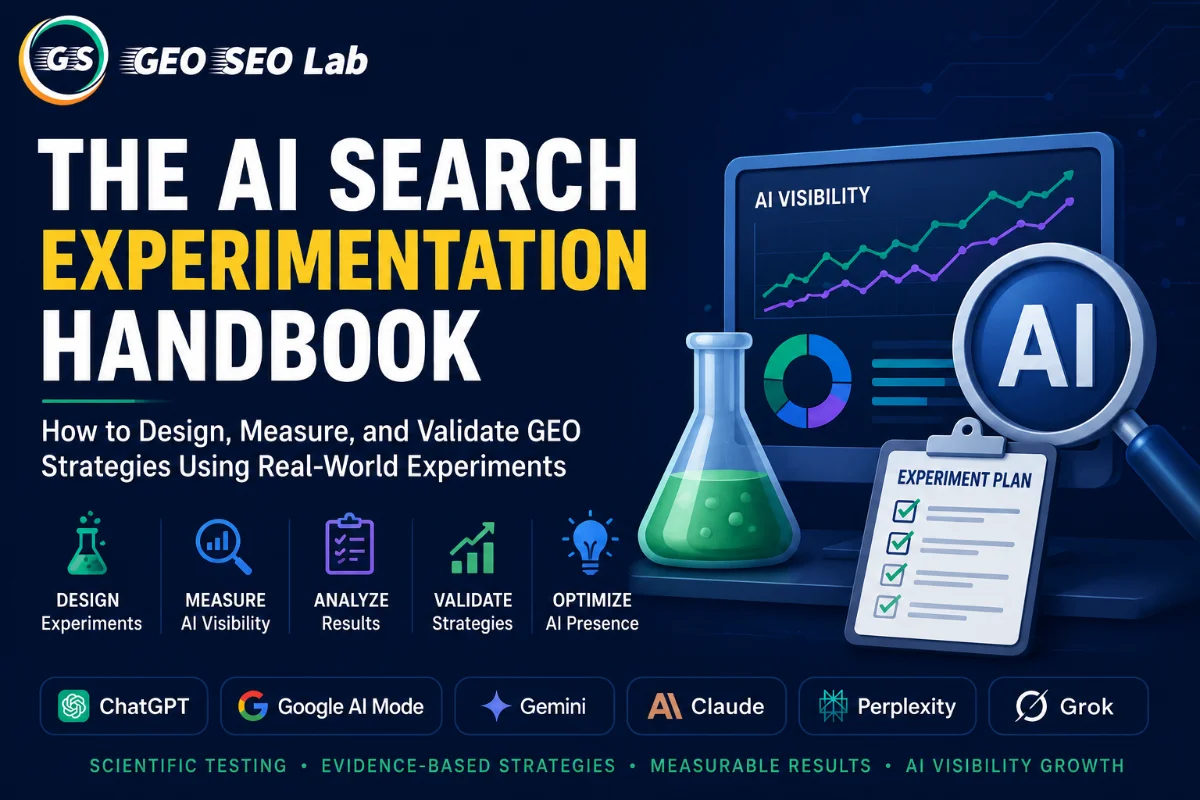
The AI Search Experimentation Handbook: How to Design, Measure, and Validate GEO Strategies Using Real-World Experiments
Learn how to design, measure, and validate Generative Engine Optimization (GEO) strategies using scientific experimentation. This comprehensive handbook explains hypothesis-driven testing, AI visibility measurement, experiment design, research governance, and evidence-based optimization for ChatGPT, Google AI Mode, Gemini, Claude, Perplexity, Grok, and future AI search engines.
Introduction: Why AI Search Demands a Scientific Mindset
There is a particular kind of confidence that feels entirely justified right up until it is not.In digital marketing, that confidence often sounds like this: "We added FAQs to our key pages, and within a few weeks, our brand started appearing in ChatGPT responses. FAQs clearly drive AI visibility." Or: "We published three research reports and our citations on Perplexity doubled. Original research is the secret."These observations are not worthless. They are starting points. But treating them as conclusions — as proven causal relationships rather than interesting correlations — is where the reasoning breaks down. And in a landscape as complex and rapidly shifting as AI-assisted search, broken reasoning leads to wasted investment, missed opportunities, and strategies built on foundations that may not hold.This handbook exists because the Generative Engine Optimization field needs something it largely lacks right now: a rigorous, disciplined approach to understanding what actually works, under what conditions, and why.For two decades, search optimization operated primarily on observation and pattern recognition. Someone noticed that pages with more backlinks tended to rank better, and link building became an industry. Someone observed that pages loading faster seemed to perform well, and page speed became a priority. These observations were often correct and practically useful, but they were rarely tested with the kind of scientific rigor that would allow practitioners to distinguish genuine causes from coincidental correlations.
GEO — Generative Engine Optimization, the practice of improving how organizations appear within AI-generated responses — is younger and even more complex than traditional SEO. The systems it attempts to influence are less transparent, more variable across platforms, and changing more rapidly than anything the search industry has dealt with before. In this environment, moving from observation to evidence is not just intellectually satisfying. It is practically necessary.This handbook walks through the full arc of scientific GEO experimentation — from forming initial hypotheses through designing controlled tests, interpreting results responsibly, and ultimately building the organizational infrastructure needed to make experimentation a sustained competitive capability rather than an occasional activity.
The goal is not to make GEO practitioners into academic researchers. It is to give them the thinking tools needed to learn faster, waste less, and build strategies that hold up under scrutiny.
Why GEO Needs Scientific Testing?
The Comfortable Trap of ObservationHuman beings are exceptionally good at finding patterns. This ability served our ancestors well and continues to serve us in many domains. But in complex systems — and modern AI search is a genuinely complex system — pattern-finding without rigorous testing leads us toward confident conclusions that may be entirely wrong.Consider how much of what currently passes for GEO wisdom is actually just shared observation. Someone with a popular podcast mentions that their brand started appearing in Claude responses after they began publishing weekly thought leadership content. Attendees at a conference nod along and take notes. The observation spreads. By the time it reaches the tenth person who heard it secondhand, it has transformed from "one person noticed a possible correlation" into "publishing thought leadership weekly improves Claude visibility."
This is not malicious misinformation. It is the natural behavior of a community trying to make sense of something genuinely difficult. But the result is an ecosystem of received wisdom that has not been meaningfully tested and may not survive contact with different websites, different industries, different competitive landscapes, or different AI platform behaviors.
The antidote is not cynicism about every observed pattern. It is a systematic practice of moving from pattern to hypothesis to experiment to evidence. That practice does not eliminate uncertainty — in a system as complex as AI search, certainty may never be fully achievable — but it substantially reduces the risk of expensive commitments to strategies that do not actually work.
What Observation Can and Cannot Tell You?
Observation is genuinely valuable. It is, in fact, the necessary starting point for any good experiment. You cannot form a hypothesis without first noticing something worth explaining.What observation cannot tell you is whether the relationship you noticed is causal, coincidental, or mediated by factors you have not considered.Imagine an organization that implements several changes over a quarter. They update their author biography pages. They add structured data markup. They publish two proprietary research reports. They improve internal linking across their content hub. They redesign their homepage. At the end of the quarter, they notice that their brand is being mentioned more frequently in Gemini responses.Which change caused the improvement? All of them? Some combination? None of them — and the improvement was actually caused by a competitor's site going down, or by a Gemini model update that happened to favor their existing content style?Observation identifies that something changed. Experimentation helps determine what caused the change.This distinction matters enormously for resource allocation. If an organization believes, incorrectly, that homepage redesigns drive AI visibility, it may invest heavily in design projects that contribute little to the actual outcome it cares about. If it correctly identifies that original research is the driving factor, it can direct those resources toward research production instead.Getting the causal story right has direct financial consequences.
The Problem With Anecdotes at Scale
The GEO field, like early SEO, is currently dominated by anecdotal case studies. Individual practitioners share their experiences. Agencies publish reports describing what they tried and what seemed to happen afterward. Conference presentations highlight successful campaigns without discussing the failed ones.This creates a survivorship bias problem. The experiments that produced positive results get shared. The ones that produced negative or ambiguous results generally do not. The result is an information environment that dramatically overstates the reliability of any given tactic.There is another problem with anecdotes: they lack the contextual richness needed for confident generalization. When a B2B software company reports that publishing original benchmark data improved their AI citation frequency, that observation is specific to their industry, their content ecosystem, their existing domain authority, their competitor landscape, and the particular AI platforms they were measuring. None of those contextual factors are typically included in the anecdote, which means practitioners who try to replicate the approach are working without the information they would need to predict whether replication is likely to succeed.The answer is not to ignore anecdotes. They remain useful as generators of hypotheses. The answer is to treat them as the beginning of a research process, not the end of one.
Correlation Is Not the Villain — Overconfidence Is
It is worth being precise about where the problem lies. Correlation is not inherently misleading. Observed relationships between variables are often genuinely informative, and in many cases, acting on correlational evidence is perfectly reasonable, especially when the cost of waiting for stronger evidence is high.The problem is overconfidence — treating correlational evidence as if it were causal proof, scaling strategies based on insufficient testing, and failing to consider alternative explanations for observed outcomes.
In the context of GEO, overconfidence sounds like: "Schema markup drives AI visibility. We proved it." What was actually demonstrated was that, for one organization, adding schema markup occurred at the same time as an improvement in AI visibility. That is an observation worth building an experiment around. It is not proof of a general principle.
Calibrating confidence to the strength of evidence available is one of the most important intellectual habits a GEO practitioner can develop.
The GEO Experiment Lifecycle
To move from observation to reliable evidence, GEO SEO Lab has developed the GEO Experiment Lifecycle™ — a structured process that traces the complete arc from initial noticing through validated learning:
The lifecycle begins with observation — noticing something in the environment worth understanding. That observation generates a question, which becomes the focus of a specific experiment. The question is sharpened into a hypothesis — a falsifiable statement about what is expected to happen and why. That hypothesis drives experiment design, which determines what will be changed, what will be measured, and how results will be interpreted.
Implementation follows, then measurement, then analysis. Analysis generates learning — not just about whether the hypothesis was confirmed, but about what the results suggest should be tested next. And from that learning, the next experiment begins.
The lifecycle is explicitly cyclical because knowledge in a complex system is never complete. Every experiment that generates learning also generates new questions. The organizations that benefit most from this process are those that treat it as continuous rather than episodic.
Why Hypotheses Come Before Experiments
One of the most common mistakes in GEO testing is beginning to make changes before articulating what is expected to happen and why. This matters for several reasons.
When you specify in advance what you predict will happen, you create the possibility of genuine surprise. If something different from your prediction occurs, that surprise is information. It tells you something about your mental model that observation alone would not have revealed.
When you do not specify predictions in advance, you lose this benefit. After the fact, it is psychologically easy to interpret almost any outcome as consistent with your intentions, because the human mind is very good at constructing post-hoc narratives. Pre-specifying predictions disciplines this tendency.
A well-formed GEO hypothesis is specific about the mechanism, the expected direction of change, and the timeframe. Rather than "we expect our AI visibility to improve," a useful hypothesis says: "If comprehensive definitions with original supporting examples help AI systems extract accurate explanations, then articles that include defined terms with supporting examples should appear more frequently in AI-generated definitional responses than otherwise similar articles that lack this feature, measurable over a twelve-week observation window."
This hypothesis can be tested, confirmed, disconfirmed, or shown to be too complicated to evaluate cleanly. All of those outcomes are more useful than vague intentions evaluated retrospectively.
What AI Search Makes Uniquely Difficult
Traditional SEO faced complexity, but it was complexity of a manageable kind. Search engines updated algorithms periodically, but the core mechanisms — crawling, indexing, ranking — were relatively stable and the signals, while numerous, were reasonably well understood.AI-assisted search introduces several new complexities that make experimentation both harder and more important.The systems are less transparent. Traditional search rankings are observable and comparable. AI-generated responses are probabilistic, variable across sessions, and produced by systems whose internal workings are not publicly documented. This means measuring outcomes requires more careful methodology than simply checking ranking positions.The systems vary across platforms. A strategy that appears to influence Perplexity responses may have no detectable effect on Gemini or Claude. Conclusions drawn from one platform cannot be assumed to generalize to others.
The systems update without announcement. AI models are retrained, retrieval mechanisms are adjusted, and system prompts change regularly. An improvement observed over several weeks may reflect a content change — or it may reflect a model update that happened to coincide with that change.
All of these factors make disciplined experimentation more difficult. They also make it more necessary, because the penalty for confident errors is higher in a more complex system.
Designing Reliable GEO Experiments
The Difference Between Running Experiments and Running Reliable Experiments
Almost every organization with a digital presence runs experiments of some kind. They publish new content and see what happens. They try different structures and measure engagement. They update their approach and check whether outcomes improve.What most of these organizations are not doing is running reliable experiments — experiments designed specifically to reduce uncertainty about which factors are causing which outcomes.
The difference is not about complexity or resources. It is about intentionality. Reliable experiments are designed before implementation begins, with specific success criteria, clearly isolated variables, appropriate comparison conditions, and sufficient time for meaningful patterns to emerge. Unreliable experiments are characterized by simultaneous changes, vague intentions, short observation windows, and conclusions drawn before sufficient evidence has accumulated.
Given that GEO experiments require real time and real resources, the discipline to run them reliably is not an academic luxury. It is a practical necessity.
Isolating Variables: The Central Challenge
The hardest part of designing reliable GEO experiments is limiting the number of things that change simultaneously. Organizations have natural pressure to improve multiple aspects of their digital presence at once. Waiting to make one change until an experiment testing another change is complete feels inefficient.
But the cost of not waiting is high. When multiple variables change simultaneously, interpretation becomes essentially impossible. If AI mentions improve, was it the content structure, the author attribution, the internal linking, or the publication of original research? Without isolation, the answer is "possibly all of them, or any combination, or something else entirely."
Practical isolation does not require freezing all other activity. It requires being deliberate about which pages receive the experimental change and which do not, and avoiding making significant additional changes to the experimental pages during the observation period.For organizations with large content libraries, this is manageable. You select a set of pages for the experimental condition, a comparable set for the control condition, implement the specific change only to the experimental pages, and avoid other significant changes to either group during the observation window.
For smaller sites, perfect isolation is harder to achieve, which is a genuine limitation worth acknowledging honestly in how you interpret results.
Designing the Comparison Condition
Control groups in GEO experiments are not always as clean as those in laboratory settings. You cannot perfectly isolate pages from environmental factors, AI model updates, or organic changes in how users interact with your content. What you can do is create the best available comparison.The most useful control pages are those that are as similar as possible to your test pages in the dimensions that might influence the outcome you are measuring. This means similar topic area, similar existing performance, similar content structure, similar authority, and similar user intent.Comparing your highest-performing cornerstone article to a newly published thin page would not be a useful experiment. Comparing ten well-established articles that received a structural improvement to ten similar well-established articles that did not would be considerably more meaningful.The goal is not perfect experimental control — that is rarely achievable in real-world digital environments. The goal is comparison rigorous enough to give you reasonable confidence that differences in outcomes are more likely due to the experimental change than to pre-existing differences between the groups.
Defining Success Before You Begin
Post-hoc interpretation of results is one of the most insidious sources of unreliable conclusions in GEO research. When you review results after the fact without having pre-specified what success would look like, you are vulnerable to motivated reasoning -the tendency to interpret ambiguous evidence in whichever direction supports the conclusion you were hoping to reach.Before any GEO experiment begins, researchers should document the following: what specific metric will be used to evaluate success, what threshold of change will be considered meaningful, what observation period will be used, and what alternative explanations will be considered if the expected result occurs.
This pre-specification is not bureaucratic formality. It is the mechanism by which you protect your conclusions from the very human tendency to find what you were looking for whether or not it is actually there.
The AI Visibility Testing Framework
The AI Visibility Testing Framework™ provides a structured sequence for moving from research question to documented findings:The process begins with the research question — a specific, answerable question about GEO behavior. That question is formalized into a hypothesis, which makes a specific prediction about direction and mechanism. Test pages and control pages are selected based on the criteria described above. A single primary change is implemented to the test group only. Observations are collected systematically over the pre-specified observation period. Results from the test and control groups are compared. And findings are documented, including both what the results suggest and what limitations prevent confident generalization.The framework's most important constraint is the instruction to implement a single primary change. Organizations that want to accelerate learning by testing many things simultaneously will consistently produce uninterpretable results. Patience in experiment design pays dividends in the reliability of conclusions.
Choosing What to Measure
AI visibility encompasses multiple distinct outcomes, and measuring the right ones for your hypothesis is essential for generating useful results.Brand mentions — the frequency with which an AI system includes your organization's name in relevant responses -are often the first metric organizations track. They are also relatively easy to observe systematically, which makes them a natural starting point.
Citation frequency -how often an AI system attributes specific claims or information to your organization -represents a different and often more valuable dimension of visibility. Being cited as a source for a specific insight communicates something different about expertise than simply being mentioned.
Representation accuracy - whether AI-generated descriptions of your organization, products, or expertise are factually correct and meaningfully complete — matters for brand integrity in ways that pure mention frequency does not capture. An organization could be mentioned frequently while being consistently misrepresented, which is arguably worse than low mention frequency.
Recommendation consistency - whether AI systems suggest your organization in contexts where you would want to be suggested - captures another dimension of practical visibility.
The appropriate metrics for any given experiment depend on the hypothesis being tested. An experiment about the impact of comprehensive definitions should measure whether AI responses in definitional queries include your content. An experiment about original research should measure citation frequency. Aligning measurement with hypothesis is as important as any other design decision.
Sample Size and the Risk of Generalizing From Too Little
One of the most common errors in GEO experimentation is drawing broad conclusions from extremely small samples. A single article performs exceptionally after a content update. A single research report gets cited. A single product page starts appearing in AI recommendations.
These observations can absolutely inform hypotheses worth testing more broadly. What they cannot do is establish general principles. Individual pages are influenced by dozens of factors that have nothing to do with the experimental change — their specific content, their existing authority, their particular topic, the competitive landscape for that topic, and the specific timing of when they were observed.
Larger samples — testing across ten or twenty or fifty pages — reduce the influence of these idiosyncratic factors. If an experimental change consistently produces the expected effect across a diverse set of pages, that consistency provides substantially stronger evidence than a single success.
This does not mean organizations with small content libraries cannot conduct useful GEO experiments. It means they should be proportionally more cautious in how broadly they generalize their conclusions and more diligent about seeking replication.
Accounting for Time
Different GEO outcomes become visible on different timescales. Technical changes — fixing crawlability issues, improving page structure, correcting factual errors — may produce observable changes relatively quickly. Brand authority, original research recognition, entity knowledge graph development, and citation patterns typically develop more slowly.
An experiment with a two-week observation window is unlikely to detect changes in AI citation patterns driven by brand authority development. An experiment with a six-month window might detect those changes clearly. Mismatching observation periods with the expected timescale of the outcome creates a specific kind of error: concluding that a strategy did not work because you did not wait long enough for its effects to materialize.
Pre-specifying observation periods, and grounding those specifications in realistic expectations about how quickly different types of changes become detectable, is an important part of experiment design that is frequently overlooked.
The Bias Reduction Model
The Bias Reduction Model provides a structured approach for minimizing the influence of motivated reasoning in experiment interpretation. It begins with the assumption - the prior belief you are testing. That assumption generates a question. Evidence is collected systematically. Findings are actively challenged by asking what alternative explanations exist and what evidence would look like if the assumption were wrong. Alternative explanations are considered seriously rather than dismissed. Conclusions are drawn proportionally - not stronger than the evidence warrants, and not weaker than it supports.
This model is most valuable when practiced in advance of reviewing results. Going through the mental exercise of asking "what would the data look like if my hypothesis were wrong?" before looking at the actual data reduces the risk that you will unconsciously interpret ambiguous evidence in your favor.
Measuring and Interpreting GEO Results
Why Interpretation Is Half the Work?
Running a well-designed GEO experiment and then interpreting the results poorly produces conclusions that are no better than those based on casual observation. The care invested in experimental design needs to be matched by equivalent care in how results are analyzed and what claims are made based on them.
Poor interpretation typically takes one of several forms. Overclaiming - asserting that results prove a causal relationship when they only suggest a correlation, or that findings apply universally when they were observed in a specific context. Underclaiming — dismissing genuinely meaningful results because they were not statistically significant in a formal sense, or because they occurred alongside other changes. Selective attention - highlighting results that support expectations and minimizing results that complicate the story. And premature conclusion - drawing firm judgments before sufficient evidence has accumulated to support them.
All of these patterns are understandable. Human beings are not naturally calibrated to reason probabilistically about complex systems. But with awareness and practice, the most damaging interpretive errors can be substantially reduced.
Why It Must Come First?
One of the most practical and frequently neglected aspects of GEO measurement is establishing a clear baseline before any experimental change is implemented. Without a baseline, you have no way of knowing whether observed outcomes represent a change from the prior state or simply a continuation of existing patterns.
A baseline for a GEO experiment should capture, at minimum, the current frequency of brand mentions for relevant query types, the existing citation patterns for your content, the current accuracy of AI-generated descriptions of your organization, and the existing competitive context — whether and how competitors are appearing in the same queries you are tracking.
Collecting baseline data for four to six weeks before implementing an experimental change gives you a meaningful picture of the pre-intervention state and allows you to detect patterns — seasonal variation, gradual trends, week-to-week fluctuations — that might otherwise be confused with experimental effects.
Organizations that skip baseline collection because they are eager to begin testing routinely find themselves unable to interpret their results with any confidence. The few weeks spent on baseline measurement pays back with substantially clearer experimental conclusions.
The AI Visibility Measurement Model
The AI Visibility Measurement Model™ organizes the multiple dimensions of AI visibility into three primary categories that together capture the full range of outcomes an organization might want to track.
Discoverability encompasses the most observable dimensions: mentions, citations, and recommendations. These tell you whether you are appearing in AI-generated responses at all, and in what capacity.
Representation captures the quality of how you appear when you do appear: whether descriptions are accurate, whether explanations are complete, whether context is appropriate to the query. High discoverability with poor representation can actually create problems — an organization that is frequently mentioned but consistently misrepresented may find that AI visibility creates as many challenges as it resolves.
Trust signals capture more subtle dimensions: the consistency of how your brand is described across different queries and platforms, the coherence of your brand identity as reflected in AI responses, and the degree to which AI-generated content about you is supported by appropriate evidence.
Tracking all three categories simultaneously provides a richer picture than discoverability metrics alone. An experiment that improves citation frequency but degrades representation accuracy has produced a mixed result worth understanding, not a clear win worth celebrating.
The Evidence Confidence Pyramid
The Evidence Confidence Pyramid illustrates how confidence in GEO conclusions should scale with the strength and breadth of supporting evidence.
At the base, a single informal observation supports very low confidence. This is the level at which most GEO "wisdom" currently exists. Above that, a single well-designed experiment provides more confidence — but still limited, because results could reflect the specific conditions of that experiment rather than a general principle.
Cross-platform consistency - observing the same effect across multiple AI systems — substantially strengthens confidence, because it reduces the likelihood that the result is an artifact of one platform's particular behavior. Multiple successful experiments across different content types and contexts strengthen confidence further. And at the peak, repeated validation across time periods, content types, platforms, and organizations provides the strongest available evidence for a general principle.
Most GEO practitioners are currently operating at the base of this pyramid. The goal is not to demand pyramid-peak evidence before taking any action — that would be paralyzing. The goal is to calibrate confidence honestly and avoid asserting certainty that the evidence does not support.
Distinguishing Leading From Lagging Indicators
One of the most practically important distinctions in GEO measurement is between leading indicators — signals that change relatively quickly and may predict later outcomes — and lagging indicators — outcomes that develop slowly and reflect accumulated effects over time.
Leading indicators in GEO might include improvements in content quality scores, increases in comprehensive definitional coverage, improvements in entity consistency across a content library, or increases in the breadth of internal linking. These changes can be measured immediately after implementation and may signal that conditions for improved AI visibility are being established.
Lagging indicators include brand mention frequency, citation recognition, expert authority signaling, and recommendation consistency. These typically develop over weeks to months following the underlying content and structural improvements that drive them.
Organizations that measure only lagging indicators may become discouraged during the period when leading indicators are improving but lagging indicators have not yet responded. Organizations that measure only leading indicators may lose sight of whether those improvements are ultimately producing the outcomes they care about.
Tracking both — with realistic expectations about the different timescales involved — produces the most complete picture of experimental effects.
The GEO Validation Framework
The GEO Validation Framework™ describes the process by which confident GEO conclusions are built incrementally through progressive validation.
The process begins with an initial observation that generates a hypothesis worth testing. A first experiment tests that hypothesis under specific conditions. If results are consistent with the hypothesis, replication is attempted — ideally under somewhat different conditions to begin testing generalizability. As replication accumulates, additional data sources are incorporated, looking for consistency or contradiction. Cross-platform validation extends the investigation to multiple AI systems. And if results remain consistent through all of these stages, a higher-confidence conclusion can be drawn.
This process is deliberately demanding. It should be. The objective is not to make GEO claims easier to support. It is to ensure that claims which survive this process are actually reliable enough to guide meaningful resource allocation.
What to Do With Negative Results
Documenting negative results with the same rigor applied to positive ones — clearly describing the experimental design, the conditions, and the findings — creates organizational knowledge that prevents future teams from repeating failed experiments and helps identify the boundary conditions around effects that have been positively established.
External Factors and the Challenge of Attribution
One of the genuinely difficult aspects of GEO measurement is the frequency with which external factors can produce changes that coincide with experimental interventions. AI model updates, changes in how specific platforms handle retrieval, competitor content changes, industry news cycles, and shifts in query patterns can all influence AI visibility outcomes independently of anything the experimenting organization has done.
This does not make GEO experimentation futile. It does make rigorous documentation of external context essential. Every significant experiment should include a log of major external events during the observation period — AI platform updates that were publicly announced, competitor activity that was observed, industry developments that might affect query patterns.When positive results coincide with a major AI model update, the appropriate response is not to declare success and scale the strategy. It is to note the confound, continue measuring after the initial post-update period stabilizes, and look for additional evidence that the experimental change — not the model update — is driving the observed improvement.
Building a Research-Driven GEO Organization
Why Episodic Experimentation Is Not Enough?
Many organizations approach GEO experimentation the way most people approach New Year's resolutions — with genuine intention and short-lived execution. They run a test when someone on the team has capacity and curiosity, document the results inconsistently, share findings informally, and then return to operating on accumulated conventional wisdom until the next occasion for testing arises.This episodic approach generates some useful insights. But it does not build organizational capability. Each experiment exists largely in isolation. Findings are not systematically integrated into how decisions get made. Teams that rotate see previous research disappear with departing colleagues. And the organization continues to make the same categories of error that rigorous experimentation would have prevented.
Building a research-driven GEO organization requires treating experimentation as an ongoing operational function rather than an occasional activity. This means allocating consistent resources to it, building governance structures that ensure quality and consistency, creating knowledge management systems that preserve findings across team changes, and establishing a culture that values learning over confirming existing beliefs.
None of this is simple to create. But the organizations that invest in it will compound their knowledge at a rate that organizations operating on conventional wisdom cannot match.
The Enterprise GEO Research Framework
The Enterprise GEO Research Framework™ describes how GEO research can be integrated into organizational operations as a continuous function rather than an episodic activity.
The framework begins with research strategy — a deliberate choice about which questions are most important to answer, given the organization's goals and competitive context. From strategy, priorities are established across the question backlog. High-priority questions become the focus of experiment design. Experiments are implemented with appropriate rigor. Results are measured. Findings are validated through replication and cross-platform testing. Validated knowledge is documented in a central repository. Playbooks and guidelines are updated to reflect new understanding. And the cycle begins again, with new questions generated by the insights just acquired.
The critical insight in this framework is that strategy comes first. Organizations that run experiments without a clear sense of which questions matter most tend to generate scattered findings that do not accumulate toward strategic understanding. Prioritizing the question backlog ensures that experimental effort is directed toward the areas of greatest potential learning.
Building and Maintaining a GEO Research Repository
A GEO research repository is perhaps the most tangible expression of organizational commitment to evidence-based optimization. It is the mechanism by which individual experiments become collective knowledge — accessible to current team members, preserved for future ones, and structured to allow patterns to be identified across multiple experiments over time.An effective research repository includes, for each documented experiment: the original research question, the hypothesis that was tested, the experimental design including variable selection and comparison condition, the observation period, the metrics used, the results observed, the interpretation of those results, the limitations that prevent confident generalization, the unexpected findings that might generate future hypotheses, and the specific follow-up questions this experiment makes worth investigating.Over time, a well-maintained repository becomes genuinely valuable in ways that go beyond its component parts. Patterns become visible across experiments that would be invisible from any single study. Questions that seemed answered get revisited as conditions change. New team members can access the organization's accumulated GEO knowledge rather than starting from conventional wisdom. And the repository itself becomes a form of organizational intellectual property — an asset that compounds in value as it grows.
The AI Experiment Governance Model
Governance might sound like an impediment to the kind of creative, fast-moving experimentation that drives learning. In practice, governance is what allows experimentation to scale without degrading in quality.
The AI Experiment Governance Model™ describes a lightweight governance structure appropriate for GEO research programs. It begins with research standards — documented principles and methodological requirements that all experiments should meet. Before a significant experiment begins, it goes through a brief approval process that ensures the design is sound and the question is worth answering. Experiments are executed according to the pre-approved design. After completion, findings go through a quality review that checks the interpretation against the evidence and flags overconfident claims. Validated findings are documented in the repository. And documentation feeds into organizational learning through regular knowledge-sharing sessions where findings are discussed and integrated into practice.
This governance structure is not designed to slow down experimentation. It is designed to ensure that the effort invested in experimentation produces reliable knowledge rather than well-documented guesses.
Cross-Functional Collaboration Makes Experiments Better
Some of the most important GEO experiments are limited by the isolation of the teams that run them. When experimentation lives exclusively within the SEO or content team, it benefits from that team's expertise but lacks the perspective of other functions whose knowledge is relevant to experimental design and interpretation.
Engineers understand technical implementation details that can make or break an experiment. Analysts bring measurement expertise that improves how results are captured and interpreted. Product teams understand user behavior in ways that inform which hypotheses are worth testing. Leadership provides strategic context that helps prioritize the question backlog. And specialists in different content domains — whether that is technical documentation, thought leadership, or product content — bring knowledge of their audiences that shapes what experiments are most likely to generate actionable insights.
Building GEO experimentation as a genuinely cross-functional practice — with clear ownership by one team but meaningful input from others — produces better experiments, better interpretations, and better integration of findings into organizational practice.
The Research Maturity Model
Organizations develop GEO research capability at different rates and through recognizable stages. The Research Maturity Model™ describes five levels of organizational research capability.
At the first level, experimentation is reactive — teams test things when problems arise or when someone has a specific idea, without consistent methodology or documentation.
At the second level, experiments happen more regularly but still without systematic methodology. Some findings get documented, but there is no consistent format or central repository.
At the third level, documentation standards are established. Experiments follow a consistent format. Findings are preserved in a central location. But experimentation is still project-based rather than continuous.
At the fourth level, a repeatable research program exists. There is a prioritized question backlog. Experiments are planned in advance. Governance structures ensure quality. Findings systematically influence decision-making.
At the fifth level, continuous research culture has been established. Experimentation is integrated into normal operations. Cross-functional collaboration is the default. Findings compound over time into a distinctive organizational knowledge base. And the organization's ability to learn from the GEO environment is itself a competitive advantage.
Most organizations are currently at levels one or two. Moving toward level four or five is a multi-year effort, but organizations that begin that journey early will have a substantial advantage over those that wait until the competitive pressure to do so becomes impossible to ignore.
Quarterly Research Roadmaps: Making Experimentation Continuous
One practical mechanism for moving from episodic to continuous experimentation is the quarterly research roadmap — a deliberately planned schedule of experiments aligned with organizational priorities.
A quarterly roadmap forces the discipline of prioritizing questions from the backlog and committing to specific experiments with specific timelines. It creates accountability for executing experiments rather than endlessly discussing them. And it ensures that experimental capacity is allocated thoughtfully rather than consumed by whichever questions happen to be top of mind at any given moment.
An example roadmap might allocate the first quarter to experiments about content structure and entity consistency — foundational questions whose answers are prerequisites for more advanced investigation. The second quarter might focus on original research and citation opportunity experiments. The third quarter might examine AI answer quality and brand representation accuracy. The fourth quarter might focus on cross-platform validation of findings from earlier quarters.
This kind of progression ensures that experimental learning compounds. Findings from earlier quarters inform the design of later experiments. And by the end of the year, the organization has a substantially richer evidence base than it would have accumulated through opportunistic, unplanned testing.
From Evidence to Playbook: Closing the Loop
The final step in building a research-driven GEO organization is ensuring that experimental findings actually change how the organization operates. This step is more often neglected than any other in the research process.
Validated findings should flow directly into the editorial guidelines and content templates that shape day-to-day content creation. If experiments establish that comprehensive definitional coverage improves AI mention frequency, that finding should show up in the checklist every content creator uses before publishing. If experiments demonstrate that certain entity consistency practices improve representation accuracy, those practices should become standard in the style guide.
Without this closing of the loop — from evidence to documented practice — experimentation produces learning that lives in reports rather than in operations. The effort invested in generating knowledge never translates into the improved outcomes that knowledge should enable..
Key Takeaways
Observation creates hypotheses; experiments create evidence. The pattern-recognition that produces interesting GEO observations is valuable as a starting point. It is not a substitute for the controlled testing needed to support confident conclusions.
Reliable experiments require deliberate design before implementation begins. Pre-specifying hypotheses, success criteria, observation periods, and comparison conditions is not bureaucratic overhead. It is the mechanism by which you protect your conclusions from motivated reasoning.
Isolating variables is the central methodological challenge. Simultaneous changes produce uninterpretable results. The discipline to change one primary variable at a time, and to wait for sufficient observation time before concluding, is what separates useful experiments from expensive guesswork.
AI visibility is multidimensional. Discoverability, representation accuracy, and trust signal consistency are distinct dimensions that require distinct measurement approaches. Tracking only one dimension produces an incomplete and potentially misleading picture.
Confidence should scale with evidence. A single observation warrants low confidence. A single experiment warrants somewhat more. Replicated findings across multiple content types, platforms, and time periods warrant the highest confidence. Most current GEO claims are supported by evidence at the lower end of this scale.
Negative results deserve the same documentation as positive ones. The organizations that learn from their failures accumulate knowledge faster than those that preserve only their successes.
Research becomes an asset only when it changes practice. Experimental findings that live in reports but do not update editorial guidelines, content templates, or decision-making processes have not delivered their value. Closing the loop from evidence to practice is the final and often most neglected step in the research process.
Continuous research capability is a competitive advantage. Organizations that build the systems, culture, and governance to make GEO experimentation a sustained function — rather than an occasional activity — will accumulate knowledge at a rate that more reactive competitors cannot match.
References and Further Reading
The frameworks and methodological principles in this article draw on established traditions in experimental design, causal inference, knowledge management, and information science. Readers interested in exploring these foundations more deeply will find the following resources useful.
Experimental Design and Causal Inference
Pearl, J., & Mackenzie, D. (2018). The Book of Why: The New Science of Cause and Effect. Basic Books.
Imbens, G. W., & Rubin, D. B. (2015). Causal Inference for Statistics, Social, and Biomedical Sciences: An Introduction. Cambridge University Press.
Kohavi, R., Tang, D., & Xu, Y. (2020). Trustworthy Online Controlled Experiments: A Practical Guide to A/B Testing. Cambridge University Press.
Scientific Reasoning and Research Methodology
Gelman, A., & Loken, E. (2014). The statistical crisis in science. American Scientist, 102(6), 460–465.
Simmons, J. P., Nelson, L. D., & Simonsohn, U. (2011). False-positive psychology: Undisclosed flexibility in data collection and analysis allows presenting anything as significant. Psychological Science, 22(11), 1359–1366.
Kahneman, D. (2011). Thinking, Fast and Slow. Farrar, Straus and Giroux.
AI Systems and Information Retrieval
Lewis, P., Perez, E., Piktus, A., et al. (2020). Retrieval-Augmented Generation for Knowledge-Intensive NLP Tasks. arXiv:2005.11401.
Manning, C. D., Raghavan, P., & Schütze, H. (2008). Introduction to Information Retrieval. Cambridge University Press.
Mitra, B., & Craswell, N. (2018). An introduction to neural information retrieval. Foundations and Trends in Information Retrieval, 13(1), 1–126.
Knowledge Management and Organizational Learning
Nonaka, I., & Takeuchi, H. (1995). The Knowledge-Creating Company: How Japanese Companies Create the Dynamics of Innovation. Oxford University Press.
Argote, L. (2013). Organizational Learning: Creating, Retaining and Transferring Knowledge (2nd ed.). Springer.
Senge, P. M. (1990). The Fifth Discipline: The Art and Practice of the Learning Organization. Doubleday.
AI Platform Documentation and Research
Google Search Central. Creating helpful, reliable, people-first content. developers.google.com/search/docs/fundamentals/creating-helpful-content
Google. Search Quality Rater Guidelines. Available at google.com/search/howsearchworks
OpenAI Research Publications. openai.com/research
Anthropic Research and Model Documentation. anthropic.com/research
Microsoft Research on Search and Information Retrieval. microsoft.com/research
Perplexity AI. About Perplexity. perplexity.ai/about
Measurement and Analytics
Sterne, J. (2010). Social Media Metrics: How to Measure and Optimize Your Marketing Investment. Wiley.
Fenton, N., & Neil, M. (2018). Risk Assessment and Decision Analysis with Bayesian Networks (2nd ed.). CRC Press.
GEO SEO Lab Research
GEO SEO Lab. The AI Search Quality Framework: How AI Systems Evaluate Information Before Generating Answers. geoseolab.com
GEO SEO Lab. Generative Engine Optimization Research, Frameworks, and Methodologies. geoseolab.com
About GEO SEO Lab
GEO SEO Lab is a research and strategy organization dedicated to helping organizations understand and improve their visibility across the full landscape of AI-assisted search and discovery — including Google Search, Google AI Mode, ChatGPT, Gemini, Claude, Perplexity, Grok, and emerging AI platforms as they develop.
Our research covers Generative Engine Optimization (GEO), AI Visibility, entity optimization, semantic search, knowledge architecture, information quality, and the methodological questions involved in understanding how AI systems retrieve, evaluate, and present information.
We believe the organizations best positioned for the AI search era are those that combine genuine information quality with disciplined research capability — that invest not just in publishing good content, but in systematically understanding what makes content genuinely useful in AI-assisted environments, and building the organizational systems to sustain that quality over time.Our commitment is to contribute research that meets the same standards of rigor we recommend to others: hypothesis-driven, evidence-based, transparent about limitations, and honest about the considerable uncertainty that remains in a field evolving as rapidly as this one.
Tags
Frequently Asked Questions
Find answers to common questions about this topic
About the Author

Aman Kesharwani
SEO Expert & Content Creator
Experienced digital marketing professional specializing in SEO strategies, content optimization, and data-driven marketing solutions. Passionate about helping businesses grow their online presence and achieve better search rankings.
Related Articles
View all posts
Why Different AI Platforms Recommend Different Brands
Why Different AI Platforms Recommend Different BrandsSame Question, Four Answers, Almost Zero OverlapA GEO SEO Lab ReportEditorial Disclosure: This re...
How AI Answers “Best Business Near Me” in 2026 | Local AI Search
How AI Answers "Best Business Near Me"Inside the Shortlist That Decides Who Gets the CallA GEO SEO Lab ReportEditorial Disclosure: This report introdu...

How to Improve AI Visibility in 2026 : 5 Fixes You Can Make Today
5 Things You Can Fix Today for Better AI Visibility No Redesign, No New Budget, Just Real Fixes You Can Ship This Afternoon Introduction Most GEO advice ...