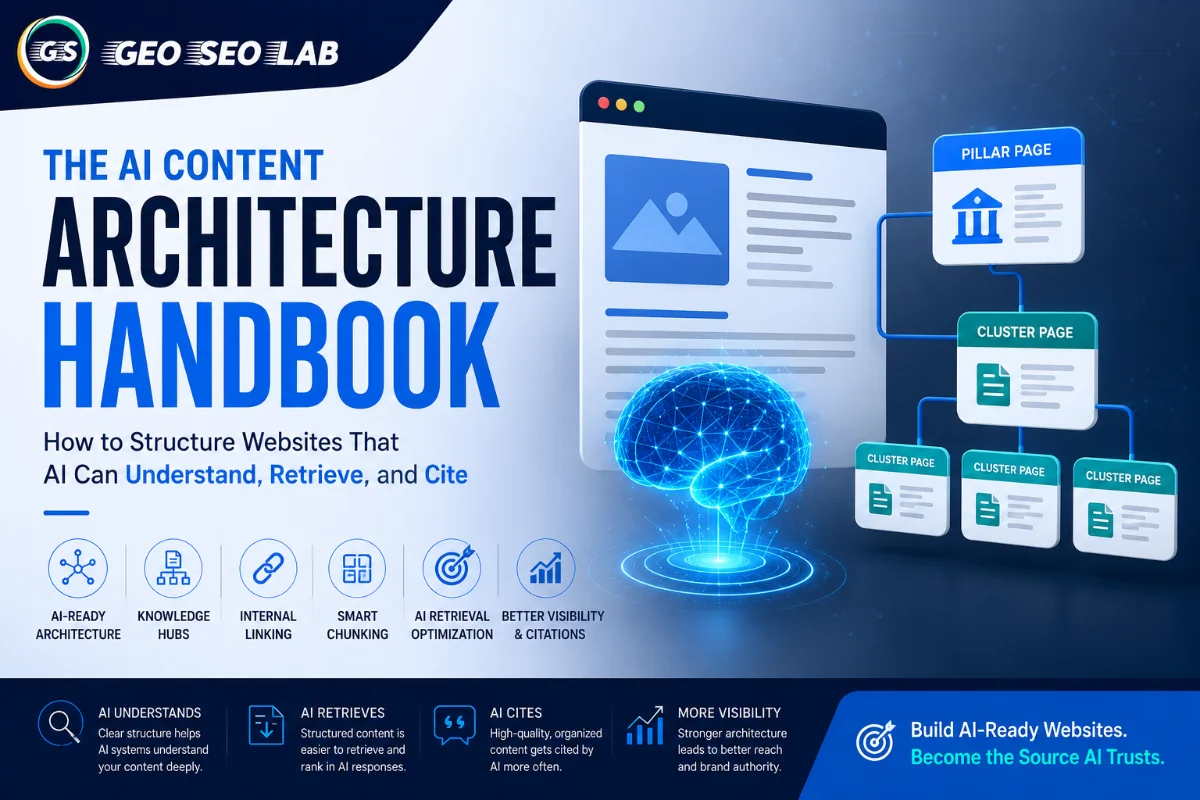
The AI Content Architecture Handbook: How to Structure Websites That AI Can Understand, Retrieve, and Cite
Learn how to build AI-first website architecture that improves content retrieval, AI citations, and search visibility. This comprehensive handbook explains knowledge hubs, content chunking, internal linking, AI retrieval pipelines, and AI-ready website structures with actionable frameworks from GEO SEO Lab.
The Problem With How Most Websites Are Built
There is a quiet crisis happening inside most company websites right now, and the people responsible for those websites often cannot see it because their measurement systems are not designed to detect it.The crisis is not a technical failure. Most websites load acceptably. Most pages are indexed. Most organizations are producing content with reasonable regularity. By the standards that have governed digital marketing for the past twenty years, things look more or less fine.The crisis is architectural. The content that fills these websites was designed to win an older competition — a competition for position in a ranked list of results, where the goal was to get a page in front of a user's eyeballs. That content was written to satisfy individual queries, built around individual keywords, and published as individual assets with limited structural relationship to anything else on the site.AI-assisted search is changing the competition. And the website architecture that served the old competition is increasingly poorly suited to the new one.When someone asks a sophisticated question of an AI assistant — "what content architecture practices actually improve AI retrieval, and why?" — the system is not looking for the page that most aggressively targeted that keyword cluster. It is looking for a source whose accumulated knowledge on the topic is coherent, well-organized, and genuinely illuminating. It is evaluating whether the organization behind the content has built a body of knowledge worth drawing from, not just a collection of pages worth ranking.That distinction — between a collection of pages and a body of knowledge — is what this handbook is about. And the gap between those two things is where most organizations are currently losing ground without fully understanding why.
Why Content Architecture Matters More Than Ever?
The Shift From Document Retrieval to Knowledge Retrieval
For the first two decades of commercial search, the fundamental question a search engine was trying to answer was relatively straightforward: which of these documents is most relevant to this query? The unit of competition was the document — the webpage, the article, the product page. Optimization meant making your document more likely to win the relevance competition for queries you cared about.This model shaped everything about how websites were built. Pages were designed to be independently competitive. Each page targeted its own set of keywords. Each page was evaluated on its own merits in terms of authority, relevance, and technical quality. The relationships between pages mattered mainly through internal linking as an SEO signal — not because the organization of knowledge across those pages was itself a meaningful competitive variable.AI-assisted search changes the fundamental question. Instead of "which document is most relevant?" the question increasingly becomes "which knowledge is most useful for answering this?" The distinction sounds subtle but has significant structural implications.A document can be relevant to a query without the organization behind it having deep, coherent knowledge on the topic. You can rank for a keyword with content that covers the topic adequately without it being part of a larger, organized body of expertise. That was enough in the old competition.
In the AI retrieval competition, the system is increasingly evaluating not just whether a specific piece of content addresses a query but whether the source of that content represents a coherent knowledge base on the relevant topic. A source whose knowledge is deep, consistently organized, clearly structured, and internally coherent is a more reliable grounding resource for AI-generated responses than a source that has produced individually adequate pages without organizing them into a meaningful whole.
How AI Systems Actually Process Websites?
One of the most consequential misconceptions about AI search is the idea that large language models simply "read" websites the way humans do — scanning from top to bottom, absorbing the full context of a page, and forming a holistic understanding.The reality is considerably more granular. Consider the diagram below, which illustrates how AI systems progressively process website content:
This is why content architecture matters. It directly affects the quality of the knowledge units that AI retrieval systems have access to.
The Evolution From Pages to Knowledge
The development of digital information architecture follows a clear progression that is worth understanding because it explains where we are and where things are heading.
The AI Retrieval Funnel — Understanding How Content Gets Selected
From the Entire Web to a Single Answer
One of the most useful ways to understand why content architecture matters for AI visibility is to trace the journey from the entire web to a single AI-generated response. This journey reveals the progressive narrowing process that determines whose content ends up contributing to AI answers.
Why Chunk Quality Has Become the New Page Quality
Traditional SEO thinking centers on the page as the unit of quality evaluation. Is this page high-quality? Does this page have sufficient content depth? Is this page technically well-optimized?
In AI retrieval, the unit of quality evaluation is increasingly the chunk — the discrete segment of knowledge that gets extracted from a page and evaluated for relevance to a specific query. A page might score well on traditional quality metrics while still producing poor chunks, if its content organization mixes multiple topics within sections, uses inconsistent terminology, or buries key information in verbose prose.
Building Knowledge Hubs — The Architecture That AI Rewards
The Difference Between a Blog and a Knowledge Ecosystem
The most important structural concept in AI content architecture is the distinction between a blog — a chronological collection of articles on related topics — and a knowledge ecosystem — an interconnected network of resources organized around coherent bodies of expertise.Both might contain similar total numbers of articles. Both might cover similar topic ranges. From the outside, they might not look dramatically different. But their internal organization is fundamentally different, and that difference significantly affects how AI systems can work with the content they contain.
A blog is organized around publication time. Articles are published sequentially, with each article designed to stand independently as a piece of content. The organizational logic is primarily chronological — newer articles appear first, older articles recede into archives. Relationships between articles are incidental rather than designed.
A knowledge ecosystem is organized around conceptual relationships. Every article has a defined place in a larger structure of expertise. Core concepts are established in foundational guides. Supporting articles expand on specific dimensions of those concepts. Case studies provide applied evidence. Research contributes original evidence. FAQs address common points of confusion. The organizational logic is educational — readers (and AI systems) can navigate from foundational understanding through increasing complexity, following a designed learning path rather than browsing a chronological archive.
Why Internal Linking Should Teach, Not Just Connect?
Internal linking is one of the most discussed and least understood elements of content architecture. In traditional SEO, internal linking was primarily a mechanism for passing page authority and signaling page importance to search engines. The practical guidance was to link frequently, use keyword-rich anchor text, and ensure that important pages received many internal links.
In AI-first content architecture, internal linking has a more important function: it explicitly communicates the relationships between knowledge units. A link is not just a navigation path — it is a statement that these two pieces of information are related in a specific way.
The Complete AI-First Website Blueprint
Rethinking Website Architecture From the Ground Up
The architecture of most websites reflects the organizational structure of the teams that built them rather than the structure of the knowledge those teams possess. Marketing owns the blog. Product owns documentation. Sales owns landing pages. Customer success owns help content. Leadership approves the About page. Each section evolves independently, governed by different priorities, maintained by different people, and designed for different audiences.
From a knowledge ecosystem perspective, this organizational fragmentation is a significant structural problem. The knowledge that exists across all these sections is related — it is all knowledge about the same organization, its products, its expertise, and its domain. But it is organized in ways that make those relationships invisible.
The Heading Hierarchy as Knowledge Architecture
Heading structure is one of the most underappreciated elements of AI-first content architecture. Most content creators think of headings as formatting decisions — visual hierarchy that makes pages easier to scan. In AI retrieval contexts, headings are much more than that.
Headings define the chunk boundaries that AI systems use to segment content into retrievable units. A heading is not just a visual label — it is a semantic declaration that says "what follows is a coherent knowledge unit about this specific topic." The quality of headings directly affects the quality of chunks.
Measuring AI-First Architecture Readiness
The AI Readiness Assessment
Before investing in architectural improvements, organizations benefit from an honest assessment of where they currently stand. The following scorecard evaluates six dimensions that together determine how ready an organization's website is for the AI retrieval era.
A Phased Implementation Roadmap
For organizations that recognize significant architectural gaps, the question of where to start is practically important. Trying to address everything simultaneously is rarely feasible, and the sequencing of architectural improvements matters — foundational work in early phases enables and amplifies the value of work in later phases.
Conclusion: From Content Publisher to Knowledge Engineer
The transition this handbook describes is ultimately not a technical one. It is a conceptual one — a shift in how organizations think about their digital presence and what they are trying to accomplish with it.
For the first two decades of digital marketing, the mental model was publishing. Organizations published content to attract visitors. They published more content to attract more visitors. The content calendar was the central planning tool. The goal was a steady stream of pages competing for search rankings.
The mental model that serves AI-first architecture is different. It is engineering. Organizations engineer knowledge systems — coherent, organized, interconnected bodies of expertise that serve both human learners and AI retrieval systems. They design before they publish. They think about relationships before they think about individual articles. They build infrastructure — glossaries, research hubs, knowledge clusters, author ecosystems — before worrying about content volume.
This is harder work than publishing. It requires more deliberate thinking, more organizational coordination, and more patience with results that compound over time rather than arriving immediately. It requires resisting the temptation to measure success by article count or posting frequency, and instead developing the ability to evaluate whether the knowledge ecosystem as a whole is becoming more coherent, more comprehensive, and more credible.
But the organizations that make this transition are building something that has enduring value. Not a collection of pages that might rank today and be displaced tomorrow by a competitor willing to publish more frequently. A body of knowledge that genuinely advances understanding in a domain — that human readers return to, that practitioners reference, that journalists cite, that AI systems draw on when constructing responses to complex questions.
In an era where AI is raising the standard for what makes a source worth citing, building that kind of knowledge ecosystem is not just good content strategy. It is the foundation of sustainable digital visibility.
About GEO SEO Lab
GEO SEO Lab works with organizations to improve their visibility across Google Search, Google AI Mode, Google Maps, ChatGPT, Gemini, Claude, Perplexity, Grok, and other AI-powered discovery platforms. Our approach combines Technical SEO, Generative Engine Optimization, AI Visibility strategy, AI Content Engineering, Entity SEO, Local SEO, and original research to help businesses build structured knowledge ecosystems that are discoverable, understandable, and trustworthy in the era of AI-assisted search.
Tags
Frequently Asked Questions
Find answers to common questions about this topic
About the Author

Aman Kesharwani
SEO Expert & Content Creator
Experienced digital marketing professional specializing in SEO strategies, content optimization, and data-driven marketing solutions. Passionate about helping businesses grow their online presence and achieve better search rankings.
Related Articles
View all posts
Why Different AI Platforms Recommend Different Brands
Why Different AI Platforms Recommend Different BrandsSame Question, Four Answers, Almost Zero OverlapA GEO SEO Lab ReportEditorial Disclosure: This re...
How AI Answers “Best Business Near Me” in 2026 | Local AI Search
How AI Answers "Best Business Near Me"Inside the Shortlist That Decides Who Gets the CallA GEO SEO Lab ReportEditorial Disclosure: This report introdu...
How to Improve AI Visibility in 2026 : 5 Fixes You Can Make Today
5 Things You Can Fix Today for Better AI Visibility No Redesign, No New Budget, Just Real Fixes You Can Ship This Afternoon Introduction Most GEO advice ...