AI Citations Explained: The Complete Guide to Winning Visibility in AI Search
Learn how AI citations influence ChatGPT, Google AI Mode, Gemini, Claude, and Perplexity. Discover why AI citations matter, how AI systems choose sources, and proven strategies to build citation-worthy content that increases AI search visibility.
Introduction: When Visibility Starts Before the Click
There is a moment that most digital marketers have not yet fully accounted for in their analytics, their strategy decks, or their KPI frameworks. It happens when a potential customer opens an AI assistant, types a question about a problem they need solved, and receives a synthesized response that mentions three companies by name, explains what distinguishes each, and recommends one as particularly wellsuited to the user's specific situation. The user closes the assistant, opens a new browser tab, and searches directly for the company that was recommended. They arrive at the website with a degree of prior orientation that a cold organic click could never have provided. They already know roughly what the company does, why it was considered relevant, and what distinguishes it from alternatives. The visit is shorter in duration but far more purposeful. The conversion probability is meaningfully higher than the site's average. In the website analytics, this visit is recorded as a branded direct or branded search visit. The AI interaction that preceded it leaves no trace in standard reporting. The role that AI played in shaping the customer's understanding, building initial trust, and directing them toward a specific choice is entirely invisible to the measurement framework the organization is using to evaluate its digital performance. This invisibility is one of the defining strategic blind spots of the current moment in digital marketing. The influence of AI systems on customer discovery and decisionmaking is growing substantially. The industry's ability to measure, understand, and deliberately build toward that influence is lagging well behind. AI citations the references, attributions, and source acknowledgments that AI systems use when constructing and presenting their responses are the mechanism through which this influence operates. They are how AI systems communicate to users that specific organizations, sources, and bodies of knowledge are trustworthy enough to inform the answers being provided. And they represent a form of visibility that is fundamentally different from a search ranking, a backlink, or an advertisement one that occurs within the conversation itself, shaping user understanding before any website is visited. This article examines AI citations comprehensively what they are, how AI systems decide which sources deserve to be cited, what characteristics of content and organizational presence make citation more likely, how organizations can build toward citationworthy status systematically, and how to begin measuring the kind of preclick influence that AI citations represent. The goal is to provide practitioners with the conceptual clarity and practical direction needed to engage seriously with this dimension of AI search visibility, rather than either dismissing it as unmeasurable or chasing it with tactics that misunderstand what actually drives it.
Understanding AI Citations and Why They Matter
The Evolution of What "Being Visible" Actually Means
Digital marketing has always required adapting to shifts in what visibility actually means in practice. In the early internet era, being visible meant having a website. As search engines became the primary discovery mechanism, visibility meant ranking well for relevant keywords. As mobile became dominant, visibility required mobile optimization. As local search matured, visibility required presence in map results and review platforms. Each of these transitions involved the same underlying dynamic: a change in how users find and evaluate options creates new requirements for what organizations need to do to participate meaningfully in that discovery process. The organizations that recognized transitions early and adapted their strategies accordingly gained meaningful advantages over those that continued optimizing for the previous paradigm. AIpowered search is creating exactly this kind of transition, and AI citations are at its center. The increasing prevalence of AI assistants as a starting point for research, comparison, and discovery means that visibility within AIgenerated responses is becoming a meaningful component of digital presence. Not the only component traditional search rankings, website experience, and content quality all remain important but an increasingly consequential one that most organizations are not yet systematically addressing. The shift can be described precisely. Traditional search visibility was binary and positiondependent: you either ranked on the first page or you did not, and your position within that page influenced how many clicks you received. AI search visibility is more nuanced: your organization either participates in the AImediated conversation that precedes many website visits, or it does not, and the quality of that participation influences how users understand and evaluate you before they arrive.
Defining AI Citations With Precision
The term "AI citation" is used loosely in current industry discussions, and some clarification about what it actually refers to helps establish a clearer strategic target. An AI citation, in the most precise sense, is any reference, attribution, or source acknowledgment that an AI system includes when constructing or presenting a response to a user query. The forms this takes vary significantly across platforms, which is worth understanding because different citation formats have different strategic implications. Some AI platforms include explicit source links alongside or beneath their responses clickable references that allow users to verify the information or explore sources more deeply. This is the citation format most analogous to traditional hyperlinking, and it creates a potential pathway for direct traffic from AIgenerated responses to source websites. Other platforms include inline source labels brief attributions within the text of the response that identify where specific claims or characterizations came from, without necessarily providing clickable links. These attributions are visible to users reading the response and contribute to the perceived credibility of specific sources, even when they do not generate direct clicks. Still other forms of AI citation involve entity mentions references to organizations, products, or people by name within AIgenerated responses, without explicit source attribution. When an AI assistant recommends a company by name in response to a product comparison query, that mention is a form of citation even if no link is provided, because it constitutes the AI system's recognition that this entity is relevant and trustworthy enough to include in its response to a user's question. Finally, some AI platforms generate synthesized responses that do not include visible attribution but that are nonetheless informed by specific sources. In these cases, the citation is implicit the source contributed to the response without being acknowledged to the user. From a business strategy perspective, implicit citations matter because they influence the accuracy and character of AIgenerated characterizations of a company or product, even when users do not see a direct attribution. Understanding these different forms of AI citation matters for strategy because different forms require different optimization approaches and generate different types of business value.
Why AI Citations Differ Fundamentally From Backlinks?
The temptation to think about AI citations as "backlinks for AI systems" is understandable both concepts involve one entity referencing another as relevant and trustworthy but the analogy breaks down in ways that matter for strategy.
Backlinks are fundamentally about navigation and authority transfer in a network of documents. When one website links to another, it is creating a navigational pathway for users and signaling to search engines that the linked content is relevant enough to point toward. The authority implications of a backlink derive from the linking site's own authority and from the patterns of linking across the web. A backlink is, at its core, a statement about a document's relevance and credibility within a web of connected pages. AI citations operate on different logic. They are not primarily about document authority or navigational pathways. They are about information utility specifically, whether the content a source has published is useful for answering the kind of question a user has asked. An AI system deciding whether to cite a source is asking, in essence: does this source have something to contribute to understanding this topic that I cannot get more reliably or more clearly elsewhere? That question is about information quality, expertise credibility, and contextual relevance in ways that the backlink question is not. This distinction has practical implications. A website can accumulate a strong backlink profile through various means creating highly linkable content, building relationships that lead to editorial links, pursuing structured linkbuilding campaigns without that profile necessarily reflecting the kind of genuine expertise and information quality that AI citation requires. Conversely, a site with modest backlinks but exceptional depth of expertise and genuinely distinctive knowledge may be wellpositioned for AI citations in ways that standard link metrics would not predict.
The path to AI citations, in other words, runs through genuine expertise and genuine information quality. Tactics that can substitute for these in traditional SEO have limited applicability in the AI citation context.
The Business Value That AI Citations Create
Before investing in building toward AI citation, organizations reasonably want to understand what the return on that investment looks like. The business value of AI citations operates through several distinct mechanisms, each worth understanding. The most direct mechanism is influence over user consideration before website visits occur. When an AI assistant mentions a company favorably in response to a relevant query describing it accurately, characterizing its distinctive value, recommending it as particularly suitable for a specific type of need that mention shapes the user's mental model before they visit the website. The user arrives with context, understanding, and a positive initial orientation that would have required significant website content to establish from scratch. This previsit influence is commercially valuable even though it is not captured in standard analytics. A second mechanism is brand awareness development among audiences who are actively researching relevant topics but who might never have encountered the brand through traditional search. AI systems that consistently reference a company when answering questions about its domain are creating brand awareness among the population of users asking those questions, regardless of whether those users subsequently click through to the company's website. A third mechanism is credibility signaling. When an AI system cites a source, it is implicitly endorsing that source's credibility on the relevant topic. Users who notice that an AI assistant they trust is drawing on a particular organization's expertise receive an implicit credibility signal about that organization. This credibility transfer can influence future decisionmaking, brand perception, and the likelihood of eventual conversion.
Finally, there is a compounding effect: organizations that consistently appear in AIgenerated responses for relevant queries develop what might be called entity recognition a form of AI understanding in which the organization is reliably associated with specific domains of expertise. This recognition is selfreinforcing, because the signals that create it also make future recognition more likely.
How AI Systems Choose Which Sources to Cite
The MultiStage Nature of AI Response Generation One of the most important misconceptions about AI search citation is the assumption that it works like traditional search ranking that some version of a ranking algorithm determines which sources appear prominently, and that understanding and optimizing for that algorithm is the primary strategic challenge.
This framing misses something fundamental about how AIgenerated responses are constructed. Traditional search ranking is primarily a sorting problem: given a set of retrieved documents, determine which order to present them in. AI response generation is an assembly problem: given a complex user query with specific intent and context, determine what information is needed to answer it well, retrieve candidate information from available sources, evaluate the quality and relevance of that information, synthesize a coherent and useful response, and depending on the platform identify the sources that contributed most meaningfully. This is a multistage process in which citation is the final output rather than the initial signal. By the time a source is cited, it has already passed through several evaluation stages. It has been retrieved as relevant to the query. It has been assessed for information quality and trustworthiness. It has been compared with other available sources for the specific information it contributes. And it has been determined to add enough distinctive value to the response to warrant explicit acknowledgment. Understanding this process and what it takes to survive each stage is the foundation for building a genuinely effective strategy for AI citation.
Retrieval and the Discoverability Prerequisite
The first requirement for AI citation is discoverability the ability of AI systems to find and access your content in the first place. This stage is most closely related to traditional SEO, and traditional SEO fundamentals matter here in ways they may not at subsequent stages. AI systems that incorporate realtime web retrieval as several major platforms now do, to varying degrees need to be able to crawl and access your content effectively. This means standard technical SEO requirements apply: content must be accessible to crawlers, indexed appropriately, structured in ways that allow content to be parsed and understood, and not blocked by robots directives that prevent AI retrieval systems from accessing it.
Structured data markup is particularly relevant at this stage. Schema markup that clearly identifies an organization, its offerings, its expertise, its authorship, and its relationship to relevant topics helps AI retrieval systems understand what your content is about and how it relates to different categories of user queries. This is not a guarantee of citation, but it is a prerequisite for the kind of clear entity understanding that makes citation more likely. Beyond technical discoverability, content needs to be present and accessible on the topics for which citation would be valuable. AI systems cannot cite sources on topics those sources have not addressed. Organizations that have significant undocumented expertise deep knowledge that has not been published in accessible form are invisible to AI systems regardless of how good their technical optimization is.
Relevance Evaluation and the Importance of Intent Matching
Surviving retrieval is necessary but not sufficient for citation. At the relevance evaluation stage, AI systems assess whether retrieved content actually addresses what the user is asking not just in terms of topical overlap but in terms of genuine alignment between user intent and content purpose. Modern AI systems are increasingly sophisticated at intent interpretation. A user asking "how can a midsized healthcare clinic improve AI visibility without a large content budget" is not just asking about AI visibility in general they are asking about AI visibility in a specific context, with a specific constraint, from the perspective of a specific type of organization. Content that addresses AI visibility in healthcarespecific contexts, or that specifically addresses resourceconstrained approaches to visibility improvement, is more relevant to this query than general AI visibility content that does not engage with these specificities. This has a direct implication for how content should be developed. The instinct in traditional SEO was to write broadly about a topic, covering many angles, to maximize the range of queries the content could rank for. In AI search, writing with specificity addressing the actual contexts, constraints, and concerns that real users in a target audience face tends to produce more relevance to the specific queries those users are actually asking. The shift from broad coverage to specific depth is uncomfortable for organizations accustomed to producing content primarily for keyword coverage. But it reflects a genuine difference in what AI systems are trying to do when they evaluate relevance: not match keywords, but match intent. Content that was written specifically to address a real user need will generally match intent better than content written to capture keyword traffic.
Information Quality Assessment
Among the factors that influence AI citation, information quality deserves the most extended discussion because it is both the most important and the most nuanced. Information quality, as AI systems assess it, is not a single characteristic but a composite of several distinct properties that work together to make content genuinely useful for answering questions.
Accuracy is the foundation. AI systems that cite inaccurate information produce responses that harm users and damage the AI platform's credibility. The pressure to cite accurate sources is therefore strong, and content that makes claims that are inconsistent with wellestablished facts or that contradict more authoritative sources is at a significant disadvantage at the quality assessment stage. Clarity matters as much as accuracy. Information that is technically correct but expressed in ways that are difficult to understand or interpret has limited utility for AI response generation. AI systems need to be able to extract meaning from content reliably, which means content that is clearly written, wellorganized, and expressed in accessible language is more useful than equivalent content that is dense, jargonheavy, or poorly structured.
Completeness influences whether a single source can contribute everything needed on a specific aspect of a topic, or whether multiple sources need to be assembled to address it adequately. Content that provides comprehensive, selfcontained treatment of specific questions is more valuable than content that hints at answers without fully developing them. This is why the instinct to create many short, thin pieces of content which served certain traditional SEO strategies is poorly aligned with what AI citation rewards. Consistency with the broader information ecosystem matters in a way that has no direct parallel in traditional SEO. If a source's claims are consistent with what other credible sources say about a topic, that consistency reinforces the reliability of all sources making the same claims. If a source makes claims that contradict most other credible sources, that inconsistency raises questions about its reliability, even if the claims happen to be correct. Organizations whose content is wellaligned with expert consensus on established topics are better positioned than those that position themselves primarily through contrarianism. Finally, evidence quality the degree to which claims are grounded in verifiable, specific, credible evidence rather than assertion strongly influences information quality assessment. Content that makes clear claims, identifies their basis, distinguishes between established facts and analytical interpretation, and cites specific evidence where available is substantially more useful to AI systems than content that makes equivalent claims without explanation or support.
Entity Authority and Organizational Credibility Beyond the content itself, AI systems evaluate the credibility of the organization or person producing the content. This entitylevel evaluation is one of the most important and least wellunderstood aspects of AI citation selection. well-understoodWhen an AI system is considering whether to cite a source, it is not evaluating the content in isolation. It is evaluating the content in light of what it knows or can infer about who produced it. A medical recommendation carries different weight depending on whether it comes from a major academic medical center, a small wellness blog, or an anonymous forum post and AI systems attempting to provide reliable responses need to make similar distinctions. Entity authority is built through the accumulation of consistent, credible signals across multiple sources. An organization with a wellestablished website, clear and consistent descriptions of its expertise and activities, presence in relevant professional directories, recognition from peer organizations in its field, coverage in credible publications, and clearly identified expert authors presents a much clearer and more credible entity profile than an organization whose digital presence is inconsistent, whose expertise is not clearly documented, and whose content lacks attribution to identifiable human experts. This is why entity management the systematic work of ensuring consistent, accurate, and comprehensive representation across the digital ecosystem is such an important component of AI citation strategy. The consistency of the entity signals surrounding an organization directly influences AI systems' confidence in that organization as a source, which in turn influences citation likelihood.
Contextual Fit and the Specificity of Citation Decisions The final stage of citation selection involves what might be called contextual fit the determination of which specific sources are best matched to the specific response being generated for the specific user who asked the specific question. This stage is where genuinely excellent but highly technical content might not be cited in response to a beginner's question, and where a clear, accessible explanation might be cited instead of a more authoritative but hardertoparse source. The citation decision is not just about which source is best in absolute terms it is about which source is best for this particular use case. Contextual fit means that organizations benefit from having content at multiple levels of depth and complexity, tailored to the different stages of understanding that different users bring to relevant topics. A SaaS company that has detailed technical documentation for experienced implementers, practical howto guides for daytoday users, and conceptual introductions for decisionmakers evaluating the product is better positioned for citation across a wider range of relevant queries than one that has only one type of content at one level of sophistication. How to Build CitationWorthy Content That AI Systems Want to Reference {#partthree}
The ExpertiseFirst Orientation The most important mindset shift for organizations pursuing AI citation is moving from a content marketing orientation to what might be called a knowledge publishing orientation.
Content marketing, as it has been practiced, is organized around business objectives: attract traffic, capture leads, support sales conversations, build brand awareness. Content is created in service of these objectives, and its quality is evaluated primarily in terms of how well it serves them. This orientation often produces content that is adequate but not exceptional content that covers topics because they are searchable, not because the organization has something genuinely distinctive to say about them. Knowledge publishing is organized around a different question: what does this organization know that would be genuinely useful to people trying to understand or navigate the problems this organization exists to solve? This question leads to different content not necessarily longer or more polished, but more genuinely informed by real expertise, more specifically responsive to real needs, and more likely to contain insights that are not easily found elsewhere.
The difference matters for AI citation because AI systems are, in essence, trying to identify the best available knowledge sources on specific topics. Content produced from a genuine knowledge publishing orientation tends to have the characteristics that make it valuable for this purpose: specificity, depth, originality, and the kind of practical grounding that only comes from actual engagement with a problem domain. Content produced primarily to rank for keywords tends to be interchangeable with many other pieces of content on the same topic and interchangeable content is exactly what AI systems do not need. Building Original Insight Into Content
The characteristic that most clearly distinguishes citationworthy content from generic content is originality the presence of genuine insights, data, or perspectives that are not available from dozens of other sources on the same topic.
Originality in the knowledge publishing sense does not require groundbreaking research or revolutionary discoveries. It requires bringing genuine firsthand knowledge to bear on relevant topics the kind of knowledge that comes from actually operating in a domain, working with real clients or customers, conducting original research, analyzing proprietary data, or synthesizing information in frameworks that reflect the organization's distinctive analytical perspective.
Several specific forms of original content tend to produce strong AI citation candidates. Original research surveys, analyses of proprietary data, experiments, benchmark studies contributes information that literally does not exist elsewhere and that AI systems cannot obtain from other sources. Expert case studies that draw on the organization's actual experience with real problems provide the kind of grounded, specific, examplerich knowledge that abstract explanations cannot replicate. Proprietary frameworks and methodologies that reflect how the organization thinks about and approaches its domain create a distinctive conceptual contribution that remains associated with the organization even when the underlying ideas are widely discussed. The investment required to produce genuinely original content is greater than the investment required to produce adequate content. This is precisely why it is strategically valuable the higher the bar, the fewer competitors clear it, and the more distinctive the organization that does.
Answering Complete Questions Rather Than Isolated Topics
One of the most practically useful shifts in content strategy for AI citation purposes involves moving from topiccentric to questioncentric content development. Traditional SEO content strategy often begins with keyword research identifying topics that generate search volume and creating content organized around those topics. The result is content structured around what a topic is rather than what users with specific needs need to know about it. AI search increasingly serves users who are asking complete questions with specific contexts and constraints. The user asking "what is retrievalaugmented generation" is asking a different question from the user asking "how should a small law firm evaluate whether retrievalaugmented generation is appropriate for their client communication tools," even though both questions involve the same underlying technology. Content that addresses the second question well with specificity about the context, practicality about the decision criteria, and realistic assessment of the constraints involved is more valuable for AI citation in response to queries like it than even the most comprehensive general explanation of the technology.
Developing questioncentric content requires understanding the actual questions that real users in your target audience are asking not just the keywords they search for. This understanding comes from engaging with actual user questions through customer support interactions, sales conversations, community forums, user research, and the direct analysis of conversational AI query patterns. Organizations that systematically gather this kind of intelligence and use it to shape content development are building toward stronger AI citation potential than those relying solely on keyword volume data.
Structuring Content for AI Interpretability
Even genuinely excellent content can be underserved in AI citation if it is structured in ways that make it difficult for AI systems to parse and extract meaning from efficiently. The structural characteristics that improve AI interpretability are largely the same ones that improve human readability: clear, descriptive headings that signal what each section contains; logical progression from foundational concepts to more specific applications; welldelineated sections that allow specific parts of a longer piece to be identified and extracted; clear sentences that express one idea per sentence rather than loading multiple ideas into complex constructions; and explicit statement of conclusions and recommendations rather than burying them within extended prose. One structural element that deserves particular attention for AI interpretability is the explicit labeling of the type of claim being made. Content that distinguishes clearly between established facts, analytical interpretations, evidencebased recommendations, and forwardlooking predictions is more useful for AI systems that need to represent information with appropriate epistemic precision. Mixing these claim types without distinction creates ambiguity about what the content is asserting, which reduces its utility for AI response generation. Structured data implementation JSONLD markup that explicitly identifies articles, their topics, their authors, their publication dates, and their relationships to organizational entities further improves AI interpretability by providing machinereadable metadata that AI systems can use to contextualize and evaluate content without relying solely on natural language parsing.
IndustrySpecific Approaches to Building Citation Potential The specific investments most likely to produce AI citation potential vary meaningfully across industries, reflecting differences in what kinds of content are most valuable for the questions users in each sector are asking. Healthcare organizations face a unique combination of high stakes and high user need. Patients and caregivers are among the most frequent users of AI assistants for informationseeking, and the quality of medical information available to AI systems directly affects the quality of guidance these users receive. Healthcare organizations that invest in evidencebased patient education resources, clear explanations of clinical approaches, transparent physician and specialist profiles, and accurate descriptions of services and conditions are contributing genuinely valuable information to the ecosystem while building the entity credibility that makes them reliable AI sources. Software and technology companies have a particular opportunity in documentation an area that many companies underinvest in despite its clear value for AI citation. Accurate, comprehensive, wellmaintained documentation for APIs, products, and platforms is exactly what AI coding assistants and technical AI systems need to provide reliable guidance. Companies that treat documentation as a competitive asset, investing in its quality and currency, are building citation potential among the technically sophisticated users who rely most heavily on AI assistance. Professional services firms law firms, consulting firms, financial advisory organizations, accounting practices build citation potential primarily through thought leadership that reflects genuine specialized expertise. Not generic content that covers broadly applicable topics, but content that demonstrates the kind of specific, nuanced judgment that comes from years of practice in particular areas. A law firm's detailed analysis of how recent regulatory changes affect a specific industry sector, or a consulting firm's framework for evaluating technology investments in a particular business context, represents the kind of distinctive expertise that AI systems can draw on when users ask sophisticated professional questions. Local businesses build AI citation potential through a different mechanism the accuracy, completeness, and richness of their structured local presence across the platforms that AI systems consult for local information. Detailed service descriptions, consistently maintained business profiles, rich and specific customer review profiles, clear communication of distinctive service characteristics, and comprehensive answers to the questions that users frequently ask about local service providers all contribute to the AI understanding that drives local recommendation and citation.
The Compounding Nature of Citation Authority
One of the most important things to understand about AI citation authority is that it is cumulative and selfreinforcing in ways that create meaningful advantages for organizations that begin building it seriously and early.
The AI Citation Flywheel™ captures this dynamic: genuine expertise produces highquality content, which generates entity recognition in AI systems, which leads to AI citations, which generate brand authority and awareness, which strengthen the organization's position as a recognized expert, which creates more opportunities for distinctive expertise to develop, which produces more highquality content. Each rotation of the flywheel builds on the previous one, and the strength of the competitive position compounds over time. This compounding dynamic has important strategic implications. Organizations that invest in building genuine citation authority now are not just addressing today's AI search landscape they are building a position that will be progressively more difficult for late movers to replicate as AI systems' entity understanding of established authorities deepens over time. The case for early, serious investment in AI citation authority is not primarily about capturing nearterm citations it is about establishing a compounding competitive advantage that grows more durable the longer it is sustained. Measuring AI Citation Success and Preparing for the Future Why Standard Analytics Miss the Most Important Dynamics The measurement challenge that AI citations create is not a minor inconvenience it is a fundamental gap between what organizations are currently measuring and what is actually happening in the customer discovery process. Standard web analytics were designed for a world where the user journey began at search, continued through a click, and was fully captured from the point of website arrival forward. The tools are excellent at measuring everything that happens on the website. They are essentially blind to everything that happens before the visit the searches, the AI interactions, the brand exposures, the considerationshaping that increasingly precedes the visit for a growing proportion of users. This means that organizations relying exclusively on standard analytics to understand their digital performance are working with systematically incomplete information. They can see the volume and character of visits they receive. They cannot see how many customer decisions they influenced without receiving a visit. They cannot see how AIgenerated characterizations of their brand are shaping user understanding before website visits occur. They cannot see the proportion of their eventual visitors whose journey was meaningfully shaped by AImediated brand exposure. This is not an argument against using standard analytics it is an argument for supplementing them with measurement approaches that capture the dimensions they miss. Building a comprehensive picture of AI search performance requires extending the measurement framework beyond postvisit metrics toward indicators that reflect previsit influence and AI ecosystem presence. Developing an AIEra Measurement Framework
Bilding a measurement framework that captures AI citation and AI visibility performance requires combining several distinct measurement approaches, each of which captures different aspects of an organization's AI search presence.
Systematic AI response monitoring involves periodically querying major AI platforms with relevant questions the kinds of questions users in your target audience would ask and evaluating the responses for mentions, citations, characterizations, and recommendations related to your organization. This is not a fully automated measurement approach in most cases, because AI responses vary and require qualitative assessment to interpret meaningfully. But it provides direct visibility into how AI systems are currently representing your organization and whether that representation is accurate, favorable, and occurring for the right types of queries. Brand search volume monitoring provides an indirect indicator of AImediated awareness. When AI systems mention a brand by name in responses to user queries, some proportion of users who encounter those mentions will subsequently search for the brand directly. Growth in branded search volume particularly growth that coincides with expansion of AI search usage suggests that AImediated brand exposure is generating awareness among users who were not previously familiar with the organization.
Referral quality analysis tracks not just how many organic visitors a site receives but what those visitors do when they arrive. If AImediated awareness is driving more qualified, intentrich visitors, conversion rates, engagement depth, and timetoconversion for organic visitors should improve even if raw traffic volume changes. Tracking these quality metrics alongside volume metrics provides a more complete picture of how searchdriven traffic is evolving.
Direct traffic monitoring provides another indirect indicator of AI influence. Users who encounter a brand through an AI interaction and then visit the website directly typing the URL or using a bookmark contribute to direct traffic rather than organic search traffic. Growth in direct traffic from users who seem to arrive with prior knowledge of the brand can indicate AImediated awareness development. Entity presence audits assess the consistency, accuracy, and completeness of the organization's representation across the major digital platforms and data sources that AI systems consult. These audits identify gaps, inconsistencies, and inaccuracies that may be undermining AI entity understanding, providing actionable improvement priorities for entity management.
A Phased Roadmap for Building AI Citation Authority
Organizations that want to build toward stronger AI citation authority benefit from approaching it as a multiphase strategic investment rather than a collection of onetime tactics.
The foundation phase involves establishing the prerequisites for AI citation: ensuring that content is technically accessible to AI retrieval systems, that structured data markup clearly communicates entity information and content relationships, that the organization's digital presence is consistent and accurate across major platforms, and that the most important existing content is structured for AI interpretability. This phase builds the infrastructure on which everything else depends.
The knowledge development phase involves making the strategic content investments that create genuine citation potential: identifying the topics where the organization has distinctive expertise to contribute, developing the original research and analysis that produce genuinely unique informational value, creating the comprehensive resources that address complete user questions rather than isolated topic fragments, and building the expert author and organizational credibility signals that support entity authority. This phase takes the most sustained investment and produces the most durable competitive advantage. The entity strengthening phase focuses on amplifying and reinforcing the organization's AI entity recognition through external signals: seeking coverage in credible publications, building presence in relevant professional directories and associations, developing executive and expert thought leadership that generates independent references, and monitoring and managing how the organization is described across the ecosystem of sources that AI systems consult. The measurement and iteration phase involves implementing the expanded measurement framework described above, systematically monitoring AI citation performance, identifying gaps between current performance and objectives, and directing content and entity development investments toward the specific areas where improvement would have the greatest impact. LongTerm Trends Shaping the AI Citation Landscape
Several trends in the development of AI search that are already clearly visible will continue to shape the AI citation landscape over the coming years. The trend toward more agentic AI systems systems that not only answer questions but take sequences of actions, complete tasks, and make decisions on behalf of users will expand the range of contexts in which AI systems need to evaluate and select sources. An AI agent helping a user research and compare enterprise software options needs to make source selection decisions across a much wider range of information types and query contexts than a simple questionanswering system. Organizations that have built strong, broad AI entity authority will be wellpositioned across this wider range. The trend toward increasing AI capability in distinguishing authoritative from nonauthoritative sources will raise the bar for AI citation over time. Early AI systems had limited ability to assess source quality sophisticatedly. Future systems are likely to be considerably more capable at evaluating expertise credibility, evidence quality, and information consistency. Organizations that have invested in genuine authority will benefit from this improvement; those that have attempted to simulate authority through surfacelevel signals will face increasing difficulty as AI systems become better at looking past appearances to substance. The trend toward more structured and explicit AI licensing and partnership arrangements between AI platforms and knowledge providers will create new pathways for direct, formalized AI citation relationships. As described in the discussion of Cloudflare's Monetization Gateway and similar developments, the relationship between AI systems and content sources is evolving toward more explicit and structured arrangements. Organizations that have built the kind of distinctive, highquality knowledge assets that make them attractive licensing or partnership partners will be better positioned to participate in these arrangements on favorable terms.
Common Misconceptions That Lead to Wasted Investment
Several misconceptions about AI citations are widespread enough to warrant direct correction, because they lead organizations toward investments that do not serve their actual citation objectives.
The misconception that publishing more content automatically generates more citations reflects a fundamental misunderstanding of what AI citation selection is evaluating. Volume is not what AI systems are optimizing for usefulness, originality, and trustworthiness are. An organization that publishes fifty additional pieces of generic content is not building AI citation authority. An organization that develops five genuinely distinctive, expertgrounded resources that address questions users are actually asking is building meaningful authority, even though its volume growth is much lower.
The misconception that AI citations can be engineered through technical manipulation through specific keyword patterns, structured data tricks, or other gaming approaches misunderstands the nature of AI evaluation. The characteristics that AI systems are evaluating when selecting citations information quality, expertise credibility, evidence strength, contextual fit are genuine characteristics of content that cannot be effectively simulated through surfacelevel optimization. This is actually good news for organizations committed to genuine expertise, because it means the competitive dynamic rewards the real thing rather than its simulation.
The misconception that AI citations are primarily relevant for publishers and media organizations misses the full range of industries where AImediated discovery is increasingly important. Healthcare providers, software companies, professional services firms, ecommerce businesses, and local service providers all face customer discovery dynamics that are increasingly influenced by AI interaction. The organizations that recognize this relevance to their specific context and adapt accordingly will have meaningful advantages over those that assume AI citation is someone else's concern.
Key Takeaways
AI citations represent a new and growing dimension of digital visibility. The influence that AIgenerated responses have over user discovery and consideration is real and commercially significant, even when it does not show up in standard analytics. Organizations that ignore this dimension are missing an increasingly important part of the competitive landscape.
AI citation selection is an evaluation problem, not a ranking problem. The multistage process through which AI systems assess information quality, entity authority, and contextual fit is fundamentally different from traditional search ranking. The strategies that produce strong AI citation potential genuine expertise, original insights, evidence quality, entity consistency are different from traditional ranking tactics. Originality is the characteristic that most clearly distinguishes citationworthy content. Generic content that restates widely available information offers little value to AI systems that can synthesize such information from many sources. Content that reflects genuine firsthand expertise and original analysis creates informational value that AI systems cannot easily obtain elsewhere. Entity authority is an organizational asset, not a singlepage characteristic. The credibility signals that influence AI citation potential accumulate across the full digital presence of an organization the consistency of its representation across platforms, the recognition of its expertise by independent sources, the clarity of its entity identity across the ecosystem. Building entity authority requires systematic attention across the full digital ecosystem. Measuring AI citation performance requires extending beyond standard analytics. Standard web analytics capture what happens on the website. AImediated influence shapes user behavior before website visits occur and is largely invisible to standard measurement frameworks. Organizations need to develop supplementary measurement approaches AI response monitoring, brand search tracking, referral quality analysis to build a complete picture of their AI search performance. The compounding nature of AI citation authority rewards early investment. The entity recognition and content authority that drive AI citation build over time in selfreinforcing ways. Organizations that begin building seriously now are establishing a position that will be progressively more durable and difficult for late movers to replicate.
References and Further Reading
AI Platform Documentation and Research
OpenAI. (2026). ChatGPT Features, Search, and Source Attribution Documentation. openai.com
Google. (2026). Google AI Mode and AI Overviews: Technical Documentation and Updates. ai.google
Anthropic. (2026). Claude Model Documentation and Research. anthropic.com/research
Microsoft. (2026). Copilot and Bing AI Search Documentation. microsoft.com/copilot
Perplexity AI. (2026). How Perplexity Works: Source Selection and Citation. perplexity.ai/about
Information Retrieval and RAG Research
Lewis, P., Perez, E., Piktus, A., et al. (2020). RetrievalAugmented Generation for KnowledgeIntensive NLP Tasks. arXiv:2005.11401. arxiv.org/abs/2005.11401
Guu, K., Lee, K., Tung, Z., Pasupat, P., & Chang, M. (2020). REALM: Retrievalaugmented language model pretraining. arXiv:2002.08909.
Mitra, B., & Craswell, N. (2018). An introduction to neural information retrieval. Foundations and Trends in Information Retrieval, 13(1), 1126.
Manning, C. D., Raghavan, P., & Schütze, H. (2008). Introduction to Information Retrieval. Cambridge University Press.
GEO SEO Lab Research
GEO SEO Lab. (2026). The AI Search Quality Framework: How AI Systems Evaluate Information Before Generating Answers. geoseolab.com
GEO SEO Lab. (2026). Google Zero: Is the Traditional Search Traffic Model Coming to an End? geoseolab.com
GEO SEO Lab. (2026). The AI Search Experimentation Handbook: How to Design, Measure, and Validate GEO Strategies. geoseolab.com
GEO SEO Lab. (2026). OpenAI & Yelp Partnership: The Beginning of AIPowered Local Search? geoseolab.com
About GEO SEO Lab
GEO SEO Lab is a research and strategy organization dedicated to helping businesses understand and improve their visibility across the full landscape of AIassisted search and discovery including Google Search, Google AI Mode, ChatGPT, Gemini, Claude, Perplexity, Grok, and the evolving ecosystem of AI platforms that are reshaping how people find, evaluate, and engage with information online. Our research spans Generative Engine Optimization, AI Visibility strategy, AI citation dynamics, entity optimization, knowledge architecture, information quality, and the evolving relationship between AI systems and the organizations whose knowledge those systems depend on.
We approach AI citation research with the same intellectual standards we apply to all our work: grounding analysis in evidence, distinguishing between what is established and what is reasoningtoward, and building frameworks that reflect the genuine complexity of the landscape rather than offering false simplicity. The competitive advantage in the AI search era belongs to organizations that approach it with the same rigor.
Tags
Frequently Asked Questions
Find answers to common questions about this topic
About the Author

Aman Kesharwani
SEO Expert & Content Creator
Experienced digital marketing professional specializing in SEO strategies, content optimization, and data-driven marketing solutions. Passionate about helping businesses grow their online presence and achieve better search rankings.
Related Articles
View all posts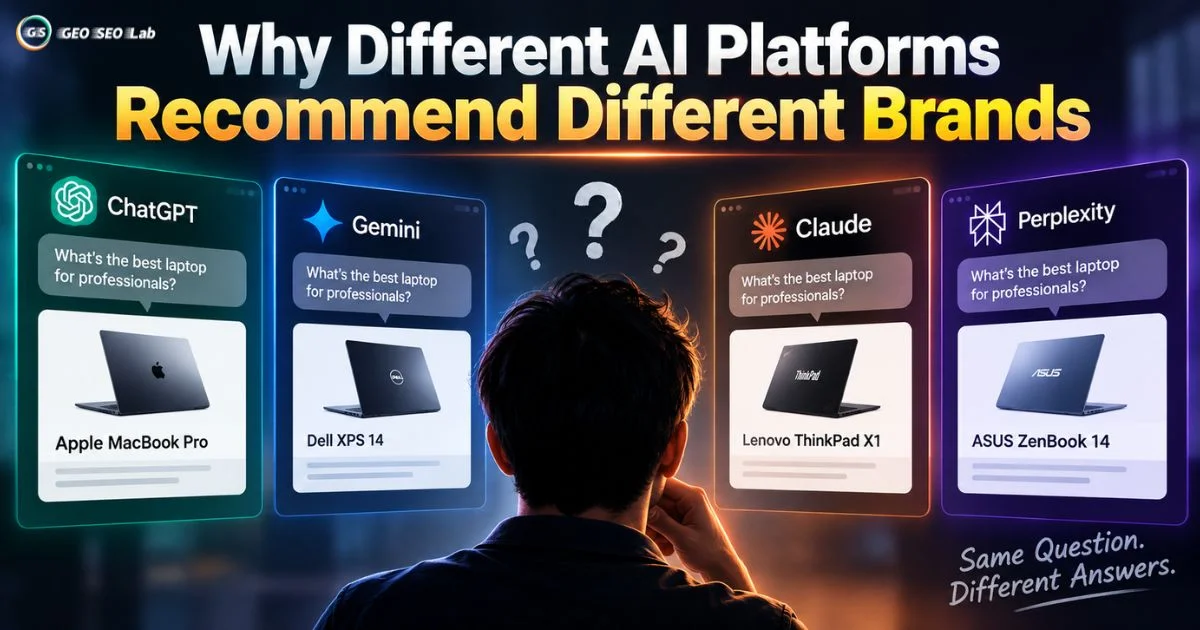
Why Different AI Platforms Recommend Different Brands
Why Different AI Platforms Recommend Different BrandsSame Question, Four Answers, Almost Zero OverlapA GEO SEO Lab ReportEditorial Disclosure: This re...
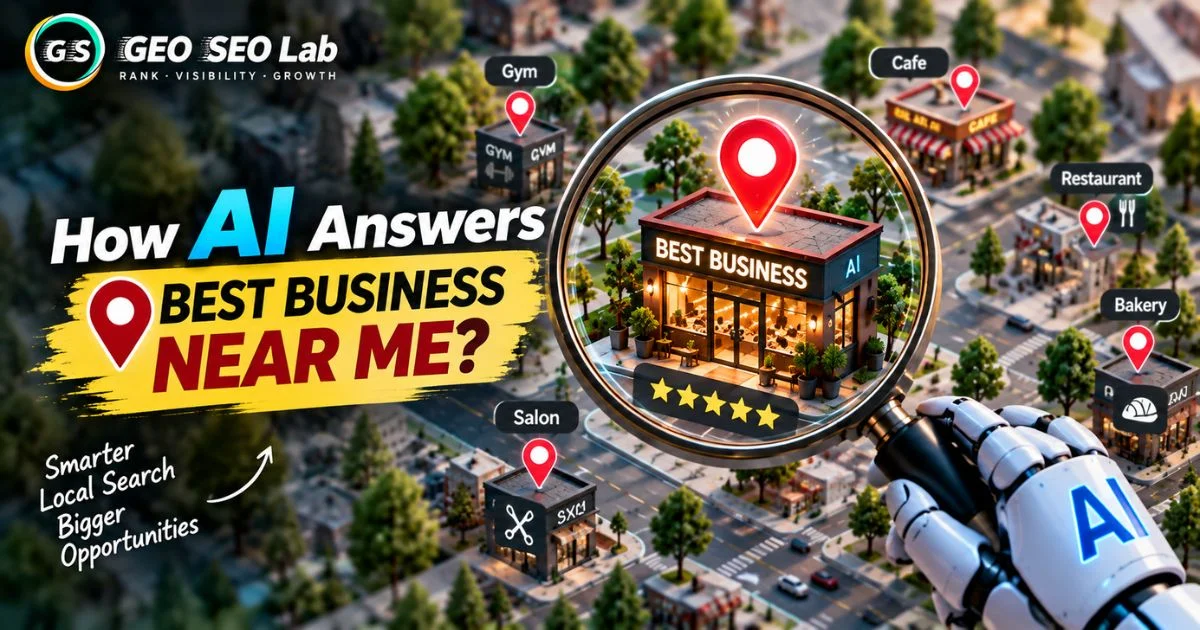
How AI Answers “Best Business Near Me” in 2026 | Local AI Search
How AI Answers "Best Business Near Me"Inside the Shortlist That Decides Who Gets the CallA GEO SEO Lab ReportEditorial Disclosure: This report introdu...

How to Improve AI Visibility in 2026 : 5 Fixes You Can Make Today
5 Things You Can Fix Today for Better AI Visibility No Redesign, No New Budget, Just Real Fixes You Can Ship This Afternoon Introduction Most GEO advice ...