The AI Citation Economy: Why AI Citations Are Becoming the New Currency of AI Search
Discover how AI citations are reshaping digital visibility across ChatGPT, Google AI Mode, Gemini, Claude, Perplexity, and other AI search engines. Learn how AI systems evaluate, retrieve, and cite trustworthy sources, why citations are becoming the new currency of AI search, and how businesses can build citation-worthy content through Generative Engine Optimization (GEO).
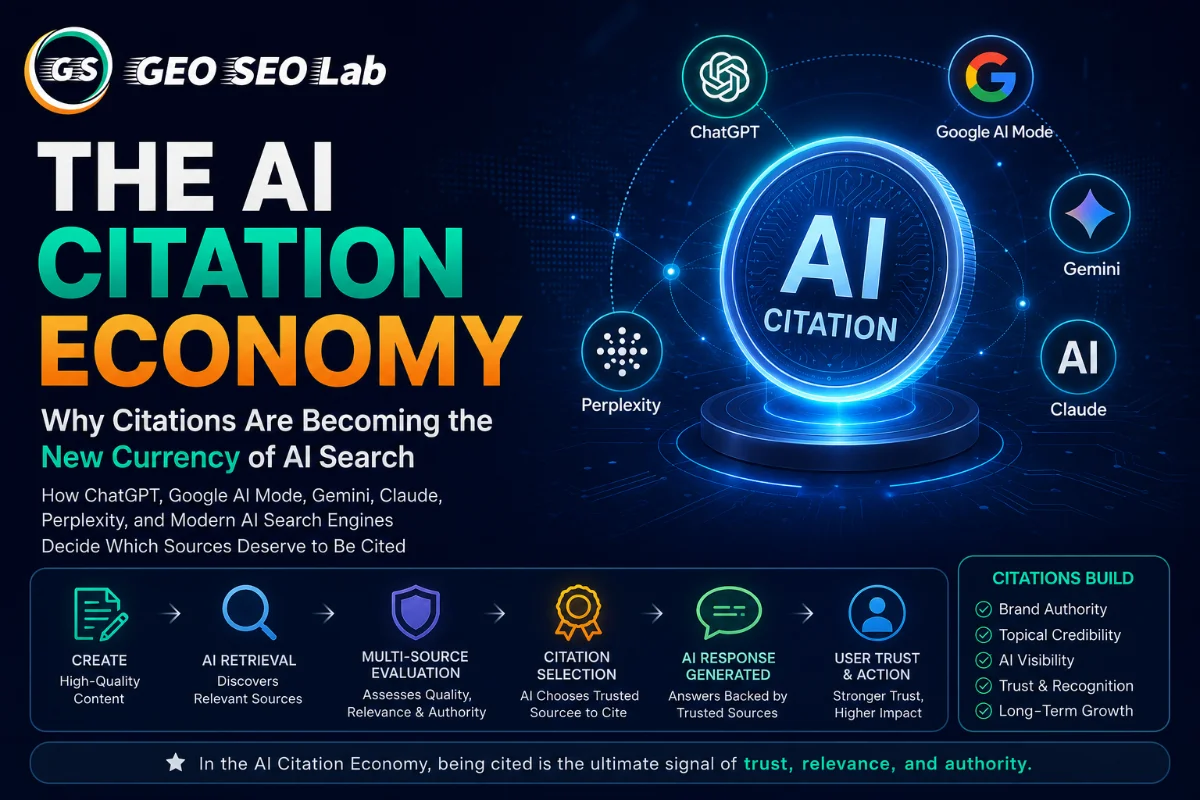
Understanding the AI Citation Economy
The underlying logic was elegantly simple: if many reputable, trustworthy websites chose to link to a particular page, that page must contain something genuinely valuable. This assumption powered an entire industry. Organizations invested substantial resources—time, money, and creative energy—into earning links because those links directly influenced search rankings, domain authority metrics, and ultimately, organic traffic volumes.Backlinks became, in every meaningful sense, the currency of traditional SEO.But something fundamental is changing.When today's users turn to ChatGPT, Google AI Mode, Gemini, Claude, or Perplexity with a question, they typically receive something dramatically different from what Google served ten years ago. Instead of a ranked list of webpages to browse through, they receive a synthesized, conversational answer—often comprehensive, often authoritative-sounding, sometimes accompanied by source references that influenced the response.This creates an entirely new form of digital recognition:AI citations.Being cited inside an AI-generated response is a fundamentally different achievement from ranking on the first page of traditional search results. A citation doesn't merely signal discoverability—it signals selection. The AI system evaluated numerous potential sources, assessed their credibility and relevance, and deliberately chose specific content to support its answer.That selective process represents something new and strategically significant.This shift is what GEO SEO Lab defines as the AI Citation Econ emerging competitive landscape where organizations don't just compete for rankings and clicks but for inclusion within the knowledge that AI systems use to generate their responses.Understanding how this economy works, what it values, and how businesses can participate meaningfully is rapidly becoming essential knowledge for every organization investing seriously in Generative Engine Optimization (GEO).
From Ranking Pages to Selecting Sources: A Fundamental ShiftTraditional search engines were fundamentally designed to answer one core question:Which webpages should appear at the top of this list?AI-powered search answers something meaningfully different:Which knowledge sources deserve to inform this answerThis distinction—subtle as it might initially appear—completely changes how visibility gets earned and maintained.
In traditional search, the journey looked like this text
AI-powered discovery introduces additional layers that fundamentally alter the competitive dynamic:text
Notice the critical difference: the most strategically important decision is no longer whether your page appears in a ranked list.It's whether the AI system considers your information valuable and trustworthy enough to actually cite when generating its answer.This represents a profound competitive shift that most organizations haven't fully internalized yet.
Defining What Actually Constitutes an AI CitationBefore discussing strategy, we need to be precise about terminology.
An AI citation occurs when an AI system references, attributes, relies upon, or incorporates a specific source while generating a response to a user query.Depending on the platform and context, citations manifest in different ways:Direct source attribution with organization name mentioned explicitlyHyperlinked references appearing below or within the responseSupporting document panels showing sources consultedWebsite mentions in the body of the generated text
Organization references when recommending solutionsResearch citations when incorporating data or findings
Knowledge source panels appearing alongside responsesRegardless of how they appear visually, citations share a common underlying significance: they identify the information that meaningfully contributed to the generated answer.
Here's the crucial distinction that separates citations from backlinks:Backlinks are created by publishers. AI citations are selected algorithmically.Organizations cannot reach out to an AI system and request a citation the way they might send a link-building outreach email. There's no citation exchange program to join.AI citations must be earned through the quality, credibility, and genuine value of the knowledge organizations create and publish.Why AI Citations Matter Far Beyond Simple VisibilityIf citations were only about visibility—about being seen by users—they would matter somewhat but not dramatically more than traditional rankings.The reason citations matter deeply is that they communicate something much more important: institutional confidence.When an AI system cites an organization's research or expertise, it's signaling to users that this source was considered sufficiently reliable and contextually relevant to influence the response. In an era when users increasingly struggle to evaluate information quality themselves, AI systems are effectively serving as credibility intermediaries.Being cited strengthens several interconnected business outcomes:
Brand recognition among target audiences who may never have encountered the organization directlyPerceived expertise that positions the organization as a knowledgeable authorityTopic authority that reinforces association with specific subject areasUser trust developed through third-party (AI) validationDecision confidence among prospects evaluating solutions
As AI-generated answers become more central to how people discover information and evaluate options, citations may evolve into one of the most powerful indicators of digital credibility available to organizations.
The implications extend well beyond marketing into brand reputation, thought leadership, competitive positioning, and even investor perception.The GEO SEO Lab Framework: The AI Citation Lifecycle
Understanding citations as isolated events misses their genuine nature. Citations are the visible outcome of a complex sequence of processes that begins long before any user submits a query.
The AI Citation Lifecycle illustrates why citation optimization cannot be treated as a final-stage publishing concern.
Every stage of this lifecycle represents both an opportunity and a potential failure point:Poor knowledge quality prevents meaningful discoveryWeak content structure limits successful retrievalInsufficient evidence reduces evaluation scores
Inconsistent entity signals reduce selection probabilityOutdated information loses citation potential over time
Organizations that consistently invest in high-quality, well-structured, evidence-rich knowledge improve their probability of successfully progressing through each lifecycle stage.Those that focus only on the final stage—publication—while neglecting earlier stages often wonder why their content never gets cited despite appearing indexed and technically accessible.AI Citations vs. Traditional Backlinks: A Side-by-Side ComparisonSince many organizations naturally map new concepts onto familiar frameworks, it's worth being explicit about how AI Backlinks remain genuinely important—we want to be clear about that. They haven't become irrelevant, and they still influence how AI systems evaluate source credibility. But AI citations introduce an additional dimension of authority that extends well beyond traditional search rankings into the emerging world of conversational AI discovery.Organizations need both—but they need different strategies for each.
How Citation Differs from Simple Discoverability?One of the most important conceptual shifts organizations need to make involves understanding that retrieval and citation are entirely separate stages with different requirements.
When AI processes a query, it doesn't simply select the first retrieved result and cite it. It may evaluate dozens—sometimes hundreds—of potentially relevant sources before determining which specific information deserves to support the generated response.
At each stage, the pool of candidate sources narrows significantly.
Organizations must optimize not just for the first stage (being retrievable) but for all stages (being evaluatable, being confidence-inspiring, being selected).This is why many organizations with substantial content libraries and respectable search rankings still rarely earn AI citations. They've optimized for discoverability without building the underlying knowledge quality that drives citation selection.The Emergence of the AI Citation EconomyThroughout most of internet history, competitive advantage in digital marketing came down to several well-understood resources:Rankings for keyword terms driving commercial intentTraffic generated through search visibilityClicks that brought users to owned properties
Backlinks that signaled authority to search algorithmsThe AI Citation Economy™ introduces new forms of competitive advantage:AI mentions in conversational responsesAI citations as sources of generated answersAI recommendations as preferred solutionsAI visibility across multiple platforms simultaneouslyMachine-recognized authority within specific domainsWithin this emerging economy, knowledge itself becomes the primary competitive asset.
Organizations that consistently contribute valuable, original, well-evidenced expertise earn greater opportunities for citation and recognition. Those that primarily produce promotional content or recycled information find themselves progressively marginalized as AI systems develop more sophisticated ability to distinguish between genuine knowledge contributions and content marketing.This represents a meaningful democratic shift—smaller organizations with genuine expertise can compete effectively with larger organizations that have historically dominated through budget-intensive link-building campaigns.Expertise, not just budget, determines competitive position in the AI Citation Economy™.
Citations Reward Knowledge Quality, Not Content Volume
This point deserves particular emphasis because it contradicts content marketing orthodoxy that many organizations have internalized over the past decade.Publishing more content does not necessarily generate more citations. The relationship is far more nuanced.AI systems are becoming increasingly sophisticated at distinguishing between:Original insights vs. rewritten summaries of existing contentEvidence-based guidance vs. unsupported assertionsComprehensive resources vs. thin content targeting keywordsGenuine expertise vs. surface-level familiarity with topicsProprietary research vs. aggregated common knowledgeA single authoritative research report containing original data, rigorous analysis, and practical insights may generate substantially more AI citation activity than fifty generic blog posts covering the same broad topic area.This shifts the strategic calculus for content investment. Rather than asking "how many articles can we publish this month?", organizations should ask "what genuinely valuable knowledge can we contribute that doesn't already exist in comparable quality elsewhere?"Quality over quantity isn't just a best practice in the AI Citation Economy™—it's the fundamental competitive mechanism.Every Citation Strengthens Entity Recognition Over TimeHere's an insight that often gets overlooked in discussions of AI citation strategy: citations don't just benefit individual pieces of content. They progressively strengthen the organizational entity associated with that content.
When an organization's research, frameworks, or educational resources earn repeated citations across AI platforms, those systems develop progressively stronger evidence connecting that organizational entity with specific topic areas.
The result is compounding authority—early citations make future citations more likely, which makes future citations even more likely still.Organizations that begin this process early, even imperfectly, develop cumulative advantages that become increasingly difficult for competitors to replicate regardless of content investment.The GEO SEO Lab Perspective on the Citation EconomyThe emergence of AI-powered search is genuinely redefining how digital authority gets built and measured.For two decades, optimization meant earning rankings and backlinks. Those signals remain important—nobody is suggesting organizations abandon proven SEO fundamentals.But AI-generated answers introduce a meaningfully different form of recognition: algorithmic citation selection based on knowledge quality, contextual relevance, and demonstrated expertise rather than link acquisition campaigns.The AI Citation Economy reflects this deeper transition from competing for webpage visibility to competing for knowledge credibility. It's a shift from asking "how do we rank?" to asking "how do we become trustworthy enough to cite?"Organizations that recognize this shift early and begin building citation-worthy knowledge ecosystems—through original research, proprietary frameworks, evidence-based educational resources, and comprehensive topical coverage—will find themselves increasingly well-positioned as AI-mediated discovery continues its rapid expansion.In the next generation of search, success will depend not only on being found but on being chosen as a knowledge source worthy of citation and trust.How AI Systems Actually Evaluate Sources Before Deciding What to CiteThe Crucial Reality: Retrieval Doesn't Guarantee Citation
One of the most expensive misconceptions organizations carry into AI search strategy is assuming that getting indexed and retrieved essentially guarantees appearance in AI responses.This assumption is incorrect, and acting on it leads organizations to focus on the wrong optimization priorities.Modern AI systems regularly evaluate dozens—sometimes hundreds—of potentially relevant sources when processing a complex query before selecting the specific subset that will actually influence the generated response.This means there are fundamentally two distinct questions any source must answer affirmatively to earn a citation:Question 1: Can the AI system find and retrieve this information?
Question 2: Does the AI system trust this information enough to include it in its answer?
Many organizations succeed reasonably well at Question 1 through basic SEO fundamentals—they get indexed, they achieve some rankings, their content appears retrievable.But they fail Question 2 because they haven't invested in building the knowledge quality, evidence depth, and topical authority that inspire genuine AI confidence.This explains a pattern that confuses many marketing teams: "We rank well in Google, we have substantial content, but we almost never appear in AI-generated responses." The answer, typically, is that ranking well answers Question 1 but doesn't address Question 2 at all.
Understanding Citation as a Confidence DecisionTraditional search engines primarily rank pages. Advanced AI systems generate responses—and this difference has profound implications for how sources get evaluated and selected.
Every statement included in an AI-generated answer carries a form of responsibility. If an AI system confidently presents inaccurate information, user trust in that system erodes. Users may make poor decisions based on that information. The AI platform's reputation suffers.This creates strong incentives for AI systems to develop sophisticated evaluation mechanisms that assess not just what information says, but how confident the system can be in the source providing it.
Citation selection therefore becomes fundamentally a confidence decision.
The stronger the AI's confidence in a source's accuracy, expertise, and contextual relevance, the greater the probability that source will influence the generated response.This confidence-based evaluation is why superficial content—content that looks informative at a glance but lacks substantive depth or supporting evidence—struggles to earn consistent citations even when it achieves decent search rankings.That Most Consistently Influence AI Citation Selection
While different AI platforms use varying retrieval architectures and evaluation methodologies, several common characteristics consistently appear to influence citation selection probability across platforms.
Factor 1: Knowledge Quality and Depth- Everything begins here, because without substantive knowledge quality, no other optimization efforts matter.AI systems increasingly demonstrate preference for sources that provide:
Comprehensive explanations that fully address the topic rather than skimming the surface
Clear, accurate definitions of key terms and concepts
Logical information structure that aids comprehension
Correct specialized terminology demonstrating domain familiarity
Educational depth that teaches rather than merely describes
Practical examples grounding abstract concepts in reality
Nuanced treatment of complex topics rather than oversimplification
Superficial content—articles that provide a quick overview without genuine depth—rarely becomes the strongest supporting source when AI evaluates competing options.
The investment in genuinely comprehensive, educational knowledge pays dividends in citation selection in ways that keyword-optimized thin content simply cannot match.
Factor 2: Demonstrated Topical Authority
AI systems attempt to assess whether an organization has demonstrated sustained, comprehensive expertise within a subject area—not just published a few articles touching on relevant topics.
The distinction between occasional topic coverage and genuine topical authority is significant.
Consider two hypothetical companies:
Company A's Content Library:
One blog post about AI Visibility published six months ago
Educational series covering related concepts
FAQ resources addressing practitioner questions
Both discuss AI Visibility. But Company B demonstrates sustained, systematic expertise rather than occasional topic mentions.
Topical authority significantly increases AI confidence because it signals that the organization genuinely understands the subject area rather than simply targeting relevant keywords.
Factor 3: Evidence Quality and Quantity
Evidence transforms opinion into substantiated information—and AI systems are increasingly sophisticated at distinguishing between the two.
High-quality evidence that strengthens citation potential includes:
Original research with methodology and findings
Verified statistics from credible sources with proper attribution
Industry reports from recognized organizations
Technical documentation demonstrating practical expertise
Government publications adding official credibility
Academic literature references showing scholarly grounding
Product documentation for technical claims
Real-world case studies showing actual outcomes
Benchmark data providing comparative context
The practical implication: every significant claim in citation-worthy content should ideally be supported by evidence. Not because AI systems count citations like academic reviewers, but because unsupported assertions reduce confidence in ways that evidence-backed statements don't.
Factor 4: Semantic Relevance to the Specific Query Context
An article can be technically accurate, well-researched, and comprehensively written while still receiving fewer citations for certain queries because it lacks sufficient semantic relevance to the specific context of the question.
Consider this example:
A user asks: "How can small urgent care clinics improve their AI visibility specifically?"
Source Option A: A comprehensive general article about AI Visibility for businesses covering all industries generically.
Source Option B: A healthcare-specific guide addressing AI Visibility for medical practices with HIPAA considerations, patient query optimization, and healthcare-specific platform nuances.
Both sources might be high quality. But Source B demonstrates stronger semantic relevance to the specific query context—it addresses the healthcare context directly rather than requiring the user to mentally translate general guidance into their specific situation.
AI systems increasingly favor contextually matched sources over generically accurate ones.
This is why industry-specific and use-case-specific content often earns more citations for relevant queries than equally well-produced generic content.
The AI Citation Economy: Why Citations Are Becoming the New Currency of AI Search
How ChatGPT, Google AI Mode, Gemini, Claude, Perplexity, and Modern AI Search Engines Decide Which Sources Deserve to Be Cited
Part 1: Understanding the AI Citation Economy
Executive Summary
For several decades, backlinks served as one of the most powerful and widely accepted signals of authority across the web.The underlying logic was elegantly simple: if many reputable, trustworthy websites chose to link to a particular page, that page must contain something genuinely valuable. This assumption powered an entire industry. Organizations invested substantial resources—time, money, and creative energy—into earning links because those links directly influenced search rankings, domain authority metrics, and ultimately, organic traffic volumes.
Backlinks became, in every meaningful sense, the currency of traditional SEO.
But something fundamental is changing.
When today's users turn to ChatGPT, Google AI Mode, Gemini, Claude, or Perplexity with a question, they typically receive something dramatically different from what Google served ten years ago. Instead of a ranked list of webpages to browse through, they receive a synthesized, conversational answer—often comprehensive, often authoritative-sounding, sometimes accompanied by source references that influenced the response.
This creates an entirely new form of digital recognition:
AI citations.Being cited inside an AI-generated response is a fundamentally different achievement from ranking on the first page of traditional search results. A citation doesn't merely signal discoverability—it signals selection. The AI system evaluated numerous potential sources, assessed their credibility and relevance, and deliberately chose specific content to support its answer.That selective process represents something new and strategically significant.
This shift is what GEO SEO Lab defines as the AI Citation Economy™—an emerging competitive landscape where organizations don't just compete for rankings and clicks but for inclusion within the knowledge that AI systems use to generate their responses.
Understanding how this economy works, what it values, and how businesses can participate meaningfully is rapidly becoming essential knowledge for every organization investing seriously in Generative Engine Optimization (GEO).
From Ranking Pages to Selecting Sources: A Fundamental Shift
Traditional search engines were fundamentally designed to answer one core question:
Which webpages should appear at the top of this list?
AI-powered search answers something meaningfully different:
Which knowledge sources deserve to inform this answer?
This distinction—subtle as it might initially appear—completely changes how visibility gets earned and maintained.
In traditional search, the journey looked like this:text the critical difference: the most strategically important decision is no longer whether your page appears in a ranked list.It's whether the AI system considers your information valuable and trustworthy enough to actually cite when generating its answer.This represents a profound competitive shift that most organizations haven't fully internalized yet.Defining What Actually Constitutes an AI Citation
Before discussing strategy, we need to be precise about terminology.
An AI citation occurs when an AI system references, attributes, relies upon, or incorporates a specific source while generating a response to a user query.
Depending on the platform and context, citations manifest in different ways:
Direct source attribution with organization name mentioned explicitly
Hyperlinked references appearing below or within the response
Supporting document panels showing sources consulted
Website mentions in the body of the generated text
Organization references when recommending solutions
Research citations when incorporating data or findings
Knowledge source panels appearing alongside responses
Regardless of how they appear visually, citations share a common underlying significance: they identify the information that meaningfully contributed to the generated answer.
Here's the crucial distinction that separates citations from backlinks:
Backlinks are created by publishers. AI citations are selected algorithmically.
Organizations cannot reach out to an AI system and request a citation the way they might send a link-building outreach email. There's no citation exchange program to join.
AI citations must be earned through the quality, credibility, and genuine value of the knowledge organizations create and publish.
Why AI Citations Matter Far Beyond Simple Visibility
If citations were only about visibility—about being seen by users—they would matter somewhat but not dramatically more than traditional rankings.
The reason citations matter deeply is that they communicate something much more important: institutional confidence.
When an AI system cites an organization's research or expertise, it's signaling to users that this source was considered sufficiently reliable and contextually relevant to influence the response. In an era when users increasingly struggle to evaluate information quality themselves, AI systems are effectively serving as credibility intermediaries.
Being cited strengthens several interconnected business outcomes:
Brand recognition among target audiences who may never have encountered the organization directly
Perceived expertise that positions the organization as a knowledgeable authority
Topic authority that reinforces association with specific subject areas
User trust developed through third-party (AI) validation
Decision confidence among prospects evaluating solutions
As AI-generated answers become more central to how people discover information and evaluate options, citations may evolve into one of the most powerful indicators of digital credibility available to organizations.
The implications extend well beyond marketing into brand reputation, thought leadership, competitive positioning, and even investor perception.
The GEO SEO Lab Framework, The AI Citation Lifecycle
Understanding citations as isolated events misses their genuine nature. Citations are the visible outcome of a complex sequence of processes that begins long before any user submits a query.text
The AI Citation Lifecycle illustrates why citation optimization cannot be treated as a final-stage publishing concern.
Every stage of this lifecycle represents both an opportunity and a potential failure point:
Poor knowledge quality prevents meaningful discovery
Weak content structure limits successful retrieval
Insufficient evidence reduces evaluation scores
Inconsistent entity signals reduce selection probability
Outdated information loses citation potential over time
Organizations that consistently invest in high-quality, well-structured, evidence-rich knowledge improve their probability of successfully progressing through each lifecycle stage.
Those that focus only on the final stage—publication—while neglecting earlier stages often wonder why their content never gets cited despite appearing indexed and technically accessible.
AI Citations vs. Traditional Backlinks: A Side-by-Side Comparison
Since many organizations naturally map new concepts onto familiar frameworks, it's worth being explicit about how AI citations differ from the backlinks that dominated traditional SEO strategy.Backlinks remain genuinely important—we want to be clear about that. They haven't become irrelevant, and they still influence how AI systems evaluate source credibility. But AI citations introduce an additional dimension of authority that extends well beyond traditional search rankings into the emerging world of conversational AI discovery.
Organizations need both—but they need different strategies for each.
How Citation Differs from Simple Discoverability?
One of the most important conceptual shifts organizations need to make involves understanding that retrieval and citation are entirely separate stages with different requirements.
When AI processes a query, it doesn't simply select the first retrieved result and cite it. It may evaluate dozens—sometimes hundreds—of potentially relevant sources before determining which specific information deserves to support the generated response.text
Organizations must optimize not just for the first stage (being retrievable) but for all stages (being evaluatable, being confidence-inspiring, being selected).
This is why many organizations with substantial content libraries and respectable search rankings still rarely earn AI citations. They've optimized for discoverability without building the underlying knowledge quality that drives citation selection.
The Emergence of the AI Citation Economy
Throughout most of internet history, competitive advantage in digital marketing came down to several well-understood resources:
Rankings for keyword terms driving commercial intent
Traffic generated through search visibility
Clicks that brought users to owned properties
Backlinks that signaled authority to search algorithms
The AI Citation Economy™ introduces new forms of competitive advantage:
AI mentions in conversational responses
AI citations as sources of generated answers
AI recommendations as preferred solutions
AI visibility across multiple platforms simultaneously
Machine-recognized authority within specific domains
Within this emerging economy, knowledge itself becomes the primary competitive asset.
Organizations that consistently contribute valuable, original, well-evidenced expertise earn greater opportunities for citation and recognition. Those that primarily produce promotional content or recycled information find themselves progressively marginalized as AI systems develop more sophisticated ability to distinguish between genuine knowledge contributions and content marketing.
This represents a meaningful democratic shift—smaller organizations with genuine expertise can compete effectively with larger organizations that have historically dominated through budget-intensive link-building campaigns.
Expertise, not just budget, determines competitive position in the AI Citation Economy™.
Citations Reward Knowledge Quality, Not Content Volume
This point deserves particular emphasis because it contradicts content marketing orthodoxy that many organizations have internalized over the past decade.
Publishing more content does not necessarily generate more citations. The relationship is far more nuanced.
AI systems are becoming increasingly sophisticated at distinguishing between:
Original insights vs. rewritten summaries of existing content
Evidence-based guidance vs. unsupported assertions
Comprehensive resources vs. thin content targeting keywords
Genuine expertise vs. surface-level familiarity with topics
Proprietary research vs. aggregated common knowledge
A single authoritative research report containing original data, rigorous analysis, and practical insights may generate substantially more AI citation activity than fifty generic blog posts covering the same broad topic area.
This shifts the strategic calculus for content investment. Rather than asking "how many articles can we publish this month?", organizations should ask "what genuinely valuable knowledge can we contribute that doesn't already exist in comparable quality elsewhere?"
Quality over quantity isn't just a best practice in the AI Citation Economy™—it's the fundamental competitive mechanism.
Every Citation Strengthens Entity Recognition Over Time
Here's an insight that often gets overlooked in discussions of AI citation strategy: citations don't just benefit individual pieces of content. They progressively strengthen the organizational entity associated with that content.
Consider how this reinforcement cycle works:
When an organization's research, frameworks, or educational resources earn repeated citations across AI platforms, those systems develop progressively stronger evidence connecting that organizational entity with specific topic areas.
The result is compounding authority—early citations make future citations more likely, which makes future citations even more likely still.
Organizations that begin this process early, even imperfectly, develop cumulative advantages that become increasingly difficult for competitors to replicate regardless of content investment.
The GEO SEO Lab Perspective on the Citation Economy
The emergence of AI-powered search is genuinely redefining how digital authority gets built and measured.
For two decades, optimization meant earning rankings and backlinks. Those signals remain important—nobody is suggesting organizations abandon proven SEO fundamentals.
But AI-generated answers introduce a meaningfully different form of recognition: algorithmic citation selection based on knowledge quality, contextual relevance, and demonstrated expertise rather than link acquisition campaigns.
The AI Citation Economy reflects this deeper transition from competing for webpage visibility to competing for knowledge credibility. It's a shift from asking "how do we rank?" to asking "how do we become trustworthy enough to cite?"
Organizations that recognize this shift early and begin building citation-worthy knowledge ecosystems—through original research, proprietary frameworks, evidence-based educational resources, and comprehensive topical coverage—will find themselves increasingly well-positioned as AI-mediated discovery continues its rapid expansion.
In the next generation of search, success will depend not only on being found but on being chosen as a knowledge source worthy of citation and trust.
Part 2: How AI Systems Actually Evaluate Sources Before Deciding What to Cite
The Crucial Reality: Retrieval Doesn't Guarantee Citation
One of the most expensive misconceptions organizations carry into AI search strategy is assuming that getting indexed and retrieved essentially guarantees appearance in AI responses.
This assumption is incorrect, and acting on it leads organizations to focus on the wrong optimization priorities.
Modern AI systems regularly evaluate dozens—sometimes hundreds—of potentially relevant sources when processing a complex query before selecting the specific subset that will actually influence the generated response.
This means there are fundamentally two distinct questions any source must answer affirmatively to earn a citation:
Question 1: Can the AI system find and retrieve this information?
Question 2: Does the AI system trust this information enough to include it in its answer?
Many organizations succeed reasonably well at Question 1 through basic SEO fundamentals—they get indexed, they achieve some rankings, their content appears retrievable.
But they fail Question 2 because they haven't invested in building the knowledge quality, evidence depth, and topical authority that inspire genuine AI confidence.
This explains a pattern that confuses many marketing teams: "We rank well in Google, we have substantial content, but we almost never appear in AI-generated responses." The answer, typically, is that ranking well answers Question 1 but doesn't address Question 2 at all.
Understanding Citation as a Confidence Decision
Traditional search engines primarily rank pages. Advanced AI systems generate responses—and this difference has profound implications for how sources get evaluated and selected.
Every statement included in an AI-generated answer carries a form of responsibility. If an AI system confidently presents inaccurate information, user trust in that system erodes. Users may make poor decisions based on that information. The AI platform's reputation suffers.
This creates strong incentives for AI systems to develop sophisticated evaluation mechanisms that assess not just what information says, but how confident the system can be in the source providing it.
Citation selection therefore becomes fundamentally a confidence decision.
The stronger the AI's confidence in a source's accuracy, expertise, and contextual relevance, the greater the probability that source will influence the generated response.
This confidence-based evaluation is why superficial content—content that looks informative at a glance but lacks substantive depth or supporting evidence—struggles to earn consistent citations even when it achieves decent search rankings.
Topical authority significantly increases AI confidence because it signals that the organization genuinely understands the subject area rather than simply targeting relevant keywords.
Factor 3: Evidence Quality and Quantity
Evidence transforms opinion into substantiated information—and AI systems are increasingly sophisticated at distinguishing between the two.
High-quality evidence that strengthens citation potential includes:
Original research with methodology and findings\
The practical implication: every significant claim in citation-worthy content should ideally be supported by evidence. Not because AI systems count citations like academic reviewers, but because unsupported assertions reduce confidence in ways that evidence-backed statements don't.
Factor 4: Semantic Relevance to the Specific Query Context
An article can be technically accurate, well-researched, and comprehensively written while still receiving fewer citations for certain queries because it lacks sufficient semantic relevance to the specific context of the question.
Consider this example:
A user asks: "How can small urgent care clinics improve their AI visibility specifically?"
Source Option A: A comprehensive general article about AI Visibility for businesses covering all industries generically.
Source Option B: A healthcare-specific guide addressing AI Visibility for medical practices with HIPAA considerations, patient query optimization, and healthcare-specific platform nuances.
Both sources might be high quality. But Source B demonstrates stronger semantic relevance to the specific query context—it addresses the healthcare context directly rather than requiring the user to mentally translate general guidance into their specific situation.AI systems increasingly favor contextually matched sources over generically accurate ones.
This is why industry-specific and use-case-specific content often earns more citations for relevant queries than equally well-produced generic content.
Factor 5: Entity Clarity and Consistency
Modern AI systems don't just evaluate individual articles in isolation—they increasingly recognize organizations as distinct entities with consistent identities, expertise areas, and relationship networks.
Organizations strengthen their entity signals (and therefore their citation potential) through:
When AI systems can clearly identify an entity and understand its expertise areas, they develop greater confidence in citing that entity's content for relevant queries.
Unclear or inconsistent entity signals force AI systems to make ambiguous judgments—and ambiguity reduces citation confidence.
Factor 6: Information Currency and Freshness
Different topics have dramatically different shelf lives for information quality.
Some foundational knowledge remains accurate and relevant for years or decades. The basic principles of communication or management haven't fundamentally changed recently.
But many rapidly evolving fields require consistent information updates to maintain citatio
Financial regulations and market conditions
In these domains, AI systems often prefer sources that reflect current knowledge over older resources that may contain outdated information.
The practical implication: organizations operating in fast-moving fields need systematic content refresh programs, not just content creation programs. Allowing important resources to become outdated is like allowing a competitive advantage to slowly erode.
The GEO SEO Lab Framework The AI Citation Evaluation Model
The AI Citation Evaluation Model™ shows the progression from available information to citation selection.
Rather than selecting sources simply because they contain relevant keywords—the old paradigm—AI systems increasingly evaluate whether sources demonstrate sufficient expertise, evidence, and contextual appropriateness to justify inclusion in a generated response that the AI is effectively endorsing to users.
This evaluation process is why citation optimization is fundamentally about building knowledge quality, not gaming retrieval mechanisms.
Why Original Research Creates Disproportionate Citation Value
Among all the factors influencing citation probability, original research stands out as a particularly powerful differentiator.
The reason connects to a concept called information gain—the degree to which a source contributes new knowledge beyond what's already widely available.
Consider the difference:
Article Type A: A well-written overview of AI citation best practices, synthesizing information from various sources, presenting it clearly, and optimizing it for search.
Article Type B: An original study analyzing citation patterns across 500 organizations in different industries, with proprietary data, statistical analysis, and findings that aren't available anywhere else.
Both may be high quality. Both may be well-structured and informative. But Type B contributes genuinely new information to the knowledge ecosystem.
When AI systems encounter multiple sources discussing the same topic, sources with original data and unique insights provide something that derivative sources cannot: information that doesn't exist elsewhere. This creates a compelling reason to cite the original source specifically rather than any of the derivative articles covering similar ground.
This explains why organizations that invest in original research—even relatively modest primary research efforts—often develop citation authority that significantly outpaces their content investment on a per-article basis.
Not Every Retrieved Source Becomes a Citation—And That's the Key Insight
The final critical insight from Part 2 deserves direct emphasis because it changes how organizations should approach content investment decisions.
Being retrievable and being citable are entirely different achievements requiring different strategies.
Traditional SEO primarily optimizes for retrieval—getting indexed, getting crawled, achieving rankings that ensure discovery.
Citation optimization requires going significantly further—building knowledge quality, evidence depth, topical authority, and entity clarity that inspire confidence in AI systems evaluating numerous competing sources.
The organizations that grasp this distinction and invest accordingly are positioning themselves for meaningful competitive advantages in AI-powered search environments.
Those that continue optimizing exclusively for traditional rankings while neglecting citation worthiness may find their digital influence increasingly limited as AI-mediated discovery grows.
Part 3: Building Citation-Worthy Content That AI Systems Choose to Reference
Why Citation-Worthy Content Requires a Different Creation Philosophy
The content creation philosophy that served organizations well during traditional SEO's dominance—research keywords, create content targeting those keywords, optimize on-page elements, build links—needs meaningful expansion for the AI Citation Economy™.
AI systems evaluating sources for citation selection aren't asking "does this page rank for the right keywords?"
They're effectively asking: "Would a knowledgeable expert consider this source worth referencing?"
That question demands a genuinely different approach to content creation.
Organizations need to shift from a production mindset (how much content can we create?) to a knowledge contribution mindset (what genuinely valuable knowledge can we add to our domain?).
This shift isn't just philosophical—it has direct practical implications for how content gets planned, researched, written, reviewed, and published.
Contrasting SEO Content with Citation-Worthy Content
Traditional SEO Content Priorities
Citation-Worthy Content Priorities
Targets specific keywords
Addresses genuine user knowledge needs
Optimized for search algorithm signals
Both approaches remain relevant—citation-worthy content can and should incorporate sound SEO fundamentals. But the primary creative question shifts from "how do we rank for this keyword?" to "what genuinely valuable knowledge can we contribute that doesn't adequately exist elsewhere?"
This question consistently produces better citations than keyword-focused briefs.
Original knowledge contributions attract early citations. Those citations strengthen authority signals. Greater authority increases the probability of future citations for related content. Recognition encourages investment in additional original research. That research generates more citations—often at higher rates than early efforts because established authority provides a head start.
This compounding dynamic is why organizations that begin citation-building efforts early, even with modest resources, often develop advantages that prove very difficult for well-resourced late entrants to overcome quickly.
The flywheel, once spinning, is hard to stop—and hard to replicate.
The Seven Defining Characteristics of Citation-Worthy Content
Characteristic 1: Genuine Originality Through Primary Research
No single characteristic distinguishes citation-worthy content from generic content more clearly than original research.
Original research means contributing new information to the knowledge ecosystem rather than synthesizing what's already widely available. It includes:
Industry benchmark studies measuring performance across organizations
Market research examining trends, attitudes, or behaviors
Proprietary analysis of unique datasets your organization has access to
Experimental findings from testing methodologies you've developed
Survey research capturing practitioner perspectives on important questions
Longitudinal studies tracking changes over time
Case study research documenting implementation outcomes with rigor
The beauty of original research is that it creates information that literally doesn't exist anywhere else. When AI systems evaluate sources for a query touching on that research domain, no derivative article can substitute for the original—because only the original contains the original data.
Even modest research efforts—a practitioner survey with 200 respondents, an analysis of outcomes from client implementations, a benchmark of publicly available performance data—can generate citation value that far exceeds the investment required.
Characteristic 2: Proprietary Frameworks and Methodologies
Proprietary frameworks represent another powerful citation driver because they give AI systems a specific, uniquely attributable intellectual contribution to reference.
Generic advice can come from anywhere. But a named, documented framework with specific components and logic—the AI Citation Lifecycle, the Citation Worthiness Pyramid™, the Entity Intelligence Framework™—can only come from its creator.
Effective frameworks that build citation potential include:
Decision frameworks helping practitioners choose between options
Maturity models assessing organizational capability levels
Process methodologies guiding implementation
Scoring systems measuring performance dimensions
Diagnostic tools identifying improvement opportunities
Strategic roadmaps structuring capability development
Organizations across industries can develop proprietary frameworks relevant to their expertise areas. A healthcare technology company might develop a "Clinical AI Readiness Framework." A financial services firm might create a "Digital Trust Maturity Model." A manufacturing consultant might introduce a "Operational AI Integration Methodology."
These intellectual contributions create uniquely attributable knowledge that AI systems can reference with confidence—and attribution clarity strengthens citation probability.
Characteristic 3: Evidence-Rich, Well-Supported Content
The practical guidance here is straightforward even if implementation requires discipline: don't make claims you can't support.
Evidence transforms assertions into substantiated information, and AI systems are increasingly capable of distinguishing between the two when evaluating citation candidates.
Statistical evidence with clear sourcing
One important practical note: evidence doesn't just strengthen citation probability—it also makes content more genuinely useful to readers, which serves both AI evaluation criteria and human user needs simultaneously.
Characteristic 4: Comprehensive Topic Coverage That Addresses Multiple User Needs
Citation-worthy resources typically address topics with substantially greater comprehensiveness than typical SEO content.
This comprehensive approach improves citation probability for multiple reasons: it increases relevance across a wider range of query variations, it demonstrates genuine topical expertise rather than surface-level familiarity, and it creates more opportunities for AI systems to find directly relevant information within a single authoritative source.
Characteristic 5: Strategic Content Structure That AI Can Interpret
Well-structured information serves both human readers and AI systems—and the structural elements that help humans navigate complex content also help AI systems extract and utilize relevant information.
Step-by-step structures for implementation guidance
Summary sections consolidating key points
Structure isn't just an aesthetic choice—it's a functional element that determines how easily both humans and AI systems can extract specific, useful information from a complex resource.
Characteristic 6: Practical Value That Helps Users Accomplish Goals
AI systems across platforms demonstrate consistent preference for content that helps users actually accomplish something rather than content that merely describes concepts at a theoretical level.
Practically valuable content formats include:
Implementation guides with actionable steps
Decision frameworks helping evaluation and selection
Characteristic 7: Systematic Content Updates That Maintain Currency
Citation-worthy content isn't a one-time creation—it's a maintained resource that evolves as understanding in the field evolves.
Perhaps the single most impactful structural change organizations can make in their content strategy is shifting from publishing isolated articles to building interconnected knowledge hubs.
Here's why this matters for citations: when AI evaluates a source, it doesn't just evaluate that individual page in isolation. It evaluates the source in context of the broader organization's knowledge ecosystem.
An isolated article signals limited topical engagement. A comprehensive knowledge hub with multiple interconnected resources signals sustained, serious expertise.
Example Knowledge Hub Structure for AI Search:
text
AI Search (Primary Hub)
├── AI Citations (This guide)
├── AI Visibility Engineering
├── Entity SEO Strategy
├── Retrieval Optimization
├── AI Authority Development
├── Knowledge Graph Strategy
├── GEO Measurement Frameworks
└── Platform-Specific Strategies
├── ChatGPT Optimization
├── Google AI Mode Strategy
├── Perplexity Visibility
└── Gemini Optimization
Each resource reinforces the others through strategic internal linking and shared conceptual frameworks. Together, they establish comprehensive topical authority that AI systems can recognize and respect—far more effectively than any individual article could accomplish alone.
Measuring AI Citation Performance and Building an Enterprise Citation Strategy
Why AI Citations Are Rapidly Becoming Strategic Business Metrics
For most of digital marketing's history, success measurement was relatively clear. Traffic went up or down. Rankings improved or declined. Conversions increased or decreased. Revenue from organic search was trackable.
These metrics remain important—we aren't suggesting organizations abandon them.
But they were designed for an internet where users clicked links to visit websites. Every meaningful interaction passed through a trackable click on a link that sent someone to a measurable property.
AI-powered search fundamentally disrupts this model.
When someone asks Perplexity a complex research question and receives a comprehensive, synthesized answer with source references, they may get everything they need without visiting any individual website. When a busy executive asks Claude to summarize the key considerations for a major technology decision, they might act on that information without clicking through to any of the cited sources.
In this environment, traditional traffic and conversion metrics increasingly undercount the actual influence organizations
Visibility means an AI system can discover and retrieve your content. It's a necessary condition but not a sufficient one.
Citation means your knowledge actually influenced the answer the AI system generated. It's evidence of genuine intellectual contribution to the conversation.
Recommendation means AI systems consistently suggest your organization as a preferred solution—the highest expression of confidence.
KPI 1: Citation Frequency Across Platforms
What it measures: How often organizational knowledge appears as a referenced source across major AI platforms.
Observable indicators:
Brand name references in AI responses
Research citations with specific data attribution
Framework mentions with organizational attribution
Product or service references in relevant contexts
Educational resource citations
Measurement approach: Organizations can develop systematic testing protocols—regularly querying AI platforms with representative questions and documenting citation patterns over time. While imprecise, trend tracking provides strategic directional insight.
Why it matters: Increasing citation frequency across multiple platforms signals growing organizational authority and knowledge influence in the AI discovery ecosystem.
KPI 2: Topic Citation Coverage Analysis
What it measures: How consistently citations occur across an organization's strategic topic areas rather than clustering narrowly around a few topics.
Practical tracking framework:
KPI 3: Knowledge Asset Performance by Content Type
What it measures: Which types of knowledge assets generate the strongest citation performance relative to their creation investment.
Content types to evaluate:
Original research reports
Proprietary framework documentation smarter investment allocation—directing resources toward content types that consistently generate strong citation returns rather than those that consume resources without proportionate citation value.
KPI 4: Entity Citation Strength Assessment
What it measures: Whether citations consistently reinforce the correct organizational entity associations across multiple dimensions.
Evaluate whether citations correctly associate your organization with:
Industries and use cases served
Geographic presence (for location-relevant businesses)
Why it matters: Citation quality matters as much as citation quantity. Citations that attribute expertise accurately to the correct entity build lasting authority. Ambiguous citations provide limited long-term benefit.
KPI 5: Evidence Integration Score
What it measures: How consistently your published content incorporates the types of evidence that most strongly support AI citation selection.
Evidence quality assessment factors:
Technical documentation accuracy
Benchmark data with clear sourcing
Why it matters: Evidence integration is a leading indicator—improvements in evidence quality should precede improvements in citation frequency, making it a valuable early warning system for citation performance trajectory.
KPI 6: Citation-to-Recommendation Progression Rate
What it measures: The degree to which citations are progressing toward the stronger signal of active AI recommendation.
Progression monitoring:
Why it matters: Recommendations represent substantially stronger competitive advantage than citations—they indicate AI systems have developed sufficient confidence to actively advocate for your organization rather than simply reference it.
The GEO SEO Lab Framework™: The Citation Maturity Model™
Organizations develop citation authority through recognizable maturity stages.
Maturity Level 1 — Discoverable
Characteristics:
Basic web presence with functional technical SEO
Limited original educational content
Maturity Level 2 — Referenced
Characteristics:
Growing topical content coverage across strategic areas
Improved knowledge organization with some internal linking
Occasional AI citations for specific queries
Stronger entity consistency emerging
Some topic areas showing citation activity
Primary Strategic Goal:
Systematically improve evidence quality and topical depth—move beyond explaining what toward explaining why and how with supporting evidence.
Maturity Level 3 — Trusted
Characteristics:
Original research contributing new knowledge
Proprietary methodologies and frameworks documented
Expand citation coverage across additional strategic topic areas while deepening authority in established areas.
Maturity Level 4 — Recommended
Characteristics:
Regular active recommendations as preferred solution
Strong entity authority with clear topic associations
Primary Strategic Goal:
Strengthen competitive leadership position through continuous knowledge innovation and adjacent domain expansion.
Maturity Level 5 — Industry Reference
Characteristics:
Recognized thought leadership defining field understanding
Proprietary frameworks referenced as industry standards
Original research setting benchmark expectations
Dominant citation presence across multiple AI platforms
Often the default recommendation in core specialty areas
Sustained competitive advantage through knowledge authority
Primary Strategic Goal:
Maintain leadership through continuous innovation, emerging topic development, and ecosystem contribution.
Building an Enterprise Citation Strategy Roadmap
Phase 1 — Comprehensive Knowledge Audit (Months 1-2)
Before optimizing, understand clearly what exists and what's missing.
Audit focus areas:
Existing research assets and their citation potential
Educational resource depth and quality
Primary deliverable: Clear baseline assessment establishing current citation performance and highest-priority improvement opportunities.
Phase 2 — Citation Worthiness Enhancement (Months 3-6)
Systematically improve the foundational qualities that drive citation selection.
Key activities:
Original research planning and initial execution
Evidence integration across existing high-potential content
Content updates for currency and accuracy
Primary deliverable: Measurably improved knowledge quality across strategic topic areas, setting conditions for improved citation frequency.
Phase 3 — Knowledge Leadership Development (Months 7-18)
Build sustained competitive advantage through consistent knowledge contribution.
Key activities:
Annual original research publication
Industry survey and benchmark studies
Primary deliverable: Recognized expertise position in strategic topic areas, with measurably improving citation performance.
Phase 4 — Continuous Measurement and Refinement (Ongoing)
Citation authority requires sustained attention and systematic improvement.
Ongoing monitoring priorities:
Content freshness maintenance
Entity recognition monitoring
New platform emergence and adaptation
Reality: The mechanisms are fundamentally different. Backlinks are deliberately created by publishers making editorial decisions. AI citations are algorithmically selected by AI systems based on knowledge quality, contextual relevance, and confidence factors. The strategic implications differ accordingly—you can systematically acquire backlinks through outreach and relationship building, but you can only earn citations by building genuinely citation-worthy knowledge.
Misconception 2: Publishing more articles reliably increases citation frequency.
Reality: Content volume has limited relationship with citation frequency. AI systems demonstrate clear preferences for originality, evidence, authority, and genuine expertise over content quantity. Organizations often find that producing fewer, substantially higher-quality resources generates dramatically more citation activity than high-volume production of average-quality content.
Misconception 3: Structured data markup directly creates AI citations.
Reality: Schema markup improves machine readability and reduces interpretive ambiguity—both valuable benefits. But structured data is essentially metadata. It helps AI systems understand what content means, not whether that content is worth citing. Knowledge quality, evidence, and authority drive citation selection; structured data supports those factors but cannot substitute for them.
Misconception 4: Only publishers and media organizations benefit from AI citation strategies.
Reality: Healthcare providers, SaaS companies, professional service firms, manufacturers, financial institutions, educational organizations, local businesses, and enterprise brands across every industry can and do earn AI citations for relevant queries. The specific strategies differ by industry context, but the fundamental approach—contributing genuinely valuable, well-evidenced knowledge—applies universally.
Misconception 5: Citation optimization produces quick results.
Reality: Building genuine citation authority requires sustained investment over time. Most organizations see meaningful initial results within 6-12 months of systematic effort, with substantial citation authority developing over 2-3 years of consistent knowledge contribution. The compounding nature of citation authority means patience is rewarded—later-stage results significantly outperform earlier-stage results.
The Future Trajectory of the AI Citation Economy
Several converging trends suggest the strategic importance of AI citations will increase substantially over the coming years.
Trend 1: Citations Will Become Primary Trust Intermediaries
As AI-generated answers become more central to how people discover information, the sources those answers cite will increasingly determine which organizations people perceive as credible authorities. Citations will function as powerful third-party endorsements—particularly valuable because they're algorithmic rather than paid.
Trend 2: Original Knowledge Will Create Insurmountable Competitive Advantages
Organizations that establish consistent original research programs early will develop citation authority that compounds over time—becoming progressively harder for competitors to displace regardless of content investment. First-mover advantages in citation authority are real and significant.
Trend 3: Citation Intelligence Will Become Standard Executive Reporting
As organizations recognize the influence of AI citations on brand perception and business development, citation performance metrics will migrate from marketing dashboards into executive reporting frameworks alongside revenue, brand awareness, and competitive positioning metrics.
Trend 4: Entity Authority Will Increasingly Drive Citation Selection
AI systems are becoming more sophisticated at entity recognition and relationship mapping. Organizations with well-developed entity ecosystems—clear identities, consistent signals, rich relationship networks—will have systematic advantages in citation selection as these capabilities mature.
Trend 5: The AI Citation Economy Will Create New Knowledge-Based Market Leaders
Industries will increasingly see organizations rise to market leadership positions based primarily on knowledge authority rather than traditional marketing spend or distribution advantages. Small organizations with exceptional expertise can displace established competitors who've relied on marketing budgets rather than knowledge quality.
The GEO SEO Lab Perspective on the Future
The fundamental transition from search engines to AI-powered answer engines is rewriting the rules of digital authority.
Backlinks remain important signals—we want to be clear about that. But they're no longer the only form of digital recognition that matters strategically.
The AI Citation Economy™ establishes a new competitive landscape where knowledge quality, original contribution, and genuine expertise determine which organizations become trusted sources within AI-generated responses.
The organizations that will lead in this economy aren't necessarily those with the largest marketing budgets or the most sophisticated technical SEO programs.
They will be organizations that consistently ask and answer the right question: "What genuinely valuable knowledge can we contribute that doesn't adequately exist elsewhere?"
Answer that question repeatedly, with rigor and originality, over sustained periods, and citations follow naturally. Authority compounds. Competitive advantage builds.
In the AI Citation Economy, lasting visibility belongs to knowledge creators—not just content publishers.
Essential Key Takeaways
✅ AI citations represent algorithmic selection, not publisher-created links—they must be earned through knowledge quality and cannot be acquired through outreach.
✅ Retrieval is necessary but insufficient—AI systems evaluate numerous sources and select only those inspiring genuine confidence; being indexed doesn't guarantee being cited.
✅ Original research, proprietary frameworks, credible evidence, topical authority, and entity consistency most consistently drive citation selection across AI platforms.
✅ Organizations should build interconnected knowledge ecosystems, not isolated articles—comprehensive knowledge hubs establish the topical authority that AI systems recognize and respect.
✅ The AI Citation Economy rewards knowledge creators—those who consistently contribute original, evidence-backed expertise that genuinely advances understanding in their fields.
About GEO SEO Lab
GEO SEO Lab is a specialized strategic consultancy dedicated to helping forward-thinking organizations build meaningful visibility, genuine authority, and consistent recommendations across Google Search, Google AI Mode, ChatGPT, Gemini, Claude, Perplexity, Grok, and emerging AI-powered discovery platforms.
Through Generative Engine Optimization (GEO), AI Visibility Engineering, Entity SEO Strategy, AI Citation Development, knowledge architecture design, and research-backed frameworks, GEO SEO Lab enables organizations to create digital assets that AI systems can confidently understand, accurately retrieve, appropriately cite, and genuinely recommend.
Tags
Frequently Asked Questions
Find answers to common questions about this topic
About the Author

Aman Kesharwani
SEO Expert & Content Creator
Experienced digital marketing professional specializing in SEO strategies, content optimization, and data-driven marketing solutions. Passionate about helping businesses grow their online presence and achieve better search rankings.
Related Articles
View all posts
How to Turn FAQ Content Into GEO Content
How to Turn FAQ Content Into GEO ContentThink about the last time you searched for a complex product or a nuanced troubleshooting step. Did you type a...
How AI Decides Which Websites to Cite: Inside the Hidden Selection Process
Introduction: The New Gatekeepers of VisibilityPicture this. Someone types a question into ChatGPT, Perplexity, or Google's AI Overview box. Within se...
Why Does AI-Generated Content Need Humanization for SEO?
Why Does AI-Generated Content Need Humanization for SEO?The Real Reason Raw AI Drafts Underperform, and What Actually Fixes ItA GEO SEO Lab ReportEdit...