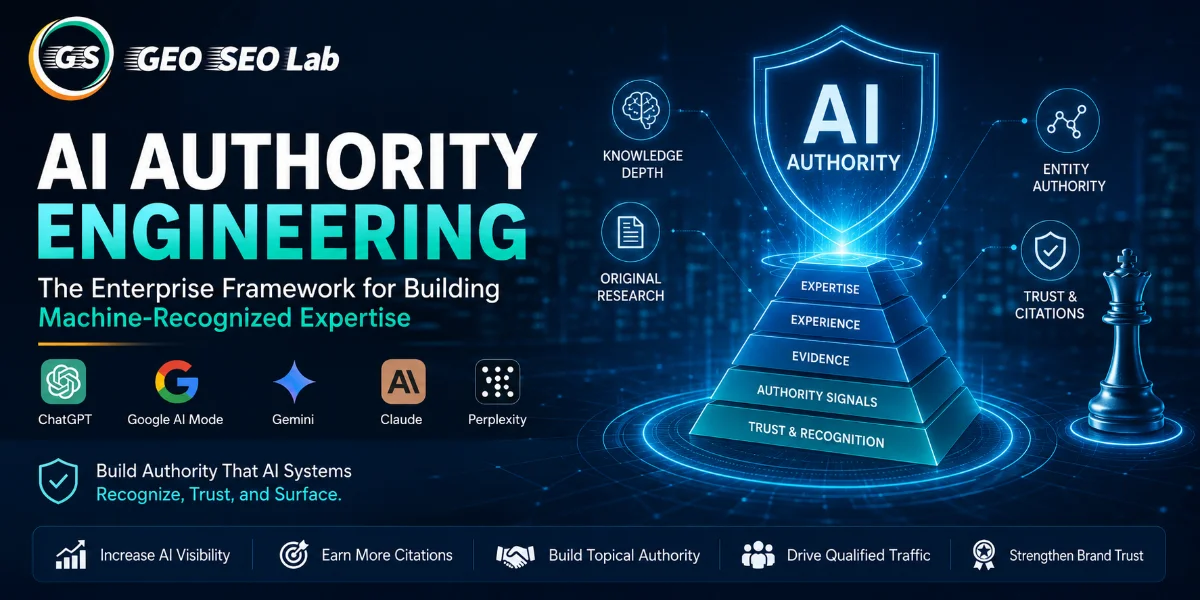
AI Authority Engineering: The Enterprise Framework for Building Machine-Recognized Expertise
Learn how AI Authority Engineering helps businesses build machine-recognized expertise that ChatGPT, Google AI Mode, Gemini, Claude, and Perplexity can identify, trust, cite, and recommend. Discover the frameworks, authority signals, and enterprise strategies required to earn long-term AI visibility.
The Difference Between Looking Authoritative and Being Authoritative
There is a distinction that the digital marketing industry has been quietly avoiding for a long time, and AIpowered search is forcing it into the open. Looking authoritative and being authoritative are not the same thing. For much of the SEO era, the gap between these two states could be managed sometimes even bridged through a combination of clever optimization, strategic link acquisition, and sufficient publishing volume. Search engines evaluated signals that could, with enough skill and investment, be cultivated independently of the underlying expertise they were supposed to indicate. Domain authority scores, backlink profiles, keyword rankings: these were measures of visibility that often correlated with genuine expertise but did not require it. AIpowered search systems are harder to game in this particular way. Not because they are immune to surfacelevel signals, but because the scale and nature of their evaluation introduces dimensions that pure optimization cannot address. When an AI system is attempting to determine which organization is best positioned to answer a specific question not just which page appears most relevant, but which entity genuinely understands the subject it is drawing on a much richer set of signals than any traditional ranking algorithm considered. It is asking, in effect: does this organization actually know what it is talking about? Answering that question well requires more than welloptimized pages. It requires the kind of genuine, demonstrated, consistently expressed expertise that AI systems can evaluate across multiple signals simultaneously knowledge depth, evidence quality, entity coherence, topical consistency, original contribution, and the relationships between all of these. This is what GEO SEO Lab defines as AI Authority Engineering: the systematic process of designing, building, and maintaining organizational expertise so that AI systems can confidently recognize, retrieve, and surface it. The word "engineering" is deliberate. It signals that authority in the AI search era is not primarily something that happens to organizations as a byproduct of their marketing activity. It is something that can be intentionally designed, systematically built, and continuously improved if organizations understand what they are building toward and invest accordingly. This article examines that understanding and that investment in full. We explore what AI authority actually means and how it differs from traditional digital authority, what signals AI systems use to evaluate expertise, how organizations can design systems that build and compound authority over time, and how to measure authority development in ways that go beyond the traffic and ranking metrics that have dominated digital marketing dashboards for two decades.
Understanding AI Authority Engineering
Why Traditional Authority Signals Are No Longer Sufficient
The concept of digital authority has gone through several significant evolutions since search engines became the primary mechanism for online discovery. Understanding those evolutions helps clarify why the current transition toward AIevaluated authority represents something genuinely different from previous changes in how authority was measured. In the earliest years of search, authority was essentially synonymous with link popularity. The PageRank algorithm's core insight that a page linked to by many other pages was likely more valuable than one linked to by few was elegant and powerful, and it drove an entire ecosystem of linkbuilding practice that persisted for two decades. As search engines became more sophisticated, authority became more multidimensional. Content quality signals, user engagement data, EEAT considerations (Experience, Expertise, Authoritativeness, Trustworthiness), entity relationships, and dozens of other factors were incorporated into evaluation models that attempted to approximate genuine quality more accurately than link counts alone could achieve. Each evolution in how authority was measured created new optimization opportunities and new gaps between organizations that were genuinely authoritative and those that had learned to simulate the signals of authority. The gap between signal and substance has never been fully closed in traditional search, and this has allowed organizations with significant marketing resources but limited genuine expertise to maintain competitive visibility by optimizing more skillfully for the signals that search engines evaluated. AIpowered search narrows this gap in important ways. The breadth and nature of evaluation that AI systems apply the synthesis of knowledge depth, evidential quality, entity consistency, topical coherence, and original contribution across many resources simultaneously is substantially harder to optimize for in the absence of the underlying substance. An organization that publishes genuinely deep, wellconnected, evidencebased expertise on a specific domain will be better positioned across this full evaluation than one that has optimized skillfully but superficially. This is not to claim that AI systems are perfect expertise evaluators they are not, and they remain susceptible to various forms of manipulation. But the direction of development is clearly toward more substantive evaluation, and organizations that understand and invest in genuine authority development are making a more durable strategic bet than those continuing to optimize primarily for surfacelevel signals.
What AI Authority Engineering Actually Is ?
AI Authority Engineering is the systematic process of building organizational expertise in ways that AI systems can recognize, understand, and trust. The emphasis on "systematic" reflects the core insight that authority in the AI era is not primarily a byproduct of good content production it is the intentional outcome of a designed process that addresses multiple dimensions of expertise representation simultaneously.
Three elements make this definition meaningful: systematic, organizational, and recognizable by AI systems.
Systematic means that authority is built through deliberate design rather than accumulated through uncoordinated activity. Organizations that produce excellent content randomly, across many topics, without coherent architecture or cumulative strategy may produce useful individual resources but will not build the kind of compounding authority that AI systems recognize as genuine expertise. Systematic authority development involves deciding which domains the organization wants to be recognized as expert in, designing knowledge ecosystems that reflect that expertise comprehensively, and building processes that ensure each new contribution strengthens existing authority rather than existing independently.
Organizational means that authority in the AI era is fundamentally an entitylevel quality, not a pagelevel quality. Traditional SEO could sometimes be won at the page level creating a single outstanding resource for a specific query. AI authority is evaluated across the full organizational entity what the organization knows, how consistently it knows it, how deeply it understands it, and how that understanding is expressed across the full ecosystem of organizational knowledge. Building this kind of entitylevel authority requires engagement across the organization, not just the marketing team.
Recognizable by AI systems means that the expertise being built needs to be expressed in forms that AI retrieval and evaluation systems can actually process and interpret. Genuine expertise that is poorly organized, inconsistently expressed, or structured in ways that make it difficult for AI systems to understand contributes less to AI authority than equivalent expertise that is clearly organized, consistently expressed, and structured for AI interpretability. This is where the "engineering" dimension becomes most practically specific.
The AI Authority Stack
The AI Authority Stack provides a framework for understanding how the different dimensions of organizational authority build on each other to create the kind of comprehensive expertise signal that AI systems can confidently recognize.
Original expertise is the foundation the genuine knowledge that the organization possesses through its experience, practice, research, and professional engagement with its domain. This is the nonnegotiable starting point. Authority engineering cannot create expertise that does not exist; it can only make genuine expertise more visible and more usable to AI systems. Organizations that attempt to build AI authority without investing in genuine expertise will find their efforts produce diminishing returns as AI systems become more sophisticated at distinguishing substance from simulation.
Evidence is the layer through which expertise becomes verifiable. Claims and recommendations backed by traceable, credible evidence are substantially more useful to AI systems than equivalent claims without evidentiary support. Evidence includes original research that generates new data, references to credible external sources, transparent methodology documentation, and case study evidence from real implementation experience. The evidence layer transforms expertise from assertion into demonstrable fact. Knowledge depth reflects the comprehensiveness of understanding within a domain the degree to which an organization's expertise extends from foundational principles through advanced application and handles the nuances, edge cases, and tradeoffs that characterize deep rather than surfacelevel understanding. Depth is what distinguishes expertise from familiarity, and AI systems evaluating authority are increasingly capable of detecting the difference. Entity strength is the coherence and clarity of the organizational identity that AI systems can recognize and associate with the expertise being expressed. This includes consistency of organizational description, clarity of the relationship between the organization and its areas of expertise, and the strength of the connections between the organization's entity and the specific knowledge domain it is claiming authority in. Topical authority is the cumulative weight of expertise signals across a specific domain the accumulated evidence that this organization consistently knows what it is talking about in this specific area. This layer is built through sustained publishing, consistent expertise demonstration, and the development of a track record that AI systems can evaluate across many interactions over time.
AI recognition is the outcome of all the lower layers working together the state in which AI retrieval systems can confidently identify this organization as an authoritative source for relevant queries and draw on its knowledge with high confidence. This recognition, once established, is selfreinforcing: citations generate more recognition, which strengthens the entity signals that support further retrieval, which generates more citations. AI visibility is the ultimate output the consistent appearance of organizational knowledge in AIgenerated responses for relevant queries, creating the kind of preclick influence that drives brand awareness, customer trust, and ultimately business outcomes.
Why Popularity and Authority Are Not the Same Thing ?
One of the most important conceptual clarifications in AI authority development is the distinction between popularity and authority a distinction that traditional search made less consequential than AI search does. Popular organizations are recognized by many people. Authoritative organizations are trusted by the right people and, increasingly, by the AI systems those people use to seek information. Popularity can be built through marketing investment, viral content, advertising, and community engagement. Authority is built through sustained demonstration of genuine expertise. For AI search purposes, the distinction matters because AI systems are attempting to generate responses that genuinely help users not responses that represent the most popular perspective. An organization whose claimed expertise is not backed by genuine knowledge depth, evidence, and consistency will, over time, generate AI citations that are less reliable, which creates a negative feedback loop: less reliable citations generate less trust from users, which reduces the value of the citations, which ultimately reduces citation frequency as AI systems calibrate toward more reliable sources. Organizations that invest in genuine authority development making the investment required to actually deepen their expertise, produce original evidence, and maintain consistent knowledge ecosystems are building a more sustainable competitive position than those relying on popularity signals to substitute for substantive authority.
The Signals That Build AI Authority
Authority as Signal Convergence
Perhaps the most important thing to understand about how AI systems evaluate authority is that they do not rely on any single signal. Authority in AI search emerges from signal convergence the alignment of many different indicators that together create a coherent and confident picture of organizational expertise. This matters because it changes the nature of the optimization problem. Traditional SEO had primary signals links, primarily, with content quality and technical health as secondary considerations. Optimizing for the primary signal could produce substantial improvements even when secondary signals were weak. AI authority evaluation does not have a single primary signal in the same way. It evaluates the coherence and consistency of expertise across many dimensions simultaneously, and weakness in any dimension reduces the overall confidence that the convergent signal creates. This means organizations cannot compensate for weak evidence by publishing more content, or for thin topical depth by strengthening entity consistency, or for poor knowledge relationships by investing in original research alone. Each dimension contributes something that the others cannot substitute for, and the most significant improvements in AI authority come from addressing the weakest dimensions rather than further strengthening alreadystrong ones. Understanding where current authority signals are weakest through systematic audit rather than assumption is therefore the essential first step in any AI authority development program.
Entity Strength: The Identity Foundation
Authority cannot be attributed to an entity that AI systems cannot clearly identify. This makes entity strength the foundational layer of AI authority development the prerequisite on which everything else depends. Entity strength for AI purposes is not primarily about brand recognition in the marketing sense. It is about the clarity, consistency, and comprehensiveness with which an organization's identity is represented across the digital ecosystem. AI systems need to be able to answer basic questions about an organizational entity with confidence: Who is this organization? What domain does it operate in? What is its specific area of expertise? How does it relate to adjacent organizations and topics in its field? These questions are answered not by any single source but by the aggregate of signals that AI systems can find about the organization across all the places it appears. The organization's own website and its structured data markup. Its Google Business Profile, its LinkedIn company page, its profiles in industry directories. Its presence in media coverage and external references. Its author profiles and expert attributions across published content. The consistency of description across all of these whether they collectively tell the same coherent story about who the organization is and what it knows is what creates or undermines entity strength. Inconsistency is the primary threat to entity strength. When different sources describe an organization differently using different terminology to describe its services, attributing different areas of expertise, characterizing its offerings in contradictory ways AI systems face genuine uncertainty about what the organization actually is. That uncertainty makes it harder to confidently attribute authority to the organization, reducing the reliability of citations and the confidence of retrieval. Systematic entity audit reviewing every significant digital touchpoint for consistency, accuracy, and alignment with the organization's intended expert positioning is foundational work that many organizations have never done at sufficient thoroughness. The returns from doing it carefully are disproportionate to the investment.
The Expertise Dimension
Surfacelevel familiarity with a topic does not constitute expertise, and AI systems are increasingly capable of distinguishing between organizations that understand a domain deeply and those that are covering it shallowly. Knowledge depth is revealed not by the breadth of topics an organization addresses but by how thoroughly it addresses the topics it claims to know. A deep treatment of a subject goes beyond basic definition and general explanation. It addresses the underlying principles that explain why things work the way they do. It handles the nuances and variations that distinguish different contexts of application. It engages with the tradeoffs and limitations that genuine practitioners must navigate. It connects the topic to adjacent concepts in ways that demonstrate integrated understanding rather than isolated familiarity.
Organizations that produce content at surfacelevel depth answering what questions without why questions, explaining principles without implementation nuance, presenting best practices without discussing the conditions under which they apply are demonstrating familiarity rather than expertise. This distinction may not matter much for traditional search, where welloptimized surfacelevel content can rank competitively. It matters significantly for AI authority, where the system is attempting to identify sources whose knowledge is deep enough to reliably inform accurate responses to complex queries. Developing genuine knowledge depth requires real investment in understanding in research, in experience, in engagement with domain practitioners who can contribute specific expertise. It cannot be produced by writing teams operating entirely from publicly available sources, because depth requires the kind of original synthesis and nuanced understanding that only comes from genuine engagement with a subject. This is one of the clearest points of connection between AI authority development and the actual development of organizational expertise, rather than just its representation.
Evidence: Making Expertise Verifiable
One of the specific characteristics of AIgenerated response systems is that they are designed to produce reliable outputs responses that users can trust to reflect accurate information. This design imperative creates a specific advantage for content that provides verifiable evidence rather than unverified assertion. When an AI system encounters a claim backed by a specific research study, a documented case study, a benchmark analysis, or other traceable evidence, it can evaluate that claim with greater confidence than when it encounters an equivalent claim made without evidentiary support. The evidence provides an additional verification pathway that increases the AI system's confidence in the reliability of the information. This does not mean every statement in every piece of content needs a formal citation. It means that the key claims the ones that are substantive, specific, and consequential for user decisions should be grounded in verifiable evidence that AI systems can recognize as credible. Claims about performance, recommendations about best practices, assertions about what works in specific contexts: these benefit from evidential grounding in ways that definitional or explanatory content does not always require. The practical investment this implies is developing the evidence production capabilities that generate original, traceable evidence research programs, benchmark studies, controlled comparisons, documented case study analyses. These are not small investments, but they produce the highestleverage authority signals available, because original evidence provides something AI systems cannot obtain from any other source: genuinely new knowledge that only the producing organization possesses.
Consistency: The Confidence Builder
AI systems build understanding of organizational expertise through accumulated signals over time. This means the consistency of expertise expression across many resources and over extended periods is a significant authority signal one that is underappreciated by organizations that think about individual pieces of content rather than the cumulative pattern. Inconsistency manifests in several damaging ways. Terminological inconsistency using different words for the same concept in different resources forces AI systems to either recognize the connection (if the relationship is made explicit elsewhere) or treat the concepts as different (if it is not). Definitional inconsistency defining the same concept differently in different resources creates genuine uncertainty about what the organization believes, which undermines confidence. Methodological inconsistency recommending different approaches to the same situation in different resources without acknowledging or explaining the tension suggests lack of coherent expertise rather than genuine understanding of contextual variation. Building and maintaining consistency at scale requires deliberate editorial governance: documented terminology standards, shared definitions for core concepts, style guides that go beyond formatting into conceptual expression, and regular review processes that identify and resolve inconsistencies as they accumulate. This is operational infrastructure investment, not content production investment, and many organizations have underinvested in it significantly. The authority development returns from this investment are substantial and durable.
Knowledge Relationships: The Network Advantage
Authority does not exist in isolated documents. It exists in the connections between documents in the network of relationships that communicates how concepts relate, how expertise builds across a domain, and how the organization's understanding of one topic informs and is informed by its understanding of adjacent topics. Knowledge relationships are what transform a collection of wellwritten individual resources into an authority ecosystem. When an organization's content explicitly connects its understanding of AI authority to its understanding of AI retrieval, entity optimization, knowledge architecture, and evidence quality making these connections articulate and traceable rather than implicit and assumed AI systems can develop a much richer understanding of the organization's expertise than any individual resource could convey. Building meaningful knowledge relationships requires more than adding internal links. It requires designing content with the connection in mind asking, for every new resource, not just "what does this explain?" but "how does this relate to what we have already published, and how should that relationship be made explicit?" This design question, asked consistently before publication rather than addressed retrospectively through link audits, produces substantially stronger knowledge relationship signals than retroactive linking campaigns.
Original Contribution: The Differentiation Signal
The most powerful authority signal available and the one that creates the most durable competitive advantage is original contribution. When an organization publishes knowledge that genuinely adds to what is available in the world, rather than reorganizing what already exists, it provides AI systems with something no other source can: genuinely unique informational value that can only be obtained by referencing this organization specifically. Original contribution takes many forms. Empirical research that generates new data about a domain. Proprietary methodologies developed through sustained practice that reflect accumulated implementation wisdom. Analytical frameworks that organize existing knowledge in genuinely novel ways that provide new insight. Case study evidence from real implementations that demonstrates principles in specific contexts. Expert synthesis that combines disparate sources into coherent understanding that the individual sources do not collectively express. Each of these forms of original contribution serves the same fundamental function in authority development: it makes the organization a source rather than a secondary reference. Sources are cited specifically because what they contain cannot be found elsewhere. Secondary references are often summarized or omitted when AI systems can find the same information in multiple places. The distinction between being a source and being a secondary reference is one of the most consequential competitive distinctions in AI authority development.
Designing an AI Authority Engine for Your Business
From Content Production to Authority Engineering The transition from content production to authority engineering is more than a change in terminology. It is a change in the organizing logic of how an organization thinks about its knowledge activity. Content production is organized around output. The planning questions are about what to produce, when to produce it, and for whom. Success is measured by volume metrics articles published, keywords covered, pages created. The quality bar is typically "good enough to be useful," and the evaluation of whether content has succeeded is primarily backwardlooking: did it generate traffic, rankings, or leads? Authority engineering is organized around expertise development. The planning questions are about what the organization knows, what it should know, and how that knowledge should be developed and expressed to maximize its authority signal value. Success is measured by expertise metrics knowledge depth developed, original contributions made, authority coherence achieved. The quality bar is "genuinely excellent within the specific domain," and the evaluation is forwardlooking: is the organization becoming more recognizably authoritative in its target domain? This shift in organizing logic produces different behaviors throughout the content development process. It leads to investing more deeply in fewer topics rather than covering many topics shallowly. It leads to developing genuine research capabilities rather than relying entirely on secondary source synthesis. It leads to creating knowledge governance processes that ensure new content strengthens existing authority rather than existing independently. And it leads to treating the organizational knowledge ecosystem as a strategic asset that requires ongoing investment and management rather than a marketing channel that produces outputs and moves on.
The Five Components of an Effective AI Authority Engine
Building an AI Authority Engine requires investment across five distinct components, each of which contributes something that the others cannot substitute for. The original knowledge creation component is the engine's power source. Without a genuine, ongoing process for creating knowledge that adds to the world rather than repeating what already exists, every other component is building on a weak foundation. For most organizations, this means developing at least one specific form of original knowledge production a research program, a systematic case study documentation process, a methodology development practice, or another mechanism for generating new knowledge from organizational experience and expertise. The investment required here is real and should not be understated. Original knowledge creation requires time from genuine domain experts, investment in research infrastructure, and editorial processes capable of turning expert insights into publishable, wellorganized resources. Organizations that are not willing to make this investment will struggle to build genuinely durable AI authority, because surfacelevel content however skillfully produced competes directly with AI systems' own synthesis capabilities in ways that original knowledge does not. The knowledge distribution component addresses the challenge of making original knowledge available across the multiple formats and contexts through which AI systems and human users encounter organizational expertise. A single research report is a powerful authority signal. That same research distributed across educational articles, case studies, conference presentations, technical documentation, and interactive tools is a substantially more powerful signal because it demonstrates sustained, multiformat engagement with the domain that is much harder to simulate than a single publication. Knowledge distribution requires editorial infrastructure the ability to identify the key insights within original knowledge production and systematically develop them across appropriate formats for different audiences and contexts. This is not simply repurposing content; it is developing the implications of original knowledge in ways that make it more useful across a wider range of user situations and AI query contexts. The authority reinforcement component ensures that each new publication strengthens rather than exists in parallel with previous authority building. This requires explicit crossreferencing, consistent terminology, deliberate conceptual scaffolding that places new resources within the context of existing ones, and regular review to ensure that the growing knowledge ecosystem remains coherent as it expands. Many organizations skip this component, treating each new piece of content as an independent project rather than as an addition to a cumulative authority ecosystem. The cost of this skipping shows up in fragmented knowledge architectures that look impressive in size but weak in coherence libraries that contain excellent individual resources but do not collectively communicate sustained expertise. The external validation component recognizes that authority signals from outside the organization significantly strengthen AI confidence in organizational expertise. When trusted external sources academic publications, industry media, conference programs, professional associations reference an organization's work, the AI understanding of that organization's authority is strengthened by signals that do not originate with the organization itself. Building external validation requires delivering the kind of work that earns external recognition research that other practitioners cite because it is genuinely useful, insights that media covers because they are genuinely novel, frameworks that practitioners adopt because they are genuinely valuable. This is circular in the best possible way: genuine expertise earns genuine recognition, which strengthens the AI authority signals that create visibility, which creates more opportunities to demonstrate expertise. The continuous evolution component is the commitment to treating authority as an ongoing development process rather than a state to be achieved and maintained. Domains change, best practices evolve, new research emerges, and user needs shift. Organizations that fail to evolve their expertise alongside their domain gradually develop authoritative accounts of how things used to work rather than how they currently work. This gradual obsolescence weakens authority in ways that are hard to detect until the damage is substantial. Continuous evolution requires processes scheduled content reviews, industry monitoring, mechanisms for incorporating practitioner feedback, ongoing research activity that ensure the knowledge ecosystem remains current and continues to reflect the actual state of organizational expertise as that expertise develops.
IndustrySpecific Authority Development Approaches
The specific investments that most efficiently build AI authority vary meaningfully across industries, reflecting different types of expertise, different user needs, and different competitive authority landscapes. Healthcare organizations face the specific challenge that their authority claims are evaluated against extraordinarily high standards the consequences of inaccurate medical information are severe enough that AI systems need to be particularly confident in the reliability of medical sources before drawing on them in responses. This makes clinical accuracy, expert review processes, evidence citation, and practitioner attribution especially important components of healthcare authority development.
Healthcare organizations that want strong AI authority need to invest in content development processes that involve genuine clinical expertise at every stage not just review, but active contribution of clinical judgment. Patient education resources developed by clinical teams with clear attribution of the specific expertise involved in their creation will consistently outperform equivalent resources produced by healthcare marketing teams without clinical collaboration, even if the marketingproduced content is better written and more skillfully optimized. Software and technology organizations have the specific authority challenge that their domains change very rapidly, which means the freshness and accuracy of technical documentation is a particularly important authority signal. An AI system trying to provide reliable guidance about a specific API or technical implementation needs to be able to trust that the documentation it is referencing reflects the current state of the product. Outdated documentation that has not been maintained to reflect product changes actively undermines authority by reducing the reliability of citations. Technology organizations should treat documentation maintenance as a core authority development investment, not a product support cost. The authority signals generated by accurate, comprehensive, wellmaintained technical documentation particularly for products used by sophisticated technical users who also rely heavily on AI assistance are among the highestleverage authority investments available in this sector. Professional services organizations face the authority challenge that their most valuable expertise is often delivered confidentially in client engagements, making it difficult to make that expertise publicly visible. Building AI authority in this context requires systematic processes for identifying and articulating the generalizable knowledge that emerges from client engagements the frameworks, principles, and insights that can be shared without compromising confidentiality.
The most effective professional services authority development programs create explicit mechanisms for capturing practitioner knowledge: structured conversations with senior professionals about how they approach specific types of problems, systematic documentation of the decision criteria they apply in complex situations, and editorial processes that translate professional judgment into publishable frameworks and analyses. Organizations that develop these mechanisms build authority from genuine, differentiated expertise. Those that rely on their marketing teams to create expertise from external sources produce content that competes poorly with the genuine expertise of organizations that have invested in these capture mechanisms.
The Authority Growth Flywheel
The Enterprise Authority Flywheel captures the selfreinforcing dynamics that make sustained authority investment so valuable: each cycle of the flywheel compounds the value of all previous cycles. Research investment produces original knowledge. Original knowledge, when wellorganized and distributed, generates educational resources that demonstrate expertise across multiple formats and contexts. This demonstrated expertise when it is genuine, consistently expressed, and evidentially supported earns industry recognition from peers, media, and professional organizations. Industry recognition provides additional external validation signals that strengthen AI authority evaluation. Greater authority generates greater AI visibility more consistent appearance in AIgenerated responses for relevant queries. Expanded AI visibility creates credibility that generates more opportunities for research engagement, speaking, collaboration, and expertise development. And the insights produced through these opportunities fuel the next cycle of research investment.
This compounding dynamic is what makes the timing of authority investment strategically important. Organizations that begin building genuine authority ecosystems early when their competitive domain is not yet crowded with welldeveloped knowledge ecosystems build the kind of head start that is genuinely difficult for later entrants to overcome. The accumulated coherence and relational richness of an authority ecosystem built over years creates a depth of AI understanding that equivalent investment made later cannot quickly replicate.
Measuring AI Authority and Building an Enterprise Authority Strategy
Authority as Strategic Infrastructure
The measurement challenge that AI authority creates is similar to the challenge created by any form of infrastructure investment: the returns are real and significant, but they are indirect, delayed, and not captured by metrics designed for more transactional activities. When an organization invests in deepening its expertise, producing original research, strengthening its knowledge ecosystem, and building external validation, those investments do not immediately produce measurable increases in website traffic or keyword rankings. They build something more fundamental the organizational capability to be genuinely authoritative that eventually produces business outcomes, but through mechanisms that standard digital marketing measurement does not track well. This measurement gap is one of the primary reasons organizations underinvest in genuine authority development. When the returns on an investment are not visible in the dashboards being monitored, the investment is vulnerable to being reduced or eliminated when budget pressure arises. Building the measurement infrastructure to make authority development returns visible even partially, even imperfectly is therefore as important as building the authority development programs themselves.
The Enterprise Authority Framework
The Enterprise Authority Framework™ provides a structure for thinking about how authority development connects to business outcomes through a chain of intermediate indicators. Knowledge creation is the starting point the production of genuine, original insights that provide the raw material for everything else. This stage is most directly measured by tracking original knowledge outputs: research studies completed, original datasets produced, proprietary frameworks developed, case studies documented. These are lagging indicators relative to the investment but leading indicators relative to the downstream authority signals. Evidence development is the next stage the work of grounding knowledge claims in verifiable, credible evidence that AI systems and human evaluators can assess for reliability. Measurement at this stage involves tracking evidence quality across published resources the proportion of key claims backed by specific evidence, the credibility of the sources cited, the transparency of methodology in original research. Authority signals represent the accumulated evidence of organizational expertise across all the dimensions described in previous sections entity strength, knowledge depth, consistency, knowledge relationships, and original contribution. Measurement here involves systematic auditing of the authority signal dimensions: entity consistency scores, topical depth assessments, knowledge relationship density metrics, and consistency audit findings. AI recognition is the stage at which authority signals translate into AI system understanding the ability of AI retrieval systems to confidently identify and draw on organizational expertise for relevant queries. Measurement at this stage requires the kind of systematic AI response monitoring described in our earlier discussion of AI citations and retrieval: regular querying of major AI platforms for relevant queries, with qualitative and quantitative assessment of organizational representation in responses. AI visibility is the visible output of AI recognition the consistent appearance of organizational knowledge in AIgenerated responses for strategically important queries. This is the most directly measurable authority outcome, though it remains imperfect in measurement because AI response variability makes systematic tracking challenging. Industry trust and business growth are the ultimate outcomes the recognition by peers, customers, and the broader market that the organization is a genuine authority in its domain, and the business development, customer acquisition, and retention effects that recognition produces.
A Practical KPI Framework for AI Authority
Translating the Enterprise Authority Framework into specific, trackable metrics requires developing indicators across several dimensions that collectively capture the health and development of the organizational authority ecosystem.
Knowledge contribution metrics track the rate of genuine expertise development: how many original research studies have been completed, how many proprietary frameworks have been developed, how many substantive case studies have been documented. These metrics capture the most important leading indicator of authority development the investment in the genuine expertise that everything else depends on. Expertise consistency metrics assess the coherence of expertise expression across the knowledge ecosystem: terminology consistency rates across published resources, definitional alignment across related content, the proportion of key concepts that are defined consistently in all resources that use them. These metrics require regular audit processes to generate, but the audit process itself is valuable for identifying and remediating the inconsistencies that undermine authority. Knowledge relationship density metrics measure how well the knowledge ecosystem is connected: internal linking quality and density, the proportion of related resources that are explicitly crossreferenced, topic cluster completeness. These metrics capture the architectural quality of the knowledge ecosystem whether expertise is organized in ways that communicate domain mastery or fragmented in ways that suggest isolated familiarity. AI visibility metrics provide the most direct evidence of authority development outcomes: brand mention frequency in AIgenerated responses for relevant queries, accuracy of organizational representation in those responses, citation frequency for specific research and frameworks, and the range of query types for which organizational knowledge is retrieved. These metrics require systematic monitoring investment but provide the clearest signal of whether authority development is producing the AI visibility outcomes that justify the investment. External recognition indicators track the independent validation signals that strengthen AI authority: media coverage that specifically attributes expertise to the organization, external citations of organizational research, speaking invitations at credible industry events, professional awards and recognition. These indicators move slowly but provide durable authority reinforcement.
The FourStage Authority Development Roadmap
Building enterprise AI authority is a longterm program, not a project with a defined endpoint. A fourstage roadmap provides a practical structure for making progress systematically. The domain definition stage begins the program by establishing clarity about which specific expertise domains the organization wants to be recognized as authoritative in. This is more constraining than it might seem. Organizations cannot engineer authority across unlimited topics the investment required for genuine depth, the consistency required for coherent knowledge ecosystems, and the original contribution required for differentiated authority all favor focus over breadth. Most organizations benefit from identifying two or three specific domains where genuine expertise exists and strategic importance is high, rather than attempting to claim authority across every topic their content touches. The foundation building stage develops the knowledge infrastructure that subsequent authority building requires: hub resources that establish the organization's comprehensive account of its core domains, knowledge governance processes that ensure consistency across new and existing resources, entity audit and remediation that addresses consistency gaps across the digital ecosystem, and structured data implementation that makes organizational identity and expertise machinereadable. The original contribution stage represents the most significant and most impactful investment in the authority development program: developing the genuine original knowledge that creates durable, differentiated authority. This includes establishing or strengthening research programs, creating systematic case study documentation processes, developing proprietary frameworks from accumulated practice wisdom, and building the editorial processes that turn genuine expertise into wellorganized, accessible knowledge. The sustained development stage is the longterm operational mode in which authority development becomes an ongoing organizational function rather than a defined program. This involves regular knowledge ecosystem reviews, continuous research and contribution, systematic AI visibility monitoring with responsedriven investment prioritization, and the kind of ongoing entity maintenance that ensures the authority signals accumulated over time remain coherent and current.
Common Misconceptions That Undermine Authority Investment
Several misconceptions about AI authority development are widespread enough to deserve direct correction, because they lead organizations to make poor investment decisions. The belief that publishing volume drives authority is perhaps the most consequential misconception, because it directs investment toward the dimension that provides the weakest authority signal while crowding out investment in the dimensions that matter most. Authority is built through knowledge depth, evidence quality, and original contribution not through output quantity. A smaller number of genuinely authoritative resources consistently outperforms a larger number of adequate ones in AI authority development. The belief that authority can be achieved quickly misunderstands the cumulative nature of the signals that build it. AI systems develop confident understanding of organizational expertise through accumulated evidence across many resources over extended time periods. The compounding dynamics of authority development are powerful precisely because they reward sustained investment but that means the returns arrive on a timeline measured in months to years, not weeks. The belief that AI authority is only relevant for large enterprises with substantial content teams overlooks the advantage that focused expertise provides. Small organizations with genuine deep expertise in specific domains can build strong AI authority within those domains often more efficiently than large organizations whose authoritybuilding investment is spread across many competing priorities. The key is focus and genuine expertise, not scale. The belief that technical optimization can substitute for genuine expertise investment reflects a misunderstanding of what AI systems are evaluating. Technical improvements structured data, entity markup, site architecture are prerequisites for making genuine expertise visible, but they cannot create authority signals that do not exist in the underlying knowledge. The most important investment in AI authority development is developing the genuine expertise that authority signals are supposed to reflect.
Key Takeaways
AI Authority Engineering is a systematic discipline, not a content production strategy. Building machinerecognized expertise requires intentional design of knowledge ecosystems, not just skillful content production. The organizing logic is expertise development, not output generation. Authority emerges from signal convergence, not singlefactor optimization. Entity strength, knowledge depth, evidence quality, consistency, knowledge relationships, and original contribution each contribute something that the others cannot substitute for. Meaningful authority improvement requires addressing weak dimensions, not further strengthening strong ones. Original contribution is the most durable authority signal. Knowledge that exists only because an organization produced it through research, case study documentation, methodology development, or expert synthesis provides AI systems with something genuinely irreplaceable. This is the highestleverage investment in authority development. Consistency is the authority signal that compounds most reliably. Sustained, consistent expertise expression across many resources over extended time periods builds the kind of confident AI understanding that isolated excellence cannot. Editorial governance that maintains consistency is as important as content quality. Authority development requires genuine expertise investment, not just content investment. Organizations that attempt to build AI authority through content production without developing the underlying expertise will produce fragile authority that degrades as AI systems become more sophisticated. The investment in genuine expertise is not optional.
Measurement must extend beyond traditional marketing metrics. Traffic and rankings do not capture the authority development outcomes that matter for AI search. Organizations need measurement frameworks that track knowledge contribution, expertise consistency, knowledge relationship density, and AI visibility specifically.
References and Further Reading
Expertise and Authority in Information Systems
Metzler, D., Tay, Y., Bahri, D., & Najork, M. (2021). Rethinking search: Making domain experts out of dilettantes. ACM SIGIR Forum, 55(1), 127.
Voorhees, E. M. (2001). Evaluation by highly relevant documents. Proceedings of the 24th Annual International ACM SIGIR Conference on Research and Development in Information Retrieval.
Knowledge Graphs and Entity Authority
Singhal, A. (2012). Introducing the Knowledge Graph: Things, not strings. Official Google Blog. googleblog.com
Noy, N., Gao, Y., Jain, A., Narayanan, A., Patterson, A., & Taylor, J. (2019). Industryscale knowledge graphs: Lessons and challenges. Queue, 17(2), 4875.
Hogan, A., Blomqvist, E., Cochez, M., et al. (2021). Knowledge graphs. ACM Computing Surveys, 54(4), Article 71.
AI Systems and Information Retrieval
Lewis, P., Perez, E., Piktus, A., et al. (2020). RetrievalAugmented Generation for KnowledgeIntensive NLP Tasks. arXiv:2005.11401.
Karpukhin, V., Oguz, B., Min, S., Lewis, P., Wu, L., Edunov, S., Chen, D., & Yih, W. (2020). Dense passage retrieval for opendomain question answering. arXiv:2004.04906.
Manning, C. D., Raghavan, P., & Schütze, H. (2008). Introduction to Information Retrieval. Cambridge University Press.
Trust and Credibility in Information Systems
Fogg, B. J. (2003). Persuasive Technology: Using Computers to Change What We Think and Do. Morgan Kaufmann.
Metzger, M. J., Flanagin, A. J., & Medders, R. B. (2010). Social and heuristic approaches to credibility evaluation online. Journal of Communication, 60(3), 413439.
Google Search Quality and EEAT
Google. (2026). Search Quality Rater Guidelines. google.com/search/howsearchworks
Google Search Central. (2026). Creating Helpful, Reliable, PeopleFirst Content. developers.google.com/search/docs/fundamentals/creatinghelpfulcontent
Google Search Central. (2026). Author Authority and EEAT Guidelines. developers.google.com/search/docs
Knowledge Management and Organizational Expertise
Nonaka, I., & Takeuchi, H. (1995). The KnowledgeCreating Company. Oxford University Press.
Davenport, T. H., & Prusak, L. (1998). Working Knowledge: How Organizations Manage What They Know. Harvard Business School Press.
Lave, J., & Wenger, E. (1991). Situated Learning: Legitimate Peripheral Participation. Cambridge University Press.
Semantic Search and Language Understanding
Devlin, J., Chang, M. W., Lee, K., & Toutanova, K. (2019). BERT: Pretraining of deep bidirectional transformers for language understanding. arXiv:1810.04805.
Reimers, N., & Gurevych, I. (2019). SentenceBERT: Sentence embeddings using Siamese BERTnetworks. arXiv:1908.10084.
AI Platform Research and Documentation
OpenAI. (2026). Research and Technical Documentation. openai.com/research
Anthropic. (2026). Claude Model Documentation and Research. anthropic.com/research
Microsoft Research. (2026). Knowledge Representation and AI Search Research. microsoft.com/research
Perplexity AI. (2026). Source Evaluation and Citation Methodology. perplexity.ai/about
GEO SEO Lab Research
GEO SEO Lab. (2026). The AI Knowledge Advantage: Why AI Search Rewards Knowledge Networks, Not Just Content. geoseolab.com
GEO SEO Lab. (2026). The AI Retrieval Gap: Why Great Content Still Fails to Appear in AI Search. geoseolab.com
GEO SEO Lab. (2026). AI Citations: The New Currency of Visibility in AI Search. geoseolab.com
GEO SEO Lab. (2026). The AI Search Quality Framework: How AI Systems Evaluate Information Before Generating Answers. geoseolab.com
GEO SEO Lab. (2026). Google Zero: Is the Traditional Search Traffic Model Coming to an End? geoseolab.com
About GEO SEO Lab
GEO SEO Lab is a research and strategy organization dedicated to helping businesses understand and improve their visibility across the full landscape of AIassisted search and discovery including Google Search, Google AI Mode, ChatGPT, Gemini, Claude, Perplexity, Grok, and the evolving ecosystem of AI platforms that are reshaping how organizations are understood, evaluated, and recommended. Our research spans Generative Engine Optimization, AI Authority Engineering, knowledge network architecture, entity optimization, information quality, AI retrieval dynamics, and the evolving relationship between AI systems and the organizations that want to be recognized as trusted experts within them.
Tags
Frequently Asked Questions
Find answers to common questions about this topic
About the Author

Aman Kesharwani
SEO Expert & Content Creator
Experienced digital marketing professional specializing in SEO strategies, content optimization, and data-driven marketing solutions. Passionate about helping businesses grow their online presence and achieve better search rankings.
Related Articles
View all posts
Why Different AI Platforms Recommend Different Brands
Why Different AI Platforms Recommend Different BrandsSame Question, Four Answers, Almost Zero OverlapA GEO SEO Lab ReportEditorial Disclosure: This re...

How AI Answers “Best Business Near Me” in 2026 | Local AI Search
How AI Answers "Best Business Near Me"Inside the Shortlist That Decides Who Gets the CallA GEO SEO Lab ReportEditorial Disclosure: This report introdu...

How to Improve AI Visibility in 2026 : 5 Fixes You Can Make Today
5 Things You Can Fix Today for Better AI Visibility No Redesign, No New Budget, Just Real Fixes You Can Ship This Afternoon Introduction Most GEO advice ...