AI Agents Are Replacing Apps: The Digital Workforce Revolution of 2026
Websites were a product of the internet.Apps were a product of the smartphone.AI Agents are a product of Artificial Intelligence. For the last 30 years, we have had to use technology by operating software manually. We click buttons, open apps, search through menus, scroll through tabs, and do hundreds of small digital Actions every day.
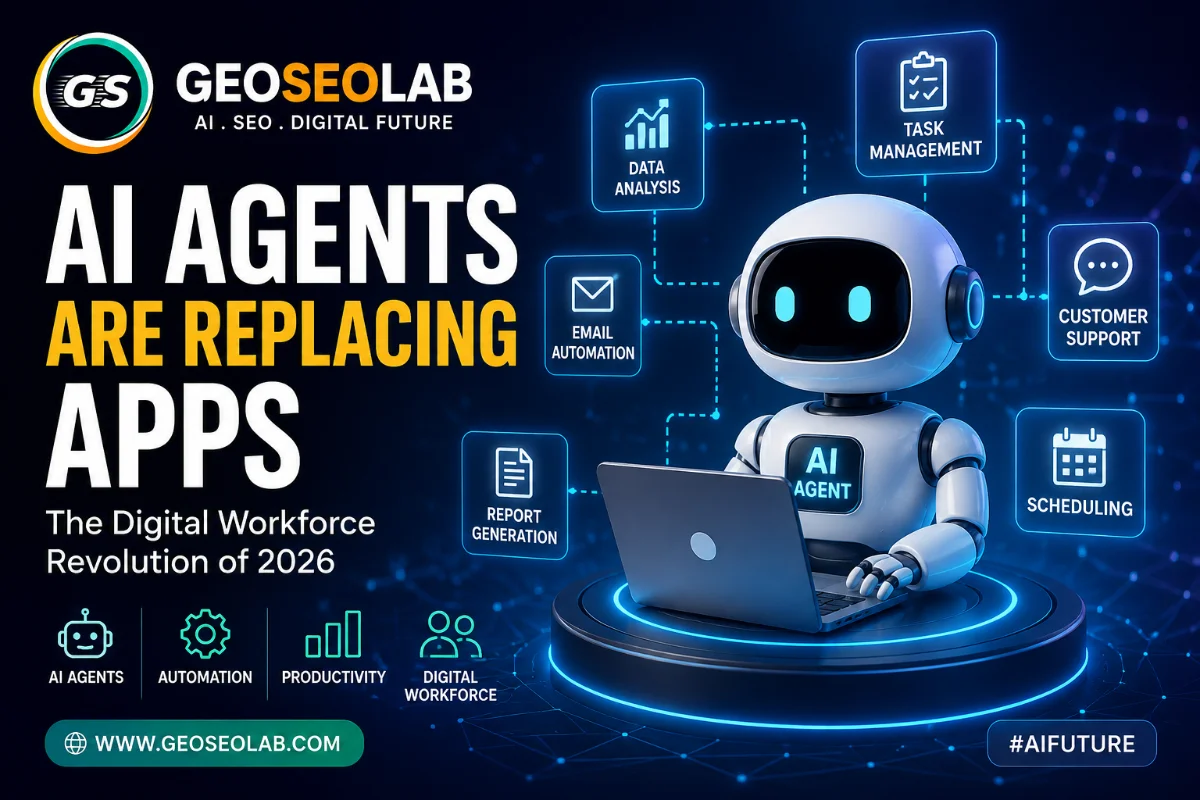
This model is beginning to change.
The next generation of AI Systems are AI Agents. Traditional software waits for instructions, but AI Agents understand goals, make autonomous decisions, and are able to Plan multiple steps Ahead to carry out a Complex task with little human input.Instead of using a travel app to book a flight, Compare hotels, and schedule ground transportation, people can now inform an AI Agent something like: "Book a three-day business trip to Singapore next month, and stay under the budget of $1,500."
The AI Agent can run the Entire workflow.
Search flights, Compare hotels, Analyze reviews, Check calendars, Optimize schedules, Book reservations, Generate travel documents.What once required multiple applications and significant human effort can increasingly be completed through a single conversational command.This shift is why industry leaders are calling 2026 the beginning of the Agentic AI era. And if experts are right, AI agents could become the largest technology transformation since the smartphone revolution.
What Is An AI Agent?
AI agents are systems that can work independently by understanding goals.They respond to prompts.AI agents are proactive. They work to achieve goals. This distinction is important.
Chatbots, for example, respond to queries.
AI agents perform actions.
As an example, a bot can advise on the steps to make a marketing campaign.
An AI Agent generates the content, creates the posts, and analyzes the results to improve the campaign and the posts in the future.
This is like the difference between hiring a consultant and hiring an employee.
One informs. The other does the work.
AI agents can do all of the following at once: Memory, Planning, Decision-Making, Tool Using and Manipulation, Advanced reasoning, Steps and Actions
Because of these features, AI agents are the first generation of digital workers, as opposed to digital assistants.
Why AI Agents Are Unlike ChatGPT-Style Chatbots
Most people were first introduced to AI as a form of conversational interface.They were a big deal because they could do things like answer questions, write emails, summarize text, and write code. They still required supervision and guidance at every step of the process.
AI agents, however, do not require supervision.As an example, imagine prompting a chatbot with the phrase “help me launch an online shop.That would likely produce an output with the suggested steps. Now, prompt an AI agent with the same phrase.
The AI agent can:
- Research products
- Analyze competitors
- Generate branding ideas
- Create website content
- Configure advertising campaigns
- Set up analytics
- Monitor sales performance
- Recommend improvements
This is a big step that suggests the shift in the computing landscape. From producing information to performing actions.
The Three Core Technologies Behind Agentic AI- There are three foundational technologies that have enabled Agentic AI.
1. Large Language Models- Large Language Models are the reasoning engine. At their core, these models interpret language, understand instructions, develop context, and respond. Without modern language technology, the class of AI agents would be nonexistent.
2. Tool Integration-AI agents can now communicate with external systems. They can now:
- Call any API
- Control Browsers
- Manipulate Spreadsheets
- Control Calendars
- Send Emails
Their capabilities allow them to step out of the conversation and into the real world.
3. Memory Systems- Traditional AI systems have a very short Memory. Slowly, AI agents have Memory. This can be translated to:
- Learning Preferences
- Goal Tracking
- Continuous Project Work
The Memory aids the system to evolve and grow its functionality. The Memory aids the transformation of AI from a temporary assistant to a persistent digital employee.
Why 2026 Is Being Called the Year of AI Agents?
There have been several notable changes that have prompted agentic AI to become more mainstream. Autonomous systems are attracting Billions of investment$. Researchers have abandoned the archaic view of chatbots and are prioritizing the advancement of agents.
Large enterprises are restructuring their systems around the AI Automations. This has all been caused by a single realization: Automating a work system means gaining an advantage over a competitor. Once AI agents have been implemented, organizations will experience a marked improvement in the optimization of all processes while reducing operational costs.The agent of the 2020's is being compared to the smartphone of 2007. The analogy can be made due to the fact that the technology is both ready and built to scale. The large majority of organizations have yet to comprehend the scale of the impending disruption.
The Industries Being Transformed First
AI agents will not be impactful for each and every industry.The Three Core Technologies Behind Agentic AI
There are three foundational technologies that have enabled Agentic AI.
1. Large Language Models- Large Language Models are the reasoning engine. At their core, these models interpret language, understand instructions, develop context, and respond. Without modern language technology, the class of AI agents would be nonexistent.
2. Tool Integration- AI agents can now communicate with external systems. They can now:
- Access any Database
- Call any API
- Control Browsers
- Manipulate Spreadsheets
- Control Calendars
- Send Emails
Their capabilities allow them to step out of the conversation and into the real world.
3. Memory Systems- Traditional AI systems have a very short Memory. Slowly, AI agents have Memory. This can be translated to: Learning Preferences, Goal Tracking, Continuous Project WorkThe Memory aids the system to evolve and grow its functionality. The Memory aids the transformation of AI from a temporary assistant to a persistent digital employee.
Why 2026 Is Being Called the Year of AI Agents ?
There have been several notable changes that have prompted agentic AI to become more mainstream.Autonomous systems are attracting Billions of investment$. Researchers have abandoned the archaic view of chatbots and are prioritizing the advancement of agents.
Large enterprises are restructuring their systems around the AI Automations.
This has all been caused by a single realization:- Automating a work system means gaining an advantage over a competitor.Once AI agents have been implemented, organizations will experience a marked improvement in the optimization of all processes while reducing operational costs.The agent of the 2020's is being compared to the smartphone of 2007. The analogy can be made due to the fact that the technology is both ready and built to scale. The large majority of organizations have yet to comprehend the scale of the impending disruption.
The Industries Being Transformed First - AI agents will not be impactful for each and every industry. Some sectors are already seeing stronger disruptions than others.
Software Development- Software development has, so far, been one of the stronger early adopters of AI. Today’s coding agents can:
- Write code
- Debug
- Review pull requests
- Document
- Test
- Optimize
Developers are less likely to write code and more likely to supervise.Overall productivity continues to grow. Digital teams are able to do work that previously required hundreds of employees.
Digital Marketing- Marketing teams are integrating AI agents rapidly.
Today’s AI agents can:
- Perform keyword searches
- Write content
- Manage Ads
- Analyze conversions
- Generate reports
SEO- With an AI agent, entire processes can be managed instead of hiring dozens of employees.
Customer Support
Autonomous Support Agents are changing customer support.
Today’s systems can:
- Close tickets
- Process refunds
- Update accounts
- Manage case escalations
- Keep the history of support cases
- Support becomes cheaper and faster.
Finance- AI agents are now in Finance for:
- Risk assessment
- Fraud
- Investments
- Compliance
- Customers
AI’s ability to analyze complex and large datasets in real time is a game changer.
The Digital Workforce
For decades, companies scaled by hiring employees.The potential future of companies is scaling by using AI. This is most commonly called the digital workforce.A digital workforce is a collection of autonomous agents that conduct business activities for a company.
- Research agent
- Marketing agent
- Sales agent
- Support agent
- Finance agent
- Recruitment agent
- Operations agent
Unlike traditional employees, AI agents can work continuously. Across multiple time zones. Without fatigue. Without scheduling conflicts. Without onboarding delays.This does not necessarily mean humans disappear.Instead, organizations may evolve toward smaller human teams supported by large numbers of AI workers.The resulting productivity gains could be extraordinary.Could Apps Become Obsolete Because of AI Agents?With Agentic AI, the most provocative assertion is that apps may lose their relevance.Currently, users work with software directly. In the future, users may primarily work with agents.Rather than opening ten different apps, people may just state objectives.The agent will do the rest.This approach is referred to as the change from software interface to outcome interface.With the new approach to interacting with agents, people no longer will interact directly with software.Software will adapt to the people.The results of this paradigm will be disruptive.Many will need to rethink the industries dependent on application design.In the next ten years, the most successful companies may not have the best apps.They may have the most advanced agents.The Potential Effect on the Economy is UncertainSome economists have started to view AI agents as a productivity enhancing technology the same as the introduction of the electricity, computing, or the internet.When considering the history of technology, the introduction of productivity enhancing technology has a strong correlation with economic growth.AI agents will give knowledge workers a lower cost of labor.This has the ability to affect:
- Law
- Accounting
- Marketing
- Research
- Administration
- Customer service
Software development- AI agents will give organizations a competitive advantage from efficiency that will be difficult to compete against. As in the past, the introduction of new technology will require people to rethink the skills needed for the workforce. The introduction of AI agents implies that those that adapt and learn the skills the fastest will be the most successful. AI Agents, Transforming Industries, Future Outlooks, SEO Techniques, and Guides
OpenAI's Plan: Moving from AI Assistant to AI WorkerOpenAI has generated a lot of interest in developing generative AI with conversational interfaces, but OpenAI has a lot more in mind.The next step in developing AI will be systems that perform tasks on their own rather than just responding to prompts. Consider a startup founder who needs research on a target market, an analysis of the competition, financial forecasts, outreach emails, and a presentation.
Currently, there are multiple different applications and this could take several hours of work.
In an agent-based system, this would be achieved with one instruction.AI agents will be capable of conducting research, collecting information, making spreadsheets, and drafting presentations and summaries.The human will be the one to make the decisions.The system will act as the layer that performs the tasks.This will be one of the most significant changes in the way people are able to perform digital work.
Google's Agentic Future- The way Google is approaching this is by embedding AI agents into the day to day tasks of its users. In a traditional search system, one would look up information.
In an agentic system, one would look up information and also receive the outcome.
An example would be that instead of searching for "best laptops under $1000", a future AI agent would carry out the entire purchasing process for the user.
In this scenario, the user sets the parameters.The agent performs the task.Google has been aiming for systems that work more along the lines of understanding agents rather than keyword search tools. This would change the way users work with the internet. The future will favor the person or company able to take productive actions on the internet rather than the one who can source the information the fastest.
NVIDIA and the Physical AI Revolution- Ai discussions typically focus on software.
However, there exists a need for AI in the physical world.NVIDIA plays an important part here.
Picture systems that can do the following:
- Manage inventory
- Maintain equipment
- Assemble products
- Optimize warehouses
- Conduct industrial inspections
The combination of AI and robotics will usher in the intelligent automation age.For many experts, the level of this passive AI and robotics integration will equal the industrial revolution in its importance and scope. Anthropic and the Safety Challenge
As AI agents gain autonomy, safety becomes a concern.Conventional software executes fixed commands.AI agents make decisions.Autonomy increases the safety risks.Safety researchers tackle the following questions:
How do we ensure agents follow human instructions?
How do we prevent harmful actions?
How do we decide on the right level of autonomy for AI?
The future of Agentic AI will rely on the system's capability and the system's trust.
Safety concerns lead to lack of adoption.
The opposite is true when safety is not a concern.
AI Agents in Healthcare:- Agentic AI is likely to have the greatest effect in the healthcare field. Healthcare systems are burdened with excessive administration. To illustrate this, consider the time-consuming tasks of a doctor:
- Documentation
- Scheduling
- Records management
- Compliance tasks
AI agents will help relieve this burden with applications that include:
Patient Scheduling- Agents handle all coordination of appointments, follow-ups, reminders, and scheduling of resources.
Medical Documentation- AI systems create clinical notes and summaries.
Diagnostic Support- Agents help physicians by studying medical data and recognizing relevant patterns.Treatment Planning- AI systems help synthesize treatment pathways and manage their progress.Healthcare professionals always retain accountability for their decisions.
Agents only simplify administrative tasks.This combination has the potential to create greater overall efficiency and provide clinicians the opportunity to concentrate more on patient interaction.
AI Agents in Education- Education is going through a colossal transformation.Traditional learning environments have a difficult time creating learning experiences that are individualized.
Personalized learning is the main strength of AI agents.Learning agents of the future may:
Keep performance records for each student. Determine student knowledge gaps
Formulate individualized learning plans. Develop study questions. Offer tutoring. Continuously track progress. Every individual student may access a learning assistant that is personalized.
This technology has major positive effect potential for both access and educational attainment.
Instruction no longer has to be the same for every individual.Learning becomes a system that helps the student, rather then the student needing to learn to adjust to the system.
AI Agents in Finance- Information processing is the mainstay of the financial industry, making it the most convenient area for AI agents. Public services give rise to prolonged and frustrating experiences for citizens involving excessive forms and tedious, inefficient, and multi-layered administrative and bureaucratic bottlenecks.
Modernization with the aid of AI agents can be applied to:
- Citizen Services
- Tax Services
- Licensing
- Benefits
- Document Processing
- Public Information Systems
Intelligent automation can help governments achieve greater efficiency and lower costs. Privatization, however, can increase the risk of surveillance.
Intelligent Automation
The next decade may realize entirely new economic categories like the application economy, creating millions of new jobs with multi-billion dollar industries.Considering the new categories that were created like the application economy, the potential new industries include the
Development of Agents
- Agent Training
- Agent Marketplaces
- Agent Infrastructure
- Agent Consulting
Many of the highest paying jobs of the next decade do not exist today.
The Future of Labor - Human and AI
Replacing all jobs with AI agents is the common myth.
History has shown that the outcome is more complex.
Technological revolutions lead to the displacement of tasks within professions.
The best example for this is that the creation of spreadsheets, search engines and email did not eliminate the need for accountants, researchers and communication respectively.
The substitution of tasks within professions is how technology has changed the workplace.
The same will be true for AI agents.Productivity will increase significantly for all workers who learn to manage, oversee, and collaborate with AI agents.
Executives will comprise the Human Component.- AI will be employed to perform repetitive tasks. The most successful will be the employed professionals. might be the people who can comprehend the talents of both human beings and AI.
Close to the Future- With advancements in AI, specific capabilities will likely become crucial.
Critical Thinking- People evaluate results and conclusions and choose strategies.
Creativity- Original ideas remain difficult to automate.
Communication- Collaborating with AI needs communication.
Leadership- People create vision, direction, and accountability.
Problem Solving- Judgment of the real world is critical to the solution of the problem.
The future belongs to people who learn to work with AI, not to people who work against it.
Risks and Challenges- Every significant advancement in technology causes some risk.
AI agents will be no different.
Security Risks- If agents are compromised, the damage could be significant.
Privacy Concerns- To work autonomously, systems have to operate and access private data.
Bias- Flawed systems will create unfair results.
Accountability- AI actions will create issues with determining responsibility.
Over-Reliance- Automation should not be used excessively.
AI will need the close work of technology, research, and of the government and private sector to accomplish its goals. AI Agents and the Road to 2030
In 2030, AI agents are likely to be as ubiquitous as cell phones, personal AI will be controllable in the form of individual agent teams; businesses will employ thousands of different digital workers; governments will automate most of their functions; the public education system will be tailored to individual needs; health care will be proactive and predictable; financial services will be advanced; and most transactions will be instantaneous and automated.
The most significant competitive gains will be seen by the earliest adapting organizations with the greatest negative impact on delaying adaptors. The following five years will determine who the leaders of the Agentic economy will be.
Conclusion: A New Dawn for Digital Technology AI agents aren’t just another software development. They will alter how people will use technology. Historically, software forced people to adopt and accommodate to its machine. AI agents, however, adopt you.Menus are replaced by goals. Interfaces are replaced by outcomes. Instruction is replaced by execution. If this transformation occurs rapidly or gradually, one truth is for certain. The future of computing isn’t software. The future of computing isn’t hardware. The future of computing is autonomous intelligence. Those professionals, organizations and governments that will comprehend this phenomenon sooner are the ones that will better accommodate to that future. Now we can truly say the age of AI agents has begun. The ensuing impact around the world may come close to, or even exceed what the technology industry has experienced at the advent of the internet.
Geo SEO Lab — Built for the AI Search Era.
Don’t just rank on Google. Get discovered by AI search engines too.
Start optimizing for the future of search today → geoseolab.com
Tags
About the Author

Aman Kesharwani
SEO Expert & Content Creator
Experienced digital marketing professional specializing in SEO strategies, content optimization, and data-driven marketing solutions. Passionate about helping businesses grow their online presence and achieve better search rankings.
Related Articles
View all posts
How to Turn FAQ Content Into GEO Content
How to Turn FAQ Content Into GEO ContentThink about the last time you searched for a complex product or a nuanced troubleshooting step. Did you type a...
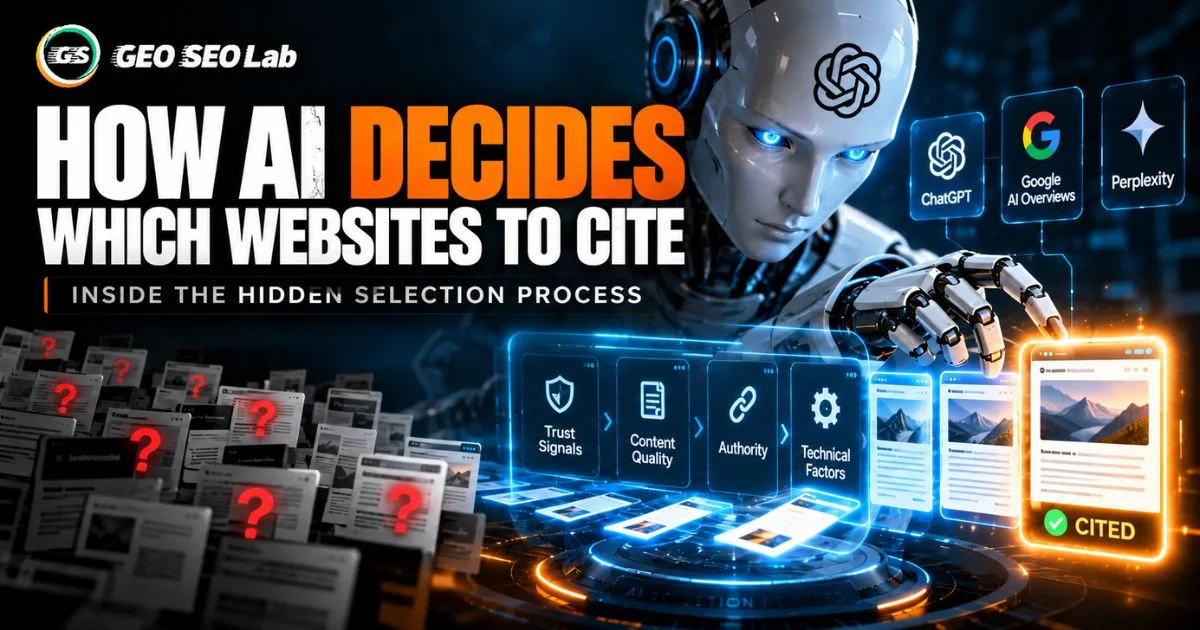
How AI Decides Which Websites to Cite: Inside the Hidden Selection Process
Introduction: The New Gatekeepers of VisibilityPicture this. Someone types a question into ChatGPT, Perplexity, or Google's AI Overview box. Within se...
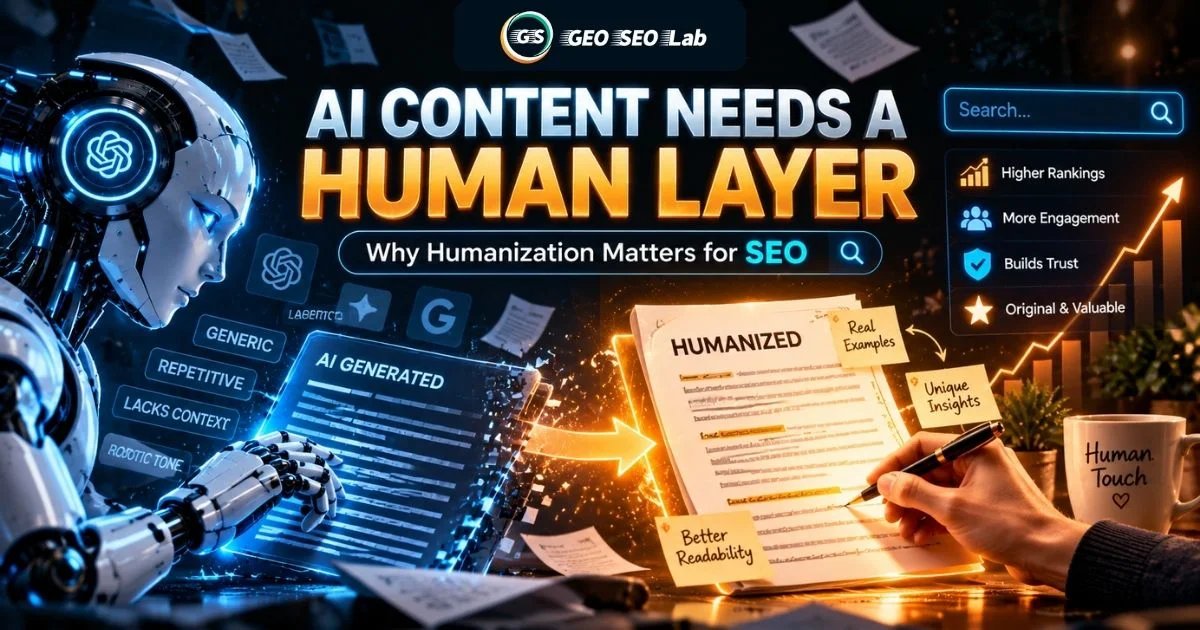
Why Does AI-Generated Content Need Humanization for SEO?
Why Does AI-Generated Content Need Humanization for SEO?The Real Reason Raw AI Drafts Underperform, and What Actually Fixes ItA GEO SEO Lab ReportEdit...