Why Your Google Business Profile Gets Views but Not Calls
Why Your Google Business Profile Gets Views but Not CallsPublication: GEO SEO LabCategory: Local SEO / Conversion Strategy / Google Business ProfileRe...
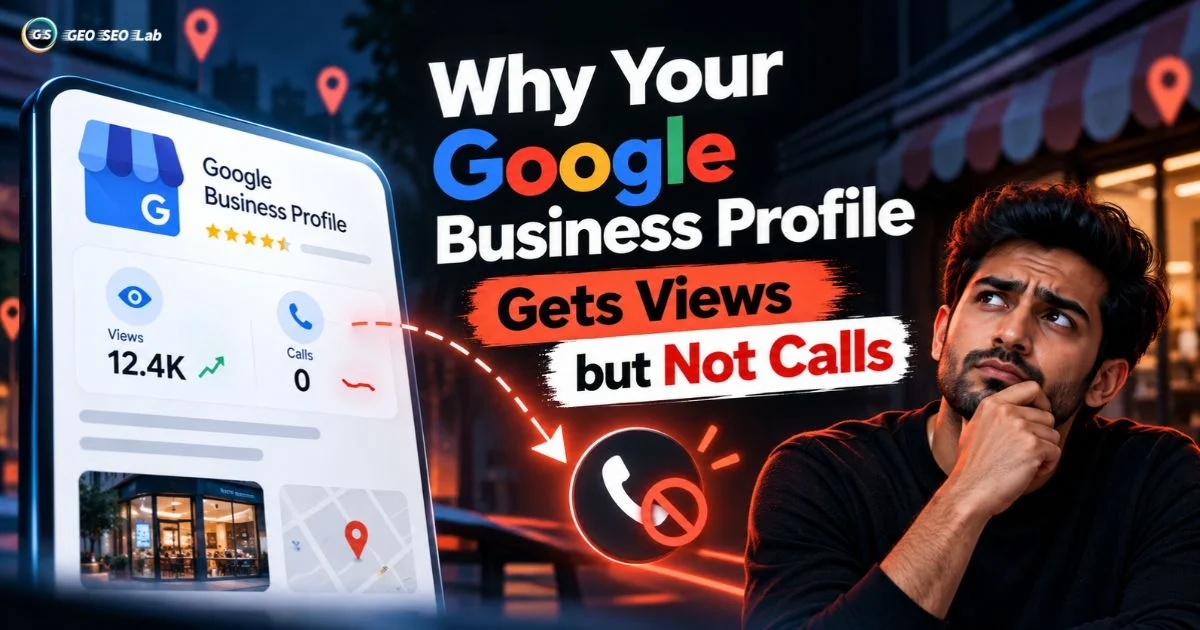
Introduction: The Most Confusing Number in Local SEO
There is a specific kind of frustration that only local business owners and local SEO practitioners really understand. You open the Google Business Profile dashboard, check the insights tab, and see the number that should feel like a win: hundreds of views this month, maybe even a healthy chunk of growth compared to last month. Your profile is showing up. People are finding it. The visibility part of local SEO, the part everyone spends so much time obsessing over, is clearly working.
And then you scroll down to see how many of those views turned into phone calls, and the number is embarrassingly small. Sometimes it is barely into double digits. Sometimes it is close to zero.
This is one of the most common and most misunderstood problems in local search, and it trips up business owners and even experienced marketers because the obvious explanation, "we just need more visibility," is usually wrong. If you are already getting meaningful views, visibility is not your bottleneck anymore. Something else is happening between the moment someone sees your profile and the moment they decide whether or not to pick up the phone, and that something else is almost always fixable once you know where to actually look.
Most local SEO content stops at the checklist stage: claim your profile, fill out every field, post regularly, collect reviews, done. That advice is not wrong, but it answers a different question than the one you are actually asking. You have probably already done most of that. Your profile is reasonably complete. You are getting views. And you still are not getting calls. The checklist has already done its job of getting you seen. What it has not done is explain why being seen is not translating into being chosen.
This article goes deeper than the checklist. We are going to walk through a genuine diagnostic process, examining relevance signals, service coverage accuracy, review quality beyond just star ratings, the specific business information details that quietly kill trust, the landing page experience waiting behind your profile link, and the subtle conversion friction points that stop someone who was genuinely interested in calling you from actually doing it.
If your Google Business Profile has traffic but not conversions, this is the troubleshooting guide built specifically for that problem.
Understanding the Gap Between Views and Calls
Before diagnosing the specific causes, it helps to understand what is actually happening at each stage of the customer journey represented by your Business Profile insights data, because the gap between views and calls is not one single problem. It is usually a combination of several smaller gaps stacked on top of each other.
Google Business Profile insights typically break visibility into a few distinct metrics: how many times your profile appeared in search results or on Maps, how many of those appearances led to someone actually viewing your full profile details, and then separately, how many of those profile views led to a specific action, like requesting directions, visiting your website, or placing a call.
A healthy funnel shows a reasonable conversion rate at each stage. A broken funnel shows a sharp drop-off at one specific stage, and identifying exactly where that drop-off happens tells you a tremendous amount about what to fix. If your profile is appearing frequently in search results but people rarely click through to view full details, the problem is likely with how your profile presents itself in the condensed search snippet, meaning your business name, primary photo, category, and star rating are not compelling enough to earn the click. If people are viewing your full profile details but not taking any action afterward, the problem shifts to what they find once they are actually looking closely: your photos, your reviews, your service descriptions, and your overall presentation of trustworthiness and relevance.
This distinction matters enormously for diagnosis. Too many business owners treat "not enough calls" as a single problem with a single fix, usually assumed to be "get more reviews" or "post more often." In reality, the specific stage where your funnel is leaking tells you whether the fix is about relevance, trust, information clarity, or something happening entirely outside the Business Profile itself, like a weak landing page or a confusing phone experience once someone does call.
The diagnostic process that follows is designed to walk through each potential leak point systematically, rather than jumping straight to generic advice that may not address your specific situation.
Diagnostic Area One: Relevance Mismatch
The first and often most overlooked cause of views without calls is relevance mismatch, meaning your profile is technically showing up for searches, but it is not showing up for the right searches, or it is showing up for the right searches but failing to clearly signal that you are actually the right fit for what the searcher needs.
Google's local ranking algorithm, according to Google's own published documentation, weighs three primary factors when determining which businesses to show for a given local search: relevance, distance, and prominence. Relevance refers to how well a business profile matches what someone is actually searching for. This sounds straightforward, but it is where a surprising number of profiles quietly fail, often because the business category selection, the business description, and the services listed on the profile do not precisely match the language and intent of the searches bringing in traffic.
Here is a concrete example of how this plays out. A general contractor who primarily does kitchen and bathroom remodels, but who selected "General Contractor" as their primary Google Business Profile category rather than something more specific like "Kitchen Remodeler" or "Bathroom Remodeler," may show up for broad searches like "contractor near me" while failing to show up prominently for the more specific, higher-intent searches like "bathroom remodel contractor near me" that are far more likely to convert into an actual call, because the person searching that specific phrase already knows what they need and is actively trying to find someone who does exactly that.
Worse, even when that same general contractor does show up for the specific search, if a searcher clicks through and sees a profile that describes the business in broad, generic contracting language without any specific mention of bathroom or kitchen remodeling, the searcher may conclude, correctly or not, that this is not a specialist in the specific work they need done, and move on to a competitor whose profile and category more precisely mirror their search.
This is the essence of relevance mismatch: showing up in search results due to broad category matching, while failing to convert because the profile does not clearly and specifically speak to the exact need that brought the searcher there in the first place.
Diagnosing relevance mismatch starts by reviewing the actual search queries driving your profile views, which Google Business Profile insights makes available, at least at a general level, through its performance data. Compare these queries against your selected business categories, your business description, and the specific services listed on your profile. Look specifically for a gap between the specific, high-intent language people are actually using to search and the more generic language your profile uses to describe itself.
The fix here involves two parts. First, review your primary and secondary category selections in your Business Profile settings, ensuring your primary category reflects your single most important specialty or service line, with secondary categories capturing other genuine service areas, rather than defaulting to the broadest possible category out of uncertainty about which is most accurate. Second, rewrite your business description and services section using the specific, high-intent language your actual customers use when searching, rather than generic industry language, ensuring that anyone landing on your profile immediately recognizes that you specifically do the thing they specifically need.
Diagnostic Area Two: Service Coverage Accuracy
Closely related to relevance mismatch, but distinct enough to deserve its own diagnostic focus, is service coverage accuracy, meaning whether your profile accurately and completely represents the full range of services you actually offer, and whether your service area settings genuinely reflect where you are willing and able to work.
A huge number of Business Profiles significantly undersell what the business actually does. This happens most often with service-based businesses that started with a narrow focus and have since expanded, but never went back to update their Business Profile's services section to reflect that growth. A plumbing company that started out focused primarily on emergency repairs but has since built out a full remodeling and installation division may still have a Business Profile that only lists emergency repair services, which means potential customers searching for installation or remodeling services never see this business as a relevant option, even though it is fully capable of doing that work.
The services section of your Google Business Profile is not a cosmetic detail. It is a direct input into Google's relevance matching algorithm, and an incomplete services list directly limits the range of searches your profile can appear relevantly for, regardless of how good your actual service delivery is once someone does call.
Service area accuracy deserves equal scrutiny, particularly for businesses that travel to customers rather than operating from a single fixed storefront location that customers visit. If your service area settings in Google Business Profile are set too narrowly, you may be invisible to searches happening just outside that boundary, even in neighborhoods you would happily serve. If your service area settings are set too broadly, spanning a radius far larger than you can realistically and promptly serve, you may be appearing in searches you cannot actually fulfill well, leading to calls that convert poorly once the caller learns the actual response time or travel fee involved, which shows up not as a views-to-calls problem but as a calls-to-customers problem further down the funnel.
Diagnosing service coverage accuracy requires a straightforward audit: list every genuine service your business currently offers, then compare that list against what is actually documented in your Business Profile's services section. Any gap represents search visibility you are currently leaving on the table. Separately, review your service area radius or specific service area list against your actual operational capacity, adjusting to reflect where you can genuinely deliver a good customer experience within a reasonable timeframe, rather than either artificially limiting your reach or overextending into areas where service quality or response time suffers.
Diagnostic Area Three: Review Quality Beyond the Star Rating
Most advice about Google reviews stops at a shallow level: get more reviews, respond to reviews, aim for a high average star rating. This advice is not wrong, but it misses a critical nuance that directly affects the views-to-calls conversion gap: the actual content and specificity of your reviews matters as much as, and sometimes more than, your overall star rating.
Here is why this matters. When someone is deciding whether to call your business versus a competitor, both showing similarly strong overall star ratings, they are very often reading the actual text of several reviews to break the tie. A profile with a 4.8 star rating built from dozens of reviews that say some version of "great service, highly recommend" provides very little actual decision-making information to a prospective customer. A profile with a 4.6 star rating built from reviews that mention specific details, like the name of the technician who did the work, the specific problem that was solved, how quickly the business responded to an urgent situation, or a specific positive detail about communication and professionalism, provides genuinely persuasive, specific evidence that helps a hesitant searcher feel confident enough to actually pick up the phone.
This is the Trust Signal Gap, a concept worth understanding clearly: the gap between having a technically strong star rating and having reviews that actually function as persuasive evidence for a specific, hesitant decision-maker weighing whether to call you versus a competitor. Many businesses have closed the star rating gap through review generation campaigns, but have not closed the trust signal gap, because generic five-star reviews without specific detail do not do the persuasive work that a genuinely compelling review does.
Diagnosing your review quality requires actually reading through your recent reviews, not just checking your average rating, and asking honestly whether they would persuade you, as a prospective customer with no prior relationship to the business, to choose this business over an equally well-rated competitor. Look specifically for whether reviews mention specific services, specific outcomes, specific staff members by name, specific details about responsiveness or communication, and specific resolution of any concerns or problems that came up during the service experience.
If your reviews are generally short, generic, and lacking specific detail, the fix is not simply generating more reviews using the same request process that produced the generic reviews you already have. The fix is changing how you ask for reviews in the first place, prompting customers with specific questions rather than a generic request. Instead of simply asking "could you leave us a review," a more effective approach involves asking customers to mention what specific problem you solved for them, how the experience compared to their expectations, or what specifically stood out about working with your team. This small shift in how the request is framed tends to produce meaningfully more detailed, more specific, and more persuasive reviews over time.
Review response strategy also plays into trust signal strength, though it is often undervalued. A business that responds thoughtfully and specifically to both positive and negative reviews signals active, attentive management to anyone reading through the review section, which itself functions as a trust signal independent of the review content alone. Generic, copy-pasted responses, or no responses at all, particularly to negative reviews, can undermine trust even when the overall rating remains strong, because prospective customers reading closely can often tell the difference between genuine engagement and a perfunctory, automated-sounding reply.
Diagnostic Area Four: Business Information Gaps That Quietly Kill Trust
Beyond reviews, there is a category of smaller, easily overlooked business information details that individually seem minor but collectively create meaningful friction and doubt for a prospective customer deciding whether to call.
Inconsistent or incomplete business hours are a surprisingly common culprit. If your Business Profile lists hours that do not match reality, whether because they were never updated after a schedule change, or because holiday hours were never specified and the profile shows standard hours during a period when you are actually closed, prospective customers who check your hours before calling, which a meaningful percentage of searchers do specifically to confirm you are currently open, may simply decide not to call at all if the information seems unreliable or if they believe you are closed when you might actually be open.
Missing or outdated photos represent a significant and often underestimated trust gap. A profile with few photos, outdated photos, or photos that do not clearly represent the actual current state of the business, its team, its work, or its location, creates an impression of neglect or inactivity, even if the business itself is thriving. Prospective customers use photos as a proxy for legitimacy and currency, essentially asking themselves, consciously or not, whether this business feels like an active, well-run, trustworthy operation, and a thin or stale photo library answers that question poorly regardless of how good the actual service quality is.
Inconsistent business information across the web, often referred to as NAP consistency, meaning consistency of your business Name, Address, and Phone number across your Google Business Profile, your website, and other directories, can create genuine confusion and erode trust for customers who cross-reference information before calling, as well as creating confusion for Google's own systems when assessing your business's legitimacy and prominence.
Missing attributes, the specific tags Google allows businesses to add indicating things like whether you offer free estimates, whether you accept specific payment methods, whether your location is wheelchair accessible, or whether you offer services like online booking, represent small but genuine pieces of decision-relevant information that, when missing, leave prospective customers uncertain about details that might otherwise have tipped them toward calling rather than continuing to search.
A thorough review of your Business Profile's basic information, checked specifically against current reality and against what a prospective customer would actually want to know before deciding to call, often surfaces several of these gaps that are individually minor but collectively meaningful in their cumulative effect on conversion.
Diagnostic Area Five: The Landing Page Problem
Here is something that gets genuinely underdiscussed in local SEO advice: a meaningful percentage of your views-to-calls gap might not actually be happening inside your Google Business Profile at all. It might be happening on your website, specifically on whatever page your Business Profile's website link directs to.
When a prospective customer clicks through from your Business Profile to your website before deciding whether to call, which is a common behavior for anyone doing slightly more research before committing to a call, the landing page they arrive at plays a direct role in whether they follow through with that call or abandon the process entirely.
A common and costly mistake is linking your Business Profile to your homepage rather than to a landing page specifically relevant to the search that brought the person there in the first place. If someone searched specifically for "emergency plumber" and clicked through to your profile, then clicked through again to your website, arriving at a generic homepage that requires further navigation to find anything about emergency services, pricing, or response times, you have introduced friction at exactly the moment the prospective customer was closest to converting.
Slow-loading websites create a similar problem. Mobile search, which represents the overwhelming majority of local business searches, is particularly unforgiving of slow page load times. A prospective customer who clicked through with genuine interest, only to wait several seconds for a page to load on a mobile connection, may simply close the page and either call a different business or abandon the search entirely, especially for urgent or time-sensitive needs.
Missing or buried calls to action on the landing page represent another common conversion leak. If a prospective customer arrives at your website genuinely interested but cannot quickly and obviously find your phone number, a clear way to request a quote, or clear information confirming you serve their need and location, the friction of searching for that information, particularly on a small mobile screen, causes a meaningful percentage of otherwise interested prospects to simply give up.
Diagnosing your landing page's role in the conversion gap requires actually clicking through your own Business Profile's website link on a mobile device, simulating the actual experience a prospective customer would have, and honestly assessing how quickly the page loads, how clearly it confirms relevance to a specific search intent, and how obvious and frictionless the path to calling or contacting you actually is. If your Business Profile is currently linking to a generic homepage, consider creating or designating a more specific, highly relevant landing page for your most important service categories, directly addressing the specific need that brings searchers to your profile in the first place.
Diagnostic Area Six: Conversion Friction in the Final Decision Moment
The final diagnostic area addresses what we call conversion friction: the small, specific obstacles that exist in the final moment when a genuinely interested prospective customer is deciding whether to actually complete the action of calling.
One of the most common sources of friction is uncertainty about pricing or cost expectations. Local service searches, particularly for home services, repairs, and similar categories, frequently come from prospective customers who are at least somewhat price-sensitive and anxious about an unknown, potentially large expense. A Business Profile and corresponding landing page that provide absolutely no pricing context, not even a general range or a clear statement about free estimates, can create enough uncertainty and anxiety that a prospective customer decides to continue comparing options rather than committing to a call that might reveal an unaffordable price.
Response time uncertainty creates similar friction, particularly for urgent service categories. A prospective customer searching for an emergency service wants some confidence that calling will result in a prompt response, and a profile or landing page that provides no information about response time, availability, or urgency handling leaves this uncertainty unresolved at exactly the moment it matters most.
The specific phone number experience itself deserves scrutiny, an often-overlooked piece of the conversion puzzle. If the phone number displayed on your Business Profile goes to a generic answering system, an unanswered line during business hours, or creates any friction before reaching an actual person, the conversion failure may be happening not before the call, but immediately after someone has already decided to call, when a bad initial phone experience causes them to hang up before truly connecting, which then shows up in your data as a low call volume relative to views, even though the actual issue is post-dial call handling rather than pre-dial decision-making.
Time-of-day and day-of-week patterns in your views-to-calls gap are worth specifically examining, since a mismatch between when people are viewing your profile and when your business is actually staffed to answer calls can create a significant and easily overlooked friction point. If a meaningful share of your profile views happen during evenings or weekends, but your phone line is unmonitored or unanswered during those windows, prospective customers may be calling, getting no answer, and simply moving on to a competitor, an outcome that would not necessarily even register clearly in your Business Profile insights data, since the call itself may have technically been attempted even though it did not result in a connection or a logged lead.
Diagnosing conversion friction requires closely examining whether pricing transparency, response time communication, and actual phone answering reliability are creating silent barriers between a genuinely interested prospective customer and an actual completed call, since these frictions often do not show up clearly in standard Business Profile metrics and require a more deliberate, honest internal audit to surface.
Putting It Together: The Conversion Friction Diagnostic Model
To make this entire diagnostic process actionable rather than overwhelming, we use what we call the Conversion Friction Diagnostic Model at GEO SEO Lab, a structured sequence for working through each of the six diagnostic areas covered in this article in a logical order, starting with the broadest potential causes and narrowing toward the most specific.
Begin with relevance, confirming your category selection, business description, and listed services accurately and specifically reflect what you do and the specific language your actual customers use when searching. Move to service coverage, confirming your full range of services and your realistic service area are completely and accurately represented. Proceed to review quality, auditing not just your star rating but the actual persuasive specificity of your review content and the thoughtfulness of your review responses. Check business information completeness, confirming hours, photos, and NAP consistency across the web are all current and accurate. Examine your landing page experience, confirming that wherever your Business Profile sends traffic genuinely continues the relevance and urgency that brought the searcher there in the first place, with fast load times and clear calls to action. Finally, examine conversion friction specifically at the decision moment, addressing pricing transparency, response time communication, and the actual reliability of your phone answering process.
Working through these six areas in sequence, rather than jumping straight to the area that seems most obviously relevant, often surfaces compounding issues that would be missed by addressing only one area in isolation. A business might have excellent reviews but a relevance mismatch in its category selection, or an excellent landing page but a genuine gap in after-hours phone coverage that is quietly costing calls that will never show up clearly in standard analytics.
Key Takeaways
A gap between Google Business Profile views and actual phone calls almost never has a single cause, and treating it as one problem with one fix, like simply collecting more reviews, often fails to address the real underlying issue.
Relevance mismatch, where your profile shows up in search but does not clearly and specifically match what the searcher is actually looking for, is one of the most common and most overlooked causes of weak conversion, often rooted in overly broad category selection or generic business descriptions.
Service coverage accuracy matters directly for search visibility. Incomplete services listings and poorly calibrated service area settings limit which searches your profile appears relevantly for, regardless of your actual service quality.
Review quality is about more than star rating. Specific, detailed reviews that mention real outcomes, staff names, and concrete experiences function as persuasive evidence for hesitant prospective customers in a way that generic five-star reviews do not.
Small business information gaps, including inconsistent hours, outdated photos, and inconsistent NAP information across the web, individually seem minor but collectively create meaningful trust erosion.
The landing page your Business Profile links to plays a direct role in conversion. Slow load times, generic homepage destinations, and buried calls to action all introduce friction at the exact moment a prospective customer is closest to converting.
Conversion friction at the final decision moment, including pricing uncertainty, response time ambiguity, and unreliable phone answering, can silently suppress call volume in ways that do not show up clearly in standard Business Profile analytics.
A structured, sequential diagnostic process, moving from relevance through service coverage, review quality, business information, landing page experience, and final conversion friction, surfaces compounding issues more effectively than addressing any single area in isolation.
About GEO SEO Lab
GEO SEO Lab is an independent research and content publication focused on the practical realities of local search optimization, conversion strategy, and the gap between visibility and genuine business results. We go beyond surface-level checklists to diagnose the specific, often overlooked issues that prevent otherwise well-optimized local businesses from converting their search visibility into actual customer contact.
The Conversion Friction Diagnostic Model, the Trust Signal Gap Analysis, and the Local Relevance Scoring Framework described in this article are original frameworks developed by our team through direct, hands-on diagnostic work across local business profiles in multiple industries, rather than theoretical best practices disconnected from real conversion data.
We write for local business owners, local SEO consultants, and marketing professionals who have already done the basic optimization work and are now facing the harder, more nuanced question of why that work is not yet translating into the calls and customers it should be producing.
References and Sources
Google Business Profile Help. (2024). How Google Determines Local Search Ranking: Relevance, Distance, and Prominence. Google Business Profile Help Documentation.
Google Business Profile Help. (2024). Understanding Your Business Profile Performance Insights. Google Business Profile Help Documentation.
Google Business Profile Help. (2024). Choosing the Right Categories for Your Business Profile. Google Business Profile Help Documentation.
Google Business Profile Help. (2024). Adding and Managing Services on Your Business Profile. Google Business Profile Help Documentation.
Google Business Profile Help. (2024). Managing and Responding to Reviews on Your Business Profile. Google Business Profile Help Documentation.
Google Business Profile Help. (2024). Setting Service Areas for Businesses That Travel to Customers. Google Business Profile Help Documentation.
BrightLocal. (2024). Local Consumer Review Survey: How Reviews Influence Purchase Decisions. BrightLocal Research.
Moz. (2024). Local Search Ranking Factors Survey. Moz Research Blog.
Search Engine Land. (2024). How Page Speed Affects Local Business Conversion Rates. Search Engine Land Industry Analysis.
Think with Google. (2024). Mobile Search Behavior and Local Business Decision-Making. Think with Google Consumer Insights.
Search Engine Journal. (2024). NAP Consistency and Its Impact on Local SEO Rankings. Search Engine Journal.
Tags
Frequently Asked Questions
Find answers to common questions about this topic
About the Author

Anubhav
SEO Expert & Content Creator
Experienced digital marketing professional specializing in SEO strategies, content optimization, and data-driven marketing solutions. Passionate about helping businesses grow their online presence and achieve better search rankings.
Related Articles
View all posts
How to Audit 100 Blog Posts Without Losing Organic Traffic
Meta Title: How to Audit 100 Blog Posts Without Losing Organic Traffic: Full GuideMeta Description: A complete, practical process for auditing a large...

Google's AI Content Guidance: What Website Owners Need to Change Right Now
Google's AI Content Guidance: What Website Owners Need to Change Right NowPublication: GEO SEO LabCategory: SEO Strategy / Content Governance / Google...
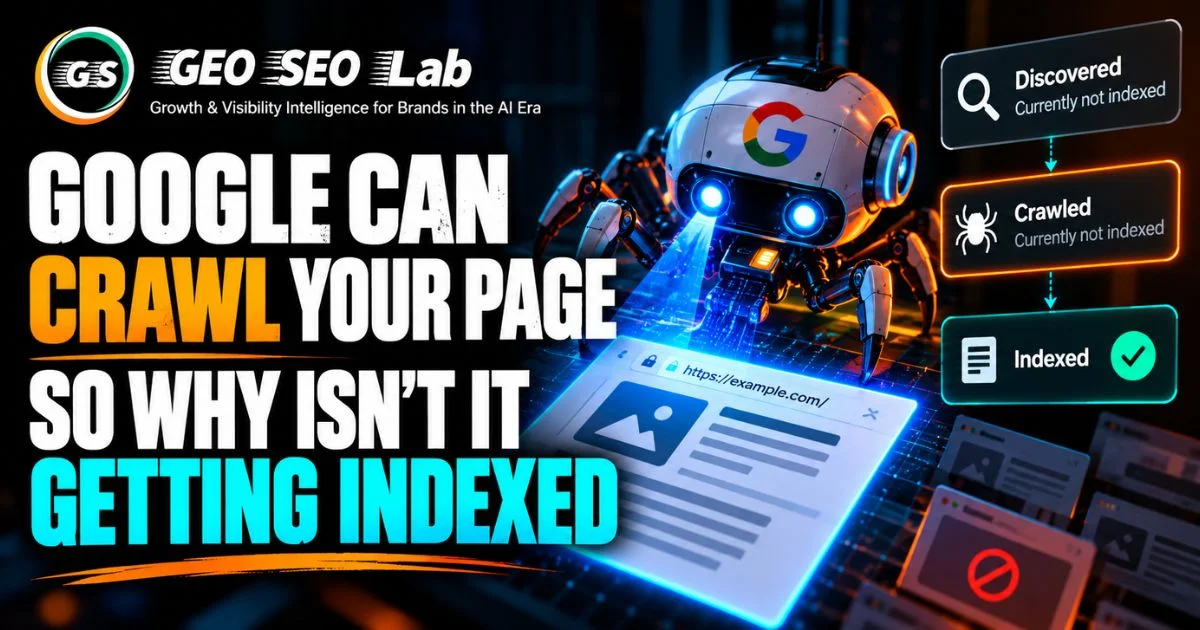
Google Can Crawl Your Page: So Why Isn't It Getting Indexed?
Google Can Crawl Your Page: So Why Isn't It Getting Indexed?Imagine pouring weeks of painstaking effort into a comprehensive, deeply researched articl...