Why PDFs May Become More Valuable Than Blogs
Nobody wakes up excited to write a PDF. Blogs get the attention, the editorial calendars, the content teams, the KPIs tied to publishing cadence. PDFs...
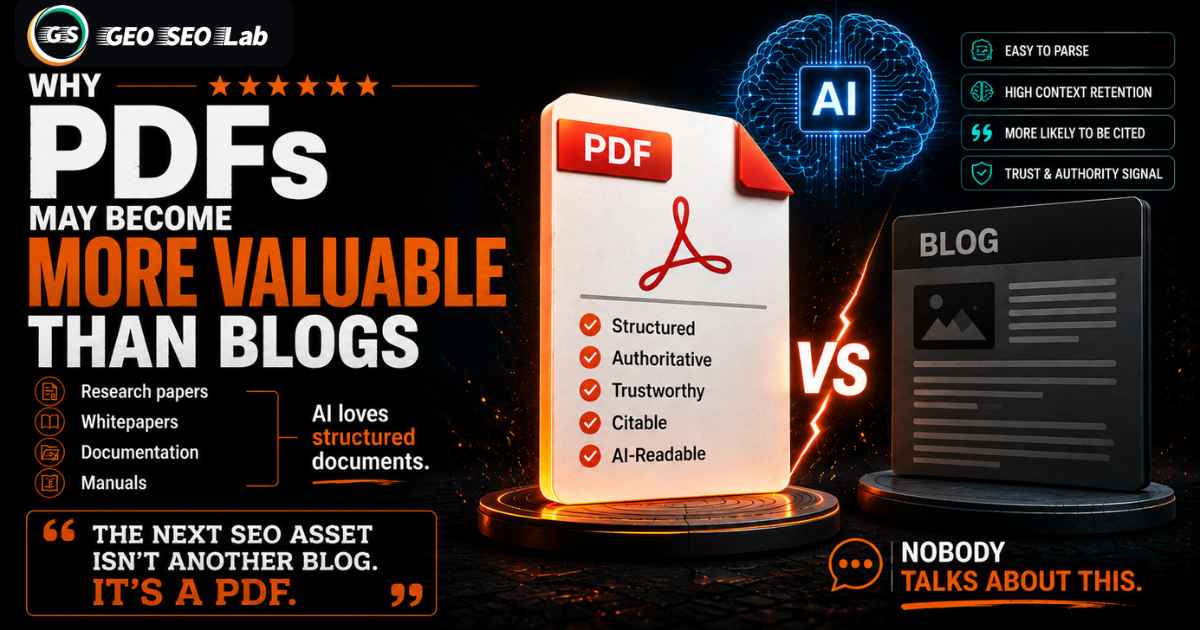
Nobody wakes up excited to write a PDF. Blogs get the attention, the editorial calendars, the content teams, the KPIs tied to publishing cadence. PDFs, when they get made at all, usually end up as an afterthought: a whitepaper cranked out for a lead-gen form, a product manual nobody proofreads twice, documentation treated as engineering's problem rather than marketing's opportunity.
That instinct made sense in a search world built entirely around HTML pages competing for rankings. It's starting to look a lot less sound in a world where AI systems are doing the reading, the summarizing, and the citing on a buyer's behalf.
Here's the uncomfortable part nobody's really saying out loud yet. A lot of what makes a blog post good at ranking on Google, fresh publish dates, internal linking, keyword density spread across a few thousand words, has almost nothing to do with what makes a document good at getting cited by an AI system constructing an answer. What AI retrieval systems actually reward looks a lot closer to what a research paper, a technical manual, or a well-built whitepaper already does naturally: dense, verifiable, structurally clean information that doesn't need persuading to be trusted, because the format itself signals rigor.
That's not a small distinction. It might be one of the more overlooked shifts happening in content strategy right now, precisely because it doesn't fit the existing playbook anyone's used to running. This report walks through why structured documents are earning outsized attention from AI systems, what's actually happening mechanically when an AI engine decides what to cite, where PDFs genuinely struggle and where that struggle gets overstated, and how a brand can start building documents that earn a place inside an AI-generated answer instead of sitting in a downloads folder nobody visits.
The Blog Glut Problem
Blogs aren't dying. Let's get that out of the way early, because it would be a lazy and inaccurate claim to make. What's happening instead is more specific: the sheer volume of blog content has reached a point where a huge share of it looks functionally identical to an AI system doing the work of deciding what's trustworthy enough to cite.
Think about what a typical company blog post looks like. An introduction that restates the obvious. A handful of subheadings covering roughly the same ground as every competitor's post on the same keyword. A closing call to action nudging the reader toward a demo. That structure was built to satisfy a search engine's appetite for fresh, keyword-relevant content and a reader's short attention span, not to provide the kind of dense, verifiable evidence an AI system is actually looking for when it needs to back up a claim.
Recent research into how generative engines actually select sources backs this up directly. A large-scale study analyzing citation behavior across ChatGPT, Google's AI Overview and Gemini, and Perplexity, covering more than 21,000 citations pulled from over 18,000 fetched pages, found that citation architecture operates on measurable, document-level properties, things like structural hierarchy, extractable evidence density, and how clearly a document resolves who or what it's actually about, rather than on keyword matching the way traditional search ranking historically worked. In plain terms: the AI isn't scanning for the right words. It's scanning for documents structured in a way that makes the information easy to lift out cleanly and trust once it's been lifted.
That's exactly where a lot of blog content quietly fails, even when it ranks perfectly well on Google. A post might be well-optimized for search intent and still be structurally shallow, light on verifiable specifics, heavy on restated general knowledge that doesn't actually add anything an AI system couldn't already infer on its own. Meanwhile, a research paper, a technical manual, or a properly built whitepaper tends to be dense with exactly the kind of extractable, specific, well-organized material these systems are hunting for by design, because that's what those formats have always demanded, long before anyone cared whether an AI would read them.
What Actually Happens When an AI Engine Picks a Source
It helps to understand, at least at a working level, what's actually happening mechanically when an AI system decides what to cite, because it explains a lot about why structured documents have an edge.
Nearly every grounded AI engine, meaning any system that pulls in outside information rather than relying purely on what it memorized during training, works on some version of the same underlying process: retrieval-augmented generation. The system breaks a query into smaller pieces, searches for candidate documents that seem relevant, chunks those documents into smaller sections, and scores each chunk for how useful and trustworthy it looks before deciding what to actually weave into its answer and cite.
That scoring step is where structure starts to matter enormously. Content that chunks cleanly into self-contained, well-labeled sections retrieves disproportionately better than content that reads as one long, undifferentiated stream of prose. A separate large-scale study, running 252,000 controlled trials comparing pairs of documents that differed by exactly one structural characteristic at a time, found that specific factors like readable content structure, organized sections versus dense paragraph blocks, comprehensiveness, and clear timestamps consistently swayed which of two otherwise similar sources got cited first. In other words, when an AI system has two roughly equivalent pieces of information to choose between, the one that's easier to mechanically pull apart and verify tends to win.
That's not a coincidence, and it's not really new either. It's the same logic that's always governed how well-designed technical documents get used by humans. A research paper with clear section headers, a defined methodology, and a results section separated from its discussion isn't built that way to please a search algorithm. It's built that way because that's how rigorous information has always needed to be organized to be trusted and reused. AI retrieval systems are, in a real sense, just formalizing a preference for that same rigor that good technical writing has always had.
There's a further layer worth understanding too. A separate audit specifically tracking citation architecture found that generative engines don't rank the full universe of possible sources the way a traditional search engine does. They retrieve a smaller set of candidates and then apply what amounts to a structural quality threshold, only pulling from sources that clear a bar for extractable evidence and clarity, and simply ignoring the rest regardless of how well those pages might otherwise rank. That threshold behavior helps explain why a page can rank respectably on Google and still never get cited in an AI answer. It didn't fail because it wasn't relevant. It failed because it wasn't structurally legible enough to clear the bar the AI system was actually applying.
Why PDFs Carry a Different Kind of Authority
None of this means every PDF automatically outperforms every blog post. That would be a lazy oversimplification. What it does mean is that certain document types, research papers, whitepapers, technical documentation, and manuals, tend to naturally embody the structural properties AI systems are already rewarding, simply because of what those formats have always required to function.
A research paper carries authority baked into its format before an AI system even reads a single sentence. It typically has an abstract that functions as a dense, self-contained summary, exactly the kind of standalone extractable chunk a retrieval system prefers. It has a defined methodology section that makes claims verifiable rather than asserted. It has citations of its own, creating a chain of sourcing that signals rigor rather than marketing polish. None of that structure exists to please an algorithm. It exists because peer review and academic convention have demanded it for decades. AI systems are simply the latest audience to reward that same discipline.
Whitepapers occupy a similar space, though with more variance in quality. A genuinely well-built whitepaper, one that presents original data, defines its terms clearly, and separates findings from interpretation, reads a lot like a lighter-weight research paper, and tends to earn similar structural trust. A weak whitepaper, one that's really just a rebranded sales brochure with a longer page count, doesn't get any special credit just because it's a PDF. The format alone isn't the advantage. What the format tends to encourage, when it's built properly, is the advantage.
Documentation and manuals might be the most underappreciated category of all here, precisely because almost nobody thinks of them as marketing assets. But documentation is, by necessity, fact-dense, specific, and free of persuasive language, exactly the traits that make a document easy for a retrieval system to trust and extract from confidently. A manual answering "how do I configure this integration" isn't trying to convince anyone of anything. It's just stating what's true, in order, with enough specificity that a reader, human or machine, can act on it directly. That lack of persuasive framing, which would have been a liability in a world built around click-through rate and conversion copywriting, turns into a genuine asset in a world where an AI system is trying to separate reliable fact from marketing spin.
The Parsing Problem Nobody Mentions
It would be dishonest to stop here without addressing the real complication in this story, because the picture isn't as simple as "PDFs are automatically AI-friendly." In some important ways, they're actually harder for machines to read than a clean webpage, and that tension deserves a fair hearing rather than getting glossed over.
The core issue is that PDFs were designed for print, not for machines. A PDF stores content as positioned glyphs sitting on a fixed visual canvas, not as structured, taggable text the way a well-built HTML page does. A two-column research paper, a scanned form, a slide deck exported into PDF format, each of these represents a genuinely different parsing challenge, and most extraction tools handle only one or two of those cases reliably. Getting genuinely clean, structured text out of a complex PDF, especially one with tables, multiple columns, or embedded charts, remains a real technical problem in 2026, not a solved one, despite how simple it sounds on paper.
This is exactly why an entire category of document parsing tools has emerged specifically to bridge that gap. Purpose-built parsers now convert PDFs into clean, LLM-ready Markdown, preserving reading order, table structure, and section hierarchy in ways that raw text extraction never managed reliably. Some of these tools go further, producing semantically labeled elements, distinguishing a heading from a table from a list item, rather than flattening everything into one undifferentiated block of text. The existence of this whole tooling ecosystem is itself evidence that PDFs, left unoptimized, genuinely do create friction for the systems trying to read them.
What this means practically is that the advantage structured documents carry isn't automatic. It's conditional. A poorly formatted PDF, scanned as an image, laid out in complex multi-column print design, missing any embedded text layer at all, can end up harder for an AI system to extract information from than an average blog post, not easier. The advantage only shows up when a document is built, or exported, with machine readability genuinely in mind: a real, selectable text layer rather than a scanned image, clean single-column reading order where possible, tables built as actual tables rather than images of tables, and consistent heading structure that a parser can reliably detect.
That nuance matters enormously for anyone taking this report's core argument seriously. The claim here isn't "convert everything to PDF." It's that the structural qualities research papers, whitepapers, and well-built documentation naturally tend to have, density, verifiability, clear hierarchy, are exactly what AI systems reward, and PDFs happen to be the native format for a lot of that kind of content. Getting the benefit requires building the PDF properly, not just producing one.
Introducing the Artifact Authority Model
This is where GEO SEO Lab's original framework comes in. We call it the Artifact Authority Model, and it's a way of organizing why certain structured document types earn disproportionate trust from AI systems, broken into four categories: research papers, whitepapers, documentation, and manuals.
Each of these four formats sits at a different point on two dimensions that matter enormously for AI citation: how much original evidence the document contributes, and how mechanically easy that evidence is to extract cleanly. Research papers tend to sit high on both dimensions when they're genuinely original. Whitepapers vary widely depending on whether they present real data or repackage existing knowledge. Documentation sits lower on original evidence but extremely high on extractability, since its entire purpose is precise, unambiguous instruction. Manuals sit similarly, trading originality for reliability and specificity.
None of these four formats is inherently superior to the others. What the framework is meant to do is help a content team recognize which format actually fits the gap they're trying to close. A brand trying to establish category-level authority probably needs a genuine research paper or a data-backed whitepaper. A brand trying to win AI citations around implementation and technical fit probably gets more mileage out of investing in documentation quality than in another piece of thought leadership. Treating all four as interchangeable "PDF content" misses the point of why each one works in the first place.
Research Papers as Citation Magnets
Original research remains one of the most reliable ways to earn genuine, durable AI citations, and the reason comes down to scarcity. Most content on the internet restates existing knowledge in slightly different words. A genuine piece of original research, even something modest in scale, a small survey, a proprietary dataset analysis, a controlled test run internally, introduces information that simply didn't exist anywhere else before, which makes it uniquely valuable as a citable source rather than just another restatement competing with a thousand similar restatements.
The structural conventions of a research paper reinforce this advantage. A clear abstract works as a self-contained summary that a retrieval system can lift almost directly. A defined methodology section signals that a claim is verifiable, not just asserted, which appears to matter to how these systems weigh trustworthiness. Explicit dating matters too. Research comparing recent, clearly timestamped content against undated content found timestamp presence functioning as a real factor in citation preference, which tracks with how these systems appear to weigh freshness generally.
This doesn't mean every brand needs to run a peer-reviewed academic study. It means treating original data, however modest, with the structural discipline a research paper demands: a clear question being answered, a described method, a results section kept separate from interpretation, and a real publish date attached to the document rather than left implicit.
Whitepapers as the New Cornerstone Content
Whitepapers have a branding problem, mostly earned. For years, "whitepaper" has functioned as a euphemism for "long PDF behind a lead capture form," heavy on persuasive framing and light on anything a reader couldn't have gotten from a shorter blog post. That version of the whitepaper doesn't earn any special treatment from an AI system just because of its file extension.
A whitepaper built to actually function as citable source material looks different. It defines its terms precisely rather than assuming familiarity. It separates data from interpretation clearly, so a retrieval system can extract the factual claim without also pulling in the surrounding sales framing. It commits to specific figures rather than vague ranges, since research into content citability consistently finds that precise numbers get cited more reliably than hedged, approximate language. And it avoids burying its most citable findings deep inside dense paragraphs, favoring instead a structure where key findings sit in their own clearly labeled sections, summary boxes, or callouts that a parser can isolate cleanly.
There's a genuine strategic opportunity here for brands willing to rebuild what a whitepaper actually is. Rather than treating it as a lead-gen wrapper around recycled blog content, treating it as a genuine, standalone piece of category research, backed by real data even if that data is modest in scope, turns the format into exactly the kind of dense, structurally rigorous document these systems are already inclined to trust.
Documentation and Manuals as Fact-Dense Retrieval Targets
If research papers and whitepapers earn trust through originality, documentation and manuals earn it through precision. There's a growing, fairly consistent pattern showing AI systems directing real traffic straight toward documentation pages, treating them as a fact-based, technical source that's easier to extract reliable information from than a persuasive product page written with conversion in mind. That's not a coincidence. Documentation, almost by definition, avoids the vague, aspirational language that makes so much marketing content structurally weak from an extraction standpoint.
Consider what a good manual or documentation page actually looks like. It states exactly what a setting does, exactly what a configuration requires, exactly what happens under a specific condition. There's no ambiguity to interpret, no persuasive framing to filter out, no vague superlative claim to verify. That specificity, which used to be treated as a purely functional, non-marketing concern handled entirely by a support or engineering team, turns out to be precisely the kind of content an AI system can trust and quote with confidence.
This creates a real opportunity for brands that have historically underinvested in documentation quality, treating it as a cost center rather than a visibility asset. Investing in clearer structure, more specific answers to narrow implementation questions, and consistent formatting across a documentation library isn't just a support-team improvement anymore. It's one of the more overlooked, high-leverage moves available for earning AI citations, particularly for any brand selling something technical enough to generate genuine implementation questions.
How to Actually Build a PDF an AI Can Read
Given the parsing challenges covered earlier, building a genuinely AI-friendly document takes some deliberate care rather than just exporting a Word document and calling it done.
Start with a real, selectable text layer. Any document produced as a scanned image, or exported in a way that flattens text into an image rather than preserving actual character data, creates immediate friction for extraction tools and may prevent clean parsing entirely. This sounds obvious, but scanned PDFs and image-heavy exports remain common, especially for older documentation being repurposed rather than rebuilt.
Favor single-column layout where the content allows it. Multi-column academic-style layouts, while visually familiar for research papers, genuinely complicate reading-order detection for a lot of parsing tools, since a parser has to correctly infer that a line at the bottom of column one continues at the top of column one on the next page, rather than jumping straight across to column two. Where a two-column layout is unavoidable for a genuine academic paper, at minimum keeping paragraph structure clean within each column helps.
Build tables as actual structured tables rather than as images of tables or loosely aligned text using spaces and tabs. Table extraction remains one of the more persistently difficult problems in document parsing, and a properly tagged table gives a parser a dramatically better chance of preserving rows, columns, and merged cells correctly rather than dumping a flattened, unusable wall of numbers.
Keep heading hierarchy clean and consistent. A document that clearly distinguishes a top-level section heading from a subheading from body text, using genuine heading styles rather than just bold, larger text, gives a parser a reliable signal for how to chunk the document sensibly, which directly affects how cleanly individual sections can be extracted and cited on their own.
Include an explicit publish or last-updated date somewhere clearly visible in the document itself, not just in a file property that most extraction tools never look at. Given how consistently freshness appears to influence citation preference, a document with no visible date at all is giving up a signal it doesn't need to give up.
Finally, consider publishing a parallel, cleanly structured HTML or Markdown version of any critical PDF alongside the PDF itself. This isn't about abandoning the PDF format, it's about hedging against the genuine parsing friction PDFs can create, giving retrieval systems an easier alternative path to the same information when the PDF itself proves difficult to extract cleanly.
Where PDFs Fit Alongside Blogs, Not Instead of Them
None of this is an argument for abandoning blog content. Blogs still serve real, distinct purposes: capturing long-tail search intent, supporting internal linking structures, keeping a brand's site feeling active and current, and covering the kind of timely, conversational topics that don't naturally fit a formal document format at all.
The argument here is narrower and more specific: for the kind of category-defining, trust-establishing, technically specific content a brand needs to earn genuine AI citation, research findings, in-depth category comparisons, implementation specifics, structured documents deserve a much bigger seat at the table than most content strategies currently give them. A blog post announcing a new feature and a piece of documentation explaining exactly how that feature works aren't competing for the same job. They're doing genuinely different work, and only one of them tends to carry the structural density an AI system is actively looking for when constructing a technical or evidence-based answer.
The most sensible path forward for most brands isn't choosing PDFs over blogs. It's recognizing that structured documents have been sitting underused in most content strategies, treated as a compliance requirement or a lead-gen gimmick rather than a genuine visibility asset, and starting to invest in them with the same editorial rigor that's historically gone into blog content alone.
Key Takeaways
- AI citation behavior depends heavily on document-level structural properties, extractable evidence density, clear hierarchy, precise entity resolution, rather than on keyword matching the way traditional search ranking worked.
- Research papers, whitepapers, documentation, and manuals naturally tend to embody these structural properties, because rigor and precision have always been requirements of those formats, long before AI retrieval existed.
- PDFs are genuinely harder for machines to parse than clean HTML in many cases, since the format was designed for print rather than structured data, and that friction is real, not a myth to dismiss.
- The advantage structured documents carry is conditional on how they're built. A poorly formatted, scanned PDF can perform worse than an average blog post in AI extraction.
- Original research and data-backed whitepapers earn durable citations through scarcity, since most web content restates existing knowledge rather than contributing anything genuinely new.
- Documentation and manuals are an underused visibility asset, since their fact-dense, unpersuasive style aligns closely with what AI systems are already inclined to trust.
- The right move isn't replacing blogs with PDFs. It's giving structured documents the editorial investment they've historically been denied.
About GEO SEO Lab
GEO SEO Lab researches the evolution of search and discovery across Google Search, Google AI Mode, ChatGPT, Gemini, Claude, Perplexity, and other AI-powered platforms. Our mission is helping businesses understand and adapt their content strategy for an AI-mediated research and buying journey, combining current industry and academic research with original, practical frameworks for document structure, evidence-building, and long-term brand trust in an increasingly AI-shaped marketplace.
Tags
Frequently Asked Questions
Find answers to common questions about this topic
About the Author

Anubhav
SEO Expert & Content Creator
Experienced digital marketing professional specializing in SEO strategies, content optimization, and data-driven marketing solutions. Passionate about helping businesses grow their online presence and achieve better search rankings.
Related Articles
View all posts
SEO vs GEO: What's the Difference? A Complete Guide for 2026
SEO vs GEO, What's the Difference, and Why Your Business Needs Both in 2026, Introduction For most of the last two decades, the goal of digital marketing c...
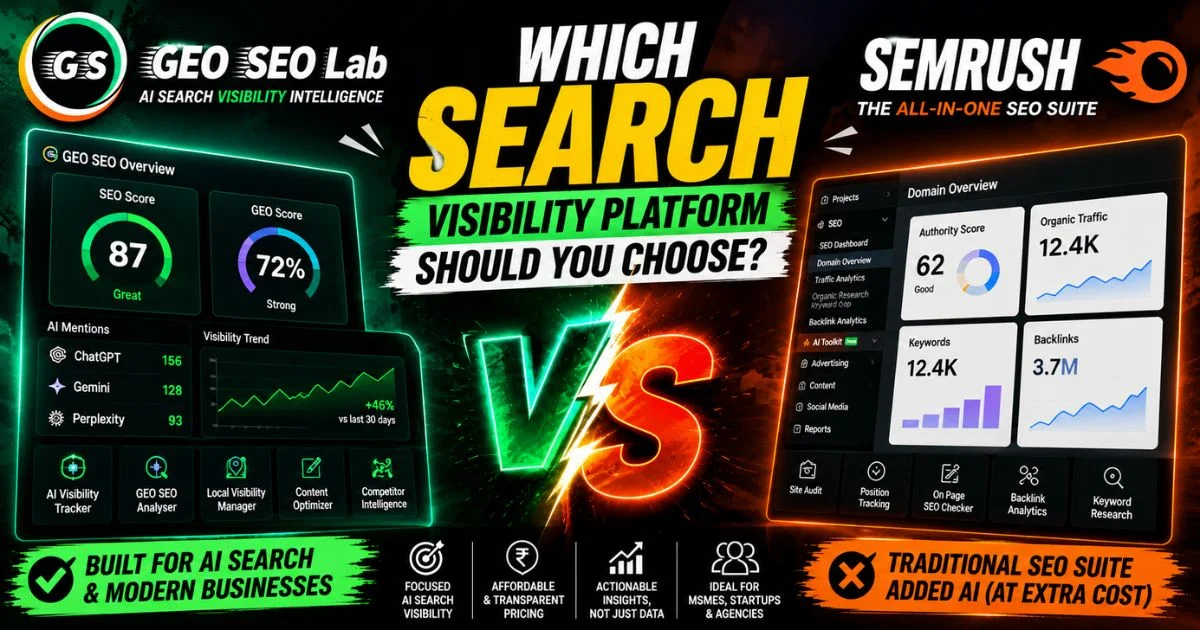
GEO SEO Lab vs Semrush: Which SEO & GEO Platform Is Best in 2026?
Picking a search visibility platform used to be a fairly narrow decision. You wanted rankings, backlinks, and maybe a competitor snapshot, and most of...
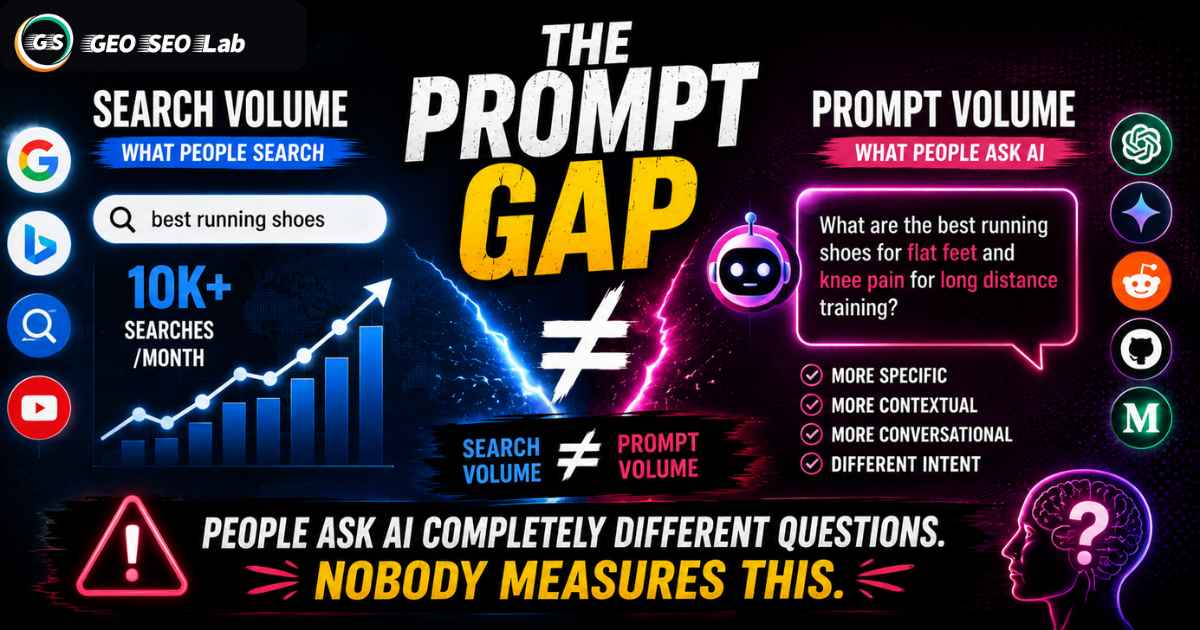
Why Does Search Volume Miss AI Search Prompts? The Prompt Gap
The Keyword Tool Everyone Trusts Is Quietly Going Blind Every marketing team has some version of the same ritual. Open a keyword research tool, type in...