GEO SEO Lab vs Semrush: Which SEO & GEO Platform Is Best in 2026?
Picking a search visibility platform used to be a fairly narrow decision. You wanted rankings, backlinks, and maybe a competitor snapshot, and most of...
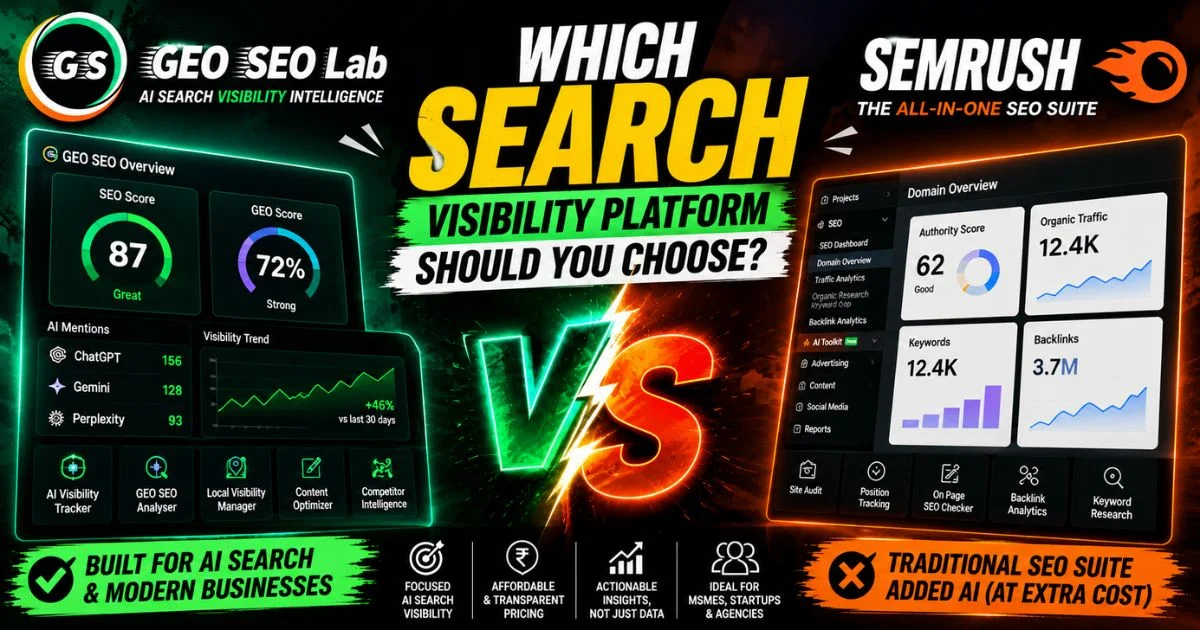
Picking a search visibility platform used to be a fairly narrow decision. You wanted rankings, backlinks, and maybe a competitor snapshot, and most of the major tools did roughly the same job with roughly the same dashboard. That's changed considerably in 2026. Now the decision includes a genuinely new question sitting alongside the old ones: does this platform actually help you show up when someone asks ChatGPT, Gemini, or Perplexity a question, not just when someone types into Google?
Two names come up a lot in that conversation right now, for very different reasons. Semrush is the long-established, broad digital marketing suite that's expanded into AI visibility tracking as an add-on to its existing toolkit. GEO SEO Lab is a newer, more focused platform built from the ground up around the idea that SEO and GEO, generative engine optimization, need to be measured and acted on together, not bolted on as an afterthought.
This report goes deep on four specific angles that actually decide this choice in practice: what each platform costs once every add-on and user seat is accounted for, how the actual feature sets compare module by module, how each platform handles a genuinely common use case, local search visibility, and how each one holds up for agencies managing several client accounts at once. This isn't an attempt to declare one platform universally better than the other, and it's worth saying plainly that Semrush is a legitimate, widely used tool with real strengths. What this report focuses on is a fair, specific breakdown across the dimensions that matter most, and why GEO SEO Lab's more focused approach ends up being the stronger fit for a large share of that audience.
Why This Comparison Matters Right Now
AI-driven search has moved from a niche curiosity to a mainstream research habit, and the tooling landscape has scrambled to catch up. According to a widely cited statistic, roughly 88% of students now turn to AI for assistance, a figure that reflects a much broader behavioural shift happening well beyond just the education sector. As Generative Engine Optimization has become a genuine, board-level priority rather than an experimental side project, the major established SEO platforms have had to bolt AI visibility tracking onto tools that were originally architected years before anyone was optimising for ChatGPT citations. Newer platforms, meanwhile, have had the advantage of building GEO into their core architecture from day one, rather than layering it on top of an existing product built for a different era of search.
That structural difference matters more than it might seem at first, and it shows up clearly once you actually start comparing pricing sheets and feature lists line by line, which is exactly what the rest of this report does.
What Semrush Actually Is
Semrush has built a genuinely broad reputation over the years as an all-in-one digital marketing suite, reportedly used by roughly 35% of Fortune 500 companies. It covers keyword research, competitor analysis, comprehensive site audits, rank tracking, backlink analysis, and a content optimization suite through its SEO Writing Assistant, all accessible through a single login that replaces what would otherwise be a stack of separate specialised tools.
In response to the shift toward AI-driven search, Semrush has added a dedicated AI Visibility toolkit, sold either as a standalone add-on at $99 per month per domain, or bundled together with the classic SEO toolkit into a newer combined offering called Semrush One, which starts around $199 per month for its entry-level tier. That AI toolkit tracks brand presence across a rotating set of major assistants, generally including ChatGPT, Perplexity, Google AI Overviews, and Gemini, providing an AI visibility score, share of voice against named competitors, and a breakdown of which specific prompts surface a competitor's brand instead of the user's own.
What GEO SEO Lab Actually Is
GEO SEO Lab was built with a different starting premise: that SEO and GEO shouldn't be treated as two separate disciplines requiring two separate tools, but as one connected visibility problem that deserves one connected platform.
The platform is built specifically for modern businesses and MSMEs, small and medium enterprises, aiming to turn what's become a genuinely complex, fast-moving digital marketing landscape into something a lean team can actually act on without needing a dedicated in-house SEO specialist. It continuously monitors website health, AI visibility, content performance, competitor movements, local presence, and customer sentiment, surfacing prioritised, actionable recommendations rather than a wall of raw data.
The core tool anchoring the platform is a GEO SEO Analyser that delivers a dual SEO and GEO score in seconds, giving a business a single, immediate read on both traditional Google rankings and AI visibility inside tools like ChatGPT, Gemini, and Perplexity. Beyond that core scoring engine, the platform includes AI audit tools, backlink analysis, competitor insight tracking, rank tracking, dedicated local SEO support, Google Business Profile optimization guidance, and integration with the tools a business already runs: search consoles, analytics platforms, CMS systems, and commerce platforms, without requiring a business to rip out and replace its existing stack.
Introducing the Tool-Fit Framework
This is where GEO SEO Lab's original framework comes in. We call it the Tool-Fit Framework, and it's a way of evaluating a platform choice across four dimensions that matter far more than a raw feature count: scope, specialisation, pricing structure, and onboarding simplicity.
Scope asks how broad a platform's coverage is across the full range of digital marketing functions. Specialisation asks how deeply a platform handles the specific discipline a business cares most about right now, the intersection of traditional SEO and AI visibility. Pricing structure asks how transparent and predictable the actual cost is once add-ons, per-domain charges, and per-user fees are factored in, not just the advertised entry price. Onboarding simplicity asks how quickly a team without a dedicated SEO specialist can actually start acting on what the platform tells them.
The next three sections dig into each of these dimensions in genuine, practical detail, starting with the one most businesses actually decide on first: cost.
Pricing First, What Each Platform Actually Costs in Practice
Advertised entry prices rarely tell the full story, so it's worth modelling out what a few realistic business scenarios actually pay once every necessary add-on gets factored in.
Scenario on: a single small business tracking one domain. On Semrush, getting both traditional SEO tracking and AI visibility means either paying for the SEO Pro plan at roughly $139.95 per month plus the standalone AI Visibility add-on at $99 per month per domain, landing around $239 monthly, or moving to Semrush One's Starter tier at $199 per month, which bundles both but caps daily tracked keywords at 500 and AI prompts at 50 per day. Either path puts a single-domain small business somewhere between $199 and $239 a month just to get baseline coverage of both traditional and AI search visibility. GEO SEO Lab's MSME-focused pricing philosophy is built specifically to bring that same dual SEO and GEO visibility to a single-domain business without that layered add-on structure, since the dual score sits inside the core platform rather than requiring a separate purchase.
Scenario two: an agency or business managing ten client domains. This is where the cost gap widens most dramatically on Semrush's side. The AI Visibility toolkit's per-domain pricing means ten domains under the standalone add-on alone run close to $990 a month, before factoring in any additional user seats, which typically run between $45 and $100 each. Combined with a base SEO subscription covering those same ten domains, a multi-client agency can realistically find itself well past $1,500 to $2,000 a month once everything is accounted for. GEO SEO Lab's structure, built around integration with tools a business or agency already runs rather than layering a separate per-domain AI charge on top of every account, is designed to keep that multi-domain cost considerably more predictable as client count grows.
Scenario three, adding team members. Semrush's additional-user cost of $45 to $100 per seat adds up quickly for a growing team that wants several people: an SEO lead, a content writer, a client account manager, all working inside the same account. That's a real, recurring line item worth factoring into any total cost comparison rather than looking only at the headline plan price.
The honest takeaway across all three scenarios is the same. Semrush's modular, per-domain, per-user pricing works reasonably well when a large team is genuinely using the full breadth of what it offers across many disciplines simultaneously, spreading that cost across daily use. For a smaller business, or a growing agency watching every domain and every seat add measurable cost, GEO SEO Lab's pricing structure, built from the outset around MSME affordability rather than enterprise-scale line-item billing, is the more predictable and considerably more budget-friendly path to the same core outcome: real visibility across both Google and AI search.
Feature Depth, A Module-by-Module Look
Pricing only tells part of the story. It's worth comparing what each platform's individual modules actually do, since "AI visibility tracking" and "SEO audit" can mean meaningfully different things depending on how a platform implements them.
Keyword and rank tracking. Semrush's rank tracking is comprehensive and well-established, covering large keyword volumes with granular location and device targeting, a genuine strength built over many years of product development. GEO SEO Lab's rank tracking covers the same core need, keyword-level position monitoring with automatic updates, but ties that tracking directly into the platform's broader GEO score, so a business sees keyword movement alongside AI visibility shifts in the same view rather than as an entirely separate report requiring manual cross-referencing.
Site audits. Semrush's site audit tool is deep and technical, flagging a wide range of crawlability, indexability, and on-page issues in granular detail, well suited to a technical SEO specialist who wants to dig into every flagged issue individually. GEO SEO Lab's AI audit tools take a more prioritised approach, surfacing the specific issues most likely to be limiting both traditional ranking and AI citation, with recommendations ordered by actual impact rather than presenting an undifferentiated list a non-specialist has to triage manually.
Content optimization. Semrush's SEO Writing Assistant helps optimise content for traditional search intent and readability. GEO SEO Lab's content performance monitoring extends that thinking into the GEO layer specifically, evaluating whether existing content is actually structured in a way AI systems can extract and cite, not just whether it satisfies a traditional keyword target.
AI visibility tracking. Semrush's AI Visibility toolkit, as covered earlier, tracks a rotating set of major assistants and provides genuinely useful competitive prompt-level detail as a standalone or bundled add-on. GEO SEO Lab treats this as inseparable from the SEO score itself, built into the core dual-score analysis every account runs, rather than an additional module a business has to specifically decide to add and pay for separately.
Competitor insight. Both platforms offer competitor tracking. Semrush's competitive intelligence is broad, covering traffic estimates, keyword gaps, and advertising data across a wide range of dimensions. GEO SEO Lab's competitor insight tracking is built specifically around the SEO and GEO intersection, showing where a competitor is winning AI citations or traditional rankings that a business isn't, tied directly back into the prioritised action plan the platform generates.
The pattern across nearly every module comparison is consistent. Semrush goes broader and deeper on pure data volume and technical granularity, a genuine strength for a specialist who wants to dig deep. GEO SEO Lab goes narrower but more integrated, consistently tying every module back into one unified, prioritised view a non-specialist team can act on immediately, which is precisely the difference that matters most for the audience each platform is actually built for.
Local SEO, A Specific Use Case Worth Examining Closely
Local search deserves its own dedicated look, since it's one of the most common and highest-stakes use cases for the exact kind of business GEO SEO Lab is built for: restaurants, clinics, real estate agencies, service providers, and other businesses whose customers are searching nearby, not searching globally.
Semrush does offer local search capability through its dedicated Local toolkit, sold as a separate plan from the core SEO toolkit, covering listing management and local rank tracking across a broad geographic footprint, a genuinely capable option for a business or agency that wants to layer local tracking on top of an existing Semrush subscription.
GEO SEO Lab builds local visibility as a core, integrated part of the platform rather than a separate purchase, with dedicated local SEO support and specific Google Business Profile optimization guidance built directly into the workflow. That matters concretely for a local business owner, because the questions that actually decide local visibility today, is a Google Business Profile fully optimized, is the business showing up accurately in Google Maps results, is local review sentiment being tracked and responded to, are increasingly the same questions that decide whether an AI assistant recommends that business when someone asks for a nearby option, and GEO SEO Lab's local module is built to answer both simultaneously rather than treating local SEO and AI visibility as separate concerns requiring separate tools.
The platform's own published guidance reflects this integrated local focus directly, with dedicated content covering real estate SEO strategy for generating high-quality property leads and a complete Google Business Profile optimization checklist aimed at improving Google Maps ranking specifically through proven local SEO combined with AI and GEO strategy. That's a genuinely different starting point than treating local as an add-on toolkit bolted onto a broader, more generic SEO platform. It's local visibility built with the understanding that a nearby customer today might just as easily be asking an AI assistant "what's a good option near me" as typing into Google Maps directly, and a local business needs both covered without paying for two separate systems to track it.
Agencies, Managing Multiple Clients Without the Cost Sprawl
Agencies face a genuinely different set of pressures than a single business managing its own visibility, and it's worth addressing that use case directly, since it's exactly the scenario where the pricing gap covered earlier becomes most consequential.
Semrush's broad toolkit genuinely appeals to agencies that need a single platform covering the full range of services they offer clients: SEO, content, social, local, and advertising, all under one login, and its established reputation and depth of technical data can be a real asset when presenting findings to sophisticated clients who expect granular reporting. The tradeoff, as covered in the pricing scenario earlier, is that the per-domain AI visibility charge and per-seat user costs scale directly with client count, meaning an agency's software costs grow in near-lockstep with its client roster, a real budgeting consideration for any agency trying to protect margin as it grows.
GEO SEO Lab's structure is built to keep that scaling more manageable, with a pricing philosophy grounded in MSME accessibility that extends naturally to an agency serving MSME clients specifically, arguably the single largest client segment most digital marketing agencies actually serve. Rather than agencies needing to pass a growing per-domain AI visibility surcharge on to every client, GEO SEO Lab's integrated dual-score approach and existing-stack integration, plugging into a client's current search console, analytics, CMS, and commerce tools rather than requiring a separate setup process per account, is built to make onboarding a new client faster and less operationally heavy, letting an agency add accounts without each one carrying the same layered cost structure.
There's also a genuine speed-to-value advantage worth highlighting for agencies specifically. An agency's real product isn't the software itself. It's the strategic recommendations and results delivered to a client. A platform that surfaces a prioritised action plan in seconds rather than requiring a specialist to manually interpret a dense, technical report lets an agency move faster from onboarding a new client to actually showing measurable progress, which is precisely the kind of fast, visible win that keeps clients renewing.
Bringing the Comparison Together
Across pricing, feature depth, local SEO, and agency fit, a consistent pattern holds. Semrush offers genuine breadth and technical depth, a strong choice for large, established teams with dedicated specialists and a need to cover many marketing disciplines from a single login, willing to absorb the cost that broad scope brings as client or domain count scales. GEO SEO Lab offers focused, integrated depth specifically at the intersection of SEO and GEO, built from the ground up for MSMEs, growing businesses, local businesses, and the agencies that serve them, with a pricing structure and onboarding experience designed to keep real AI-era visibility affordable and immediately actionable, without the per-domain cost sprawl that can make comprehensive AI tracking add up quickly elsewhere.
Neither conclusion is meant as a knock on Semrush, which remains a genuinely capable, widely trusted platform for the audience it's built to serve. What this comparison makes clear is that for the large and fast-growing segment of businesses and the agencies serving them that need real, affordable, immediately actionable visibility across both Google and AI search without enterprise-level overhead, GEO SEO Lab was built with exactly that gap in mind.
Key Takeaways
- A single-domain small business pays roughly $199 to $239 a month on Semrush to cover both traditional SEO and AI visibility tracking, while GEO SEO Lab's core platform includes the dual SEO and GEO score without that layered add-on cost.
- An agency managing ten client domains can see Semrush's AI Visibility add-on alone approach $990 a month before user seats and base SEO subscriptions, a cost structure GEO SEO Lab's pricing philosophy is built to avoid.
- Feature-by-feature, Semrush offers greater raw data depth and technical granularity, while GEO SEO Lab offers tighter integration, tying SEO, GEO, local, and competitor data into one prioritised, actionable view.
- Local SEO is a core, built-in part of GEO SEO Lab's platform, including Google Business Profile optimization guidance, rather than a separate toolkit purchase.
- Agencies serving MSME clients specifically benefit from GEO SEO Lab's faster onboarding and more predictable per-client cost structure as their roster grows.
About GEO SEO Lab
GEO SEO Lab helps brands become discoverable, trusted, and recommended in the AI era. Built specifically for modern businesses and MSMEs, the platform transforms complex digital marketing into a clear, intelligent growth system, continuously monitoring website health, AI visibility, content performance, competitor movements, local presence, and customer sentiment while delivering prioritised, actionable recommendations that drive real traffic, qualified leads, and measurable growth. Our GEO SEO Analyser delivers a dual SEO and GEO score in seconds, and our local SEO and agency-ready integrations are built to bring real AI-era visibility within reach of businesses that don't have enterprise-scale marketing budgets.
References
- GEO SEO Lab, official platform pages, geoseolab.com
- eesel AI, An Understandable Guide to Semrush SEO Pricing in 2026
- Ryrob, Semrush Review 2026: Features, Pricing & AI Tools Tested
- Demandsage, Semrush Pricing 2026: New Plans & Cost Breakdown
- Indexly, Understanding Semrush Pricing: A Complete Overview
- Layer3 Labs, Semrush AI Toolkit Review 2026: Features, Pricing, Fit
- BloggingPursuits, Semrush Toolkits Explained: Features, Pricing & Use Cases
- EchoWi, Semrush AI Visibility Toolkit Review 2026: Price and Fit
Pricing figures for Semrush reflect publicly available information current as of mid to late 2026. Since subscription pricing and feature bundles can change, readers are encouraged to confirm current rates directly on each platform's official pricing page before making a purchasing decision.
A GEO SEO Lab Report
Editorial Disclosure: This report introduces an original framework developed by GEO SEO Lab, referred to below as the Tool-Fit Framework. It's our own way of organising what actually matters when a business is choosing between platforms like this, not an official comparison methodology endorsed by Semrush or any third party. Every pricing figure and feature detail attributed to Semrush in this report comes from Semrush's own public pricing pages and independent 2026 reviews, cited where it appears. Details about GEO SEO Lab come from our own platform and public-facing pages.
Tags
Frequently Asked Questions
Find answers to common questions about this topic
About the Author

Anubhav
SEO Expert & Content Creator
Experienced digital marketing professional specializing in SEO strategies, content optimization, and data-driven marketing solutions. Passionate about helping businesses grow their online presence and achieve better search rankings.
Related Articles
View all posts
SEO vs GEO: What's the Difference? A Complete Guide for 2026
SEO vs GEO, What's the Difference, and Why Your Business Needs Both in 2026, Introduction For most of the last two decades, the goal of digital marketing c...
Why Does Search Volume Miss AI Search Prompts? The Prompt Gap
The Keyword Tool Everyone Trusts Is Quietly Going Blind Every marketing team has some version of the same ritual. Open a keyword research tool, type in...
There Is No Number One Position in AI Search
There Is No Number One Position in AI Search: Why Google, Gemini, ChatGPT and Perplexity See Different WinnersCategory: AI Search Research & GEO Strat...