We Deleted Google for 7 Days. Here's What Happened.
It started, honestly, as a throwaway comment in our team Slack channel. Someone on our content team said, half joking, "At this point, I basically nev...
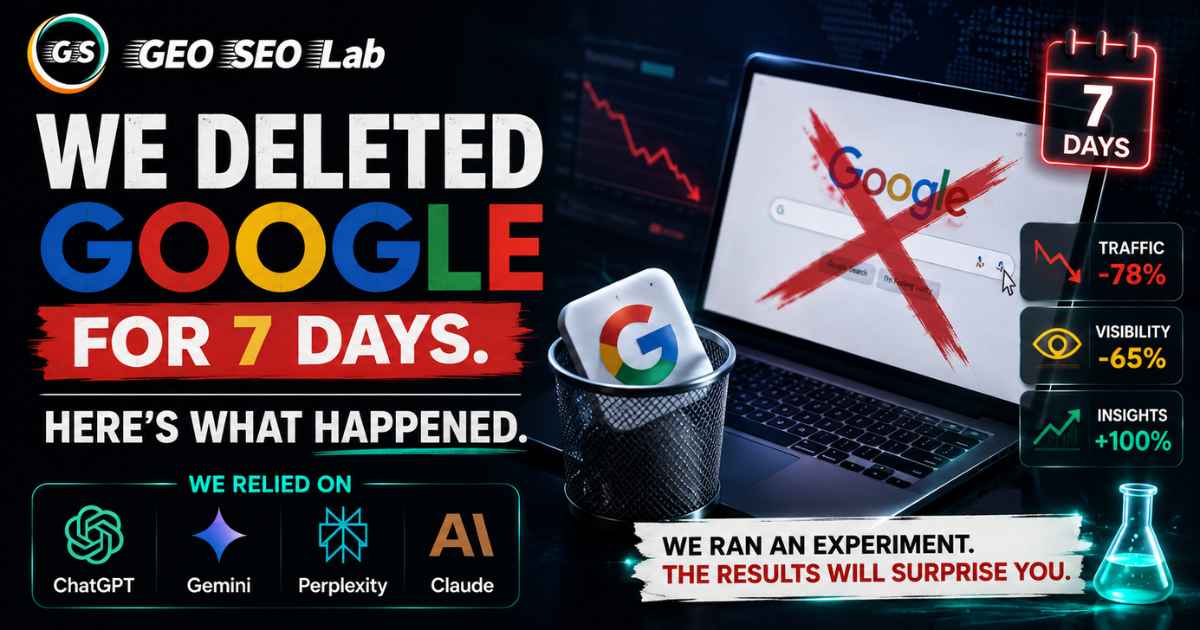
It started, honestly, as a throwaway comment in our team Slack channel. Someone on our content team said, half joking, "At this point, I basically never open Google anymore, I just ask Claude." Someone else pushed back immediately. Then someone else pushed back on the pushback. Within about twenty minutes, what began as banter turned into an actual dare: what if we just... didn't use Google for a week?
Not Google Search. Not Google Maps for directions. Not Google Docs, since half our workflow runs through it. Just the search engine itself, the one thing every single person on our team, SEO specialists included, has used reflexively since childhood.
We're a research team that spends our working hours thinking about how AI is changing search behaviour. It felt almost embarrassing that none of us had actually lived inside that shift for more than a few minutes at a time. So we set the rules, picked a start date, and did it.
This piece is the honest write-up of that week. Not a polished case study with a predetermined conclusion, but an actual account of what broke, what surprised us, which AI tool consistently gave us the best answers, which one confidently made things up, and whether a team of marketers whose entire job depends on search could actually function without the thing search has meant for the last two decades.
We debated for a while whether to even publish this. Internal experiments have a way of sounding more scientific than they actually are once you write them up cleanly, and we didn't want this to read like a rigorous academic study wearing a marketing headline. It isn't that. It's six people, doing their actual jobs, keeping honest notes, for one week. Read it with that in mind, and we think it's more useful, not less, because it reflects what a real team actually experiences rather than a cherry-picked highlight reel.
How We Set Up the Experiment
We kept the rules simple on purpose because the moment you start adding exceptions, you're not really testing anything.
For seven consecutive working days, six people on our team agreed to stop using Google Search entirely. Not Google as a company (we still used Gmail and Docs, since abandoning our entire email and file infrastructure for a week felt like a different experiment altogether), just the search box itself and anything that quietly routes through it, like the address bar defaulting to a Google query.
In its place, everyone was assigned one primary AI tool for the week: ChatGPT, Gemini, Perplexity, or Claude. Two people used ChatGPT, since it's the most commonly used tool across our own client base, and we wanted more than one data point on it. Everyone kept a running log of every task they attempted, what tool they used, whether it actually solved the problem, and how confident they were in the answer they got. At the end of each day, we did a quick quality check on anything that felt uncertain, cross-referencing a sample of answers against traditional sources to see how often each tool was actually right.
We didn't cherry-pick easy tasks. Our jobs involve everything from quick factual lookups to competitor research to technical troubleshooting to genuinely messy, ambiguous questions that don't have one clean answer. That range turned out to matter a lot because the tools performed wildly differently depending on which kind of task we threw at them.
A few practical guardrails kept the week from turning into chaos. If someone genuinely couldn't complete a task after a real, honest attempt with their assigned AI tool, they were allowed to note it as a failure and move on rather than quietly cheating by opening a new browser tab. We also agreed upfront that any client-facing work would still go through our normal quality checks before it left the building, since this was a test of our own workflow, not an experiment we were willing to run on paying clients without a safety net. That single rule turned out to matter more than we expected, for reasons that become clear a bit further down.
A Rough Day-by-Day Diary
Day one felt like driving with one hand. Everyone described some version of reaching for Google reflexively and catching themselves. Productivity dipped slightly, mostly from the friction of retraining a habit rather than any real limitation in the tools themselves. Several people described feeling oddly self-conscious, like they were being watched, even though the only thing different was which browser tab they opened first.
Day two was when the complaints started getting specific. This is when the local product lookup problem surfaced, and when the first genuinely wrong, confidently stated answer got caught during an end-of-day review. It was also the day someone admitted, a little sheepishly, that they'd started actually enjoying the back-and-forth conversational style more than they expected to.
By day three, something interesting happened. The complaints didn't disappear, but they stopped being about "I can't find anything" and started being about "this specific type of question doesn't work well with this specific tool." That shift, from general frustration to specific pattern recognition, ended up being one of the most useful outcomes of the whole week, because it's exactly the kind of insight that's hard to get from reading about AI search secondhand.
Days four and five were the most productive of the week, by most people's own account. By this point, everyone had developed a rough internal sense of which kinds of questions their assigned tool handled well and which ones it didn't, and people started proactively working around the weak spots rather than hitting them by surprise. This is also when the comparison and synthesis tasks really started to shine, since multiple people were now deep into research-heavy work rather than quick lookups.
Day six brought the most memorable hallucination of the week, the technical detail described further down in this piece, and it triggered a genuinely useful team conversation about verification habits that outlasted the experiment itself.
Day seven felt almost anticlimactic, which in its own way was the most telling result of all. Nobody was desperate for the week to end. A few people admitted they were curious what it would be like to just keep going a bit longer, purely out of curiosity rather than any pressure to prove a point.
What Broke Almost Immediately
Quick local and transactional lookups were rougher than expected. Someone needed to find a specific replacement part for office equipment, cross-reference it against three suppliers, and check same-day availability near our office. This is exactly the kind of task Google has quietly gotten extremely good at over the years, blending maps, inventory data, and local business listings into one glance. None of our four AI tools handled this cleanly. They could describe the part and suggest general places to look, but the actual real-time inventory and precise local availability just wasn't something any of them could reliably confirm. That task ended with someone quietly opening Google in an incognito tab, which honestly felt like the most realistic finding of the entire week.
Fast-moving news and anything genuinely happening right now was a mixed bag. A teammate tracking a live industry announcement found that some tools handled it well when they had live web access turned on, and handled it badly, sometimes confidently wrong, when they didn't. The lesson here wasn't that AI tools are bad at current events. It was that the gap between "this tool can browse the live web right now" and "this tool is working from training data with a cutoff" is invisible until you actually hit it, and hitting it without realising it is where the real risk lives.
Muscle memory itself broke first, before anything technical did. More than one person admitted their fingers just typed "google.com" out of habit before catching themselves, multiple times a day, for at least the first three days. That's not a knock on any AI tool. It's a genuine reminder of how deeply the reflex of typing a query into a blank search box is wired into all of us after twenty-plus years of the same behaviour.
What Was Surprisingly Better
Genuinely messy, multi-part questions felt like a completely different experience. Instead of typing a keyword, getting ten links, opening four of them, and manually stitching together an answer, our team could just ask the actual question they had in their head and get something coherent back immediately. One person researching a technical implementation question for a client described it as "having a genuinely competent colleague sitting next to me instead of a filing cabinet I have to search myself." That comparison came up more than once during the week, unprompted, from different people.
Follow-up questions were a real quality of life improvement. With traditional search, every refinement to a question meant starting over with a new query and often ending up on a completely different page. With an AI assistant, you could just keep going, narrowing the question, adding context, asking it to compare two options it had just mentioned, without losing the thread of the conversation. Several people said this alone changed how much research they were willing to do before giving up, since the friction of "asking one more thing" dropped to almost nothing.
Comparison and evaluation tasks genuinely improved. Instead of opening six competitor websites in six tabs and manually building a mental comparison chart, someone could just ask an AI tool to lay out the tradeoffs directly. The answers weren't always perfect (more on that below), but the format itself, a synthesised comparison instead of a stack of tabs, was a real improvement for this specific kind of task.
Writing and brainstorming work got noticeably faster. Nobody on our team was surprised that AI tools are good at drafting and idea generation, since that's not exactly a hidden use case anymore. What surprised a few people was how much better the output got once they leaned into genuinely conversational back and forth, rather than typing one long prompt and accepting whatever came back on the first try.
Which AI Gave the Best Recommendations
This is the question our team argued about most, and honestly, the answer depended heavily on the type of question being asked, rather than any single tool being the clear overall winner.
For research-heavy, source-driven questions, where our team specifically wanted to see where an answer actually came from, the tool with the strongest, most consistently visible citation habits was the clear favourite. Being able to glance at a response and immediately see which sources backed up a specific claim made it dramatically easier to trust the answer, or catch it when something looked thin.
For nuanced, judgment-heavy questions, the kind where there genuinely isn't one right answer and the value is in how carefully the tradeoffs get explained, the team consistently preferred the tool that gave the most balanced, least overconfident responses. More than one person specifically noted that this tool was the most willing to say "this depends on your specific situation" instead of just picking a confident-sounding answer and running with it, which built more trust over the course of the week, not less.
For quick, conversational, everyday questions where speed mattered more than depth, the most broadly used general-purpose assistant on our team was the one people reached for out of habit by day three, mostly because it was already open in another tab and the answers were good enough for low-stakes questions.
For structured comparison and planning tasks, one tool consistently produced the most usable, well-organised output without needing much follow-up prompting to get there, which made it the preferred choice specifically for that narrow use case.
No single tool won every category, and honestly, that itself was one of the most useful findings of the whole week. The old mental model of "which search engine is best" doesn't map cleanly onto "which AI assistant is best," because the honest answer is that it depends entirely on what you're actually trying to do.
Which AI Hallucinated
We're not going to pretend this didn't happen, because it did, more than once, and it's honestly the part of this experiment that matters most for anyone thinking about relying on these tools for real work.
The clearest example came from a teammate researching a fairly specific technical detail about a product integration. One tool gave a confident, specific, detailed answer, complete with what sounded like a plausible explanation. When we checked it against the actual product documentation afterwards, the answer was wrong in a meaningful way, not just slightly off, but describing a feature that didn't actually exist in the version being asked about. Nothing about the tone of the answersignalledd any uncertainty. It read exactly like every other confident, correct answer we'd gotten all week.
That's the real danger, and it's worth stating plainly. Hallucinations from these tools rarely come with a warning label. They sound exactly as confident as correct answers do, which means the burden of catching them falls entirely on the person asking the question, and only if that person already knows enough about the topic to notice something is off.
We also noticed a pattern worth naming specifically: hallucinations happened far more often on narrow, specificlesser-knownwn details than on broad, well-established topics. Ask any of these tools to explain a widely understood concept, and you'll almost always get something solid. Ask about a specific, niche detail, a particular product version, an obscure regulation, an exact statistic, and the risk of a confidently wrong answer rises considerably. This lines up with something we already understood conceptually going into the experiment, that these systems work from patterns in a huge amount of text, and the more heavily a topic is covered across that text, the more reliable the resulting answer tends to be. Living through it directly, rather than just knowing it as an abstract fact, made the caution feel a lot more real.
Could Marketers Actually Survive Without Google
Short answer: yes, but not painlessly, and not without real trade-offs that matter depending on the specific job being done.
For the genuinely research and synthesis-heavy parts of our job, understanding a topic, comparing options, drafting content, and thinking through a strategic question, the week without Google honestly didn't feel like a major loss. In some ways, several people on our team described it as a genuine upgrade, since the friction of manually piecing together an answer from ten tabs disappeared almost entirely.
For anything involving current, local, transactional, or highly specific factual verification, the week exposed real gaps that traditional search still fills more reliably right now. Nobody on our team walked away from this experiment believing traditional search is obsolete. What we walked away believing is that the two tools are genuinely good at different things, and treating them as interchangeable is a mistake in either direction.
The most honest conclusion, and the one that actually matters for how our own team works going forward, is that the future almost certainly isn't "AI replaces search" or "search stays exactly as it was." It's a genuinely blended workflow where the choice of tool depends on the specific task in front of you, and where knowing which tool to reach for and knowing when to double-check a confident-sounding answer,becomes its own real skill.
The AI Reliance Scorecard
Based on this week, we started sketching out a rough internal framework for deciding which tool to reach for, and how much to trust the answer without double-checking it. Broadly, task types fall into a few buckets. Broad, well-established, widely covered topics are generally safe to trust from any of the major AI tools with minimal verification. Narrow, specific, lesser-known details deserve active scepticism and a quick cross-check against a primary source before being repeated anywhere that matters. Anything current, local, or transactional still leans heavily toward traditional search or a direct, authoritative source, at least for now. And genuinely judgment-heavy, multi-factor questions are often where AI assistants add the most real value, provided the answer gets treated as a strong starting point for thinking rather than a final, unquestioned conclusion.
What This Means for Businesses Thinking About AI Visibility
Living through this experiment as a research team, rather than just studying it from the outside, sharpened something for us that's easy to state in theory and much harder to really internalise until you feel it directly. When a person stops typing a keyword into Google and starts asking an actual question to an AI assistant instead, the entire relationship between a business and a potential customer changes shape. There's no page of ten links to scan anymore. There's one synthesised answer, and a business either gets included in that answer, confidently and accurately, or it simply doesn't exist in that moment at all.
That's not an abstract industry trend anymore, at least not to us. It's what our own team experienced, repeatedly, over a single week of trying to get real work done. The businesses that show up favourably inside these conversations aren't necessarily the ones with the best traditional keyword rankings. They're the ones whose information is clear, consistent, genuinelywell-sourcedd, and credible enough that an AI system is willing to stake its own answer on citing them by name.
Key Takeaways
- Traditional search still wins clearly for local, transactional, and highly current lookups, tasks that depend on real-time, precise, location-specific data.
- AI assistants meaningfully improved messy, multi-part research, comparison tasks, and iterative brainstorming, largely because follow-up questions carry context instead of forcing a fresh search each time.
- No single AI tool won across every task type. The right tool depended heavily on whether the job called for strong sourcing, balanced judgment, quick everyday answers, or structured comparisons.
- Hallucinations happened, and they were most common on narrow, specific, lesser-known details rather than broad, well-covered topics, and they never came with an obvious warning sign in tone.
- The realistic future for most marketing teams is a blended workflow, not a full replacement of one tool by another, with the real skill being knowing which tool fits which task and when a confident answer still deserves a second check.
About GEO SEO Lab
GEO SEO Lab is a research and strategy group focused on helping businesses understand and improve visibility across AI-assisted search and discovery, including Google Search, Google AI Mode, ChatGPT, Gemini, Claude, Perplexity, and the broader ecosystem, reshaping how people find and evaluate information. Our work spans Generative EngineOptimizationn, AI visibility strategy, entity optimization, and measurement frameworks built to connect real AI visibility to real business outcomes. Experiments like this one are part of how we stay grounded in what these tools actually do day to day, not just how they're discussed in industry commentary.
References and Further Reading
- GEO SEO Lab internal experiment logs and daily task tracking, July 2026
- Google Search Central, documentation on how Search and AI features are evaluated
- OpenAI, Anthropic, Google, and Perplexity product documentation on model capabilities, browsing access, and citation behaviour
- GEO SEO Lab, The State of AI Search in 2026, ten trends every brand should prepare for before 2027
Tags
Frequently Asked Questions
Find answers to common questions about this topic
About the Author

Anubhav
SEO Expert & Content Creator
Experienced digital marketing professional specializing in SEO strategies, content optimization, and data-driven marketing solutions. Passionate about helping businesses grow their online presence and achieve better search rankings.
Related Articles
View all posts
SEO vs GEO: What's the Difference? A Complete Guide for 2026
SEO vs GEO, What's the Difference, and Why Your Business Needs Both in 2026, Introduction For most of the last two decades, the goal of digital marketing c...
GEO SEO Lab vs Semrush: Which SEO & GEO Platform Is Best in 2026?
Picking a search visibility platform used to be a fairly narrow decision. You wanted rankings, backlinks, and maybe a competitor snapshot, and most of...
Why Does Search Volume Miss AI Search Prompts? The Prompt Gap
The Keyword Tool Everyone Trusts Is Quietly Going Blind Every marketing team has some version of the same ritual. Open a keyword research tool, type in...