The State of AI Search in 2026: 10 Trends Every Brand Should Prepare for Before 2027
Eighteen months ago, "AI search" was still a bit of a novelty a summary box bolted onto the top of a page you scrolled straight past on your way to t...
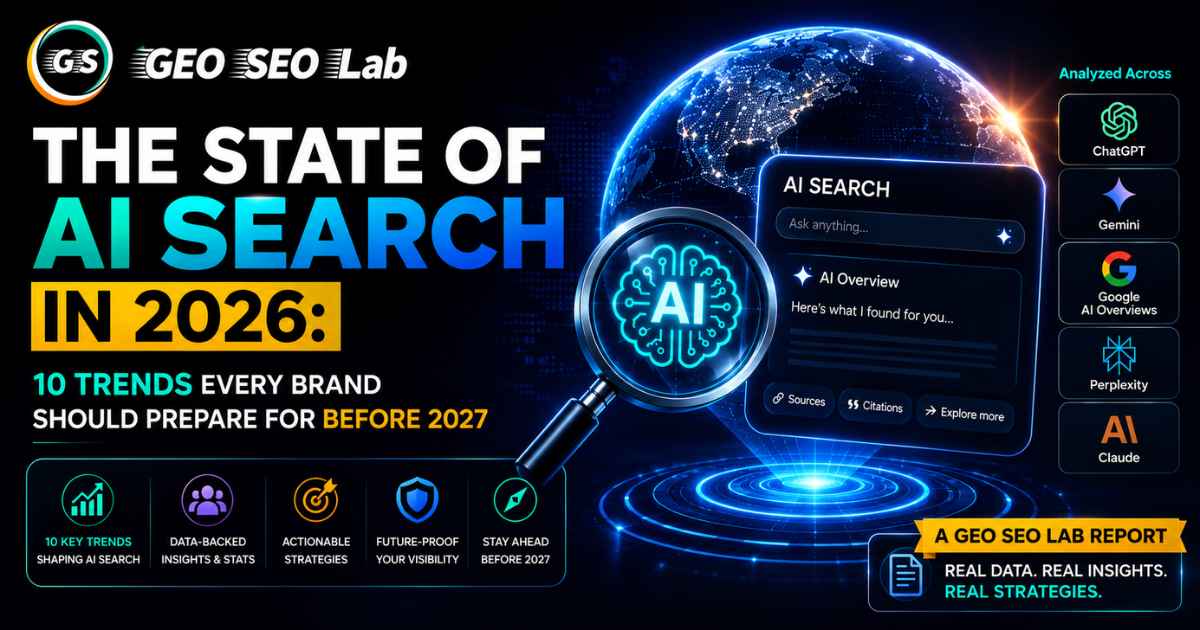
Eighteen months ago, "AI search" still felt like a novelty a summary box bolted on top of a page you scrolled past on your way to the real results. That framing doesn't hold anymore. By the middle of 2026, AI-generated answers aren't a layer sitting on top of search. For a huge share of queries, they are the search.
Google's AI Overviews now show up on close to half of U.S. queries, depending on whose tracking you trust. The overlap between ranking number one on Google and being cited in an AI answer has collapsed from roughly 75% down to as low as 17% in some analyses. ChatGPT alone is fielding hundreds of millions of weekly users who increasingly treat it as a front door to the internet, not a chatbot novelty. And a growing slice of "search" traffic isn't typed by a human at all it's issued by a shopping agent, a research assistant, or a support bot acting on someone's behalf.
If your organic strategy is still built around ten blue links and a keyword list, the math has quietly shifted out from under you. This isn't a doom-and-gloom piece, though it's a practical map of where AI search actually stands right now, backed by numbers that matter, and what a brand needs to start doing this year, not "eventually," to stay visible as the shift accelerates into 2027.
Below are the ten trends we think matter most, a short framework for organizing the work, a FAQ for the questions we hear most often, and a reference list so you can check our sourcing yourself.
Zero-Click Search Has Become the Norm, Not the Exception
For years, "zero-click search" was a talking point something SEOs worried about at the margins. In 2026, it's simply how search behaves most of the time. Roughly 60% of Google searches now end without a click to any website at all, up a couple of points from 2024, according to SparkToro and Datos data. That's already substantial. But the number that should really get a brand's attention is what happens once Google's more aggressive conversational experience, AI Mode, gets involved: multiple 2026 studies put the no-click rate at 93% once AI Mode is active.
Interestingly, the picture isn't uniformly bleak. Datos's Q1 2026 report actually found the strict U.S. zero-click rate ticked down slightly, from 24.5% in December 2025 to 22.4% by March a reminder that different measurement methodologies tell meaningfully different stories, and that "zero-click" isn't one clean, universally agreed number. What's consistent across nearly every dataset, though, is the direction of travel: fewer raw clicks overall, but the clicks that do happen skew toward people who've already made up their minds.
What this means for brands: stop treating click-through rate as your only success metric. A query can generate zero clicks and still deliver real value if your brand is the one named in the answer. Impressions and share-of-voice inside AI answers matter as much as traditional rankings now arguably more, for top-of-funnel, informational queries.
AI Overviews and AI Mode Have Gone from Experiment to Default
Google's AI Overviews aren't a side experiment anymore they're core search infrastructure. BrightEdge measured AI Overview presence at roughly 31% of tracked queries in February 2025, climbing to about 48% by February 2026. Longer, more complex queries saw close to a 49% jump in AI Overview representation since May 2024. Put simply: the more a query sounds like a real question and less like a keyword string, the more likely Google is to answer it directly, in-page.
AI Mode is a different animal entirely, and it's worth understanding separately from AI Overviews. Rather than a summary sitting above the usual results, it's a fully conversational search experience closer in spirit to chatting with an assistant than typing into a search box. Behind the scenes, AI Mode uses a technique called "query fan-out," breaking a complex question into several smaller searches that run simultaneously and get stitched into one combined answer. It draws on Google's Knowledge Graph, real-time web data, and increasingly shopping and local data too.
The engagement numbers back up how different this experience really is. QuickSEO found AI Overview sessions average around 21 seconds of user time per query, while AI Mode sessions average 49 seconds stretching to 77 seconds for brand-comparison queries. People aren't skimming AI Mode. They're reading it, and in many cases, that's the entire journey.
What this means for brands: the "one headline, one meta description" mindset from classic SEO doesn't map cleanly onto query fan-out. If Google is breaking a single user question into five sub-searches behind the scenes, your content needs to answer plausible sub-questions too, not just the headline query.
ChatGPT Is a Search Engine Now, Whether or Not OpenAI Calls It One
It's worth saying plainly: ChatGPT is a search engine. Maybe not by original design, but by usage, absolutely. ChatGPT crossed 900 million weekly users in early 2026, roughly double its count from a year earlier, and depending on the measurement source, its share of raw AI-search usage ranges from the high-60s to the high-70s percentage range one January 2026 analysis put it at 60.7%, while an April 2026 StatCounter read had it closer to 77%. Either way, nothing else is close.
What makes this genuinely disruptive for brands, rather than just an interesting usage stat, is what happens once someone gets an answer. Traffic from ChatGPT is scarce compared to Google's scale, but the referrals that do land tend to convert at a much higher rate a pattern several 2026 studies converge on, generally putting AI referral traffic somewhere between three and nine times more likely to convert than a typical organic Google visit. The theory holds up intuitively: someone who's already had a multi-turn conversation about their problem and gotten a specific recommendation before clicking through is a much warmer lead than someone skimming a results page.
The catch, and it's a real one, is scale. Per one industry trends report, ChatGPT referrals account for just 0.02% of total publisher referral traffic, with Perplexity trailing even further behind at 0.002%. High intent, tiny volume for now.
What this means for brands: don't chase ChatGPT referral traffic as a volume play in 2026. Chase it as a quality play. A handful of highly qualified visitors from a well-earned AI citation can outperform a much larger batch of low-intent organic clicks.
Being Cited Is Not the Same as Ranking and the Gap Is Widening
This might be the single most important mental shift for anyone doing this work in 2026: ranking well on Google and getting cited in an AI answer are related, but they're not the same job anymore.
The data here is genuinely mixed, which is instructive in itself. One analysis found that 76.1% of URLs cited in Google AI Overviews also rank in the top 10 of traditional search results a meaningful correlation. But flip that coin over: 59.6% of AI Overview citations come from URLs that don't rank in the top 20 at all. Both statistics are true simultaneously, and the explanation is that AI Mode draws from a much wider pool of sources than a classic top-10 page ever needed to.
Meanwhile, being cited isn't free even when it happens. Where AI Overviews appear, they now reduce the click-through rate for the top organic result by as much as 58%, dropping from about 7.3% down to 1.6% on AI Overview-triggering keywords, per an Ahrefs comparison of December 2023 to December 2025 data. Getting cited is good. Getting cited and clicked is a different, harder problem.
What this means for brands: you now need two strategies running in parallel one for classic organic ranking, and one for citation-worthiness, which rewards different signals (freshness, specificity, structure, quotability) more than raw backlink volume.
Structured Data and Entity Clarity Are No Longer "Nice to Have"
If GEO has a technical backbone in 2026, it's this: AI systems don't read your site the way a human does, and they don't read it the way a 2015-era Googlebot did either. In contrast to traditional platforms, AI engines no longer just index pages they source information they consider trustworthy, understandable, and usable in order to construct an accurate answer.
Two pieces of infrastructure keep coming up across nearly every 2026 GEO guide: schema markup and llms.txt. Implementing schema especially Article, Organization, FAQ, HowTo, and Breadcrumb types helps AI engines parse content correctly, and it's worth double-checking that AI crawlers like GPTBot, ClaudeBot, and PerplexityBot aren't accidentally blocked in robots.txt. There's a small wrinkle worth flagging: Google discontinued the visible FAQ rich result in Search around mid-2026, but the underlying FAQPage schema itself remains valid and continues to help language models which often can't execute JavaScript to reveal hidden FAQ answers understand a page's content. The SEO benefit of that particular schema type faded; the GEO benefit didn't.
llms.txt is the newer, more contested piece. It's a simple markdown-based index file, placed in a site's root directory much like robots.txt, meant to give AI crawlers a clean map of a site's most important content. Adoption is still genuinely low by one estimate only around 10% of domains have implemented it and not everyone agrees it's essential yet; one enterprise guide flatly advised against bothering with it, while several others called it critical future-proofing, particularly for letting shopping agents parse pricing and product data without friction. Our honest read: it's cheap enough to implement that the "wait and see" argument is more about prioritization than principle.
What this means for brands: audit schema coverage across your top revenue-driving and informational pages, confirm robots.txt isn't quietly blocking the crawlers that matter now, and treat llms.txt as cheap insurance rather than an urgent deadline.
Search Is Turning Into Checkout Agentic Commerce Arrives, Stumbles, and Adjusts
Maybe the most dramatic shift of 2026 is that "search" is starting to blur directly into "purchase," with no browser tab in between. Google launched the Universal Commerce Protocol (UCP) at NRF 2026 in partnership with Shopify an open standard letting AI agents interact with merchant catalogs, pull real-time pricing and inventory, manage multi-item carts, and complete purchases backed by Google's Shopping Graph of more than 50 billion listings.
OpenAI's parallel bet had a rockier road. Stripe and OpenAI launched Instant Checkout inside ChatGPT in September 2025, but OpenAI ended up sunsetting it, pivoting instead toward working with retailers to build dedicated apps inside ChatGPT in part because conversion rates for purchases completed directly inside ChatGPT ran about three times lower than purchases that simply redirected users to the merchant's own site. By the time it was sunset on March 5, 2026, only around 30 Shopify merchants had actually integrated with it.
That stumble hasn't slowed the broader trend if anything, competitors accelerated. Mastercard, Visa, and American Express have all rolled out support for agentic commerce transactions. Perplexity's PayPal-powered shopping feature enables instant in-chat purchasing. Microsoft launched Copilot Checkout in January 2026, anchored on PayPal and supporting Shopify, Stripe, and Etsy from day one. McKinsey estimates agentic AI could influence between $3 and $5 trillion in global retail commerce by 2030, and Morgan Stanley projects nearly half of online shoppers will use AI shopping agents by that same year, representing roughly a quarter of their total spend.
What this means for brands: if you sell anything online, product-data hygiene just became a ranking factor in its own right. Structured, machine-readable fields for pricing, shipping timelines, and return policies matter now, because if those details only exist as pretty text on a page, a shopping agent constructing a structured query often can't reliably use them.
"Ground Truth" Beats Backlinks Reviews, Reddit, and UGC Now Carry Real Weight
Classic SEO trained a generation of marketers to chase backlinks as the ultimate trust signal. AI answer engines weight things differently. Systems like ChatGPT and Copilot draw citations from a mix of sources that includes Wikipedia, Reddit, YouTube, and major news outlets, which pushes the importance of third-party credibility content you don't fully control well above where it sat in traditional SEO.
One GEO tools guide frames this as a layered "Source Stack" that AI models implicitly trust: a foundation of well-structured brand assets (technical docs, help centers, schema, llms.txt), a validation layer made up of reviews and user-generated content that supplies the fresh, verified sentiment signals models need to reason about a product, and an amplification layer of PR and earned media that feeds the third-party sites the models actually pull from. That middle layer genuine, verified customer sentiment is doing more work than it used to.
There's a genuine opportunity buried in here for smaller players too. Small businesses often have an edge in "verified local data," since local AI agents tend to prioritize authentic local reviews over generic enterprise-scale content. Scale isn't the only lever anymore; specificity and verifiability are pulling real weight.
What this means for brands: a review-generation strategy and active, honest participation in relevant forums and community spaces aren't just reputation management anymore they're a direct input into whether AI systems trust and cite you at all.
Freshness and Original Data Are Now Direct Ranking Signals for AI Citation
AI answer engines lean hard on recency in a way classic SEO never fully did. A guide published in 2024 that hasn't been touched since is going to lose ground to a freshly updated 2026 article covering the exact same topic, and the fix isn't complicated: refresh cornerstone content on a real schedule, add a visible "last updated" date, and fold in new data points rather than letting evergreen pages quietly rot.
Original research carries outsized weight here too. Original research, proprietary data, and expert commentary are specifically called out as strong drivers of AI citation. Separately, one study analyzing 10,000 real-world queries found pages containing structured lists, direct quotes, and concrete statistics saw 30 to 40% higher visibility in AI-generated responses compared to pages without that kind of structure.
It's also worth understanding that different AI engines don't behave identically once they've found your content. Claude, for instance, tends to synthesize information rather than quote it directly, and favors well-structured, logical content a genuinely different weighting than engines that lean toward pulling exact phrasing.
What this means for brands: publish something with a genuinely fresh data point at least monthly if you can manage it, structure your writing with real lists and specific numbers instead of vague claims, and build a refresh calendar for your best-performing older content instead of letting it fossilize.
The Field Has Fragmented You're Now Optimizing for Five-Plus Surfaces at Once
Here's the uncomfortable part: there is no single "AI search" to optimize for anymore. Google AI Overviews and AI Mode, ChatGPT, Perplexity, Microsoft Copilot, Gemini, and Claude all behave differently, pull from different source mixes, and reward slightly different content characteristics. Google remains dominant on volume, but AI Overviews now appear in roughly one in four searches, while adoption skews heavily by region AI adoption is highest in India at 59%, followed by the UAE at 58%, with Singapore and China close behind.
One notable shift on the horizon: Apple has announced Claude will be integrated into Safari, a move that could meaningfully expand Claude's influence over how people discover content simply by virtue of default placement, regardless of Claude's current standalone usage share.
This is where we'll introduce the one original framework in this piece. We call it the AI Visibility Stack, and it's just a simple way of organizing the fragmented work above into four layers you can actually staff and budget against:
- Crawlability layer can AI bots physically reach and parse your content (robots.txt, server-side rendering, no paywalls blocking key pages)?
- Structure layer is content organized the way these systems prefer to extract from (schema, clear headers phrased as real questions, llms.txt)?
- Trust layer does third-party evidence back up your claims (reviews, forum mentions, press, expert quotes)?
- Transaction layer if commerce is relevant, can an agent actually complete an action against your data (structured pricing, inventory, UCP or ACP compatibility)?
It's not a universal industry standard just a lens we've found useful for triaging where a brand's gaps actually are, rather than throwing effort at all five AI surfaces evenly.
What this means for brands: stop asking "are we optimized for AI search?" as if it's one yes/no question. Ask which layer, on which surface, is weakest the answer is rarely the same for every brand.
Measurement Is the Real Bottleneck, Not Strategy
Almost every GEO guide we reviewed for this piece agreed on one thing more than any other: the tactics are becoming reasonably well understood, but measuring whether they're working remains genuinely hard. Without weekly tracking across all five major AI surfaces, teams are essentially flying blind on whether their GEO investment is paying off.
Budget allocation reflects this uncertainty too. One pragmatic 2026 split recommended for a brand with an already-mature SEO program is roughly 70% classic SEO, 25% GEO-specific work like measurement tooling and off-page seeding, and 5% set aside for experiments a healthy reminder that GEO is additive to SEO, not a wholesale replacement of it, at least not yet.
And on the biggest fear driving a lot of this anxiety that AI will simply replace organic traffic outright the honest 2026 answer is more nuanced than either extreme. AI surfaces are genuinely reducing classic search traffic for informational queries, but they're also producing referral traffic that converts roughly four times better, because those visitors arrive already pre-qualified. The more useful framing is portfolio management: defend your organic baseline, invest deliberately in GEO, and measure both rather than betting everything on one horse.
What this means for brands: build a measurement habit before you build a bigger content calendar. Track AI Overview presence per keyword, log which of your pages get cited and by which engine, and separate impression-style visibility metrics from click-based ones so you're not comparing apples to oranges internally.
Key Takeaways
- Zero-click is now the majority behavior, not an edge case around 60% of Google searches end with no click, climbing into the 90s when AI Mode is engaged.
- AI Overviews cover close to half of U.S. queries, and AI Mode's "query fan-out" means a single search is really several searches stitched together.
- ChatGPT functions as a search engine with hundreds of millions of weekly users and unusually high-converting, if still low-volume, referral traffic.
- Ranking and being cited are separate games. A large share of AI citations come from pages nowhere near a top-20 organic position.
- Schema markup and llms.txt are baseline infrastructure now, not experimental add-ons even where a specific rich result, like FAQ snippets, has gone away.
- Agentic commerce is real but immature. UCP, ACP, and card-network support are scaling fast even as early efforts like ChatGPT's original Instant Checkout got pulled back and rebuilt.
- Third-party trust signals reviews, Reddit, press now function like the new backlinks for AI citation purposes.
- Freshness and original data are direct citation drivers, not just a nice SEO habit.
- There is no single "AI search" to optimize for five-plus surfaces behave differently, and a brand's weakest layer is rarely the same across all of them.
- Measurement, not strategy, is the current bottleneck for most GEO programs in 2026.
About GEO SEO Lab
GEO SEO Lab is an editorial resource focused on tracking how generative and answer-engine search is reshaping brand visibility. We synthesize published industry research, platform announcements, and measurement data into practical guidance for marketing and content teams navigating the shift from classic SEO to AI-era discovery. Where we introduce original frameworks, like the AI Visibility Stack in this piece, we say so explicitly rather than presenting them as established industry consensus.
Tags
Frequently Asked Questions
Find answers to common questions about this topic
About the Author

Anubhav
SEO Expert & Content Creator
Experienced digital marketing professional specializing in SEO strategies, content optimization, and data-driven marketing solutions. Passionate about helping businesses grow their online presence and achieve better search rankings.
Related Articles
View all posts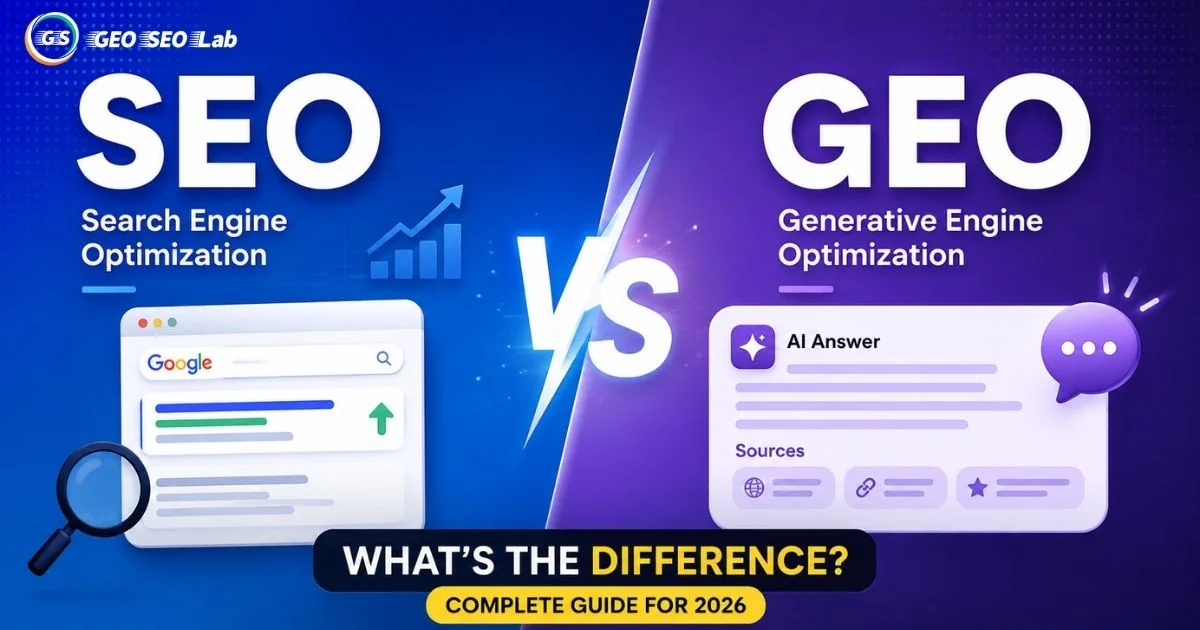
SEO vs GEO: What's the Difference? A Complete Guide for 2026
SEO vs GEO, What's the Difference, and Why Your Business Needs Both in 2026, Introduction For most of the last two decades, the goal of digital marketing c...
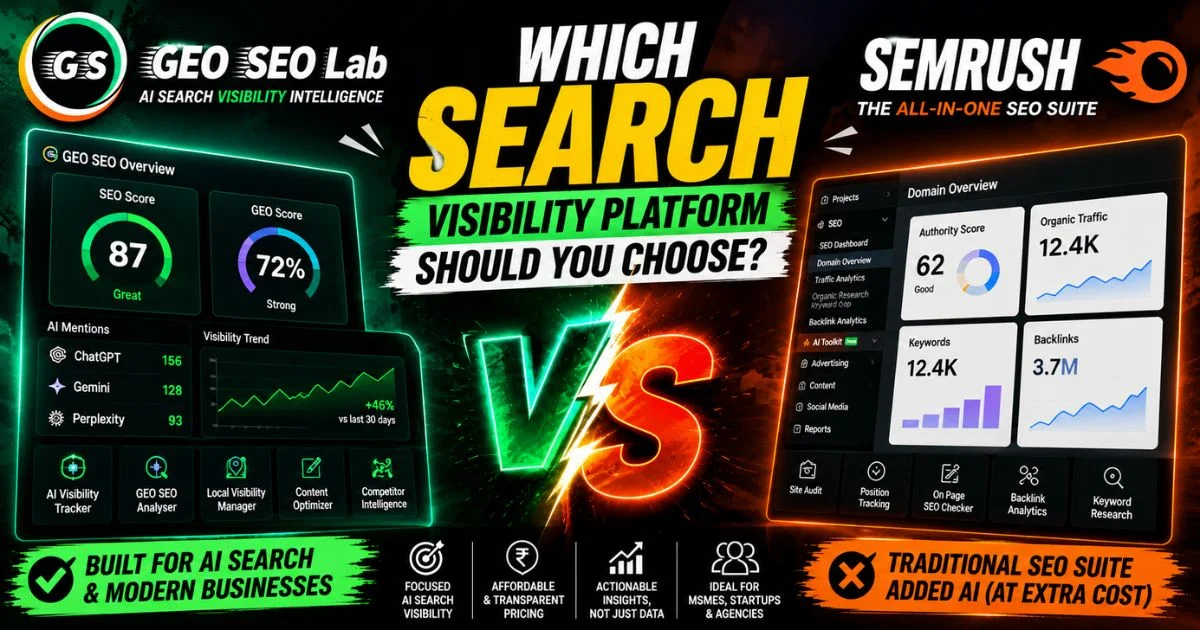
GEO SEO Lab vs Semrush: Which SEO & GEO Platform Is Best in 2026?
Picking a search visibility platform used to be a fairly narrow decision. You wanted rankings, backlinks, and maybe a competitor snapshot, and most of...
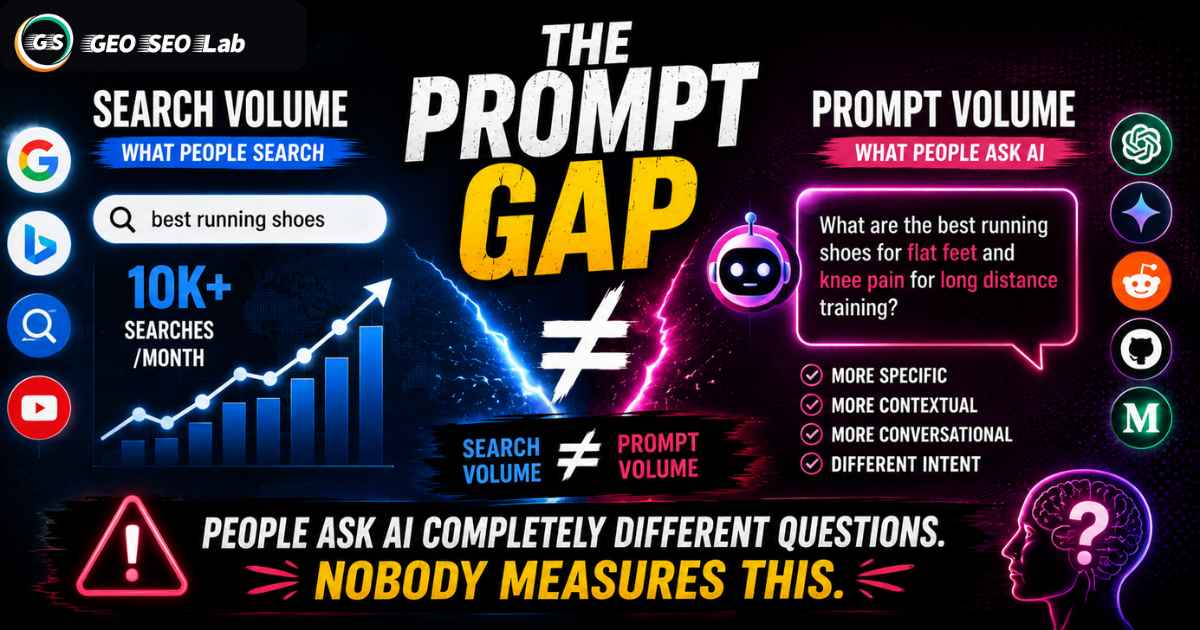
Why Does Search Volume Miss AI Search Prompts? The Prompt Gap
The Keyword Tool Everyone Trusts Is Quietly Going Blind Every marketing team has some version of the same ritual. Open a keyword research tool, type in...